Specs are compiled from manufacturer listings and verified buyer reviews and can change over time — please confirm the key details on the product page before buying.
If you are buying a pair of women’s construction boots, the quick answer is this: match the boot to your footing first, then worry about the rest. A steel toe keeps heavy stuff off your toes, but a 6-inch shaft, a waterproof upper, and a sole that grips wet plywood are what decide whether you survive a 10-hour shift without aching. Every pick below is a real women’s boot with a genuine safety toe, so you can start scanning with confidence instead of guessing whether a men’s size will ever fit right.
This guide is built by comparing the manufacturers’ published specifications and the patterns across verified customer reviews, so you get each pick’s real strengths and trade-offs instead of marketing spin.
Every pick below is a real women’s boot with a genuine safety toe, so start with the toe cap and waterproofing specs and work down from there. Knowing whether your site demands a waterproof membrane or just splash resistance narrows nine boots to two or three fast.
Top Picks


How To Choose The Best Women’s Construction Boots
Most construction footwear is still built around a man’s foot, so first check whether the boot is made on a women’s last (a mold shaped for a woman’s foot, not a scaled-down men’s one). Then focus on three things that matter most: the toe cap, the waterproofing, and how much the boot weighs on your foot at the end of a shift.
Toe caps, steel vs composite
A steel toe is a metal cap that shields your toes from impact, while a composite toe swaps the metal for a non-metallic cap. The composite version usually runs lighter and does not set off a metal detector, which matters if you walk through security at a plant or an airport job. Both protect the same way under a falling load; the choice depends on weight and whether metal on your foot bothers you.
Waterproofing that survives a wet pour
Waterproof leather and a sealed membrane keep water from soaking through the upper so your socks stay dry on a wet site. Look for the words “waterproof membrane” or “seam sealed” rather than a vague water-resistant coating, because a water-resistant boot blocks splashes but not a standing puddle. If you work outside in rain or around concrete washout, this is the feature worth paying for.
The 6-inch shaft and how it locks your ankle
A 6-inch shaft is the leather height from the sole to the top of the boot, and it does two jobs: it stabilizes the ankle on uneven ground and keeps debris out when you kneel. Taller shafts protect more but feel heavier and slower to lace. For most construction work, 6 inches is the balance point between support and mobility.
Weight on your foot, shift after shift
Boot weight is measured per boot, and it builds up over a shift. A 34.4 oz / 975 g boot protects more but tires your legs faster than a lighter pair. If you are on ladders or scaffolding all day, lighter boots win. If you are standing on a concrete slab with heavy loads overhead, the extra protection is worth the weight.
Outsole grip and slip resistance
The outsole is the treaded bottom of the boot, and its slip resistance decides whether you stay upright on an oily concrete floor or wet metal grating. Look for oil-, slip-, and abrasion-resistant wording on the spec sheet. That describes an outsole built to grip through grease and abrasion instead of turning slick.
Side-by-Side Comparison
| Model | Best For | Toe Type | Waterproof | Weight | Amazon |
|---|---|---|---|---|---|
| Wolverine Women’s Floorhand Steel-Toe 6″★ Best Overall | Everyday site work | Steel toe | Waterproof | — | Amazon |
| CAT Women’s Abbey Steel ToeBest For Public-Facing Sites | Public-facing job sites | Steel toe | Waterproof leather | 1.31 lb | Amazon |
| Avenger 7146 Composite Toe Pull-OnBest Pull-On | Easy on and off | Composite toe | Waterproof | 4.5 lb | Amazon |
| Wolverine Women’s Piper Composite Toe 6″ | All-day comfort | Composite toe | Waterproof | 3 lb | Amazon |
| KEEN Utility Women’s Vista Energy Mid | Light-duty interior work | Composite toe | Water resistant | 2.6 lb | Amazon |
| Timberland PRO Women’s Titan EV 6″ | Hard-surface trades | Composite toe | Waterproof membrane | 3.3 lb | Amazon |
| Timberland PRO 6″ Direct Attach MaxTRAX | Outdoor and wet conditions | Steel toe | Waterproof, seam sealed | — | Amazon |
| Ariat Women’s Tracey Composite Toe | A boot that doesn’t look like one | Composite toe | Not waterproof | — | Amazon |
| KEEN Utility Cincinnati 6″ Composite Toe | Heavy-duty construction | Composite toe | Waterproof KEEN.DRY | 34.4 oz per boot | Amazon |
Detailed Reviews
1. Wolverine Floorhand Steel-Toe 6″ Work Boot
Our pick — 4.0+★ from 650+ verified ratings; the strongest balance of quality and price.
The waterproof steel-toe that quietly became the site standard for women who want a classic 6-inch boot.
If your job site asks for one boot that handles mud, a concrete pour, and a full day on your feet, this is the pick to start with. It is a 6-inch waterproof steel-toe boot with a removable full-cushioned footbed (an insert you can pull out and swap for your own) plus a rubber midsole that absorbs the shock of each step. That combination is what keeps your feet from throbbing by the last hour of a shift. The crowd favorite here sits at 4.0+ stars across 680+ owners, which is the strongest trust signal on this list.
The thing that wins people over is the build quality, and it is not close: quality is the most-praised trait by more than four times the next item, value for money. Owners describe a boot that feels solid from the first lace-up and looks good enough to wear off the clock. What you get is a boot that lands between work and everyday wear, with waterproofing that handles a wet morning without turning your socks into sponges. The full-cushion footbed and rubber midsole are the real comfort story here, not a marketing line.
The honest catch is fit. Owners split almost evenly between those who find it true to size and those who say it runs small, so order up if your foot sits between sizes. Durability also splits: some owners call it nicely constructed with a hard toe, while others report the upper ripping after a week of wear. Sized up if you sit between sizes, this is the safest first pair for most women shopping construction footwear.
What Earns The Top Slot
- Waterproof upper with a removable full-cushioned footbed and rubber midsole for all-day shock relief
- Highest-rated pick in this lineup at 4.0+ stars, with quality the most-praised trait
- Classic 6-inch steel-toe build that suits mud, concrete, and wet mornings
- Looks clean enough to wear after the shift ends
Where It Asks You To Compromise
- Fit runs small for some owners, so sizing up is the safer call
- A few report the upper ripping within a week of hard wear
- Steel toe rather than composite, so it carries the metal-cap weight
Go with this if: you want the strongest all-around construction boot and the highest-rated pick on the list.
Size up if: your foot sits between sizes — the fit is the one thing most likely to surprise you.
2. CAT Women’s Abbey Steel Toe Industrial Boots
A slip-on Chelsea that puts a steel toe under a styling you could wear straight from the site to the counter.
If your job is half job site and half customer-facing — think a project manager, a site inspector, or a foreman walking a client through a build — the Abbey solves a problem the heavy boots on this list do not. It is a Chelsea-style slip-on with a steel toe, an electrical-hazard protective build, and a slip-resistant outsole. The waterproof leather upper keeps the boot fresh through a wet day, and the mid-top shaft gives ankle coverage without the laced-up weight of a full work boot.
There is a real weight advantage here, and it is dramatic. At 1.31 pounds per boot, this is the lightest pick with a published per-boot weight on the entire list. Compare that to the Avenger 7146 at 4.5 pounds and you are looking at a 3.4x gap — the kind of difference you feel climbing a ladder at the end of the day. Comfort leads the praise for this boot, with quality close behind, and owners describe a boot suited to long workdays rather than a quick look around. The slip-on entry is genuinely fast when you are switching between boots and office shoes.
The caveat is fit, and it is a real one: some owners find it runs slightly bigger than their regular shoe size, and a few note the left boot ends up tighter than the right. Try it on early and stay close to your normal size. The slip-on has less fine-tuning than a lace-up, so if you have a narrow or very wide foot you may want a laced alternative. If your day splits between a job site and a client walkthrough, this 1.31-pound slip-on is the smart pick.
The defining advantage: 1.31 pounds per boot with a steel toe, an electrical-hazard build, and slip-resistant tread — light enough to climb all shift and sharp enough for a client walkthrough.
Where it asks patience: the fit swings slightly bigger, and the slip-on cuts both ways by giving you less lace-up tightening than a standard work boot.
Reach for this if: you want a light, tidy steel-toe that handles a public-facing workday.
Look elsewhere if: you need a lace-up for a very high or very wide instep that a slip-on cannot tune.
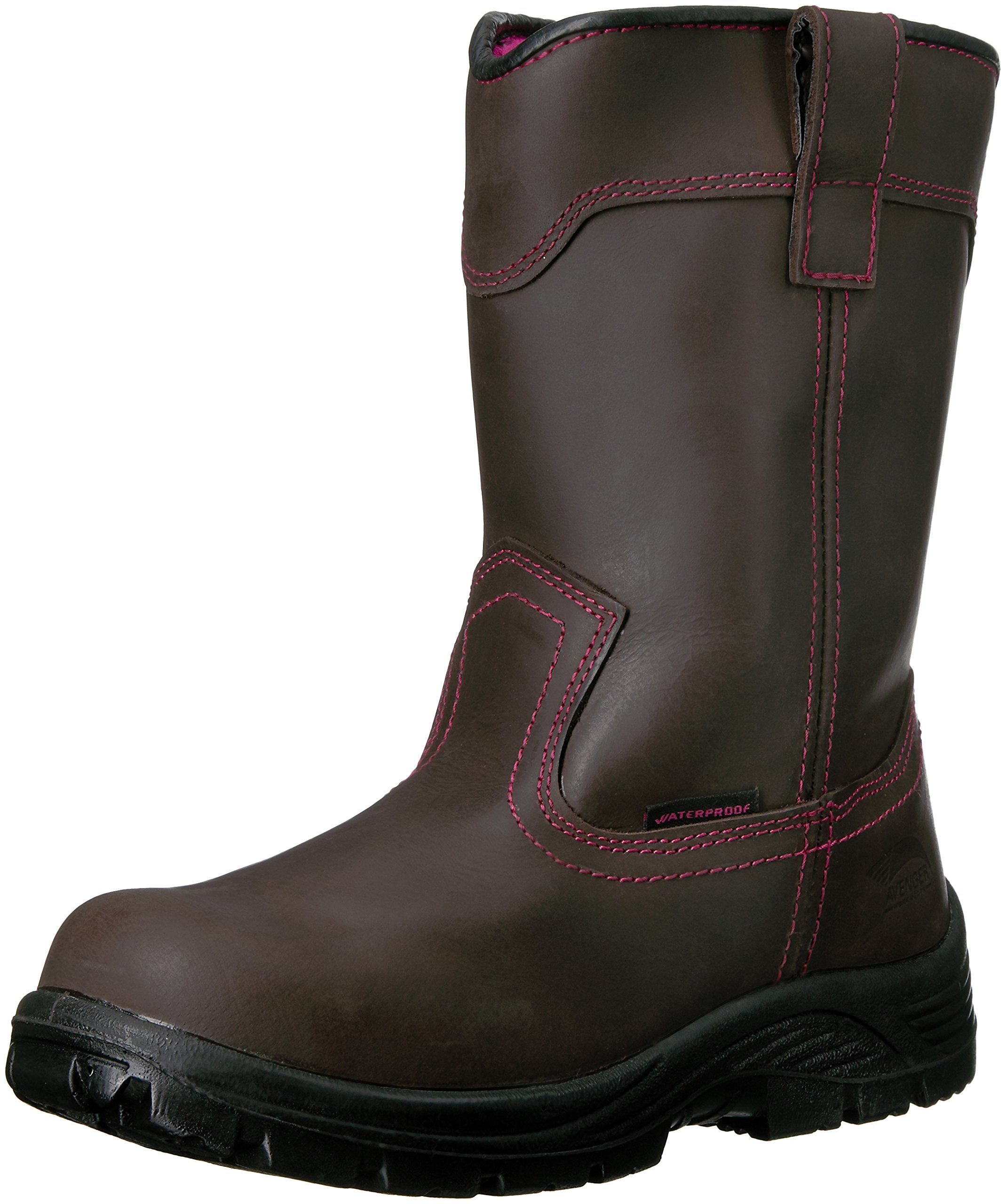
3. Avenger Women’s 7146 Composite Toe WP Pull-On Work Boot
A waterproof pull-on built on a real women’s last, with a composite toe and a splash of pink that earns comments.
Some shifts demand fast entry — a muddy job site, a plant where you suit up in seconds, a warehouse floor where laces get caught on pallets. This pull-on boot solves that with no lacing at all: you step in, and the composite toe and oil/super slip-resistant outsole do the safety work. Full-grain leather and direct-attach construction hold the boot together through wet ground. It is also built on a specific women’s last, which means the toe box and heel are shaped for a woman’s foot rather than a scaled-down men’s boot.
The protection is real and certified. It meets or exceeds ASTM F2413-11 impact and compression and early-hazard ratings — a published safety standard for toe protection and electrical performance. The waterproof membrane keeps your feet dry, and the pink stitching is a detail owners genuinely love; appearance is the second most-praised trait after build quality. Warmth is a strength in winter — owners describe feet staying warm through the cold months — and the Vibram and rubber outsoles give a flexible, tough tread that holds on slippy concrete.
Here is the trade-off you should weigh first: at 4.5 pounds, this is the heaviest boot on the list. Compare it to the CAT Abbey at 1.31 pounds and the gap is 3.4x. That weight buys you full-grain leather and a solid stance, but it is not the boot to pick if you are on scaffolding all day. Owners also split on fit, comfort, and water resistance, with some reporting the sole breaking and feet getting wet. Try it early and stay dry on the sizing call.
Why it earns a spot: a certified composite-toe, waterproof pull-on on a women’s last with an oil- and slip-resistant outsole — built for fast entry on tough ground.
The honest weight: at 4.5 pounds it is the heaviest pick here, and a few buyers report sole issues or water getting in.
This one suits: the woman who wants a certified pull-on and hates lacing up a boot.
Skip the weight if: you are climbing ladders all shift — the 4.5-pound build will wear you down.
4. Wolverine Piper Composite Toe 6″ Construction Boot

The lighter Wolverine that trades steel for composite and still keeps feet comfortable past hour ten.
If you liked the Floorhand but wanted a composite toe and a lighter foot, the Piper is the Wolverine to look at next. It is a 6-inch waterproof boot with a composite toe — a non-metallic cap that protects the same way under a falling load without the metal on your toes. At 3 pounds it sits lighter than the Avenger 7146 at 4.5 pounds, which is the kind of difference you feel on stairs and ladders through a full shift. The waterproof upper keeps water out of the boot on a wet pour.
What earns it fans is comfort, and the counts back it up: comfort is the second most-praised trait after quality, and build quality is the runaway leader here. Owners describe a boot that feels comfortable and lightweight, with good water resistance and a feminine appearance that does not look boxy on a woman’s foot. The composite toe keeps it light enough for all-day wear, and the waterproof upper handles rain without the leak that cheap boots develop. It is a strong pick if your job is a mix of indoor finish work and outdoor site time.
The honest split is on fit and durability. Some owners find it fits as expected and lasts three years; others say it runs too wide and starts to fall apart. Ankle and arch support also splits, with some praising it and others wanting more arch support. If your foot is narrow, order carefully and consider an aftermarket insole. If your shift splits between indoor finish work and wet outdoor site time, this 3-pound waterproof composite boot is the smoother ride.
Strong Points
- Composite toe at 3 pounds — lighter than the Avenger 7146 at 4.5 pounds
- Waterproof upper that keeps rain out of the boot
- Comfort is the second most-praised trait, behind build quality
- Feminine appearance that doesn’t look boxy
Points To Weigh
- Runs wide for some owners, cut narrower if your foot is slim
- Durability splits — some last years, others start to come apart
- Arch support divides owners; an aftermarket insole may help
Best matched to: the woman who wants a waterproof composite boot that stays comfortable through a mixed shift.
One thing to plan for: fit runs wide, so a narrow-footed buyer should look hard at the sizing.
5. KEEN Utility Vista Energy Mid Composite Toe Work Boots
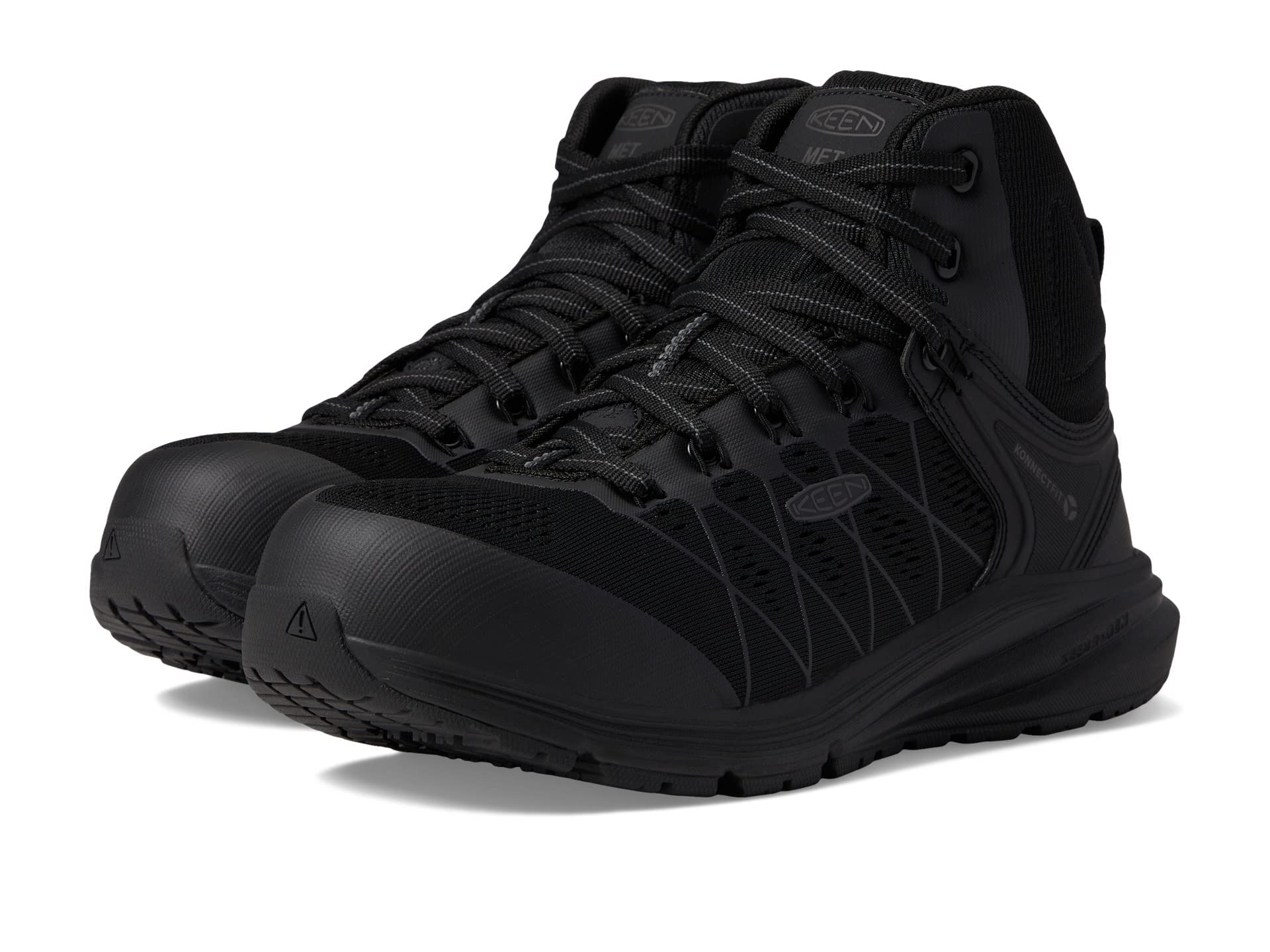
The featherweight for warehouse and maintenance work, shaped on KEEN’s wider women’s form.
Not every construction job means standing in a mud pit. If your day is a warehouse aisle, a maintenance bay, or a manufacturing line, the Vista Energy Mid does the job without the weight of a heavy site boot. It is a composite-toe boot weighing 15.5 oz / 439 g per boot, built with a moisture-wicking lining and a met guard for extra coverage over the instep. The water-resistant textile upper handles a light rain, and the non-marking outsole (a sole that won’t scuff floors) keeps you from leaving marks indoors.
The fit is the star. Shaped on KEEN’s traditional wider women’s form, the boot is praised most for fit, with comfort a close second — both well ahead of the other traits. Owners describe it as comfortable, stylish, with great ankle support and a lightweight design. The moisture-wicking lining pulls sweat away from the foot, and the removable insole means you can swap in your own for a custom feel. At 439 g per boot it is the lightest boot with a published individual weight anywhere on the list.
Here is the catch: this is a light-duty boot, not a heavy-site boot. The water-resistant upper is not a full waterproof membrane, so a long soak will end with wet feet. Durability also splits, with some owners reporting the soles start peeling within two days of use. It suits the warehouse-to-maintenance buyer who wants fast, comfortable daily wear and does not need a boot built for the mud and the rebar.
What it delivers: a composite-toe boot at 439 g per boot on KEEN’s wider women’s form, with a met guard and removable insole — light enough to wear all shift in a warehouse or bay.
The honest limit: water-resistant, not fully waterproof, so standing water will get through; and a few owners mention the soles peeling early.
Made for you if: you work indoors or on a light-duty floor and want a light, comfortable composite-toe boot.
Look past it if: you spend the day in puddles or on rebar — this boot is built for lighter ground.
6. Timberland PRO Titan EV 6″ Composite Toe Waterproof Boots

The boot for anyone who gets off a hard concrete slab and wants the shock to disappear underfoot.
If you work masonry or plant floors and the ground is unforgiving, the Titan Ev is built around underfoot cushioning. It pairs an anti-fatigue system — a shock-absorbing geometric layer that returns energy back to your foot — with HoverSpring foam, a lightweight cushioning material designed to flex underfoot. The composite toe is a non-metallic, asymmetrical cap that meets ASTM F2412-18a and ASTM F2413-18 impact and compression standards. A waterproof membrane meets the ASTM F1671-07 standard, and the Timberland PRO rubber outsole is built for slip, oil, and abrasion resistance with heat resistance on concrete.
Build quality is the trait that carries it. Quality leads the praise, with durability close behind, and owners describe a high-quality boot suited to masonry work in particular. What you get is a 6-inch ankle-height lace-up at 3.3 pounds, with a polyurethane insole for cushioning and a leather upper for durability. The heat-resistant outsole is the detail that matters if you weld or work around hot slag — the sole shrugs off heat where a cheap rubber sole would soften. It is the boot to pick if your feet take a beating from the ground up.
The catch is comfort and fit for some feet: while many find it comfortable and true to size, others report it hurting the feet and running too small. Value also splits, with some calling it worth it and others advising a cheaper alternative. If you size up and your foot likes a firmer, cushioned platform, the Titan delivers; if you want a soft, roomy fit from the start, look at the KEEN options on this list.
Why it stands out: an anti-fatigue cushioning system plus HoverSpring foam and a composite toe meeting ASTM F2413-18 — built for concrete floors and masonry work.
Where it can go wrong: comfort and fit split, with some owners finding them too small, so the sizing call matters more here than on most picks.
Pick this when: you want the most cushioned platform for concrete and masonry work.
Think twice on: the sizing — a firm, close fit here means owners who go too small end up uncomfortable.
7. Timberland PRO 6″ Direct Attach MaxTRAX Steel Toe Waterproof Work Boot
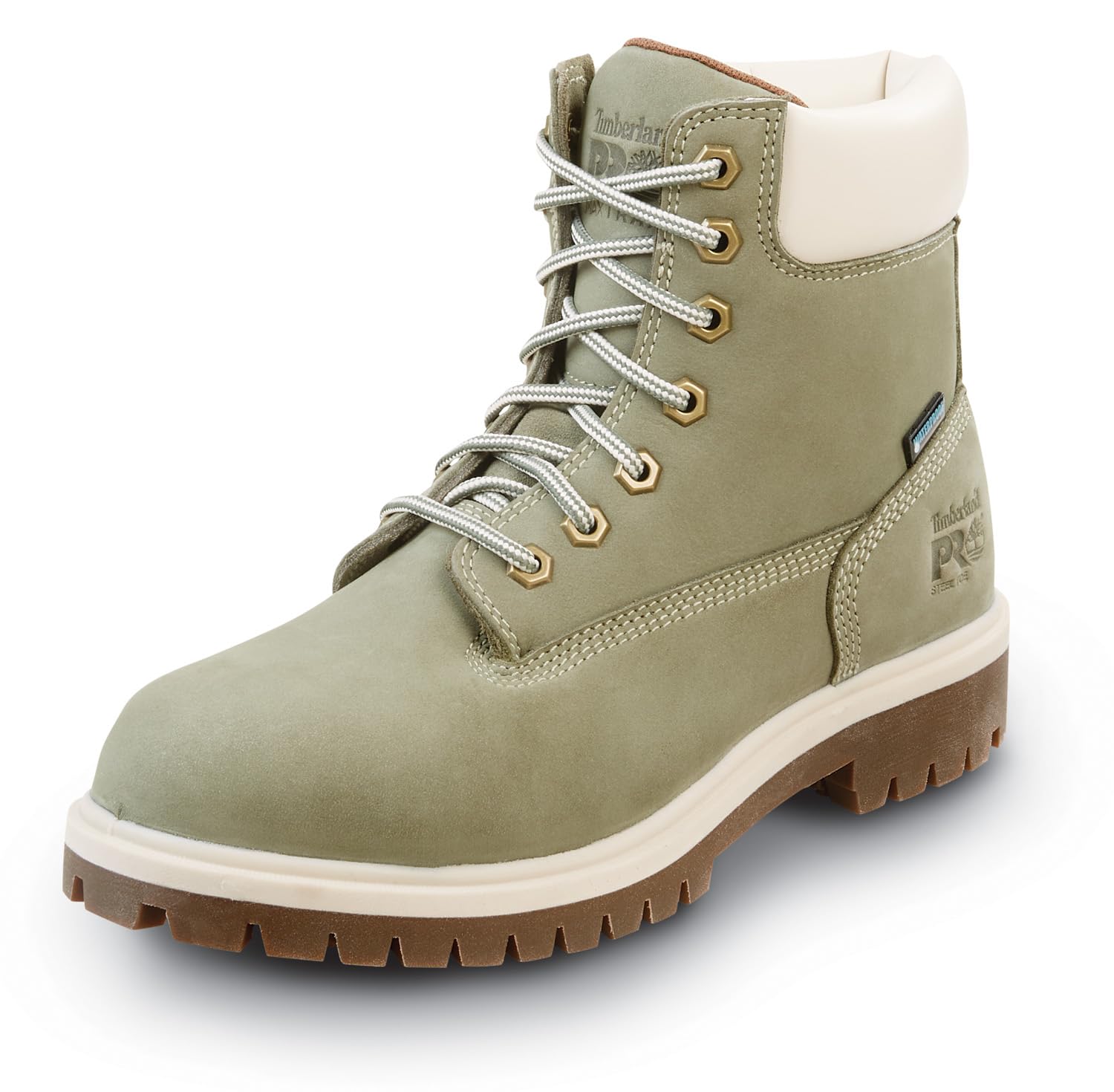
A steel-toe boot with a slip-grip tread that holds on wet metal and an insulation layer for cold sites.
When the site is wet and cold and the ground is slick, this is the boot that stacks the odds in your favor. It pairs a steel toe with an EH (electrical-hazard) rating, a seam-sealed waterproof leather upper, and 200 grams of insulation to hold warmth through a cold shift. The outsole uses the SR Max MaxTRAX patented slip-resistant tread design — a sole built to grip through water, oil, and grease. The breathable open-cell PU footbed and PU midsole underfoot give you a layer of cushioning for long days on hard ground.
Comfort is what carries it, and durability is right behind. Owners describe a boot comfortable enough to fit both thick and thin socks, and durable enough to last for years. It suits outdoor work — that is the third most-praised trait — and the waterproof build is a specific strength. What you get is a 6-inch lace-up with a seam-sealed waterproof construction and an ASTM F2413-24 I/C EH SRO compliant build, meaning it is certified for impact and compression protection, electrical hazard, and slip resistance. The insulation layer is a real comfort advantage on a cold morning.
The split is on fit and value: while many find it comfortable, some report issues, and value divides owners who expect a cheaper price for the build. The steel toe also carries the metal weight compared to the composite toes on the rest of this list. If you want a boot built for a wet, cold, oily site and you do not mind steel, this is a strong pick at the higher end.
The headliner: a seam-sealed waterproof steel-toe with 200 grams of insulation, EH rating, and MaxTRAX slip-resistant tread — built for wet, cold, oily ground.
What to expect: fit and value split, and the steel toe adds weight versus the composite picks nearby.
The right call if: you work wet, cold, or oily ground and want a certified slip-resistant steel-toe.
The wrong call if: you want the lightest boot on the site — the steel toe and insulation add weight.
8. Ariat Women’s Tracey Composite Toe Work Boot

The composite-toe boot that passes for a fashion boot and still puts protection on your foot.
If you want a safety toe under a boot that does not scream “job site,” the Tracey is the shape to look at. It is a composite-toe work boot with a silhouette that owners say does not look like a typical work boot — a real advantage if you move between a site and a client meeting in the same day. The composite toe keeps the boot light while offering the same protection as a steel cap under a falling load, and the brand sits in the line once known for work and outdoor gear.
What wins people over is fit, and it is the most-praised trait by a wide margin — more than four times the style count. Owners describe a boot that fits right from the start and looks good doing it. The composite toe keeps the front of the boot light, and the boot suits outdoor wear, with that trait also earning a spot in the praise breakdown. It is the pick for the woman who wants a safety-toe boot that looks considered rather than borrowed from a man’s shelf.
Be clear-eyed about what this boot is not: water resistance gets mixed feedback, and some customers note it is not actually waterproof. The boot also stiffens up at first, taking time to break in, and some report it scuffs easily. Weight and ease of use split as well. If you need a waterproof boot for a wet site, skip to the Timberland PRO or Wolverine picks. If you want a stylish composite-toe for dry work and off-site wear, the fit is what makes this one worth it.
The strongest argument: fit is the runaway most-praised trait, and the composite toe makes it a real safety boot disguised as a good-looking one.
The wrinkle: water resistance is mixed and some reviewers point out it is not waterproof, so this is a dry-site boot.
Fits best if: you want a safety toe that looks good enough for the office and fits right from the start.
Wrong pick if: you work in wet conditions — the water resistance is a weak spot.
9. KEEN Utility Cincinnati 6″ Composite Toe Waterproof Work Boots
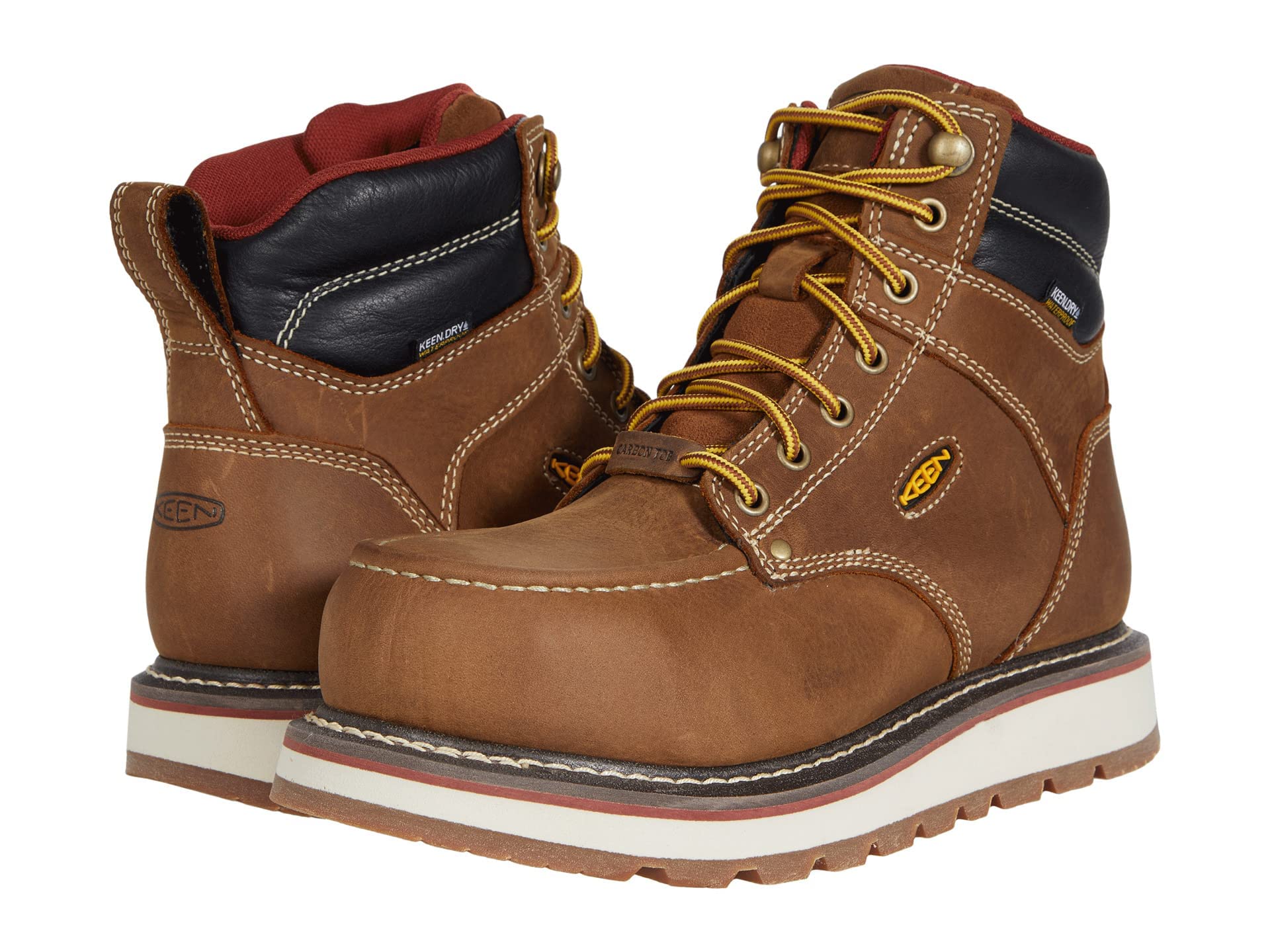
The serious-site wedge boot: a carbon-fiber toe, a Goodyear welt, and a waterproof membrane for the hardest ground.
For heavy construction, welding, iron work, and road work, you want a boot that stands up to the grind — and the Cincinnati is the one on this list built for that. It is a 6-inch waterproof wedge boot with a Goodyear welt (a stitched-on sole construction that holds up under hard wear) built on a women’s foot form. The toe is a non-metallic carbon-fiber cap that KEEN says is 15% lighter than steel, and the KEEN Luftcell midsole is an air-infused foam designed to keep comfort going all day. Weighing 34.4 oz / 975 g per boot, it has the weight of a serious work boot.
The comfort and appearance both earn praise. Owners describe a boot that does not rub on the foot and that looks good enough to wear to work without fuss. The KEEN.DRY waterproof, breathable membrane and barnyard-resistant leather upper mean a wet, dirty site does not end with soaked socks. The protection and ankle support are real strengths too — you get a boot that holds your ankle steady on uneven ground. The removable PU insole lets you swap in your own orthotic if you use one.
Two things to weigh: durability and weight. Durability splits, with some owners reporting the boots last almost two years and others saying they fall apart after two months. And the boot is genuinely heavy — that is a real comfort cost on a ladder. If you work heavy construction, iron work, or road work and accept 34.4 oz per boot, this is the one to buy. If you want light and fast, the KEEN Vista Energy Mid earlier on this list is the lighter sibling.
The build you get: a carbon-fiber toe KEEN says is 15% lighter than steel, a stitched Goodyear welt, and a KEEN.DRY waterproof membrane — built for the hardest sites.
The weight you pay: 34.4 oz / 975 g per boot is real weight, and durability splits, with some owners reporting early failures.
For the woman who: does heavy construction or iron work and wants maximum protection and ankle support.
Not the one if: you spend your day on ladders and need light boots above everything else.
Know the Specs
Composite Toe vs Steel Toe
A steel toe is a metal cap that protects the toes from impact, while a composite toe uses a non-metallic cap — often carbon fiber or a similar material — to do the same job. The composite version usually runs lighter and does not set off a metal detector, which matters if you pass through plant security. Both protect the same way under a falling load, so the real choice depends on weight and whether metal on your toes bothers you.
Waterproof vs Water Resistant
A waterproof boot uses a sealed membrane or seam-sealed leather to keep water from soaking through, so your socks stay dry in a puddle. A water-resistant boot blocks splashes but lets water through after a long soak. If you work in rain, around concrete washout, or on wet ground, the waterproof membrane is the feature worth checking first.
Weight Per Boot
Boot weight is measured per boot, and it builds up over a shift. A 34.4 oz / 975 g boot protects more but tires your legs faster than a 439 g pair. If you are on ladders or scaffolding, light boots win. If you are standing on concrete with loads overhead, the extra protection is worth the weight.
The Goodyear Welt
A Goodyear welt is a stitched-on sole construction that holds up under hard wear — it is a classic heavy-duty build. It protects your foot and lets the sole take a beating, but it adds weight and bulk. For the toughest sites, the stitched welt is a sign of a boot built to last; for a light-duty floor, it is more boot than you need.
Common Questions
Will a women’s construction boot fit like my regular sneaker size?
Is a composite toe as protective as a steel toe?
How do I know a boot is actually waterproof and not just splash proof?
How heavy is too heavy for a construction boot?
Are these boots made on a real women’s last?
What does the ASTM F2413 standard on a work boot mean?
Do construction boots need breaking in before a shift?
Will the sole grip hold on wet metal and oily concrete?
Can I swap in my own orthotic insole?
Is a steel toe or composite toe better for welding or iron work?
The Bottom Line
For most women shopping for a construction boot, the
Think about the ground you actually stand on before you order. A warehouse or maintenance floor barely needs the 34.4 oz / 975 g build of the Cincinnati, while a wet, cold, oily site will punish a water-resistant boot that was never meant for standing water. Match the boot to the ground first and the fit call second: order slightly early, keep the box, and size up if you sit between sizes.
How we choose
We do not accept paid placement. Every pick is matched to a real buyer and a real use-case; we do not hands-on test units.
Sources
Specifications: manufacturer listings and product documentation. Review insights: verified customer reviews, as of November 2026. Pricing: not shown on this page (it changes often); check the current price via the retailer link.
As an Amazon Associate, Tactical Gear Guy earns from qualifying purchases. This does not affect which products we feature.