Specs are compiled from manufacturer listings and verified buyer reviews and can change over time — please confirm the key details on the product page before buying.
You want free local TV that holds a steady picture instead of pixelating whenever a cloud rolls past. The mileage printed on an antenna box is a marketing estimate, not a predictor of your reception. This guide ranks seven antennas by tower distance, amplifier needs, and cable reach rather than box claims.
This guide is built by comparing the manufacturers’ published specifications and the patterns across verified customer reviews, so you get each pick’s real strengths and trade-offs instead of marketing spin.
Where you put the antenna matters more than the range printed on the box. The picks below are ordered by the job they do best, from a full outdoor array that pulls suburban and rural signals to compact window units built for apartment living. Here is what separates a reliable best wireless tv antennas setup from a box that never quite locks on.
Top Picks
How To Choose The Best Wireless TV Antennas
An over-the-air antenna is a passive or amplified piece of metal and circuitry that catches broadcast signals and feeds them down a coax cable into your TV’s tuner. Nothing about it connects to the internet. So the choosing process is really about three things: where your towers are, what your building does to signals, and how much cable freedom you have to move the antenna until the picture settles.
Check your tower distances before you buy anything
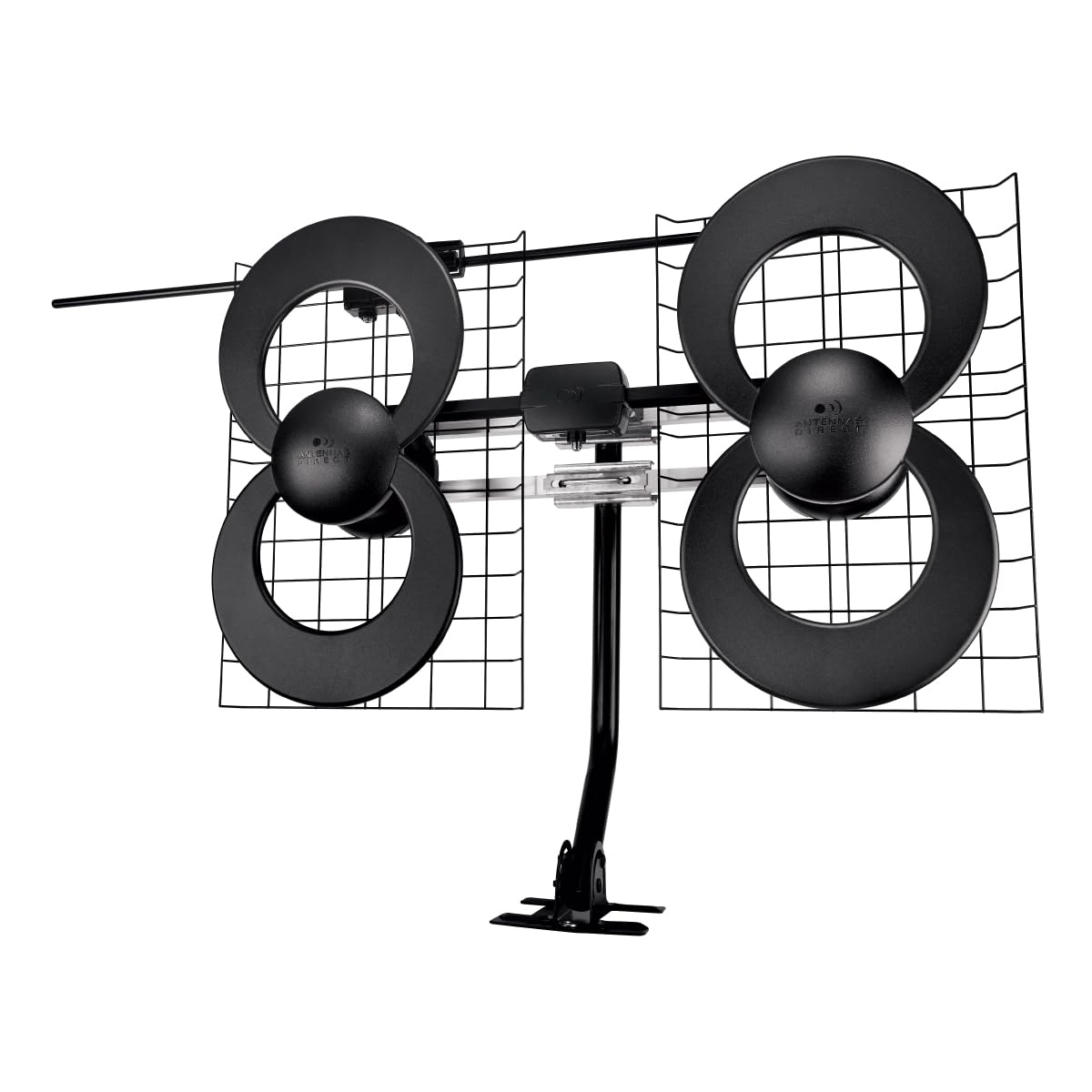
Your reception depends on how far you sit from the broadcast towers that serve your market. Distance plus obstructions like trees, hills, and your home’s building materials all pull signal strength down. A multi-directional antenna with dedicated UHF (the frequency band most digital channels ride on) and Hi-VHF elements can sweep a wider arc than a single-direction design. That matters in suburbs where towers sit in different directions. The Antennas Direct ClearStream 4V, for instance, uses a 43-degree horizontal reception pattern to cover more than one tower angle at once.
Decide if you need an amplifier
An amplifier is a small booster that lifts whatever signal the antenna catches. It helps when you are far from towers and the raw signal is faint. It can actually hurt when you are close, because a strong signal gets over-amplified and turns into pixelation and dropouts. Look for models that either skip the amp or let you place it sensibly. Compact indoor units with a built-in smart IC chip filter cellular and FM interference, which is useful in dense apartment buildings where phones and radio crowd the airwaves.
Cable length and mounting decide your placement options
The antenna only performs where the signal is good, so the cable is a real spec. A 26.25ft cable gives you room to move a unit across a room, while a 38FT cable lets you reach a window, a balcony, or a roof corner. Weatherproof casing and rust-resistant hardware matter the moment the antenna goes outside on an RV or a fence post. Mounting accessories, tape, and a pivoting mast base tell you how permanent the install can be.
Side-by-Side Comparison
| Model | Best For | Stated Range | Channel Capacity | Setup Style | Amazon |
|---|---|---|---|---|---|
| Antennas Direct ClearStream 4V★ Best Overall | Suburban and rural outdoor installs | 70 miles | — | Mast mount, indoor or outdoor | Amazon |
| Upgraded TV Antenna Indoor Outdoor (IceHeat)Budget Champion | Cord cutters on a tight budget | — | 200 | Stable base, 26.25ft cable | Amazon |
| ApexWaveTV Digital TV Antenna | Apartments and flexible relocating | 120 miles | 180 | Magnetic stick base, compact | Amazon |
| Firstlar 2026 TV Antenna | High channel counts with an amp | — | 1000 | 17ft coax plus USB power | Amazon |
| Elize 2027 TV Antenna | Long-cable bedroom and RV setups | — | — | 38ft cable, built-in amplifier | Amazon |
| Mnbiko Indoor TV Antenna | 360° indoor coverage in one spot | — | 2000 | 10FT thickened coax, 3-minute setup | Amazon |
| Kutemp 6000+ Miles TV Antenna | All-weather indoor/outdoor dual use | — | — | 38FT coax, weatherproof, 1-minute setup | Amazon |
Detailed Reviews
1. Antennas Direct ClearStream 4V Outdoor TV Antenna
Our pick — 4.0+★ from 4,000+ verified ratings; the strongest balance of quality and price.
A four-loop outdoor array built to pull signals from several towers at once.
This is the antenna you buy when you live outside the city and the towers are not all in one direction. It uses four patented loops plus dedicated Hi-VHF elements and reflectors (metal surfaces that bounce and focus incoming signal) to grab broadcast UHF and VHF waves from more than one angle. The result is a 43-degree horizontal reception pattern, which is the arc it can sweep without being aimed. It’s built to pick up NEXTGEN TV, 4K, 8K UHD, and Full HD 1080p without any internet connection.
What makes this the strongest pick for suburban and rural homes is the design intent. The reflectors add forward gain and shield the incoming signal from interference that causes pixelation or a full loss of picture. It measures 17.4″ H x 27.8″ W x 6″ D, so it’s a real fixture meant for a mast, not a shelf. The 20-inch mast has a pivoting base that installs on vertical or horizontal surfaces, and the box includes all-weather mounting hardware and an adjustable mast clamp.
The catch is range expectations and the price stance. Distance and obstructions still decide your actual reception. And the value proposition divides buyers cleanly: some owners find it a worthwhile long-term investment, others feel it asks a lot for what it delivers. What wins people over is quality and raw channel count — those two dominate owner feedback by a wide margin, and the picture quality gets described as cable-like.
Where It Delivers
- Four patented loops with dedicated UHF and Hi-VHF elements handle multi-directional tower layouts
- Reflectors focus gain and cut the interference that causes pixelation
- Installs indoors, in an attic, or outdoors with the included 20-inch pivoting mast
- Backed by a manufacturer lifetime warranty
What To Weigh
- 70-mile rating trails some indoor units’ claimed range
- A 4.1-pound fixture that needs real mounting space
- Value-for-money sentiment is genuinely split among owners
Built for: houses in suburbs and rural areas where towers sit at different angles and an attic or roof mount is possible.
Pass if: you are in a tight apartment and want something that sits on a desk.
2. IceHeat TV Antenna
The simplest entry into free local channels, with cable long enough to chase the signal.
If your goal is to stop paying for cable and find out what your local airwaves carry, this is the least risky way to test it. It is a compact unit with a stable support base, so you can set it on a window ledge, a wall shelf, or an RV roof and move it until the picture locks. The 26.25ft coax cable is the standout spec — that much reach lets you drag the antenna across a room toward the best spot instead of accepting the one near the outlet.
Its build leans toward durability for the tier: a UV-resistant casing, a rust-resistant aluminum bracket, and a flame-retardant cable. Setup is genuinely a two-step job. Connect it to the TV’s Cable/Antenna Input port, then run a Channel Scan. Buyers report picking up a healthy spread of local stations with no monthly bill attached. It lists a 200-channel capacity and is rated for indoor or outdoor use, with a 2-year manufacturer warranty behind it.
The honest edge case: reception is the split opinion on this unit. Some buyers get a clean, wide channel spread, while others describe weak pickup — which usually traces back to distance from towers and where the antenna sat. Try a few positions and rescan before you judge it.
Why it earns its slot: the combination of a stable base, 26.25ft of cable, and weather-resistant hardware makes it a fair all-scenario starter. Antenna quality and channel selection are the two things owners talk about most favorably.
Right call if: you want to test cord cutting in an apartment or on an RV without much outlay.
Hold off if: you are far from towers and need amplified pickup.
3. ApexWaveTV Digital TV Antenna
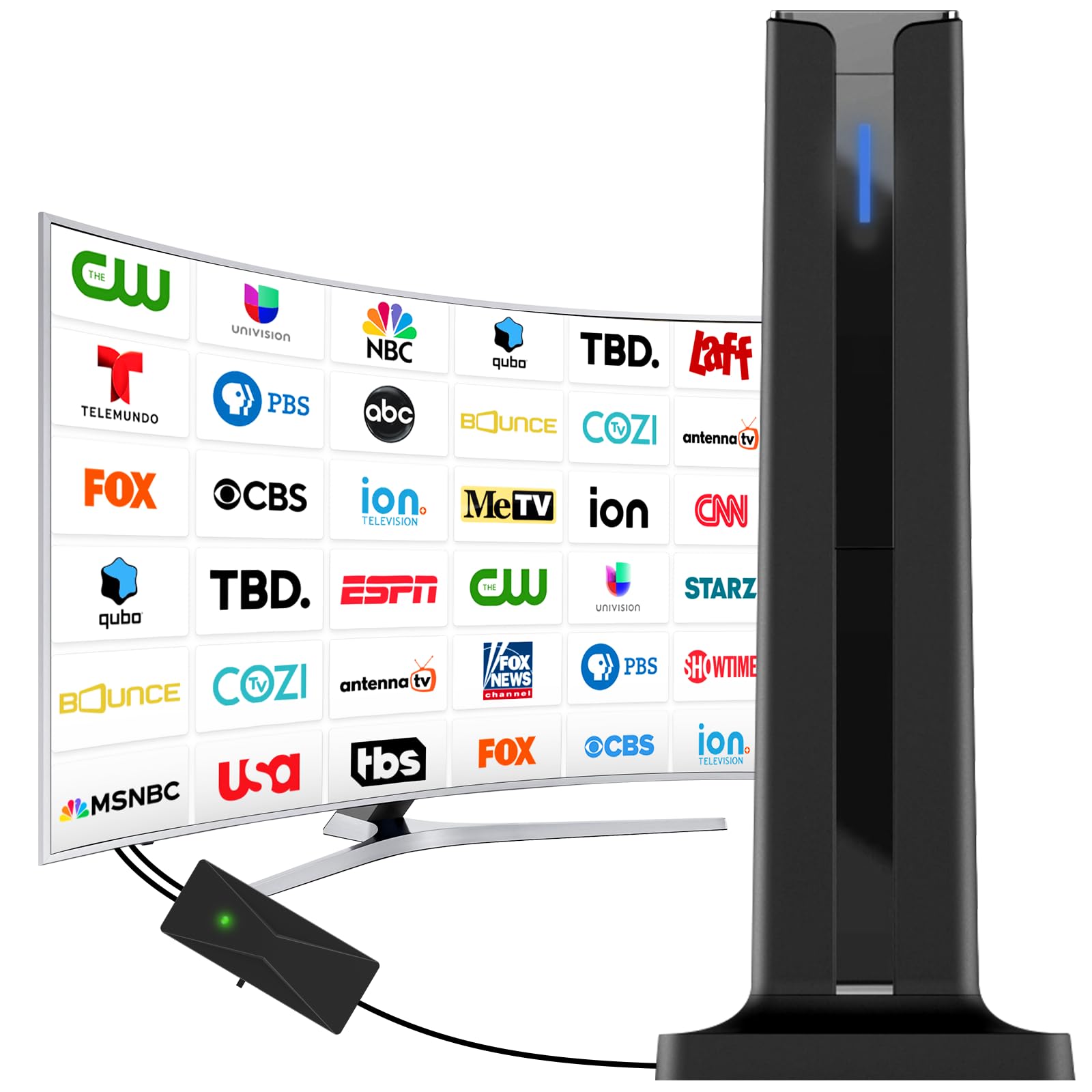
A tiny magnetic puck that catches signals from every direction at once.
You can skip the aim-and-rescan dance with this one. Its upgraded Smart IC chip (a chip that pulls in TV signals) grabs signals from 360° and filters out cellular and FM interference along the way. So you can set it almost anywhere in a room and still catch channels from all directions. It handles 4K, UHD (ultra-high-definition), and 1080P broadcasts, and a constant scanning function finds new channels as they come on air.
The physical footprint is what sells it for apartment life. At 6.69″L x 2.95″W x 2.95″H and 0.22 kg, it is small enough to tuck on a window sill, stick to metal with the magnetic base, or set on a desktop without a visible tangle. Setup is a three-step routine: connect to the CABLE-ANT IN port, position it, and run Channel Search. Quality and signal quality are what owners praise most, with ease of installation right behind.
The spec sheet and the living room disagree here. The 120 miles of claimed range is the biggest number in this lineup — larger than the ClearStream 4V’s 70 miles, which sits on a mast. But owners do report mixed channel coverage depending on placement, which is exactly why the magnetic base and compact shell earn their keep: you can keep experimenting until you hit the spot. The standard coax here cuts signal loss to boost that reception radius.
The deciding detail: the 180-channel capacity combined with a 3.5+ rating across 4,300+ buyers makes this the most-shopped shape in the lineup. It is the antenna for people who want to move the unit, not mount it.
The one honest limit: results vary with where you put it, so budget a little patience for repositioning and rescanning.
Pick this when: you rent, have windows in multiple directions, and want zero drilling.
Pick something else when: you have a dedicated attic or roof spot and want a fixed install.
4. Firstlar 2026 TV Antenna
The high channel-count pick for fringe areas that need a signal boost.
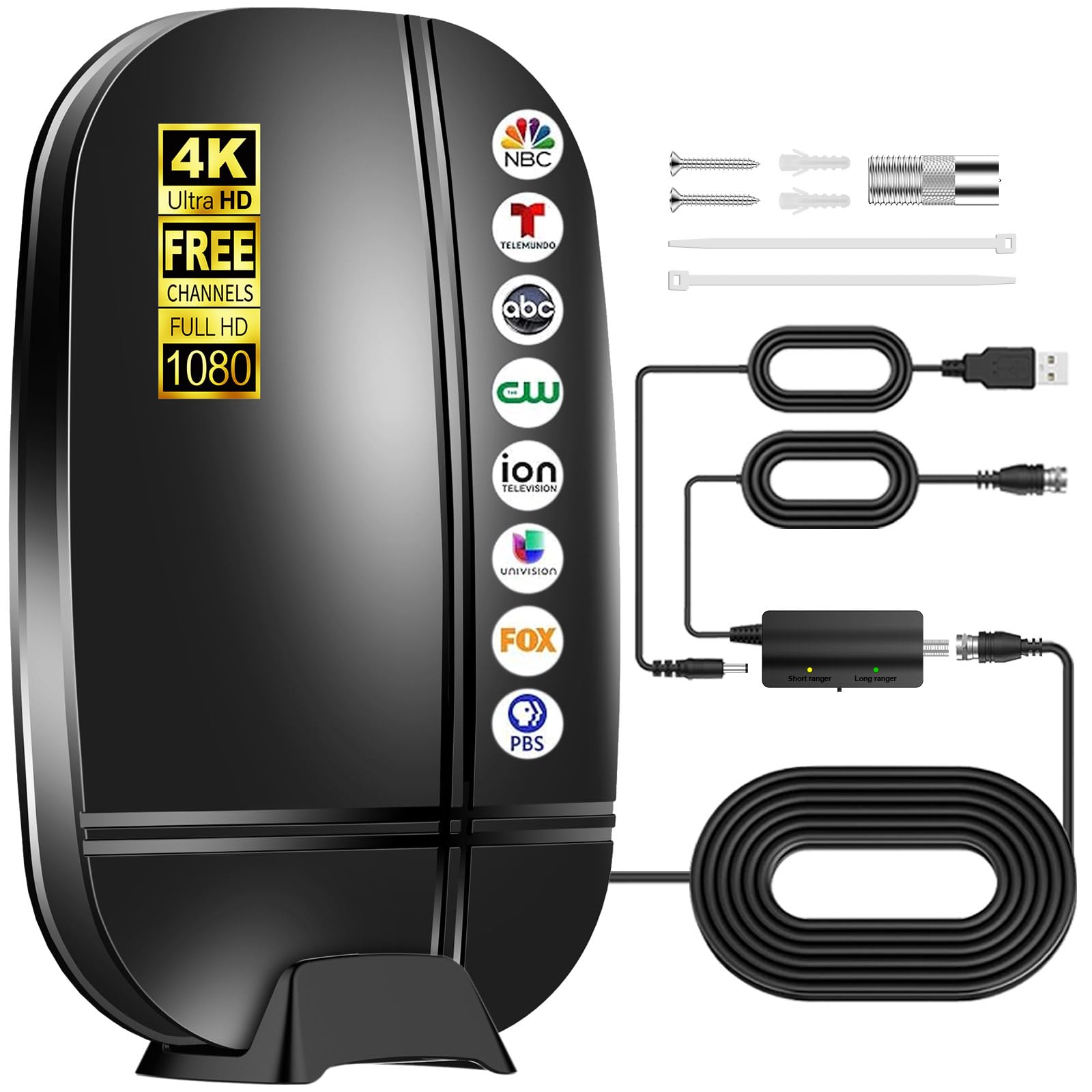
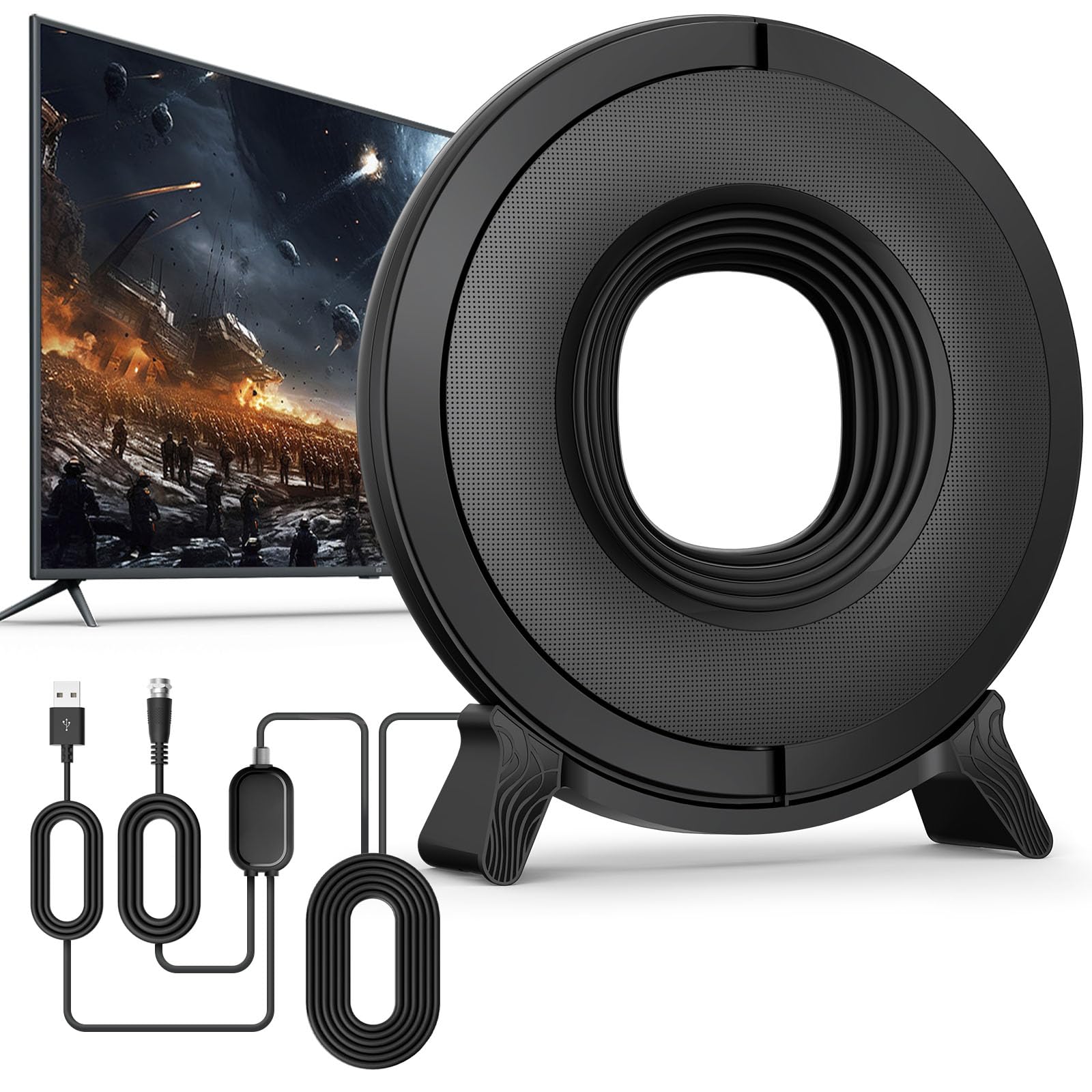
When you are far from the towers, raw metal alone is not enough. This model adds a high-gain amplifier signal booster on top of its smart IC chip. The booster lifts weak pickup while the chip blocks cellular and RF interference, which is the combination that keeps far-away channels stable. It supports 1080p, 4K, 8K, and HDR across both smart TVs and older sets, so a set-top box setup works just as well.
The numbers frame the trade-off clearly. It lists a 1000-channel capacity — well ahead of the ApexWaveTV’s 180 — and it ships with 17ft of coaxial cable plus a USB power cable. That USB power run is what feeds the amp, so keep it in mind when you pick a mounting spot. Wall, window, table, or an unobstructed outdoor corner all work as long as you can reach power.
What lands with owners is the stability and the format support. Picture and sound come through crisp, and the smart TV compatibility means it drops into a modern living room without adapters. The build measures 9″L x 2″W x 9.7″H. Just remember that amplification is a tool, not magic: in a strong-signal neighborhood, over-boosting can work against you. Rescan every time you reposition the antenna to capture the channels available in the new spot.
Reasons It Leads
- Amplified booster targets fringe-tower homes
- 1000-channel capacity is the largest count on the close-in picks
- Works with smart and older TVs plus set-top boxes
- Handles 1080p, 4K, 8K, and HDR
Reasons To Pause
- Needs USB power near the mounting spot for the amp
- 17ft of cable gives less room to roam than longer runs
- Amplification can hurt reception when you’re close to towers
The fit: distance from broadcast towers and a modern or older TV in the same house.
The mismatch: you have no power outlet anywhere near your ideal antenna spot.
5. Elize 2027 TV Antenna
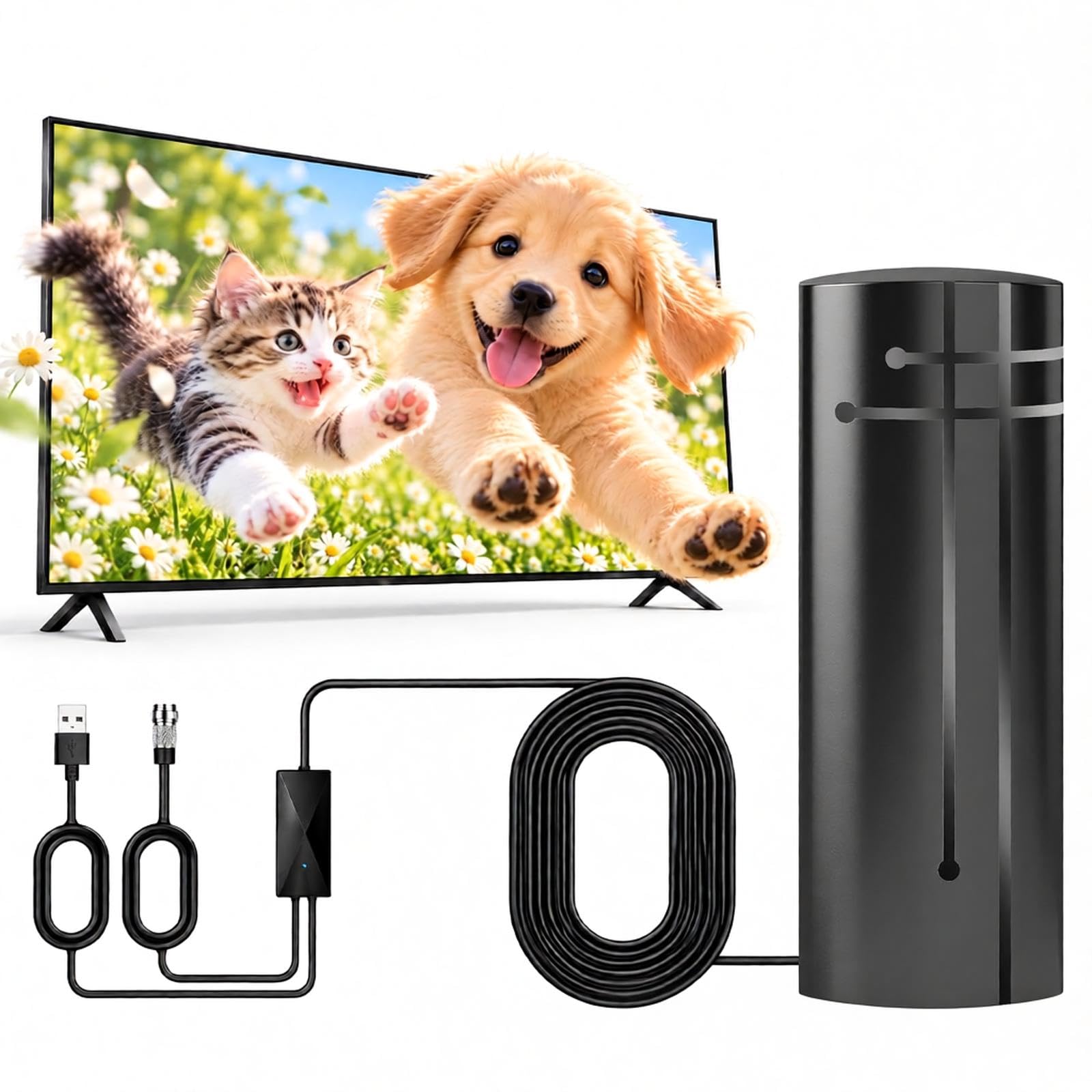
Thirty-eight feet of cable that lets you put the antenna exactly where the signal lives.
Placement is the whole game with over-the-air TV, and this model hands you the most room to play with. The 38ft coaxial cable means the antenna can go behind the TV, on a wall, by a window, in a bedroom, a basement, or an RV while the TV stays put. A built-in signal amplifier boosts the signal the moment it’s received, so faint broadcasts get a lift before they ever travel down that long cable.
It covers the full spread of formats — 720p, 1080i, 1080p, and 4K HD — and picks up the major networks like ABC, CBS, NBC, FOX, CW, ION, and Univision. That means news, NFL and MLB games, sitcoms, and kids’ shows all come in without a recurring fee. Setup is a few-minute job, and installation and effectiveness are exactly what owners talk about most. The clear picture and the amplifier are the things that get singled out.
The catch worth naming: this is cable-length value, not a precision array. It doesn’t publish a channel capacity or a maximum range figure the way some rivals do, so treat the reception as dependent on your distance to towers and where you can run that 38ft line. A 2-year warranty backs it up.
Best reason to grab it: the 38ft cable solves the one problem indoor antennas cannot — covering distance from television to window.
Worth knowing: no published channel count or range rating, so your tower distance decides results.
Suits you if: you want an antenna in a far bedroom or an RV with a built-in amp.
Look elsewhere if: you need published specs to compare before you commit.
6. Mnbiko Indoor TV Antenna

Set it down once and let 360° reception do the aiming for you.
If you want an antenna you never have to fuss with, this is built around that idea. Its 360° multi-directional reception captures signals from every angle, so there is no aiming or rotating to hunt for a tower. Premium filters and upgraded internal components handle the rest, delivering richer color and clear sound whether the unit sits in a living room, an office, or a basement.
The cable choice tells you how it wants to be installed. It uses an extra-long, upgraded 10FT thickened coaxial cable, which keeps signal loss low while letting you shift the unit toward a window or wall. Setup is a three-minute, three-step routine: plug in, position, scan. It carries a 2000-channel capacity and a 90-ohm impedance rating. The slim silver body measures 2.8″L x 2.8″W x 7.7″H, so it disappears on a desk or shelf.
Where this lands against the pack is in the channel ceiling. Its 2000-channel capacity tops the Firstlar’s 1000 and the ApexWaveTV’s 180. That’s a rating on the spec sheet, not a promise about your market — what you actually receive still depends on distance to towers and building materials. It does pick up the majors like ABC, CBS, NBC, FOX, and PBS, so the standard networks are the realistic target.
what separates it: early owner feedback gives it a 4.5+ star top rating, and it pairs that with a 2000-channel ceiling and 90-ohm impedance (a measure of signal matching). That adds up to the strongest spec sheet among the indoor units.
The honest caveat: it only published 20+ ratings so far, so the picture on long-term reliability is thinner than on the higher-volume picks.
Choose it for: a basement or office where you want coverage without aiming anything.
Not for you if: you need a weatherproof outdoor unit for an RV roof.
7. Kutemp 6000+ Miles TV Antenna

Built to take rain and wind on a balcony while blocking 5G clutter.
This is the pick for someone whose antenna is going outside and staying there. It carries a weatherproof and waterproof casing built to resist heavy rain and strong winds, and it ships with the full mounting kit — double-sided tape, screws, and nylon straps — for drill-free installation indoors or out. At 5.1″L x 2.7″W x 10.2″H, it’s slim enough to hug a wall, window, or balcony rail. The 38FT thickened coaxial cable gives you plenty of room to reach a high signal spot.
Its format support is the most forward-looking in the lineup. It is ATSC 3.0 Ready, meaning it supports NextGen TV, and it handles 1080P, 4K, and 8K ultra HD. Professional anti-interference filtering is the under-the-hood part: it blocks signal noise from 5G, cellular, FM, and home electronics, which is what keeps pixelation and screen stutter out of the picture. It carries a 75-ohm impedance rating.
The trade-off is bulk: at 5.1″L x 2.7″W x 10.2″H with a weatherproof shell, it wants a fixed outdoor spot. This is a dense, weatherproof unit for a semi-permanent spot, not a sit-anywhere indoor puck. Like the Mnbiko, it has only 20+ ratings so far, so the long-term track record is thin. And no range or channel-count figure is given, so your reception depends on tower distance and the height you can mount it at. If your antenna lives on a balcony, a fence post, or a camper roof, the weatherproof build is the whole point.
Strong Suits
- ATSC 3.0 Ready with 4K and 8K support
- Anti-interference filtering against 5G, cellular, and FM noise
- Weatherproof casing plus full mounting hardware in the box
- 38FT cable for high or distant mounting spots
Where It’s Thin
- No published range or channel capacity to compare
- Only 20+ ratings so far, so reliability evidence is early
- Bulky for someone wanting a tiny desk antenna
The match: balconies, fences, campers, and RV roofs where weather is the daily reality.
The mismatch: you’re shopping purely on published range numbers and want a paper comparison.
Know the Specs
Stated Range (miles)
The miles on the box are an estimate of the farthest broadcast tower an antenna is designed to reach in ideal conditions. Real reception is usually shorter because trees, hills, and your home’s building materials absorb signal along the way. Treat a range figure as a comparison between models, not a guarantee for your address. The ApexWaveTV’s 120 miles and the ClearStream 4V’s 70 miles are listed on very different kinds of antenna — one indoor, one a mast-mounted array — so read them alongside the form factor.
Amplifier vs. No Amplifier
An amplifier is a booster that lifts the signal the antenna catches before it travels down the cable. It helps when your tower signal is faint and distant, and it can hurt when the signal is already strong because over-boosting turns into pixelation and dropouts. If you are near towers, try the antenna without the amp first. If you are at the edge of the coverage, an amplified model like the Firstlar or the Elize is built for exactly that situation.
Impedance and Coax Cable
Impedance is the electrical resistance of the connection, measured in ohms. Broadcast TV antennas are typically built around a 75-ohm rating so they match the coax cable and the tuner cleanly. A mismatch can cost you signal. Longer cables also lose some signal as it travels, which is why a thicker, upgraded cable helps on long runs. That is why a 38FT run on the Kutemp or the Elize is paired with a thickened cable and, in the Elize’s case, a built-in amp.
Multi-Directional vs. Directional
Directional antennas aim at a single tower and gain more focus. Multi-directional ones sweep a broad arc so they can pick up more than one tower without turning. The ClearStream 4V sits in the middle, with a 43-degree horizontal reception pattern and dedicated UHF and Hi-VHF elements. The indoor 360° designs, like the ApexWaveTV and the Mnbiko, catch signals from every angle, which is handy in apartments where towers are scattered. The trade-off is that a broad sweep can pull in weaker signals across the arc rather than a strong one from one spot.
Common Questions
Will a wireless TV antenna work on a non-smart older TV?
Do I need an amplifier or not?
How do I run a channel scan after moving the antenna?
Why do these antennas say 6000+ miles if towers are not that far?
Can a wireless TV antenna pick up cable-only channels?
What is ATSC 3.0 and does it matter for my antenna?
How much coaxial cable do I actually need?
Can I use one of these antennas outdoors on an RV?
Why does my picture pixelate even with a good antenna?
Does a bigger channel capacity number mean more channels for me?
The Bottom Line
For most homes, the wireless TV antenna that solves the widest range of problems is the Antennas Direct ClearStream 4V. It is the one pick built as a real multi-directional array with reflectors and a pivoting mast, designed to hold signals from several towers at once in suburban and rural conditions. The indoor shoppers should look to the ApexWaveTV for its 360° reception and magnetic base, or the Mnbiko if you want that 2000-channel ceiling on an indoor unit. And if the antenna has to live outside on a balcony or an RV roof, the weatherproof Kutemp is the match. Whatever you pick, run a channel scan after every move — antenna position decides your picture more than any spec sheet.
How we choose
We do not accept paid placement. Every pick is matched to a real buyer and a real use-case; we do not hands-on test units.
Sources
Specifications: manufacturer listings and product documentation. Review insights: verified customer reviews, as of November 2026. Pricing: not shown on this page (it changes often); check the current price via the retailer link.
As an Amazon Associate, Tactical Gear Guy earns from qualifying purchases. This does not affect which products we feature.