Specs are compiled from manufacturer listings and verified buyer reviews and can change over time — please confirm the key details on the product page before buying.
The hard part of water cooling a PC is not the pump or the tubing — it is finding a case that actually has somewhere to bolt the radiator. A 360mm radiator is roughly as long as a school ruler, and plenty of good-looking cases simply have no wall wide enough for it. Below you will find eleven cases that all accept real water-cooling hardware, ranked so the easiest builds sit near the top. The crowd favorite is the MONTECH King 95 PRO, a curved-glass dual-chamber case that ships with six fans and takes a 360mm top radiator, rated 4.5+ stars across 500+ owners.
This guide is built by comparing the manufacturers’ published specifications and the patterns across verified customer reviews, so you get each pick’s real strengths and trade-offs instead of marketing spin.
Some cases here swallow a 420mm radiator plus a second one; others squeeze a 360mm into a footprint small enough for a desk. The list below spells out which is which, so you can match the chassis to the loop you already own with this watercooling pc case shortlist.
Top Picks


How To Choose The Best Watercooling PC Case
Water cooling lives or dies on one number: the length of the radiator you plan to install. Everything else — the glass, the lighting, the wood trim — is decoration around that one radiator measurement. Get the radiator spec right and the rest of the build follows without drilling or returns. Get it wrong and you are drilling holes or returning a case.
Radiator support is not the same as fan support
A radiator is a flat metal tank with fins, and it needs a mounting wall that is both long enough and clear of obstructions behind it. A case that lists eleven 140mm fan slots may still only fit three 420mm radiators — or only one, depending on how the brackets are arranged. Read the radiator line separately from the fan line. A thick radiator (the kind with a push-pull fan setup) needs extra depth behind the mounting face, and that depth is rarely listed.
Check GPU clearance against a front radiator
When you hang a radiator on the front wall, it eats into the space your graphics card needs. Cases here list anywhere from 415mm to 460mm of GPU clearance, but that figure usually assumes no front radiator. Slide a 30mm-thick radiator plus a fan into the front and you may lose 55mm of that allowance. Note the specific warning one case gives — side-mounting a 240mm cooler can clash with GPUs wider than 280mm.
Dual-chamber and triple-chamber layouts
A dual-chamber case puts the power supply and all its cables in a second compartment behind the motherboard. That means the main window shows hardware instead of a bird’s nest of wires, and the power supply gets its own air path. A triple-chamber case splits this further, giving the CPU radiator its own isolated space so its heat does not bleed into the graphics card area.
Glass, mesh, and how the air actually moves
Tempered glass looks superb and blocks airflow completely, which is why almost every case here pairs a glass window with a mesh or open panel elsewhere. A mesh panel lets air pass but also lets dust in, so a removable dust filter matters over months of use. Curved glass is a structural piece rather than a flat sheet — it needs care when you pop it off for cleaning.
Side-by-Side Comparison
| Model | Best For | Radiator Support | Max GPU Length | Pre-Installed Fans | Amazon |
|---|---|---|---|---|---|
| MONTECH King 95 PRO★ Best Overall | First-time glass build | 360mm top / 240mm side / 120mm rear | 420mm | 6 | Amazon |
| Lian Li A3-mATX (A3X-WD)Most Compact | Small desk, big radiator | 360mm AIO | 415mm | None | Amazon |
| Okinos Cypress 7Best Wood Finish | Walnut looks, modest loop | 360mm top / 280mm side | 415mm front | 4 | Amazon |
| Antec C8 Wood | Triple 360mm loops | 360mm top, bottom, and side | 440mm | None | Amazon |
| Antec Flux Pro | Fans included, big loops | 420mm + 360mm together | — | 6 | Amazon |
| Corsair AIR 5400 RS-R | Isolated CPU cooling | 360mm front chamber | — | 3 reverse-rotor | Amazon |
| be quiet! Light Base 900 FX | Two 420mm radiators | Up to two 420mm | — | 4 Light Wings 140mm | Amazon |
| Lian Li O11D EVO XL | Triple 420mm custom loop | 3 × 420mm | 460mm | None | Amazon |
| HAVN HS 420 | Display-panel showcase | Up to 420mm top, right, bottom | — | None | Amazon |
| ASUS ProArt PA602 | Quiet air-and-AIO builds | One 420mm | 440mm | 2 × 200mm + 1 × 140mm | Amazon |
| Corsair 9000D RGB Airflow | Extreme multi-radiator rigs | 480mm front and roof / 360mm side / 240mm rear | — | None listed | Amazon |
Detailed Reviews
1. MONTECH King 95 PRO Curved Dual-Chamber ATX PC Case
Our pick — 4.5+★ from 550+ verified ratings; the strongest balance of quality and price.
Curved glass on two sides, six fans already spinning, and a 360mm radiator slot up top.
If this is your first loop, the King 95 PRO removes the two chores that stall most builds. First, the fans are already installed — two 140mm RX140 fans on the side, three 120mm RX120 fans along the bottom, and one 120mm AX120 fan at the rear, all wired to a 1-to-10-port controller. Second, the dual-chamber body stuffs the power supply and every cable into a separate compartment behind the motherboard, so the window shows components instead of wire clutter.
The design is what wins people over — it is the single most-discussed thing in the feedback, and the curved 4mm tempered glass paired with 0.8mm metal panels is why. Both glass panels pop off without a screwdriver, which matters when you are test-fitting a radiator before committing to tube runs. Hardware room runs to ATX, Micro-ATX and Mini-ITX boards, graphics cards up to 420mm, CPU coolers up to 175mm, and power supplies up to 185mm across seven PCIe slots.
Plan your radiators before you buy, because the slots decide what you can cool. The top fits a 360mm radiator (a 360mm-long cooling panel), the side fits a 240mm one, and the rear fits a 120mm one. A top-mounted 360mm is the natural home for a CPU loop, and the side slot takes a second radiator if you are cooling the graphics card too. For storage you get room for five 3.5-inch drives or eight 2.5-inch drives. At 17.4 by 11.81 by 18.7 inches, versus the Antec Flux Pro’s 20.86 by 9.64 by 21.45 inch frame, so it sits on a normal desk without eating the whole surface.
What earns the top spot
- Six fans and a 10-port controller arrive pre-installed, so you are not buying cooling twice
- Curved glass on front and side gives a wide view with no corner pillar in the way
- 420mm GPU clearance leaves room for the longest current graphics cards
- Dual-chamber routing keeps the visible side of the build clean
Where it asks for patience
- The side radiator slot tops out at 240mm, so a three-fan side radiator is off the table
- Curved glass demands care when you remove it for cleaning
- Six pre-wired fans mean real cable traffic behind the tray on day one
Go for this: a first water-cooled build where you want the fans, the radiator slot, and the glass already sorted in one box.
Think twice: if your plan is a 360mm radiator on the side wall rather than the roof — this one stops at 240mm there.
2. Lian Li A3-mATX PC Case, 415mm GPU, 360 AIO, Wood Black Mesh
A 26.3-liter box that somehow swallows a 360mm radiator and a 415mm graphics card.
The headline here is what fits inside: a 360mm AIO plus a GPU up to 415mm inside a 26.3L chassis, with four expansion slots and room for up to ten 120mm fans. That is a genuine small-form-factor case that does not force you to downsize your loop. Steel mesh panels on the side and the top let air move freely, which is exactly what a hot graphics card and a radiator need.
Weighing 11 pounds, it is dramatically easier to lift onto a desk than the Antec Flux Pro at 29 pounds — the same class of hardware, a very different backache. The walnut wood front panel gives it a finish that hides dust better than gloss black, and the modular structure lets you pull panels off before you start routing. Power supply flexibility is unusual for the size: ATX, SFX and SFX-L units all fit, and you can mount the PSU at the front or the side.
Here is the honest catch, and it is the one this case is known for: cable management is tight. There is not much depth behind the motherboard tray, so plan your runs before you screw anything down. The case also ships with no fans, so the cooling budget is on you. What wins people over beyond that is the wood-and-mesh look — it is the most-discussed positive in the feedback, and it photographs far better than a plain black slab.
The size-to-radiator ratio: few cases pack a 360mm radiator and 415mm of GPU room into something this small, and the Lian Li does it with the side panels off and the PSU repositionable.
The trade you accept: cable depth is the recurring gripe. Use flat cables and route them early, because adding a second pass later is a fight.
Reach for this if: you want a real 360mm loop on a small desk and you are comfortable planning cables before assembly.
Look elsewhere if: you want a case that arrives with fans installed and generous cable room.
3. Okinos Genuine Walnut Wood PC Case, Cypress 7
Real walnut grain on the outside, four PWM fans and 200 CFM of intake on the inside.
The Cypress 7 leads with its wood, and the wood is genuine walnut rather than a printed vinyl wrap. Four 120mm PWM fans come pre-installed and pull a stated 200 CFM of intake volume, so you are not starting from zero. The front panel carries a Type-C 3.2 Gen 2 port rated at 10Gbps plus two USB 3.0 ports and audio jacks, which makes it a sensible desk-side case rather than a floor box.
For water cooling, the top holds a 360mm radiator and the side holds a 280mm unit. Be deliberate here: installing a 240mm water cooler on the right side can interfere with graphics cards wider than 280mm, and the front fan position supports GPUs up to 415mm while the rear supports up to 390mm. Vertical GPU mounting is not supported at all — horizontal only.
Case quality is what gets praised most, followed closely by the wood appearance, and that tracks with a chassis this solid. At 6.45 kg it is far easier to move than the Antec C8 Wood at 10.39 kg, which matters if you rearrange your desk or haul the build to a LAN. Storage reaches up to five SSDs, though the side tray that holds two of them blocks additional fan mounting, so pick your priority. A magnetic tempered glass side panel pops off for quick access.
The build-quality read: a solid, well-finished chassis with real wood veneer, and the pre-installed PWM fans mean the loop starts with airflow already accounted for.
The planning note: side-mounted AIOs and wide graphics cards can collide, and there is no vertical GPU option — check your card’s width before you buy the side radiator bracket.
Best for: a warm, furniture-grade desk build with a top-mounted 360mm CPU loop and a normal-width graphics card.
Not the one for: vertical GPU setups or wide triple-slot cards paired with a side radiator.
4. Antec C8 Wood Full-Tower E-ATX PC Case

Three thick 360mm radiators at once, and room for 440mm of graphics card.
This is the case for a custom loop that cools everything twice over. Antec states it supports thick 360mm radiators on the top, the bottom and the side simultaneously — three full-size radiators in one chassis, which is a rare allowance outside the super-tower class. The top and bottom each hold three 140mm fans or two 160mm fans, and the full cut-out at the bottom takes interchangeable 120mm or 140mm fan brackets.
Your cables stay out of sight because the dual-chamber design puts the power supply in its own compartment. The smooth tempered glass on the front and side means neither the wood trim nor the glass is broken up by a frame. Long graphics cards fit, up to 440mm, and the motherboard list covers E-ATX, ATX, Micro-ATX and ITX (the four common board sizes). You get six internal bays, and a Type-C port sits up front for quick device hookups.
Construction is the aspect buyers talk about most, and the matching sentiment on spaciousness explains why: this is a big, solid full tower. At 10.39 kg it is noticeably heavier than the Okinos Cypress 7 at 6.45 kg, so decide before purchase whether it lives on the floor or a sturdy desk. It also ships with no fans, which for a triple-radiator build is arguably correct — you will be choosing your own fans anyway.
Why it earns its place
- Three thick 360mm radiators at once is a serious cooling ceiling
- 440mm GPU room covers the largest cards in horizontal orientation
- Dual-chamber keeps the power supply and its heat out of the main bay
- Interchangeable 120mm/140mm bottom brackets give fan flexibility
The honest asterisks
- No fans included, so budget for six to nine fans on top
- Heavy at 10.39 kg, which rules out frequent moving
- Three radiators means a lot of tubing, so plan your runs before you cut
Pick this one if: you are building a full custom loop with two or three radiators and you want the headroom in one chassis.
Pass on it if: you are fitting a single AIO — most of this case’s capacity would sit empty.
5. Antec Flux Pro Full-Tower E-ATX PC Case, 6 PWM Fans Included

A 420mm radiator and a 360mm radiator can run at the same time — with six fans already in the box.
Running a 420mm radiator and a 360mm radiator at the same time is the spec that separates the Flux Pro from most full towers. If you are cooling both the CPU and a top graphics card, that means two full-size radiators with no compromise on fan size. Antec rates the chassis for up to twelve fans at once, and six PWM fans (speed-controlled fans) arrive pre-installed: three Tranquil 140 PWM at the front, two P12R PWM reverse fans on the power-supply shroud, and one Tranquil 140 PWM at the rear.
Two features are unusual enough to mention on their own. The iShift PSU mount rotates the power supply 90 degrees, which changes how its cables exit and frees horizontal room. A CPU/GPU dual temperature display sits on the case itself, so you can read temperatures without opening an app. Cooling brackets on the top, front and PSU shroud are removable, which makes fitting a 420mm radiator far less fiddly.
Airflow is the thing owners rave about — the multi-directional vent design and the reverse-flow shroud fans keep a steady stream over the components. Case quality and spaciousness rank right behind it. The size is the trade: at 29 pounds and 20.86 by 9.64 by 21.45 inches, it is a heavy, tall tower next to the Lian Li A3-mATX at 11 pounds. Its ten internal bays also dwarf the A3-mATX’s four, so storage-heavy builds have a clear home here.
Cooling headroom: a 420mm and a 360mm radiator together, twelve fan positions, and six fans pre-fitted is a combination that lets a big loop breathe without extra spending.
The weight reality: 29 pounds and a tall frame mean you want a sturdy floor spot or a very solid desk before you start building.
Worth it for: dual-radiator builds that want fans, an isolated power-supply mount, and a temperature readout on the front of the case.
Skip the shortlist if: your desk is small or you move the tower often — 29 pounds is a commitment.
6. CORSAIR AIR 5400 RS-R ARGB Panoramic Mid-Tower PC Case

The radiator gets its own room, so the heat it makes never reaches the graphics card.
Your CPU radiator gets its own room here, and that changes the cooling math. Three separate chambers split the case up. A dedicated chamber at the front holds a 360mm radiator for CPU cooling, and because it is walled off from the rest of the case, the heat that radiator produces stays out of the central bay. The middle chamber feeds vertical airflow straight to the graphics card and motherboard, then exhausts it out. The third chamber houses the power supply, storage and cables, with its own intake and exhaust.
Airflow ducts do the quiet part of the work. A duct at the bottom fan array squeezes intake air into a narrow channel, raising its velocity at the same fan speed — more cooling without more noise. Three reverse-rotor fans are pre-installed, and they pull air in from the panel side of the case rather than pushing it through a filter first.
Design and cooling lead the feedback, and the separate-chamber layout is exactly why — Walling the CPU radiator off in its own front chamber keeps its exhaust out of the bay that feeds the graphics card. At 13.92 kg it is a substantial mid tower, lighter than the Corsair 9000D at 29.1 kg but heavier than most mid towers here. Size and fit land as mixed notes: check your graphics card length and radiator thickness against the chamber dimensions before you commit, because a triple-chamber mid tower has less slack than a full tower.
Choose it when: CPU temperature is your priority and you want the radiator’s heat physically separated from the graphics card.
Double-check first: the front radiator chamber and the central bay are sized for standard hardware — measure your card and radiator thickness before ordering.
7. be quiet! Light Base 900 FX White PC Case
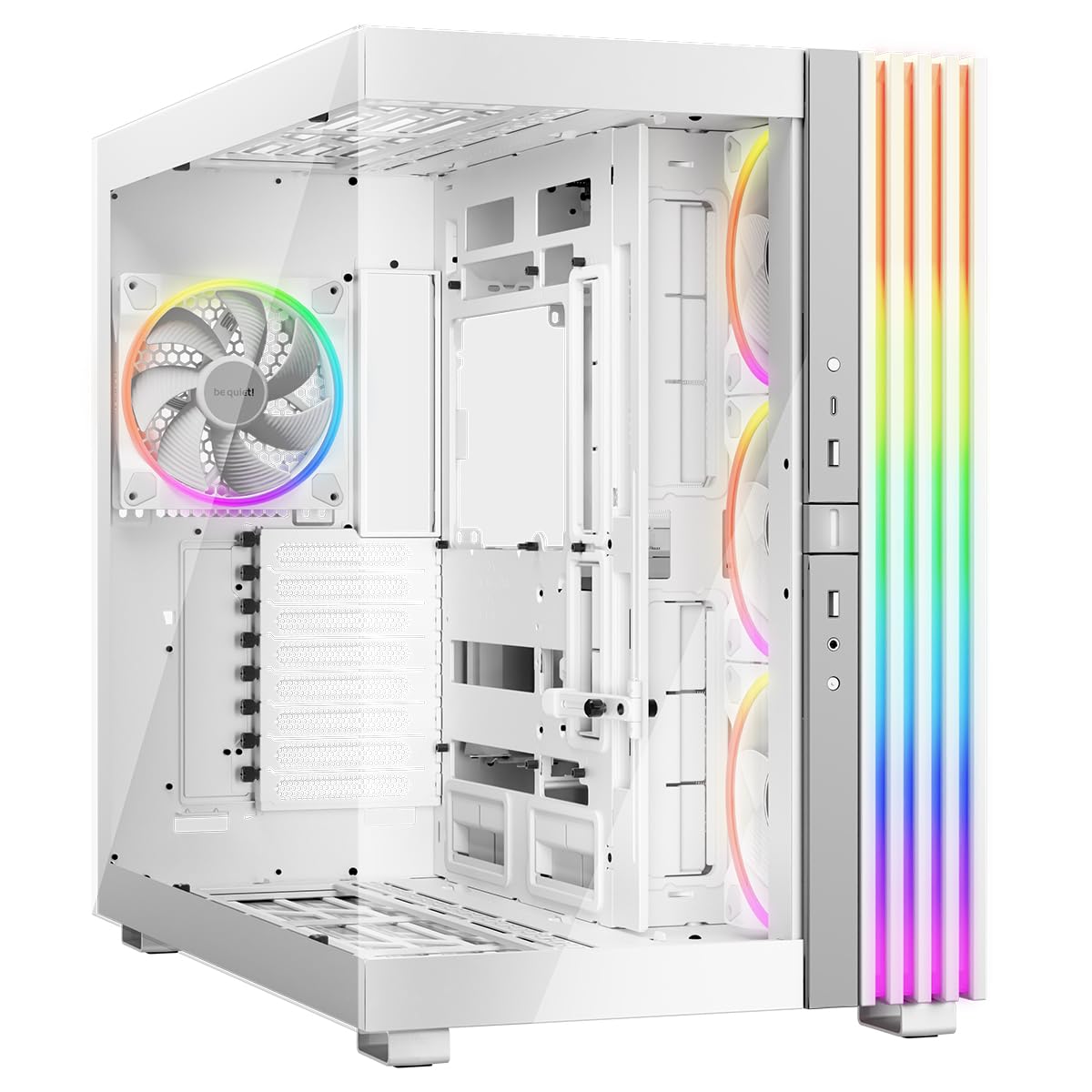
A white dual-chamber chassis that will hold two 420mm radiators and ten fans.
Compatibility runs to E-ATX boards, up to ten fans, seven expansion slots, and high-end liquid cooling systems up to two 420mm radiators. That is a serious cooling ceiling in a case that also offers inverted and horizontal layout options — you can flip the internals so the glass faces the way your desk needs it. Four Light Wings 140mm PWM fans come pre-installed, and ARGB lighting is built in.
The all-steel body with a fully windowed front and side gives the build a clean, bright look, and the white finish is the reason many buyers pick this version over the black one. Cable management is handled by two integral fan and RGB hubs, which cuts the number of wires that have to reach the motherboard.
This is not the easiest case here to build in — ease of use and adjustability come through as mixed rather than clear wins. Treat it as a case that rewards planning: decide radiator placement and fan orientation before you start, because the layout flexibility means more choices to get right. Case quality is what earns the most praise, and the airflow and appearance hold up next to the rest of this list. At 24.8 by 22.44 by 16.93 inches it has an unusually wide footprint, so measure your desk before you fall for the white finish.
The cooling ceiling: two 420mm radiators plus ten fan positions in a dual-chamber body gives a big custom loop room to breathe.
The layout tax: inverted and horizontal options mean more decisions up front, and the wide footprint needs a generous desk.
Suits you if: you want a white showcase build with two big radiators and the option to flip the internal layout.
Look past it if: you want a build that assembles itself quickly — this one asks you to plan the layout first.
8. LIAN LI O11D EVO XL Black E-ATX Full Tower Case

Three 420mm radiators, a removable front pillar, and a motherboard tray that moves in three steps.
Fitting three 420mm radiators in one chassis is the number that matters, and it puts this case at the top of the custom-loop food chain alongside the Antec C8 Wood. The adjustable motherboard tray moves up and down through three levels of height, so you can shift the board to clear whichever fan and radiator combination you choose. Graphics cards run to 460mm — the longest allowance in this guide — so even the biggest cards clear the front. Up to eleven fans fit.
The front pillar comes out, leaving an unobstructed view of the hardware without weakening the structure. Airflow got attention too: the top mesh panel opening is 14.5% larger and the side mesh opening 14% larger than before, with a fully open bottom panel and three dust filters. Cable management uses three dual-layer clips that mount anywhere along vertical grommets, so routing is not locked to fixed tie points.
Case quality and size are the strongest points in the feedback, and the customizability is why builders keep coming back — you can run different fan and AIO sizes without fighting the chassis. Storage capacity and removability come through as mixed, so plan your drive count early. At 19.37 kg this is a heavy full tower, and 7 internal bays cover a storage-heavy build. Toolless installation and a movable IO module make the assembly side less painful than the weight suggests.
Why custom-loop builders choose it
- Three 420mm radiators is the highest radiator count on this list
- 460mm GPU clearance handles any card you can buy
- Removable front pillar opens the view without losing rigidity
- Adjustable three-position motherboard tray fits tricky radiator stacks
Things to weigh first
- No fans included, so add eleven fans to the plan
- 19.37 kg makes it a floor-standing case in practice
- Mixed notes on storage capacity — count your drives before building
The one for: a showcase custom loop with three 420mm radiators and the longest graphics cards made.
Not for: a single-AIO build — the capacity is wasted, and so is the weight you lift.
9. HAVN HS 420 Dual-Chamber Mid Tower PC Case

Eleven 140mm fan slots, three 420mm radiator positions, and a VESA mount for a small screen.
Three 420mm radiator positions — top, right and bottom — with eleven 140mm fan slots is the cooling spec, and it is the same tier as the Lian Li O11D EVO XL at a smaller overall size. The hybrid structure takes a dual-chamber layout but keeps a traditional case size ratio, and it directs cool air from a bottom intake straight onto the centrally positioned graphics card. A 3-way adjustable support bracket holds graphics cards of different shapes without sag.
The glass is heat-formed into a curve with the smallest radius HAVN could produce, which reduces distortion so the view into the case stays clear. The SimpliCable routing system uses grooved guides running top to bottom, and a fan hub handles the wiring. Every fan bracket has flexible rubber pads to isolate it from the chassis and stop resonance building up into a hum.
A VESA display mount is included for a portable screen, so the case can act as a mini showcase with a status display on the glass. Design is what buyers single out most, with build quality right behind it, and the airflow and cable paths come in for steady praise. Value for money is a mixed note — this is a premium chassis, and the price sits accordingly. At 17.83 kg it is heavier than the MONTECH King 95 PRO at 10 kg, so treat it as a floor case.
The layout idea: bottom intake feeding a central GPU plus three 420mm radiator spots gives a loop flexibility most mid towers cannot match.
The cost side: value lands as mixed, and 17.83 kg means no shelf spot — decide before you clear the desk.
Suit yourself to: a glassy showcase with three 420mm radiator options and a screen mount for system stats.
Look past it if: you want a light, budget-conscious mid tower — this one is heavy and premium.
10. ASUS ProArt PA602 E-ATX Full-Tower PC Case

Two huge 200mm fans push air through a 15.5mm grill, quiet enough to forget.
Airflow starts at the front: a 15.5mm grill with 45% porosity lets air in, and two extra-thick 200 x 38mm fans pull it through, backed by a 140mm rear exhaust. Two deflectors redirect the incoming stream toward the motherboard and components, and a built-in fan hub keeps the wiring under control. For water cooling, the case supports one 420mm radiator for an AIO or a custom loop, and graphics cards fit horizontally or vertically.
Build quality is the strongest point in the feedback, with spaciousness close behind — E-ATX boards and large CPU coolers both fit with room to spare. Noise level also comes through as a positive, which makes sense given the low-speed 200mm fans do the heavy lifting. An IR dust indicator on the front panel tells you when the filter needs cleaning, which keeps airflow from quietly dropping off over months.
Fast front-panel hookups come standard: a USB Type-C 20Gbps port (20 gigabits per second, quick enough for fast external drives), plus a power-lock latch and two-section PWM control. At 35.5 pounds it belongs on the floor, not your desk. Nine internal bays cover storage, but the 420mm radiator limit means a second full radiator is not part of the plan — this is a one-big-radiator case with exceptional air cooling around it.
The quiet-cooling case: two 200 x 38mm front fans and a 45%-porosity grill move a lot of air at low noise, and the IR dust indicator protects that airflow over time.
The radiator limit: one 420mm radiator is the ceiling, so a dual-radiator loop needs a different chassis.
Built for: a quiet E-ATX workstation with one 420mm AIO and enormous front fans doing the cooling.
Skip if: your loop needs two big radiators, or you want a case that does not weigh 35.5 pounds.
11. CORSAIR 9000D RGB Airflow Super Full-Tower PC Case

A super tower that fits 480mm radiators in two places, for the biggest loops made.
Radiator support is the reason this case exists: up to 480mm in the front and the roof, 360mm in the side, and 240mm in the rear. Fan capacity runs to 18 x 120mm, 7 x 140mm, or 4 x 200mm. For a build with multiple large radiators and a dozen fans, that ceiling is well above anything else on this list.
The InfiniRail system is an aluminum multi-point mounting rail in the front and roof. You slide it to position 120mm and 140mm fans wherever you want, rather than accepting fixed vertical mounting points. An included iCUE LINK System Hub controls the RGB front I/O and can manage up to 13 additional iCUE LINK devices, from fans and coolers to Hydro X Series parts. The steel front panel is removable for cleaning.
Design earns the most praise, with the sheer size a close second — this case is enormous, and at 29.1 kg it is the heaviest thing here. Cable management, mounting options and fit all come through as mixed, so expect to think carefully about routing before you commit. Reliability lands as a negative note, so buy with a return window in mind. At 27.48 by 12.09 by 27.48 inches it needs real floor space, and 8 internal bays cover a storage-heavy workstation.
What it does best
- 480mm radiators front and roof is the largest radiator allowance in this guide
- InfiniRail lets you slide fan positions instead of accepting fixed mounts
- iCUE LINK hub included and expandable to 13 more devices
- 18 x 120mm fan capacity for extreme airflow builds
Before you commit
- 29.1 kg and a 27.48-inch footprint demand floor space and two people to lift
- Cable routing and fan mounting come through as mixed — plan both carefully
- Reliability is a negative note, so keep the return window open until the build is finished
The fit is: an extreme multi-radiator workstation where 480mm of radiator and 18 fans are the whole point.
Look elsewhere if: you are building a normal single-loop gaming PC — this much case is overkill, and it weighs 29.1 kg.
Know the Specs
Radiator support in millimeters
A radiator’s number — 240mm, 360mm, 420mm, 480mm — describes how many fans bolt to one side of it in a row. A 360mm radiator takes three 120mm fans, and a 420mm takes three 140mm fans. The case needs a mounting wall at least that long plus clearance behind it for the fan thickness and the tank ends. Two cases can both list 360mm and still differ in whether a thick push-pull radiator fits.
GPU clearance and graphics card length
Graphics card clearance is the horizontal space from the rear bracket to whatever blocks it at the front — often a fan mount or a radiatorwall. A case rated for 460mm of card might only leave 400mm once a front radiator and fan are installed. Always subtract the radiator and fan thickness from the stated card length before you buy.
Fan slots versus radiator slots
A fan slot and a radiator slot are counted separately because a radiator needs screw holes on both sides and a flat mounting face. A case can list eleven fan positions and still only accept one large radiator. Look for the radiator figure specifically, and note whether it says “up to 420mm” or “two 420mm radiators simultaneously” — the second is a far bigger allowance.
Dual-chamber and triple-chamber layouts
Dual-chamber puts the power supply and cable bundle in a compartment behind the motherboard tray. Triple-chamber adds a third space, usually for the CPU radiator or the storage, so heat from one area does not reach another. The practical gain is a cleaner window and separate airflow paths. The practical cost is a wider or deeper body than a single-chamber case of the same internal volume.
Common Questions
Will a 360mm AIO fit in a case that lists six fans pre-installed?
Can I mount a radiator on the front and still fit a long graphics card?
What is the difference between a 240mm and a 360mm radiator for cooling?
Do I need a full tower for a custom water loop?
How much does a full water-cooling case weigh?
Does a dual-chamber case help water-cooling temperatures?
Can I install a water cooler vertically in every case?
How many fans can I run off one radiator header on the motherboard?
Is tempered glass a problem for airflow in a water-cooled build?
What does radiator thickness mean for fitting a case?
The Bottom Line
For most builders, the watercooling pc case winner is the MONTECH King 95 PRO, because it hands you six pre-installed fans, a 360mm top radiator slot, and a curved-glass dual-chamber body without asking you to buy cooling twice. If your plan is a full custom loop with three big radiators, grab the LIAN LI O11D EVO XL — its three 420mm radiator support and 460mm GPU clearance are the highest ceiling here. And for a desk-friendly build that still takes a 360mm AIO (an all-in-one liquid cooler), the Lian Li A3-mATX is the one to reach for at 11 pounds in a 26.3L footprint.
One last nudge: the top pick carries the highest score on this list at 4.5+ stars with 500+ owners behind it, and a proven build with the radiator slot already in place is why it stays first.
How we choose
We do not accept paid placement. Every pick is matched to a real buyer and a real use-case; we do not hands-on test units.
Sources
Specifications: manufacturer listings and product documentation. Review insights: verified customer reviews, as of November 2026. Pricing: not shown on this page (it changes often); check the current price via the retailer link.
As an Amazon Associate, Tactical Gear Guy earns from qualifying purchases. This does not affect which products we feature.