Specs are compiled from manufacturer listings and verified buyer reviews and can change over time — please confirm the key details on the product page before buying.
You do not need a new sleeping bag — you need a warmer layer inside the one you already own. A fleece or Thermolite liner slips into your existing bag and traps a pocket of heat against your body, so a three-season bag stops feeling like a gamble on a cold night. The picks below are all insulated liners that actually add warmth, not thin travel sheets that only keep the bag clean.
This guide is built by comparing the manufacturers’ published specifications and the patterns across verified customer reviews, so you get each pick’s real strengths and trade-offs instead of marketing spin.
Whether a liner adds real warmth or just feels clammy depends on three things: the degrees of warmth it claims to add, the fabric against your skin, and how easily you get in and out. Below are the strongest options for a cold-weather night, and this breakdown of the best warmest sleeping bag liner picks the one that matches how you actually sleep.
Top Picks


How To Choose The Best Warmest Sleeping Bag Liner
The warmest liner is not simply the thickest one on the shelf — it is the one whose claimed warmth boost matches your coldest nights and fits closely enough to trap your body heat. It is the one whose claimed warmth boost matches the coldest night you actually camp in, fitted closely enough that your body heat has nowhere to leak out. Start with the degree figure, then work down to shape and fabric.
Read the “adds up to” number first
Liner makers advertise a warmth boost — a stated number of degrees the liner adds inside your bag. That degree figure is the fastest way to sort a serious cold-weather insert from a mild-weather comfort layer. A liner claiming a bigger boost is built to stretch a summer bag into shoulder-season use; a smaller figure suits someone who only wants a touch more comfort in a hostel or a hotel room. If you sleep cold, aim for the higher end of the range.
Shape decides whether you sleep or thrash
A mummy liner narrows toward the feet and pairs with a hooded sleeping bag, keeping dead air space to a minimum so you warm up faster. A rectangular liner gives your legs room to sprawl but leaves more air to heat. If you know you kick and roll, look at the width and length figures and pick something at least as long as your bag. A full side zipper is the difference between sliding in and squirming in — worth checking before you commit.
Fabric: fleece versus Thermolite
Fleece liners feel soft immediately, hold warmth well, and can be machine washed. Thermolite liners (a hollow-core synthetic insulation that traps air in tiny tubes) are typically lighter for the same warmth and pack into a smaller sack. Fleece is the cozy choice for car camping and cabin trips; Thermolite is the ounce-conscious choice for backpacking. Both work as a hygiene layer that keeps your main bag cleaner between washes.
Side-by-Side Comparison
| Model | Best For | Claimed Warmth Added | Dimensions | Closure | Amazon |
|---|---|---|---|---|---|
| Fleece Mummy Sleeping Bag Liner★ Best Overall | Cold nights, do-anything pick | Up to 27°F / 15°C | 85″L x 32″W | Drawstring, no zipper | Amazon |
| Teton Sleeping Bag LinerWashable Double | Washable double-bag layer | Adds 10 degrees | 91″L x 91″W | Zipper | Amazon |
| Arctic Lemmings Fleece LinerBudget Fleece | Budget fleece warmth | Extra warmth (no figure listed) | 75″L x 32″W | Zipper | Amazon |
| REDCAMP Fleece Liner | Couples and doubling up | Extra warmth (no figure listed) | 75″L x 32″W | Zipper | Amazon |
| Litume Velvet Mummy Liner | Easy in-and-out mummy fit | Up to 14°F / 8°C | 85″L x 32″W | YKK half zipper | Amazon |
| Litume Cold Weather Thermolite Liner | Light pack, cold nights | Up to 22°F / 12°C | 85″L x 32″W | Drawstring, no zipper | Amazon |
| Snugpak Thermalon Liner | Stretchy close hug | Boosts bag’s thermal properties | 65″L x 22″W | — | Amazon |
| Snugpak Fleece Liner with Side Zip | Extra season for a long bag | Adds a season of use | 94″L x 30″W | Full side zipper | Amazon |
| Sea to Summit Reactor Insulated Liner | Tall sleepers, extra-wide cut | Up to 25°F | 92″L x 35″W | Drawstring | Amazon |
Detailed Reviews
1. Fleece Mummy Sleeping Bag Liner
Our pick — 4.5+★ from 600+ verified ratings; the strongest balance of quality and price.
The liner that turns a summer bag into a cold-night bag and still stuffs into a carry-on.
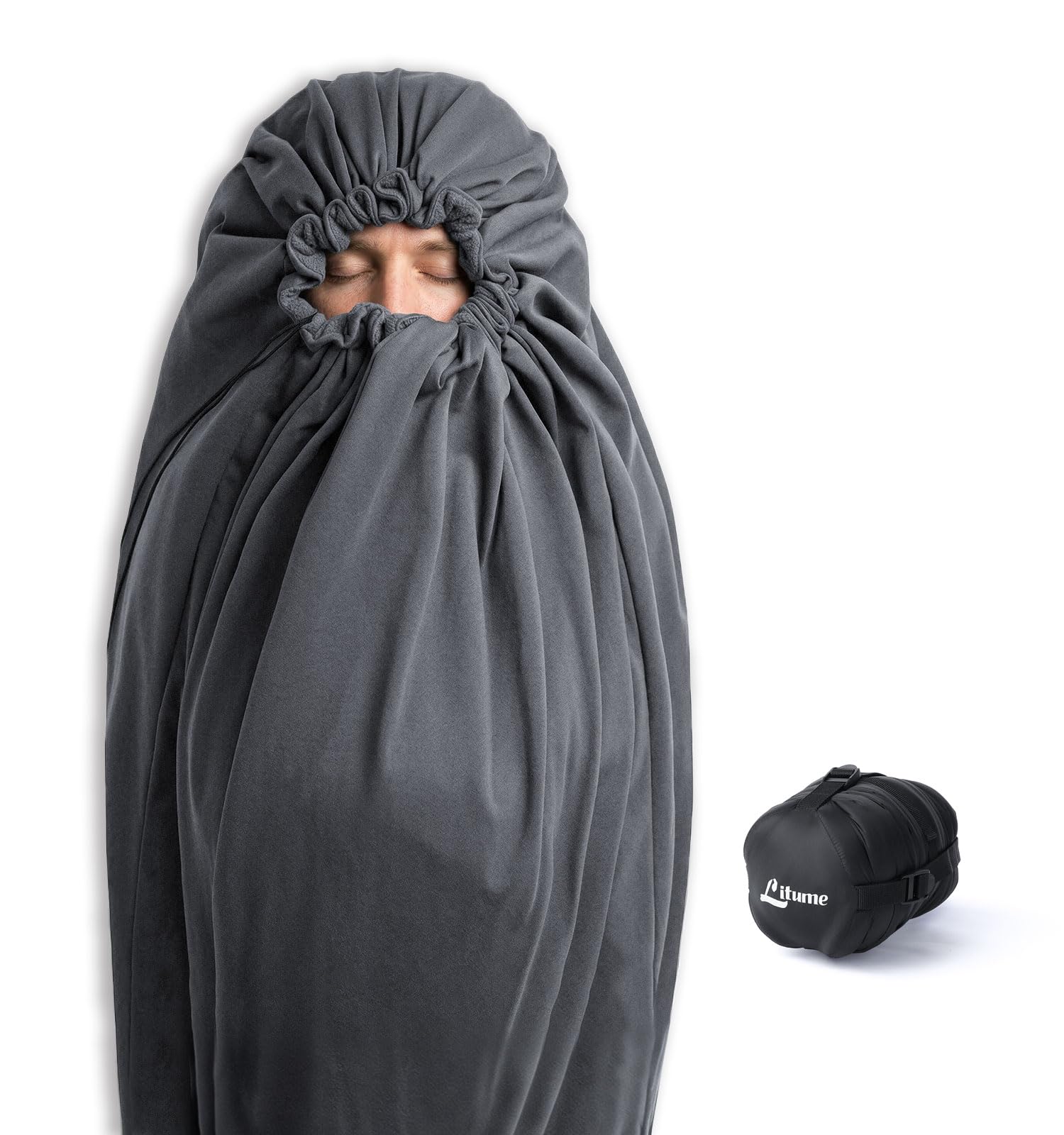
Twenty-seven degrees Fahrenheit is the headline: Litume says this fleece mummy liner can add up to 27°F / 15°C of warmth on top of your existing sleeping bag. For you, that is a summer-weight bag that suddenly holds through a frosty morning instead of leaving you curled up and shivering at 3 a.m. The drawstring hood seals around your head and the foot box gives your toes their own space, so heat stays trapped where it escapes fastest.
The thick fleece is what wins people over — it feels soft against your skin. It rolls down into its included stuff sack at 4.7 x 10.6 in, then compresses to 4.7 x 7.5 in at 1.1 lb (510 g). That is small enough to live in a backpack, a carry-on, or the trunk of your car without you noticing it is there. It is machine washable too, so keeping your main bag clean between trips stops being a chore.
The honest catch: it is a no-zipper mummy design, so you slide in through the top rather than unzipping the side. If you like to throw your legs wide or get up several times a night, a full-zip liner is easier to live with. It is the crowd favorite by a wide gap — 4.5+ stars across 600+ ratings — and its 27°F warmth figure ties the Sea to Summit for the highest in this group.
Where this liner earns its keep
- Up to 27°F / 15°C of extra warmth — the highest claimed figure here.
- Packs to 4.7 x 7.5 in and 1.1 lb (510 g), so it hides in a daypack.
- Drawstring hood and foot box concentrate heat where you lose it.
- Machine washable fleece keeps your sleeping bag cleaner for longer.
What you’ll want to know first
- No zipper — entry is over the top, which is slower for restless sleepers.
- Fleece holds warmth beautifully but is not the lightest fabric for serious backpacking.
- Mummy taper suits a mummy bag better than a wide rectangular one.
Reach for this if: you sleep cold, want the biggest warmth boost in a bag you already own, and value a soft fleece feel over a side zipper.
Look elsewhere if: you need to unzip and step out easily — the Litume Velvet’s half zipper below solves that.
2. Teton Sleeping Bag Liner
The widest liner here, built to line a double bag and save you a hand-wash.
This one is a different animal from the mummy liners at 91″L x 91″W — the comparison figures put it a stretch wider than the Arctic Lemmings after both widths are measured, because it is cut to fit TETON’s double sleeping bags. If you and a partner share a double bag, this fabric layer adds a claimed 10 degrees of warmth. It also spares you from hand-washing the bag itself to protect its zippers and warranty.
Material is where this one shines — the soft brushed poly-flannel earns the most praise in owner feedback, and the flannel feel translates into a cozy night rather than a clammy one. It doubles as a guest sheet or a travel blanket on drafty airplane seats. It also weighs a full 16 ounces — fine for car camping, too heavy for a weight-conscious backpacker.
Getting in and out divides opinion sharply: the split sides help, but plenty of owners find the liner awkward to enter and the sizing tricky against their bag. Go in knowing this is a bed you settle into for the night, not one you pop out of on a whim.
Best use case: couples in a double bag or anyone who wants a washable flannel layer at home and at camp.
Trade-off to weigh: the 91″ square cut and 16 oz weight make it a basecamp item, not a pack item, and the entry takes some getting used to.
Fits best: a double sleeping bag that needs a clean, warmer inner layer for the season.
Think twice: if you are hiking in with limited weight — the mummy picks above and below are far more packable.
3. Arctic Lemmings Fleece Sleeping Bag Liner
An entry-level fleece layer that zips flat and works just as hard at home as in a tent.
Arctic Lemmings builds this from a 250g/m² fleece cushion — the denser weave is the reason it feels warmer than a thin travel sheet. It runs 75″L x 32″W, long enough for the manufacturer to recommend it up to 75 inches of height, with a full-length zipper so you can open it right up. Warmth is the quality owners single out most, and the fleece-like-a-jacket feel is the recurring comparison.
Where it earns extra credit is versatility: zipped shut it is a liner, opened flat it is a camping or travel blanket you can drape over a hostel bed or a couch. At 0.81 kg it is not a featherweight, but it rolls into a tote for a trip without much fuss. It washes by machine and hangs to dry.
One caveat to set expectations: the warmth claim carries no degree figure, unlike the Litume and Sea to Summit liners that publish exact numbers. Treat this as a mild-weather comfort boost rather than a deep-winter rescue layer, and size your bag expectations accordingly.
Pick this when: you want a fleece liner and blanket in one at the entry-level end of the market.
Pass if: you need a published degree rating to plan for genuinely cold nights.
4. REDCAMP Fleece Sleeping Bag Liner

Two of these liners zip together into one double — a clever trick the single mummy sacks cannot match.
REDCAMP cuts this liner at 75″L x 31″, but the real hook is the pairing design: two liners zip together into a double-sized liner for couples sharing a bag. The polar fleece is thicker and breathable, washable, and soft enough that camping owners put comfort right up alongside warmth in what they value. Quality and warmth share the top spot in owner feedback, a rare tie that speaks to a liner that feels built rather than thrown together.
Beyond the tent, it works as a plain blanket — throw it in the car for a park picnic, a backyard movie night, or a drafty cabin bunk. The package rolls down to roughly 12.6 x 6.7 in at 1.76 lb / 0.8 kg, so it stows easily for a weekend trip. A 365-day limited manufacturer warranty backs it, which is more coverage than most liners here advertise.
The recurring gripe is the zipper — it holds up for most, but a share of buyers report it giving out after limited use. Treat the zip gently, open it slowly, and it should serve you well. The other honest note: at 1.76 lb it is a car-camping weight, not a fast-and-light one.
Why buy it: the two-liner double configuration and the polar fleece comfort make it a smart pick for couples who share a sleeping setup.
Watch the weakness: zipper durability is the one thing to baby — zip it slowly and avoid yanking at the pull.
Ideal for: partners who want a shared, washable fleece layer without buying a second sleeping bag.
Not for: solo backpackers counting grams — the polar fleece weight adds up fast.
5. Litume Velvet Sleeping Bag Liner

A velvet mummy liner with a real zipper, so getting in stops being a fight.
For anyone who has ever squirmed into a zipperless mummy sack in the dark, the YKK half zipper here is the feature that matters. Litume builds it from a velvet velour fabric that adds up to 14°F / 8°C of warmth, and the drawstring hood plus cord lock wrap your head and shoulders so the heat has nowhere to go. It is cut mummy-style at 85″L x 32″W and weighs 397 g, with a 70D nylon stuff sack and strap included.
Two details stand out beyond the zipper. The fabric is made without intentionally added PFAS/PFC — the forever chemicals — which matters if you sleep against it night after night. And it dries quickly, so a hostel stay or a damp morning does not leave you with a soggy liner for the next night. Portability and quality both land firmly in the positive column in owner feedback.
Here is the fair warning: some owners find it pretty thin, and it does not carry the big 20-plus-degree claims of the Litume Thermolite or the Sea to Summit. For summer nights when a full bag is too hot, though, it is exactly right.
Best match: restless sleepers and hostel travelers who want velvet warmth and a zipper they can open fast.
Skip if: you need a deep-winter warmth boost — the thin velour tops out around 14°F / 8°C.
6. Litume Cold Weather Thermolite Sleeping Bag Liner
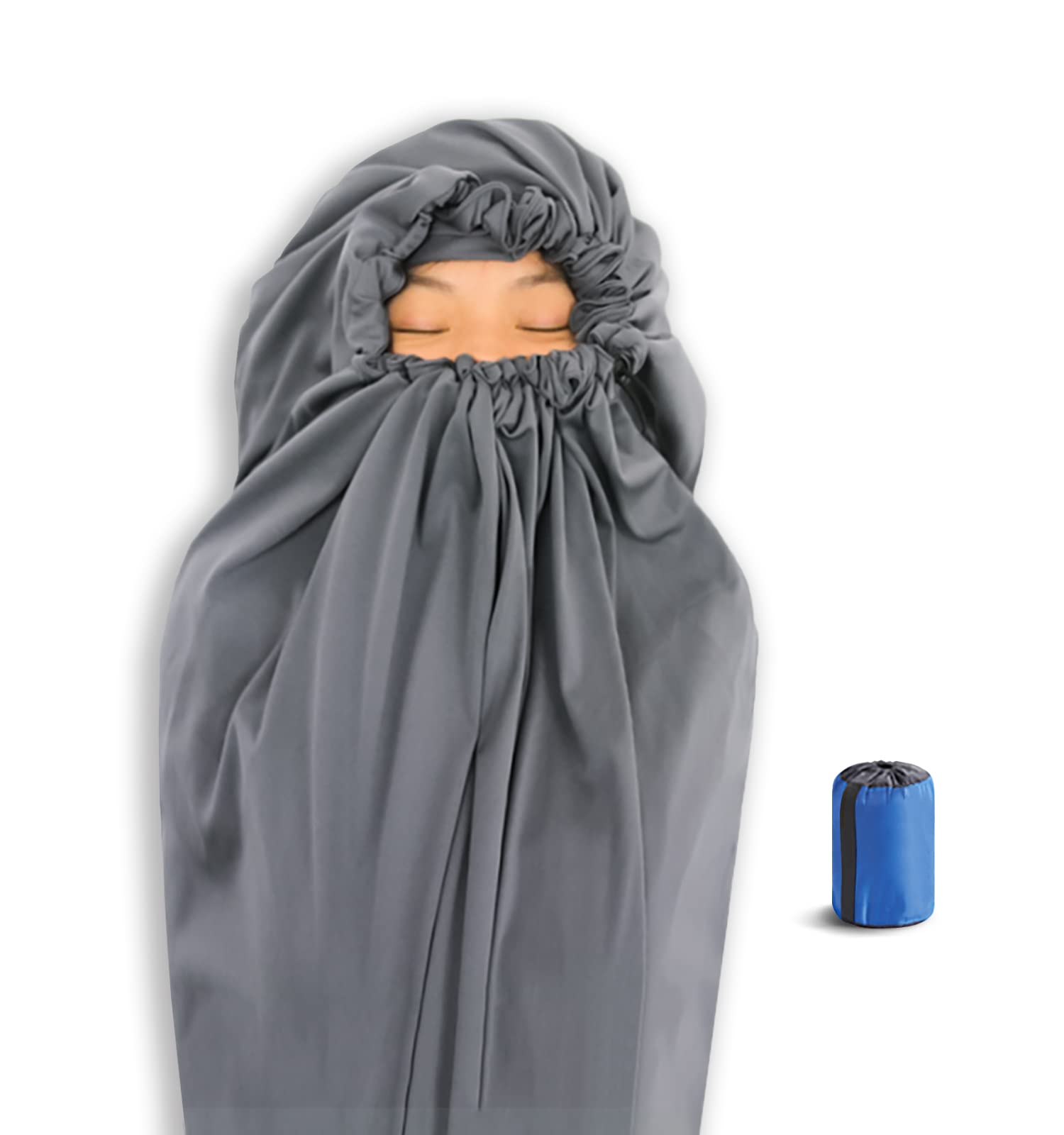
Thermolite insulation that reads like a heavier build but slings into a pack at 490 g.
Litume’s Thermolite pick adds up to 22°F / 12°C of warmth — just under the 27°F of the fleece Best Overall, but in a fabric family that packs down flatter. Thermolite (a hollow-core synthetic insulation that traps air in tiny tubes) is engineered to be light for its warmth, and that is where those 490 g go a long way. Warmth is what owners value above all here, with quality a close second, and it is the sort of liner that holds heat steadily through the night rather than in bursts.
Two things make it a backpacker’s friend. The zipperless design means nothing catches against you as you roll over — no snag, no pressure point. The 70D nylon shell gives it durability and let it compress with a little squeeze. Because it is a mummy shape at 85″L x 32″W with a drawstring hood, it slides in cleanly under a mummy bag’s own shell.
The recurring caveat is fit: some owners find it snug across the shoulders, and the size does not leave much room for broad frames or a bag layered over thick winter clothing. If you are a wide sleeper, check the 32″ width against your own bag before committing. For everyone else, it is a warm, light layer that earns its place on a winter backpacking trip.
Standout strength: 22°F / 12°C of warmth at 490 g, in a zipperless mummy that never snags.
Honest limitation: the 32″ width runs snug on broad shoulders, and the mummy taper leaves little room for a bag plus heavy layers.
Go for it if: you hike with a pack and want real cold-weather warmth in a light, snag-free layer.
Consider twice: if you are broad-shouldered or want to layer this inside a bulky bag.
7. Snugpak Thermalon Sleeping Bag Liner

A knitted liner that gently hugs your body, keeping your own heat from escaping.
Snugpak’s Thermalon liner takes a different approach to warmth: the knitted polyester construction gives it a stretchy quality that gently hugs your body, so there is less dead air to heat. Softness and stretchiness both come up as genuine loves in owner feedback — the fabric feels like a regular blanket against the skin rather than a slithery sheet. A water-wicking system moves moisture away from your body, so you stay dry and warm instead of chilled by your own sweat.
The measurements are where this one splits the field. At 65″L x 22″W it is the shortest and narrowest liner in this group — the fleece picks run 85″L x 32″W and the Teton is wider still. That close fit is the point: it eliminates air space and warms up fast. Tie-in loops near the feet keep it from twisting inside a Snugpak bag, and the compression sack packs it to 8 by 5 inches.
The price of that skin-tight hug is room, and that cuts both ways. If you are tall or like to sprawl, this will feel restrictive — check the 65-inch length against your own height before you buy. If you run cold and hate cold pockets of air, the snug, stretchy fit is exactly what warms you fastest. Keep it for shorter sleepers who want maximum body contact.
What makes it cozy
- Stretch-knit hugs your body so there is less cold air to warm.
- Water-wicking fabric keeps you dry instead of damp-and-chilled.
- Tie-in loops stop it twisting inside the bag at the feet.
- Compression sack packs it down small for travel.
The fit trade-off
- At 65″L x 22″W it is the most compact cut here — restrictive for taller or sprawling sleepers.
- Weight draws mixed opinions, with some finding it heavy for the size.
- No published degree figure, so warmth planning is by feel.
Made for: shorter sleepers who love a stretchy, skin-hugging layer and hate cold pockets of air.
Reconsider if: you are tall or wide — the 65-inch length and 22-inch width will feel tight.
8. Snugpak Fleece Sleeping Bag Liner with Side Zip

The long, full-zip fleece liner built to give a tall sleeper an extra season of comfortable bag use.
At 94″L x 30″W, this is the longest liner here — longer than the 85″ Litume mummy picks and longer even than the 91″ Teton. If you are tall, that extra length keeps your toes out of the cold spot at the end of the bag. The full-length side zipper is the other luxury: it opens wide for easy entry and lets you vent when you have warmed up too far. Snugpak says it adds another season of use to your bag’s comfortable range, which is the practical version of “warmth” for a three-season camper.
The fabric is knitted polyester fleece that is brushed and sheared to a plush finish — as owners tell it, it holds warmth all night and is worth the outlay. An adjustable hood with a draw cord lets you cinch it down against drafts, and tie-in loops near the feet stop it from twisting inside a Snugpak bag. It comes with a compression stuff sack, though at 2 pounds it is not a liner you will carry up a mountain lightly.
The honest note is weight: 2 pounds packed is the heaviest here, and the length and density are why. This is a car-camping and cabin liner, or a basecamp layer for a tall sleeper’s rectangular bag. Backpackers should look at the lighter Litume Thermolite above instead.
Where it wins: the 94-inch length and full side zip make it the best fit for tall sleepers who want easy entry and a plush fleece feel.
Where it costs you: at 2 pounds it is the heaviest liner here — fine for the car, a chore on your back.
Right for: tall campers and car-campers who want a long, full-zip fleece liner that adds a season to their bag.
Wrong for: hikers counting weight — 2 pounds is a lot of liner to carry.
9. Sea to Summit Reactor Insulated Sleeping Bag Liner

Heavier Thermolite throughout and a 25°F claim, in an extra-long mummy built for tall sleepers.
Sea to Summit stuffs the Reactor Extreme with a heavier weight of Thermolite throughout and rates it at up to 25°F of added warmth — just under the 27°F fleece Best Overall and above the 22°F Litume Thermolite. For a backpacker, that is the most warmth per packed inch here: it rolls into its stuff sack at 7 x 5 inches and 14.9 oz. The hollow-core Thermolite insulation is soft and stretch-knit, so it moves with you rather than fighting you.
This is the tall sleeper’s liner of choice. At 92″L x 35″W it has a roomy cut, and it is mummy-shaped with a toe box and a draw cord hood so your extremities stay covered. Sea to Summit rates it for sleepers up to 7.75 feet, so even very tall campers get full coverage from hood to toe. It works as both a warmth layer and a hygiene barrier that keeps your main bag cleaner between washes.
The fair trade-off: premium Thermolite and the extra-long cut put this at the top of the price ladder, so it is the liner you buy once and keep for years rather than a budget dabble. It is also sold in one extreme-long size, so shorter sleepers get more liner than they strictly need.
The one for you if: you are tall, backpack, and want a stretch-knit mummy that packs 25°F of warmth into 14.9 oz.
Skip if: you are short and want a snug fit — the extreme-long 92″ x 35″ cut is sized for tall frames.
Know the Specs
Claimed warmth added (degrees)
Liner makers advertise how many degrees the liner can add inside your bag — for example “up to 27°F / 15°C” or “adds 10 degrees.” That number is your fastest filter: a bigger boost stretches a summer bag into shoulder-season use, while a smaller one is a mild comfort layer. Treat it as a claim from the maker, not a guarantee, and match it to the coldest night you actually camp in.
Dimensions and shape
Length and width decide whether your legs can move and whether heat has room to leak out. Mummy liners taper toward a foot box and pair with hooded bags, warming faster; rectangular liners give more space but leave more air to heat. Check both figures against your own bag — a liner shorter than your bag leaves a cold gap at the toes.
Fabric: fleece versus Thermolite
Fleece feels soft right away, holds warmth well, and is machine washable — the cozy choice for car camping. Thermolite (a hollow-core synthetic insulation that traps air in tiny tubes) is lighter for the same warmth and packs smaller, making it the backpacker’s pick. Both act as a hygiene barrier that keeps your main bag cleaner between washes.
Closure and hood
A zipperless mummy slides in over the top, which is lighter and snag-free but slower to enter. A side or half zipper lets you step in and vent when you warm up. A drawstring hood and cord lock seal the heat around your head and shoulders, where it escapes fastest — a small detail with an outsized effect on a cold night.
Common Questions
Does a sleeping bag liner actually make my bag warmer?
Will a liner fit inside my existing mummy sleeping bag?
Is a fleece liner warmer than a Thermolite liner?
Can I use a liner on its own without a sleeping bag?
How do I wash a sleeping bag liner?
What size liner do I need for my height?
Should I get a zippered or zipperless liner?
Can two liners be zipped together for a couple?
How small does a warm liner pack down?
Is a liner better than buying a warmer sleeping bag?
The Bottom Line
For most campers, the warmest liner worth buying is the Litume Fleece Mummy Sleeping Bag Liner — its up-to-27°F / 15°C claim is the biggest in the group, it packs to 4.7 x 7.5 in at 1.1 lb, and it carries the strongest owner confidence of any liner here. If you prefer lighter Thermolite warmth for backpacking, the Litume Cold Weather Thermolite Liner delivers up to 22°F / 12°C at 490 g. And if you are tall and want a 25°F boost in an extra-long mummy, reach for the Sea to Summit Reactor Extreme at 92″L x 35″W.
How we choose
We do not accept paid placement. Every pick is matched to a real buyer and a real use-case; we do not hands-on test units.
Sources
Specifications: manufacturer listings and product documentation. Review insights: verified customer reviews, as of November 2026. Pricing: not shown on this page (it changes often); check the current price via the retailer link.
As an Amazon Associate, Tactical Gear Guy earns from qualifying purchases. This does not affect which products we feature.