Specs are compiled from manufacturer listings and verified buyer reviews and can change over time — please confirm the key details on the product page before buying.
You can own every fillet gauge on this page and still scrap a joint — because the number stamped on the leaf tells you the leg size, and it tells you nothing about the throat. The gauge that earns its keep is the one whose leaf seats flush against both the plate and the weld face, so the leg you read is the leg you actually laid down. Below are seven fillet gauges, from a single hardened leaf to a six-piece inspection kit, sorted by what each one genuinely measures well.
This guide is built by comparing the manufacturers’ published specifications and the patterns across verified customer reviews, so you get each pick’s real strengths and trade-offs instead of marketing spin.
Some sets measure one dimension and some measure six, so the right pick depends on whether you are laying fillet beads or signing off on them. Here is how to tell which one belongs in your pocket when you are shopping for the best weld fillet gauge.
Top Picks


How To Choose The Best Weld Fillet Gauge
The mistake most first-time buyers make is treating a fillet gauge as a single-measurement tool. It is really two jobs in a small stainless body — measuring the leg of the triangle and measuring the throat that runs through the middle — and not every set on this page does both comfortably.
Leg Size Versus Throat Size
The leg is the short side of the weld where it meets the plate, and the leaves on a standard seven-piece set are cut to check it directly. The throat is the shortest distance from the corner of the joint to the weld face, so a gauge that only reads legs leaves you guessing on the number an inspector actually signs off on. A two-sided leaf — markings available on both sides — lets you flip the same piece to check both.
How Fine The Steps Need To Be
Most sets step through standard imperial sizes from 1/8 inch up to 1 inch, with metric equivalents engraved beside them. If you weld thin tube and sheet, the increments matter more than the top end: a set that runs in 1/32-inch increments gives you a finer check than one that jumps straight from 1/4 inch to 5/16 inch.
Stainless Steel And How It Reads
Every set here is stainless steel, and that is the right call — the tool lives in a pocket next to grinding dust and spatter, and plain steel markings turn into rust smudges fast. Look for etched or laser-cut numerals rather than printed ones, because a printed scale wears off right where your thumb sits.
Pocket Carry Or Bench Kit
A single leaf and a pouch disappears into a shirt pocket and gets used on every weld. A six-piece inspection kit needs a bench or a toolbox drawer, and if you are climbing into a tank or under a trailer, the smaller the kit the more likely it is to come out with you.
Side-by-Side Comparison
| Model | Best For | Pieces | Range Covered | Weight | Amazon |
|---|---|---|---|---|---|
| Ally Tools 7 Piece Fillet Welding Inspection Gauge Set★ Best Overall | Everyday welding, pocket carry | 7 | 1/8″ – 1″ (3.2 – 25.4mm) | 5.9 ounces | Amazon |
| Weld Gauge Set Stainless Steel Cam Type + Fillet GaugeBest for Fabrication | Fabrication with angle checks | 2 | Cam 0-60mm; Fillet 3.2 – 25.4mm | 9.9 ounces | Amazon |
| RIVERWELD 12 Piece Fillet Weld Set | Fine-step measuring on small welds | 12 | 1/32″ increments to 1/2″; 1/16″ to 1″ | 7.4 ounces | Amazon |
| Hicarer 3 Piece Welding Gauge Set | Mixed checks in one kit | 3 | Fillet 1/8″ – 1″; Cam 0-60mm | 11.3 ounces | Amazon |
| Weld Gauge Set 6 Piece (Cam, Fillet, Hi-Lo, Taper, Undercut, Convexity) | Full inspection coverage | 6 | Fillet 3.2 – 25.4mm; Taper 1-15mm | 1.34 pounds | Amazon |
| Fillet Weld Gage Set (7 pc.) GAL-8a | Bare-bones leg and throat checks | 7 | Fillet leg and throat sizes | 4.2 ounces | Amazon |
Detailed Reviews
1. Ally Tools 7 Piece Fillet Welding Inspection Gauge Set
Our pick — 4.5+★ from 350+ verified ratings; the strongest balance of quality and price.
Seven stainless leaves, one leather pocket case, and both scales etched on every piece.
The full range fits in your shirt pocket: seven leaves covering imperial 1/8″ to 1″ and metric 3.2mm to 25.4mm, so you can check a fillet in whichever scale the drawing calls out. Each leaf is stainless steel, which means the markings survive a pocket full of grinding dust instead of rusting into a brown smear. And the numerals are permanently etched rather than printed, so the 1/4″ stamp still reads after a year of thumbs sliding over it.
This is also the lightest full set here. At 5.9 ounces it weighs roughly half what the Hicarer three-piece kit carries — 11.3 ounces — and you will notice that difference the moment it rides in a chest pocket all shift instead of pulling at a belt loop. The included leather case is a real carry case, not a plastic sleeve, and it fits the leaves without them rattling together.
What keeps this at the top is that buyers keep coming back to the same word in reviews: quality. The stainless build is what wins people over, and the value holds up against sets that ask noticeably more for the same fillet coverage. One honest limit — the leaves are flat cut, so if you need angle measurement or undercut depth, this set will not give it to you. It measures fillet leg and throat, and it does that one job cleanly. Check the current listing here.
What earns it first place
- Both scales on one set — imperial 1/8″ to 1″ and metric 3.2mm to 25.4mm, so no conversion guesswork at the bench.
- Permanently etched numerals that hold up to constant handling.
- 5.9 ounces with a leather pocket case — the lightest full set on this list.
- Stainless steel that resists bending when a leaf gets dropped on concrete.
Where it stops short
- Fillet leaves only — no cam-type angle scale and no undercut or convexity check.
- Sizes step through the standard imperial set, so very fine gradations on tiny welds are not there.
Take this one if: you weld fillets daily and want one pocket-sized set that reads both metric and inch without swapping tools.
Keep looking if: your inspection sheet needs angle, undercut or convexity readings — you will need a multi-piece kit instead.
2. Weld Gauge Set Stainless Steel
Two gauges, one bag, and an angle scale most fillet sets simply do not carry.
Most fillet gauges stop at the leg and throat. This pair goes further, because the cam-type gauge adds a linear range of 0-60mm (0-2 in), a curving range of 0-20mm (0-1 in) and an angle range of 0-60 degrees. That angle scale is what makes it worth a second look for anyone building frames rather than running production beads.
The fillet gauge beside it covers metric 3mm through 25mm and imperial 1/8″ through 1″, with stated accuracy better than +/- 0.5mm metric and +/- 1/50″ imperial. In plain terms, the leaf sits close enough that you can trust it on a joint that has to pass a visual inspection without a rework ticket. Both gauges are stainless steel, built thick enough that a drop on the shop floor will not fold the leaf over.
The catch is a sensible one: the cam gauge has sharp edges, and the listing says so directly — be careful when you handle it. That is a handling note, not a defect, but it is worth knowing before you shove it into a pocket with bare fingers. If your work is purely fillet welds and you never touch an angle, the Ally Tools set above covers the same range for less fuss. If you do measure preparation angles, this is the pair that carries the extra scale.
The angle advantage: a 0-60 degree scale on the cam gauge turns this from a fillet checker into a general fabrication tool.
Carry note: 9.9 ounces with two pouches and two instruction sheets — more to keep track of than a single leaf set, and the sharp cam edge wants respect.
Worth it for: fabricators who check fillet size and joint angle on the same job and want both in one bag.
Pass if: you only ever run fillet beads — the angle scale will sit unused.
3. RIVERWELD 12 Piece Fillet Weld Set

Twelve leaves stepping in 1/32-inch increments, for welds too small to eyeball.
Where the Ally Tools set steps through the standard imperial leaves, this one splits them finer — 1/32″ increments up to 1/2″, then 1/16″ up to 1″. On thin sheet and small tube, that extra resolution is the whole point. A joint that should finish at 3/16″ can be checked at 5/32″ or 7/32″ rather than guessed at between two leaves.
The leaves are stainless steel with markings on both sides, so you can flip a piece to read the other face instead of hunting for the right orientation under a hood. Stated measurement accuracy is +/-0.5%, and the set covers fillet weld leg, throat and theoretical throat — the three numbers an inspection sheet tends to ask for. It ships as a 12-piece kit in a compact package, and at 7.4 ounces it tucks away easily.
The trade-off is the opposite of the Ally Tools set: this one goes deep on fillet measurement and has nothing for angle, undercut or convexity. For anyone welding thin material where 1/16-inch gaps between leaves are too coarse, that spec sheet is persuasive on its own.
Resolution where it counts: 1/32″ steps turn a guess into a reading on small fillets.
What you give up: no cam gauge, no undercut check — this is a pure fillet measuring set.
Reach for this if: your work runs small and you need to know a weld is 3/16″ rather than somewhere between two sizes.
Not your tool if: you also need angle or profile checks on the same pass.
4. Hicarer 3 Piece Welding Gauge Set

A single fillet leaf, a seven-piece RI set, and a bridge cam gauge in one kit.
Three tools in one package covers three different jobs. The single fillet weld gauge handles quick undercut, tire height, porosity and dimple checks on its own. The seven-piece RI set reads fillet leg and throat from 1/8″ to 1″ imperial and 3.2mm to 25.4mm metric. And the bridge cam gauge adds preparation angles, fillet weld lengths, rebar depths, undercuts and pitting, with screws you tighten to lock a reading in place.
That locking screw is a small detail that matters on a ladder. Instead of holding a gauge steady against a joint and trying to read a scale at the same time, you fix the position, pull the tool away and read it comfortably. The whole kit is stainless steel with a brushed surface, built with a thickened profile and high hardness so it resists rust, deformation and breakage.
The laser inscriptions on the single gauge are clear, but they are a different marking style from the engraved RI leaves, so the kit is not uniform across all three pieces. Neither issue undercuts what it does; it just suits a bench better than a pocket.
Out on the job
- Three distinct tools: single fillet gauge, 7-piece RI set, and bridge cam gauge.
- Tightening screws let you lock a reading before pulling the tool away from the joint.
- Stainless with a brushed finish and thickened profile for shop-floor durability.
- Fillet coverage from 1/8″ to 1″ in both inch and metric.
Weigh these first
- 11.3 ounces — the bulkiest three-tool kit here and not a pocket carry.
- Marking styles differ between the single gauge and the RI leaves.
Best used by: the welder who wants fillet size, undercut and angle covered without buying three separate tools.
Think twice if: you want everything in a chest pocket — this one wants a toolbox drawer.
5. Weld Gauge Set 6 Piece
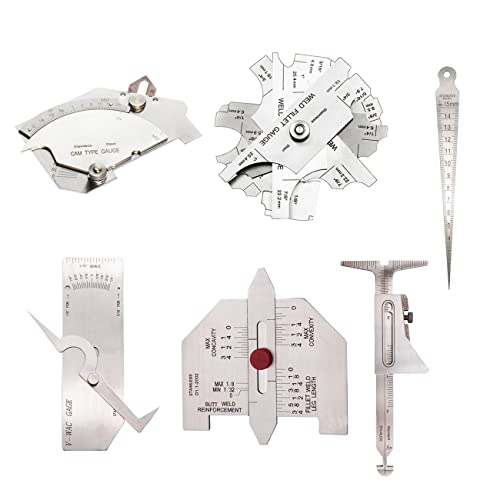
Six stainless gauges that between them answer nearly every question a weld inspector asks.
This is the four-piece kit above with two more tools bolted on, and those two are the ones you miss when they are gone. The Hi-Lo gauge measures internal misalignment, gap, bevel, crown height, fillet weld size, scribe line and socket welds. The taper gauge runs 1-15mm (1/32-5/8 inch) with stated accuracy of 0.1mm (1/64 inch), which makes it the tool for small holes, slots and gaps that no leaf gauge will reach.
Everything else carries over: the cam gauge at 0-60mm linear, 0-20mm curving and 0-60 degrees; the fillet gauge from 3mm to 25mm and 1/8″ to 1″ at better than +/- 0.5mm and +/- 1/50″; the undercut checker at 0-1/4″; and the convexity concavity gauge at 0-3/4″. All stainless steel, all with fastening screws where a fixed reading helps.
Here is where the size becomes real. This kit weighs 1.34 pounds against the 1-pound four-piece version — a third more weight for two more gauges, and the package measures 13.07 x 7.87 x 1.89 inches. That is a proper bench kit, not something you slip into a pocket. If you crawl into confined spaces, you will feel every ounce of it.
Complete coverage: six gauges span fillet size, angle, misalignment, gaps, undercut and profile — the widest set of checks on this list.
Bench-bound bulk: 1.34 pounds and a large package means it belongs in a toolbox, not a pocket.
Built for: inspection work where any single fillet, gap or profile question might come up and you want the tool already in the box.
Look elsewhere if: you work off a ladder or inside tanks — the carry bulk will wear on you.
6. Fillet Weld Gage Set (7 pc.) GAL-8a

Seven leaves at 4.2 ounces — the lightest fillet set here by a wide margin.
Nothing on this page weighs less. At 4.2 ounces this seven-piece set disappears into a pocket, and the leaves carry markings on both sides so you can check leg size on one face and throat size on the other without flipping through the stack. It is stainless steel and it ships in a small package, so it survives the ride in a tool bag without needing its own padded slot.
The build is deliberately plain. This is a fillet leg and throat checker, full stop — no cam gauge, no undercut scale, no convexity reader. For anyone whose work is purely fillet welds, that is not a shortcoming so much as a lack of clutter. There is nothing on it that is not measuring a fillet.
Where it differs from the Ally Tools set at the top is breadth of scale and the carry case — the Ally Tools brings metric and inch together with a leather pouch, while this one sticks to English/Standard markings. If your drawings are all in inches and you want the smallest possible tool on your person, this is the one. If your work crosses into metric, look upward on this list instead.
The case for the lightest set
- 4.2 ounces — the smallest carry on this entire list.
- Both-side markings let you read leg and throat on one leaf.
- Stainless steel against rust and bending.
Not built to do
- English/Standard measurement system only — no metric equivalents on the tool.
- No cam, undercut or profile checks at all.
Pick this one when: inch-only fillet checks are all you need and you want the least weight in your pocket.
Move up the list if: your drawings call out millimeters — this one does not carry them.
Know the Specs
Fillet Leaf Range And Steps
The leaf range is the span of fillet leg sizes the set can check, and the step size is how far apart those checks sit. A set covering 1/8″ to 1″ gives you the common shop sizes, while one running in 1/32″ increments lets you call a small weld more precisely. Coarse steps on thin material often leave you guessing between two leaves.
Leg Versus Throat Measurement
Leg size is the short side of the weld triangle where it meets the plate. Throat size is the shortest distance through the weld to the joint root. Sets that mark both sides of the leaf let you check each dimension with the same piece, which is why both-side markings show up on the more useful sets here.
Cam Gauge Ranges And Accuracy
A cam-type gauge is a sliding, rotating gauge that reads distance and angle rather than a fixed leaf size. On the sets here it typically covers 0-60mm linear, 0-20mm curving and 0-60 degrees of angle. Fillet accuracy on these kits is commonly stated as better than +/- 0.5mm metric and +/- 1/50″ imperial.
Undercut, Hi-Lo And Taper Gauges
These are the specialty add-ons. An undercut checker measures how deeply the weld edge has eaten into the plate, often across 0-1/4″ on a 1/16″ scale. A Hi-Lo gauge reads internal misalignment and gap. A taper gauge uses a narrowing blade to measure small holes and slots, commonly across 1-15mm.
Common Questions
Does a fillet gauge measure leg length or throat thickness?
What is the difference between a 7 piece fillet gauge and a 12 piece set?
Will these gauges read both metric and imperial weld sizes?
Can I check an angle with a fillet weld gauge?
How do I check undercut depth with these gauges?
Will stainless steel weld gauges rust in a damp shop?
What does a Hi-Lo gauge measure on a weld?
How accurate are these fillet gauges?
Is a six-piece weld gauge kit worth it over a single fillet set?
Can these gauges be used on pipe as well as flat plate?
The Bottom Line
For most people shopping for the best weld fillet gauge, the answer is the Ally Tools 7 Piece Set — it carries both metric and inch scales on etched stainless leaves, weighs 5.9 ounces, and comes in a leather pocket case, so it is the one that actually travels with you. If your work runs small and you need finer resolution, the RIVERWELD 12 Piece Set steps in 1/32-inch increments where the standard leaves are too coarse. And if you sign off on joints rather than lay them, the six-piece Necygoo kit covers angle, misalignment, undercut and profile in one box — just accept the 1.34-pound carry that comes with it.
How we choose
We do not accept paid placement. Every pick is matched to a real buyer and a real use-case; we do not hands-on test units.
Sources
Specifications: manufacturer listings and product documentation. Review insights: verified customer reviews, as of November 2026. Pricing: not shown on this page (it changes often); check the current price via the retailer link.
As an Amazon Associate, Tactical Gear Guy earns from qualifying purchases. This does not affect which products we feature.