Specs are compiled from manufacturer listings and verified buyer reviews and can change over time — please confirm the key details on the product page before buying.
You mount a wind speed and direction indicator on the roof, and after a season of rain, ice and sun you need it to still report the truth. A well-placed outdoor sensor gives you trustworthy wind speed and direction for sailing, spraying, drone flights or reading which way your bonfire smoke will drift. Get the sensor placement wrong and the console fills with readings you quietly stop trusting. This guide separates the nine strongest options by how each one actually behaves in a backyard.
This guide is built by comparing the manufacturers’ published specifications and the patterns across verified customer reviews, so you get each pick’s real strengths and trade-offs instead of marketing spin.
Some run a wind vane and cups; some run a solar sensor with no moving parts at all. The two specs that decide most installs are wireless range and sensor design. Here is what to weigh before buying a wind speed and direction indicator that keeps earning its spot on your fence.
Top Picks


How To Choose The Best Wind Speed and Direction Indicator
Your first decision is sensor style, because that choice drives everything else. A traditional vane-and-cups wind sensor (a spinning cup set plus a pivoting tail) has moving parts that spin and pivot, so it needs a clear, open spot with nothing blocking the wind. A solid-state or multi-sensor unit (no moving parts, or several sensors in one housing) packs wind, rain and sun into one housing, which means fewer cables but a single point of failure if something inside goes wrong. Neither sensor style wins outright — the right one depends on where you can mount it and if you want a wall console or a phone app.
Range beats almost every other spec
Wireless range is the spec that quietly ruins more installs than any other. If your sensor sits at the far end of an orchard or on the back fence, the console must receive that signal through walls and weather. Look for the open-air range in feet and remember it shrinks when obstacles sit between sensor and display. A 300 ft sensor is fine for a suburban backyard; a long property or a metal-sided barn may need the reach of a unit rated far higher.
Which wind readings you actually need
A direction readout in plain compass letters is enough for most people — you want to know the wind is coming from the northwest. Serious users want the degree value too, so they can log the exact bearing. Current speed and a “top gust” reading matter for sailing, spraying and roofing work, because the sudden gust is the number that decides whether you climb the ladder. History and trend arrows are a bonus, not a necessity.
Rain, sun and temperature as tiebreakers
Most buyers end up choosing between units that measure wind equally well, so the extras decide it. A rain gauge with a stated error range tells you how honest the precipitation figure is. UV index and light intensity matter if you garden or work outside. A console with a large display suits a kitchen or workshop wall, while a phone app makes more sense if you travel and want to check conditions remotely. Choose the extras you will actually use — a rain gauge or UV sensor — rather than the longest feature list.
Side-by-Side Comparison
| Model | Best For | Wireless Range | Display | Sensor Type | Amazon |
|---|---|---|---|---|---|
| Raddy UV7 Professional 12-in-1★ Best Overall | All-round backyard station | Up to 300 ft | 5.12″ VA | 7-in-1 outdoor sensor | Amazon |
| Sainlogic SA68 12-in-1Big-Screen Pick | Large-print readout for a kitchen wall | — | 8″ LCD | Integrated outdoor sensor | Amazon |
| La Crosse S81120-INTCompass Classic | Compass bearing and degree readings | Up to 330 ft | LCD | Breeze wind sensor | Amazon |
| Urageuxy Wireless Weather Station (WS029TU) | Long yards and farm installs | Up to 492 ft | VA LCD | Wind vane + rain gauge | Amazon |
| Urageuxy WS0214 | Compact desktop and shelf placement | Up to 328 ft | LCD | Waterproof wind sensor | Amazon |
| La Crosse V23-WTH | Wi-Fi forecasting and remote checks | Up to 400 ft | Color LCD | Separate wind + temp sensors | Amazon |
| Raddy VP7 APP | App control and 5-day forecast | Up to 330 ft | LCD with 4-level backlight | 7-in-1 sensor, 433 MHz | Amazon |
| AcuRite Iris 5-in-1 (01540M) | Sharing data to Weather Underground | — | Color LCD | Built-in anemometer + vane | Amazon |
| Tempest Weather Station | No-moving-parts install, app only | Up to 1,000+ ft | No display | Solid-state, solar-powered | Amazon |
Detailed Reviews
1. Raddy UV7 Weather Station
Our pick — 4.5+★ from 50+ verified ratings; the strongest balance of quality and price.
A screen you can read from across the room, fed by one sensor that also watches the sun.
The Raddy UV7 does the wind job first and the lifestyle extras second, which is the right order. A single outdoor sensor reports wind speed and wind direction alongside temperature, humidity, rainfall, UV and light intensity. That data crosses up to 300 ft of open air to the console, so a backyard, a garden plot or a rooftop mount all sit comfortably within reach. You get the full picture without stringing cable through a wall.
The display is where this one pulls ahead of most of the field. It is a 5.12″ VA panel, the type that holds its contrast when you look at it from an angle rather than head-on, so a glance from the doorway still reads. Four brightness levels let you dial it down for a bedroom and up for a sunny kitchen, and automatic Night Mode keeps it from glowing like a lamp after dark. Paired with the atomic clock sync, the time is set for you and adjusts for Daylight Saving automatically.
The sun metrics are the differentiator here. Light intensity is measured up to 128 klux and UV Index runs from 0 to 15, with a 5-level exposure indicator alongside. If you grow tomatoes or spend the day on a roof, that is the number that tells you when to cover up. The catch is scope: the 1 included sensor plus 3 optional remotes (sold separately) means multi-zone coverage costs more, and the UV/light figures are only as useful as the spot you mount the sensor in. The crowd here is clearly happy — 4.5+ stars across 50+ owners — and the compact VA panel is the piece that wins them over.
What earns it the crown
- Wind speed and direction plus rain, UV and light from one integrated sensor
- 5.12″ VA display holds up from wide viewing angles
- UV Index 0–15 with a 5-level exposure readout
- Atomic clock sync with automatic Daylight Saving adjustment
Where it asks a little more
- Extra zones need optional remote sensors bought separately
- 300 ft range is modest next to the long-range pick on this list
Go for it if: you want wind readings and sun exposure on one clear screen with zero fuss.
Pass if: your sensor spot is far from the house — the wider-range Urageuxy covers more ground.
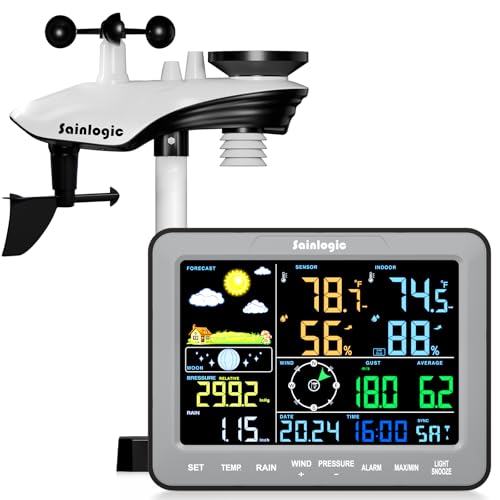
2. Sainlogic SA68 Weather Station
Built for eyes that want the numbers big and bold, not squinted at from six feet away.
You can read this unit’s 8″ display from a kitchen doorway without your glasses, thanks to heavy, high-contrast type. Three adjustable backlight levels keep it legible in a dark hallway or a bright sunroom. If your station lives on a wall where elderly parents or a farm crew glance at it in passing, that sheer size is the whole point, and it is why this model earns its spot here despite a weaker overall score than the leaders.
The rain gauge gets unusual attention for this tier. Light rain (≤15 mm) is rated to within ±1 mm, and heavier rain (15–9999 mm) to within ±7%, with a manual calibration function so you can fine-tune against your own local baseline. That is a genuinely useful spec for orchard and ranch work where rainfall totals drive real decisions. The wind sensor feeds speed and direction into the same console.
Honesty time: the outdoor temperature accuracy is the recurring gripe in owner feedback, and setup draws mixed reactions — some find it quick, others wrestle with it. Functionality sits in mixed territory too, so go in expecting to spend a little time dialing readings against a known reference. Treat those as a fit note: this is a big friendly screen with a serious rain gauge, best for a buyer who values legibility over turnkey accuracy. skip it if precise temperature tracking is your main need.
The value read: an 8″ high-contrast screen and a calibrated rain gauge at a mid-tier spot is a fair trade for the mixed reports on accuracy and setup.
Reach for this if: large print and rainfall totals top your list.
Look elsewhere if: you want a station you can trust for temperature right from the start.
3. La Crosse S81120-INT Weather Station
The wind specialist — it tells you the bearing, the degrees and which way the gust is trending.
This is the pick for someone who cares about wind direction more than anything else on the screen. A compass rose shows cardinal direction, and you also get the exact degrees plus a tend indicator that tells you if the wind is shifting. Current and top wind speed in mph or kmh sit alongside the history. Mount the wind sensor up to 330 ft from the console, and the outdoor temperature range runs from -40°F to 140°F (-40°C to 60°C), so a cold-climate install is covered.
The console adds indoor and outdoor temperature and humidity with HI/LO records and trend arrows, plus custom alerts for temperature, humidity and wind. You can set a wind threshold and let the station warn you before you climb a ladder. The adjustable backlight with auto dim keeps it readable at night without blazing. Four language settings and a full weekday calendar are the small niceties that make it feel finished.
Weigh the trade-offs before you commit. The display readability gets split reactions — some see it easily, some find it hard to view — so check the angle you plan to mount it at. Battery life draws more criticism than anything else here, and durability notes follow close behind. This unit uses a 5V adapter as its main power and relies on 2 AA batteries for backup, so plug it in and treat the batteries as insurance. As owners tend to put it, the build quality is the standout — this is a genuine wind instrument first.
The case for it: degrees-plus-compass direction and a wind tend indicator make this the most wind-focused console in the mid-range.
What to plan around: keep it on mains power and mount where the screen angle suits your room — battery-only use and awkward viewing are the two things to avoid.
Suits you if: knowing the exact bearing and gust trend is the reason you are buying.
Not ideal if: you need a bright, easy screen from a steep angle — the SA68 wins that fight.
4. Urageuxy Weather Station
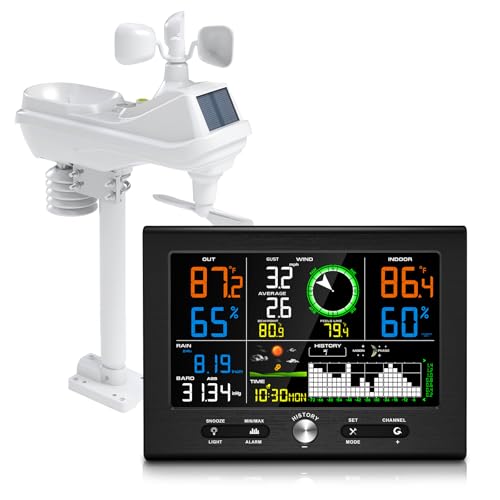
For the property where the sensor lives a long walk from the house.
Here is the spec that earns this pick its place: an open-air wireless range of up to 492 ft. That is 64% more reach than the Raddy UV7’s 300 ft, enough to hold a signal from a back-fence sensor where the UV7 drops out. If you have a large yard, a farm or a patio sensor with a long run back to the house, this reach is what you are paying for. The wind vane and speed sensor feed in alongside rainfall, indoor/outdoor temperature and humidity, and barometric pressure.
The outdoor sensor is rated for real conditions, operating from -40°F to 140°F with accuracy of ±1°F, and humidity from 1% to 99% at ±3%. That range is what lets it keep reading through a heatwave or a cold snap instead of conking out. The console calculates dew point and feels-like temperature and adds a weather forecast plus a history graph, so you see the pattern rather than one frozen moment. Customizable alerts for temperature, humidity, rainfall and wind gusts round it out — useful for protecting plants or gear before a front rolls through.
Two things to know going in. The backlight defaults to off on battery power, so you need the power adapter plugged in for continuous glow — plan your outlet accordingly. And with 4.5+ stars across 30+ owners, the sample is smaller than the older names on this list, though the feedback is clean. The VA LCD handles wide viewing angles and syncs to the WWVB atomic clock for the time, so once the console is up you rarely touch it. The combo of long range and a stable atomic-set clock is the reason this one sits high in the list.
Why it climbs the list
- Up to 492 ft open-air range — the widest reach in the mid-range group
- Sensor rated from -40°F to 140°F at ±1°F accuracy
- Custom alerts for wind gusts, rainfall, temperature and humidity
- WWVB atomic clock sync with history graph
The fine print
- Backlight only stays on when the power adapter is connected
- A newer name, so the review history is thinner than the established brands
Made for: big properties where the sensor-to-console distance is the deciding factor.
Think twice if: you plan to run it on batteries alone and want a lit screen.
5. Weather Station Wireless Indoor Outdoor

A slim desktop console that covers wind, temperature and humidity without hogging the shelf.
Some stations expect wall-mounting and a permanent spot. This one is built to sit on a desk, a windowsill or a shelf and still pull wind speed and direction, temperature, humidity and dew point off a waterproof outdoor sensor. The wireless link runs up to 328 ft, so a garden or patio mount still reaches inside. It also logs minimum and maximum records, plus date, clock and alarm — a tidy all-rounder for someone who wants the basics done well.
Alerts are the feature that gives it an edge over a plain thermometer. You can set personalized thresholds for temperature, humidity, wind gusts, dew point and feels-like temperature, so the console pings you before conditions turn. Trend indicators on the bright LCD show whether temperature and humidity are climbing or falling. The package includes the power adapter, mounting hardware and manual, and setup is a short mount-and-connect job.
The honest catch is the small sample: 4.0+ stars across 20+ owners, which is enough to trust the basics but thinner than the veteran models. It is also a wind-and-temperature station rather than a full weather suite — no rain gauge or UV reading here. If you want the sun and rain numbers too, the Raddy UV7 covers that ground. For a compact everyday desk console that handles wind direction cleanly, this is the one to sit on the shelf.
What it does well: a waterproof wind sensor, 328 ft of range and customizable gust alerts in a footprint that fits a desktop.
Set your expectations: no rain gauge and no UV sensor — this is wind, temperature and humidity only.
Pick this if: you want a compact console with solid wind direction and threshold alerts.
Move on if: rainfall and sun exposure are must-haves.
6. La Crosse V23-WTH Weather System

The color console that pulls in a forecast as well as the wind off your roof.
Stand-alone, this is a handsome color station with wind speed, direction in compass-rose form, indoor and outdoor temperature and humidity, and custom alerts. Add Wi-Fi and it turns into something else: a 7-day forecast with AccuWeather data streaming, sunrise and sunset times, UV index, chance of precipitation and even thunderstorm and air-quality alerts. The free La Crosse View app lets you check conditions and historical data from anywhere. Six different views and seasonal scene changes keep the display from growing stale on the wall.
For wind specifically, current and top speed show up alongside direction and a compass rose. The sensor setup is split — one temperature/humidity sensor plus a separate wind sensor — which gives you freedom to mount each where it belongs, up to a 400 ft transmission range. Outdoor temperature spans -40°F to 140°F (-40°C to 60°C). Records carry a time and date stamp, and an indoor comfort meter gives a quick read on how livable the room is.
One quirk to understand before you set it up: wind direction is a Wi-Fi-only reading on this model, so factor in a stable network at the console’s spot. The station runs on its included 5V adapter with a CR2032 battery for backup — the battery holds your data, it does not run the unit. Setup is where this one shines; it earns praise for being quick to get online and running. The catch is that the full forecast experience depends on that Wi-Fi link working, so it rewards buyers who want data on their phone.
Where it wins: a color console that pairs local wind readings with a 7-day AccuWeather forecast and a phone app.
Know this first: direction readings and the richer forecast views depend on a working Wi-Fi connection at the display.
Ideal for: someone who wants forecast data on their phone as much as readings on the wall.
Less suited to: an off-grid cabin with no Wi-Fi — you lose the direction readout and the app.
7. Raddy VP7 Weather Station
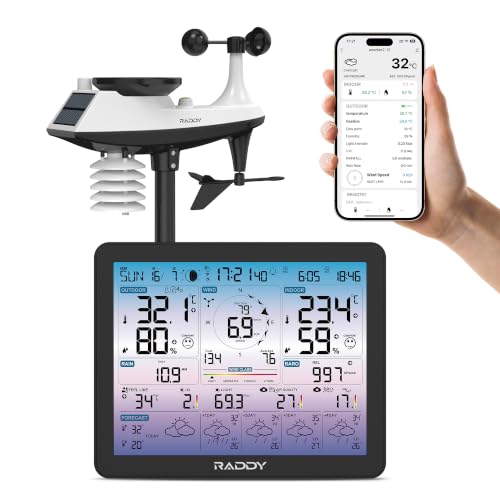
A phone-first station — real-time wind and rain on the wall, deeper trends in your pocket.
Where the UV7 keeps things on the console, the VP7 pushes them to your phone. A single 7-in-1 outdoor sensor tracks wind speed, direction, rainfall, UV index, light intensity, temperature and humidity, then sends it all to the display over 433 MHz RF up to 330 ft. Connect via 2.4GHz Wi-Fi to the Tuya Smart app and you get historical trends, real-time alerts and a 5-day weather report from anywhere. For a backyard, a small farm or a rental property you check on remotely, that app angle is the reason to buy this over its sibling.
The console rounds out the reading with sunrise, sunset, moon phases, heat index, dew point, wind chill and air quality on a 4-level adjustable backlight. The housing is UV-resistant ABS, chosen to shrug off sun and impact rather than crack after a season outdoors. With 50+ ratings landing at 4.5+ stars, the reception is warm, and the 7-in-1 sensor’s coverage is the part that earns the praise.
The one real limitation: the app is the heart of the experience, so a weak Wi-Fi signal at the console means you are back to a plain local display. It is also priced above the UV7 despite a very similar sensor package, so the premium buys you the app and the 5-day forecast, not more wind precision. If remote checking is worth it, this delivers; if you just want a screen in the kitchen, the UV7 does the same wind job for less.
What makes it worth the step up
- 2.4GHz Wi-Fi link to the Tuya Smart app for remote trends and alerts
- 7-in-1 sensor covers wind, rain, UV and light in one housing
- 5-day forecast plus sunrise, sunset and moon phases
- Rated for -40°F to 158°F with UV-resistant ABS housing
What to keep in mind
- Needs solid Wi-Fi at the console to use the rich forecast features
- Priced above the near-identical-sensor UV7 — you are paying for the app
Worth it for: remote monitoring of a backyard or farm with trends on your phone.
Skip the premium if: a wall display is all you need — the UV7 keeps the same sensor core for less.
8. AcuRite Iris Weather Station
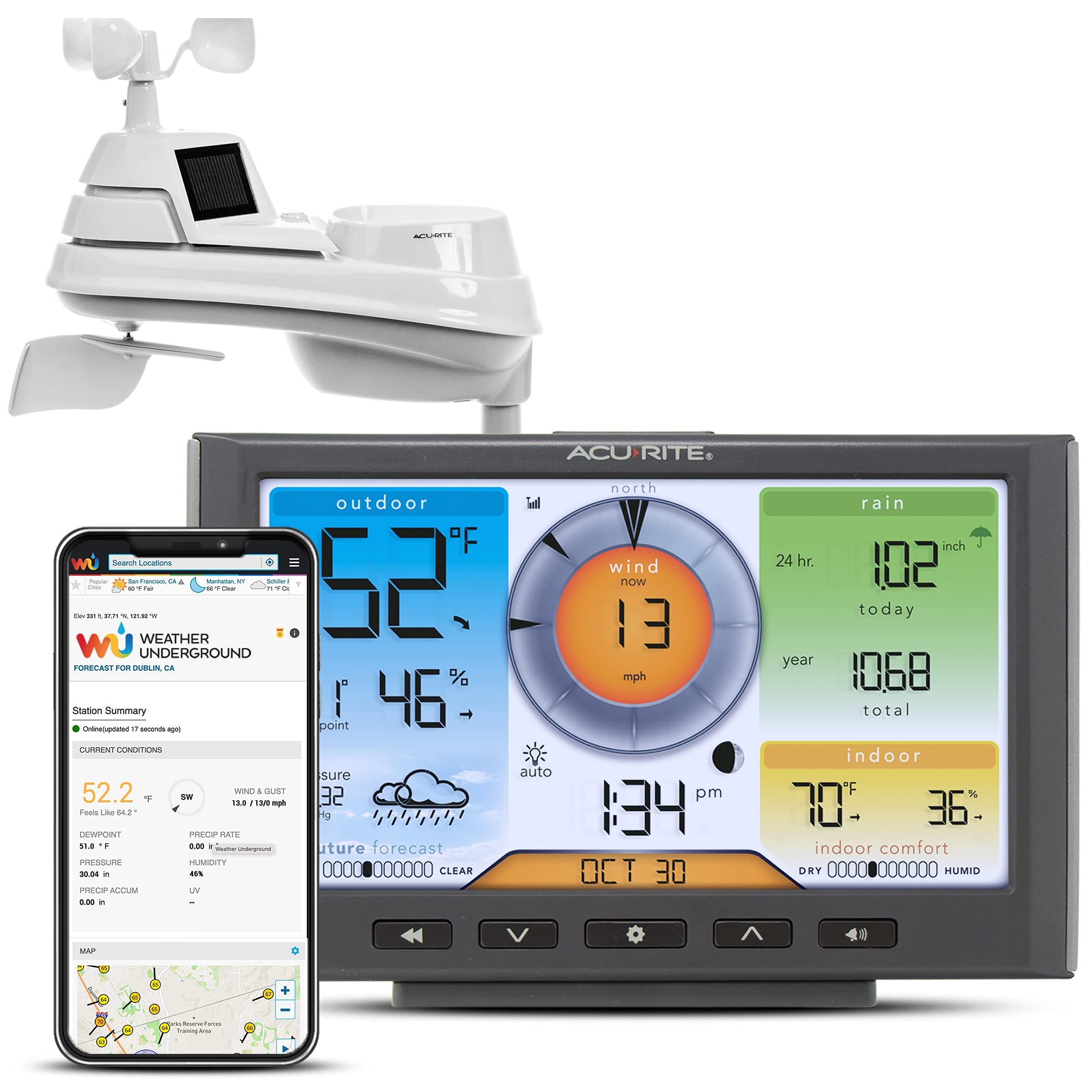
For people who do not just read the weather — they publish it to the whole neighborhood.
The Iris is built around one idea: get your backyard readings onto Weather Underground. A single 5-in-1 sensor packs a built-in anemometer, wind vane, rain gauge, barometer, hygrometer and thermometer, so wind speed and direction come in one unit. Connect the color LCD console to Wi-Fi and you can share your data with more than 250,000 personal weather stations across the globe, and check it remotely. No other pick on this list puts that community side so front and center.
The console delivers over 25 data points, including heat index, dew point, wind chill and enhanced rainfall history, with threshold alarms so the station warns you when conditions cross a line you set. Wind speed and direction stream in wirelessly alongside indoor and outdoor temperature and humidity and barometric pressure. The large color LCD shows the current time and date with an adjustable dimmer, so it works as a clock as much as a weather screen.
Set expectations on two fronts. First, this is the most-reviewed station here, so the mixed reports on accuracy carry weight — the outdoor temperature tends to read a few degrees high for some buyers, and the screen can be awkward from certain angles. Second, it is not the cheapest route to a display; you are paying for the Weather Underground integration and the data volume. Mount it in open air, let the sensor settle, and it earns the reputation it has built.
The community angle: Wi-Fi sharing to Weather Underground and 25+ live data points make this the pick for amateur meteorologists.
The honest caveat: temperature readings run high for some owners — cross-check against a known reference if exact figures matter to you.
Go here if: you want to publish your wind and rain data to Weather Underground.
Look past it if: out-of-the-box temperature accuracy tops your priorities.
9. Tempest Weather Station
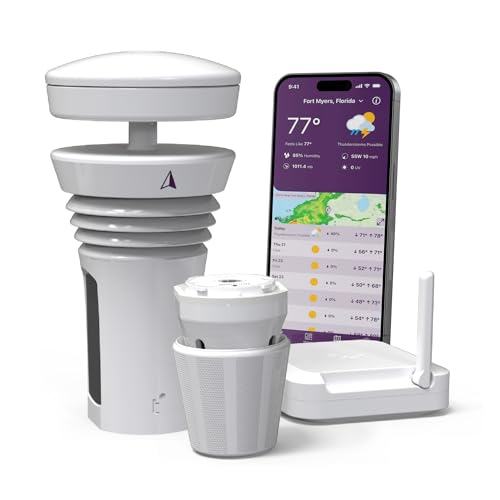
No cups, no vane, no spinning — one solar-powered puck that reports the wind every three seconds.
This is the design that changes how wind sensing works. Tempest has no moving parts at all. Instead, its solar-powered sensor measures wind speed and direction electronically, then transmits wirelessly up to 1,000+ ft and refreshes every 3 seconds. For a buyer who has watched cups jam with ice or a vane get stiff in the cold, the maintenance argument alone is compelling. Toss in temperature, humidity, barometric pressure, dew point, solar radiation, UV index, lightning strikes and rainfall in one device, and it is the most complete sensor here.
It is a phone-and-app station by design — there is no local display in the box, so all readings land on your phone and any connected smart-home setup. The integration list is broad: Amazon Alexa, Rachio, IFTTT and popular platforms, so you can automate sprinklers, lights or a thermostat off real backyard conditions. The maker promises years of near-zero maintenance, and the sealed, no-moving-parts build is what makes that credible. Owners find it easy to set up and genuinely impressive when storms roll through.
The trade-off is honesty about what it does not nail. Rain measurement draws the most criticism, and accuracy and connectivity both ride mixed — some find the wind and rain figures spot-on, others see them drift. There is also no screen to glance at, so if you want a console on the wall this is the wrong shape of product. Still, with 4.0+ stars across 2,000+ owners, it is the most battle-tested station here. For a weather purist who lives in the app, it leads on data and reach.
The spatial case: 1,000+ ft of range and 3-second updates in a sealed, solar-powered unit with nothing to jam or oil.
What you give up: a wall display, and rain readings that are not its strong suit — cross-check rainfall if totals matter.
The fit: app-first weather watchers who want the widest range and zero moving parts.
Not the fit: anyone who wants to glance at a console on the kitchen wall.
Know the Specs
Wireless transmission range
This is the open-air distance, in feet, that the outdoor sensor can send data to the console before the signal fades. Walls, metal siding and dense trees all eat into that figure, so the number is a ceiling, not a guarantee. If your sensor is far from the house, choose a station with generous reach — the mid-range units here run from 300 ft up to 492 ft, and the flagship no-moving-parts model hits 1,000+ ft. A short range that barely covers your yard is the most common reason a station feels unreliable.
Wind speed and direction sensing
A traditional anemometer uses spinning cups for speed and a pivoting vane for direction, and it needs clear open air to read true. Direction shows up as plain compass letters or as exact degrees — the degree figure matters if you log bearings for sailing or spraying. Solid-state sensors measure the same thing with no moving parts, which removes the jamming risk in ice and snow. Whatever the style, mount the sensor high and clear of buildings so the wind hits it undisturbed.
UV index and light intensity
The UV index runs from 0 to 15 and tells you how strong the sun’s burn risk is right where you are, rather than a regional average. Light intensity, measured in klux, shows how bright your spot is — handy for a greenhouse or a solar setup. These are the numbers that separate a full weather suite from a plain wind gauge, and they are worth having if you garden, work outdoors or manage plants under cover.
Display type and backlight
VA and LCD panels differ in how well they hold contrast at an angle — a VA screen keeps its readability when you look from the side, while a plain LCD can wash out. Backlight levels let you dim the screen for a bedroom or brighten it for a sunny room, and some units default the light off on battery power to save energy. Match the screen size and viewing angle to where you plan to put the console; a big bold display is worthless from a steep angle.
Common Questions
Will my wind sensor reach the console from the back of a large yard?
Do I need a station with a rain gauge if I mainly want wind?
How accurate is the wind direction on a vane versus a sensor with no moving parts?
Can I run these stations on batteries alone?
What does the wireless range actually mean when walls are in the way?
How often does a wind station update its readings?
Is the UV index reading useful if I just want wind data?
Do I need Wi-Fi for the forecast features on these stations?
Where should I mount the outdoor wind sensor for reliable direction readings?
Can a station with no display still show wind speed and direction?
The Bottom Line
For most buyers, the strongest wind speed and direction indicator here is the Raddy UV7 — its 5.12″ VA display (a screen type that stays readable from any angle) pairs with one sensor covering wind, rain, UV and light, and the compact console is what wins people over. If your sensor lives far from the house, the Urageuxy rain-gauge station gives you the widest mid-range reach at 492 ft. And for a no-moving-parts, app-first setup, the Tempest leads on range and update speed. One nudge before you decide: the UV7 has a smaller review history than the veteran names, but it holds the highest score of the mid-range group — go look at it if wind and sun on one clear screen is what you are after.
How we choose
We do not accept paid placement. Every pick is matched to a real buyer and a real use-case; we do not hands-on test units.
Sources
Specifications: manufacturer listings and product documentation. Review insights: verified customer reviews, as of November 2026. Pricing: not shown on this page (it changes often); check the current price via the retailer link.
As an Amazon Associate, Tactical Gear Guy earns from qualifying purchases. This does not affect which products we feature.