Specs are compiled from manufacturer listings and verified buyer reviews and can change over time — please confirm the key details on the product page before buying.
You want a hammock you can zip shut and forget about the mosquitoes. That is the whole promise of a zip-up hammock: a zippered net or full enclosure seals you in, and you sleep instead of swatting. The six picks below cover the full range, from a budget-friendly classic that has been trusted for years to a premium lay-flat tent that turns trees into a real bed. Each one has a zipper that actually matters, and each one solves the bug problem differently.
This guide is built by comparing the manufacturers’ published specifications and the patterns across verified customer reviews, so you get each pick’s real strengths and trade-offs instead of marketing spin.
You will see how zipper placement, net density, fabric weight, and hang geometry change the experience. The goal is simple: match the zipper style, mesh density, and lay geometry to how you actually camp. That is why this breakdown of the zip up hammock focuses on the closure system first, then the comfort and packability that follow.
Top Picks

How To Choose The Best Zip Up Hammock
The zipper is the part that fails first, and it is the part that decides whether you stay sealed in or wake up bitten. So start there, then work outward to fabric, size, and hang. A hammock that zips smoothly and seals tight is worth more than one with a bigger footprint and a sticky closure.
Zipper type and placement
A double-sided zipper lets you open from inside or outside, which matters when you are half asleep and need to step out. A full-length zipper running the whole side of the net is easier to manage than a short entry gap. Look for a zipper that sits away from the netting itself, because a slider that catches mesh is the most common complaint in this category.
Mesh density and no-see-um protection
No-see-um mesh has holes small enough to block tiny biting midges, not just mosquitoes. Denser mesh keeps more bugs out but can cut airflow, so the net should hang up and away from your face rather than draping on it. A net that stays off your skin is the difference between a comfortable night and a claustrophobic one.
Fabric, panel width, and lay angle
A wider single panel lets you lie diagonally, which flattens your body instead of curling it. Ripstop nylon resists tears better than plain weave, and a stitch-free panel avoids the stiff ridges that poke at your shoulders. Longer hammocks generally give a flatter lay, so check the length and width together rather than the weight alone.
Weight, capacity, and packed size
Every gram counts when the hammock rides in a backpack all day. Check the maximum weight recommendation against your own body weight plus gear, and look at the packed size so it fits the space you have. A hammock that packs to a 4.7″ by 11″ bundle but still rates 500 pounds is the one you will actually bring.
Side-by-Side Comparison
| Model | Best For | Weight Capacity | Item Weight | Dimensions (L x W) | Amazon |
|---|---|---|---|---|---|
| Grand Trunk Skeeter Beeter Pro★ Best Overall | Trusted everyday camping | 400 pounds | 1.8 pounds | 126″L x 60″W | Amazon |
| AnorTrek Professional Camping HammockMost Spacious | Two-person lounging | 600 pounds | 1.1 kg | 114″L x 55″W | Amazon |
| OneTigris KOMPOUND | Cold-weather camping | 330 pounds | 2 pounds | 102.36″L x 51.18″W | Amazon |
| Onewind 11ft Ultralight | Flat diagonal sleep | 500 pounds | 2.1 pounds | 132″L x 64″W | Amazon |
| Hennessy Explorer Deluxe Zip XL | Tall sleepers | 300 pounds | 3 lb 9 oz | 12″L x 8″W (packed) | Amazon |
| Haven Tents Lay Flat Hammock Tent | Lay-flat luxury | — | ~6.5 pounds | 80″ x 30″ (sleep area) | Amazon |
Detailed Reviews
1. Grand Trunk Skeeter Beeter Pro Mosquito Hammock
Our pick — 4.5+★ from 800+ verified ratings; the strongest balance of quality and price.
The do-everything first hammock, with a zipper that seals the bugs out on both sides.
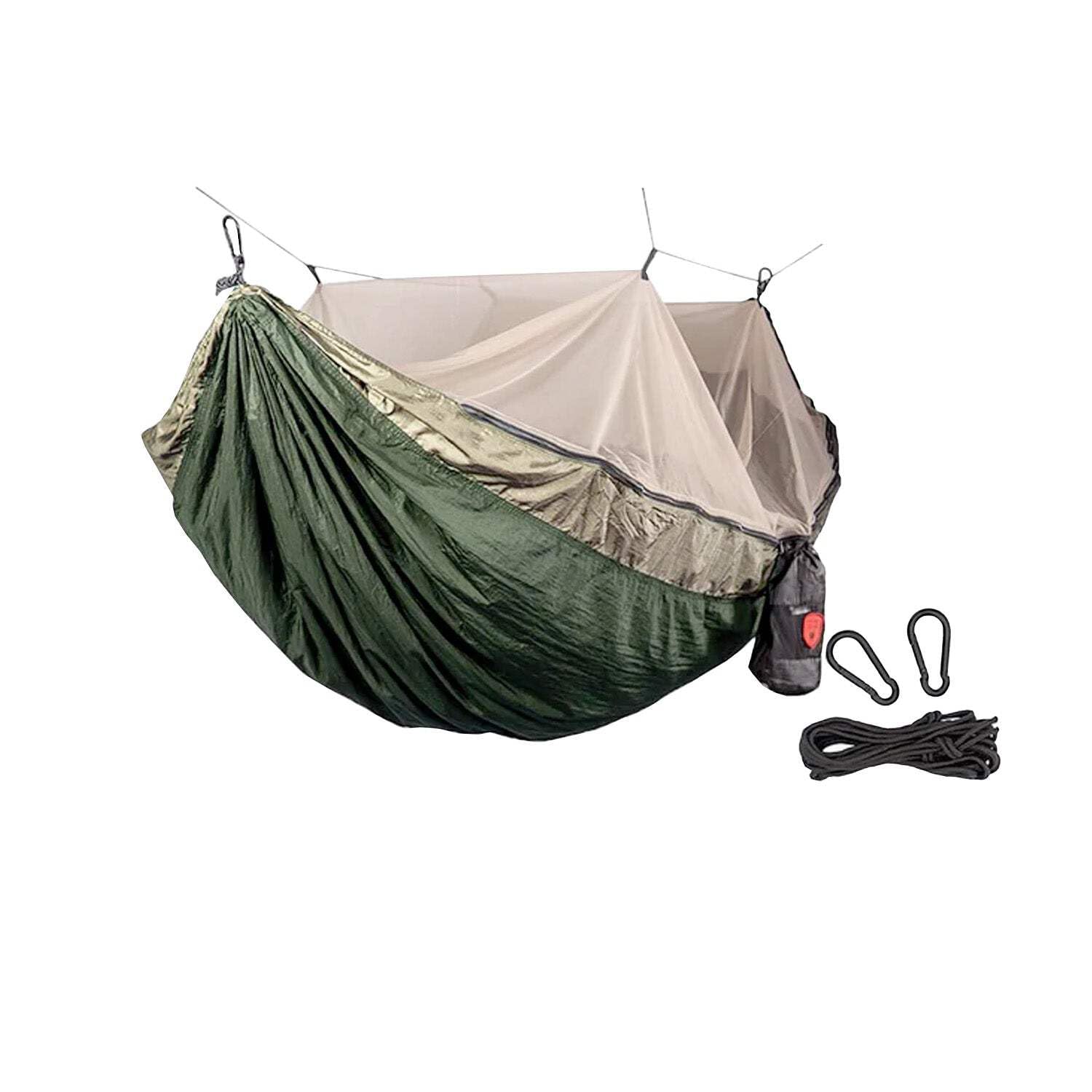
If you are new to zipped hammocks, this is the safest place to start. The Skeeter Beeter Pro holds one person and measures 126″ long by 60″ wide, so you get room to stretch rather than curl. The no-see-um netting hangs overhead and away from you, which means you can still read or sip a drink without feeling boxed in. The double-sided zipper runs both ways, so you can open it from inside or outside without fumbling.
The whole package arrives ready to hang: two nautical-grade carabiners, a starter rope kit, suspension cord, and a stuff sack. Two interior pockets keep your phone and headlamp off the floor, like a small tent shelf. When the bugs are gone, you flip the hammock over and use the bare side as a plain lounger. At 1.8 pounds it disappears into a pack, and the 400-pound maximum weight recommendation leaves room for a heavier sleeper plus gear.
The one thing to weigh is that this is a single-person hammock built for one body. The netting and fabric are triple-stitched at the reinforcements, but the straps and durability are the two areas where opinions split, so treat the suspension with normal care and check the rope kit before a long trip. If you want a two-person hang, the AnorTrek below spreads wider and holds more.
What earns the top spot
- Double-sided zipper opens from inside or out, so night exits are quick.
- No-see-um net hangs off your face, keeping airflow and elbow room intact.
- 1.8-pound pack weight and included carabiners, rope, and stuff sack.
- Two interior pockets keep small gear organized like a tent shelf.
Where it asks for care
- Single-person only, so couples need a wider model.
- Straps and long-term durability draw mixed notes, so inspect the kit.
Best starting point: solo campers and first-time zipped-hammock buyers who want a proven, all-inclusive hang.
Look wider: if you plan to share the hang with a partner, this one is built for a single body.
2. AnorTrek Professional Camping Hammock with Mosquito Net
Two people, two poles, and a net that opens wide instead of draping on your face.
This is the hammock for a pair or a parent and kid. The AnorTrek seats two and carries a 600-pound weight capacity, well above the Grand Trunk’s 400 pounds. It measures 114″ by 55″ and uses soft square ripstop 230T nylon, which resists tears while staying breathable. Two semi-circular aluminum poles, each 47.3 inches long, push the net up and out so it never blocks your view.
The bug net itself is dense B3 polyester, with holes tighter than many rivals to keep small mosquitoes from slipping through. A real anti-rollover design lets you fully open the zippers, push the net to the far side of the poles, and use the hammock bare when the coast is clear. The poles double as a stability aid that helps stop you tipping out. Everything packs into one attached storage bag with two shoulder ropes, and the two tree straps run 10 feet each with 18+1 loops for easy anchoring.
At 1.1 kg it is the heavier of the double options, and the poles add bulk to your pack. Buyers report no threads popping during use and a comfortable night’s sleep, and the build quality earns the most praise of any trait. If you want a solo ultralight, this is more hammock than you need.
The wide-open advantage: those two 47.3-inch poles are the reason the net stays off your face and the hammock feels bigger than its footprint, which matters when two people share one hang.
Trade-off to note: the pole-and-strap setup is more hardware to pack and carry than a bare net hammock, so it suits basecamp and car camping better than fast-and-light backpacking.
Reach for this if: you camp as a pair or want a wide, open view through the net.
Skip the poles if: your priority is the lightest possible solo pack.
3. OneTigris KOMPOUND Camping Hammock

A zippered inner cover that traps heat, so frost stops forming on your sleeping bag.
Most zip-up hammocks stop at bugs. This one adds a zipable internal cover that closes off the top of the hammock, which helps hold your blanket in place and fights the condensation that frosts your bag. It is built from 210T nylon taffeta with YKK zippers, a combo chosen for tear resistance and easy cleaning. The hammock measures 8.5 feet by 4.2 feet wide and holds up to 330 pounds (150 kg), fitting one person.
The high-density mosquito net keeps airflow moving while blocking insects, and elasticated side ropes hold the hammock open so it never snaps shut around you. They also quiet the rocking motion. There is an adjustable ridgeline to hold the net, a lantern attach point inside, and a storage bag that converts into an outdoor sling for your water bottle and phone. The kit includes two 12KN carabiners, two guylines with bungee cords, and two 9.2-foot tree-friendly straps.
Here is the honest catch: this is a compact single. The size draws mixed feedback from buyers who find it cramped, and the zipper quality is a split verdict — some find it smooth, while others note it can catch the netting. The 330-pound capacity is also the lowest in this group. If you are tall or broad, size up.
Why it wins on chilly trips: the inner thermal layer is the feature no other pick here offers, and it turns a summer hammock into a three-season shelter with a zip.
Fit note: the 330-pound capacity and 8.5-foot length suit smaller sleepers best, so check your height against the dimensions before you commit.
Your pick when: cold mornings and condensation are the enemy and you want a sealed, warmer hang.
Consider the Onewind instead if: you need a longer, wider, higher-capacity bed.
4. Onewind 11ft Camping Hammock

Eleven feet of stitch-free panel, so you lie diagonal instead of curled like a banana.
The Onewind solves the biggest comfort complaint in hammock camping: the banana curve. It unfolds to 132″ by 64″, big enough to lay diagonally and sleep flat. The 64″ single wide panel is stitch-free, so there are no stiff seam ridges digging into your shoulders. Compare it to the OneTigris at 102.36″ by 51.18″ and you can see the extra length and width that make the flat lay possible.
The fabric is 40D ripstop nylon, chosen to be more durable than 210T parachute nylon while staying light. It supports up to 500 pounds. An adjustable UHMWPE ridgeline rates at 1500 pounds of maximum strength and lets you tune the sag to your liking. The bug net connects with a full two-way zipper, made of breathable polyester, and rolls to the side when you don’t need it.
At 2.1 pounds it still packs into a 4.7″ by 11″ bundle, and the double-sided stuff sack lets you hang one end and release the hammock without dragging it in the dirt. The kit is complete: two cinch buckles, two continuous loops, the ridgeline, two 12-foot tree straps, shock cords, and two aluminum stakes. If there is a limit, it is the packed price tier — this sits at premium-hammock territory, though it wears it well.
Why flat-lay campers pick it
- 132″ by 64″ footprint lets you sleep diagonally and flat.
- 500-pound capacity and 40D ripstop nylon for durable support.
- Adjustable UHMWPE ridgeline tunes the sag to your preference.
- Packs to 4.7″ by 11″ in a double-sided stuff sack.
The honest limit
- At 2.1 pounds it is not the lightest solo option in this group.
- Full kit means more small parts to keep track of on setup and teardown.
The sleep-first choice: side and stomach sleepers who want a genuinely flat bed between trees.
Weigh the weight: ultralight purists may prefer fewer grams over the extra length.
5. Hennessy Hammock – Explorer Deluxe Zip XL

Built for the tall camper, with a side-entry zipper the length of the hammock.
Finding a hammock that fits a long frame is its own problem. The Explorer Deluxe Zip XL is designed for anyone up to 7 ft and 300 lbs, which is a rare spec in this category. The side entry is a full-length 10 YKK zipper, so you slide in sideways instead of crawling through a gap. A 140d high-density nylon bottom gives the bed its durable base, and the asymmetric shape is cut to match your diagonal lie.
The full system is included: a rainfly in 70d polyester ripstop, a 30d No-See-Um mosquito mesh with an elastic hold-open, a gear loft that slides on the ridgeline, and polyester ropes tested to 1800 lbs. A structural ridgeline keeps the hang identical every night, so your setup does not drift. The whole kit rolls into a compact 5″ x 8″ x 12″ package at 3 lb 9 oz.
The trade-off is the rainfly size. Buyers split on it, with some saying it provides just the right room and others wanting it bigger. At 3 lb 9 oz this is also a heavier carry than the Onewind or Grand Trunk. What you get for that weight is a shelter built like a small system, and many owners treat it as a grab-and-go kit.
The tall-frame answer: a 7-foot length limit is the reason this one earns a slot no other hammock in the group fills.
Plan for the fly: if you camp in heavy rain, budget for more coverage or an added tarp, since the rainfly size is the most debated part of the kit.
Made for you if: you are a tall sleeper who needs a hammock that actually fits a long body.
Pack-light caveat: the 3 lb 9 oz system is a load, so distance hikers may want a lighter shell.
6. Haven Tents Lay Flat Hammock Tent
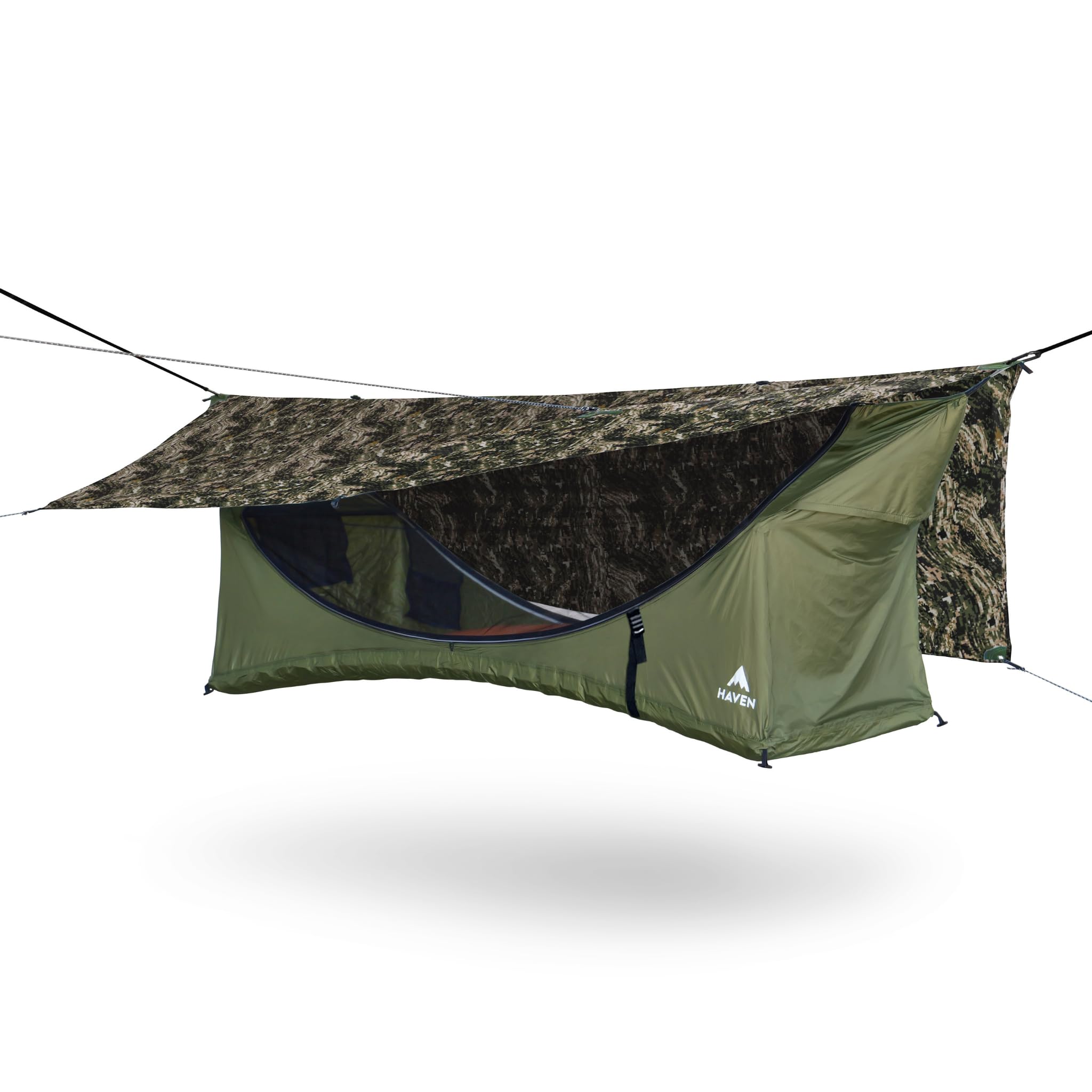
A hammock that becomes a tent, with a flat bed and a storm-ready camo rainfly.
This is the full-shelter end of the category. The Haven XL gives you a flat 80″ by 30″ sleeping area that fits campers over 6 ft tall, with no bowing or shoulder squeeze. Spreader bars open the body into a rigid bed, and a custom insulated air pad slides into corner pockets to form the sleeping platform. The pad is R3 rated for 3-season use, and the pump sack to inflate it comes in the kit.
The digital camo rainfly is built from 20D ripstop nylon at 4,000mm waterproof, with sealed edges and 112 inches of coverage to shield you and your gear. The integrated mosquito net closes with a full zipper. A structural ridgeline keeps the hang consistent between trees. If there are no trees at all, you can pitch it on the ground like a bivy using trekking poles, or deploy the lounge strap to turn it into a swinging chair.
Construction is the trait buyers praise most, and setup runs a close second — the kit arrives ready to hang with straps and carabiners. The real question is weight. At roughly 6.5 lbs trail weight and a packed size near 16 by 8 inches, this is a camp-comfort choice, not a fast-and-light one. The flatness and width also draw mixed feelings, with some finding it roomy and others too narrow, so try the dimensions against your sleep style.
What the premium buys: a true flat bed, an included R3 insulated pad, and a 4,000mm rainfly turn this into a complete shelter rather than just a bug net.
The weight reckoning: about 6.5 lbs is a serious carry, so it earns its place at basecamp and on short hikes more than on long-distance treks.
Worth it for: campers who want a flat, warm, fully sheltered bed and will trade pack weight for it.
Think twice if: you are counting every ounce on a multi-day route.
Know the Specs
Weight capacity vs. item weight
Weight capacity is how much the hammock can safely hold, and item weight is what it adds to your pack. A 400-pound capacity with a 1.8-pound shell is a different tool than a 600-pound capacity at 1.1 kg. Match capacity to your body plus gear, and match weight to how far you carry it. The two numbers rarely peak together — the 600-pound AnorTrek carries 1.1 kg, the 400-pound Grand Trunk just 1.8 pounds — so decide which one matters more for your trip.
Mesh density and zipper design
No-see-um mesh has fine holes that block tiny midges, while a two-way zipper lets you open from either side. A full-length zipper is easier to manage than a short gap, and a slider that stays clear of the net avoids the catching problem. Dense mesh protects better but can reduce airflow, so a net that hangs off your face keeps the balance right.
Ridgeline and hang geometry
A ridgeline is the cord that holds the net above you and sets the sag of the hammock. An adjustable one lets you change the curve to suit your body. A structural ridgeline keeps the same hang every night, so your setup does not change between trips. Set the ridgeline sag right and a 132-inch hammock sleeps flat; set it wrong and you feel every curve.
Waterproofing and thermal layers
A rainfly’s waterproof rating in millimeters tells you how much water pressure the fabric resists before it leaks. A thermal layer or insulated pad holds warmth against your back, where hammocks lose heat fastest. If you camp in cold or wet weather, a 4,000mm rainfly rating and an R3 insulated pad matter more than fabric color or brand. For warm, dry trips, a no-see-um net and a bare nylon shell is enough.
Common Questions
How does a zip-up hammock keep bugs out compared to one with no net?
Can I use a zip-up hammock without the net?
What weight capacity do I need for a hammock with a zippered net?
How tall can I be and still fit in these hammocks?
Will the zipper catch the mosquito netting?
Do I need a separate rainfly for a zip-up hammock?
How small do these packed hammocks get?
Is a lay-flat hammock better for side sleepers?
How do I hang a zip-up hammock without damaging trees?
What is the difference between no-see-um mesh and regular mosquito netting?
The Bottom Line
For most campers, the zip up hammock winner is the Grand Trunk Skeeter Beeter Pro because it seals the bugs out with a double-sided zipper, hangs a no-see-um net off your face, and arrives with carabiners and a stuff sack at 1.8 pounds. If flat, diagonal sleep is what your back wants, the Onewind 11ft Ultralight gives you 132″ by 64″ of stitch-free panel. And for cold nights or a fully sheltered bed, the OneTigris KOMPOUND and the Haven XL cover the thermal and all-in-one extremes.
The quick way to decide: match the length and capacity to your body first, then trim pack weight. A full-length two-way zipper that seals cleanly and a net held off your face by poles or a ridgeline are the two things every happy hammock camper agrees on.
How we choose
We do not accept paid placement. Every pick is matched to a real buyer and a real use-case; we do not hands-on test units.
Sources
Specifications: manufacturer listings and product documentation. Review insights: verified customer reviews, as of November 2026. Pricing: not shown on this page (it changes often); check the current price via the retailer link.
As an Amazon Associate, Tactical Gear Guy earns from qualifying purchases. This does not affect which products we feature.