Specs are compiled from manufacturer listings and verified buyer reviews and can change over time — please confirm the key details on the product page before buying.
Buying a foam mat is really about three things: how thick it is under your knees, whether it stays put when you push off it, and how much floor it covers without you buying a second set. Get those wrong and you get a mat that slides, a knee that aches, or a gym corner that is half padded. This guide sorts eight real options by what they actually do — singles you roll up and puzzle tiles you build a floor with — so you can pick once and stop shopping.
This guide is built by comparing the manufacturers’ published specifications and the patterns across verified customer reviews, so you get each pick’s real strengths and trade-offs instead of marketing spin.
Every pick below states its real foam density, thickness, tile count and coverage so you can match it to your space in seconds. These workout foam mats are ranked by real foam density and thickness, not thin tiles that flatten in a month.
Top Picks


How To Choose The Best Workout Foam Mats
Two mats in this list can look identical in a photo and behave completely differently under your feet. The difference is almost always thickness, foam density, and whether the surface is textured. Here is what actually matters when you are standing on it in socks.
Decide between a rolled mat and a tile floor first
A single rolled mat like the Body Sport is one piece you unroll and wipe down — ideal for a stretch corner or a home yoga spot. Puzzle tiles are modular squares that lock together, so you can cover a garage bay, protect a carpet, or build a padded zone around a rack. If you are padding more than a body-length of floor, tiles win on coverage.
Thickness is the cushioning number, not a marketing word
A 1/2-inch tile is the everyday standard — enough to soften knees and hips on a hard floor. A 3/4-inch tile like the CAP set adds a firmer, deeper layer for heavier lifting setups. A 1-inch tile like the checkered ProsourceFit sits at the top of the cushioning scale, so it absorbs more shock but also feels plusher and less stable under fast footwork.
Density decides how long the foam lasts
High-density EVA foam (ethylene vinyl acetate — the closed-cell foam most gym tiles are cut from) springs back after a knee or a dumbbell presses into it. Low-density foam compresses and stays dented. That is why two 1/2-inch tiles at the same size can feel worlds apart after a few months of use.
Side-by-Side Comparison
| Model | Best For | Thickness | Coverage / Format | Surface | Amazon |
|---|---|---|---|---|---|
| Body Sport Personal Thick Foam Workout Mat★ Best Overall | One-piece rolled mat for stretching and floor work | — | Single mat, rolls up | Ribbed one side, smooth the other | Amazon |
| BalanceFrom Puzzle Exercise MatBudget Champion | Budget starter floor for a home gym corner | 1/2 inch | 6 tiles, 24 sq ft | Double-sided non-slip | Amazon |
| Our Modern Space 12-Pack Floor TilesMost Coverage Per Tile | Bigger garage or play-area coverage | 1/2 inch | 12 tiles, 48 sq ft | Cushioned, shock-absorbing | Amazon |
| CAP Interlocking Puzzle Mat | Firmer footing under heavier weights | 3/4 inch | 6 tiles, 24 sq ft | Diamond-textured, water-resistant | Amazon |
| Art3d EVA Puzzle Exercise Mats | Balanced gym floor at full 48 sq ft | 1/2 inch | 12 tiles, 48 sq ft | Grip-enhancing non-slip | Amazon |
| ProsourceFit Exercise Puzzle Mat 1/2 in | 48 sq ft of proven large-floor coverage | 1/2 inch | 12 tiles, 48 sq ft | Textured, water-resistant | Amazon |
| ProsourceFit 1-Inch Checkered Mat | Maximum cushioning for knees and joints | 1 inch | 6 tiles, 24 sq ft | Checkered, traction-boosting | Amazon |
| bemaxx Gym Mats Set | Whole-room floor protection | 0.4 inch | 24 tiles, 96 sq ft | Anti-slip, geometric pattern | Amazon |
Detailed Reviews
1. Body Sport Personal Thick Foam Workout Mat
Our pick — 4.5+★ from 600+ verified ratings; the strongest balance of quality and price.
The mat you unroll for floor work and never resent carrying — because it weighs next to nothing.
Buy this one if your workout happens on your back, your knees, or your wrists rather than under a barbell. It is a single mat, not a tile floor, and it tips the scales at exactly 16 ounces — under half the weight of the 10-pound 12-pack tile set. That means you can carry it to a class in one hand and hang it on the wall after.
Body Sport builds it from high-density foam with what the brand calls advanced foam technology, and the point of that is simple: the foam pushes back instead of bottoming out. Owners consistently say the cushioning holds up under knees and it does not leave them sore on a hard floor. The two-sided design does real work here — a ribbed side and a smooth side, so you pick grip or glide depending on whether you are holding a plank or sliding through a stretch.
Storing it takes almost no space. Two reinforced rings let it hang flat against a wall instead of sprawling on the floor, and cleanup is a wipe with soap and water. The honest catch: it is one mat covering one person, so if you want a padded zone for a rack, a bike, or kids, you need tiles instead. It also carries the guide’s top rating: 4.5+ stars across 600+ reviews.
What it gives you
- 16 ounces — light enough to carry to a class without a bag
- Ribbed side and smooth side, so one mat covers grip work and glide work
- Two reinforced rings let it hang flat and out of the way
- High-density foam that absorbs impact instead of bottoming out
What to weigh first
- Single-mat coverage — one person, not a floor
- The foam suits bodyweight floor work, not dropped barbells
The right call for: anyone who stretches, does Pilates, or works through floor exercises and wants a mat that travels and hangs easily.
Look elsewhere for: a padded garage bay — this covers one body-length, and the tile sets below are the tool for that job.
2. BalanceFrom Puzzle Exercise Mat 1/2″ Thick
Six tiles, one small padded corner — the cheapest honest way to stop kneeling on concrete.
This is the entry point into tile flooring, and it is a smart one. Six 24″x24″ tiles at 1/2-inch thick cover 24 square feet when locked together, which is roughly the footprint of a bike, a bench, or a stretching spot. The whole set weighs 4 pounds — carry it home in one arm and lay it out in minutes.
What buyers keep coming back to is how it holds up and how easy it goes down. It works well under a stationary bike, and the double-sided non-slip surface keeps the mat planted during floor work rather than skating away mid-set. The 1/2-inch high-density EVA foam cushions spine, hips, knees and elbows on a hard floor, and a moisture-proof treatment means soap and water cleanup without the foam drinking anything in. There is even a 2-year warranty backing it.
The trade-off is scale. Six tiles solve a corner, not a room — if you are building a full garage setup, step up to a 12-pack below. And at 24 sq ft you will notice how fast the edges run out. For a first gym mat or a spare-room stretch pad, though, the value is hard to argue with.
Where it shines: 24 sq ft of double-sided non-slip foam at 1/2-inch thick, assembled and disassembled without tools, backed by a 2-year warranty.
Where it stops: 6 tiles is a corner-sized footprint — the 12-tile sets further down cover 48 sq ft if you need more room.
Buy this if: you have a small home gym or a bike to protect a floor under and want the least expensive way to pad it.
Hold off if: your workout area is bigger than a bike and a bench — you will want double the tiles.
3. Our Modern Space 12 Pack 48 SQFT Exercise Mat
Double the tiles of the balance-focused set — twice the floor, same easy-click layout.
Twelve 24″x24″ tiles at 1/2-inch thick add up to 48 square feet — twice the coverage of the 6-tile BalanceFrom above. That is the jump from “a corner” to “a proper padded zone” for yoga, cardio, or a weight bench. The full set weighs 10 pounds, which is a two-handed carry but still trivial to move around.
The foam does the job it is meant to: cushioning and shock absorption underfoot, and the tiles stay locked in place during floor work rather than sliding as you shift weight. The foam is free of PVC, lead, silicone, BPA, phthalates and latex, which is the kind of empty-bucket list that matters if kids or pets share the room. Wipe it down and it looks clean again.
One thing to know before you buy: the listing calls them extra thick, but buyers have flagged that they do not measure a full 1/2 inch in hand. The tiles still cushion fine and the grip holds, so it is a sizing-expectation note rather than a dealbreaker — just do not expect the deeper 3/4-inch or 1-inch feel from this one.
The value read: you get 12 tiles and 48 sq ft for a mid-range layout, with a foam spec that skips PVC, lead, BPA, phthalates and latex — a sensible pick for a family room or a play area doubling as a gym.
The honest limit: buyers report the tiles measure under the advertised 1/2 inch, so treat the thickness as standard 1/2-inch-class foam rather than a deep, plush tile.
Reach for this if: you want twice the floor area of an entry-level tile set and a foam that avoids the common chemical additives.
Think twice if: you specifically want a verified full 1/2-inch or thicker tile — the CAP at 3/4 inch is the firmer, deeper option.
4. CAP 24-Inch Interlocking EVA Foam Puzzle Exercise Mat

At a true 3/4-inch thick, it sits a full quarter-inch deeper than the standard half-inch tiles.
Thickness is the whole story with the CAP set. Each tile measures 24″L x 24″W x 0.75″Th — the deepest cushioning of any tile set here at 6 tiles per pack. Six tiles cover 24 sq ft, and the set weighs 7.2 pounds. If your knees complain on a 1/2-inch tile, this is the step up that addresses it directly.
The surface earns its keep too. A diamond texture adds traction under bare feet and wipes clean, and the water-resistant finish is the kind of detail that matters when a sweat puddle lands on it. The interlocking design clicks quickly, and finishing strips give the outer edges a clean, finished look instead of open puzzle teeth. For garage gyms, owners mention the thick foam makes a concrete floor feel workable.
The honest trade: some sets arrive with edges that do not line up perfectly, so check the fit while you lay them out rather than after. And this is hand-wash only — no throwing tiles in the tub. Neither issue undercuts the cushioning, which is the reason to buy this pack in the first place.
Why it earns a place
- 0.75 inches thick — the deepest foam of any tile pack here
- Diamond texture adds grip underfoot and wipes clean
- Finishing strips give the outer edges a clean look
- Cushions a concrete garage floor underfoot
What to expect going in
- Occasional sets have edges that don’t align cleanly — check the fit on day one
- Hand-wash only, so no soak-and-scrub shortcuts
This one wins on: deep 3/4-inch cushioning for knees and joints on a hard garage floor, plus a textured top that resists slipping.
Just know: it is a 6-tile, 24 sq ft pack — a starter pad, not full-room coverage.
5. Art3d EVA Puzzle Exercise Mats, 24″x24″, 1/2″ Thick, 12-Pack
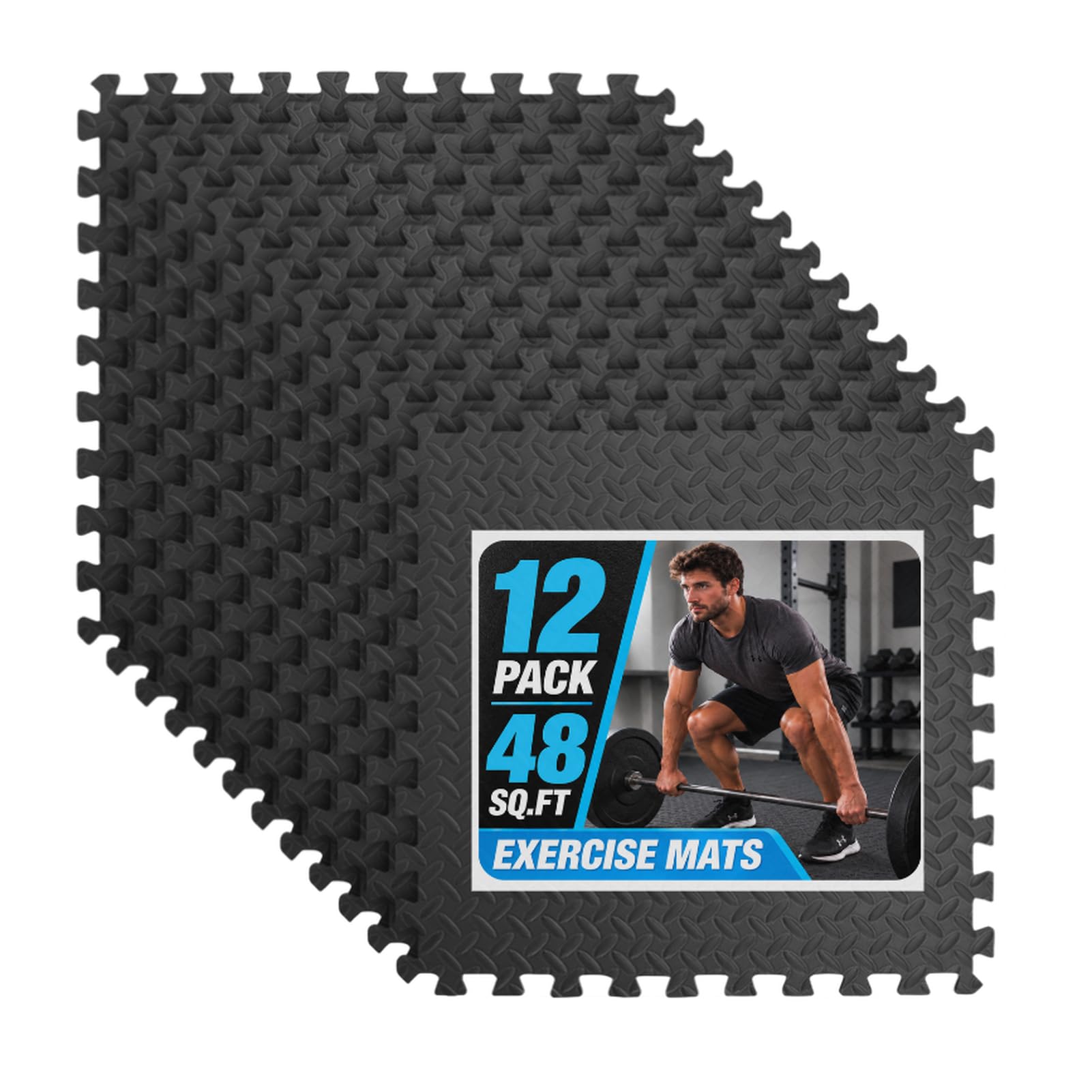
Full 48-square-foot coverage from tiles that lock together and stay locked.
Twelve 24″x24″ tiles at 0.5-inch thick stretch across 48 square feet here — twice the tile count of the CAP pack above, and the wider layout many home gyms actually need. The EVA foam holds its shape under daily pounding, and the BPA-free construction is one less thing to think about with bare feet and kids on the floor.
The thing everyone raves about is how well the tiles stay together. Under the weight of home gym equipment, the seams hold, and the pieces fit cleanly on the first try rather than needing a fight. Shock absorption is genuinely good for feet on concrete, and the non-slip surface keeps you steady through fast routines. It is a set that clicks, stays clicked, and cleans up with a wipe.
Compared to the thinner-feeling 12-pack from Our Modern Space, this one delivers the full advertised 0.5-inch thickness with a firmer, more reliable interlock. Budget-minded buyers may want more tiles per dollar, but if you want 48 sq ft that behaves like a permanent gym floor, this is the safer bet.
The standout: 12 tiles at a full 24″x24″x0.5″ and 48 sq ft of coverage, with an interlock that holds firm under equipment weight — the sturdiest “build a floor” option here.
The trade-off: you pay for the full 48-square-foot footprint, so if you only need a corner, a 6-tile pack does the same job for less.
A match for: a home gym that needs 48 sq ft of stable, shock-absorbing foam that won’t pop apart mid-workout.
Not for: a single stretching spot — six tiles already cover that.
6. ProsourceFit Exercise Puzzle Mat 1/2 in 12 Tiles

A 48-square-foot gym floor you can disassemble as fast as you laid it down.
You get the same 12-tile, 48 sq ft footprint as the Art3d, but the pitch is versatility. High-density EVA foam (a firm, springy foam) provides support under a bench, a bike, or bare feet on a garage floor, and the water-resistant, noise-reducing design means the tiles double as a play mat or a carpet protector when the workout gear comes off. The set weighs 9.3 pounds and breaks down just as fast as it goes together.
It works — thousands of buyers have turned a garage or spare room into a usable fitness space with this exact set, and easy assembly plus good value are the recurring themes. Wipe down with warm water and dish soap, air dry, done.
Where it asks a little more patience: the interlock is not the most forgiving on the market, and a few sets loosen under shifting weight over time. Foam may also compress slightly under heavy equipment, leaving minor surface variation. Neither issue is a reason to walk away — treat it as foam that prefers a flat, hard, stationary surface rather than a wrestling mat.
Why it holds up: high-density EVA, a 48 sq ft layout from 12 tiles with end borders, phthalate-free foam, and a design that disassembles for storage without tools.
The real caveat: the interlock can work loose over time under shifting loads, and foam compresses slightly under heavy equipment — give it a flat, stationary surface.
Pick it for: a garage or spare room you want to turn into a home gym and possibly take apart later.
skip it if: you need a tile that never separates — the Art3d above interlocks more firmly.
7. ProsourceFit Exercise Puzzle Mat 1-inch

One full inch of cushion means the floor disappears under your knees and your feet.
If joint comfort on a concrete floor is the deciding factor, this is the deepest tile in the guide at a full 1″Th across each 24″x24″ tile. Six tiles cover 24 sq ft and the set weighs 10 pounds — a two-hand carry that lays out into a genuinely cushioned workout surface. High-quality EVA foam that springs back to shape is the promise, and the thickness backs it up.
The checkered surface is what gives it extra traction, and customers note it holds a spinning bike steady and feels soft on bare feet. It also works as a kids’ play mat or a garage floor pad when your equipment moves out. Interlocking tiles let you build whatever size zone you need, one tile at a time.
Here is the honest part: on some surfaces the slick checkered top feels slippery under fast movement, and a few sets have shown foam that wears faster than expected under constant load. Treat the grip as traction help rather than a non-slip guarantee on a smooth concrete floor, and keep hard use on top of a stable tile layout.
What you notice first
- A full 1-inch thickness — the deepest cushioning in this lineup
- Checkered surface adds traction and looks sharp in a room
- Soft and forgiving under knees and bare feet
- Interlocks so you can size the zone yourself
The fine print
- The checkered top can feel slick under fast footwork on smooth floors
- Durability feedback is split — expect foam that shows wear under constant heavy load
The one to grab if: your knees and joints need real cushioning on a hard garage or basement floor, and you want the deepest tile available.
Second-guess it if: you are doing fast, grippy footwork on polished concrete — the checkered top is traction help, not a grip guarantee.
8. bemaxx Gym Mats Set 24 pcs
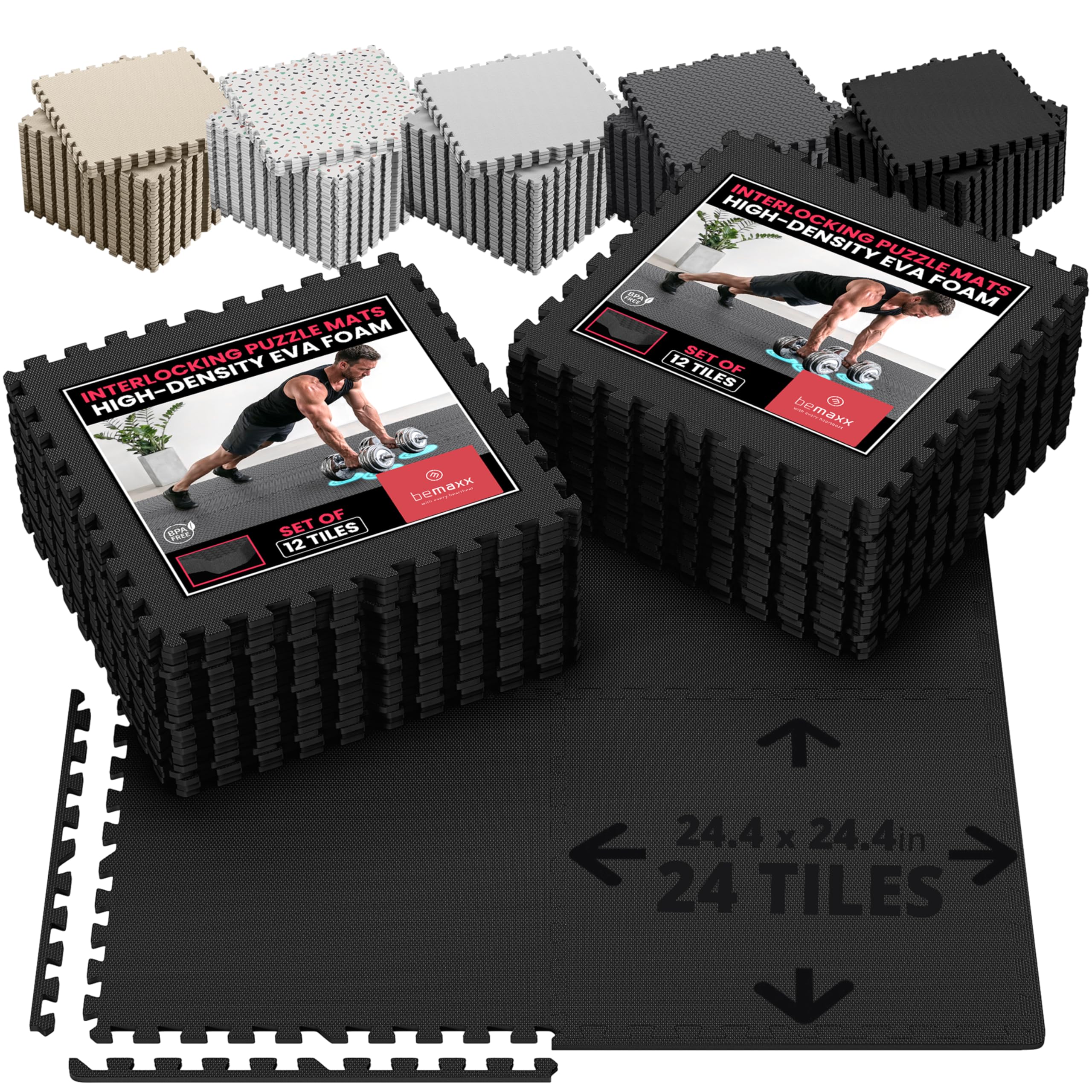
Twenty-four tiles sprawling across 96 square feet — enough to floor a whole garage bay.
This is the coverage brute of the group. Twenty-four tiles at 24.4″L x 24.4″W x 0.40″Th add up to roughly 16 ft x 12 ft = 96 sq ft — four times the footprint of the 24 sq ft packs. Four times the tile count of a 6-tile set. If your project is “protect this entire room” rather than “pad a corner,” this is the pack built for it.
The foam is highly compressed EVA with an anti-slip surface that also dampens noise and insulates warmth, which means a cold concrete basement floor stops feeling like one. It is BPA-, lead-, phthalate-, latex- and silicone-free, resistant to sweat and fluids, and wipes clean with a damp cloth. Edge pieces are included for a finished perimeter, and the anthracite geometric pattern looks deliberate rather than utilitarian.
The catch is thickness. That is the trade for covering 96 sq ft in one box. On a hard floor they still soften the surface, but they are not the deep-cushion choice for sensitive knees.
The coverage play: 24 tiles at 24.4″x24.4″x0.40″ give you roughly 16 ft x 12 ft of protective, noise-dampening, wipe-clean floor — the largest single layout in the guide.
The trade-off: at 0.40 inch, these are the thinnest tiles here — fine for floor protection, less so for deep knee cushioning.
Built for: an entire room that needs floor protection from equipment, sweat, cold, and noise all at once.
Pass on it if: joint cushioning is your priority over area — the 3/4-inch or 1-inch tiles cushion far deeper.
Know the Specs
Thickness (the cushioning number)
Thickness, measured in inches, is how much foam sits between you and the hard floor. A 1/2-inch tile softens knees and hips in everyday floor work. A 3/4-inch or 1-inch tile goes deeper, which matters if you kneel or lift on concrete. The thinner a tile, the less it can soak up impact — simple as that.
EVA foam density
EVA (ethylene vinyl acetate) is a closed-cell foam — the material most gym tiles are cut from. High-density EVA packs the cells tightly, so the foam pushes back after a knee or a dumbbell presses in instead of staying dented. Lower-density foam feels soft at first and then flattens under load. Density is why two 1/2-inch tiles can age so differently.
Coverage in square feet and tile count
Coverage tells you how much floor you actually pad. Tile count multiplied by tile size gives the square feet, so a 6-tile pack of 24″x24″ tiles lands around 24 sq ft while a 12-tile pack doubles that to 48. Pick the coverage that matches your real footprint — a bench and bike versus a full garage bay.
Surface texture and grip
The top surface decides whether you slide. A textured or checkered top adds traction for bare feet and holds a mat in place during fast movement. A smooth or double-sided non-slip finish resists slipping too, but the level of grip varies. If you sweat a lot or push off hard, favor a surface with a visible texture pattern.
Common Questions
How thick should a workout foam mat be for floor exercises?
Will interlocking foam tiles slide apart during a workout?
Can a foam mat protect a concrete garage floor?
What is the difference between EVA foam and rubber gym mats?
How do I clean a foam workout mat?
Is a rolled mat or a puzzle tile floor better for a home gym?
How many tiles do I need to cover my workout space?
Are these foam mats safe to use around kids and pets?
Can I put heavy gym equipment on top of foam tiles?
Do foam mats help with noise from a treadmill or bike?
The Bottom Line
If your training lives on the floor, the workout foam mats worth starting with is the Body Sport Personal Thick Foam Workout Mat — it is the highest-rated pick here, weighs 16 ounces, and hangs out of the way. If you need to pad a floor rather than one body-length, start with the Art3d 12-pack for a firm 48 sq ft of tiles that stay locked.
Want the deepest cushioning under your knees? The ProsourceFit 1-inch checkered set goes a full inch thick. And if the job is protecting an entire room, the bemaxx 24-tile set covers roughly 96 sq ft in one go. Match the thickness and square footage to your space and you won’t rebuy.
How we choose
We do not accept paid placement. Every pick is matched to a real buyer and a real use-case; we do not hands-on test units.
Sources
Specifications: manufacturer listings and product documentation. Review insights: verified customer reviews, as of November 2026. Pricing: not shown on this page (it changes often); check the current price via the retailer link.
As an Amazon Associate, Tactical Gear Guy earns from qualifying purchases. This does not affect which products we feature.