Specs are compiled from manufacturer listings and verified buyer reviews and can change over time — please confirm the key details on the product page before buying.
You pour boiling water into your oolong, and two things happen at once: the tea gets bolder, and the clay quietly starts to learn it. A good unglazed zisha (purple sand clay, plain fired clay that breathes instead of glazing over) holds the aroma of what you brew and starts giving it back. So the real question is not which pot looks nicest on the shelf. It is which capacity suits your sessions, which clay body is honestly what the listing claims, and whether the lid holds seal when you tilt the pot. This guide sorts four very different pots and one full tea set on exactly those points.
This guide is built by comparing the manufacturers’ published specifications and the patterns across verified customer reviews, so you get each pick’s real strengths and trade-offs instead of marketing spin.
Expect to see the same few numbers decide everything: capacity in ml or ounces, clay type, and how tight the lid seats. Below are five pots that cover one-person brewing up to a full gongfu set for two, each with the honest catch named. The short answer: a Yixing zisha teapot pays you back when its capacity and clay match the way you actually brew.
Top Picks

How To Choose The Best Yixing Zisha Teapot
Start with size, not style. A Yixing pot is not a pitcher you fill once — it is a small vessel you re-brew in again and again through a session. If you drink alone and brew 6g to 8g of leaf at a time, a 180ml to 240ml pot is the working size. If you share, 380ml upward keeps refills coming without standing up every five minutes. Pick your capacity first, because everything else follows from it.
Clay body: what “genuine zisha” should mean
Zisha means purple sand — an unglazed clay from the Yixing region, fired hard but left porous so it can hold the scent of your tea. The listings here name specific clay types like zini (the classic purple clay) and HeiJinGang black sand. Unglazed and unglazed only: a glazed pot looks similar but seals the surface, so it never seasons. Read the material line and check that it says clay, not ceramic or porcelain.
Filter, spout, and the lid seal
A ball filter is a rounded perforated strainer built into the wall, and on a small 180ml pot it keeps loose-leaf shards from clogging the pour. The other test is the lid: a well-made pot lets you tilt to near vertical and the lid stays seated by suction. Lids that sit loose on purpose get a rope linking pot and lid — that rope is not decoration, it stops the lid from chipping on the table.
One pot, one tea family
Because unglazed clay takes on flavour, most tea drinkers keep a pot tied to a type — pu’er and dark oolong in one, green tea in another. If you plan to move between very different teas, a pot with an easily cleaned spherical filter helps. Plan the pot around the tea you actually drink, not the collection you imagine.
Side-by-Side Comparison
| Model | Best For | Capacity | Clay | Weight | Amazon |
|---|---|---|---|---|---|
| Teapot 8oz Yixing Zisha Classics Kungfu★ Best Overall | Solo sessions, classic fanggu shape | 240ml / 258 ml | Yixing zisha clay (yellow) | 0.2 kg | Amazon |
| Chinese Gongfu Black Sand Xishi PotBest for Two | Brewing for one or two | 6.8 oz / 200cc | HeiJinGang black sand clay | 8 ounces | Amazon |
| Yixing Zini Xishi Ball Filter Teapot | Loose-leaf brewing with a ball filter | 180 ml | Zini purple clay | 0.49 kg | Amazon |
| Artisan Yixing Clay Tea Set, 12.8 Oz | Gifting and two-cup gongfu service | 380 ml | Zini purple clay (signed) | 12.8 ounces | Amazon |
Detailed Reviews
1. Yixing Clay Teapot 8oz
Our pick — 4.0+★ from 40+ verified ratings; the strongest balance of quality and price.
A 240ml classic fanggu pot that weighs 0.2 kg — light enough to pour one-handed all session.
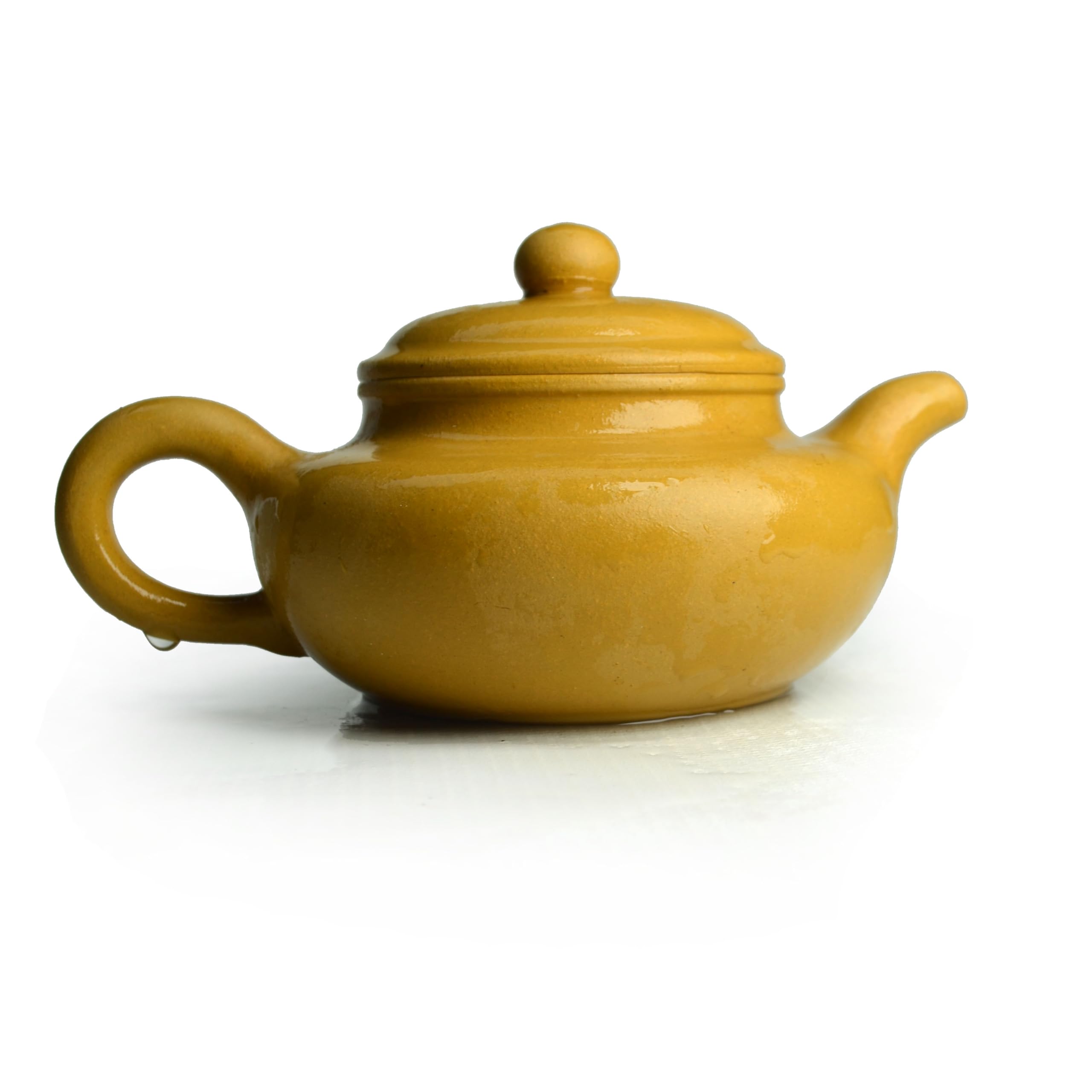
If you brew alone and want one pot that does everything, this 240ml/258ml zisha pot in the classic fanggu (arched, round-bodied) shape is where I would start. Handmade pots are never identical, so expect your own thumbprint-thin wall variation — the listing is upfront that handmade marks sit inside the pot.
The clay is unglazed Jiangsu Yixing zisha in yellow, which means it breathes and holds the scent of your tea. The listing also notes you can store dry leaf in it between brews, which is a genuinely useful trick for pu’er. And this is the pot that makes the size question clearest by contrast: it holds 240ml against the Artisan set’s 380ml, so it suits a single drinker rather than a table of two.
The honest catch is the price tier for the smallest capacity here — a smaller pot that sits just above the entry-level options. If you brew big rounds, look at the 14.2oz pot below instead. The rope linking lid and body is included for a reason: a lid this light will slip off a wet table.
What earns it the top spot
- 240ml is the sweet size for one person re-brewing through a session
- 0.2 kg keeps the pour steady even with a full pot of boiling water
- Unglazed zisha clay holds aroma and can store dry leaf between brews
- Lid rope and gift wrap included — no scrambling for a replacement lid
Where it asks for care
- Handmade variation means no two pots pour or feel identical
- It sits high in the entry-level band for its small capacity
- Narrow spout delivers a slow pour, so short bursts beat one torrent
Buy it for: solo oolong and pu’er sessions where one pot needs to do all the work.
Know first: the smallest capacity here means refilling more often than a shared pot.
2. Black Sand Yixing Clay Xishi Pot
The Xishi silhouette in black sand clay, sized to pour a clean cup for you and one companion.
HeiJinGang — black sand — is a separate zisha clay type, and it reads far darker than the yellow and zini pots here. That alone makes this one easy to keep for a single tea family without mixing two pots up. The Xishi body shape is the classic squat, rounded form, and at 6.8oz/200cc it pours for one comfortably or two in rounds. Heat retention lands among the things owners single out, and that tracks with a squat, thick-walled body.
This is also the lightest pot in the lineup at 8 ounces, roughly a third of the Zini 180ml pot’s 0.49 kg. That lightness is a real ergonomic plus when your wrist is doing twelve pours in a gongfu session. The ball filter handles whole-leaf oolong and pu’er without the shards slipping down the spout.
Here is the one thing to weigh: the durability read across reviews is mixed, with some pots reported cracking when hit with 175-degree water. That is not every unit — plenty come through sturdy — but it tells you to pre-warm the pot slowly rather than blast it cold with a hot pour. If you pour boiling water into a cold pot and expect zero risk, this is not the vessel for you.
The case for it: a lighter, darker, squat pot that pours well for one or two and holds heat — and the black clay keeps your tea families visually separate.
The catch: warm it up in slow steps. Handmade clay wants a gradual heat, and a sudden hot fill is the one way to shorten its life.
Reach for this if: you brew for one or two and want a darker clay pot as your second or your pu’er pot.
Look elsewhere if: you pour boiling water in cold straight from the tap and expect zero risk — pre-warming is part of the routine.
3. Yixing Zini Clay Xishi Teapot

A 180ml ball-filter pot for the drinker who wants a true small-format gongfu pour.
Some sessions want small and frequent. At 180ml this zini (classic purple clay) Xishi pot is built for exactly that: short, hot brews with a fresh pot every few minutes. It is the smallest capacity here — the Artisan set holds 380ml, a little over twice as much. For solo brewing that is not a downside; it is the format.
The ball filter sits at the heart of it. A perforated spherical strainer lets the leaf expand while the water flows clean, so a fine oolong or a broken pu’er does not end up in your cup. The clay body is zini, unglazed and ready to season. The dense, smooth-fired zini body also resists acid and base, a sign of a hard-fired pot rather than a soft one.
The counterweight: at 0.49 kg it is the heaviest single pot in the lineup, more than twice the weight of the black sand Xishi above. Full of water, that means a two-handed pour on the first few sessions until your wrist adjusts. And 180ml means more refills per session — fine for solo, less so for a crowd.
The honest read: a true small-format pot that gives you the ball filter and a dense zini body. It rewards patience and a slow pour.
Size note: 180ml is the working size for one drinker. If you regularly brew for two, the 380ml Artisan set gives you more room per round.
Matches you when: you want a tight, small-format ball-filter pot for solo gongfu and don’t mind a heavier lift.
Not for: big groups or anyone who wants a one-handed pour from a full pot.
4. Yixing Clay Tea Set 12.8 Oz

A signed 380ml pot with two cups and a certificate — a whole gongfu service in one box.
This is the only pick that arrives complete. You get the 380ml zisha pot, two gongfu cups, a certificate and a gift box. For a gift or for kitting out a first tea table, that packaging matters as much as the clay. The pot is a 50% handmade fanggu piece, mould-formed and hand-refined by Zhou Chenghua, an officially recognized Chinese craftswoman, and it bears her marks inside and out. That signature is the provenance story most artisan pots do not give you.
The clay is natural zini purple, listed as lead-free and cadmium-free, and its porous unglazed body holds aroma so a brew keeps tasting right for longer. It has a built-in strainer rather than a separate ball filter, so there is one less part to lose.
The honest limit is that a lot of this object is presentation: certificate, gift box, two cups. If you only want a working solo pot, the smaller picks give you the same clay for less. And the built-in strainer will not stop the finest dust the way a separate ball filter does. For a gift or a two-cup table, though, this is the most complete thing on the list.
What seals it: a real artisan signature, a certificate, and a full pot-plus-two-cups set at 380ml — a complete table in one purchase.
Fair warning: if you brew strictly alone, a smaller single pot spends less of your money on cups and packaging.
The one to give: a self-contained gongfu set for a wedding, a parent, or a friend starting out in tea.
Skip it for: pure solo brewing, where a smaller pot gives you more clay for the same money.
Know the Specs
Capacity in ml vs ounces
A Yixing pot’s working size is its capacity. 180ml to 240ml suits a single drinker re-brewing; 380ml to 420ml suits two people sharing a round. The specs here list capacity two ways — millilitres and fluid ounces — so watch for matching figures like 6.8oz/200cc and 14.2oz/420ml. Bigger is not better — it just means fewer refills per session.
Clay type: zini, zisha, and black sand
Zini is the classic purple clay; zisha is the broad family word for unglazed Yixing clay; HeiJinGang is a black sand variant. The one thing that matters is that the body is unglazed so it seasons. A glazed pot never takes on flavour. Check the material line says clay, and that the fire is high-temperature, which is stated on all the pots here.
Ball filter vs built-in strainer
A ball filter is a perforated sphere in the pot’s wall that lets water flow while holding back leaves. A built-in strainer is a set of holes inside the wall — simpler, one less part to lose, but less forgiving of fine dust. Both work for loose-leaf gongfu; ball filters handle fine shards better.
Weight and the lid rope
Weight tells you how the pot will pour. The pots here run from 8 ounces to 16 ounces and from 0.2 kg to 0.49 kg. A lighter pot is easier for one-handed pours with boiling water inside. A lid rope links pot and lid so the lid cannot drop and chip, and it is a practical clue that the lid sits loose-by-design.
Common Questions
What size Yixing teapot should I buy for brewing alone?
Do I need a ball filter or a built-in strainer?
Can I use the same Yixing pot for green tea and pu’er?
Why does my Yixing teapot sometimes crack when I add hot water?
Is a lid rope necessary on a Yixing teapot?
What does zisha mean and is it the same as zini?
Should I clean a Yixing teapot with soap?
What is the difference between the 380ml Artisan set and the 420ml single pot?
Why do these handmade teapots all look slightly different?
Do I need to season a new zisha teapot before using it?
The Bottom Line
For most drinkers, the best yixing zisha teapot here is the 240ml classics fanggu pot — the lightest at 0.2 kg, the most balanced capacity for one person, and made from unglazed zisha clay that will season with your tea. If you want a larger pour and a darker clay for pu’er, reach for the Zini 14oz pot. And for a gift or a complete two-cup gongfu table, the signed Artisan set is the one that arrives ready to serve.
How we choose
We do not accept paid placement. Every pick is matched to a real buyer and a real use-case; we do not hands-on test units.
Sources
Specifications: manufacturer listings and product documentation. Review insights: verified customer reviews, as of November 2026. Pricing: not shown on this page (it changes often); check the current price via the retailer link.
As an Amazon Associate, Tactical Gear Guy earns from qualifying purchases. This does not affect which products we feature.