Specs are compiled from manufacturer listings and verified buyer reviews and can change over time — please confirm the key details on the product page before buying.
If you want clean sashimi, the knife has to be a single-bevel yanagiba — a blade ground flat on one side with a hollowed back — because that geometry is what lets you pull a slice through fish in one stroke without tearing the flesh. A double-bevel chef’s knife crushes the cells and leaves a ragged edge. The nine picks below are all genuine yanagiba blades, and the mid-range SHAN ZU is the one most home cooks should start with, since it pairs a hard Japanese steel core with a comfortable octagonal handle and a real gift box.
This guide is built by comparing the manufacturers’ published specifications and the patterns across verified customer reviews, so you get each pick’s real strengths and trade-offs instead of marketing spin.
You will see blade length, steel hardness, and bevel angle explained in plain terms, so you can match a knife to the fish you actually cut. Read on for the full breakdown of the best Yanagiba Sushi Knife options worth your counter space.
Top Picks


How To Choose The Best Yanagiba Sushi Knife
A yanagiba is a slicer, not a chopper. It is built for long, smooth pull strokes through boneless fish, so every choice below is about getting a blade that glides rather than pushes. Get these four things right and the rest is detail.
Start with the single-bevel edge
The defining feature of a yanagiba is a single-bevel edge (one side flat-ground, the other hollowed out). That shape lets the blade pass through fish without dragging or crushing the flesh. Skip anything described as a double-bevel or Western slicer, because it will not give you the clean face a sashimi plate needs.
Match blade length to your cutting board
Longer blades allow a longer uninterrupted pull, which preserves texture. A 9.5-inch blade suits smaller fillets and tighter kitchens, while a 10.5-inch or longer blade lets you draw through a whole loin in one motion. Check that the length actually fits your board and counter before you commit.
Know the steel and its hardness
Hardness is measured on the Rockwell scale — the higher the number, the longer the edge holds but the more brittle the steel becomes. VG10 and 10Cr15MoV cores in the low 60s hold a keen edge well. Traditional high-carbon white steel can take an even finer edge but demands drying and oiling after every use.
Think about the handle and upkeep
Octagonal handles (eight-sided, so they index naturally in your hand) help you aim the blade and control the direction of the cut. Wood handles like rosewood, olive, and magnolia feel warm and reduce fatigue. Whatever you pick, plan on hand washing and drying, and on water whetstones for sharpening rather than a pull-through gadget.
Side-by-Side Comparison
| Model | Best For | Blade Length | Steel / Hardness | Weight | Amazon |
|---|---|---|---|---|---|
| SHAN ZU 10 Inch Sushi Knife★ Best Overall | Everyday sashimi at home | 10 inches | 10Cr15MoV / 62 HRC | 272 g | Amazon |
| Sashimi Sushi Knife 9.5 inch VG10Best Value | Beginners on a budget | 9.5 inches | VG10 / 58+ HRC | 7.68 ounces | Amazon |
| JapanBargain Yanagiba 10-1/2 InchLongest Reach | Long pull cuts, light hand | 10.5 inches | High carbon stainless | 4.8 ounces | Amazon |
| MITSUMOTO SAKARI 10 Inch Sashimi | Gift-ready traditional look | 10 inches | Tungsten alloy / 15° bevel | 5.92 ounces | Amazon |
| KEEMAKE 11.5 inch VG10 Yanagiba | Big fillets, long strokes | 11.5 inches | VG10 / 58+ HRC | 8.96 ounces | Amazon |
| HOSHANHO 10″ Sashimi Knife | Sharpness that lasts | 10 inches | 10Cr15CoMoV / 62 HRC | 6.4 ounces | Amazon |
| Masahiro Fukui Yanagi 10.6 inch | Pro-grade Japanese stainless | 10.2 inches (260 mm) | MBS-26 / HRc58-59 | 6.1 oz (170 g) | Amazon |
| FINDKING Prestige Yanagiba 10.5″ | Complete gift package | 10.5 inches | SKD11 Damascus | 2.3 pounds | Amazon |
| Yoshihiro Shiroko Kasumi Yanagi | Serious sushi craft | 11.8 inches | White Steel #2 / 62-63 HRC | 12.5 ounces | Amazon |
Detailed Reviews
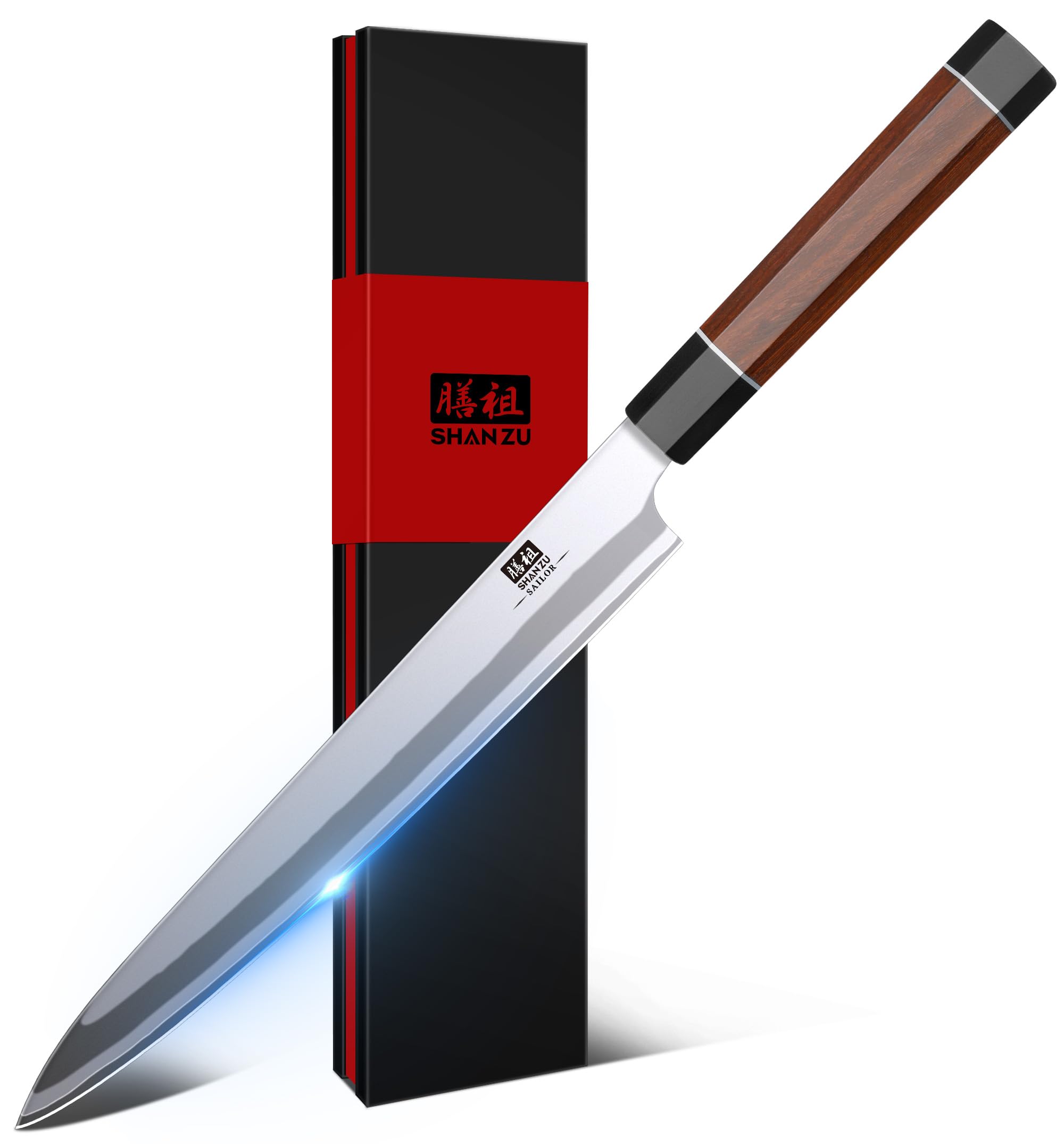
1. SHAN ZU 10 Inch Japanese Sushi Knife
Our pick — 4.5+★ from 500+ verified ratings; the strongest balance of quality and price.
Nine layers of forged steel and a 62 HRC core wrapped in a gift box — this is the yanagiba most home cooks should buy.
The SHAN ZU is the strongest all-round package here, and it is the one to start with if you are new to single-bevel knives. Its blade is a 9-layer forged structure — meaning nine sheets of steel are hammered and bonded into one solid piece — so it resists corrosion and chipping better than a thin stamped blade. At 10 inches long it gives you enough draw length for a whole salmon fillet without feeling unwieldy on a standard board.
The core is Japanese 10Cr15MoV steel hardened to 62 HRC (Rockwell hardness, a scale where higher means the edge holds longer). That means fewer trips to the whetstone. The 12° edge angle is the sharpening angle of the cutting bevel, and it is kept narrow so the blade glides through fish with little resistance. One honest catch: 62 HRC steel is hard, so it wants water whetstones and hand washing, not a pull-through sharpener or the dishwasher.
What wins people over is the balance of blade and handle. The octagonal handle is made from natural red sandalwood — an eight-sided shape that lets your fingers index the blade so you can aim the direction of each slice. It reduces hand fatigue across a long prep session and looks the part on a counter. The matte blade finish cuts down fingerprints and food residue, so the knife stays looking clean between wipes.
Why This Holds First Place
- 9-layer forged build resists chipping and corrosion
- 62 HRC core holds a keen edge across weeks of use
- 12° bevel slices clean and splits fish with little drag
- Octagonal red sandalwood handle aims the cut and cuts fatigue
- Ships in a presentation gift box, ready to give
Before You Commit
- Hard steel means whetstone sharpening, not a pull-through
- Hand wash and dry only, no dishwasher
- 10-inch blade needs a board with some length to it
Buy it if: you want a home yanagiba that arrives sharp, balanced, and gift-ready without a steep learning curve.
Hold off if: you want a knife you can toss in the sink and run through a sharpener — this one rewards hand care.
2. Sashimi Sushi Knife Japanese 9.5 inch Yanagiba
A 9.5-inch VG10 single-bevel for the cook who is testing the water on a real yanagiba.
Short, light, and built for a beginner’s hand. The KEEMAKE-made 9.5-inch is the smallest blade in this group, and at 7.68 ounces it is easy to control while you learn the draw-cut. Next to the JapanBargain at 4.8 ounces, its 7.68 ounces gives it a planted feel rather than a feathery one.
The core is Japanese VG10 high-carbon stainless, vacuum heat treated to 58+ Rockwell, and the edge is hand-sharpened between 12 and 15 degrees. That is a steel known for holding a fine edge while resisting rust, so it is a sensible first carbon-stainless blend. The 3.1 mm blade thickness is designed to push meat gently away from the edge instead of tearing it, which is exactly what you want on tuna and salmon.
What buyers consistently bring up is the overall quality for the price, and the natural rosewood handle gets credit for feeling solid with a smooth transition to the blade. The recurring note is sharpness — some arrive very sharp, others need a touch-up on a whetstone before the first slice. If you already own stones and know how to use them, that is a non-issue. If not, budget for a session.
The fit note that matters: this is stamped, not forged like the SHAN ZU, so treat it as a learning knife rather than a lifelong piece.
Reach for this if: you want to try a single-bevel slicer without committing to a full-price forged blade.
Look elsewhere if: you expect it to arrive razor-sharp every batch — some need a quick stone pass.
3. JapanBargain Japanese Yanagiba Knife 10-1/2 Inch
The lightest 10.5-inch blade on this list, made in Japan for long uninterrupted pull strokes.
At 4.8 ounces, this is the build you reach for when your wrist is tired. It is the lightest in the entire group, at 4.8 ounces versus the SHAN ZU at 272 g, and its 10.5-inch blade versus the 9.5-inch KEEMAKE. That extra length means fewer strokes per fillet, and fewer strokes means less chance of dragging through the fish.
The steel is high-carbon stainless, forged and made in Japan following traditional techniques. It is rust-resistant and easy to maintain, and the natural wood handle gives balance across a full prep session. The long, narrow profile is the classic yanagiba shape — built to preserve texture and appearance on seafood.
What earns the most praise here is the quality for the money, with buyers treating it as a budget Japanese knife that still feels genuine. The honest caveat is sharpness, which is genuinely mixed — some arrive fairly keen, others need work on the stone before they will cleanly cut sashimi. It is not a defect so much as a batch-to-batch variable.
The Case For It
- 4.8 ounces — light enough to slice for a long time without strain
- 10.5-inch blade handles whole fillets in fewer passes
- Made in Japan with forged high-carbon stainless steel
- Rust-resistant and simple to keep up
What To Expect
- Arrival sharpness varies — some need a whetstone session
- Light weight means less blade-forward heft than forged picks
Best for: cooks who value a feather-light blade and long pull cuts on a home budget.
Think twice if: you want a heavy, planted feel — this one is deliberately airy.
4. MITSUMOTO SAKARI 10 Inch Japanese Sashimi Knife
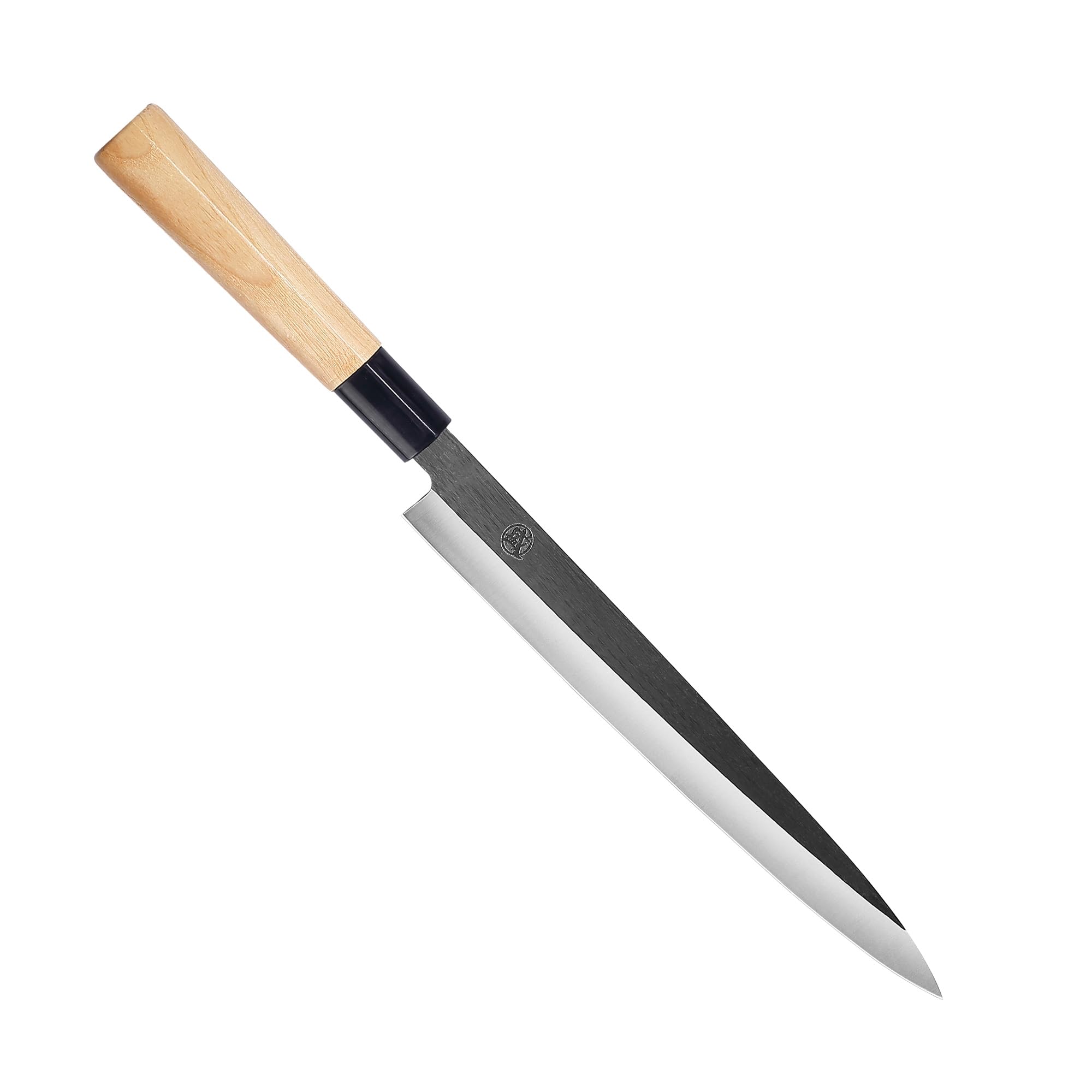
A hand-finished ash-wood handle and textured tungsten blade that looks as good as it cuts.
The first thing you notice is the handle — rare Manchurian ash wood, hand-finished, a dense grain that holds up to knife marks and shrugs off wet hands. It is a 10-inch blade with a precision 15° single-bevel edge (the grinding angle of the cutting side), and the textured blade surface is designed to keep fish from sticking as you slice. That matters on salmon, where a sticky blade turns one clean cut into a ragged pull.
The blade is forged from tungsten alloy, chosen for edge retention, and the oval handle contours to the hand to keep you comfortable through a long session. Beyond raw fish it handles soft herbs, sushi rolls, and fruit garnishes, so it earns its drawer space between sushi nights.
The catch is quality consistency. Buyers are genuinely split on this knife — some find it sharp and well made, others find it not as sharp as the listing claims. That is worth knowing before you buy it as a gift: it is a lovely-looking piece, but if pristine out-of-box sharpness is your must-have, set expectations.
The real draw: the hand-finished ash handle and textured blade give it a distinctive feel that stands out for the price.
And the honest note: sharpness and overall quality land as mixed, so buy it for the look and handle, not a guaranteed edge.
Choose this if: you want a striking traditional knife that doubles as a serious gift.
Pass if: you need a blade that is guaranteed razor-sharp on day one.
5. Sushi Knife Japanese 11.5 inch Sashimi Knife

The longest of the KEEMAKE pair, at 11.5 inches — built for whole loins and long draw strokes.
If you regularly break down big fish, the length is the whole story. This is an 11.5-inch blade versus its 9.5-inch sibling, and at 8.96 ounces it carries noticeably more weight forward. That longer blade lets you draw through a whole tuna or salmon loin in fewer, smoother passes, which is the entire point of a yanagiba.
The steel matches its smaller sibling — Japanese VG10 high-carbon stainless, vacuum treated to 58+ Rockwell, hand-sharpened between 12 and 15 degrees. The 3.1 mm single-bevel blade is designed to push meat away from the edge so it slices without tearing, and the natural rosewood handle creates a smooth transition from blade to grip for control across that long stroke.
Where this one gets honest: quality and value are both genuinely split in buyer feedback. Some find it a good, capable knife; others find it doesn’t live up to the long-blade promise. That split is worth weighing against the extra length — if you don’t truly need 11.5 inches, the smaller KEEMAKE is the safer bet.
Fits: cooks who fillet large fish and want maximum blade length for long, single-stroke cuts.
Skip if: you mostly cut small portions — the length is a burden, and the quality reviews are divided.
6. HOSHANHO Sushi Knife 10″
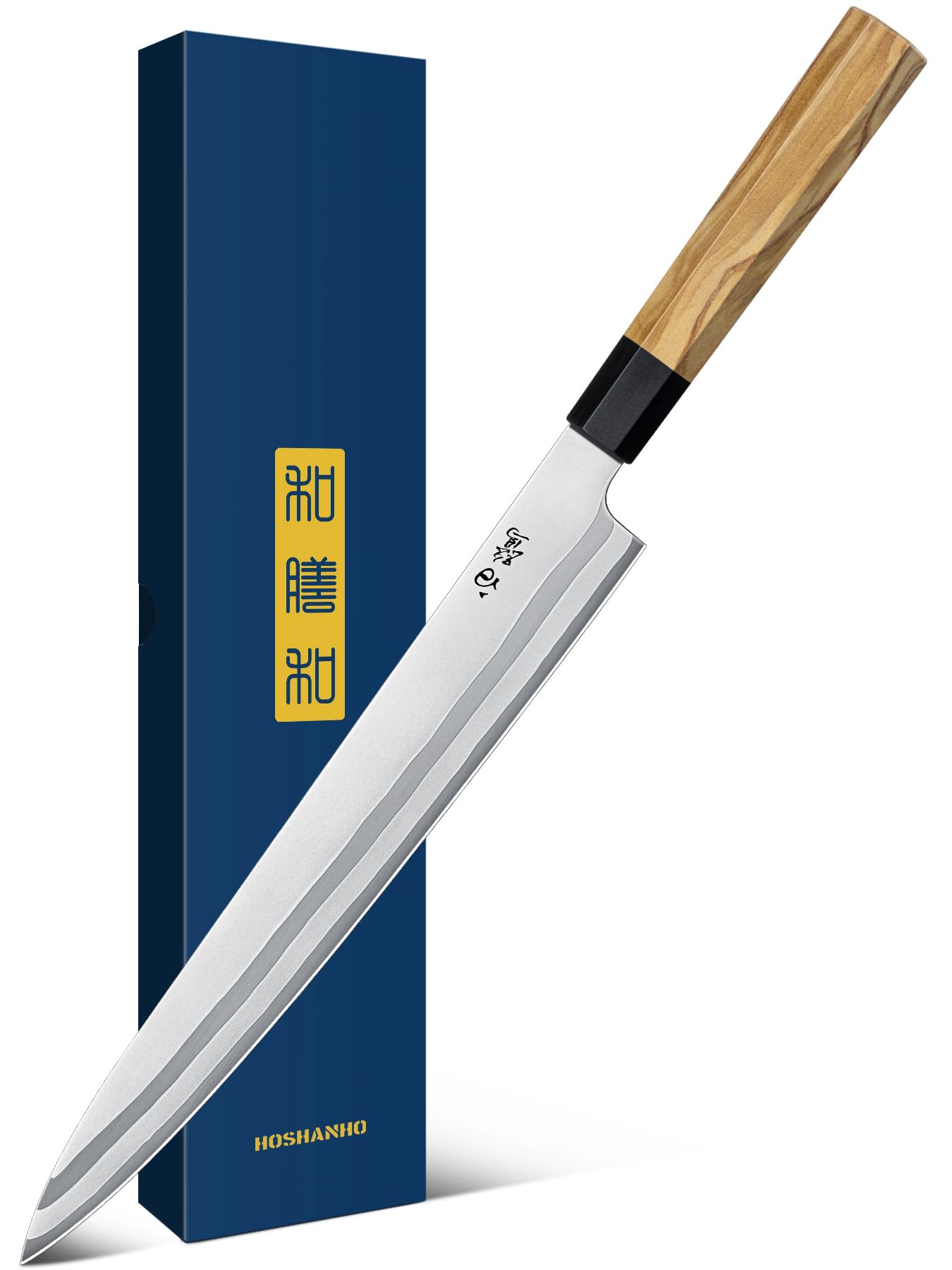
A mirror-polished 12° edge on a 62 HRC core — this one is built to stay sharp.
What sells this blade is the edge and the steel behind it. The Japanese 10Cr15CoMoV high-carbon core is heat treated to a hardness of 62 HRC, which is the same hardness tier as the SHAN ZU. That hardness means the edge resists wear through frequent use, so you sharpen less often. The 12° bevel is honed narrow and mirror-polished so it slices through fish flesh while preserving the cellular structure — the difference between a clean sashimi face and a bruised one.
The handle is the other story. It is precision-machined from high-density olive wood with rounded octagonal edges, so it prevents slip and rotation and balances the blade in your hand. At 6.4 ounces it sits in the middle of the weight range — heavier than the JapanBargain’s 4.8 ounces but lighter than the KEEMAKE 9.5-inch at 7.68 ounces, a comfortable all-day feel.
This is where the buyer consensus really backs it up: blade quality is the standout, followed closely by sharpness, and the knife is described as cutting flawlessly in single strokes. Owners find it superior quality for the price. The only thing to know is that beyond sashimi, it is pitched as a multi-purpose slicer — if you want a dedicated fish-only blade, that is fine, it just does more.
Where It Shines
- 62 HRC core keeps the edge sharp across frequent use
- 12° mirror-polished edge cuts clean without bruising flesh
- High-density olive wood octagonal handle resists slip
- Solid blade quality and sharpness reputation for the price
Worth Knowing
- Pitched as multi-purpose, not purely a fish-only slicer
- Hard steel still wants water whetstones and hand care
Go for it if: edge retention is your top priority and you want a blade that stays sharp between sessions.
Reconsider if: you insist on a single-purpose sashimi knife with no crossover pretensions.
7. Masahiro Fukui Stainless Steel Yanagi Blade 10.6 inches

A workhorse Japanese stainless yanagiba for cooks who want a hard-use blade that shrugs off rust.
This is the pick for anyone who dreads the upkeep of carbon steel. The blade is Masahiro’s original MBS-26 stainless — a steel with 0.9% carbon, 13% chrome, molybdenum, and vanadium — hardened to HRc58-59. The chrome content gives it real rust resistance, so you are not chasing oxidation like you would with white steel, and the molybdenum and vanadium add toughness.
The blade is about 10.2 inches (260 mm) long with a base thickness of roughly 2.5 mm, and it weighs 6.1 oz (170 g) — light and controlled in the hand. It is forged with a semi-tang (the tang is the metal extension into the handle), made in Japan. For a pro kitchen or a serious home cook, this is the steel you can use hard without babying it.
What buyers appreciate most is the quality, backed up by honest sharpness — it is described as able to hold an edge through a lot of abuse, which is exactly what a stainless MBS-26 core is for. It is a solid value for what it delivers. The trade-off is character: it is a tool, not a showpiece, so don’t expect the grain patterns of a Damascus blade.
The case for stainless: 13% chrome and a 58-59 HRc core mean real rust resistance and an edge that holds up to hard use.
Fair warning: it is a plain, practical blade — no visual drama.
Pick this if: you want a hard-use stainless yanagiba that survives a busy kitchen without carbon-steel fuss.
Not for you if: you want a decorative showpiece for the counter.
8. Prestige Series Yanagiba Knife 10.5 Inch
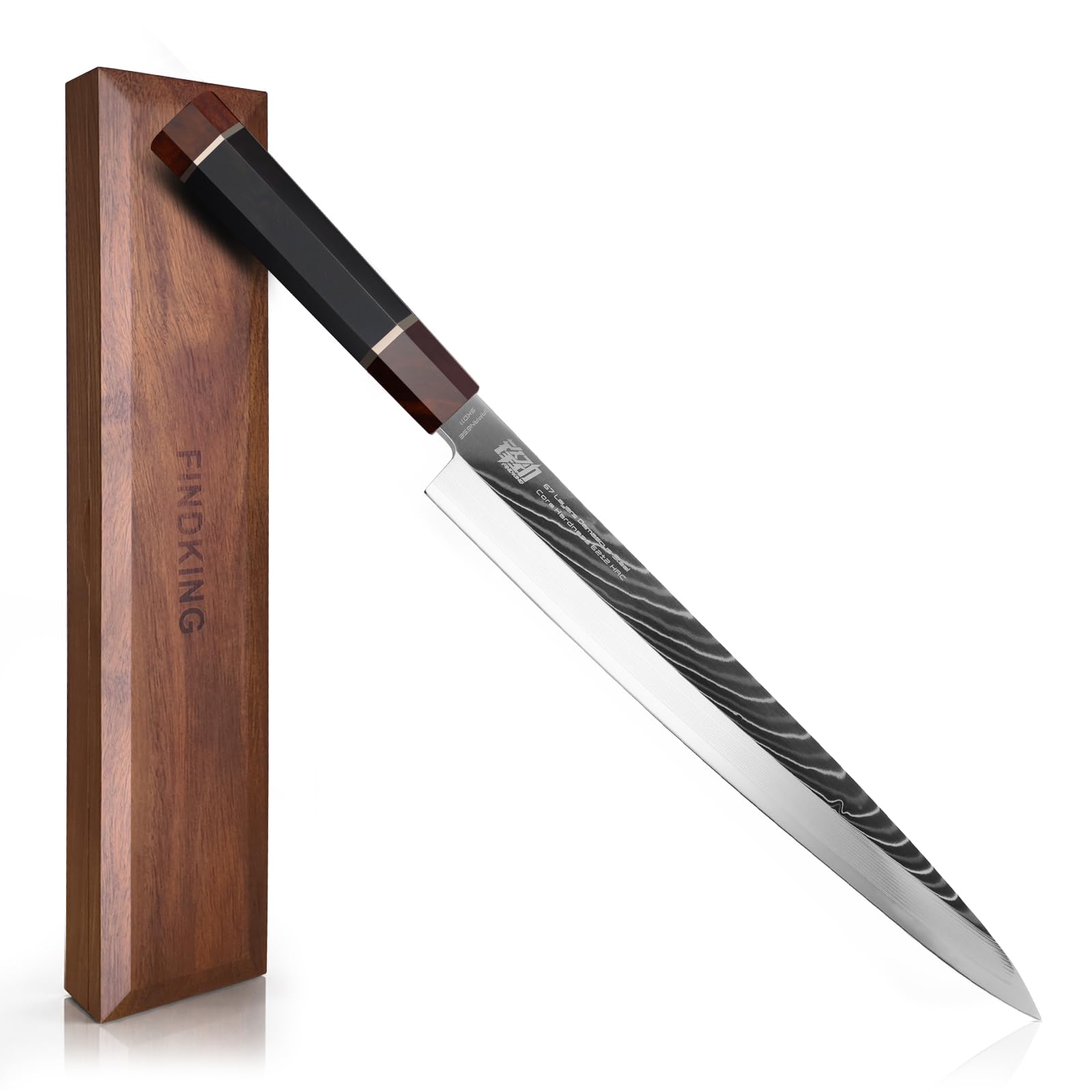
The complete package — Damascus blade, ebony octagonal handle, walnut saya, wooden gift box.
If you are buying a yanagiba as a gift or want a full setup out of one box, this is the one. The 10.5-inch blade is made from Japanese SKD11 alloy steel, built for edge retention and durability, and the Damascus pattern adds a visible finish that catches light. The single-bevel edge helps guide each slice with accuracy and control, and the blade is made for a smooth draw-cut motion through sashimi, sushi, and fish fillets.
The handle combines ebony wood, sapele mahogany, and copper spacers in an octagonal shape, so it sits stable in the hand and reduces fatigue during long slicing runs. It also ships with a fitted walnut saya cover with felt lining to protect the edge between uses, plus a wooden presentation box with inner cushioning. That is more included hardware than any other pick here.
What buyers rave about is that it looks like a work of art and cuts cleanly — the kind of knife that slices “like a hot knife through butter.” Quality and sharpness are both strongly praised. The value is where opinions divide — some think it is a great deal, a few feel otherwise. It is also the heaviest pick at 2.3 pounds, so factor that in if you like a light blade.
The Bundle Advantage
- SKD11 Damascus blade with a refined pattern finish
- Ebony and mahogany octagonal handle with copper spacers
- Walnut saya with felt lining protects the edge in storage
- Wooden gift box makes it a ready presentation piece
Weigh These
- 2.3 pounds — the heaviest in this group by a wide gap
- Value opinions divide among buyers
Choose it when: you want a complete, gift-ready yanagiba set with a protective saya and case in one purchase.
Weigh it if: you favor a featherweight blade — this one has real heft at 2.3 pounds.
9. Yoshihiro Shiroko Yanagi Sushi Sashimi Chef Knife 11.8″

Handcrafted White Steel #2 at 62-63 HRC — the most traditional blade here, and it asks the most of you.
This is the pick for the cook who has committed to sushi craft. The blade is White Steel #2 (a high-carbon Japanese steel) forged with iron to create the misty Kasumi pattern, hardened to 62-63 on the Rockwell scale — the hardest in this group. It is a genuine single-bevel yanagiba with a flat Shinogi grind on the front, a concave Urasuki on the back, and a flat Uraoshi rim. That combination cuts with minimal damage to the surface cells, which protects the texture and taste of the fish.
The blade is 11.8 inches long and the handle is a traditional D-shaped Wa handle in magnolia wood, lightweight and shaped to weld to the hand. At 12.5 ounces it is the heaviest hand-built piece here. A protective wooden sheath called a saya is included, and the knife is made in Japan by hand, not mass produced.
The reality check is care. Carbon steel can oxidize if not properly maintained, so you must hand wash and dry immediately after acidic ingredients and oil regularly. Sharpening should be on water whetstones only. The reviews back up the performance — it cuts like butter through salmon and tuna — but durability feedback is genuinely mixed, with some reporting chips from slicing. That is the trade-off of a very hard, very fine edge: treat it like a precision instrument, not a cleaver.
Why it earns its following: White Steel #2 at 62-63 HRC and a true Shinogi/Urasuki/Uraoshi grind give it a level of cutting refinement the stainless picks cannot match.
The real cost: carbon steel needs drying and oiling, whetstones only for sharpening, and the very hard edge can chip if abused.
Best for: cooks who understand carbon steel and will give this blade the water-stone sharpening and dry-and-oil routine it needs.
Not the one if: you want low-maintenance stainless — this is the highest-care knife in the group.
Know the Specs
Blade Length
The length of the cutting edge, measured from the heel to the tip. A longer blade lets you make longer, fewer pull strokes through a fillet, which preserves the fish’s texture. Shorter blades like the 9.5-inch are easier to control on small cuts and in tight kitchens. Match length to the size of fish you actually prepare and to the length of your board.
Rockwell Hardness (HRC)
A scale that measures how hard the steel is. Higher numbers hold a keener edge longer but make the steel more brittle, so a very hard carbon blade needs to be kept off bones and frozen food. Lower hardness trades some edge life for toughness. The picks here range from around 58 to 63 HRC.
Single-Bevel Geometry
A yanagiba is ground flat on one side with a hollowed back. That asymmetry is what lets the blade slice cleanly through fish rather than push and crush it. It means the knife is sharpened differently from a double-bevel blade, and the hollow back needs to be kept flat on the stone when honing.
Steel Type
Stainless steels (VG10, MBS-26, SKD11) resist rust and need less upkeep. High-carbon traditional steels like White Steel #2 take an exceptionally fine edge but can oxidize, so they demand drying and oiling after use. Choose stainless for convenience, carbon for the finest edge and traditional craft.
Common Questions
What is the difference between a yanagiba and a regular chef’s knife?
Can I use a yanagiba for vegetables or chicken bones?
Do I need to sharpen a new yanagiba from the start?
What length yanagiba should I buy?
Is stainless steel or high-carbon steel better for a yanagiba?
How do I keep a high-carbon yanagiba from rusting?
Can I sharpen a single-bevel knife with a pull-through sharpener?
Is the FINDKING Prestige a good gift knife?
Will a yanagiba work for cutting sushi rolls and garnishes?
How often do I need to sharpen a yanagiba?
The Bottom Line
For most home cooks, the winner is the SHAN ZU 10 Inch Sushi Knife — nine-layer forged steel, a 62 HRC core that holds its edge, a 12° bevel for clean slices, and an octagonal red sandalwood handle that aims your cut. If a longer, feather-light blade fits your hand better, reach for the JapanBargain 10-1/2 Inch at just 4.8 ounces. And if you want a gift-ready complete set, the FINDKING Prestige Yanagiba arrives with a sai and wooden box. One honest nudge: the SHAN ZU is the strongest starting point, and buying it now means you learn on a real single-bevel blade rather than fighting a cheap slicer.
How we choose
We do not accept paid placement. Every pick is matched to a real buyer and a real use-case; we do not hands-on test units.
Sources
Specifications: manufacturer listings and product documentation. Review insights: verified customer reviews, as of November 2026. Pricing: not shown on this page (it changes often); check the current price via the retailer link.
As an Amazon Associate, Tactical Gear Guy earns from qualifying purchases. This does not affect which products we feature.