Specs are compiled from manufacturer listings and verified buyer reviews and can change over time — please confirm the key details on the product page before buying.
If you catch, the pitch that hurts is the foul tip that lands on the inside of your wrist. A good wrist guard sits between your skin and the ball, and the four picks below cover every job from a lace-on catchers’ guard to a gel shell that hardens into a custom shield. The short answer: the All Star Pro Lace On Wrist Guard is the strongest overall choice, because it laces straight onto your mitt and weighs just 1.76 ounces. The crowd favorite among catchers, it holds 4.5+ stars across 600+ ratings.
This guide is built by comparing the manufacturers’ published specifications and the patterns across verified customer reviews, so you get each pick’s real strengths and trade-offs instead of marketing spin.
Some guards mold to your wrist, some strap onto your glove, and one covers your whole hand at the plate. Here is how each one actually behaves in a game, so you can pick the right wrist protection for baseball instead of guessing.
Top Picks

How To Choose The Best Wrist Protection for Baseball
Start with your position, because that decides the shape of the guard before anything else matters. A catcher takes foul tips and wild pitches on the exposed wrist behind the glove. A hitter takes a fastball off the back of the hand. Those are two different pieces of gear, and buying the wrong one leaves the vulnerable spot bare.
Match the guard to the job behind the plate
If you catch, the guard has to stay put while you flex your wrist to receive a pitch. A lace-on guard threads through your mitt so it moves with the glove instead of sliding around your arm. A pull-on sleeve relies on compression to hold a shield in place. Both work, but the lace-on style stays anchored when you block a ball in the dirt.
Know how the shield actually hardens
Gel-to-shell guards arrive soft and flexible, then stiffen into a shield molded to your own wrist after you activate them. That molding step is what makes the fit feel custom rather than generic. It also means the guard is shaped to one wrist, so a hand-me-down may not mold as cleanly the second time around.
Measure your wrist, not your hand
Wrist guards are sized by circumference, and the difference between sizes is small. A guard that is too loose rides up your forearm and leaves the bony part of the wrist uncovered. One that is too tight pinches when you squeeze the glove. Wrap a tape measure around the wrist bone and order to that number.
Side-by-Side Comparison
| Model | Best For | Weight | How It Attaches | Shield Type | Amazon |
|---|---|---|---|---|---|
| All Star Pro Lace On Wrist Guard with Strap★ Best Overall | Catchers who want it fixed to the mitt | 1.76 ounces | Laces onto the mitt, plus strap | Fitted guard | Amazon |
| EvoShield MLB Protective Speed Stripe Wrist Guard | Players who want a molded custom fit | — | Pull-on neoprene sleeve | Gel-to-shell, custom molding | Amazon |
| Franklin Sports PRT Baseball + Softball Hand + Wrist Guard | Hitters guarding the hand at the plate | 4 ounces | Finger loops plus wrist strap | Soft shell that hardens on impact | Amazon |
| EvoShield Pro-SRZ™ 2.0 Protective Wrist Guards | Players who want a molded shield and a sleeve | 0.1 kg | Compression sleeve holds the shield | Gel-to-shell, 30-minute mold | Amazon |
Detailed Reviews
1. All Star Pro Lace On Wrist Guard with Strap
Our pick — 4.5+★ from 650+ verified ratings; the strongest balance of quality and price.
A lace-on guard that stays fixed to your mitt through every pitch.
The reason this one wins for catchers is the attachment, not the padding. It laces directly onto the mitt, so the guard stays locked in the same spot as your glove while you set up, receive, and block. That means the exposed wrist bone behind the glove is covered before the pitch even leaves the hand. It weighs 1.76 ounces, which is light enough that you stop noticing it by the second inning.
What wins people over here is the build — 60 owners single out quality as the standout trait, with wrist protection close behind at 40. Those two numbers describe the same experience: the guard feels solid on the arm and the protection shows up in the exact spot foul tips land. It is built for adults, arrives in a 4.5-inch large size, and the pull-on style with a strap keeps the fit steady as you move.
Here is the honest catch. The Velcro is the most-discussed weak point — several catchers have found the strap hook-and-loop wears out faster than the guard itself. Treat the closure kindly, keep it clean of dirt and rosin, and you are likely to get a long life out of the shell. For a catcher who wants to low-maintenance behind the plate, nothing here is more practical.
What Catchers Get
- Laces onto the mitt so the guard cannot slide off the wrist mid-play
- 1.76 ounces — light enough to forget it is on
- Streamlined 4.5-inch fitted design that stays close to the arm
The Wear Point To Watch
- Velcro has a mixed reputation and can loosen over a long season
- One size listed for adults, so fit depends on your wrist measurement
Reach for this if: you catch regularly and want the guard attached to the glove instead of floating on your arm.
Think twice if: you play the field only and never wear a mitt — you would be paying for a lacing system you cannot use.
2. EvoShield MLB Protective Speed Stripe Wrist Guard
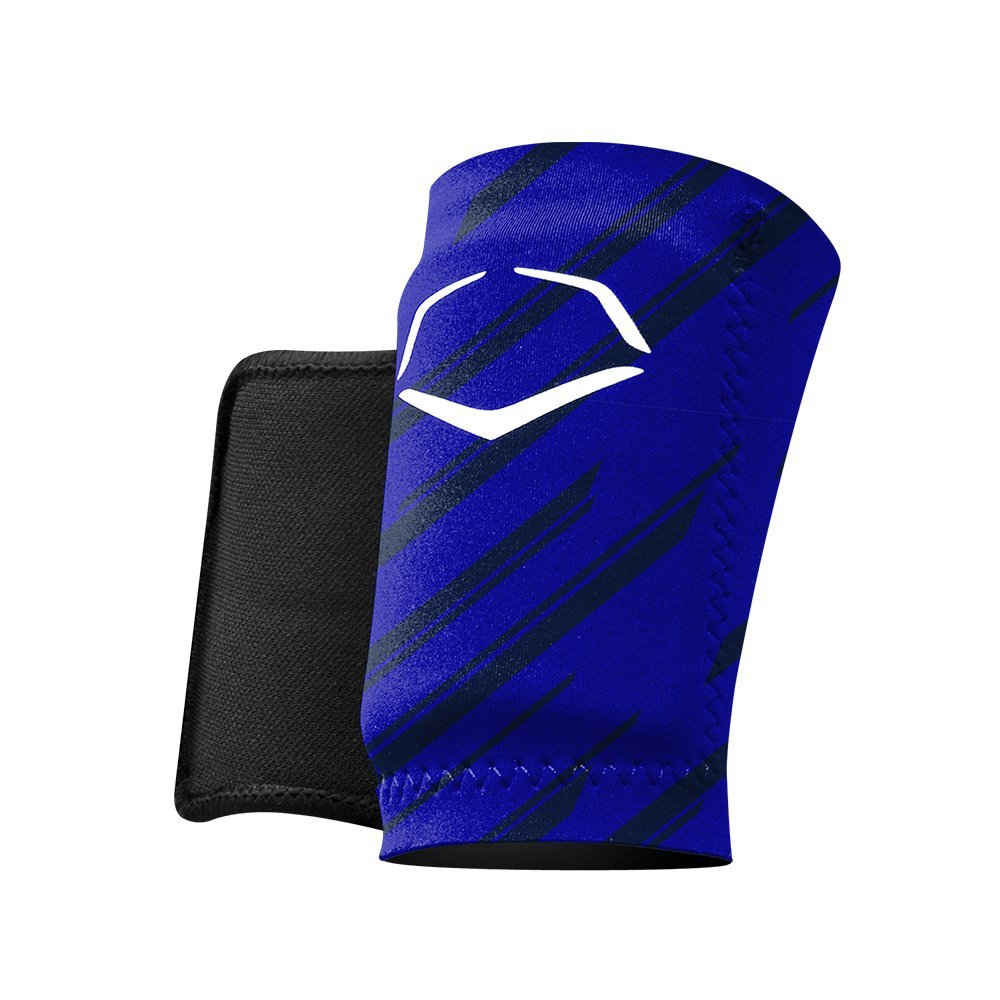
A soft gel shield that cures into a hard shell molded to your wrist.
The trick with this guard is the material. The gel-to-shell shield starts soft and flexible, then cures into a hard barrier in minutes, so it sets to the exact curve of your wrist. A neoprene sleeve holds the shield in place with a compressed fit, and you can wear it on either the inside or the outside of the wrist depending on which side you need covered.
That custom fit is the whole point of the design. Rather than a generic pad that sits flat against the arm, the shell takes the shape of your wrist as it cures, so there is less empty space between you and the impact. EvoShield rates it for men, women, and kids, which makes it a sensible pick for a youth player moving up a level as well as an adult who wants the same molded feel.
Relative to the All Star guard above, this one suits the player who moves between positions. There are no laces tying it to a mitt, so it works equally well in the field, at the plate, or behind it. The trade-off is that molding is a one-time step — once the shell sets, it is shaped to that wrist for good. Get the fit right on the first try, because a re-mold will not come out as clean.
Where it earns its spot: a soft-then-hard shell and a stretch sleeve give you a guard that hugs the wrist instead of rattling around on it, and the inside-or-outside option means you point the protection exactly where you take contact.
One thing to plan for: the mold sets once, so measure and re-check the position before you activate the material.
The fit-first pick: choose this if you want a molded shield that follows your wrist shape rather than a strap-first design.
Not the one for you if: you share gear with teammates — a molded shell is shaped to one wrist.
3. Franklin Sports PRT Baseball + Softball Hand + Wrist Guard

The plate-side guard that covers hand and wrist in one piece.
Here is the piece that covers the spot nobody thinks about until a fastball rides in. This is a hand guard with a wrist protector attached, built to absorb impact at the plate rather than to catch pitches. The interior shell is pre-curved to sit against the back of your hand, covering the spot a pitch rides in on. That means protection over the back of the hand — the classic hit-by-pitch target.
At 4 ounces it is noticeably heavier than the All Star lace-on guard, which makes sense once you see what it covers. The dual-hand design works for right-handed and left-handed hitters alike: slide the finger loops over your chosen fingers, then cinch the wrist strap. One owner noted it works well for 13U and older travel ball, and another mentioned it does not interfere with the swing — the two questions every hitter asks first.
What holds up in the field is the overall build, with quality the most-praised trait and protection right behind it. The shell stiffens on contact to spread the force, and the wrist strap holds it tight against the hand through the swing. The trade-off is that this is plate gear, not a catchers’ guard. If you are crouching behind the dish taking foul tips, you want a lace-on guard, not a hand shell.
What Earns It A Slot
- Protects hand and wrist in one piece instead of two separate items
- Works for right and left-handed hitters with a simple loop-and-strap setup
- Shell hardens on contact to spread the force of the pitch
Weigh Before You Commit
- 4 ounces is heavier than a catchers’ lace-on guard and takes getting used to
- Designed for the plate, so it is the wrong tool for a catcher behind the dish
The hitter’s answer: buy this if your worry is a pitch riding in on your knuckles rather than your glove hand.
skip it if: you catch and need protection behind the mitt — the lace-on guard up top is built for that job.
4. EvoShield Pro-SRZ™ 2.0 Protective Wrist Guards

A molded shield held tight by a compression sleeve.
This is the top-tier version of the gel-to-shell idea, and the headline number is 30 minutes — that is how long the air-activated material takes to go from a malleable gel into a customized, form-fitting shield. The package gives you two pieces: a compression sleeve and the shield itself. The sleeve holds the shield in place, while the shell deflects and disperses impact across its full surface rather than letting force land in one spot.
Sizing is the part to get right before you order. EvoShield tells you to measure your wrist circumference and match it to the scale: S for 5 to 6 inches, M for 6 to 7 inches, L for 7 to 8 inches, and XL for 8 to 9 inches. Do that measurement with a tape around the wrist bone, and the fit is snug rather than sloppy. The listing is set up for youth sizing, so check your number against the scale rather than assuming.
What buyers notice is the protection itself, with snug fit a close second in the feedback. Catchers report the sleeve steadies the wrist and makes it easier to get up and throw after a block. Compared to the Speed Stripe guard from the same brand, this one adds the dedicated compression sleeve and the full-surface dispersion, which is what the premium step buys you.
The premium payoff: a molded shield plus a compression sleeve means the guard stays put while you move, and the shell spreads impact across the whole piece instead of one hot spot.
The honest catch: value is the mixed part of the picture here — some players see the worth, others do not, so this is the pick to choose when the custom fit matters more to you than the entry-level option.
The step-up choice: go here if you want the full sleeve-and-shield setup and a molded fit at the wrist.
Only if the fit is right: measure your circumference first — a molded shield cannot be re-sized once it sets.
Know the Specs
Gel-To-Shell Material
This is an air-activated material that arrives soft and bendable, then hardens into a shield shaped to your wrist. The advantage is a fit that follows your own wrist rather than a flat pad that sits away from the arm. The catch is a one-time set: once the shell cures, it holds that shape, so measure and position it carefully before you activate it.
Weight In Ounces
Weight decides whether you keep the guard on for a full game. A lace-on guards’ guard in the 1.76-ounce range disappears on your arm, while a 4-ounce hand-and-wrist shell is heavier because it covers more skin. Pick the lightest piece that covers the spot you actually get hit, and you will wear it without thinking about it.
Wrist Circumference Sizing
Guards are sized by the distance around your wrist, not your hand. EvoShield’s scale runs S at 5 to 6 inches, M at 6 to 7 inches, L at 7 to 8 inches, and XL at 8 to 9 inches. Measure around the wrist bone with a soft tape, then order to that number. A guard that is too loose slides up the forearm and leaves the wrist bone exposed.
Closure And Attachment
How a guard attaches decides whether it stays put. Laces thread through the mitt and lock the guard to the glove, a pull-on sleeve uses compression, and a finger-loop-and-strap setup anchors to the hand. Each holds the shield in a different spot, so choose the attachment that matches your position rather than the one that looks toughest.
Common Questions
Will a lace-on wrist guard fit my catcher’s mitt?
How do I measure my wrist for a wrist guard?
Is a gel-to-shell guard better than foam and plastic?
Can a hitter wear wrist protection during a swing?
What is the difference between a catchers’ wrist guard and a batting hand guard?
How long does a gel-to-shell wrist guard take to mold?
Can I wear a wrist guard on the inside of my wrist?
How do I clean a molding wrist guard?
Can kids wear these wrist guards?
The Bottom Line
For most catchers, the wrist protection for baseball winner is the All Star Pro Lace On Wrist Guard with Strap, because it laces straight onto the mitt, weighs 1.76 ounces, and stays exactly where the foul tips land. If you want a molded shield that shapes to your own wrist, grab the EvoShield Pro-SRZ 2.0. And for protecting the hand at the plate, the Franklin Sports PRT Hand + Wrist Guard is the one to reach for. Catchers who want to stop thinking about their wrist entirely should start with the top pick — it has the highest rating here and the most catchers behind it.
How we choose
We do not accept paid placement. Every pick is matched to a real buyer and a real use-case; we do not hands-on test units.
Sources
Specifications: manufacturer listings and product documentation. Review insights: verified customer reviews, as of November 2026. Pricing: not shown on this page (it changes often); check the current price via the retailer link.
As an Amazon Associate, Tactical Gear Guy earns from qualifying purchases. This does not affect which products we feature.