Specs are compiled from manufacturer listings and verified buyer reviews and can change over time — please confirm the key details on the product page before buying.
If you want one answer: the Gyokucho Razorsaw Ryoba is the safest pick for most people, because its 22 TPI crosscut and 9 TPI rip edges cover both cuts on a.018-inch blade that follows your pencil line. But the right Japanese tool depends on the job: saw for joinery, kanna for surface, chisel for mortises. A pull saw trims and joinery, a kanna plane smooths a board face, and an oire nomi chisel cuts a mortise. This guide sorts all nine by task, so you can buy one great tool instead of five wrong ones.
This guide is built by comparing the manufacturers’ published specifications and the patterns across verified customer reviews, so you get each pick’s real strengths and trade-offs instead of marketing spin.
You will see which blades are thin enough to track a line, which planes need a hammer tap to set, and which saws swap teeth in seconds. Here is the shortlist of woodworking tools japanese worth your bench space.
Top Picks


How To Choose The Best Woodworking Tools Japanese
The biggest mistake first-time buyers make is assuming a Japanese saw works like a Western saw. It does not. A Japanese pull saw cuts on the stroke toward you, not away. That pull tension is why the blade can be.018 inches thin and still cut a clean line.
Pull stroke versus push stroke
A push saw needs a thick blade so it does not buckle under pressure. A pull saw is under tension as you draw it back, so the steel can be thinner without bending. The Gyokucho Razorsaw blade is just.018 inches thick. That thinness is what lets it turn a tight corner in a dovetail without wandering.
Your first few cuts will feel strange, because the saw bites as you pull rather than as you push. Start slow, let the teeth set the line, then lengthen your stroke. Most people find the control comes within a board or two.
Which tool does which job
A Ryoba double-edge saw is the generalist. One side has rip teeth for cutting with the grain, the other has crosscut teeth for cutting across it. If you only buy one Japanese saw, buy this style.
A kanna plane is the finisher. It takes thin shavings off a board face and brings out the grain on surfaces people will see. A chisel set is for joinery — mortises, tenons, and paring cuts where a saw cannot reach.
Blade steel and how you keep it sharp
Laminated steel means a hard cutting layer bonded to a softer iron backing. It stays sharp and is easier to hone on a whetstone than a solid hard blade. Replaceable-blade tools skip sharpening entirely — you just swap in a fresh edge.
Side-by-Side Comparison
| Model | Best For | Blade / Cutting Width | Tooth Count (TPI) | Weight | Amazon |
|---|---|---|---|---|---|
| Gyokucho Razorsaw Ryoba 9-1/2″★ Best Overall | All-round first saw | 9.5 in blade,.018 in thick | 22 crosscut / 9 rip | 185 g | Amazon |
| SUIZAN Ryoba 8″Best Traveler | Travel and small joinery | 8.27 in blade, 0.5 mm thick | 7–12 rip / 14 crosscut | 6.17 oz | Amazon |
| KAKURI Block Plane 30mmEasiest Start | Beginners who hate sharpening | 30 mm blade, 23 mm cut | — | 9 oz | Amazon |
| Temple Tool Co. Pull Saw 9.5″ | Looks and heritage | 9.5 in blade, high carbon steel | — | 0.32 kg | Amazon |
| Senkichi Kanna 50mm | Wide smoothing passes | 50 mm blade | — | 680 g | Amazon |
| SUIZAN Kanna 2″ | Serious smoothing | 50 mm blade, 43 mm cut | — | 22.9 oz | Amazon |
| KAKURI Kanna 50mm | Two-handed control | 50 mm blade, 42 mm cut | — | 1.4 lb | Amazon |
| KAKURI Chisel Set 3-Piece | Mortise and tenon | 9 / 15 / 24 mm blades | — | — | Amazon |
| TAJIMA Pull-Stroke Set | Flush cuts and trim | 2 blades, 16 & 19 TPI | 16 / 19 | 13.44 oz | Amazon |
Detailed Reviews
1. Gyokucho Razorsaw 9-1/2″ Double Edge (Ryoba) For Hardwoods
Our pick — 4.5+★ from 650+ verified ratings; the strongest balance of quality and price.
One saw that rips, crosscuts, and still weighs barely more than a phone.
Start with what this saw does to a board. The blade is 9-1/2 inches long with a.018-inch thickness, which is thin enough to slice a narrow kerf and stiff enough to track a straight pencil line. One side carries 22 teeth per inch for clean crosscuts, the other carries 9 teeth per inch for fast ripping with the grain. You get two saws in one handle.
Hardwood is where it earns its place. The teeth are cut specifically for hard or abrasive woods, so oak and maple do not dull the edge as fast as they would on a general-purpose blade. The wood handle and 185-gram weight keep it balanced in one hand. Across 650+ owner ratings it sits at 4.5+ stars — one of the strongest scores here — and reviewers credit its raw cutting speed in hardwood.
The honest catch is that a thin blade rewards light hands. Owners describe the ease-of-use side as mixed, largely because a pull saw punishes a heavy push the way a Western saw never does. Feed it gently and it will reward you with a cut that needs almost no cleanup.
What earns the top slot
- Rip and crosscut on one tool, so you cover both jobs with a single purchase
- .018-inch blade leaves a narrow kerf and follows a line without wandering
- Built for hard and abrasive woods, so oak and maple do not chew the teeth
Where your technique matters
- Thin blade wants a light pull; pushing it hard can kink or snap it
- The 9.5-inch blade is short next to the 23-inch overall body, so long rips take patience
Reach for this if: you want one do-everything pull saw and you are willing to learn the pull stroke properly.
Think twice if: you plan to cut thick, gummy softwood all day — the fine teeth prefer a cleaner cut over brute speed.
2. SUIZAN Ryoba Double Edge Saw 8″
A compact 8-inch pull saw that slips into a tool bag and swaps blades by hand.
The number that matters here is 6.17 ounces. That is the whole saw, and it makes this the one you toss in a backpack without noticing it. The blade runs 8.27 inches with a 0.5 mm thickness and leaves a 0.8 mm kerf — narrow enough for trim, molding, and joinery where a fat cut would show.
Teeth are split usefully: rip teeth run 7 to 12 teeth per inch for cutting with the grain, and a 14-tooth crosscut edge handles the other direction. The elastomer handle grips when your hands are dry or damp. When the edge goes, you unscrew the handle by hand, slide in a SUIZAN 8-inch replacement blade, and tighten it back down — no tool needed.
Set it beside the Gyokucho and the size gap is obvious. This saw’s overall length is 16.93 inches against the Gyokucho’s 23 inches, so you trade reach for portability. Owners talk most about cutting performance, and the recurring note is that it handles rip cuts in white oak with ease. That is a lot of saw in a small package.
Why the size pays off: short blades and light bodies suit small joinery, trim work, and anything you carry to a job.
The trade to know: the 8-inch blade runs out of steam on long rip cuts down a full board, so keep the longer saw for stock breakdown.
Built for: anyone who works away from a bench or wants a light second saw.
Skip if: your work is mostly breaking down long boards, where blade length beats lightness.
3. KAKURI Japanese Hand Plane 30mm
The kanna with no sharpening to learn — swap a blade instead of honing one.
Traditional Japanese planes need a whetstone and some patience. This one skips that whole ritual. It uses a replaceable blade system, so when the edge dulls you swap in a fresh blade and keep going. That is the single reason to pick it over the heavier kanna options below.
The blade is 30 mm wide and cuts a 23 mm shaving, with a body 6.1 inches long, 1.6 inches wide, and 1.9 inches tall. It weighs 9 ounces, which is light enough for one-hand chamfer work on edges and small parts. The white oak body is made in Japan, and an English instruction manual walks a first-timer through setup.
A quick-set chipbreaker removes the fiddly gap adjustment that trips up new kanna users. You will still set the blade depth with a light hammer tap, which is how these planes have always worked. Set it beside the Senkichi and the size difference shows: this blade is 30 mm against the Senkichi’s 50 mm, and the body is 6.1 inches long against 9.49 inches. The compact build is the point.
Where it fits: beginners, and anyone who wants smooth chamfers without owning a whetstone.
The honest limit: replaceable blades cost money over time, and a 23 mm cut is slow on a wide board face.
Best for: detail and edge work where a small, simple plane beats a big one.
Go bigger if: you plan to flatten full furniture panels — you want blade width for that.
4. Temple Tool Co. Japanese Pull Saw 9.5″ Ryoba

Handcrafted Japanese steel in a walnut-and-brass handle you will want to leave out on the bench.
Most pull saws are tools. This one is furniture. The handle is solid Wingnut wood, which sits in the walnut family, and it is finished with brass components. That combination is why owners keep talking about quality above every other trait — it is the thing that draws your eye before you ever make a cut.
The working end is serious too. Rip teeth on one edge, crosscut teeth on the other, and a high-carbon steel blade that keeps its edge through soft and hardwoods. It cuts on the pull stroke, so the blade can stay thin and light, and the narrow kerf means a fast, accurate line. It is made in Japan in a city with over 100 years of saw-making behind it.
The maker is worth knowing: Chris Schoenberg, the woodworker behind Third Coast Craftsman, started the company to blend Western and Japanese craftsmanship. That blend of Western and Japanese craft shows up in the walnut-and-brass fit and finish. It also explains the price sitting above the plainer saws here. If you only want to cut wood, the Gyokucho does the same job for less. If you want a tool that feels like an heirloom, this is the one.
The case for the walnut handle
- Walnut-family wood and brass give it a fit and finish the plain saws do not attempt
- High-carbon Japanese steel holds sharpness for clean cuts in soft and hardwoods
- Separate rip and crosscut edges cover both directions without a second tool
What you give up for the looks
- You pay for craftsmanship and materials, not a spec advantage over cheaper saws
- A wood handle needs occasional care that an elastomer grip does not
Pick it for: the woodworker who wants a beautiful tool that also performs.
Look elsewhere for: pure value — the plainer saws cut just as cleanly.
5. Senkichi Japanese Hand Plane 50mm
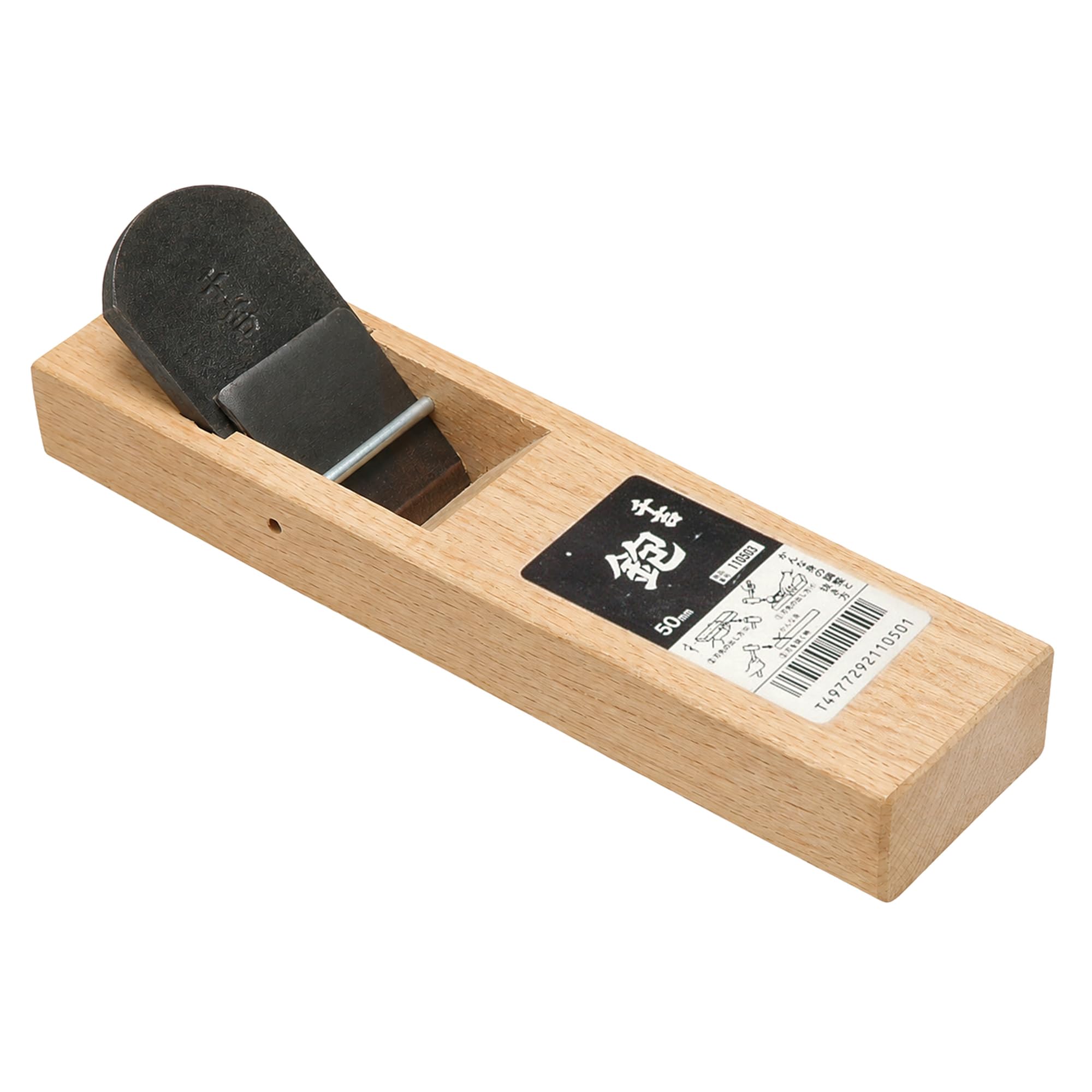
A long, heavy kanna built to take thin, even shavings off a full furniture panel.
The blade is a 50 mm laminated carbon tool steel edge bonded to a backing layer, which is the traditional construction that lets you sharpen it again and again on a whetstone. The oak body runs 241 mm, or 9.49 inches, giving it a long bearing surface that keeps the cut level as you draw it toward you.
Weight does the work here. At 680 grams, or about 1.50 pounds, the plane stays flat on the board without you fighting it. That long, heavy build is the direct counterpoint to the little 6.1-inch block plane above — the Senkichi’s body is 9.49 inches against the KAKURI’s 6.1, and the blade is 50 mm against 30 mm. More surface on the wood means fewer dips.
An adjustable cutting depth lets you set it for leveling, fitting parts, or a final light pass. The catch is that laminated carbon steel and oak reward care. Owners are split on build quality and durability, so treat the iron with respect, keep it dry, and resharpen on schedule. Do that and it delivers the smooth, glassy surface on visible faces that people buy a kanna for.
Where it shines: smoothing cabinet doors and shelves where the grain will be seen.
Set it up well: this is a tuned tool, not a swap-in blade — expect to sharpen and set the blade before the first cut.
Worth it if: you want a classic long-body kanna for finishing big flat panels.
Not your tool if: you dislike blade setup and want a plane that works straight from the box.
6. SUIZAN Kanna Japanese Wood Planer 2″ Double Blade
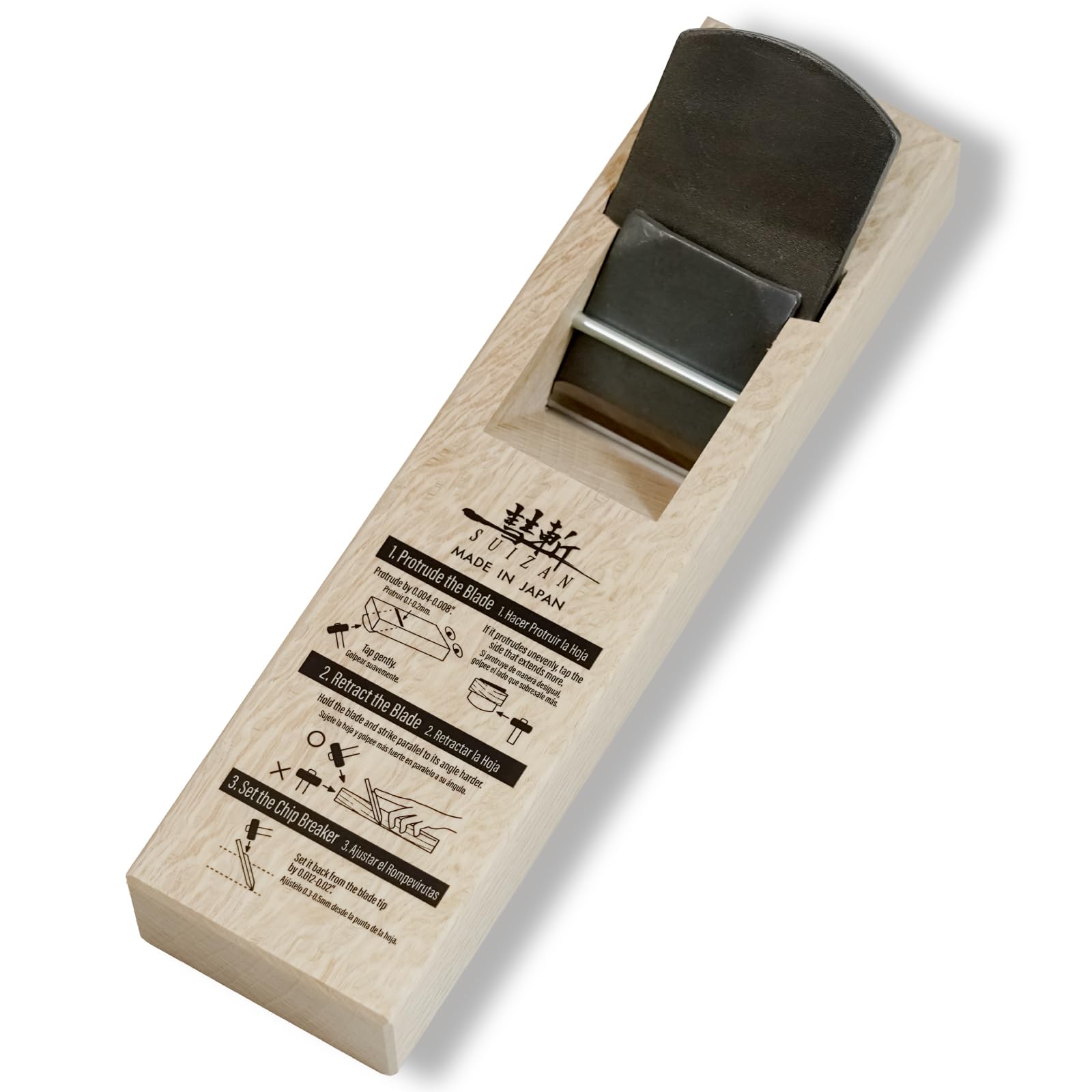
A pull-stroke plane whose two-blade setup glides across hard and soft woods alike.
Want the polished surface without the fuss of a single-iron plane? This SUIZAN pairs a 50 mm Japanese steel blade with a metal chipbreaker — a cap that sits close to the edge and stops the wood from splitting as it lifts. That two-part structure is why the shavings come off clean instead of torn.
The oak body is 240 mm long and 63 mm wide, and the whole plane weighs 650 grams. It suits smoothing, flattening, and chamfering, and it needs no power — the pull stroke gives you control the way a small block plane would, but with better feel.
Here is the part that surprises people used to screw-adjust planes: there are no adjusting screws. You tap the top of the blade with a hammer to push it out a little at a time, and tap the front of the body left and right in turn to pull it back. Set the chipbreaker close to the edge. Owners find it comes sharp and glides smoothly on both hard and soft wood, leaving flat, even finishes. That hammer-tap setting is the honest catch — it takes a few tries before your hand learns how light a tap needs to be.
What it gives you: clean, tear-free shavings on visible surfaces without power tools.
The learning curve: no screws means you set the blade by ear and by tap, so practice on scrap first.
Great for: the woodworker ready to learn traditional blade setting on a solid 50 mm plane.
Hold off if: you want a knob to turn — this plane asks you to set it by hand.
7. KAKURI Japanese Hand Plane 50mm

A large, well-balanced kanna you grip with both hands and pull in one steady sweep.
Size is the sell. This plane is 9.5 inches long, 2.5 inches wide, and 2.4 inches tall, which is big enough to grip firmly with both hands. That balanced build gives you a stable pull and covers more surface in a single pass, which matters when you are smoothing a whole panel.
The blade is Japanese high carbon steel, laminated with soft iron and hand-sharpened by craftsmen. That soft-iron backing does two things — it makes the hard edge more durable and it makes sharpening easier. A two-blade chipbreaker structure cuts down on wood splitting compared with single-blade planes. The body is white oak, and an English instruction sheet is included.
Craftsmanship and ease of use both come up strongly with this one, and the pull stroke being easier on the body than pushing is a common theme. The adjustability is more mixed — some find the blade quick to set, others fight it. Expect to fine-tune with a hammer before your first cut, as with any kanna. The big body is a joy on flat work and awkward on tight, curved parts.
The strong point: a big, stable two-handed pull that flattens broad surfaces with fewer passes.
The honest snag: blade tuning takes patience, and the large body does not fit small or curved work.
Choose this if: you smooth large flat panels and want a heavy, balanced plane.
Pass if: your work is detail and curves — you want the small block plane instead.
8. KAKURI Japanese Wood Chisel Set 3-Piece

Three oire nomi chisels in the widths that handle most mortises and tenons.
Widths are what make a chisel set useful. This one gives you 9 mm, 15 mm, and 24 mm — three sizes that cover Kumiko work, mortising, tenon cutting, carving, and general DIY. The blade edge is laminated with softer iron, and the back is hollow ground, which is the traditional shape that makes a chisel easier to flatten and sharpen on a whetstone.
Each side of the blade is chamfered to cut resistance, so you get a cleaner slice with less force. The handle is white oak with a hoop reinforcement, built to take a mallet. That is the difference between a paring chisel and a bench chisel — these can be struck, and owners put that to the test with serious pounding.
Here is the fair warning on a hard, sharp edge: durability is the mixed point. Some owners find these sturdier than expected, others hit a brittle edge if they over-strike or pry. Use a mallet, cut with the bevel, and do not lever the blade sideways in a mortise. Made in Japan by hand, with an official English instruction sheet in the box.
Why the three widths work
- 9, 15, and 24 mm cover mortises, tenons, and detail carving in one set
- Laminated steel and a hollow-ground back make sharpening simpler on a whetstone
- Hoop-reinforced oak handles take mallet strikes the way a bench chisel should
How to keep them whole
- Hard edges can be brittle if you pry or over-strike, so cut straight and use a mallet
- It is a starter set, so expect to touch up the edges before fine paring work
Buy it if: you are starting joinery and want three real Japanese chisels to learn on.
Go premium if: you cut mortises daily and need a set built for constant abuse.
9. TAJIMA Pull-Stroke Saw Set, Flush Cut Hand Saws

A two-blade flush-cut kit with a quick-release handle and a case to keep it tidy.
This set is built around changing blades fast. You get one straight handle, a 16 TPI blade, a 19 TPI blade, and a tri-fold canvas case. The quick-release retainer holds the blade tightly and swaps it in seconds, so you can move from a coarser trim cut to a fine finish cut without a second handle.
The steel is SK-95 high carbon, and the teeth are impulse hardened — spot-hardened so the cutting edge stays sharp while the blade body keeps flexibility. That matters on flush cuts against a surface where a stiff blade would mar the work. The elastomer-wrapped handle stays put in your hand, and the whole kit weighs 13.44 ounces.
Where the Gyokucho above is a generalist rip-and-crosscut saw, this kit is the trim specialist. Owners praise the sharpness first, and the fine teeth leave very little work for a chisel afterward — a real benefit on dovetails in softer wood. The 19 TPI blade is the one for the cleanest finish, the 16 TPI for faster trimming. Durability is the split point, so treat the teeth with care and the edge holds.
The smart buy here: two grits of cut and a case, all on one handle that swaps blades in seconds.
One caveat: the fine teeth demand careful storage — the canvas case exists for a reason, so use it.
Reach for it if: you do trim, dovetails, or finish cuts and want a dedicated flush-cut saw with a case.
Skip if: you need one saw for heavy stock breakdown — this is a finishing kit.
Know the Specs
Teeth Per Inch (TPI) and rip versus crosscut
TPI is simply how many teeth sit in one inch of blade. A higher count like 22 cuts slower but cleaner, which suits crosscutting across the grain. A lower count like 9 rips faster with the grain. A Ryoba puts both on one saw, which is why it is the generalist choice.
Blade thickness and kerf
Kerf is the width of the slot the saw leaves behind. A thin blade like the SUIZAN’s 0.5 mm steel leaves a 0.8 mm kerf, so the saw removes less wood and tracks a line more easily. Thin blades need a pull stroke, because pulling keeps them under tension instead of letting them buckle.
Laminated steel versus replaceable blades
Laminated steel bonds a hard cutting layer to a softer backing, which keeps the edge tough and easy to hone on a whetstone. Replaceable-blade tools like the KAKURI block plane skip sharpening — you swap the blade — but you buy new edges as the old ones wear.
Plane blade width and body length
A wider blade like the 50 mm kanna models clears more surface per pass, while a narrow 30 mm block plane suits detail and edges. A longer body, like the 9.49 inch Senkichi, stays flatter over a full panel than a short one. Match the size to the surface you actually smooth.
Common Questions
Do Japanese pull saws cut on the push or the pull stroke?
What is the difference between the rip side and the crosscut side of a Ryoba?
Can a beginner use a Japanese kanna plane without experience?
How do I set the blade depth on a kanna plane that has no screws?
Is a replaceable-blade plane as good as a laminated steel one?
What chisel widths do I need for mortise and tenon joinery?
How do I keep Japanese saw and chisel teeth from rusting?
Can I sharpen a Japanese pull saw the way I sharpen a Western saw?
Why does a thinner Japanese saw blade cut straighter than a thick Western one?
The Bottom Line
For most people, the woodworking tools japanese winner is the Gyokucho Razorsaw Ryoba, because it puts rip and crosscut teeth on one thin blade and covers the widest range of jobs. It holds 4.5+ stars across 600+ ratings, and its rip-and-crosscut blade makes it the one Japanese tool to buy first.
Want a lighter saw for travel and small joinery? The SUIZAN Ryoba 8″ at 6.17 ounces fits a tool bag without weighing you down. For smoothing visible surfaces, reach for the SUIZAN Kanna 2″ and its clean two-blade pull cut. And if joinery is the next skill on your list, the KAKURI Chisel Set gives you three real Japanese chisels to learn on.
How we choose
We do not accept paid placement. Every pick is matched to a real buyer and a real use-case; we do not hands-on test units.
Sources
Specifications: manufacturer listings and product documentation. Review insights: verified customer reviews, as of November 2026. Pricing: not shown on this page (it changes often); check the current price via the retailer link.
As an Amazon Associate, Tactical Gear Guy earns from qualifying purchases. This does not affect which products we feature.