Specs are compiled from manufacturer listings and verified buyer reviews and can change over time — please confirm the key details on the product page before buying.
You want a PC case that looks like furniture instead of a light-up plastic box, and you need to know which wood panels are real. That is the whole point of this list. Every case below has genuine wood — real walnut or oak panels, not a wood-print sticker over steel. The tricky part is that wood changes what fits inside, so the case that looks best on your desk may not swallow a long graphics card. This guide sorts that out for you.
This guide is built by comparing the manufacturers’ published specifications and the patterns across verified customer reviews, so you get each pick’s real strengths and trade-offs instead of marketing spin.
Wood panels shrink the front intake area, so airflow and graphics-card length become the two numbers that decide your build. Below you get nine real-wood chassis compared on GPU clearance, fan size and motherboard support, so you can pick a wood case for pc that fits your parts and your room without guesswork.
Top Picks


How To Choose The Best Wood Case for PC
Start with the wood itself. Real walnut or oak front slats give you the warm grain you are after, and they age instead of peeling. A wood-look vinyl finish looks convincing in listing photos and starts lifting at the corners a year later. Every case on this list uses genuine wood panels, so that question is already answered for you.
Check the graphics-card length limit first
A wood slat front takes up depth that a plain mesh front does not. That means card length is the number that quietly kills builds. Short two-fan cards clear almost anything. A long three-fan flagship card needs a case rated for it — the Fractal Design North handles up to 355 mm (roughly 14 inches of card), while the Antec C8 Wood takes up to 440 mm.
Match the fan size to your cooling plan
Bigger fans move more air at lower speed, which is why they stay quieter. The ASUS ProArt PA401 runs two 160 mm front fans for up to 138 cfm of airflow (cubic feet per minute — the volume of air pushed through). A compact mATX wood case that fits ten 120 mm fans gives you a different trade-off: more small fans, a smaller footprint.
Decide how much glass you want to look at
A tempered glass side panel (heat-treated glass that resists scratching) shows off your parts and lighting. It also means cable routing is on display, so tidiness stops being optional. If your desk faces the wrong way, or you want the wood to be the only focal point, a mesh or solid side panel suits you better.
Side-by-Side Comparison
| Model | Best For | Max GPU Length | Internal Bays | Case Type | Amazon |
|---|---|---|---|---|---|
| Fractal Design North (Charcoal/Walnut)★ Best Overall | Desk showpiece with airflow | 355 mm | 2 | Mid Tower | Amazon |
| Lian Li A3-mATX Wood Black MeshMost Compact | Tiny footprint, huge GPU | 415 mm | 4 | Mini-Tower | Amazon |
| FOIFKIN F600 WalnutBest Glass Showcase | Panoramic glass on a budget | 400 mm | 2 | Mid Tower | Amazon |
| Okinos Mirage 6 Walnut | Vertical airflow with ARGB fans | 410 mm | 3 | Mid Tower | Amazon |
| ASUS ProArt PA401 Wood Edition | Quiet airflow for creative work | 315 mm | 2 | Mid Tower | Amazon |
| Lian Li LANCOOL 217 Walnut | Five fans included, no extras needed | — | 5 | Mid Tower | Amazon |
| Antec C8 Wood | Big E-ATX builds, triple radiators | 440 mm | 6 | Full Tower | Amazon |
| Corsair FRAME 4000D Wood RS | Swappable, upgradeable frame | — | 3 | Mid Tower | Amazon |
| Fractal Design Terra Jade | Smallest build with walnut | 322 mm | 2 | Mini-Tower | Amazon |
Detailed Reviews
1. Fractal Design North Charcoal Black Tempered Glass
Our pick — 4.5+★ from 3,500+ verified ratings; the strongest balance of quality and price.
Walnut slats on a mesh-backed front — the look that made wood cases a thing.
The front panel bars are cut from genuinely sourced walnut, and that is the whole pitch. What most buyers do not expect is that the slats sit over open mesh, so you get natural ventilation through the wood instead of baking your parts behind a solid slab. It is the crowd favorite of the category at 4.5+ stars across a 3,000-plus owner base, and the walnut front is what wins people over by a wide margin. It reads like a piece of mid-century furniture that happens to run a graphics card.
You get two 140 mm Aspect PWM fans (PWM means the board can slow them down instead of running them flat out), and that saves you a fan purchase on day one. Motherboard support spans ATX, mATX and ITX, so you are not locked into one build size. Clearance follows the wood front’s depth: a GPU up to 355 mm, or 300 mm if you tuck a 360 mm front radiator in place. Seven bridgeless expansion slots leave room for multi-card setups and add-in cards.
Storage is where this case gets tight. It carries two combined 3.5″/2.5″ drive mounts plus two dedicated 2.5″ mounts, which is leaner than the Lian Li A3-mATX and its 4 internal bays — worth weighing if you keep a big media library on spinning drives. It also weighs 9.5 kg, so you won’t want to shuffle it around weekly. One honest note: another pick here has the larger owner base, but the North holds the higher score.
What sells it
- Walnut front slats over open mesh — wood looks with real ventilation
- Two 140 mm Aspect PWM fans included at no extra cost
- ATX, mATX and ITX boards all fit, with seven expansion slots
- Tempered glass side panel for a scratch-resistant view of your build
Where it pinches
- Only 2 internal bays — heavy storage builds need more
- Case weighs 9.5 kg, so it stays put rather than moving around
Go for it if: you want one case that looks like furniture and still breathes, on an ATX board with a normal-length card.
Think elsewhere if: you need four or more drive mounts or a radiator-pushing 355 mm-plus card.
2. Lian Li A3-mATX PC Case, Wood Black Mesh
A 26.3-liter box that still swallows a 415 mm graphics card.
Here is the number that reframes what you thought about small cases: 415 mm of GPU clearance. If you built a long-card system and then wanted it small, this is the wood case that makes it work. The walnut front panel is modular, so the design stays clean instead of looking bolted on.
Airflow is handled by steel mesh side and top panels, which is why high-TDP cards (cards that dump a lot of heat) still run fine in here. You can fit a 360 mm radiator and up to ten 120 mm fans — none included, so budget for those separately. The PSU can mount front or side and takes ATX, SFX or SFX-L units, which gives you clearance options a lot of small cases never offer. Four internal bays beat the North’s two.
The compact design is what turns heads — more owners single it out than any other aspect, with the natural wood look right behind. The honest caveat is cable management, which is the one area buyers push back on. In a 26.3 L frame every cable has fewer places to hide, so plan your routing before you close it up. At 11 pounds it is easy to lift, and it is far smaller in every other direction.
The compressed build: mATX or ITX board, a long GPU, and a 360 mm radiator can all live in 26.3 L — a combination full towers used to be required for.
What you pay for small: no fans in the box and tight cable paths, so set aside time and a fan budget.
The right call when: footprint matters more than drive bays and you already own a long graphics card.
Look past it if: you hate fiddly cable work or want fans already installed.
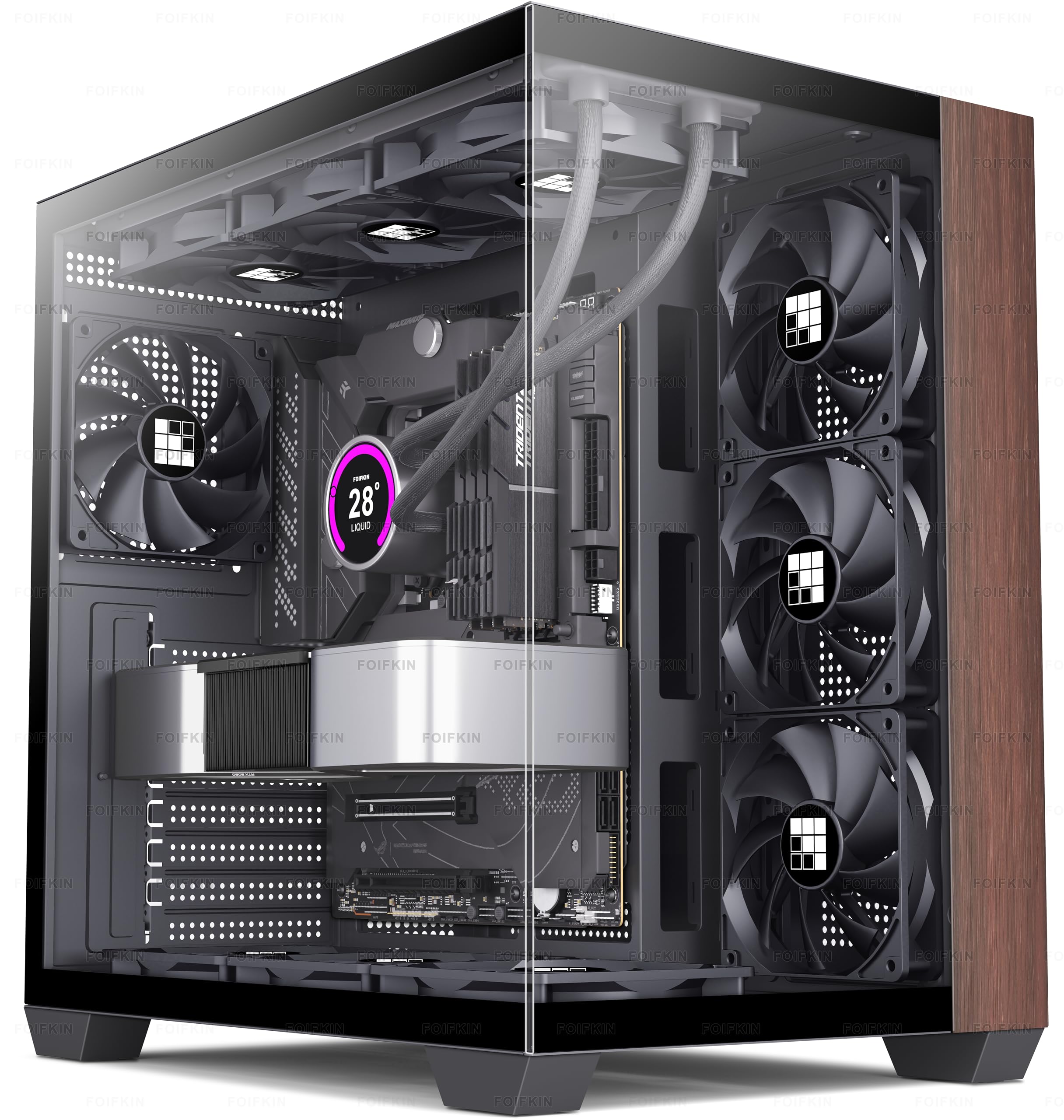
3. FOIFKIN F600 PC Case – Walnut Wood
Two panes of glass, seven fans already spinning, and a walnut accent that ties it together.
The 270° double-cabin glass curtain wraps the front and side, so your parts are visible from more than one angle. Seven no-LED fans come pre-installed — that is a full cooling setup you will not have to buy or wire yourself. It takes ATX, mATX and ITX boards, a 400 mm GPU, a 360 mm cooler, and a CPU air cooler up to 170 mm tall. The glass side panel hinges off without tools when you want to get inside.
Look at the size next to the Fractal North: the F600 measures 16.4″D x 11.8″W x 15.2″H, against the North’s 17.6″D x 8.46″W x 18.46″H. That means it is shallower front-to-back but noticeably wider, because the dual-cabin glass layout needs the room. Check your desk width before you commit. Up to ten 120 mm fans can sit on the sides, top and PSU mount point, so cooling headroom is not the worry.
The panoramic glass design is what owners rave about most, with the value and the roomy interior close behind. Cable management is the split verdict — some builds come out clean, others fight the wiring. Plan your runs and route them early. The walnut elements blend into a modern workspace rather than shouting for attention, and typing to a case this quiet-looking never gets old.
What you get in the box: seven fans and a near-full glass wrap — cooling and looks handled before you plug anything in.
The one to plan for: the wide footprint and tight cable routes mean you measure your desk and mind the wiring layout.
Pick it when: you want to see your build from every angle and skip the fan shopping.
Skip if: your desk is narrow, or you prefer a solid side panel that hides the cables.
4. Okinos Genuine Walnut Wood PC Case, Mirage 6

Bottom-and-side intakes push air up and out the top — wood up front, real airflow behind.
Four ARGB PWM fans arrive already mounted: three 120 mm reverse-blade fans at the bottom and one at the rear. An ARGB controller with four 3-pin connectors lets those fans sync to your motherboard’s lighting. The vertical airflow layout — bottom and side intakes, top exhaust — keeps the GPU and CPU from sharing one hot pocket. At 6.6 kg it is easy to lift onto a desk.
Clearance is generous for a mid-tower: a GPU up to 410 mm with a 35 mm gap between the fans and the card, a 360 mm radiator on top plus a 240 mm on the side if you run both, and air coolers up to 175 mm. The front I/O includes a Type-C 3.2 Gen 2 port rated at 10 Gbps — that is a fast file transfer, so a big project folder moves in less time than a slower port allows. Four full-size magnetic filters (dust screens that pull off for cleaning) protect the parts above them.
The walnut accents carry this case — they are the reason most buyers pick it, with the value close behind. Noise is the one split note: with four fans moving air through a glass box, some builds run louder than others, so set the fan curve in your board’s software. Cable management is the other spot to watch, as it is on almost every panoramic-glass case.
Why vertical wins: separate bottom intake and top exhaust means GPU heat exits far from your CPU cooler.
Fair warning: four fans through glass will announce themselves — tune the curve on day one.
Best fit for: a build where the GPU runs hot and you want lighting synchronized from the board.
Give it a pass if: a near-silent desk is the priority over airflow.
5. ASUS ProArt PA401 Wood Edition

Two oversized 160 mm front fans that push 138 cfm without screaming.
Two 160 x 32 mm ring-blade fans sit up front and deliver up to 138 cfm of airflow. Big blades move air at lower RPM, which is the quiet way to cool a workstation. The wood front panel is certified by the Forest Stewardship Council for sustainability, so you can trace where the timber came from — a detail the cheaper wood cases do not offer. The port set is aimed at creators: a USB Type-C 20Gbps port, plus power and reset button locks and two-section PWM control.
This is the tightest fit on the list for graphics cards. The spec sheet lists support for a 315 mm GPU and a 240 mm radiator, which is well under the Lian Li A3’s 415 mm. That is the number to check before anything else. Panel access is thoughtful: a left-side panel lock, a detachable PSU bracket, and integrated rear cable clips. Together they make a clean build easier for a first-time builder.
Appearance and build quality tie as the strongest notes here. The one recurring caveat is size — this case is not as roomy inside as its exterior suggests, so a long card plus a big radiator will not both make it. If your parts are mid-length, the 160 mm fans pay you back in noise every single day.
Built for the desk: big slow fans, clean wood, and a panel that swings off with a lock — set-and-carry-everyday practical.
The trade-off: the 315 mm GPU limit rules out the longest cards, so measure yours first.
Right pick for: creative workstations that need quiet air and a 315 mm-or-less graphics card.
Not for you if: you run a flagship-length card or want maximum interior room.
6. Lian Li LANCOOL 217 ATX Mid-Tower

Five fans, two of them 170 mm monsters — cooling sorted before you open the box.
Five fans come fitted: two 170 x 30 mm units up front, two 120 mm reverse-blade fans, and a 140 mm fan at the rear. The toolless mounting lets you raise the front fans into a CPU mode that aims air straight at your processor. This is the case for someone who does not want to think about thermals again. The walnut panels run dark and integrated, and the finish holds up next to any desk setup.
Dual PSU mounting gives you a choice: face the power supply forward, or rotate it for cleaner cable routing — units up to 220 mm fit. Back-connect motherboards hide their cables behind the tray, which keeps the inside looking like the pictures. Two power buttons cover whichever side your desk faces. Five internal bays give you storage headroom the mid-range picks do not. Weigh 10.5 kg against the North’s 9.5 kg: this is a heavier, bigger desk anchor.
Owners love how the walnut panels and steel frame complement each other — the finish earns more praise than any other trait, with buildability and cable routing right behind it. That is a case that is easy to work in, not just easy to look at. It houses big cards and large air coolers, so a high-end air build fits without drama.
What owners praise
- Five fans included — two 170 mm front units with a CPU-aiming mode
- Dual PSU mounting and back-connect motherboard support
- Cable routing called out as the easy part of the build
What to know
- At 10.5 kg it is one of the heavier cases on this list
- Five internal bays take up space you may not need
Choose this when: you want the fan and PSU work done for you and a walnut finish that matches dark furniture.
Size up first if: your desk shelf has limited headroom, because this tower runs tall.
7. Antec C8 Wood Full-Tower E-ATX PC Case

Room for a 440 mm card and three thick 360 mm radiators — the wood panel is just the bonus.
If you are running a workstation board or a water-cooling loop, this is where you land. It takes E-ATX, ATX, mATX and ITX motherboards, a GPU up to 440 mm, and thick 360 mm radiators on the top, bottom and side at the same time. The dual-chamber design separates the power supply and cables from the main components. Six internal bays mean storage is not a compromise. smooth tempered glass front and side panels meet the wooden front panel on the edge.
Build construction is what owners single out above all, with the sheer interior space close behind. Assembly draws praise too, and that matters in a full tower — you remove panels to reach the parts you are working on. Cable management is easier here because the dual chamber puts the wiring in its own section. Airflow rates well even with all that glass, thanks to the interchangeable 120 mm/140 mm fan brackets on the bottom cut-out.
The one thing to accept is the scale. It measures 18.26″D x 11.93″W x 18.74″H — footprint-wise it is the biggest case here except the Corsair frame model. This is a floor-standing tower or a very large desk build, not a compact option. For a big-brother build, the room and the wood front earn their keep.
Space where it counts: 440 mm GPU and three 360 mm radiators mean no build plan gets boxed out.
How big is big: this tower takes real floor or desk space, so plan the room before the build.
The answer for: E-ATX boards, water loops and a big graphics card that all need to live together.
Not your case if: you want a compact footprint or a light lift onto the desk.
8. CORSAIR FRAME 4000D WOOD RS Modular Mid-Tower

A case you can rebuild part by part — walnut slats up front, modular steel underneath.
Four RS120 PWM fans come pre-installed front and rear, with daisy-chainable 4-pin connectors so one cable chain handles them. Zero RPM mode lets them stop entirely at light load, which means silence for browsing and word processing. The InfiniRail fan mounting system is the clever bit: slide a steel rail and mount fans up to 200 mm wherever you want, 140 mm in the roof, instead of living with fixed screw points. The wood slats are FSC-certified walnut for a real-grain look with airflow through the gaps.
The FRAME system is what separates this from every other case here. You can swap the motherboard tray for billet aluminum, or change the front panel or PSU shroud later. That is a case that grows with your build instead of being replaced. Three 360 mm radiator locations (front, roof, side) give you cooling options for a hot card and a big cooler together. Build quality earns the most praise from owners, with looks next and cable management right behind.
The size split is the one wrinkle — a few builders found it bigger than expected, so check the 19.21″D x 9.41″W x 19.13″H footprint against your desk. It weighs 9.7 kg, so it sits solidly once placed. The modular promise is real, but it only pays off if you plan to keep upgrading.
Where it leads: interchangeable panels and trays mean the case outlives one build — rare in this category.
Check the footprint: the modular layout makes it deeper than a compact mid-tower, so confirm it fits.
The smart buy for: builders who upgrade parts over time and want a wood case that keeps up.
Look elsewhere if: you buy one case and never open it again.
9. Fractal Design Terra Jade — Walnut Front, Mini ITX

10.4 liters of walnut and anodized aluminum — the whole build fits a bookshelf corner.
The number that defines it is 10.4 L. That is the total volume of the case, and yet it holds a graphics card up to 322 mm long. The front panel is cut from FSC-certified solid walnut, and the body is anodized aluminum with an 8 mm-thick front. It still runs a PCIe 4.0 riser cable (a flexible cable that mounts the card flat instead of plugged straight into the board), so a powerful card fits sideways. A Type-C 20Gbps port sits up front next to the aluminum power button.
At 4 kg it is the lightest case on this list — easy to lift onto a shelf or carry between rooms. The stepless, slidable central wall gives you 30 mm of internal flexibility, so you choose how to split space between the cooler and the card. That is how a case this small stays buildable. Design and appearance are what keep owners happy with it, and it fits a living room or office without shouting.
The trade-offs are real and honest. Cooling performance and internal space draw split notes — in a 10.4 L frame, plan your cooler and card sizes carefully before you commit. The value-for-money note is also split, because you pay a premium for this size class. If a tiny footprint is the goal, those are the costs of getting there.
Tiny and solid: solid walnut front, aluminum body, only 4 kg — the easiest case here to lift and place.
The fine print: 10.4 L leaves little slack, so check cooler height and card length together.
Made for: small-space builds that still want a real graphics card and a real walnut front.
Your money is better elsewhere if: you need room to grow or lower-cost cooling.
Know the Specs
Maximum GPU length
This is the longest graphics card the case will take before it hits the front panel or a radiator. A case with a wood slat front gives up some depth, so the number matters more than on a plain mesh tower. Compare your card’s listed length against the case’s limit before you buy. A 415 mm limit, like the Lian Li A3, takes almost any card on the market, while a 315 mm limit rules out the longest ones.
Fan size and airflow (cfm)
Fan size is the blade diameter: 120 mm, 140 mm, 160 mm, even 170 mm. Larger blades move more air at lower speed, which usually means quieter operation. Airflow is quoted in cfm, or cubic feet per minute — the volume of air pushed through in a minute. A case rated for 138 cfm is pushing a lot of air per minute. More fans or bigger fans both help, but so does an open front behind the wood.
Internal drive bays
Each bay holds a storage drive — either a 3.5-inch hard drive or a 2.5-inch solid-state drive. Count how many drives you actually run. Two bays cover a boot SSD plus one large drive, while six bays, as on the Antec C8 Wood, leave room for a media library. Wood cases with panoramic glass often cut bay counts to make room for the view.
Motherboard form factor
ATX is the standard-size board, mATX is shorter, and ITX is smallest. The case must support the board you own or plan to buy. A wood case that lists ATX, mATX and ITX gives you room to change boards later. A mini-ITX-only wood case, like the Terra, suits a compact build but locks you into that board size.
Common Questions
Is the wood on these PC cases real wood or a vinyl wrap?
Will a wood front panel block airflow to my graphics card?
How do I know a long graphics card will fit before I buy the case?
Do I need to buy extra fans with a wood PC case?
What size wood case fits an E-ATX workstation board?
Can I fit a 360 mm radiator in a wood mid-tower case?
Does a tempered glass side panel scratch easily?
Which wood case is smallest for a small desk or shelf?
Is a wood PC case harder to build in than a steel one?
The Bottom Line
For most builders, the wood case for pc to get is the Fractal Design North because walnut front bars over open mesh give you real wood, real airflow, and two fans in the box — and it holds the top owner rating in this group. Want the smallest footprint that still takes a giant card? The Lian Li A3-mATX packs 415 mm of GPU room into 26.3 L. And for a full-tower water-cooling build, the Antec C8 Wood gives you E-ATX and triple 360 mm radiators behind a wooden front. Buy the North if you want the honest all-rounder — the wood look and the airflow both show up in the same case.
How we choose
We do not accept paid placement. Every pick is matched to a real buyer and a real use-case; we do not hands-on test units.
Sources
Specifications: manufacturer listings and product documentation. Review insights: verified customer reviews, as of November 2026. Pricing: not shown on this page (it changes often); check the current price via the retailer link.
As an Amazon Associate, Tactical Gear Guy earns from qualifying purchases. This does not affect which products we feature.