Specs are compiled from manufacturer listings and verified buyer reviews and can change over time — please confirm the key details on the product page before buying.
Most cheap cameras for YouTube fail in the same boring way: the box promises 8K, but the footage looks soft and the audio is unusable. What actually matters is whether the camera records clean video, holds a battery through a full shoot, and lets you frame yourself without guessing. This list sorts the nine strongest value options by what they genuinely deliver — and by which creator each one fits.
This guide is built by comparing the manufacturers’ published specifications and the patterns across verified customer reviews, so you get each pick’s real strengths and trade-offs instead of marketing spin.
You will see which cameras carry a selfie-friendly flip screen, which include a microphone in the box, and which one is tough enough to leave the house. The picks below cover every budget tier for a youtube cheap camera.
Top Picks
How To Choose The Best YouTube Cheap Camera
A cheap YouTube camera is a tool for one job: getting clean video and clear voice onto a memory card without a crew. Everything else is decoration. The three specs that decide whether you enjoy using it are the screen you frame with, the battery that keeps it running, and the storage it writes to.
Frame yourself without a helper
When you film alone, you need to see yourself. A flip screen rotates up to 180° so it faces forward, while a pocket gimbal camera turns its whole lens instead. Either one lets you check your framing mid-sentence instead of hoping. A fixed rear screen forces you to shoot blind, which is why it is the first thing to check.
Battery, storage, and the kit in the box
Recording drains a small battery fast, so look at the milliamp-hour (mAh) figure — that is how much charge the cell holds. A 2400mAh pack is a bigger tank than a 1500mAh one. Bundled cards also matter: a 32GB card gives you room to record without buying anything extra, and Class 10 (a speed rating for how fast the card writes) keeps 4K video from stuttering.
Know what the resolution label really means
Budget cameras often reach a headline number like 88MP or 96MP through interpolation — the camera guesses the extra pixels instead of capturing them. That is fine for a thumbnail. For video quality, trust a real sensor figure and a frame rate you can see in the spec list, not a bigger number on the box.
Side-by-Side Comparison
| Model | Best For | Video Spec | Still Resolution | Included Card | Amazon |
|---|---|---|---|---|---|
| OPRKQEE 4K Pocket Camera★ Best Overall | Solo vloggers who want hands-free framing | 4K | 75MP | 16GB | Amazon |
| Gavonde 8K Digital CameraFlip Screen Pick | Travel and everyday shooting with a flip screen | 8K | 88MP | 32GB | Amazon |
| Kefalyn 4K CamcorderNight Shoot Pick | Night shoots and interviews with external audio | 4K | 96MP | 32GB | Amazon |
| VENOPTIX 4K Gimbal Camera | Multi-angle short-form video and TikTok | 4K at 30fps | 75MP | — | Amazon |
| Uytya 5K Camcorder | Beginners who want a full creator bundle | 5K at 20fps | 64MP | 32GB | Amazon |
| Yatao 6K Flip Screen Camera | Beginner channels on a budget | 6K | 64MP | 64GB | Amazon |
| KODAK PIXPRO FZ55 | Pocketable everyday photos and simple clips | 1080p | 16MP | — | Amazon |
| FamBrow 8K Video Camera | Long-form recording with a stabilizer and mic | 8K at 15fps | 88MP | 32GB | Amazon |
| DJI Osmo Action 4 | Outdoor, action, and low-light filming | 4K at 120fps | 10MP | — | Amazon |
Detailed Reviews
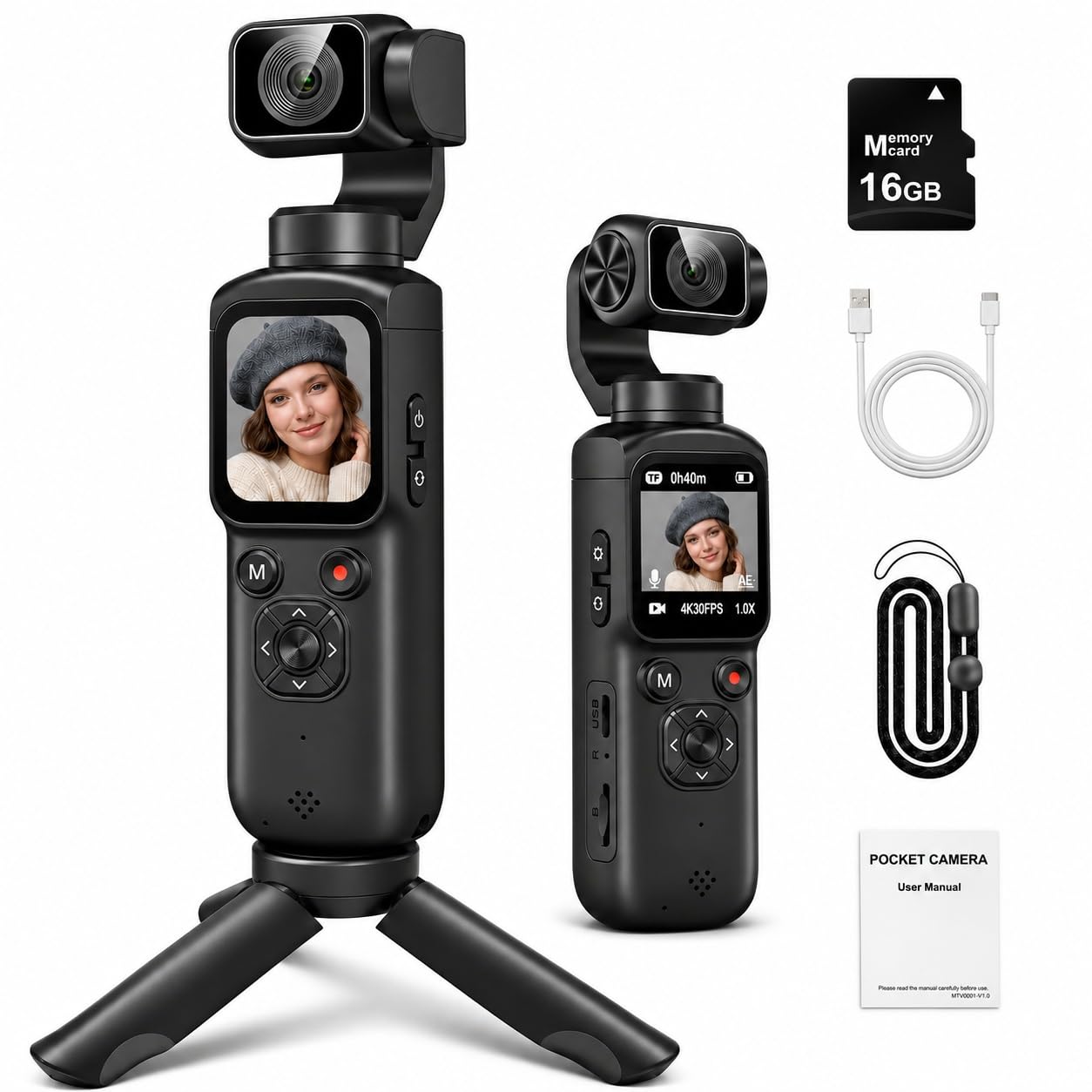
1. 4K Vlogging Camera 75MP Pocket Camera
A pocket gimbal camera that swings its own lens around so you never film blind.
If you record alone, this is the pick to beat. The lens rotates 330° automatically on the horizontal axis and 180° by hand on the vertical, so you can point it at your face, your desk, or the room without touching a tripod. Intelligent face tracking then locks onto you and keeps you centered while you talk. The body is built around a gimbal stabilizer (a motorized mount that smooths out hand shake), which is the feature that keeps a handheld vlog from looking jumpy.
Storage and runtime are sorted for a full session. You get a 16GB Class 10 TF card in the box, and the detachable 2400mAh battery is rated for more than 200 minutes of continuous 4K recording. The card slot takes up to 256GB if you want a longer archive. Pairing over WiFi lets you pull clips onto your phone and post before you leave the location. Reviewers single out the build quality and the pocketable body — this feels like a real camera, not a toy.
Two things to weigh before you buy. Video tops out at 4K, so it is not a night camera and low-light clips will show grain. Focus is a PDAF system (phase-detect autofocus, a method that snaps onto a subject quickly) rated from 10cm to infinity, so it is happiest on normal scenes rather than extreme close-ups. For the price of a mid-range pick it delivers more usable framing tools than anything else here.
Why it earns the top slot
- 330° auto rotation plus 180° manual tilt means constant framing flexibility
- Face tracking holds you centered for hands-free recording
- 2400mAh battery rated for over 200 minutes of 4K
- 16GB card and tripod included, so it shoots on day one
Where it holds back
- Tops out at 4K — no 5K or 8K option
- PDAF focus is tuned for 10cm to infinity, not macro work
Made for: the solo creator who films at a desk or on the move and wants the camera to follow them.
Pick another if: you need low-light night footage or an included external microphone — the Kefalyn covers both.
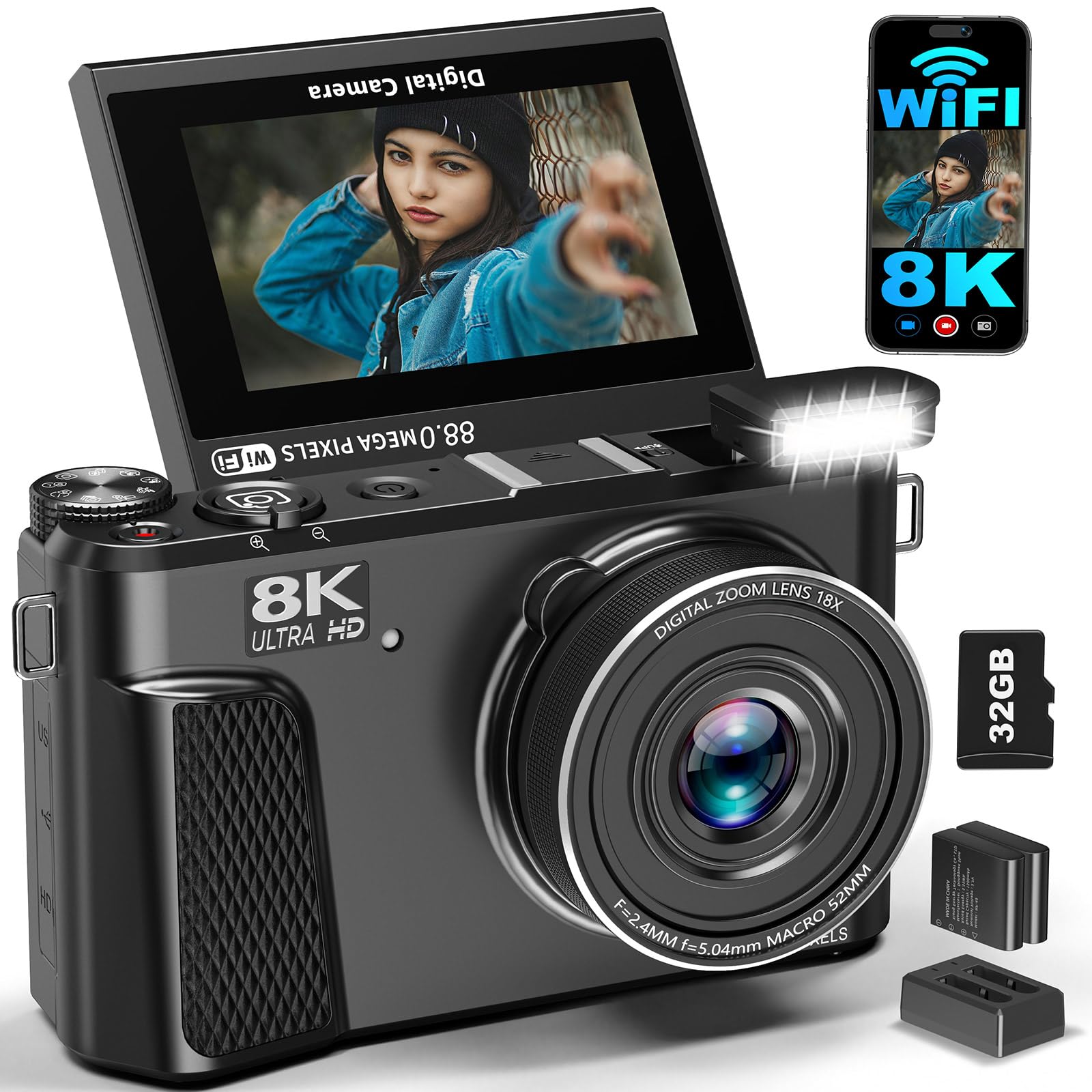
2. 8K Digital Camera 88MP Travel Camera
Two batteries and a 32GB card included — this kit is ready before you unbox the tripod.
Here is the difference that matters against the OPRKQEE above. This Gavonde holds a 32GB card to the OPRKQEE’s 16GB, so you get twice the storage before you think about buying more. The 3.0-inch IPS display flips 180° so you can frame a selfie or a talking-head shot from the front. Megapixels land at 88MP, which is 17% higher than the 75MP on the top pick — though on a budget sensor that figure comes from interpolation, so treat it as a photo spec, not a video one.
The 18X digital zoom pulls distant subjects closer, and four photo modes plus four video modes cover time-lapse, loop, and slow motion. A built-in flash helps at indoor events and evening shoots. Two 1500mAh batteries with a dual charger are in the package, and the body measures 4.7 inches long, 2.8 inches tall and 2.1 inches deep — small enough to drop into a jacket pocket on a hike. WiFi handles instant sharing to your phone, and USB-C covers both charging and data.
The honest catch is the video ceiling. It advertises 8K, but a camera at this level leans on upscaling and the tiny 10g battery cells mean shorter sessions between swaps — which is why two are included.
The traveler’s logic: two batteries, a 32GB card, a bag, and a forward-facing screen turn this into a grab-and-go kit for road trips and family filming.
The trade you accept: you are buying convenience and storage rather than cinema-grade detail, and heavy 8K claims on value hardware deserve a sceptical eye.
Reach for it if: you travel light, want a flip screen for selfies, and would rather not buy a card separately.
Look elsewhere if: you need proven night performance or a metal-hinged screen that survives daily abuse.
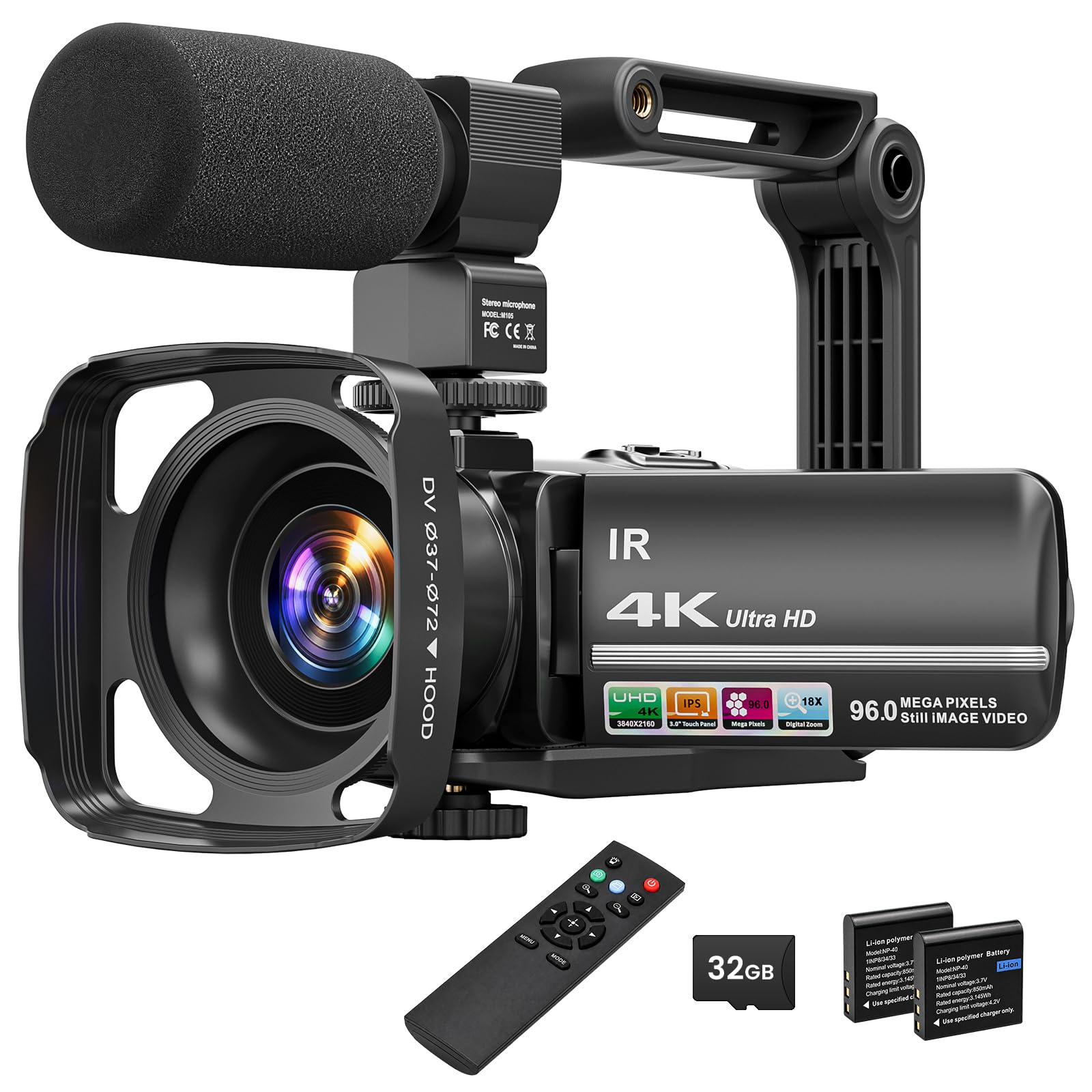
3. 4K Video Camera Camcorder 96MP
The one that keeps recording after dark and ships with a real microphone.
Most creators lose audio before they lose video, and this Kefalyn treats that as the priority. A detachable external stereo microphone is in the box to pick up clean voice for tutorials, interviews, and livestreams. The 3.0-inch screen rotates 270°, so you can fold it forward and watch yourself while you record. A 96MP sensor sits behind the 4K video pipeline, the biggest still number among the mid-range picks here.
Then there is the feature almost nothing else on this list offers: IR night vision, which uses infrared light the eye cannot see to expose a scene in near darkness. That makes it a genuine option for night vlogs and dim indoor events. The 18X digital zoom reaches distant subjects, and a handheld stabilizer plus a built-in lens hood fight hand shake and glare at outdoor shoots. Face detection, continuous shooting, time-lapse, slow motion, and charging while you record round out the toolset.
The package is generous: a 32GB SD card, two rechargeable batteries, a wireless remote, and a lens cover. The slot accepts cards up to 256GB, which you supply yourself. The 16:9 aspect ratio keeps you natively in the shape YouTube plays back. Where it asks patience is the fixed wide lens paired with digital-only zoom — push past 18X and the image softens.
What you gain over the day-only picks: infrared night mode and a bundled stereo mic solve the two problems that ruin most cheap-camera channels — dark footage and hollow voice.
What it asks of you: the zoom is digital, so far-off detail comes at the cost of sharpness.
Built for: interviewers, night-time vloggers, and anyone whose content lives indoors under weak light.
Think twice if: you want a pocketable body — this is the camcorder shape, not a mini camera.
4. Vlogging Camera 4K 330° Pocket Camera

Vertical, horizontal, and everything in between — this pocket camera reframes without a tripod.
Here is how it lines up against the OPRKQEE, the other rotating-lens camera on this list. The VENOPTIX does 4K at 30fps with a recording resolution of 2704×1520 pixels, and its zoom runs to 4x digital versus the OPRKQEE’s 3.99x — effectively identical reach. The rotating lens also carries a wider 4x digital figure because its focal range runs 1.8mm to 4.6mm. Where they split is focus. This one is tuned for close-range work from 10cm to 2m, which makes it the better tool for product macros and tight portrait framing.
Reviewers praise the crisp 4K output and the stabilisation that rescues handheld takes. Landscape and portrait modes let you switch shape for a standard YouTube upload or a vertical short without rotating the file later. Thirty creative filters, including Ins1977, vintage negative, and retro tones, let you bake the look in at capture. The 1.72-inch IPS touchscreen handles previews and settings, WiFi pushes files to the app for quick posting, and the 2400mAh cell runs up to 3 hours of continuous shooting.
Its limitation is a deliberate one: smart face tracking works in video mode only, so photo shooting stays manual in that respect. There is also no flash on the body, so evening shots need available light. For short-form creators chasing quick edits, the trade is well worth it.
Your match if: you post shorts and vertical clips and want a camera that flips orientation without a mount.
Not your match if: you need built-in flash or face tracking while shooting stills.
5. 5K Video Camera Camcorder 64MP

Five-K footage plus the tripod, mic, and extra battery you would otherwise buy separately.
The headline here is the recording spec: 5K at 20fps, with a 4K at 60fps option for smoother motion, and 64MP stills from a high-sensitivity CMOS sensor. That 5K mode puts it a step above the 4K-only pocket cameras on this list. A 3.0-inch 270° rotatable IPS touchscreen with a metal hinge folds forward for selfies and low-angle shots, and the hinge is rated for durability rather than novelty.
The bundle is the real argument. In one box you get a 32GB memory card, dual 1800mAh batteries, a tripod, an external mic with noise reduction, a remote control, and a lens hood. For a first YouTube setup, that removes almost every extra purchase. Features include 16X zoom, IR night vision for late-night shoots, four recording modes (normal, time-lapse, slow motion, loop), and four photo modes. Built-in anti-shake plus recording-while-charging keep a long session going.
One honest point decides whether this suits you: the focus is manual, and sharpness wants at least 0.6m of distance from your subject. It is also listed as Mac-incompatible, so file transfer on an Apple computer may need a workaround. Buyers rate the build quality for the price highest, with picture quality close behind. Audio is the one area reviewers split on — a few find the mic wanting, so test it early in a quiet room.
The value read: tripod, mic, card, two batteries, and a hood in one purchase is the shortest path from unboxing to a finished video.
The follow-up question: will a manual-focus camcorder frustrate you? If you move constantly, an autofocus pick above is calmer to live with.
Go this way if: you want one order to cover your whole starting kit and can work with manual focus.
Reconsider if: you edit on a Mac or need the camera to track a moving subject automatically.
6. 6K WiFi Flip Screen Digital Camera with Mic and Fill Light

A wide-angle lens and a macro lens in one body, with a fill light for warm or cool tone.
Two lenses do two jobs here: a wide-angle lens for landscapes and room shots, and a macro lens for close-up detail. The video spec reaches 6K Ultra HD, and stills run to 64MP. A 16X zoom covers the distance in between, and automatic or manual exposure control lets you take the reins when a scene is tricky. The flip screen turns forward for selfies, which is the whole point of a vlogging body.
The accessories are what make it a starter kit rather than a bare camera. A 64GB card is the biggest included card on this list. You also get two batteries with a charging stand, a microphone, a bi-color fill light that shifts between warm and cool tones, and a lens hood to cut glare. WiFi and app control move clips to your phone for posting, and USB-C supports webcam use for livestreams. Slow motion, continuous shooting, and a built-in flash fill in the rest.
Set your expectations on review sentiment, because this one is the most divisive pick here. Reviewers rate it well for everyday clips and vlogging, and often praise the beginner-friendly setup. But the scores sit lower than the leaders, so read the trade-off as fit rather than failure. It rewards a creator who wants lighting and audio solved in the box.
The creative angle: macro plus wide-angle plus a tone-adjustable fill light covers product shots, room tours, and evening takes from one camera.
The buying caution: it is a value-tier body, so expect budget-camera limits in low light and treat the 6K label as headline, not guarantee.
Suits you if: you want lighting, audio, and a big card included and shoot a mix of close-ups and wide shots.
Pass if: you want the highest-confidence purchase on the list — the leaders carry stronger scores.
7. KODAK PIXPRO FZ55 16MP Compact Digital Camera

Real glass, real zoom — a proper lens instead of a phone-style digital crop.
The spec that sets this one apart is the lens. Where every other pick on this list leans on digital zoom that crops and softens, the FZ55 has a 5x optical zoom with a 28mm wide-angle lens — the glass physically moves, so the detail stays. The sensor is 16MP, and video records at 1080p for travel clips and simple talking-head segments. A 9-point contrast-detection autofocus handles the framing.
It is the most-owned camera here by a wide margin, thanks to a pocketable point-and-shoot body, easy menus, and clear 16MP photos. It takes Class 10 SD, SDHC, or SDXC cards up to 512GB — far beyond the bundled cards on the bundlers. The LB-012 lithium-ion battery charges over USB with the included adapter and wants a full charge before first use. A wrist strap, USB cable, and AC adapter are in the box.
The honest limit is video ambition. At 1080p it is not a 4K vlogging body, and there is no flip screen for self-framing. Reliability reviews are mixed — most units run fine, but a small share fade over time, so don’t expect a workhorse. For a channel built on stills and short clips, it earns its keep.
Why the lens wins: optical zoom beats digital cropping every time — a distant shot stays detailed instead of turning to mush.
Where it stops short: 1080p ceiling and no forward-facing screen make it a stills-first tool for YouTube.
Right for: photo-led creators and travel shooting who want genuine optical reach in a pocket body.
Wrong for: anyone set on 4K video and a selfie flip screen.
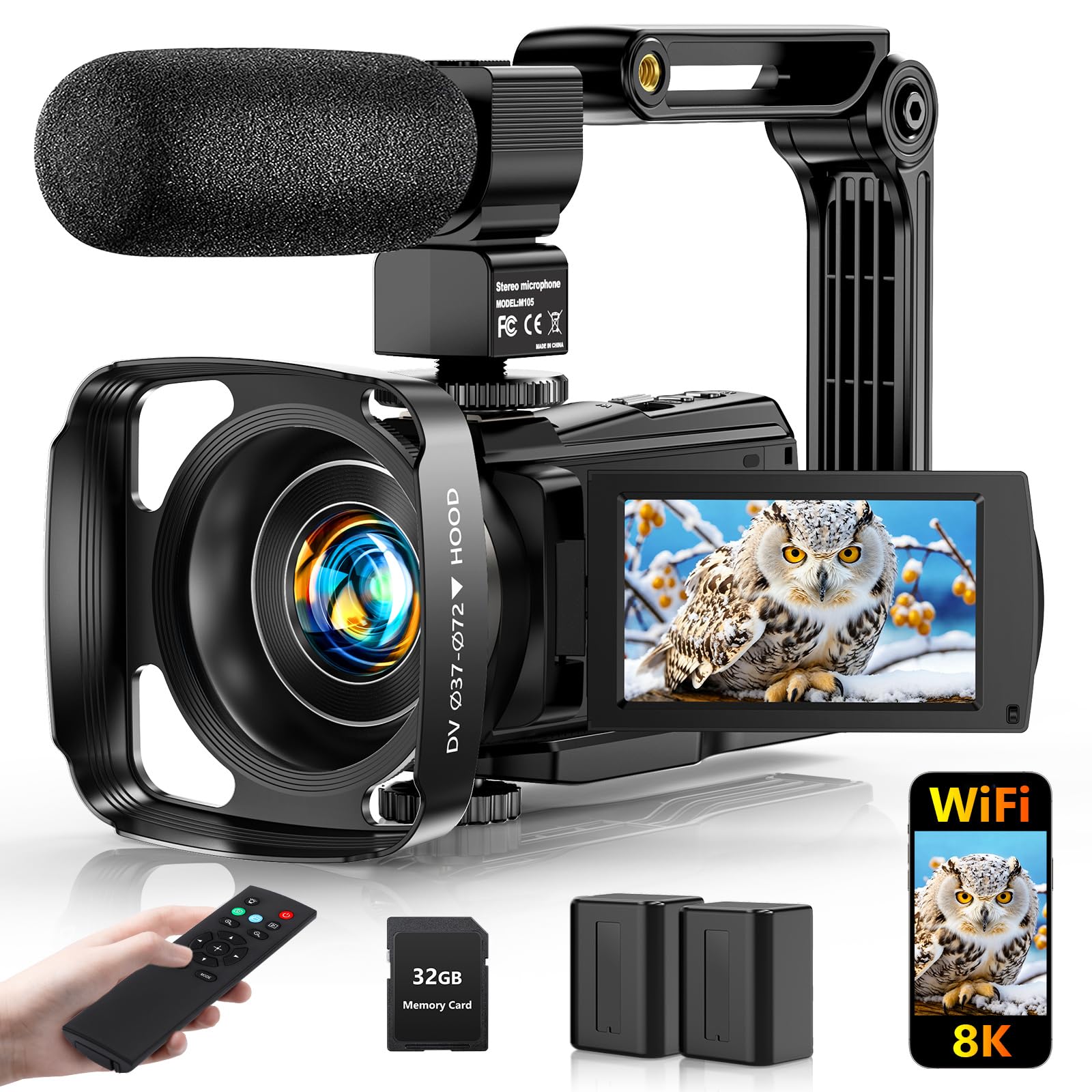
8. 8K Video Camera Camcorder 88MP WiFi
Six-axis stabilization and an 18X zoom in a handheld camcorder body.
Steady footage is the goal, and this FamBrow attacks it head-on. A six-axis stabilization system works to cancel shake across six directions of movement, which matters most when you film handheld while walking. Video reaches up to 8K at 15fps, with 6K, 5K, 4K, and 1080P also available, so you can drop resolution to gain smoothness. Stills go to 88MP through interpolation, and the 18X digital zoom closes distance on far subjects.
A 3.0-inch IPS capacitive touchscreen rotates up to 270°, so you can monitor a selfie or a group shot from low angles. WiFi handles remote control and file transfer, and a built-in IR LED supports shooting in dark scenes. As a webcam it covers calls and livestreams, and it accepts an external microphone plus an HDMI device for a more elaborate rig. The package is thorough: a handheld stabilizer, external mic and cable, two batteries, a 2.4G remote, a 32GB SD card, a storage bag, lens hood, and USB cable.
The trade-off sits in the frame rate. That 8K mode runs at 15fps, which suits static scenes but will look choppy on fast motion — use 4K when things move. The interpolation behind the 88MP still number means treat it as marketing polish. Where it does deliver is stability and kit.
The stabilization story: six-axis correction plus the included handheld stabilizer is a genuine pair of defenses against shaky handheld video.
The spec to read carefully: 8K at 15fps is a slideshow for movement — 4K is the practical mode.
Best matched to: creators who film handheld and want a stabilizer and mic bundled rather than bought later.
Steer clear if: you shoot fast action and need a high frame rate at maximum resolution.
9. DJI Osmo Action 4 Essential Combo
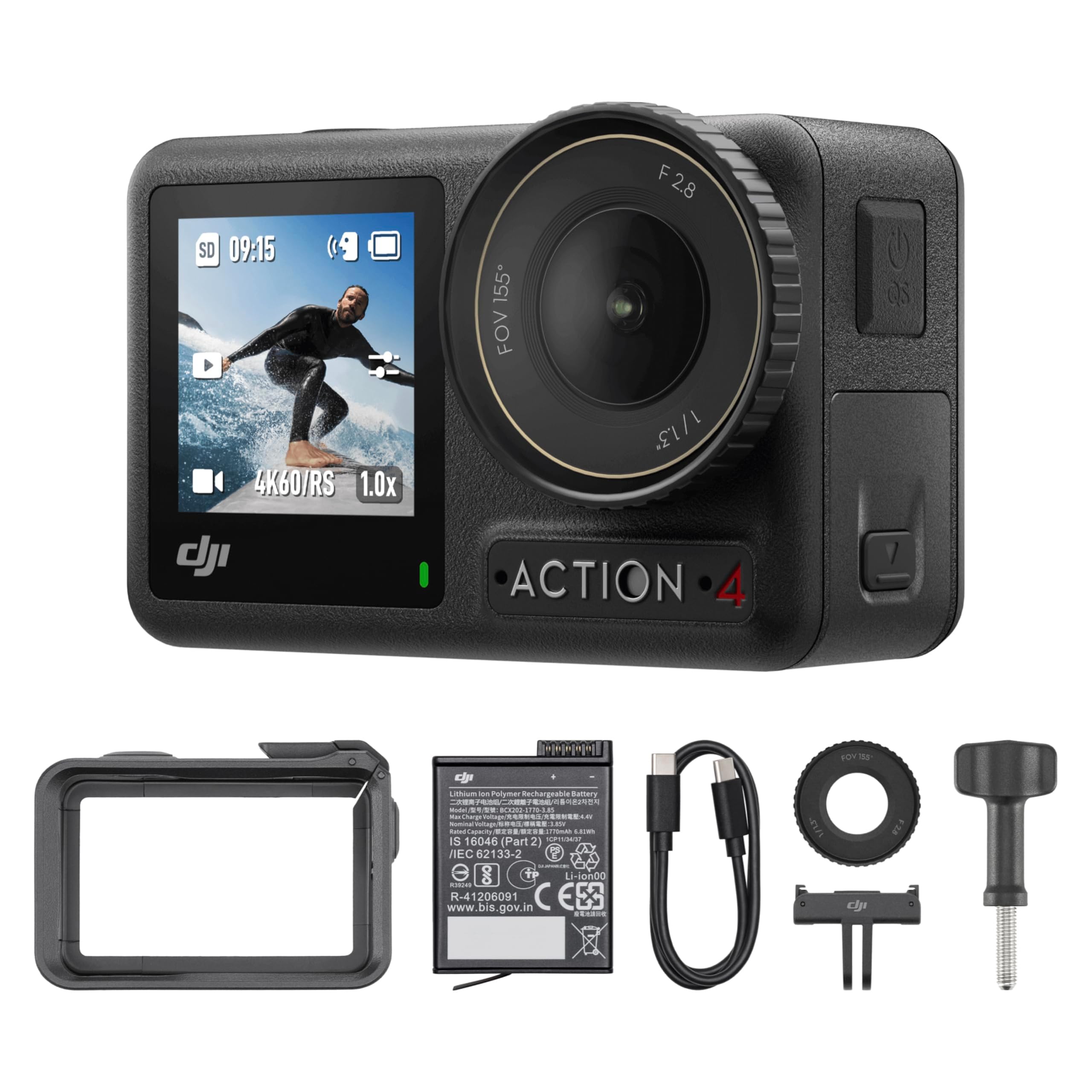
Waterproof to 18m and rated for minus 20°C — this one leaves the house with you.
Nothing else on this list is built for the outdoors like the Osmo Action 4. A 1/1.3-inch sensor with 2.4μm pixel size pulls clean detail out of dim scenes, and auto white balance keeps color true even underwater. It shoots 4K at 120fps with a 155° ultra-wide field of view, so you capture more of the scene with minimal cropping. Waterproofing reaches 18m, and the 1770mAh battery is rated for up to 150 minutes while working in temperatures as low as -20°C — that figure sits against the 160 minutes in the spec sheet, so plan for the shorter number on a cold day.
Stabilization comes in three modes to keep shots level whether you vlog or cycle. A magnetic quick-release system mounts, switches angles, and turns vertical in seconds. Dual full-color touchscreens front and rear let you frame and change settings without pulling the camera off the mount. Pro-grade color science runs 10-bit depth with D-Log M for editing flexibility. DJI OsmoAudio connects directly to a DJI Mic 2 or Mic Mini transmitter for clean voice on the move.
Two caveats, both mild. Stills resolve to 10MP, so this is a video-first camera, not a photo tool. The Essential Combo skips the curved adhesive base you get in the Standard Combo — worth knowing if you plan to stick it to a helmet or board. Reviewers consistently praise the 4K video quality and the stabilisation. It is the most battle-tested pick here, with 4.5+ stars across 2,000+ owners.
Where it leads: waterproofing to 18m, a cold-rated battery, and 4K at 120fps make it the only true action camera in the bunch.
Where it holds back: 10MP stills and a combo that omits the curved adhesive base.
The obvious choice for: cyclists, divers, and travelers who film in weather and need footage that survives the trip.
Overkill if: you film seated indoors — the rotating-lens picks above cost less and frame easier.
Know the Specs
Frame rate versus resolution
Resolution (like 4K or 8K) is how many pixels each frame holds. Frame rate (fps) is how many frames play each second. A high resolution at a low frame rate, such as 8K at 15fps, gives crisp detail on still scenes but looks choppy with movement. A lower resolution with a higher rate, like 4K at 60fps, keeps motion smooth. Pick the mode that matches what you film.
Digital zoom versus optical zoom
Digital zoom crops into the image and enlarges it, so pixel detail drops as you push in. Optical zoom moves real glass to magnify the scene without losing sharpness. A camera with 5x optical zoom keeps distant subjects clear, while a digital-only body softens them. On a value camera, digital zoom is best kept modest.
Battery capacity in mAh
Milliamp-hours (mAh) measure how much charge a battery holds. A 2400mAh cell in a pocket camera is a bigger reserve than a 1500mAh one, though the length of a session also depends on the screen and video mode. Cameras rated in minutes, like 150 to 200 minutes of recording, translate directly to how many takes you get before a swap. Carry a spare if you shoot long.
Interpolation and megapixel headlines
Interpolation means the camera creates extra pixels by estimating them, not capturing them. That is how a budget body lists a huge megapixel number. For thumbnails and prints it can be fine. For judging video quality, look at the actual recording mode and frame rate instead of the still-image megapixel figure.
Common Questions
Will a cheap YouTube camera record in real 4K or upscaled 4K?
Do I need a flip screen to vlog alone?
Is an included external microphone better than the camera’s built-in mic?
How much memory card space does a 4K video need?
Can these cameras work as a webcam for livestreams?
Is a waterproof action camera worth it over a regular vlogging camera?
What does 10-bit color and D-Log M actually give me?
How long does the battery last on these budget cameras?
Are these cameras compatible with Mac computers for transferring files?
Is a 16MP camera enough for YouTube?
The Bottom Line
The strongest all-rounder for most creators is the OPRKQEE 4K Pocket Camera. Its 330° rotating lens and face tracking mean you can film alone without a tripod, and the 2400mAh battery keeps you recording for more than 200 minutes. When you want a full starter kit in one order, the Uytya 5K Camcorder bundles the tripod, mic, card, and two batteries so you can shoot on day one. And if your channel goes outside, the DJI Osmo Action 4 is waterproof to 18m and keeps working in the cold. Whatever you pick, lock in the flip screen and the battery life first — those two specs decide whether you actually enjoy filming.
How we choose
We do not accept paid placement. Every pick is matched to a real buyer and a real use-case; we do not hands-on test units.
Sources
Specifications: manufacturer listings and product documentation. Review insights: verified customer reviews, as of November 2026. Pricing: not shown on this page (it changes often); check the current price via the retailer link.
As an Amazon Associate, Tactical Gear Guy earns from qualifying purchases. This does not affect which products we feature.