Specs are compiled from manufacturer listings and verified buyer reviews and can change over time — please confirm the key details on the product page before buying.
Choosing a porch handrail is really a question of how it attaches and what it is made of. Get the mount wrong and the rail wobbles under a wet hand. Get the material wrong and the paint bubbles within a season. The nine contenders below cover both problems, and the Kenosha Iron wall-mounted unit earns the top spot for its American fabrication and its clean 2-inch standoff from the wall. Every pick here is genuine wrought iron or iron construction, so you are comparing solid metal against solid metal.
This guide is built by comparing the manufacturers’ published specifications and the patterns across verified customer reviews, so you get each pick’s real strengths and trade-offs instead of marketing spin.
Your steps can be concrete, brick, or wood, but the fit is what decides your choice. The comparison below covers step counts, rail lengths, and mounting styles, so you can match one to your porch without guessing. Read on to find the best Wrought Iron Handrails for Porches for your entryway.
Top Picks

How To Choose The Best Wrought Iron Handrails for Porches
A porch rail has one job: let somebody grab something solid on a wet or icy morning without the rail shifting under their hand. Three things decide that — how many steps you are covering, whether the rail bolts to a wall or stands on its own posts, and whether the metal will still look right after a hard winter. Answer those three and the rest is finish and detail.
Match the rail to your step count first
A two-step porch and a five-step staircase need different spans. A short wall-mounted unit such as a 24-inch rail suits a small step-off, while a kit built for three to five steps runs much longer. Measure the actual rise of your steps before you buy — a rail that falls short leaves a gap exactly where someone reaches for it.
Wall mount, in-ground, or surface mount
A wall-mounted rail bolts to the house or a solid adjoining wall and gives you a fixed standoff so your knuckles clear the siding. An in-ground post is the choice when there is no wall to attach to — it goes into a dug hole and gets set in concrete. A surface-mounted kit bolts down through base plates onto the steps themselves, which works on concrete, brick, or wood.
What the finish does over the years
Almost every iron rail here ships powder coated — that is a baked-on paint layer rather than a brushed-on coat, and it is what resists fingerprints, rain, and sun fade. A matte black powder coat hides scuffs and wipes clean with a damp cloth. Bare or thinly painted iron is the finish that starts rusting at the weld seams first.
Side-by-Side Comparison
| Model | Best For | Steps Covered | Length | Weight | Amazon |
|---|---|---|---|---|---|
| Kenosha Iron 2 Ft Wall Mount★ Best Overall | Small porch step-off | 2 steps | 24 in | 5.5 lb | Amazon |
| White Wrought Iron Rail (Outvita)Best White Finish | White-trim porches | 3 or 4 steps | 39.96 in | — | Amazon |
| VEVOR 3 Step Retro ArchHeaviest Build | Long concrete runs | 3 to 4 steps | 60.4 in | 28.1 lb | Amazon |
| SPACEEUP Single Post | No wall to bolt to | 1 or 2 steps | — | — | Amazon |
| VEVOR Flexible 3-5 Step | Adjustable step heights | 3 to 5 steps | 55 in | — | Amazon |
| CR Fence & Rail 5 Step Kit | Code-conscious builds | 4 to 5 steps | 68 in | — | Amazon |
| ANTSKU 3 Step Iron Picket | Decorative curb appeal | 2 or 3 steps | 39 in | 16.8 lb | Amazon |
| Vezek 4 Ft Grab Bar | Garage and long walls | Wall run | 48 in | — | Amazon |
| ROOMTEC 2 Pack 4 Step | Two matching rails | 4 steps | 54.2 in | — | Amazon |
Detailed Reviews
1. Kenosha Iron Wrought Iron Handrail
Our pick — 4.5+★ from 450+ verified ratings; the strongest balance of quality and price.
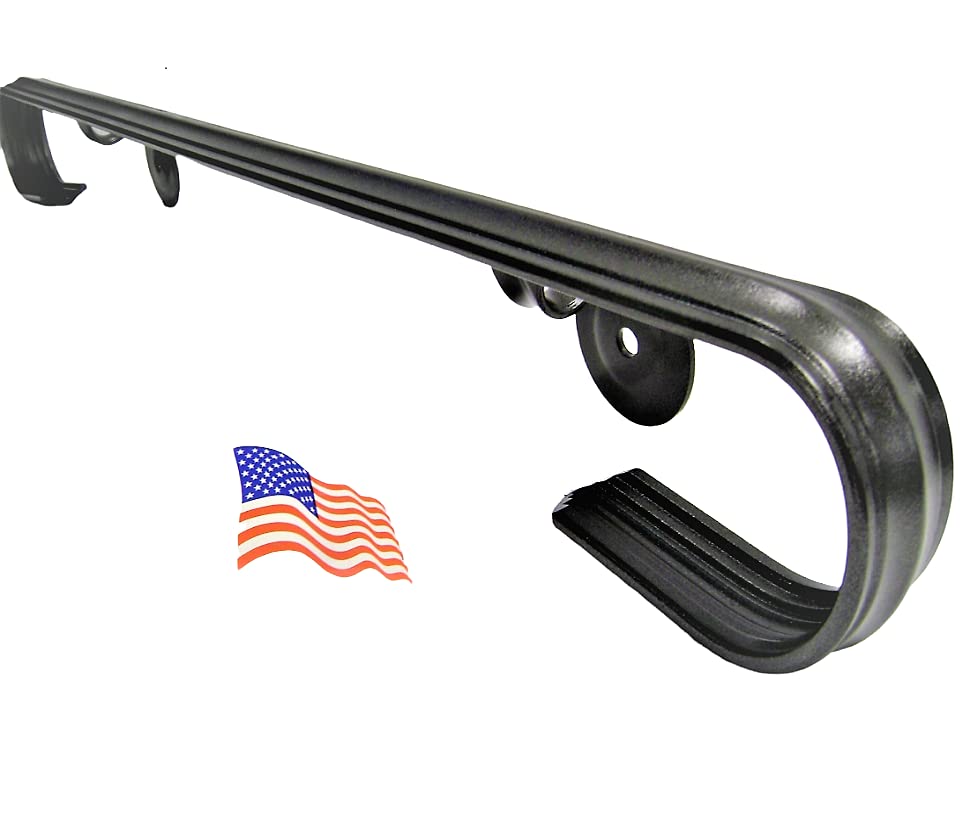
Two feet of American-made iron that bolts flat to the wall and stays put.
This is the rail for a short porch step-off, and it is built like a fixed piece of your house rather than an add-on. The 24-inch span runs to a 2-inch width, and the whole thing weighs 5.5 pounds — which tells you it is a single solid bar of iron, not a hollow tube. The clear space between the rail and the wall measures 2 inches, so your hand wraps around it without your knuckles scraping the siding. That is the single spec that decides whether a wall-mounted rail feels comfortable or cramped, and 2 inches is generous.
Weight is where it separates hardest from the biggest kit in this group. The VEVOR 3-step kit tips the scale at 28.1 pounds across 60.4 inches, so the Kenosha is a different animal entirely — compact, easy for one person to hold against the wall while drilling, and a sensible match for two steps off a porch. Mounting is straightforward by design: exterior installs use 2 black oxide bolts with washers and masonry anchors, and snap toggles are supplied for drywall. The painted black metallic finish is the sort that dresses up brick, siding, and painted wood equally well.
What wins people over is the build quality itself, followed closely by how planted it feels once bolted down. The wrinkle worth knowing is the hardware — a fair number of buyers report screws and anchors missing from the box, so check yours before you schedule the install and pick up masonry anchors if your steps are concrete. That is a small planning note, not a reason to pass on the rail.
Where it earns its place
- Fabricated in America with a custom 24-inch design
- 2-inch wall clearance keeps your grip comfortable
- 5.5 pounds of solid iron — simple for one person to position
- Snap toggles for drywall plus oxide bolts and masonry anchors for outside
What to plan around
- Hardware can arrive incomplete — verify the box before install day
- Built for a two-step span, so longer flights need a different kit
Reach for this one if: you have a short two-step porch with a solid wall alongside and want a permanently fixed iron bar.
Look elsewhere if: your steps number three or more — this rail simply will not span them.
2. White Wrought Iron Outdoor Handrail
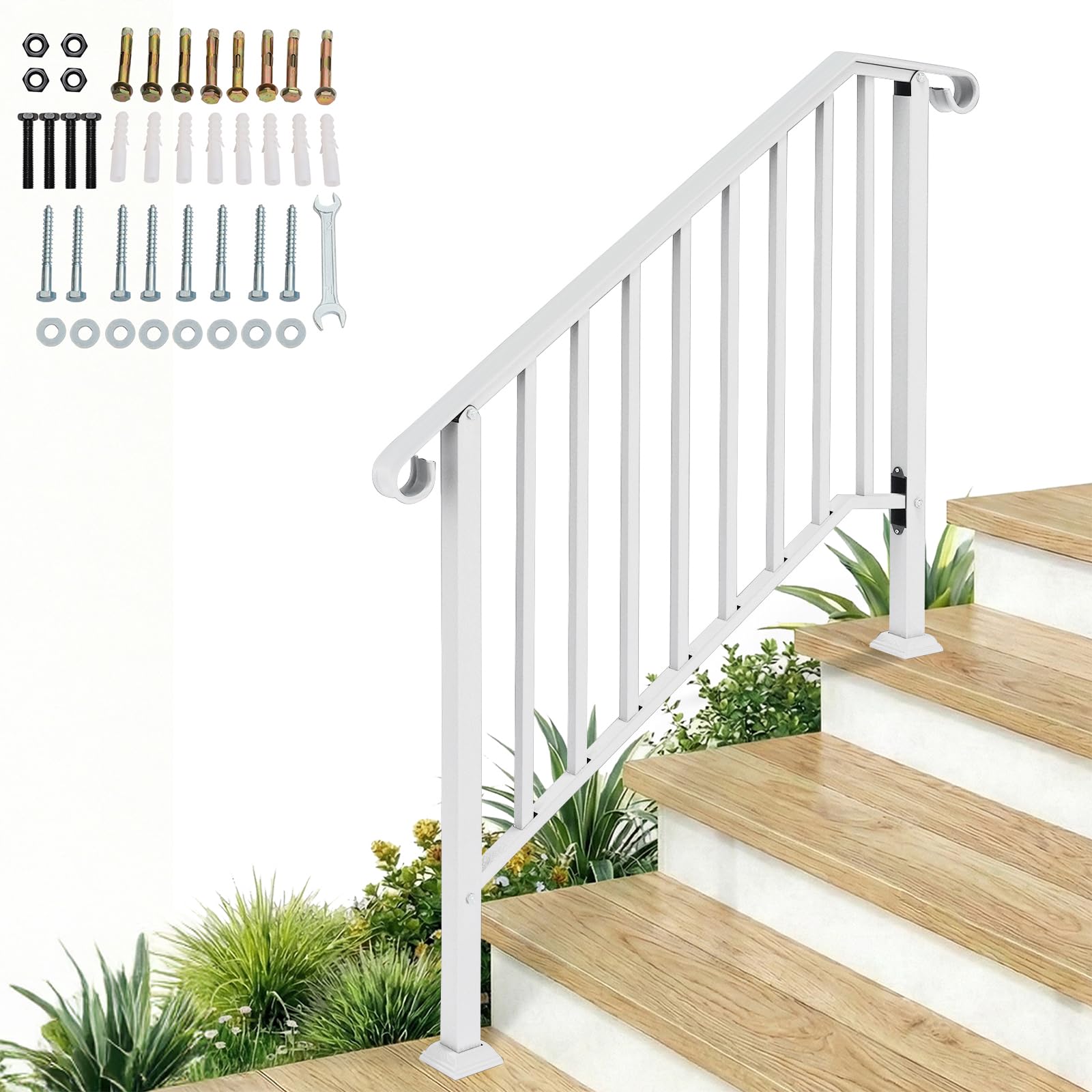
White iron and a curling picket design for porches where black would clash.
Most rails in this category are black, and that is precisely the reason this one stands out — a white powder-coated finish that blends into white trim, picket fencing, and light siding. It spans 39.96 inches and covers three or four steps, with an angle you can set to match your staircase rather than being locked to one pitch. Nine extra support bars and two bases run under the rail to stiffen the whole structure. The maker notes that wrought iron is more rigid than aluminum alternatives.
Owners generally like how it looks and how the price sits against the alternative of building a rail from lumber. Where the feedback splits is assembly and stiffness — some find it quick to put together, others wrestle with the instructions, and opinions on rigidity run both ways. Stability and fit also draw scattered gripes. None of that reads as a broken product; it reads as a rail that rewards careful measuring and patient assembly over a rushed afternoon job.
The classic curling and iron picket detailing is the visual payoff, and it does more decoration work than the plain bars here. It also suits a porch where children and older family members use the steps daily, since the extra support bars add a lower grab point below the top rail.
The honest read: a good-looking white iron rail at a fair entry point, best suited to someone comfortable with a bit of assembly patience and a careful measurement before drilling.
Pick this if white trim defines your porch: the powder-coated white finish and picket scrollwork match that look where a black bar would fight it.
Weigh the assembly: come prepared to read the instructions twice and check your step pitch first — the fit complaints trace back to measuring, not the iron.
3. VEVOR 3 Step Stair Hand Rail Kit
A 28.1-pound iron arch that covers three or four steps and does not flex.
If you have ever leaned on a hollow rail and felt it give, this is the answer to that memory. At 60.4 inches long by 3.3 inches wide and 28.1 pounds, it is the substantial one in this lineup — versus the 24-inch Kenosha at 5.5 pounds. More metal is what you want on a long concrete stair run, because a heavy rail resists the sideways shove that happens when someone catches a stumble. It is designed for three to four steps in a black retro arch profile.
Stability comes from stainless steel expansion bolts that double up the anchoring, and the kit arrives with screws, nuts, expansion bolts, and metal anchors so you are not hunting for fasteners the night before. The finish is powder coated and the install surface is flexible — concrete, wood, tile, or marble all work as long as the base is solid.
Quality and sturdiness are the themes owners keep returning to, with assembly being the one point of disagreement. Some find it quick; others hit snags getting everything lined up. That is the normal cost of a rail this heavy, so budget an unhurried afternoon and a helper for the lift.
Why the heft matters: 28.1 pounds and a 60.4-inch span give this rail the mass to feel planted under a full lean, which is exactly the reassurance a long stair run needs.
The right call for long concrete runs: this is the rail you want where the staircase is wide and the weather turns nasty.
Bring a second pair of hands: 28.1 pounds is a genuine two-person lift onto the anchors.
4. SPACEEUP Single Post Handrail

No wall, no problem — a single iron post set straight into the ground.
Plenty of porches simply have nothing to bolt a rail to. This is the solution for those: one ornamental wrought iron post that goes into a hole dug about 18 inches deep, then gets filled with concrete. No base plate, no drilling into brick. It is built for one or two steps and works on concrete, brick, or wood approaches. The matte black finish is powder coated, and the side scrolls are hand forged, which gives the rail a look most buyers read as more expensive than it is.
The install is where this rail shines — digging and setting a post is intuitive work, and owners consistently describe it as a quick, simple job with no base to fuss over. Appearance is the close second; the clean curled detailing makes it a piece you notice rather than tolerate. For a small condo entryway or a single step off a patio, the proportions suit the space.
The honest catch is weather exposure at the welds. Owners mention that “durability and rust resistance are significant concerns” with welds coming apart and rust showing quickly in exposed spots. That is a real consideration for an in-ground post, which sits at the dampest point of your steps. If your porch gets standing water or heavy salt exposure, plan to inspect the welds and touch up the coating each season. In drier, sheltered settings the same rail has plenty of happy long-term owners.
Why people like it
- Installs without attaching to any wall — just dig 18 inches and set in concrete
- Hand-forged scrolls give it a decorative look beyond plain bars
- Suits 1-2 step approaches on concrete, brick, or wood
Where to be careful
- Weld and rust reports mean regular coating checks are wise in wet climates
- One-post design covers a short run only
Ideal for the wall-less entryway: single-step and two-step porches where the post is the only practical mounting option.
Watch the weather: the in-ground foot sits where moisture collects, so a seasonal coat of paint on the joints goes a long way.
5. VEVOR Fit 2 or 3 Steps Outdoor Stair Railing

Built to bend to your steps rather than bend your steps to fit it.
Step heights vary wildly from house to house, and this rail is designed around that fact. The posts measure 38.35 inches tall, the space between them runs 42.7 inches, and the max height for steps is 25.5 inches — figures that let it adapt across three to five steps. Because it is adjustable, it fits the odd stair runs that fixed kits miss. Powder-coated black iron keeps the finish simple to wipe down.
The kit deserves a mention because it is unusually complete: 2 M6 bolts, 8 self-tapping screws, 8 expansion screws, a drill bit, and 2 open-ended spanners. That covers the entire mount in one box, which is why buyers often describe assembly as easier than building a rail from lumber. Solid bases under the posts give the structure something to push against, and the ergonomic profile is shaped for a comfortable grip.
Quality and sturdiness are the divisive points — some find it solidly built, others find it flexes more than they hoped. That split usually tracks with the surface it is mounted to and how carefully the posts are set. On solid concrete with the expansion screws fully driven, the rail behaves quite differently than on a loose wooden tread.
The adjustable advantage: a 25.5-inch max step height and a 42.7-inch post spacing mean this kit can meet a staircase that most fixed-length rails overshoot or undershoot.
The trade-off: flexibility is achieved through adjustment, and the more the parts move, the more a careful install matters for a planted feel.
Choose it for odd step heights: good where your staircase pitch does not match a standard three-step rail.
Make sure your surface is solid: the expansion screws do their best work in firm concrete rather than soft or crumbling wood.
6. CR Fence & Rail Hand Rails for Outdoor Steps, 5 Step Kit
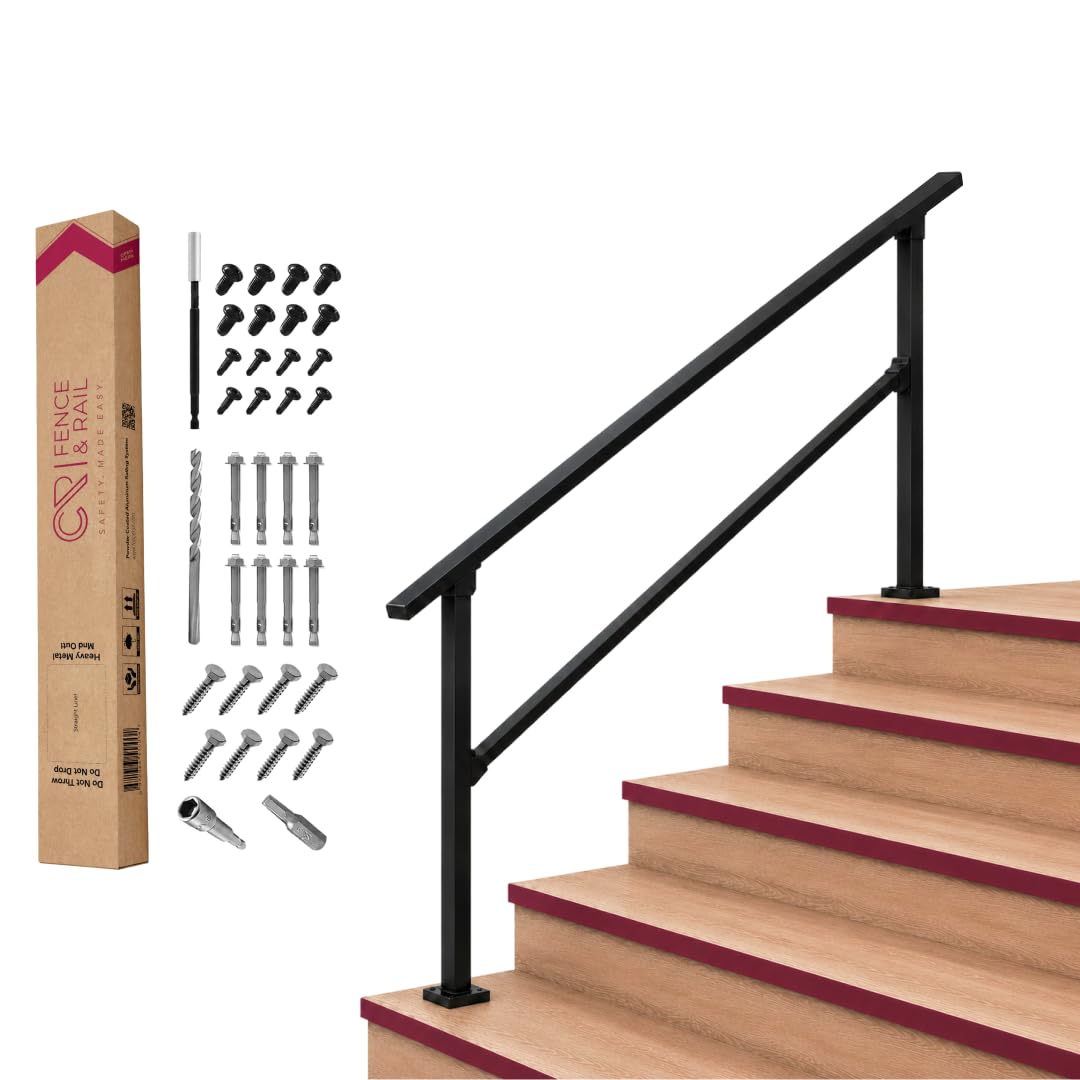
The kit that lists its code compliance and its weld pattern on the label.
Most rails tell you how they look. This one tells you what it will hold. Each post is tested to hold 238 pounds of lateral force — the sideways load of somebody grabbing hard or catching a stumble — and the kit is designed to meet IBC code requirements, including IBC 1014.2, IBC 1014.3.1 Part 2, and IBC 1607.8.1 through 1607.8.1.2. Confirm your local code, since jurisdictions differ, but if your project involves an inspection, this is the kit built to face it.
The package runs 68 inches long and 36 inches wide, with 2 posts at 36 inches, a 68-inch top rail, and a 54.5-inch middle rail, plus all hardware. It covers four to five steps and can be chained with separate top-rail connectors for a continuous run on a longer staircase. No cutting or welding is needed. Every joint is welded on all four sides rather than spot-welded, and the enclosed safety brackets seal out water at the base to help prevent rust from working from the inside.
The five-layer matte black powder coat resists fingerprints, grease, rain, snow, and UV exposure, and the rails wipe clean. Owners tend to lead with the overall build and how complete the kit is, right down to extra drill bits in the box. A family-owned American company with 20+ years in the business backs it with a ten-year warranty and free replacement parts. The main gripe is durability over the very long haul, which is note on a rail this large.
Built for inspection day: the 238-pound lateral load rating per post and the listed IBC references make this the pick for anyone who needs to show the rail meets a standard.
Right for permitted builds: four or five steps where you want code references and a four-side-welded joint, not a spot weld.
Plan the connectors: extending past this kit requires top-rail connectors sold separately.
7. ANTSKU 3 Step Handrails
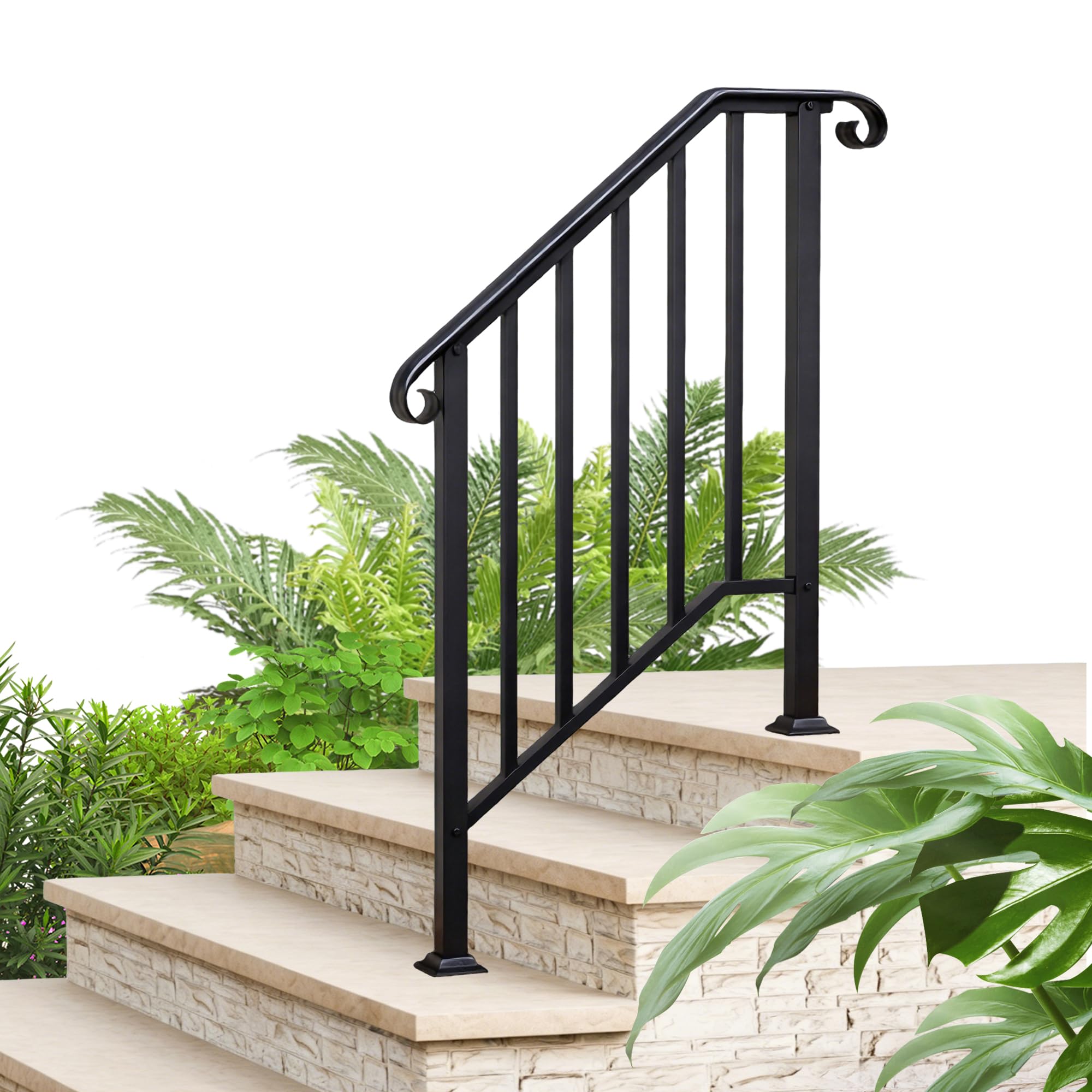
Piano-black iron pickets that read as architecture, not afterthought.
There is a difference between a rail you install and a rail that improves the look of the house. This one lands in the second camp. The grip surface runs 26 inches plus an extra 10.2 inches, the profile is 2 inches wide, and the upper post stands 39 inches tall, with a max step height of 12.6 inches for two or three steps. At 16.8 pounds it is heavier than most short rails, so it feels planted rather than borrowed.
The matte black powder coat is the centerpiece — owners single out how the near-black finish sits against a brick porch, and it wipes down easily. The iron picket style mixes modern and traditional lines, so it works on a new-build porch or an older home without looking out of place.
Setup is straightforward: mark your spot, drill, drive the screws, and fit the base trim. Most buyers describe the assembly manual as clear enough to finish in a sitting. None of the feedback here suggests any weakness in the iron itself — the finish and the strength are what buyers talk about, and both hold up.
What stands out
- Sleek piano-black powder coat that owners say complements brick
- 16.8 pounds of iron for a short rail — solid under hand
- Detailed manual makes the drill-and-mount routine quick
What it is not
- Fits two or three steps only, so longer flights need a bigger kit
- Decorative pickets not to everyone’s taste on a very modern facade
The pick for kerb appeal: short porches where you want the rail to add to the look of the house, not just the safety.
Know your span: designed for two or three steps — measure before committing on a longer run.
8. Vezek 4 Ft Wrought Iron Handrail

Four feet of continuous iron grip for a garage wall or a long stair edge.
A single rail that runs the whole way gives you something to hold wherever you place your hand — and at 48 inches long, this one covers real distance. The handrail profile is about 1¾ inches wide and the clear space from the cap to the wall is 1.7 inches. Brackets can be up to 39 inches apart, which allows a long, uninterrupted grab surface with no post interrupting the line. That is what makes this a good fit for the garage-to-house step where a lot of falls happen.
The matte black powder coat does double duty against weather, and the screws self-drill into the rail — there are no pre-drilled holes to line up or measure. For indoor and outdoor use across porches, garages, gardens, hotels, and buildings, it adapts to whatever surface you are attaching to, provided that surface is solid.
Owners describe it as heavy-duty and good-looking in the same breath, and the extra money for the longer run of solid iron reads as sound value to most. The screws are the one recurring complaint — some buyers find them cheap and swap them for sturdier fasteners. A quick hardware upgrade is a small price for four feet of continuous grip.
The value equation: a 48-inch bar with a 39-inch max bracket spread puts an unbroken grip surface along an entire doorway or stair edge, where shorter rails leave you reaching.
Swap the screws: the supplied fasteners are the weak link, and better bolts take an afternoon of extra work.
Best for the garage approach: where the doorway step needs a full-length grab bar rather than a stub rail.
Measure your run first: note that brackets reach 39 inches apart and the rail needs a solid surface to anchor to.
9. ROOMTEC 2 Pack 4 Step Hand Rails

Two matching rails in one box, for a wide staircase that needs both sides.
A staircase with both rails covered feels dramatically safer than one with a rail on the house side only. That is the logic behind this two-pack. Each rail measures 54.2 inches by 36 inches and the posts sit 1 foot apart, so the span can run the length of the steps at a consistent height. The rails adjust to different step heights, the holes come pre-drilled, and the top and middle rails can be shortened for a shorter run.
The oval handle has a non-slip, textured powder coat that gives grip even when wet — a detail you appreciate on a rainy morning. The wrought iron is built to hold weight without wobbling, and plastic end caps cover the rail ends. Real welding with no sharp cut edges is another comfort when there are children around.
Owners describe installation as clear and straightforward, and satisfaction with how sturdy the pair feels is common. Buyers repeatedly credit the pair with a real fall-prevention payoff on the steps. The one nagging point is the plastic caps: several customers note that they do not snap together cleanly. That is cosmetic and easy to set right with a dab of adhesive; it does not affect how the rail holds.
Where the two-pack wins: covering both sides of a staircase with one purchase, with a non-slip oval grip and adjustable rails that can be shortened to fit.
Choose this for wide stairs: two rails on the porch means a handhold on either side for whoever is descending.
Be ready to fix the caps: they have a reputation for not seating well, so a little adhesive settles it.
Know the Specs
Step count and rail length
Step count is the first gate. A two-step porch calls for a short wall-mounted rail, while a four or five step staircase needs a kit built to that length. Match the rail’s stated step range and its overall length to the real rise of your steps. If the span falls short, you leave a gap in exactly the place a hand reaches for support, which is the one thing the rail exists to prevent.
Mounting type
Wall-mounted rails bolt into the house and hold a fixed standoff so your grip clears the siding. In-ground posts go into a dug hole filled with concrete when there is no wall to use. Surface-mounted kits fix base plates through the step itself onto concrete, brick, or wood. Each suits a different porch, so pick by what your entryway offers rather than by look alone.
Powder coat finish
A powder-coated rail has a baked-on coating rather than brushed paint, and it resists fingerprints, grease, rain,UV fade, and everyday grime. A matte black or white powder coat wipes clean with a damp cloth. A finish is the first line of defense against rust at the weld seams, so staying on top of touch-ups where the coating wears is what keeps iron looking right season after season.
Wall clearance and grip width
The clear space between the rail and the wall is what lets a full hand wrap around the bar — a 2-inch standoff is comfortable, while a narrower one leaves knuckles scraping the siding. The rail profile width matters too: a 1¾-inch or 2-inch bar gives a full-finger grip. On a wall-mounted install, check both numbers so the rail feels natural when you are on the steps in bad weather.
Common Questions
How do I know which handrail fits my number of steps?
Can a wrought iron handrail be installed on wooden steps?
What does powder coated mean on a porch rail?
Will a wall-mounted handrail fit if my porch has no wall alongside the steps?
How tall should a porch handrail be?
Do I need to dig and pour concrete for an in-ground handrail post?
How do I prevent a wrought iron rail from rusting?
Can I connect two handrail kits to cover a longer staircase?
Is a two-pack handrail worth it for a wide porch?
What is the difference between wrought iron and aluminum for a porch rail?
The Bottom Line
For most porches, the wrought iron handrails for porches that earns the top spot is the Kenosha Iron 2 Ft Wall Mount — American-made, 5.5 pounds of solid iron, with a 2-inch wall clearance that keeps a full hand comfortably around the bar. It also holds 4.5+ stars across 400+ owners, the strongest review record in this lineup. If your stairs run long, the VEVOR 3 Step Retro Arch at 28.1 pounds gives you the serious mass a long concrete flight calls for. And when there is no wall to bolt to, the SPACEEUP Single Post sets straight into the ground and solves the entryway problem in one dig. Pick by step count and mount type first — the finish and detail are the easy part after that.
How we choose
We do not accept paid placement. Every pick is matched to a real buyer and a real use-case; we do not hands-on test units.
Sources
Specifications: manufacturer listings and product documentation. Review insights: verified customer reviews, as of November 2026. Pricing: not shown on this page (it changes often); check the current price via the retailer link.
As an Amazon Associate, Tactical Gear Guy earns from qualifying purchases. This does not affect which products we feature.