Specs are compiled from manufacturer listings and verified buyer reviews and can change over time — please confirm the key details on the product page before buying.
Back buttons only help if the sticks underneath them stay accurate. That is the real shortlist here: controllers for your Xbox Series X|S or Xbox One that put extra inputs under your fingers and still hold a straight line in a firefight. Some use magnetic Hall Effect sticks that resist drift, some add paddles you can remap mid-match, and one gives you a six-button fightpad module. Below you get what each one actually does, where it falls short, and who it fits.
This guide is built by comparing the manufacturers’ published specifications and the patterns across verified customer reviews, so you get each pick’s real strengths and trade-offs instead of marketing spin.
Rear buttons let you jump, reload, or crouch without lifting your thumbs off the sticks. This guide shows how each controller maps those rear inputs, how each stick type holds up over months of play, and which shell actually fits your hands. Pick by rear-input count first: two back buttons cover jump and crouch, while four paddles or six mappable inputs suit gadget-heavy loadouts.
Top Picks

How To Choose The Best Xbox Controller with Back Buttons
The rear buttons are the reason you are here, so start there. Count them first, then check whether they can be remapped. Two rear buttons cover jump and crouch in most shooters. Four paddles let you keep reload, melee, and a gadget on your fingers too.
Count the rear inputs before anything else
Two programmable back buttons are the common setup. That is enough to move your two most-used face buttons off your thumbs. Four paddles, like the ones on the SCUF VALOR PRO, push that further. More paddles means a longer setup session, because you have to decide what each one does.
Stick technology decides how long it stays accurate
Standard analog sticks wear down and start drifting — the cursor creeps when you are not touching it. Hall Effect sticks use magnetic sensors instead of physical contact, so there is nothing to wear out in the same way. TMR sticks are a related magnetic design; ASUS claims its TMR joysticks are more accurate and use less power than Hall Effect. Either way, you are buying a controller that should hold its aim longer than a stock pad.
Trigger stops and hair triggers change your reaction window
A trigger stop shortens how far the trigger travels before it registers. In a shooter that means your shot fires sooner. Several picks here switch between a short-pull mode for FPS and a full analog pull for racing. If you play both shooters and racing games, that switchable trigger travel matters more than extra RGB.
Wired or wireless, and what it costs you
A wired pad skips charging entirely and generally means a stable connection. Wireless frees your couch setup but adds a battery to think about. The Turtle Beach Victrix Pro BFG Reloaded lists a rechargeable battery rated for up to 20 hours, and the ASUS ROG Raikiri II lists at least 30 hours of 2.4GHz play with RGB, audio, and vibration off. Read those numbers as best-case figures with the extras switched off.
Side-by-Side Comparison
| Model | Best For | Rear Inputs | Stick Type | Connection | Amazon |
|---|---|---|---|---|---|
| Hyperkin The Competitor★ Best Overall | All-round value | 2 back buttons | Hall Effect | USB wired | Amazon |
| GameSir T7 ProBest Value | Trigger-stop fans on a budget | 2 back buttons | Hall Effect | Wired | Amazon |
| 8BitDo Ultimate 3-modeMost Versatile | Multi-device households | 2 back paddles | Hall Effect | 2.4G / USB / Bluetooth | Amazon |
| Turtle Beach Rematch | Wireless with trigger stops | 2 back buttons | TMR | USB transmitter / Bluetooth | Amazon |
| SCUF VALOR PRO | Maximum paddle count | 4 rear paddles | Hall Effect | USB-C wired | Amazon |
| Turtle Beach Victrix Pro BFG Reloaded | Swappable modules | 4 mappable buttons | Hall Effect | Wired + wireless | Amazon |
| ASUS ROG Raikiri II | Long wireless sessions | 4 rear buttons | TMR | 2.4GHz wireless | Amazon |
| Razer Wolverine V4 Pro | Competitive PC-and-console play | 4 back buttons + 2 claw bumpers | Capacitive anti-drift | 2.4GHz / Bluetooth / USB-C | Amazon |
Detailed Reviews
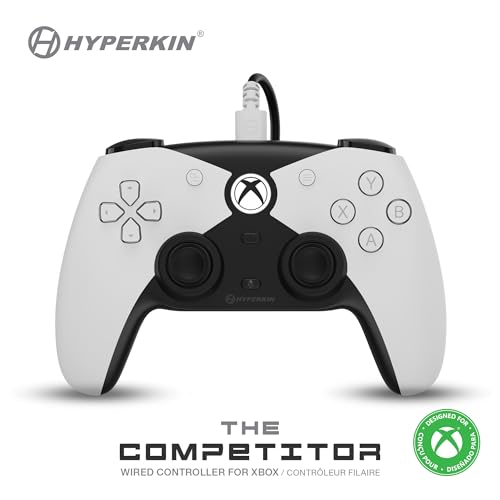
1. Hyperkin The Competitor Wired Controller
Our pick — 4.0+★ from 600+ verified ratings; the strongest balance of quality and price.
Magnetic sticks that resist drift, two rear buttons, and a wire that never needs charging — this is the safe default.
If you want the drift problem solved without paying a premium, this is the pick. It carries 4.0+ stars across 600+ owners, and what wins people over is the feel of the sticks — smooth travel with no notchiness, which is exactly what the Hall Effect design promises. Hall Effect here means the sticks read position with magnetic sensors instead of rubbing contacts, so there is no wear surface to grind down over a year of play. The shell is officially licensed by Xbox and light in the hand, which matters in long sessions.
Practically, you get two programmable rear buttons. That covers the two buttons most shooter players want on their fingers — typically jump and crouch — so your right thumb barely leaves the stick. The symmetrical stick layout will feel familiar if you have played PlayStation pads, and odd for a few minutes if you are coming off a standard Xbox pad. There is also a headphone jack and USB-C, so cable swapping is easy. The trade-off is simple: this is a wired controller, so you are tethered to the console or PC.
What Holds Up Over Months
- Hall Effect sticks and Hall Effect triggers, so drift is the one failure mode this design targets directly
- Two back buttons for jump and crouch without thumb gymnastics
- USB-C connection and a headphone jack — no battery to manage, no dongle to lose
- Officially licensed by Xbox, so it pairs like a first-party pad
Where It Stops Short
- Two rear buttons is the ceiling here — no third or fourth paddle for gadget-heavy loadouts
- Wired only, so the cable decides how far back you sit
- The symmetrical stick layout is a taste thing; some hands never settle into it
Reach for this if: you want drift-resistant sticks and two clean rear buttons with zero charging routine, on either an Xbox Series X|S or a PC.
Look elsewhere if: your game plan needs three or four paddles, or you refuse to play with a cable attached.
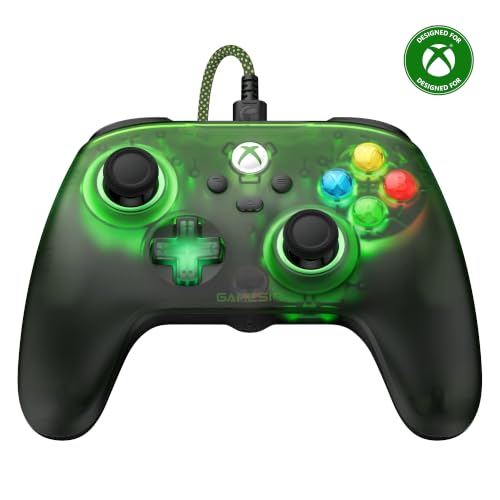
2. GameSir T7 Pro Wired Xbox Controller
Trigger stops and two back buttons on a wired pad that keeps the spend modest and the response quick.
The spec that earns this one a slot is the switchable trigger stop. In FPS mode you shorten the pull so your shot registers sooner; flip back to full travel for racing and analog throttle. Add Hall Effect sticks rated for up to 5 million cycles, and you have a pad built to outlast the drift that ends most controllers. GameSir also gives you four rumble motors — two in the grips, two in the triggers — so acceleration and impacts hit through the triggers, not just the body.
The textured grips are laser-engraved, which keeps your hands from sliding when a session runs long, and there is a 3.5mm headset jack for chat. Remapping runs through GameSir Nexus software, where you can adjust stick sensitivity, trigger range, and vibration intensity, then save profiles per game. The honest caveat is reliability: the recurring gripe is the controller randomly powering off, so if you need a wired pad that never blinks mid-match, weigh that against the trigger-stop value. If random power-offs are not a dealbreaker, its trigger stops and four-motor rumble are hard to match at this price.
Compared with the Hyperkin above, you gain adjustable trigger stops and lose nothing on stick technology — both run Hall Effect. What you give up is the Hyperkin’s officially licensed shell.
Where the money goes: the short-pull trigger stop and the four-motor rumble are the two features that separate this from a plain licensed pad, and both are things you feel in the first match.
Buy this if: you play shooters where a shorter trigger pull matters and you want that without spending premium money.
Think twice if: you need a connection you can set and forget, because random power-offs are the trade-off here.
3. 8BitDo Ultimate 3-mode Wireless Controller for Xbox
One pad that talks to your Xbox, your PC, your phone, and your Mac — and recharges on a dock.
Connection flexibility is the whole pitch. This is 8BitDo’s first 2.4G wireless Xbox controller, and it links to Xbox or Windows PC over 2.4G or a wired USB cable, then to Apple and Android devices over Bluetooth. One controller pairs with your Xbox, PC, and phone, so you skip buying a second pad and charger. The integrated charging dock reconnects the pad automatically when you lift it out, so it stays topped up between sessions.
Rear inputs come as two pro back paddle buttons, backed by Hall Effect joysticks and Hall Effect triggers. You also get three custom profiles and support for 8BitDo Ultimate Software X, so your remap travels between games. Owners describe it as responsive with great feedback and excellent connectivity, and it earns praise for working with nearly anything that takes Bluetooth or USB.
What pulls you up short is size. At 7.48 x 5.51 x 0.79 inches it is a flatter, wider shell than the SCUF VALOR PRO at 6.02 x 4.21 x 2.52 inches, so it lies differently in your palms. That flat, wide shell suits some hands and leaves others missing the fuller grip of a standard Xbox pad. The 40th Anniversary Rare edition styling is a shelf-piece look, not a neutral one.
One controller, several screens: if your household jumps between an Xbox, a laptop, and a tablet, this removes the need for a second pad and a second charger.
The right call for: anyone who wants one wireless controller to cover console, PC, and mobile, with paddles in reach.
Pass if: you need a chunky, full-grip shell in your hands, because this one is deliberately slim.
4. Turtle Beach Rematch Wireless RGB Gaming Controller
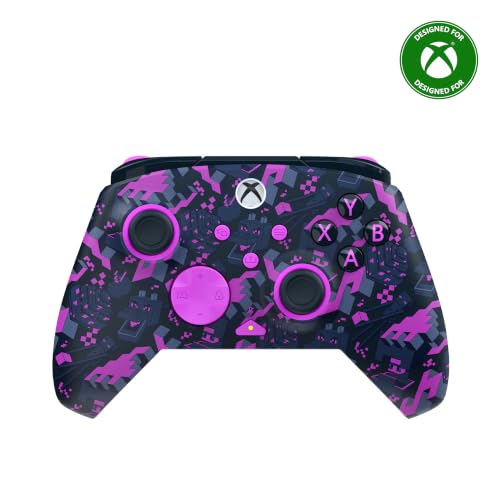
Three trigger positions, TMR sticks, and a wireless dongle — a tuning kit disguised as a Minecraft controller.
Look past the licensed design and the hardware is competitive. The hair triggers have 3-way trigger stops, so you can dial travel for a quick FPS pull or a longer analog squeeze for racing. The thumbsticks are TMR (tunnel magnetoresistance — a magnetic sensing design, like Hall Effect, chosen to avoid the physical wear that causes drift), which Turtle Beach pairs with dual rumble motors and impulse triggers for feel. You also get two mappable quick-action back buttons, the minimum that makes rear inputs worthwhile.
Wireless runs through a USB transmitter for Xbox and Windows 10/11 PCs, with Bluetooth for compatible Android and streaming devices. A built-in rechargeable battery pairs with a 10ft USB-C play-and-charge cable, so a long session is a cable away rather than a dead stop. The 3.5mm jack carries patented on-board audio controls, which means chat and volume tweaks without diving into menus.
Worth knowing: this is a newer listing with a light review base, so the long-term picture is thinner than the SCUF’s. And at 8.48 ounces it is lighter than the SCUF VALOR PRO at 9.12 ounces — that difference is small but noticeable over a four-hour session. Fewer total buttons (14) also means less real estate for macros than a four-paddle pad.
It earns its place if: you want wireless freedom plus genuine trigger adjustability for a mix of shooter and racing games.
Look past it if: you want proven longevity data or more than two rear buttons.
5. SCUF VALOR PRO Wired Performance Xbox Controller – Black

Four embedded paddles, 16 configurable functions, and the highest paddle count on this list.
This is the one to look at if two rear buttons already feel cramped. Four embedded rear paddles can be configured across up to 16 functions, and a switch flips between three saved remapping profiles. The Instant Triggers cut trigger pull to shave milliseconds off your reaction, and the performance grip is built to stay non-slip through a long session — that grip and the overall build are what owners talk about most. There are 24 buttons in total here, against 14 on the Turtle Beach Rematch, a big jump in available inputs.
The customisation runs deeper than mapping. Faceplates and thumbsticks swap out, so you can change the look and the stick height without buying a new pad. An audio control system changes volume on the fly rather than through menus.
The catch is reliability and connection. This is a wired USB-C controller, and the recurring complaints centre on connectivity dropping out and, for some, drift developing over time. Treat it as a wired pad that needs a stable USB-C connection and occasional stick maintenance.
Paddles over everything: if your loadout needs four inputs on your fingers and your thumbs never leaving the sticks, nothing cheaper on this list gets you there.
Made for: competitive players who will actually map four paddles and use the profile switch between games.
Not for: anyone who wants a plug-in-and-forget wireless pad, since this one is wired and has a mixed connectivity record.
6. Turtle Beach Victrix Pro BFG Reloaded Controller
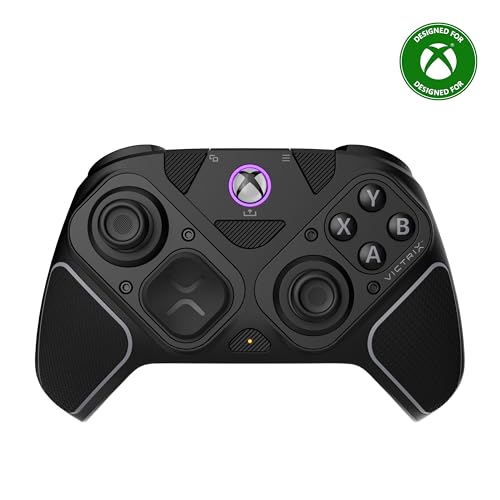
Three swappable modules, eleven interchangeable parts, and a fightpad layout you can bolt on when a game calls for it.
Modularity is the reason this exists. It ships with 3 customizable modules built around Hall Effect technology, and 11 interchangeable components to rearrange. One of those modules is an ergonomically enhanced 6-button fightpad with Kailh microswitches — swap it in for fighting games and back out for shooters. Four mappable quick-action buttons sit on the rear, and the Hall Effect clutch triggers have five stops plus a hair-trigger mode for a short, fast pull.
It runs wired or wireless, with a rechargeable battery listed at up to 20 hours. A 3.5mm jack carries a lifetime Dolby Atmos subscription, and Turtle Beach throws in a carrying case and a module tool, so the swapping is meant to travel. Customisation and grip are the two things owners single out — this is a pad that feels right in the hand for people who like a full shell. What wins people over is the build quality overall, with the most praise landing on how solid the controller feels.
Where it gets awkward is button layout during regular play. Feedback is mixed on the triggers and on responsiveness, with some finding the extra buttons get in the way during ordinary use. If you never touch the fightpad module, you are paying for flexibility you will not use. Its 10-button count also reads lower than the SCUF’s 24, because this pad leans on modules rather than raw button totals.
Flexibility tax: you are buying a system, not a single pad, and that only pays off if you genuinely switch genres enough to use the modules.
Worth it for: players who move between fighting games and shooters and want one controller to cover both layouts.
Skip the swap if: you play one genre and want the simplest possible control scheme.
7. ASUS ROG Raikiri II Xbox Wireless Gaming Controller for PC
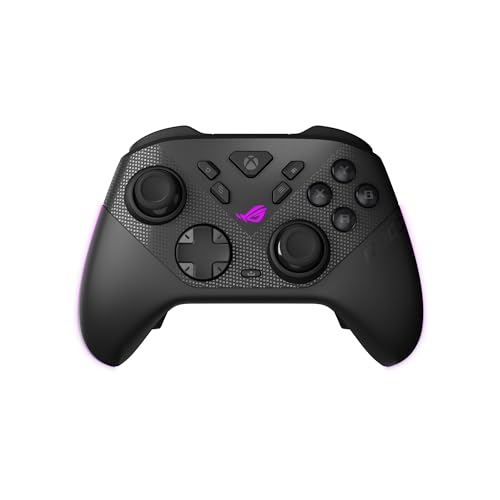
A claimed 30 hours of cordless play and four rear buttons — the marathon option for long sessions.
Battery is the headline. ASUS lists at least 30 hours of 2.4GHz wireless play on a single charge, with the fine print that RGB lighting, audio, and vibration are off. Even discounting that, it means you are charging far less often than a typical wireless pad. Rear inputs are generous — four fully programmable rear buttons, and micro-switch internals across the D-pad, ABXY, rear buttons, and bumpers, so every press has a tactile click. The sticks are TMR, which ASUS claims are more accurate and less power-hungry than Hall Effect.
The dual-mode triggers are the sleeper feature. You switch between micro-switch triggers with short travel for a fast pull and TMR sensor triggers with full travel for analog control — one toggle, two feels, across racing and shooters. There is also anti-slip grip for long sessions.
Here is the honest part: build quality is contested, with some finding it sturdy and others flimsy, and connection dropouts are a recurring complaint. Pair that with 4.0+ stars and you have a pad that impresses on the spec sheet and occasionally frustrates in the moment. At 9.6 ounces it is the second-heaviest here after the Razer, so it is not a featherweight.
Pick it for: the battery figure and the dual-mode triggers, if you play in long stretches and hate hunting for a charger.
Reconsider if: a rock-solid wireless link is your top priority, because dropouts come up here.
8. Razer Wolverine V4 Pro Controller

Six mappable rear inputs and mouse-click buttons — the most aggressive input stack here.
This is the top of the ladder, and the rear-button count shows it. You get four removable mouse-click back buttons plus two claw grip bumpers, six mappable inputs in total, so you can remap a whole gameplan onto your fingers without lifting your thumbs from the sticks. It carries 4.5+ stars from a smaller owner base, and the buttons themselves are the draw — click actuation feels instant compared with rubber-dome presses.
The sticks are capacitive anti-drift thumbsticks with contactless sensors, which the company pitches as reliable accuracy and smoother tracking in FPS and sports games. Razer Pro HyperTriggers let you switch between instant mouse-click activation and full-range analog control, so racing and shooters share one pad. On PC, polling runs up to 8000 Hz, meaning the controller reports its position far more often for lower perceived latency. Four onboard profiles and the Razer Controller app handle your remaps.
Two things to know. At 14.72 ounces it is much heavier than the Turtle Beach Rematch at 8.48 ounces — a real difference if you play with your arms up. And this is a premium pad with a small review base, so you are trusting a newer track record. For players who live in competitive lobbies, the input count and polling rate are the argument.
The Competitive Case
- Six mappable rear inputs (four back buttons plus two claw bumpers) — the most on this list
- Up to 8000 Hz polling on PC for lower perceived input delay
- Capacitive contactless sticks built to resist drift
- Interchangeable thumbstick caps, magnetic faceplate, and four onboard profiles
The Fine Print
- Heavy — 14.72 ounces, noticeably more than the lighter pads here
- A premium-tier buy, with a shorter review history to lean on
- All that configuration takes a session or two to set up to taste
Built for: competitive players who want the most rear inputs and the lowest latency on PC, and will use all of it.
Overkill for: casual couch play where two back buttons already cover what you need.
Know the Specs
Rear Inputs: Back Buttons vs Paddles
Back buttons and paddles both sit on the underside where your middle and ring fingers rest. The difference is shape and control. A back button is a small press point; a paddle is a longer lever. Two rear inputs cover your most-used face buttons — usually jump and crouch. Four paddles let you keep more commands on your fingers so your thumbs stay on the sticks. Every extra input means a longer setup, since you decide what each one does.
Hall Effect vs TMR Sticks
Both are magnetic sensing designs that avoid the physical friction that wears out ordinary analog sticks and causes drift. Hall Effect uses a magnetic field to read stick position. TMR uses a different magnetic sensing method; ASUS claims its TMR sticks are more accurate and use less power than Hall Effect. Capacitive, contactless sticks like the Razer’s are a similar anti-drift idea. Whichever the label, the goal is a stick that holds its aim longer than a stock pad.
Trigger Stops and Hair Triggers
Trigger stops (small switches that cut how far the trigger travels before it registers) make your shot fire sooner. Multiple stops let you choose how short the pull is — the Turtle Beach Rematch offers 3-way stops, the Victrix Pro BFG Reloaded offers five plus a hair-trigger mode, and the ASUS Raikiri II switches between micro-switch short travel and full analog travel. Racing games want the full analog pull so you can feather the throttle; shooters want the short one so the shot lands faster.
Connection and Battery
Wired pads skip charging and keep the link stable, at the cost of a cable. Wireless pads with 2.4GHz dongles trade that tether for a battery. The Victrix Pro BFG Reloaded lists up to 20 hours of battery and the ASUS Raikiri II at least 30 hours of 2.4GHz play with RGB, audio, and vibration off. Bluetooth adds phone and tablet support but is not the mode you want for competitive play.
Common Questions
Will a third-party Xbox controller with back buttons work on Xbox Series X and Xbox One?
How many back buttons do I actually need for shooters?
Do Hall Effect sticks really stop stick drift?
Is a wired controller better than wireless for competitive play?
Can I remap the back buttons to any game or do I set it per game?
What do trigger stops do and should I use them for racing games?
Do these controllers have a headphone jack for chat?
How long does the battery last on the wireless options?
Can I swap the thumbsticks or faceplate if I want a different feel?
What is the difference between TMR and Hall Effect joysticks?
The Bottom Line
For most people, the xbox controller with back buttons to start with is the Hyperkin The Competitor. It gives you Hall Effect sticks (magnetic sticks that resist drift) and two programmable rear buttons on an officially licensed shell, with no charging to think about. If your trigger pull is the thing holding you back, grab the GameSir T7 Pro for its adjustable trigger stops. And if you want the most rear inputs and the lowest PC latency (the shortest delay between your press and the game reacting), the Razer Wolverine V4 Pro is the one to reach for.
The one honest nudge: the Hyperkin sits at 4.0+ stars across 600+ owners, a track record that makes it the low-risk first step into rear-button play before you spend on a four-paddle or modular setup.
How we choose
We do not accept paid placement. Every pick is matched to a real buyer and a real use-case; we do not hands-on test units.
Sources
Specifications: manufacturer listings and product documentation. Review insights: verified customer reviews, as of November 2026. Pricing: not shown on this page (it changes often); check the current price via the retailer link.
As an Amazon Associate, Tactical Gear Guy earns from qualifying purchases. This does not affect which products we feature.