Specs are compiled from manufacturer listings and verified buyer reviews and can change over time — please confirm the key details on the product page before buying.
If rainwater pools against your foundation or swamps the low corner of your lawn, the fix is a catch basin: a buried plastic box with a grate on top that catches surface water and sends it into a buried pipe. This guide explains which ones actually move water, which ones clog, and how to match one to the pipe you already have. One note before you read: this list uses flexible, human-like matching for catch basins — so not every pick is the exact number or size you searched, but the nearest same-type size serves the same purpose. You are never being pointed at a splash block or a decorative cover here; every pick connects to a drainage pipe.
This guide is built by comparing the manufacturers’ published specifications and the patterns across verified customer reviews, so you get each pick’s real strengths and trade-offs instead of marketing spin.
Some basins arrive as bare boxes you adapt yourself, while others come as full kits with outlet seals and a plug already in the box. Here is how each one handles that job in a real yard, so you can pick the shape that fits your pipe and your patience level with a yard drainage catch basin.
Top Picks


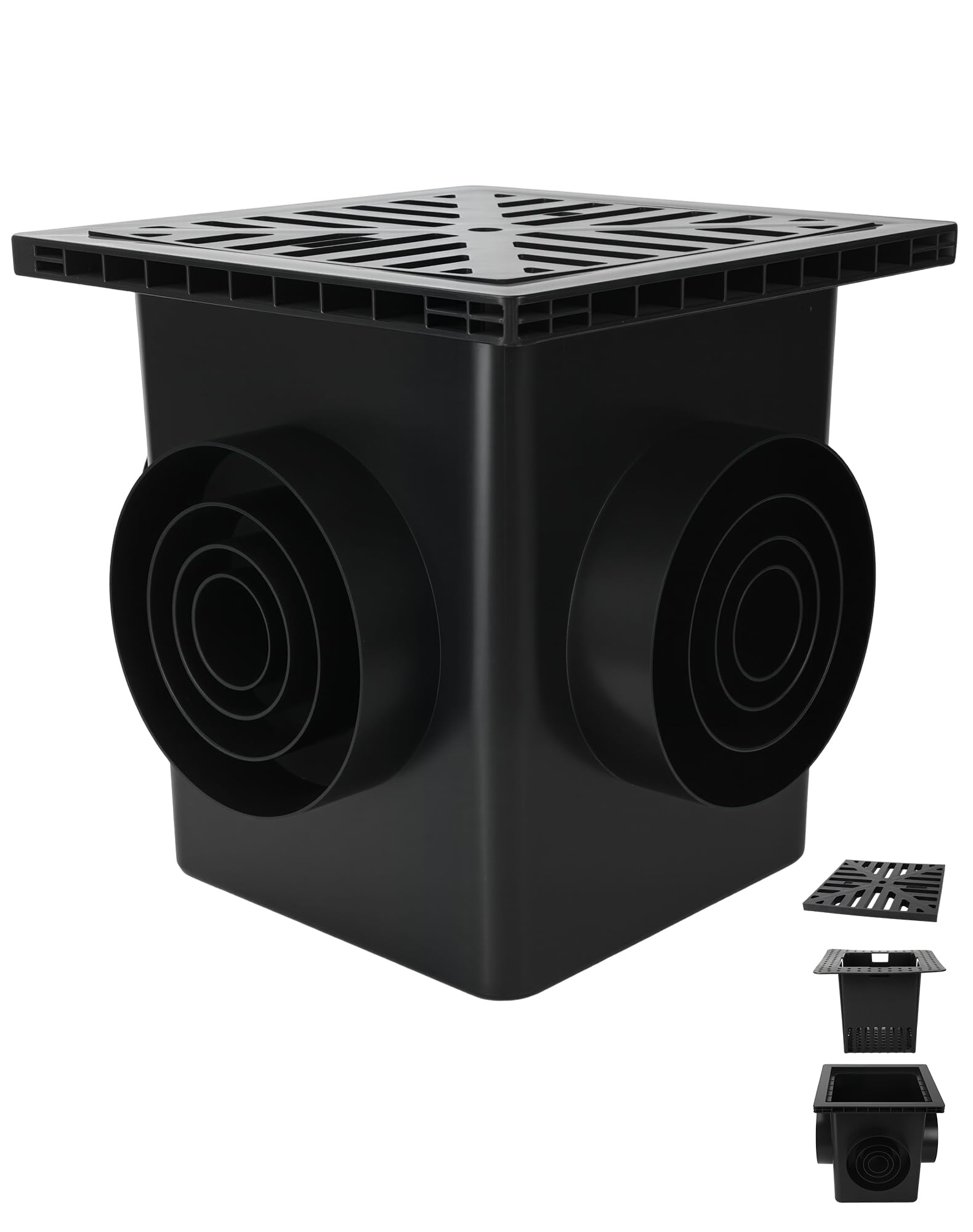
How To Choose The Best Yard Drainage Catch Basin
The mistake most people make is buying the basin first and hunting for pipe later. Work backwards: find the buried pipe or the downspout you want to feed, measure its outside diameter, and only then pick a basin whose outlets can meet it. A basin that cannot seal to your pipe just becomes another puddle with a lid on it.
Match the outlet to your pipe, not the other way around
Basins connect to pipe in two ways: through removable outlet adapters that push into keyed side openings, or through molded spouts at set diameters. Adapters are the friendlier route because they lock in place and seal soil-tight, and the better kits ship with a plug so you can close the opening you are not using. If your pipe is already in the ground at a fixed height, check that the basin’s depth and outlet height line up before you dig the hole.
Grate open area and load rating decide the hard jobs
A grate’s open surface area is the actual hole water passes through, and it is the number that governs how fast a heavy downpour clears. The load rating tells you what can roll over the top: light-duty grates handle foot traffic and mowers, while a Class B rating covers cars and light trucks at low speed when the basin is properly installed. If your basin sits in a driveway apron or a lawn the truck crosses, that rating is not a detail.
Debris baskets: convenience you have to open and empty
A debris basket or strainer inside the basin catches leaves before they reach the pipe, which is the difference between lifting a grate once a season and rodding out a blocked line. The trade-off is maintenance: you have to open the grate and pull the basket. Basins without one rely on the grate alone and send anything small enough to slip through straight down the line.
Side-by-Side Comparison
| Model | Best For | Pipe Sizes | Basin Size | Grate / Basket | Amazon |
|---|---|---|---|---|---|
| NDS Square Catch Basin Drain Kit (1200BKIT)★ Best Overall | Downspouts and walkways | 3 in. & 4 in. sewer, corrugated, triple-wall, 4 in. Sch. 40 (6 in. & 8 in. with extra adapters) | 12 in. square | Plastic grate, 53.1 sq. in. open area; no basket | Amazon |
| Uni-Green Catch Basin Kit 12×12 (UGCB1212)Most Versatile | DIY multi-pipe layouts | 2, 3, 4 and 6 in. — four outlets | 12 in. square | Grating plus debris basket | Amazon |
| Dooeant Upgrade 12 IN Catch Basin Drainage KitCleanest Maintenance | Leaf-heavy yards | 2 in., 3 in., 4-3/8 in., 6-3/8 in. — four spouts | 12 in. square | Clutter basket inside | Amazon |
| NDS 1200 Square Catch Basin Drain | Budget starter basin | 3 in. & 4 in. via outlet adapters | 12 in. square | Grate fits on top; built-in sump; no basket | Amazon |
| Polylok 12″x12″ Square Catch Basin Kit | Fitting 6 in. pipe at 12 in. size | 2 in., 3 in., 4 in., corrugated, up to 6 in. | 12 in. square | Green grate; no basket | Amazon |
| YACMCMK Large Drainage Catch Basin | No-hub custom plumbing | Undrilled — cut to your pipe | 18x18x15 in. | Fiberglass grate plus debris basket | Amazon |
| Kritkin 15 x 15 x 15 Inch Catch Basin | Large yards with soil runoff | Undrilled — cutting lines for reserved holes | 15.75 x 15.75 x 15.75 in. | Resin grid plus debris basket | Amazon |
| RYSIMWU 22x14x16 in Large Catch Basin | Big-volume collection | Undrilled — precise cut to existing pipe | 22x14x16 in. | Fiberglass grate plus debris basket | Amazon |
Detailed Reviews
1. NDS Square Catch Basin Drain Kit with 2-Opening Catch Basin
Our pick — 4.5+★ from 750+ verified ratings; the strongest balance of quality and price.
The 12-inch basin that swallows a whole downspout and keeps up with the storm.
The two numbers worth knowing before anything else: a 162 GPM flow rate — that is gallons per minute the grate will pass — and 53.1 sq. in. of open surface area on the 12 in. square plastic grate. In real terms, that open area is why this basin keeps draining during a hard rain instead of topping over like a mostly-plastic lid with a few slots. It is the crowd favorite here by a clear margin, holding 4.5+ stars across 700+ ratings, and it is the pick most people should start with.
What you get in the box is the part that saves an extra trip: the 12 in. catch basin with two side openings, two outlet adapters, one plug, and the plastic grate. The adapters connect it to 3 in. and 4 in. sewer and drain pipe, single-wall corrugated, triple-wall, and 4 in. Sch. 40 pipe, and they lock into keyed side openings for a soil-tight fit with no tape or glue. Need 6 in. or 8 in. pipe? Extra adapters are sold separately. The included plug seals the opening you are not using so all the water goes one way.
The rating that separates this from the smaller basins: NDS Class B loads, up to 175 psi, when properly installed with the grate — meaning autos and light trucks rolling over it at speeds under 20 mph. That is the difference between a lawn mower crossing it and a driveway that actually needs to drain. Four weephole knockouts on the bottom let trapped water escape so the basin does not sit stagnant, and there is a bottom knockout for a third keyed opening if your layout needs one.
What works in your favor
- 162 GPM and 53.1 sq. in. of open grate area handle heavy downspout flow
- Two adapters plus a plug cover 3 in. and 4 in. pipe from the start
- Class B rating (up to 175 psi) for vehicles when installed correctly
- Weephole knockouts drain standing water instead of letting it sour
Where it asks for more
- 6 in. and 8 in. connections need adapters you buy separately
- No debris basket — leaves ride straight through the grate to the pipe
- The Class B rating only applies when the whole kit is installed properly
Go with this one: a downspout, patio edge, or walkway dumping water where you can bury a 12 in. basin and run 3 in. or 4 in. pipe away.
Look elsewhere: if you want a leaf basket to lift out, or you already own 6 in. pipe and would rather not buy adapters.
2. Uni-Green Catch Basin Kit 12X12
Four knockout outlets on a 12-inch square, so your layout stops dictating the basin.
Most basins force one or two pipe directions. This one gives you four outlets with knockout slots — areas you open only where you need them — sized for 2, 3, 4 and 6 in. pipe. If you are laying out a patio drain that needs to take water from two sides and send it to a third, that flexibility is the whole reason to pick it. It is the mid-range workhorse of this lineup rather than the outright winner.
A debris basket under the grating does the dirty work you would otherwise do with a drain snake. That basket catches what slips through the grate, and lifting it out beats fishing around inside a buried box by hand. The rim is widened compared with typical basins, which the maker positions as more resistant to breakage — note because a thin rim is exactly what cracks when a loaded wheelbarrow rolls over the edge.
The honest catch is the fit question. The outlets are set up for nominal 2, 3, 4 and 6 in. pipe, and pushing a real-world pipe into a nominal knockout sometimes needs a little persuasion or an adapter. Set your pipe’s actual outside diameter against the knockout size before you dig the hole, and this one installs quickly. Get that wrong and no basket will rescue the job.
Where it earns the spot: four outlets and a debris basket on a 12 in. square footprint is a genuine option-setter in this size class.
Measure first: dry-fit your pipe to the knockout before backfilling — a fit that looks close on paper can be snug in the ground.
Built for: a DIY patio or landscaped bed where water arrives from more than one direction.
Not the one if: you want a simple two-port basin with fixed adapters and no basket to empty.
3. Dooeant 12 IN Catch Basin
Four spouts and a basket that keeps the leaves out of the line.
The clever part here is the clutter basket sitting inside the basin. It catches leaves and the smaller debris that slips past the grate, so clearing it means opening the lid and lifting the basket instead of rodding a clogged pipe. Under a tree or beside a gravel path, that is the difference between a ten-minute chore and a lost weekend. The four spouts at 2 in., 3 in., 4-3/8 in. and 6-3/8 in. give you real sizing flexibility for a DIY patio layout.
Owners praise the build, and the unit takes a knock without cracking — at 5.5 lb it is a solid molded piece, not a flimsy shell. A basket inside also means the small stuff never reaches your buried pipe, which is exactly where a clog is hardest to reach.
The one thing to check before ordering: sizing. The spouts are stated at 4-3/8 in. and 6-3/8 in., not a round 4 and 6, so a pipe that measures closer to a true 4 in. may not seat the way you expect. Dry-fit your pipe to the spout first. If it matches, install is quick, and the basket pays for itself the first fall the leaves come down.
The real draw: a removable basket plus four spout sizes covers most yard layouts in one kit.
The catch to size up: measure your pipe’s outside diameter against the 4-3/8 in. and 6-3/8 in. spouts — the odd sizes are the point, and also the fit risk.
Pick it when: leaves or grit are your constant battle and you would rather empty a basket than snake a line.
Second-guess it if: your ground pipe is a clean true 4 in. and you want a guaranteed seat without adapters.
4. Polylok 12″x12″ Square Catch Basin Kit (Green Grate)

The small basin that quietly fits a 6-inch pipe without adapters.
Here is the spec that earns it a place: this 12 in. square basin is now cut to fit 6 in. pipe, plus 2, 3, 4 in. and corrugated pipe through its seals. If you already have a fat 6 in. line running under the lawn and want a collector that drops straight in, that saves you the adapter hunt the NDS kits send you on. The green grate is a nice touch if your yard is more lawn than concrete.
Two inlet/outlet holes come pre-cut, so the openings are ready before you dig — no knife work on a cold morning. The molded body takes normal landscaping knocks, which is the right spec for a basin at the edge of a mower’s path. It is a straightforward collector: grate on top, pipe in the side, water down the line.
What it does not include is a debris basket, so anything small enough to pass the grate travels down toward the pipe. Pair it with a leaf screen upstream if you are under trees. Also confirm the seal diameter against your actual pipe — the basin seals accept several sizes, but corrugated and smooth pipe can sit differently inside that same seal.
Why owners keep it
- Ready to take 6 in. pipe — rare in a 12 in. square basin
- Seals accept 2, 3, 4 in. and corrugated pipe as well
- Holes come pre-cut, so install starts the moment you dig
- Built for normal landscaping knocks
What to plan around
- No debris basket — leaves go through to the line
- Different pipe materials can seat differently in the same seal
The short answer: buy this if a 6 in. line already exists and you want a 12 in. collector on it now.
Keep looking if: you want a strainer basket to catch leaves before they reach the pipe.
5. YACMCMK Catch Basin 18x18x15
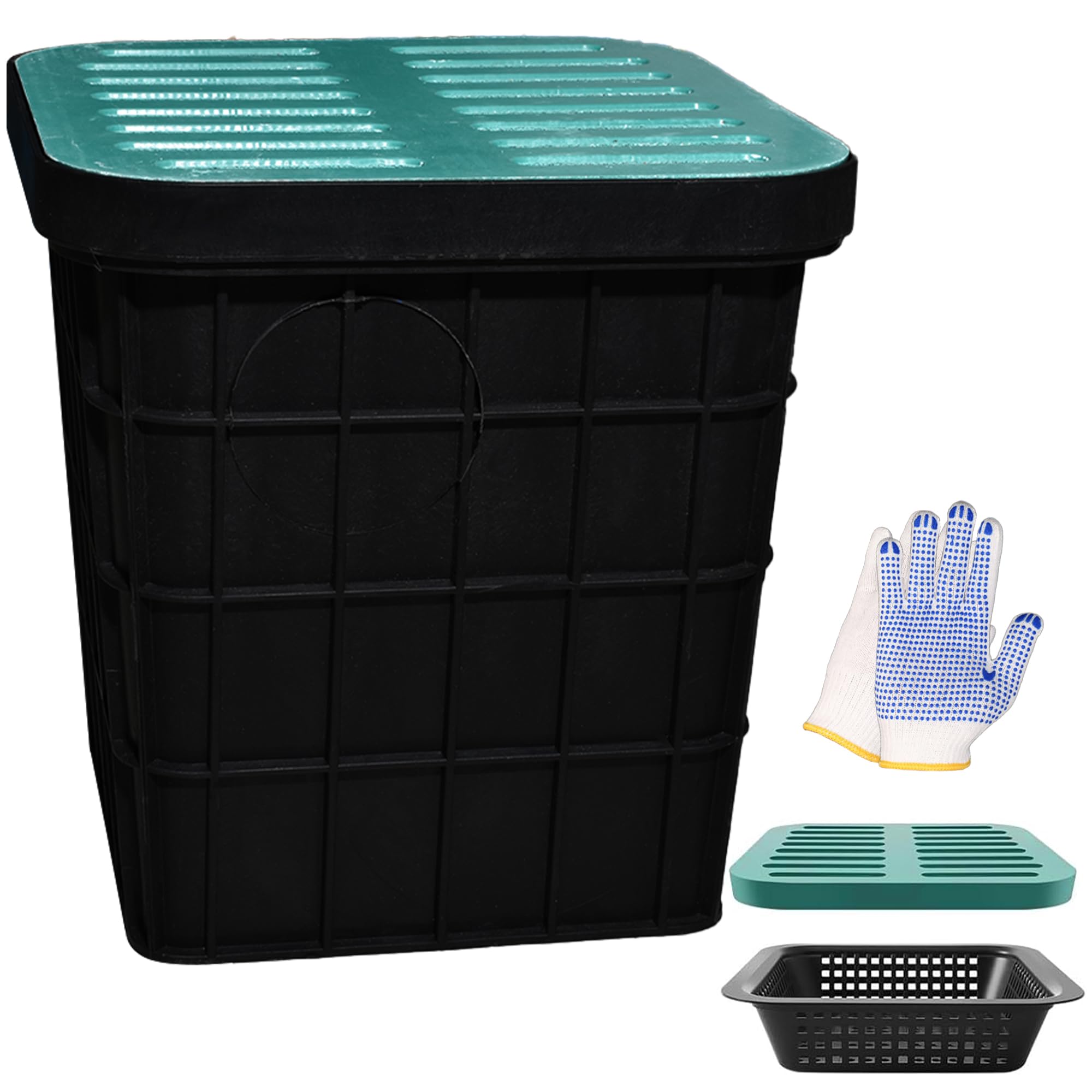
An 18-inch intake for driveways and French drain runs that swallow real volume.
At 18x18x15 in., this is a different size class from the 12 in. basins — the kind of intake you set where several downspouts converge or a French drain line needs a collection point. A grate that wide catches more surface water before it sheets past, which is exactly the failure a small basin has on a sloped driveway.
It ships with a polyethylene (PE) well, a fiberglass grate, a debris basket, and two pairs of gloves. The fiberglass grate is a deliberate upgrade over plain plastic: the maker says it resists UV exposure and aging and outlasts ordinary plastic. Fiberglass also has no recycling value, so you are less likely to have someone lift it. The drain basket catches small leaves and garbage before the pipe, and clearing it means opening the grate and pulling the trash out.
The defining design choice is the absence of pre-drilled holes. You cut the wall to the diameter of the pipe already in your ground using a drilling kit, so the basin adapts to your existing system instead of forcing you to convert pipe sizes. That is freedom for a plumber or a confident DIYer and extra work for anyone without the right hole saw. Budget that step before you buy.
Where it pulls ahead: an 18 in. body plus a fiberglass grate and debris basket makes this the serious intake of the group.
The trade-off: no reserved holes means you supply the cut and the tool — plan for that before the basin arrives.
Made for: a driveway edge, downspout cluster, or French drain collection point that needs real volume.
Wrong fit when: you want drop-in installation with openings ready to accept a standard pipe.
6. Kritkin Catch Basin 15 x 15 x 15
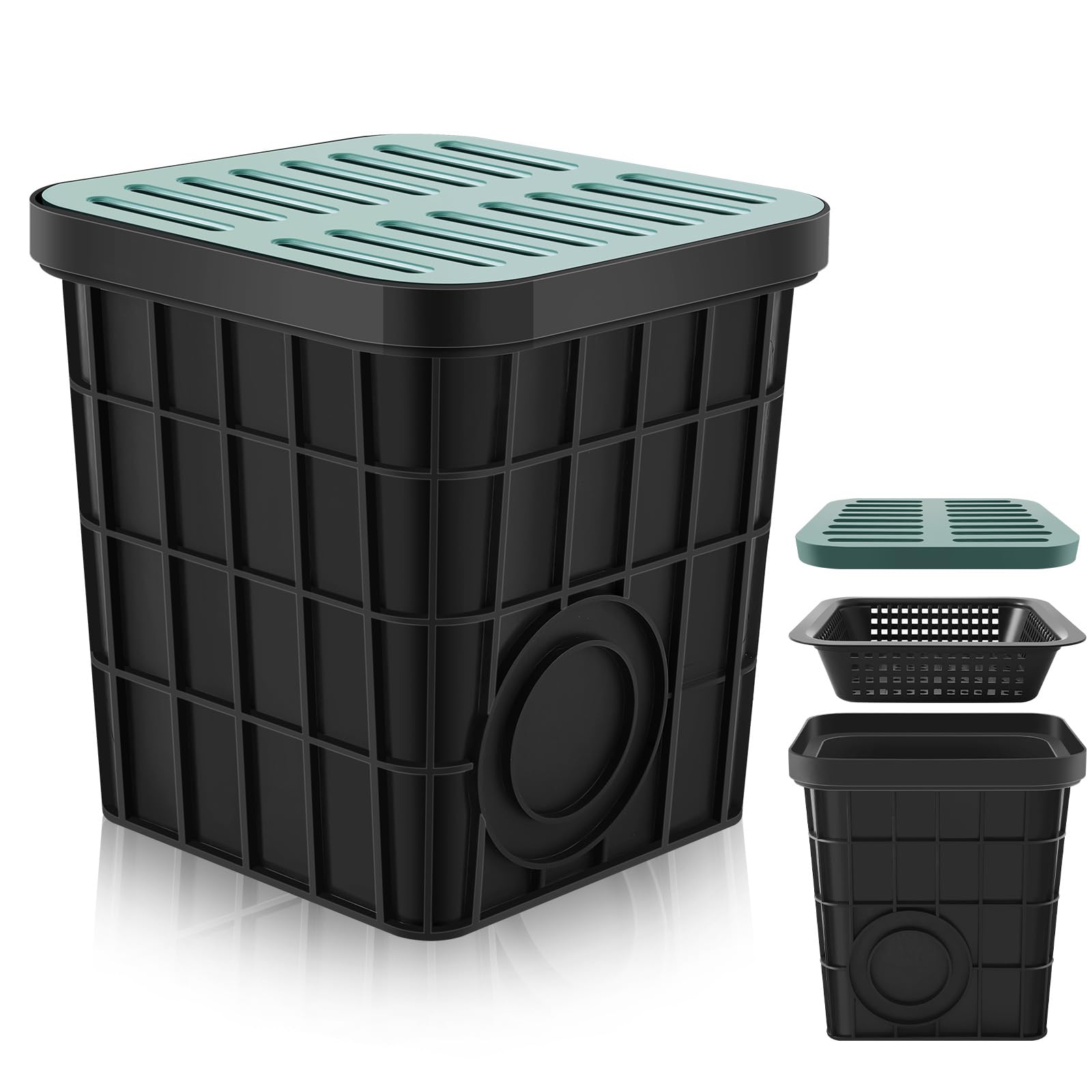
A mid-size collector for the slope where rain turns soil into a river.
The measure that matters here is the body: 15.75 x 15.75 x 15.75 in. of polyethylene, closed with a resin grid and fitted with a debris basket. That footprint catches a genuinely larger area than the 12 in. basins, so on a slope shedding soil during a downpour it holds up better than a small grate would. Owners keep praising the build quality, and the sturdiness shows in the molded polyethylene body and the resin grid.
The black and green color combination is easy to live with at the edge of a lawn, and the design intention is practical, not decorative. The debris basket and grid cover block smaller leaves and trash from the pipe, and cleaning is a lift-and-tip job once you pop the top.
Like the other large-format basins, this one arrives without pre-drilled outlets — it has cutting lines for the reserved holes, and you open the one that lines up with your pipe. That means no size-adapter shopping, but it does mean you need a hole saw and a little nerve. Set your pipe diameter against the cutting lines, mark, cut, and seal, and the rest of the install is quick.
The case for it: a 15.75 in. body with a resin grid and a debris basket covers medium-to-large yards without overshooting into oversized plumbing.
The honest caveat: you cut your own outlet from the marked cutting lines, so bring the right tool and measure twice.
Reach for it if: a medium slope or lawn corner needs more intake area than a standard 12 in. basin offers.
Hold off if: you need a pre-cut outlet that drops straight onto a fixed pipe with no trimming.
7. RYSIMWU Catch Basin 22x14x16
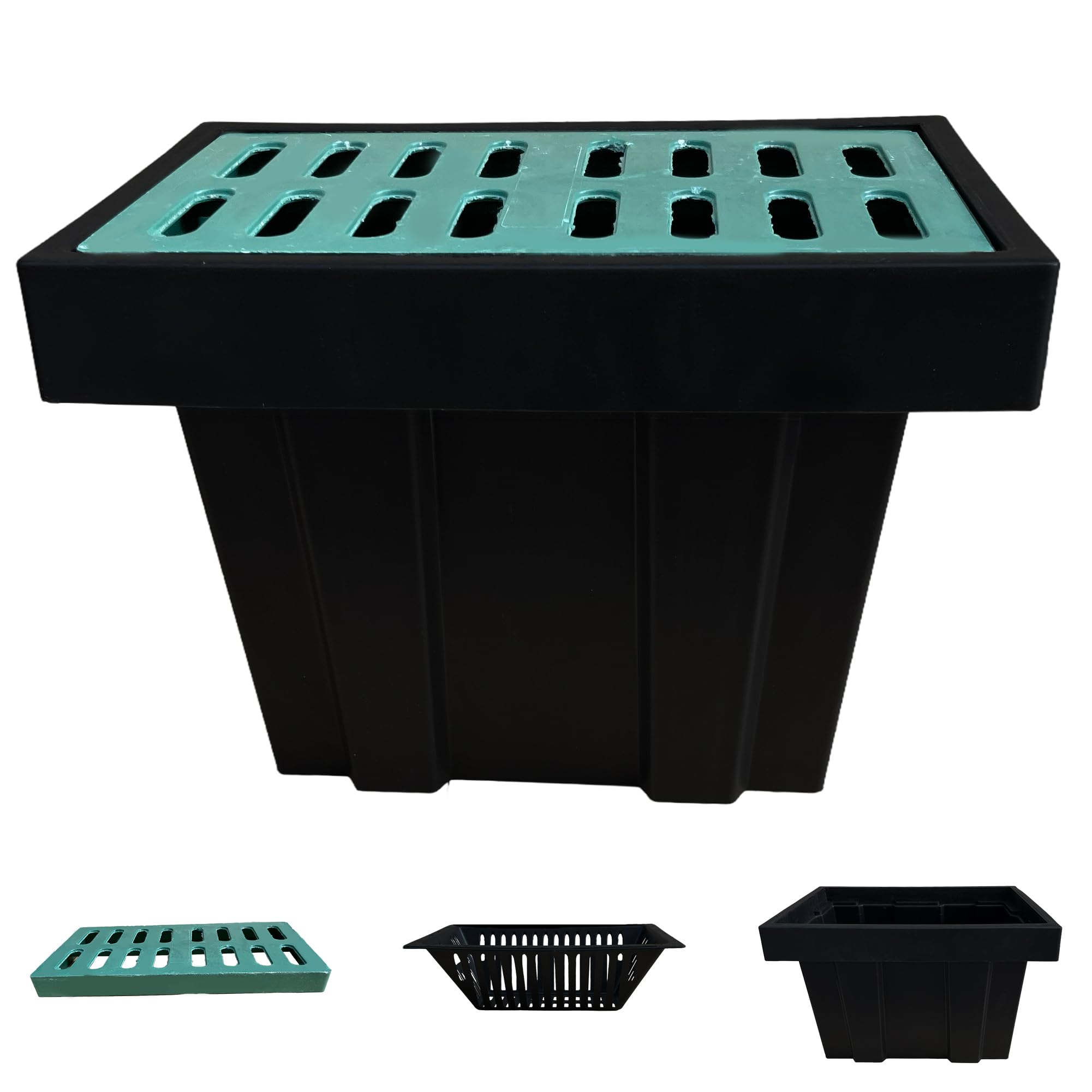
The long 22-inch footprint that catches wide sheets of water in one shot.
Where most basins are square, this one runs 22x14x16 in. — longer than it is deep, which gives a stretched intake edge for water crossing a walkway or a broad lawn corner. If your problem is a wide sheet of runoff rather than a single downspout stream, that extra length is the spec that matters. The kit arrives complete with a polyethylene storm pit, a fiberglass grate, a debris basket, and two pairs of gloves.
The fiberglass grate is the reason to pick this over a plain plastic lid, and the polyethylene body resists weather and time. Inside, the basket handles small leaves and debris the same way the other large basins do: open the grate, tip out the trash, and the pipe stays clear. Use it on yards, lawns, downspouts, walkways, French drains, patios, and municipal lines.
Same as its large-format siblings, there are no reserved holes. You cut the wall to match the diameter of the pipe already buried in your yard, which lets you build a drain that fits what you have rather than the other way around. It is a confident move for a prepared installer and a trip to the hardware store for anyone else.
The strengths that stand out
- 22x14x16 in. body gives a long intake edge for wide runoff sheets
- Fiberglass grate and polyethylene body resist weather
- Debris basket keeps leaves and grit out of the pipe
- Cut-to-fit outlets match the pipe you already have
The parts that cost you time
- No pre-drilled holes — you supply the cut for every outlet
- The long footprint needs a wider hole than a square basin does
Best matched to: broad, shallow runoff across paths and lawn edges where a square intake misses half the flow.
Think twice if: your pipe is already fixed at a height that only a pre-cut outlet will meet.
8. NDS 1200 Square Catch Basin Drain with 2 Openings

The plain 12-inch workhorse for a lawn that just needs the puddle gone.
This is the NDS 1200 in its simplest form: a 12 in. square polypropylene basin that captures stormwater and pushes it into 3 in. or 4 in. pipe through outlet adapters, with the grate sitting on top. It is UV-treated to resist fading and cracking, so a basin half-buried in the sun does not go brittle. If your job is a persistent puddle at the low point of a lawn, this does the work without extras.
The detail that earns it a listing is the built-in sump area — a small settling pocket at the bottom that collects particles before they can reach the pipeline. Sediment that drops out here does not travel downstream to clog a far-away section of pipe. Weephole knockouts on the bottom let standing water drain down instead of sitting, and the keyed side openings lock the adapters in place.
What it lacks is everything after the grate. The flow rate and load rating depend entirely on which grate you fit, and it does not ship with the debris basket the larger basins include. Treat it as the budget-first, basics-done-right option for a single puddle, and add a leaf screen upstream if trees hang over the spot. Buyers keep mentioning its function and durability — it drains, it holds up, it lasts.
The value read: a UV-treated 12 in. basin with a sump for sediment, sized for 3 in. and 4 in. pipe, at the entry tier.
What it asks you to add: no basket and a grate-dependent load rating, so pair it with care if debris or wheels are involved.
Buy it for: one stubborn puddle on a lawn or under a downspout, where you want the simple version.
Move up if: leaves are heavy or a vehicle crosses it — the bigger kits and their rated grates handle that better.
Know the Specs
Flow rate and grate open area
Flow rate, measured in GPM (gallons per minute), is how much water the grate passes in a given time. The 162 GPM on the NDS kit is tied directly to its 53.1 sq. in. of open surface area — the actual holes water falls through. A wider grate with more open area drains a downpour faster, while a smaller or tighter grate lets water pool and spill past the edges. When you compare two basins, compare the open area before the outside size.
Outlet adapters, knockout slots, and pre-cut holes
Outlets come in three flavors. Removable outlet adapters push into keyed side openings and seal soil-tight, often able to accept several pipe sizes. Knockout slots are molded areas you punch or cut open only where you need a connection. Pre-cut holes are already open when the box arrives. Adapters and knockouts give flexibility; pre-cut holes give speed. Match whichever style you pick to the pipe already buried in your yard.
Load rating for vehicles
A load rating tells you what the grate can take rolling over it. NDS rates its 12 in. kit for Class B loads, up to 175 psi, when installed properly — the rating for autos and light trucks at speeds under 20 mph. That matters on a driveway apron or a lawn a truck crosses, and it matters less on a bed a mower glides over. The rating also depends on the specific grate fitted, so the lid and the basin have to match.
Debris baskets and sediment sumps
A debris basket is a removable strainer inside the basin that catches leaves and grit before the pipe. A sediment sump is a settling pocket at the bottom that lets particles drop out of the flow. Both keep the buried line clearer. The difference is maintenance: a basket must be lifted and emptied, while a sump works passively until you flush it. A basin with neither relies on the grate alone to keep the pipe clear.
Common Questions
Will a catch basin connect to the corrugated pipe already buried in my yard?
Do I need a debris basket in my catch basin?
Can a catch basin sit in a driveway where cars drive over it?
How deep do I need to dig for a 12-inch catch basin?
What is the difference between a catch basin and a French drain?
Do the large basins come with holes already cut for pipe?
Can I open more than one outlet on a catch basin?
How do I stop a catch basin from clogging with leaves?
Will a catch basin fix standing water against my foundation?
Are NDS and Polylok basins compatible with each other’s pipe fittings?
The Bottom Line
The smartest all-around choice for most yards is the NDS Square Catch Basin Drain Kit — it pairs a 162 GPM grate with 53.1 sq. in. of open area, includes two adapters and a plug, and carries the Class B rating for vehicles. That combination covers a downspout, a walkway, and a driveway apron without buying extra parts. If a 6 in. pipe is already in the ground, the Polylok kit drops onto it with pre-cut openings and no adapter hunt. And if the job is a wide sheet of runoff that a 12 in. basin keeps missing, step up to the RYSIMWU 22x14x16 in. for the longer intake edge. One nudge worth acting on: the NDS kit is the pick that blends a rated grate, real flow, and a complete fitting set — the combination its owners keep coming back to praise.
How we choose
We do not accept paid placement. Every pick is matched to a real buyer and a real use-case; we do not hands-on test units.
Sources
Specifications: manufacturer listings and product documentation. Review insights: verified customer reviews, as of July 2026. Pricing: not shown on this page (it changes often); check the current price via the retailer link.
As an Amazon Associate, Tactical Gear Guy earns from qualifying purchases. This does not affect which products we feature.