Specs are compiled from manufacturer listings and verified buyer reviews and can change over time — please confirm the key details on the product page before buying.
Buying a wrist rest for a mechanical keyboard is not about a soft pad. It is about matching one number to your board: the length. A rest that is 17.13 inches long sits under a full-sized keyboard; a rest that is 12.8 inches long sits under a compact one, and neither will look or feel right on the other. Match the length to your case width and the material to your wrists, and your palms stop hovering over the desk edge. Get either wrong and you have a pad that overhangs the case or slides under your wrists.
This guide is built by comparing the manufacturers’ published specifications and the patterns across verified customer reviews, so you get each pick’s real strengths and trade-offs instead of marketing spin.
Below you get nine rests sorted by keyboard layout and material — silicone, gel, foam and solid walnut — so the fit is right the first time. The trick is matching length and height to your board before you click buy.
Top Picks


How To Choose The Best Wrist Rest for Mechanical Keyboard
The rest has one job, and it is a physical one: raise your palms to the same plane as the front row of your keycaps so your wrists stop bending upward. Mechanical keyboards often sit taller than membrane boards, so a rest that is too thin leaves your hands angled back. A rest that is too thick pushes your shoulders up. The number that decides this is the thickness in inches.
Match the length to your layout, not to your keyboard’s brand
Full-sized boards with a number pad want a rest around 17 inches long. Tenkeyless boards want roughly 14 inches. Compact 60 to 75 percent boards sit best under something around 12 to 13 inches. A rest that overshoots the case edge is not dangerous, but it takes up desk space and may catch your mouse hand. A rest that is too short leaves the outer edges of your palms unsupported.
Silicone, gel, memory foam or solid wood
Silicone is firm and springy, and the honeycomb-patterned versions grip a desk without feet. Gel and memory foam give more sink and tend to run thicker. Solid walnut is the firmest option of all — there is no give, but there is also nothing to deform, and the surface stays cool. Neoprene-filled nylon pads sit in the middle, with a cloth top and a squishy center.
Check the base before you check the surface
A rest that slides is worse than no rest, because you keep re-seating it mid-sentence. Rubber feet and honeycomb suction bases are the two fixes you will see here. A flat pad with no grip underneath will drift on a glass or gloss-laminate desk.
One detail most buyers skip
The silicone rests here are built for specific keyboard models, and the listing says outright which ones they will not fit. Keychron’s 17.13-inch version, for example, is not made for the K10 Pro, K10 Max, Q6, V6 or their variants. Confirm your exact model before you order, because the length is fixed and cannot be adjusted later.
Side-by-Side Comparison
| Model | Best For | Length | Material | Height | Amazon |
|---|---|---|---|---|---|
| Keychron Silicone 17.13″★ Best Overall | Full-sized boards | 17.13 in | Silicone | 0.71 in | Amazon |
| GRIFITI Fat Wrist PadBest for Tenkeyless | Tenkeyless gaming boards | 14 in | Nylon over neoprene | 0.75 in | Amazon |
| Keychron Silicone 15.37″Highest Rated | 96% layouts | 15.37 in | Silicone | 0.71 in | Amazon |
| Faluber Cooling Gel | Hot desks and long sessions | 17.3 in | Gel over memory foam | 24 mm | Amazon |
| YMDK Mini Wood (2 pcs) | Travel and split setups | 14 in | Walnut and beech wood | — | Amazon |
| GamaKay Wooden Wrist Rest | 75% compact boards | 12.8 in | Walnut | 0.7 in | Amazon |
| Kensington ErgoSoft | Tall-front gaming keyboards | 23 in | Faux leather over gel | For fronts over 0.79 in | Amazon |
| ASFSKY Wood and Foam | Desk-matching looks | 17 in | Faux leather over memory foam | 0.79 in | Amazon |
Detailed Reviews
1. Silicone Wrist Rest Keychron K10 17.13″
Our pick — 4.5+★ from 750+ verified ratings; the strongest balance of quality and price.
A full-width silicone slab that measures 17.13 inches and sits flat under a 100% board.
The case for this one starts with the length: 17.13 inches, cut for Keychron’s 100% layout K10, K10 Version 2, C2 and C2 Pro. That extra reach matters if you actually use your number pad, because the rest runs the whole way across instead of stopping short at the arrow keys. It is the safest starting point for most people with a standard-sized mechanical board.
What wins people over, judging by the feedback pattern, is simply how well made it feels in the hand — a firm, springy block rather than a wobbly cushion. The silicone surface is smooth on top, and the honeycomb pattern underneath grips the desk so the rest does not walk away from you. Three hundred and thirty-six thousandths of an inch of thickness (0.71 in per the spec sheet) puts it near flush with the front of a Keychron case. At 250 g it is heavy enough to stay put, and it is noticeably lighter than the TKL version of the same rest, which weighs 300 g.
The catch is cleaning. Silicone picks up dust and lint almost by design, and the maker’s own care note admits the surface will attract it. A rinse in warm water and a wipe with a lint-free cloth takes care of it, so it is a two-minute job rather than a real problem. The other thing to watch is compatibility: this rest is explicitly not for the K10 Pro, K10 Max, Q6, Q6 Pro, Q6 Max, V6 or V6 Max. On the flagship-to-flagship comparison, this one runs 17.13 inches against the GRIFITI pad’s 14 inches, and it is a 250 g block versus 300 g for the 14.09-inch Keychron.
Where it earns its place
- 17.13 inches of length covers a full 100% layout with a number pad
- Honeycomb non-slip base holds it to the desk without rubber feet
- 0.71 in height lines up with a standard Keychron front edge
- Firm silicone cushioning rather than a soft foam that bottoms out
- Rated at 4.5+ by the crowd, with hundreds of owners behind that score
What to weigh first
- Silicone draws dust and lint and needs a warm-water rinse now and then
- Will not fit the K10 Pro, K10 Max, Q6 series or V6 series
- Only sold in black, so it will not match a light-coloured desk
Buy this one: you have a 100% Keychron board with a number pad and want the rest to run edge to edge.
Keep looking: your board is a K10 Pro or Q6-series, where this specific 17.13-inch cut is not designed to fit.
2. GRIFITI Fat Wrist Pad 14 X 2.75 X 0.75 Inch
The fat one — 0.75 inches of squish that rises to meet a tall gaming keyboard.
Tall mechanical boards are the problem this pad solves. At 0.75 inches thick it sits higher than the 0.71-inch silicone Keychron rests, so if your keyboard case has a chunky front lip, your palms land level instead of sloping back. The cloth overcoat is nylon and the center is squishy neoprene, which gives it a softer, more forgiving feel than solid silicone. You can throw it in the wash when it gets grubby, which is more than you can say for most pads here.
At 14 inches long, this rest covers a tenkeyless board’s main block and arrow cluster without creeping into your mouse space. Buyers report the width is generous enough to rest your whole wrist and palm on it, not just the heel of your hand. A non-skid base (a grippy underside that stops it sliding) keeps it planted while you type. It also comes in a range of colours if black nylon does not suit your desk.
Two honest notes. The neoprene smell is the most-discussed gripe among buyers, and it does fade, but expect a rubbery whiff out of the packaging for a few days. On the numbers, it is 14 inches against the 17.13 inches of the Keychron above — a shorter reach for a shorter board, and 22 percent less length on paper.
The trade-off, honestly: a washable nylon top and a grippy base are exactly what a gaming board wants, and the 0.75-inch lift suits a high case front. The smell and the softer give are the price of that squish.
Who it fits: anyone with a TKL or 15-inch laptop who wants a cloth-feel surface and a pad they can rinse in the machine.
Reach for it: your keyboard case front sits tall and you want a washable, cloth-topped pad with real squish.
Pass it by: you want a firm, springy surface that will not compress under a heavy wrist.
3. Silicone Wrist Rest Keychron K4 Pro 15.37″
The 96% fit — 15.37 inches for boards that squeeze a numpad into a tighter case.
A 96% layout (a board with a number pad squeezed into a narrower body) leaves a gap most rests do not fill. This one is 15.37 inches long and built for exactly that gap — Keychron K4 Pro, K4 Max, Q5, V5 and V5 Max, plus AULA F99, F99 Pro, F87 Pro, Rii RK909, Redragon K719 and EPOMAKER Cypher 96. At 3.13 inches wide it gives your palm more surface to land on than the GRIFITI pad’s 2.75 inches — 14 percent more width than the GRIFITI.
What wins people over here is fit — it is the thing owners talk about first and most often, and the theme is that the length lands right on the case edges rather than hanging over. At 4.8 it is the highest-rated rest in this lineup, though with a smaller pool of owners behind that score than the top pick has. The softness and the smooth silicone get noticed too, and the 317 g weight keeps the honeycomb base stuck down. It does not shift around under normal typing.
The honest catch is dust. Silicone collects it, and the feedback here flags that the surface gathers lint over time — the smooth finish makes it easy to wipe off, but you will be doing it. The other point is fit-specific: if your board is not one of the 96% models listed, this 15.37-inch length is an odd middle size that may look undersized on a full board and oversized on a TKL.
Fit is the headline: 15.37 inches of length is a genuine match for a 96% case, which is a size most rests skip entirely. Add the 3.13-inch width and your whole hand has a place to sit.
Not a universal pad: the smooth silicone draws dust, and the length only works on the 96% boards it names. Outside that list, measure carefully.
Made for you if: you run a 96% layout like the K4 Pro or Q5 and want a rest that actually spans it.
Skip the guesswork: check that your board is on the compatibility list, because no amount of cushioning fixes the wrong length.
4. Faluber Cooling Gel Wrist Rest 17.3-inch
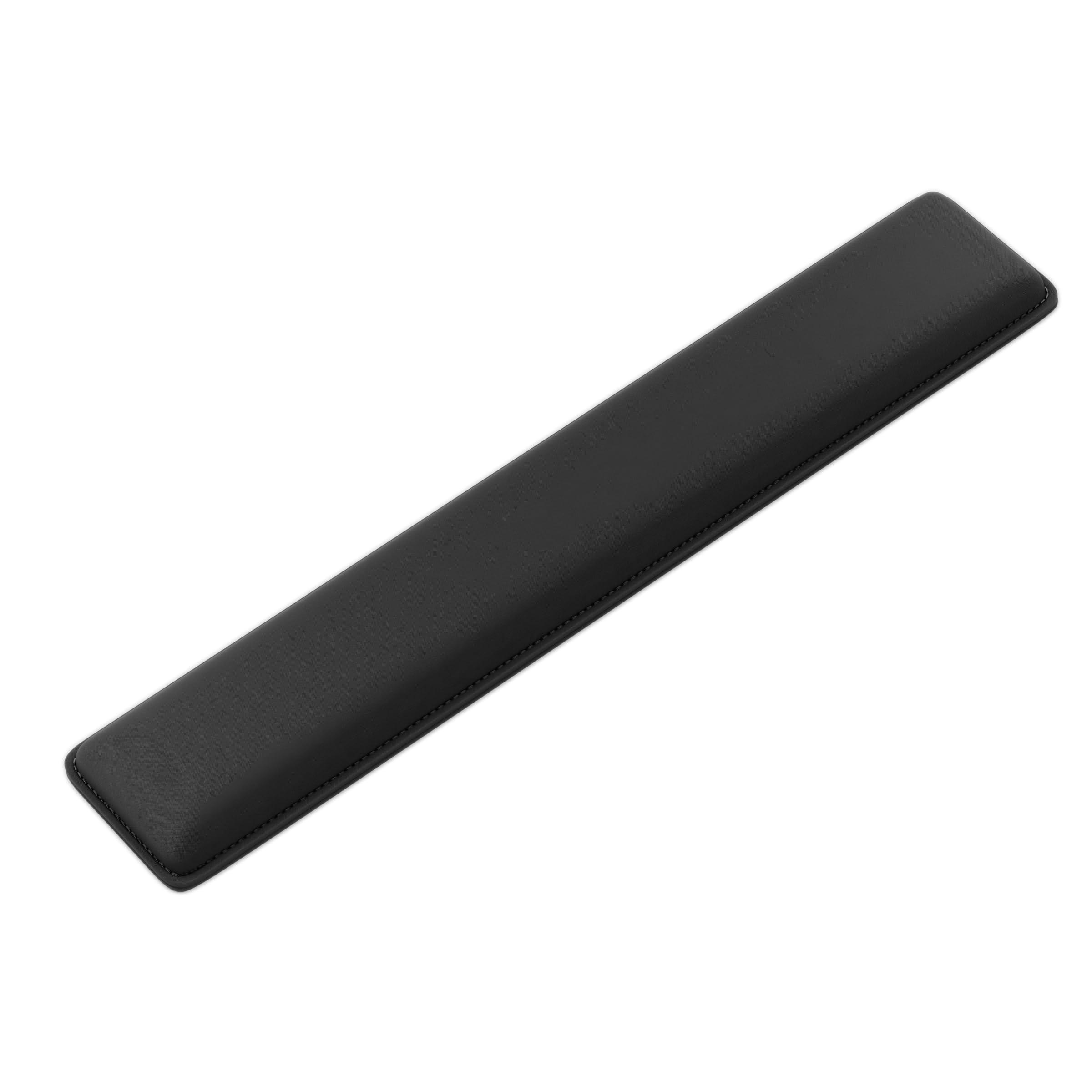
A three-layer pad with a gel midlayer, for anyone whose wrists run hot by mid-afternoon.
Most rests here are one material. This one is three: a silky polyester top, a cooling gel midlayer to move heat away, and a memory foam core at medium firmness underneath. The gel layer is the whole point — on a long typing day, a plain foam pad holds warmth against your skin, and this one is designed to pull it away. At 17.3 by 3.5 inches it fits a full-sized 100% mechanical board, and at 24 mm thick it gives a substantial lift.
Comfort is what the feedback centres on, and the recurring description is the balance point — not too hard, not too soft, sitting in the middle where your palms can relax without sinking through. It also stays put; the non-slip footpad holds it against the desk, and it does not creep during a session. The polygon-stitched base frame is there to stop fraying, which matters more on a fabric-topped pad than on solid silicone. The stain-resistant surface wipes clean, so a coffee-ring is not a crisis.
Two things to weigh. At 420 g it is the heaviest rest here — that mass is why it stays still, but it is not something you toss in a bag. And 24 mm is a real height; if your keyboard’s front edge is low and slim, this lift will push your hands up higher than a 0.71-inch silicone pad would. Pair it with a tall board, not a low-profile one.
Why it holds its own
- Gel midlayer is built to wick heat away from the wrist
- Memory foam core at medium firmness for balanced sink
- 17.3-inch length fits a full-sized 100% mechanical board
- Stain-resistant fabric surface wipes clean in seconds
- Polygon stitched base frame guards against fraying
Before you commit
- 420 g is heavy for a wrist pad you plan to carry around
- 24 mm thickness asks a lot of a low-profile keyboard front
The right call: you want a full-width pad with a cool-to-the-touch top for long desk sessions.
Look elsewhere: your board is a low-profile model, where 24 mm of lift is more than the front edge wants.
5. YMDK 2 pcs Mini Wood Wrist Rest, Walnut and Beech
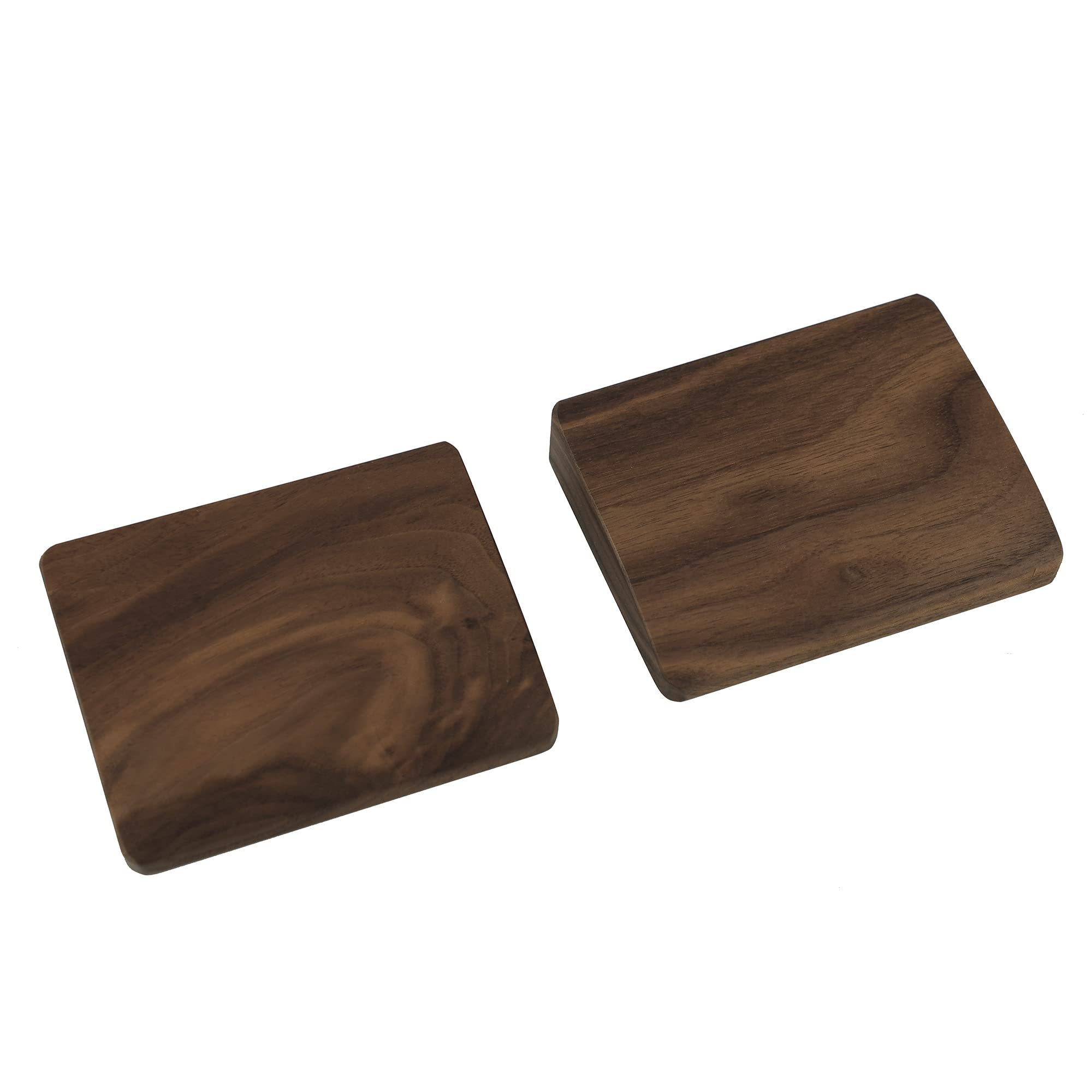
Two small wood blocks instead of one long pad — carry one, park the other.
This is the odd one out, and deliberately so. You get two mini walnut wrist rests in the box, each with rubber feet, rather than a single strip that spans the keyboard. That makes it the pick for a compact or split setup where a 14-inch pad would be overkill, or for anyone who wants one rest at the desk and one in a bag. Each block is 14 inches long and 2.3 inches wide.
Solid walnut brings something silicone and foam cannot: nothing to deform. There is no cushion to bottom out, no memory foam to lose its spring, and the surface stays at room temperature rather than warming up under your palms. The wood is oil-painted to guard against rot, and the rubber feet hold each block in place. Fit is the other strength — the review pages are full of people pairing these with a Keychron Q10, and the quality is the aspect that comes up most. More than one buyer has called the surface better than a keyboard maker’s own branded palm rest.
Two honest limits. Walnut grain varies, and the listing says outright that no two surfaces match and the piece you receive will not look identical to the photo — that is nature, not a defect. The surface is also a film coat that can split over time, so treat it as a finished wood product rather than an indestructible slab. And at 2.3 inches wide, it is narrower than every other rest here; it supports the heel of your hand rather than the whole palm.
The wood argument: no foam to flatten, no silicone to dust, and two blocks for one outlay. The grain and the film finish are the trade for that durability.
Worth it for: split or compact keyboard users who want firm wood support and a spare block for travel.
Not the one: you want a single continuous pad across a full-sized board, where two 14-inch blocks will leave a gap.
6. GamaKay Wooden Wrist Rest Pad, 12.8″ Compact Walnut

A 12.8-inch walnut plank shaped to raise your palms and drop your thumbs slightly.
Compact boards and full-length pads do not get along. This rest is 12.8 inches long and 3.11 inches wide, sized for 60%, 65% and 75% layouts — the 61, 63, 64, 68 and 75-key sizes. At 0.7 inches high it gives a modest lift, and the rounded rectangular shape means there is no sharp edge under your forearm. It weighs 0.53 kg, so it is a planted block, not something that shifts mid-keystroke.
The shape is the interesting part. The surface is contoured so your thumbs and upper palms sit supported while the base of your palm drops slightly lower — a posture detail that a flat foam strip cannot offer. Add the anti-skid rubber feet and it stays exactly where you put it. Stability and ergonomics are the two things the feedback keeps returning to, and the size and height are frequently called right for a 75% board. The finishing is done by hand, sanded through nine grades of sandpaper, which gives the wood a smooth, cool feel that holds up through a long session.
Two caveats worth knowing. The finish divides people — the wood is genuine walnut, so the grain and the tone vary from piece to piece, and not everyone loves the exact slab that lands on their desk. Also, real wood does not like direct sun; the listing warns to keep it out of it, or the colour will shift. On dimensions, this 12.8-inch plank is shorter than the 14-inch GRIFITI and shorter again than the 17.13-inch Keychron, which is the point — it is built for a smaller keyboard.
Why compact users like it
- 12.8-inch length sized for 60%, 65% and 75% boards
- Contoured surface lifts thumbs and upper palms, drops the wrist base
- Anti-skid rubber feet keep it fixed on the desk
- Solid walnut will not deform like memory foam
- Hand-polished surface stays cool under the palm
Where it asks patience
- Grain and finish vary piece to piece, so no two look alike
- Walnut needs keeping out of direct sunlight
- At 12.8 inches it will look short under a full-sized board
Pick it up: your board is a 75% or smaller, and you want firm, cool wood rather than sinking foam.
Leave it: your keyboard carries a number pad, where 12.8 inches stops well short of the case edge.
7. Kensington ErgoSoft Wrist Rest

Gel padding under a faux-leather top, built for keyboards with a tall front edge.
The spec line that matters here is the fit rule: this rest is designed for keyboards with a front height of more than 0.79 inches. That is the highest compatibility threshold in this lineup, and it tells you what Kensington built it for — chunky mechanical and gaming boards whose front lip sits well above the desk. If your keyboard is slim, this rest will feel like it is propping your hands up; if your board is tall, it levels them out.
Under the faux-leather exterior is gel-cushioned padding, which gives a softer, more conforming feel than silicone and more structure than plain foam. The non-skid rubber backing keeps it from sliding whether you are typing or gaming. Kensington says the curved shape and dimensions are ergonomist approved to keep wrists aligned. At 23 inches long it is by far the longest pad in this lineup, and 1.4 pounds makes it the heaviest — this is a permanent desk fixture, not a portable one.
The long length is a double-edged spec. On a wide desk with a full board and a mouse, it can run past the keyboard and give you somewhere to rest your mouse hand too. On a narrow desk, 23 inches of pad may not fit alongside everything else. And because it is built for tall-front boards, a low-profile keyboard is a genuine mismatch — the rest would sit too high, lifting your wrists above the keys instead of level with them.
The fit rule is the feature: a front height of more than 0.79 inches is a specific, useful threshold that most pads never state. If your board meets it, the gel and the rubber backing do the rest of the work.
Check your desk width: 23 inches is a lot of real estate, and it only pays off if you have the room.
The fit: a tall mechanical or gaming board with a front over 0.79 inches, on a desk with room to spare.
The mismatch: a slim or low-profile keyboard, where this height lifts your hands rather than supporting them.
8. ASFSKY Keyboard Wrist Rest, Wood and Memory Foam
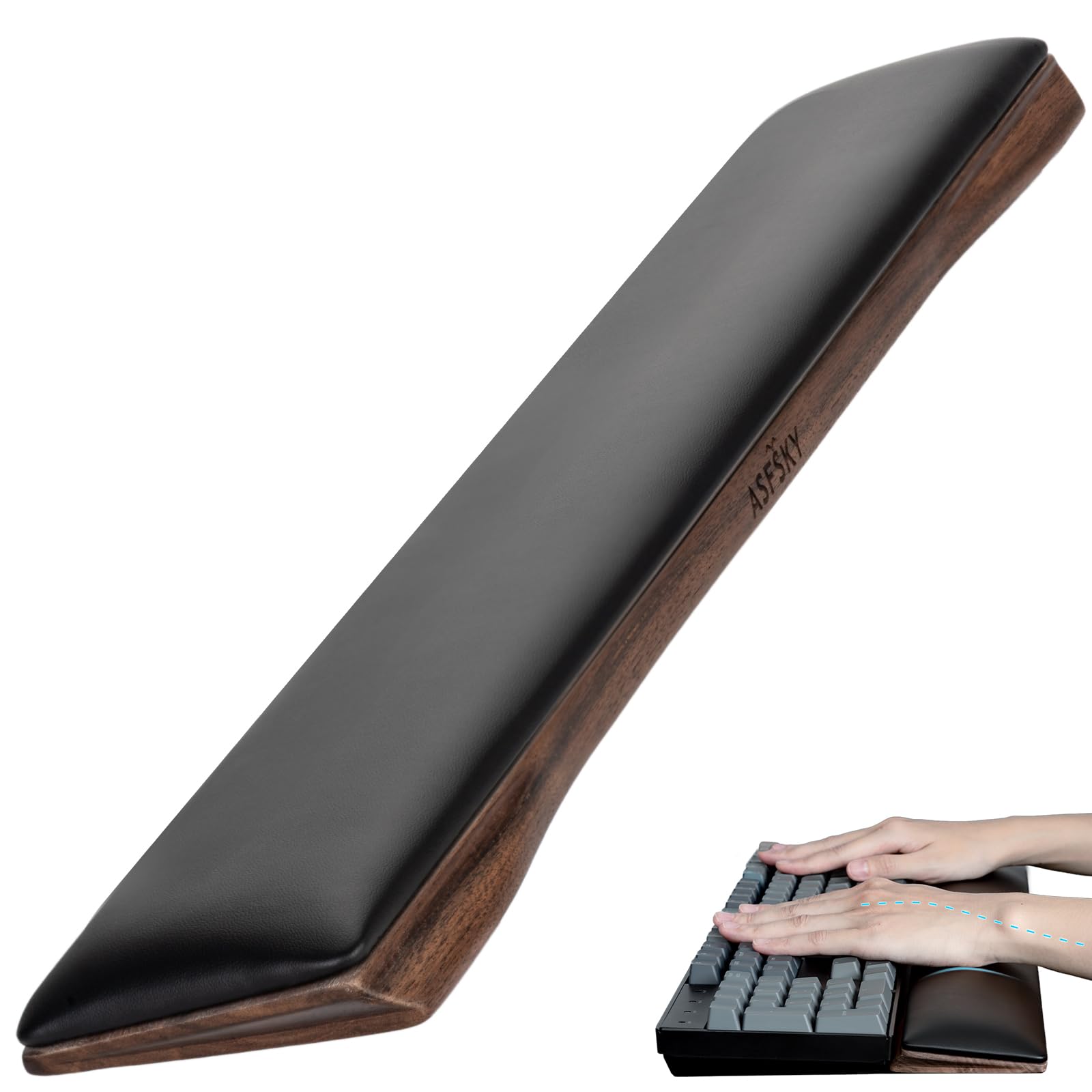
A walnut base under a memory foam top — the look of wood with some give under your palm.
This one splits the difference between the wood picks and the foam ones. The foundation is natural solid walnut, but the top surface is high-density memory foam wrapped in faux leather. So you get a firm, stable platform that will not flex, plus a padded top that moulds to your wrist instead of a hard plank. It measures 17 by 3 inches and stands 0.79 inches tall, which suits a full-sized mechanical board.
The PU leather wrap is the practical touch — it is stain-resistant and wipes clean, so it holds its look on a gaming desk or an office workstation without much fuss. A no-slip rubber grip runs along the bottom to keep it planted. Build quality is the thing that lands with buyers; the construction is described as well-made and the support while typing draws regular praise. The 0.79-inch height also puts it in line with taller case fronts than the 0.71-inch silicone pads.
The point to weigh is grip. Feedback on stability is genuinely split — some find it stays put, others note it moves more than they would like. A quick wipe of the desk and the rubber base before you set it down helps, but plan on checking it if you type hard. The other thing is the material mix: if you want the pure feel of bare wood under your palm, the GamaKay above is the more direct option; this one trades that for the squish of foam.
What it does well
- Walnut foundation gives a firm, non-flexing base
- Memory foam top moulds to the wrist for cushioned support
- PU leather surface is stain-resistant and easy to wipe clean
- 17 by 3 inches fits most full-sized boards
What to keep in mind
- Stability is mixed — it can shift if the desk surface is slick
- The foam-over-wood mix is not the same bare feel as solid walnut
For you: you want the look of solid wood without a hard surface under your wrist, on a full-sized board.
Not for you: you type hard and need a pad that will not budge an inch, where a heavier base wins.
Know the Specs
Length: the number that decides fit
Length is the first spec to check, because it has to match the width of your keyboard’s case. A full-sized board wants something around 17 inches, a tenkeyless board around 14 inches, and a compact 60 to 75 percent board around 12 to 13 inches. Get this wrong and the rest either overhangs the case edge or leaves the outside of your palms hanging off. Unlike thickness, length cannot be adjusted or lived with — it either spans your board or it does not.
Height and thickness: matching your keyboard’s front
Thickness sets how high your palms sit, and it has to line up with the front edge of your keyboard. A thin silicone pad at 0.71 inches suits a standard mechanical case front; a thicker gel pad at 24 mm or a rest built for fronts over 0.79 inches suits a taller board. If the rest is too thick for a slim keyboard, your wrists ride upward; too thin for a tall one, and they angle back downward. Either way, the flat typing posture you were after is gone.
Base grip: why non-slip beats non-existent
A rest that slides is a rest you keep re-seating, which defeats the purpose. There are two common fixes here: a honeycomb patterned silicone base that creates suction against the desk, and rubber feet or a rubber grip strip along the bottom. A flat nylon or foam pad with no grip underneath will drift on a glass or gloss surface. If your desk is smooth and shiny, weight also helps — a heavier pad at 300 g or more has more to hold it down.
Material: how each one behaves through a long day
Silicone is firm and springy, and it does not deform, but it picks up dust and lint. Memory foam and gel give more sink and warmth, and gel is used specifically to move heat away from the wrist. Nylon over neoprene is softer and washable. Solid walnut is the firmest — nothing compresses, nothing wears out the way foam does, but the surface is hard and the finish needs looking after. Pick silicone for firm spring, gel or foam for sink, walnut for zero give.
Common Questions
Will a 17.13-inch wrist rest fit my Keychron K10?
Is a wooden wrist rest better than a foam one for a mechanical keyboard?
How thick should a wrist rest be for a mechanical keyboard?
Does a honeycomb base actually stop the wrist rest from sliding?
Can I use a wrist rest under my mouse hand as well as my keyboard?
How do I clean a silicone wrist rest that has gone tacky or dusty?
Will a 14.09-inch rest fit a SteelSeries or Logitech TKL keyboard?
Does a wrist rest help with carpal tunnel discomfort?
Is a cooling gel wristrest worth it, or is it a gimmick?
How do I know if my keyboard is a 96% layout or a full-sized one?
Can I travel with a wood wrist rest?
The Bottom Line
Got a full-sized mechanical keyboard? The Keychron 17.13-inch silicone rest is the one to order. Its 17.13-inch length spans a 100% layout (a board with the full number pad), so nothing hangs off the edge. The honeycomb base (a patterned underside that grips the desk) holds it down, and the 0.71-inch height lines up with a standard case front so your wrists sit level. It is the highest-rated rest here, and the 17.13-inch length is the easiest fit to get right on a 100% board.
If your board is tenkeyless, reach for the 14.09-inch Keychron rest, which also covers SteelSeries, Logitech and Lemokey TKL models. Running a 96% layout? The 15.37-inch version is cut for exactly that in-between size, and it carries the highest rating here.
Prefer wood under your palms to foam? The GamaKay walnut rest at 12.8 inches is the compact-board answer. It is firm and cool to the touch, and shaped to lift your thumbs while the base of your palm drops. One nudge before you commit: length is the only spec you cannot fix later, so measure your case width first and let the material be the second decision.
How we choose
We do not accept paid placement. Every pick is matched to a real buyer and a real use-case; we do not hands-on test units.
Sources
Specifications: manufacturer listings and product documentation. Review insights: verified customer reviews, as of November 2026. Pricing: not shown on this page (it changes often); check the current price via the retailer link.
As an Amazon Associate, Tactical Gear Guy earns from qualifying purchases. This does not affect which products we feature.