Specs are compiled from manufacturer listings and verified buyer reviews and can change over time — please confirm the key details on the product page before buying.
If you want your garage door to obey your smart-home hub instead of a cloud app, you need a relay — not a branded opener. The three picks below all speak Z-Wave, the radio language most serious home-automation hubs understand. That means your door can open, close, and report its position without a Wi-Fi cloud service in the loop.
This guide is built by comparing the manufacturers’ published specifications and the patterns across verified customer reviews, so you get each pick’s real strengths and trade-offs instead of marketing spin.
You will see what each relay can switch, how much current it handles, and which hubs play nicely — so you can pick a Z-Wave Garage Door Opener setup that matches your panel and your wiring. Buying blind here usually ends in a relay your hub cannot see.
Top Picks
How To Choose The Best Z-Wave Garage Door Opener
The first thing to get straight is that almost none of these devices are garage door openers in the traditional sense. They are relays — switches your hub flips for you — and they wire into the wall button circuit or switch a motor circuit directly. Decide which job you need before anything else, because a relay that switches a motor is not the same tool as a relay that taps a control circuit.
Know your hub before you buy the relay
Z-Wave is a radio protocol, and a smart speaker is not a Z-Wave hub. You need a real controller — Hubitat, Home Assistant, or a Z-Box — to see these devices and build the automation. Some panels only offer partial control, meaning one relay at a time or all relays together rather than independent switching. Check that your controller exposes the individual relays before you commit.
Match the relay to what you are switching
A dry-contact relay carries no voltage of its own, so it is safe for button circuits and low-voltage triggers. When you want to switch a real load — a pump, a fan, a light — you need the current rating to cover it. The numbers on these units run from 10 A up to 20 A, and that ceiling is the honest limit of what the relay can handle.
Plan the power source and the install location
These relays do not plug into a wall outlet. They take a USB C supply or a 12-24 V AC/DC source, and the adapters and jumper wires often come separately. Mounting hardware matters too, since a unit that goes on a wall or in a garage needs to sit where the signal reaches your hub. Z-Wave Long Range support helps here, but only if your controller speaks it.
Side-by-Side Comparison
| Model | Best For | Relays | Current Rating | Power Source | Amazon |
|---|---|---|---|---|---|
| Zooz ZEN16 800LR MultiRelay★ Best Overall | Multi-device automation on one unit | 3 dry contact relays | 15 A, 15 A, 20 A | USB C or 12-24 V AC/DC | Amazon |
| Zooz ZEN17 800LR Relay | Two doors plus sensor inputs | 2 dry contact relays | 20 A (NO), 10 A (NC) | USB C (included) or 12-24 V AC/DC | Amazon |
| GoControl GD00Z-8-GC | Simple plug-in door control with a tilt sensor | Single door controller | — | 120 V 50/60 Hz power supply (included) | Amazon |
Detailed Reviews
1. Zooz ZEN16 800LR MultiRelay
Our pick — 4.5+★ from 500+ verified ratings; the strongest balance of quality and price.
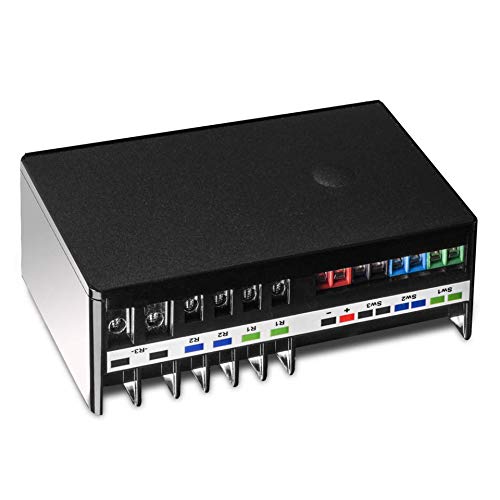
Three separate relays in one box — the garage, the sprinklers, and the fireplace from a single Z-Wave device.
This is the pick for a household with more than one thing to automate. One MultiRelay gives you three dry-contact relays you can control independently, rated at 15 A, 15 A, and 20 A. That means you could run your garage door, a set of landscape lights, and a pool pump without buying three separate controllers. Zooz even points out one unit can handle up to three garage doors at a commercial site.
What wins people over is how cleanly it pairs with real controllers. Buyers report consistent success pairing it with Hubitat, Home Assistant, and SmartThings, and the 800 series radio adds Z-Wave Long Range if your hub supports it. S2 security and SmartStart make pairing less of a fight than older relays. It also remembers its on/off state after a power cut and can run an auto-on or auto-off timer when your hub exposes the advanced settings.
Here is the honest catch: this is not a plug-and-play box. You supply the power — a USB C cable and a 5 V supply, or a 12-24 V AC/DC source — and neither cable nor adapter is in the box. Jumper wires are not included either. SmartThings users need a custom edge driver from Zooz’s support page. And Wink, Ring, Vivint, and Alarm.com panels give you partial control only, so if that is your controller, plan around it.
What earns it the top spot
- Three independently switchable relays: 15 A, 15 A, and 20 A
- Handles any 1-240 V device up to 20 A, from doorbells to pool pumps
- 800 series radio with Z-Wave Long Range ready for better coverage
- S2 security and SmartStart for simpler, more secure pairing
- Restores on/off status automatically after a power failure
What to plan around
- Power supply, USB cable, and jumper wires all sold separately
- Custom edge driver required for SmartThings
- Partial control only on Wink, Ring, Vivint, and Alarm.com panels
Reach for this if: you want one box to automate several loads and you already run Hubitat, Home Assistant, or a Z-Box.
Hold off if: you want to plug something straight into a wall outlet with nothing else to buy, since the power supply is not in the box.
2. Zooz ZEN17 800LR Relay

Two doors on one relay, plus two sensor inputs your hub can watch — the wiring flexibility pick.
Where the ZEN16 gives you three plain relays, this one gives you two relays that switch two ways plus two separate inputs. The normally open relay handles 20 A and the normally closed one handles 10 A, so you can match the contact type to the motor or device you are driving. Learn that difference once and a single ZEN17 controls up to two garage doors independently.
Owners consistently praise its reliability. The 800 series chip makes it a stronger repeater for your mesh network, and S2 authenticated security plus SmartStart keeps pairing clean. HomeSeer owners run it as a direct MyQ replacement, so it slots into a real automation stack rather than a vendor app. Hubitat and Home Assistant are the two smoothest pairings, and the USB C cable is in the box — unlike the ZEN16 above, which makes you buy one.
Setup is where opinions split. Some find it quick, others wrestle with configuration, so budget a calm afternoon rather than ten minutes. A handful of owners also wanted better mounting options. The support story has a firm edge too: this one is not supported at all by ADT Pulse, Vivint, Wink, Ring, or Alarm.com panels, which is narrower than the ZEN16’s partial-control list. Bring your own power supply either way.
The sensor trick: the two inputs sit apart from the outputs and take 12-24 V or dry contact signals, so a door sensor, water sensor, or alarm panel can trigger the relays for you. That opens automations like a door opening a light or a water leak shutting off a circuit.
Where it stops short: the normally closed side carries 10 A and the normally open side carries 20 A — so check the device before you wire it to something hungry.
Pick this one if: you have a two-door garage, want sensor inputs to trigger automations, and run HomeSeer, Hubitat, or Home Assistant.
Look at the ZEN16 instead if: a third relay matters more to you than a second input, or your panel is a Ring or Vivint system.
3. GoControl GD00Z-8-GC

The one that ships with everything you need — power supply, tilt sensor, and bracket in the box.
If you want one door automated and no wiring puzzle, this is the shortest path. The GD00Z-8-GC arrives as a complete kit: the controller, a 120 V 50/60 Hz power supply, a tilt sensor, and the mounting bracket and hardware. Nothing else to chase down. It is built for a single garage door, and the metal housing is meant to be screwed into place.
The daily win is knowing whether the door is actually open or closed. The included tilt sensor reports whether the door is actually up or down, so your automation reflects reality rather than a guess. Owners like that the tilt sensor reports real door state, and many hubs can announce that status through routines. Z-Wave Plus with S2 security is the protocol here, so it fits standard hub pairing.
You should walk in with eyes open on two points. It is a single-door unit, so a two- or three-bay garage needs a second kit or one of the Zooz relays above. And it is rated lower than those two by its own buyers, which usually traces back to how it sits on the wall and how the sensor lines up.
Straightforward read: one door, one box, one power supply. The tilt sensor removes the guesswork about whether the door is open, which is the question most garage automations get wrong.
The trade you accept: single-door scope and a weaker overall reception than the Zooz picks, in exchange for zero extra parts to order.
Best matched to: a single-door garage and a buyer who would rather not source a power adapter or a tilt sensor themselves.
Reconsider if: your garage has more than one door, or you want the flexibility to switch a motor load directly rather than just press a button circuit.
Know the Specs
Dry Contact Relays and Current Ratings
A dry contact relay is a switch with no voltage of its own — it simply closes or opens a circuit for whatever is wired to it. That is why it can tap a garage door’s wall-button circuit without feeding power into it. The current rating (15 A, 20 A, 10 A) is the ceiling on how much load the contact can carry, so it decides whether you can switch a pool pump or a fireplace valve, not just a low-voltage signal. Check the rating against the device, and never apply voltage to the input switch terminals.
Z-Wave, S2 Security, and Long Range
Z-Wave is the radio language the relay and your hub use to talk, and it needs a real hub — a smart speaker alone will not do it. S2 is the newer pairing security layer, so the device and controller authenticate before they exchange commands. SmartStart lets you add the device by scanning a code rather than running inclusion steps. Long Range is a Z-Wave mode that extends coverage, but only if your controller supports it, so treat it as a bonus rather than a guarantee.
Common Questions
Do I need a separate hub to run a Z-Wave garage relay?
Will the ZEN16 work with SmartThings?
Can one relay control more than one garage door?
What power source do these relays need?
Why do some hubs only give partial control?
What does the tilt sensor on the GoControl kit actually do?
Does the relay remember its state after a power cut?
Can I use these relays for anything other than a garage door?
Do I need jumper wires to install one?
The Bottom Line
For most smart-home owners, the z-wave garage door opener winner is the Zooz ZEN16 800LR MultiRelay, because three independent relays let you automate the door and two other loads from one device. If a second door and sensor-triggered automations matter more, grab the Zooz ZEN17 800LR. And if you want one door done with every part in the box, the GoControl GD00Z-8-GC is the one to reach for.
How we choose
We do not accept paid placement. Every pick is matched to a real buyer and a real use-case; we do not hands-on test units.
Sources
Specifications: manufacturer listings and product documentation. Review insights: verified customer reviews, as of July 2026. Pricing: not shown on this page (it changes often); check the current price via the retailer link.
As an Amazon Associate, Tactical Gear Guy earns from qualifying purchases. This does not affect which products we feature.