Specs are compiled from manufacturer listings and verified buyer reviews and can change over time — please confirm the key details on the product page before buying.
Most kids get handed a size 5 ball years before their legs are ready for it, and that single mismatch is behind a lot of shanked passes and bruised confidence. A size 4 ball is lighter and smaller, so an 8-to-12-year-old can strike it cleanly and build real control instead of compensating for a ball that is too big. This guide covers nine size 4 balls that hold air, survive a season, and suit everything from a carpeted hallway to a wet Saturday pitch.
This guide is built by comparing the manufacturers’ published specifications and the patterns across verified customer reviews, so you get each pick’s real strengths and trade-offs instead of marketing spin.
The trick is matching the ball’s construction — stitched, bonded, or foam — to the surface it will be kicked on, not to the badge on the box. Below are nine size 4 balls that hold air, hold their shape, and hold up, from a 16-ounce butyl-bladder workhorse to an 8-ounce thermally bonded match ball.
Top Picks


How To Choose The Best Youth Soccer Ball Size 4
Start with the surface, because grass, turf, and a carpeted hallway each rule out a different half of this list. A ball built for a grass pitch will scuff your skirting boards, and a foam indoor ball will feel like kicking a pillow on wet turf. Decide where 80 percent of the kicks will land — grass, concrete, or laminate — then shop only inside that group.
The bladder is what you actually live with
A bladder is the inner balloon that holds the air, and it is the part that decides whether you are pumping the ball every other day. Butyl rubber is the slower-leaking material, so a butyl-bladder ball tends to stay firm for weeks rather than days. Cheaper rubber bladders lose pressure faster, which is why some balls feel flat by the second practice even when nothing has punctured them.
Match the ball’s build to the surface
A machine-stitched ball with a synthetic leather or TPU cover is the standard choice for grass and playground games — the stitching gives a predictable bounce and the cover shrugs off scuffs. A thermally bonded ball has no visible seams, which gives a truer roll and a cleaner strike, but the trade-off is a higher cost. Foam and soft-shell balls belong indoors only, where their whole job is to be quiet and harmless to furniture.
Weight matters more than most parents expect
A size 4 ball should feel light enough for a smaller leg to strike cleanly. Heavier balls in this size, like a 16-ounce model, suit older or stronger players who want a more substantial feel on the foot. Lighter options in the 8-ounce range are easier for younger kids to control and less punishing on the shins during practice drills.
Read the inflation guidance before you pump
Overinflation is the quiet killer of youth balls — it makes the surface rock-hard, shortens the life of the seams, and hurts on a cold morning. Follow the maker’s psi figure exactly and check pressure with a gauge rather than by thumb. Several balls ship flat and need a pump you may have to supply yourself, so confirm what is in the box before the first practice.
Side-by-Side Comparison
| Model | Best For | Weight | Construction | Bladder / Core | Amazon |
|---|---|---|---|---|---|
| WILSON Traditional Soccer Balls★ Best Overall | Rec games and schoolyard play | 16 ounces | Machine-sewn | Butyl rubber | Amazon |
| adidas Starlancer Club Soccer BallBest for Beginners | 12U practice and beginners | 0.36 kg | Machine stitched | Butyl bladder | Amazon |
| Vizari National Team Soccer BallFan Favourite | Fans and flag-colour collecting | 13.75 ounces | Machine-sewn | Durable bladder | Amazon |
| Skill Blox SoftStrike Indoor Ball | Quiet indoor touch training | 0.38 kg | Multi-layer, plastic | Plastic core with foam layer | Amazon |
| Runleaps Star Pattern Soccer Ball | Gifts and backyard play | 340 g | Molded plastic | TPU | Amazon |
| WILSON NCAA Vantage Soccer Ball | Touch and durability on grass | 0.57 kg | Stitched | Butyl rubber | Amazon |
| HopeRock Indoor Soccer Ball | Toddlers and indoor safety | 0.32 kg | Foam | Foam | Amazon |
| Nike Pitch Soccer Ball | Stable flight on the pitch | 13.12 ounces | Rubber | Rubber bladder | Amazon |
| adidas World Cup 2026 Competition Ball | Serious training and match feel | 8 ounces | Thermally bonded smooth | Butyl bladder | Amazon |
Detailed Reviews
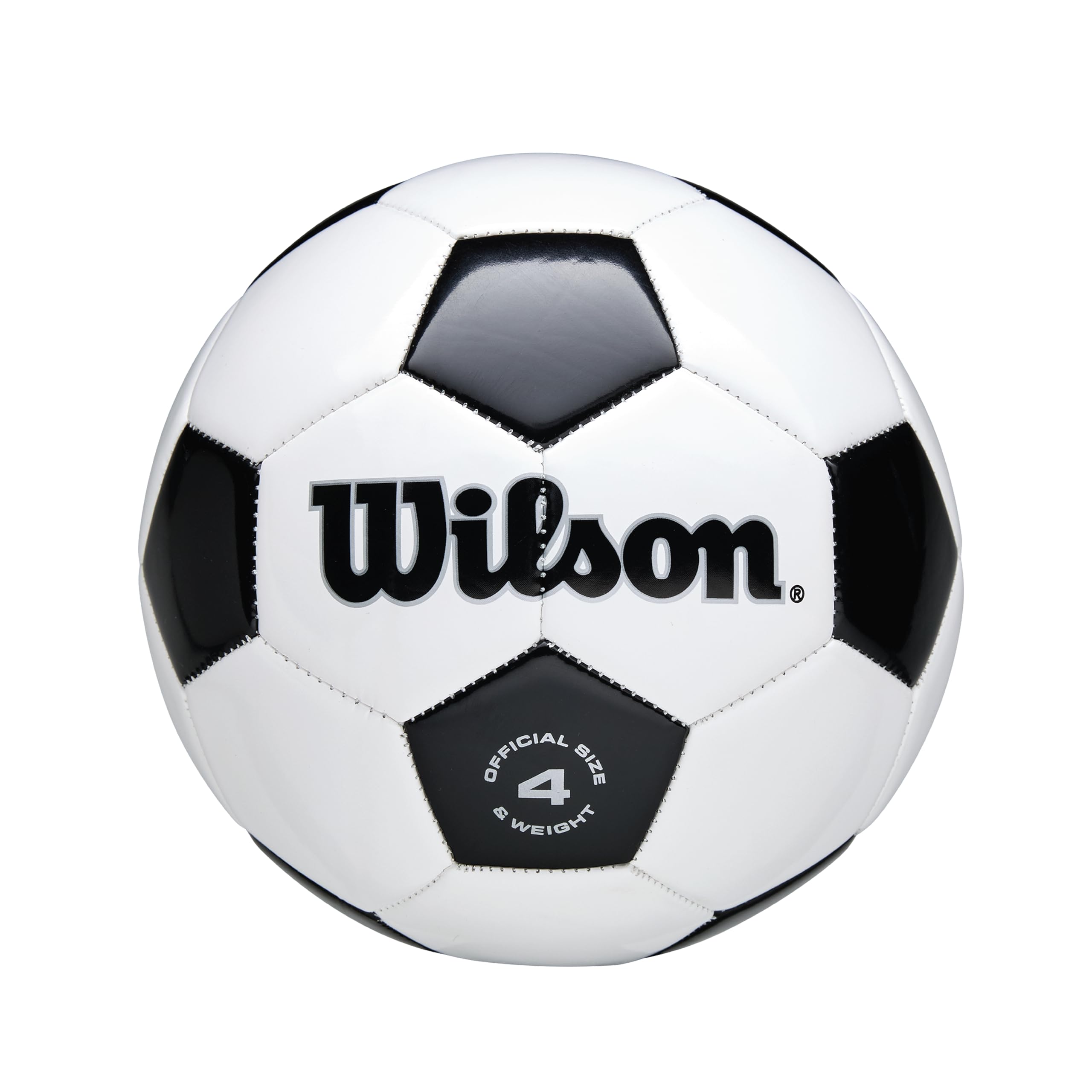
1. WILSON Traditional Soccer Balls
Our pick — 4.5+★ from 19,500+ verified ratings; the strongest balance of quality and price.
A 16-ounce butyl-bladder ball with a synthetic leather cover and classic black-and-white panels.
You get a ball that lasts a full rec season without fuss. A synthetic leather cover resists scuffs, so it still looks decent after weeks on concrete. A butyl rubber bladder (a rubber inner tube that holds air slowly) keeps it firm, so you inflate it once and it is still usable in November. Machine-sewn panels keep it round, so it rolls true instead of wobbling. The classic black-and-white panels with silver accents also read instantly as a real soccer ball to a kid, which does more for practice than any tech feature.
The honest number to know is weight: 16 ounces. That is heavier than the 13.75-ounce Vizari below, so it suits stronger kids and recreational adult kickarounds better than tiny legs. Wilson lists proper inflation at 8 to 10 psi, so buy a gauge and stay in that window — pushing past it is what kills seams on any stitched ball. It ships as a single ball with no pump in the box, so budget for one.
Look past the weight and the value is hard to argue with: 4.5+ stars across 19,000+ ratings. Buyers report the size lands right for younger kids learning the game, and that it holds up around six-year-olds. One oddity: the league listing says NCAA and the age range is marked adult, even though it is a size 4. Families are clearly using it well below that. If you want one dependable ball instead of a rotating cast of them, this is the one that keeps coming back.
What earns its place
- Butyl rubber bladder holds air and shape between practices
- Synthetic leather cover takes scuffs from concrete and grass alike
- Classic black-and-white panelling kids recognise instantly
- Machine-sewn construction keeps a predictable, repeatable bounce
Where it asks more of you
- At 16 ounces it runs heavier than the lighter youth options here
- Needs a pump and gauge — neither is included
- Listed age range says adult, so check the size tab carefully when ordering
Go here if: you want the safest single purchase for a rec team or a family with kids of mixed ages kicking the same ball.
Think twice if: your player is small enough that a 16-ounce ball feels like work rather than play.
2. adidas Starlancer Club Soccer Ball
A beginner-friendly club ball with a soft touch and a blue finish kids actually ask for.
The Starlancer’s pitch is simple: a young player’s first real ball, built to feel gentle on the foot. Machine-stitched construction gives it that softer strike feel, and the 0.36 kg weight sits lighter than the 0.38 kg Skill Blox foam ball — noticeable when a ten-year-old is striking over and over at practice. The 100% TPU cover and butyl bladder are both aimed at casual, recreational use, which is exactly the grade most 12U players need.
What wins people over is the overall build — the quality of the thing is the standout, with appearance the clear second. The blue shade gets called out as genuinely good-looking, and beginners take to it quickly. Two honest notes: it ships flat with no pump, so plan for that, and air retention draws mixed reports — some balls stay firm, others need topping up. The cover also has a sticker that frustrates people trying to peel it cleanly on arrival.
Durability is the real question mark. Some of these last through a full season of practices; others get chewed up fast, so treat it as a soft-touch practice ball rather than an every-day-on-concrete workhorse. If your player is new to the game and playing on grass, that trade is fair.
First-touch feel: the soft, stitched strike is the reason to choose it over a firmer ball — a nervous beginner gets a gentler response on the foot.
The honest caveat: air retention and long-term durability are the two spots where experiences split, so pair it with a pump and keep it off rough tarmac.
Reach for this if: you are outfitting a first-season 12U player who needs a soft touch and a good-looking ball to stay keen.
Look elsewhere if: the ball needs to survive daily street play — a sturdier cover serves that better.
3. Vizari National Team Soccer Ball
Flag-inspired graphics on a 13.75-ounce ball designed by a professional footballer.
At 13.75 ounces the Vizari is the lightest full-cover grass ball in this group — 2.25 ounces under the 16-ounce Wilson above — which makes it easier for a smaller player to swing through a strike. The 30-panel machine-sewn layout spreads the stitching load, and Vizari’s own spec calls out a durable bladder for consistent inflation across vigorous training. The national-colour graphics are the hook though: this is a ball a kid picks because it looks like the one their team wears.
Quality is where it earns its reviews — that is the aspect buyers bring up most by a wide margin, with air retention a distant and more divided second. It arrives in Mexico Green, ships as a single ball, and the rubber material keeps the surface feeling familiar to anyone used to a standard training ball. It is a size 4 even though the listing also advertises size 3 for drills, so confirm the variant you tap.
The deflation question deserves a straight answer: some owners mention the ball going soft between sessions. Pair it with a gauge and a pump and that becomes a chore rather than a problem. Where it beats the field is character — a collector’s-piece look with genuine training feel underneath.
The case for it: buy this for the kid who cares what the ball looks like as much as how it plays.
Be aware: it will likely need topping up more often than a butyl-bladder ball, so keep a pump in the kit bag.
4. Skill Blox SoftStrike Indoor Soccer Ball Size 4

A 21-centimetre neoprene-over-foam ball that stays quiet on hard floors and ships with a pump.
Indoor training balls live or die on two things: noise and damage. The SoftStrike handles both with a neoprene outer over a soft foam layer, what Skill Blox calls CushionCore — the result is a ball that glides across hard floors with minimal thud and no scuffs. It measures 21 centimetres across against the 22.86 centimetres of the Runleaps star ball below, so it is the more compact of the two soft options and easier to keep on a shorter indoor line.
It is a 0.38 kg ball, slightly heavier than the 0.36 kg adidas Starlancer, and that extra mass is what stops it skidding off a fast laminate floor. You get a pump in the box, so setup is minutes, and you can tune firmness to match a nervous beginner or a confident player. The whole design brief — close control, first touch, quiet reps — is exactly the drill work that translates to outdoor match day.
What it does well is indoor use, and buyers confirm the walls and floors come out of a session unharmed. Two things to size up honestly: opinions on wall markings split, so light-coloured walls still deserve a caution, and value for money divides opinion given it is a training aid rather than a match ball. Treat it as equipment, not a ball, and the maths works.
Why it earns a slot: a genuinely quiet indoor ball with an included pump and a compact 21-centimetre footprint — the practical pick for apartment touch work.
The catch to weigh: it is a training tool at a training-tool price, and a few players still see marks on pale walls.
Best fit: apartment families and players who want to sharpen first touch through winter without upsetting neighbours.
Not the one for: anyone who needs a match-legal ball for actual games — this is a skill tool.
5. Runleaps Star Pattern Soccer Ball

A 340-gram molded TPU ball with a star print and a firm, lively rebound.
The Runleaps is built around a single promise: a durable TPU surface that keeps its pattern no matter how much sun or sweat it sees. At 340 grams it is light enough for young players, and the molded plastic construction gives it a firm, lively rebound rather than a dead thud.
Quality is the standout here, with the star-pattern appearance a clear second — kids gravitate to it, and the pink-and-blue colourway stands out on grass. It ships uninflated with no pump included, which is the one setup step people miss. Buyer feedback on size splits: some find it spot-on for toddlers and young beginners, others note it does not match an official size. Check the variant listing carefully if exact dimensions matter for your league.
Air retention is mixed, so expect to top it up periodically. Used as a backyard and playground ball rather than a match ball, it earns its keep comfortably.
Pick this when: you want an eye-catching, sun-proof ball for casual backyard and playground kicking at the entry tier.
Pass if: your league checks ball dimensions at registration — order with the official spec in hand.
6. WILSON NCAA Vantage Soccer Balls
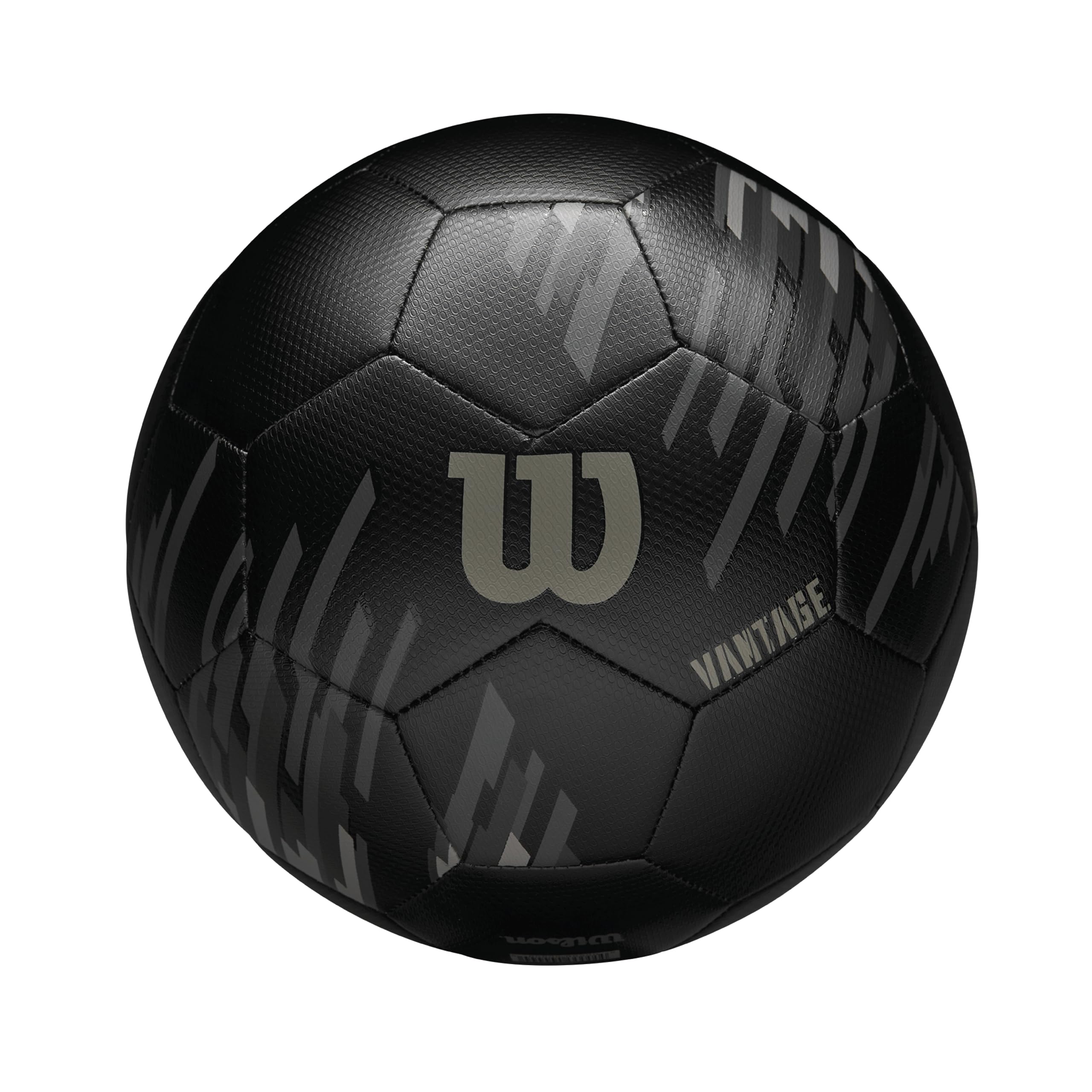
A textured cover and a sugar-cane liner — the Vantage is the touch-first upgrade over the Traditional.
Where the Traditional Wilson is a durable all-rounder, the Vantage is the one built for feel. The textured TPU composite cover gives a grippier first touch for passing and receiving, and the butyl rubber bladder is the same slow-leak design that keeps the ball firm for weeks. It carries a liner made with 40% sugar cane EVA, a sustainable material choice Wilson calls out directly — a nice detail for a family that cares about that side of the purchase.
Weight is the adjust-and-notice figure: 0.57 kg, well up on the 16-ounce (roughly 0.45 kg) Traditional above, so this is a ball for stronger youth players rather than small beginners. The upside is that a heavier ball trains a more committed strike; the downside is that tired legs notice it late in a session. Bright contrasting colours keep it visible in any light, and it ships without packaging, which Wilson frames as a shipping-footprint choice.
Build quality and value are the two things that carry this ball, with appearance close behind — it looks and feels like a serious training ball. Durability and inflation both draw some mixed notes, so keep a gauge handy and don’t overdo the psi. For a committed club player, the touch is the reason to spend up from the Traditional.
The touch upgrade: a textured TPU cover plus a butyl bladder — the combination that makes clean passing feel easier and keeps the ball round between sessions.
Weight check: at 0.57 kg it is a heavier ball, best saved for players strong enough that the mass trains rather than tires them.
Made for: club-level youth players who want better first touch and will notice the difference on a wet pitch.
Skip for: a first ball for a small beginner — the weight is the wrong starting point.
7. HopeRock Indoor Soccer Ball, Size 4
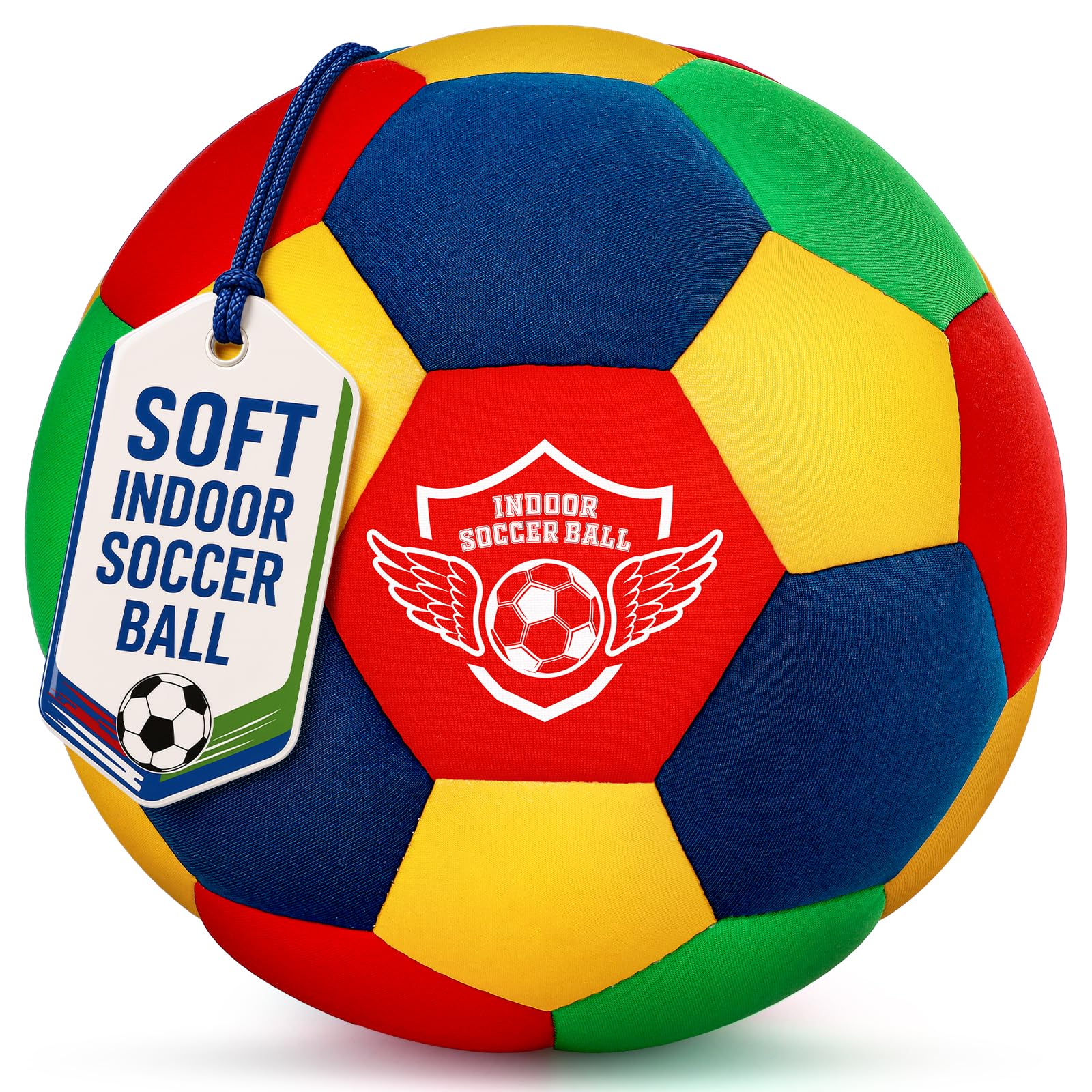
A 0.32 kg foam ball quiet enough for the living room and soft enough for a toddler.
HopeRock built this for the house, not the pitch. It is a foam ball through and through, and at 0.32 kg it is the lightest pick in this entire group. That is light enough that a toddler can boot it across a hallway without leaving a mark on the sofa. It still rolls and bounces like a real ball, which keeps kids interested instead of dismissing it as a toy.
What buyers talk about most is the size, and it is clearly tuned for young kids — the 3-12 age range on the listing lines up with what families report. Indoor use and softness come next, and the quiet operation is the practical win when someone is practicing in a room above a neighbour. A pump is included, so the flat-pack shipping is a one-time setup rather than a recurring frustration.
The honest trade-offs: durability and inflation both split opinion. Some balls hold up to endless kicks, others come apart with heavy use, and a few arrive struggling to inflate properly. That points to a ball for gentle indoor play with toddlers and early beginners, not for a hard-kicking older kid. Used within that brief, it is exactly what it claims to be.
Why parents like it
- Foam construction is gentle on walls, sofas, and shins
- Quiet enough to keep a session indoors without complaints
- At 0.32 kg it is the lightest ball here — well suited to small legs
- Pump included, so it is ready the day it arrives
The parts to think about
- Durability splits — hard kicking wears foam faster than leather or TPU
- Inflation is inconsistent on some units from the start
- Not a match ball and never meant to be one
Right for: households with toddlers or early beginners who need a safe, silent ball for indoor play.
Wrong for: a competitive youth player who needs a real match ball for training sessions.
8. Nike Pitch Soccer Ball

Molded grooves cut drag in the air — this is the ball that flies straight.
Nike’s Aerowsculpt technology is the headline: molded grooves that disrupt airflow across the surface to reduce drag and hold a more stable line in flight. A twelve-panel design goes with it, which is the layout that gives a truer bounce and a more predictable roll. At 13.12 ounces it sits on the lighter end of the stitched and moulded options — comfortably under the 16-ounce Wilson Traditional — so a young player can strike it without fighting it.
The textured casing is the other half of the story: it gives a consistent feel through passing, shooting, and dribbling, and a rubber bladder holds pressure and shape between sessions. For a kid who has outgrown a squishy beginner ball and wants something that behaves like a proper match ball, this is the natural step up.
What lands with families is the overall quality, with value for money second — kids take to it quickly and the size reads right. Durability is the one split note, with some balls lasting a season and others wearing out faster. from the start, check the size variant on the listing, since Nike’s colourway naming is easy to mis-tap.
The flight advantage: Aerowsculpt grooves plus twelve panels mean a straighter ball in the air — the difference a young player feels on long passes.
What to keep in mind: durability reports split, so treat it as a match-feel ball rather than an all-surface beater.
The one to grab if: your player is moving up from beginner gear and wants a ball with genuinely stable flight.
Hold off if: the ball will be kicked on concrete daily — that surface eats through covers fast.
9. adidas World Cup 2026 Competition Ball

At 8 ounces with a smooth surface and a match-grade build, this is the serious player’s ball.
The first thing you notice is the weight: 8 ounces, half the heft of the 16-ounce Wilson Traditional and the lightest grass ball in this whole lineup. It also uses thermally bonded smooth construction, meaning the panels are fused with heat and there is no stitching to catch or lift. That gives a surface with fewer interruption points, so your strike is cleaner and the roll is truer. The butyl bladder (a rubber inner tube that holds air slowly) is the same slow-leak design adidas uses on its club ball. A FIFA World Cup 26 printed logo finishes it off.
The materials read as considered rather than cheap: 60% polyurethane and 40% polyester, with a recycled polyester share and a rubber inner. That face surface is what gives the tactile feel buyers describe as genuinely nice to receive on the foot. At 7.76 inches in diameter it is a size 4 for players taking training seriously, whether that means a club academy kid or an adult working on touch.
What carries it is quality first — training use comes up specifically — with value and design close behind, and the overall feel getting the nod. The one honest note is that at this shaping it is clearly aimed at adult-level use, so for a small beginner it is overkill. For an older youth player or a coach buying a durable training ball, it is the most refined option here.
Best match for: club players and coaches who want a smooth, light, properly-built ball for serious training. If you just need a knockabout ball for a backyard kick, the cheaper Wilson Traditional covers that job.
Not worth it for: recreational backyard kicking with small kids — the build is far beyond what that needs.
Know the Specs
Why Size 4 Lands at a Specific Diameter
A size 4 ball is designed for players roughly between 8 and 12, and the diameter figures reflect that — the Runleaps ball measures 22.86 centimetres, the Skill Blox indoor ball 21 centimetres. The point of the smaller diameter is control: a smaller ball means a smaller target, so a young player’s first touch gets trained against a realistic shape rather than a beach-ball-sized surface. If the ball feels too big underfoot, the player compensates with a clumsy poke instead of a clean strike.
Butyl versus Rubber Bladders
A bladder is the inner balloon, and its material decides how often you pump. Butyl rubber is the slow-leak choice — a butyl-bladder ball holds air and shape between sessions, which is why both Wilson models and both adidas models use it. Standard rubber bladders are cheaper and lose pressure faster, so expect more topping up. Neither is a defect; it is a trade you should know about before you decide how annoying a weekly pump session would be.
Stitched, Bonded, and Foam Construction
Machine-sewn stitching is the durable standard for grass and playground play — visible seams, predictable bounce, and a cover that takes abuse. Thermally bonded construction removes the seams entirely, giving a cleaner strike and a truer roll, but it costs more and can be less forgiving on rough concrete. Foam construction is for indoors only: its job is to be quiet and harmless to furniture, not to survive a match. Pick the construction for the surface, not the other way round.
Reading the PSI and Weight Numbers
Psi stands for pounds per square inch, the pressure figure makers give for correct inflation — the Wilson Traditional lists 8 to 10 psi, and staying in that window is what protects the seams and the touch. Weight works alongside it: an 8-ounce ball like the adidas World Cup 26 is light and fast, while a 16-ounce ball feels substantial underfoot. Neither is wrong; the right weight depends on the player’s size and how hard they strike the ball.
Common Questions
What age is a size 4 soccer ball right for?
How often should I pump a size 4 soccer ball?
What does the psi number on the ball mean?
Can my kid use an indoor foam ball for outdoor practice?
Does a heavier size 4 ball help training?
What is the difference between stitched and thermally bonded construction?
Will a size 4 ball fit a standard pump and needle?
Is it worth buying a match-grade ball for a recreational player?
How do I choose between a stitched ball and a foam indoor ball?
Does the panel count on a soccer ball actually matter?
The Bottom Line
For most families, the best youth soccer ball size 4 is the WILSON Traditional Soccer Balls. It is the 4.5+ star crowd favourite with 19,000+ ratings. A butyl rubber bladder (a rubber inner tube that holds air slowly) keeps it firm, and a synthetic leather cover shrugs off playground abuse. Yes, the adidas Starlancer has more reviews, but the Wilson holds the higher score and the more dependable build. If your player is new to the game and needs a softer touch, grab the adidas Starlancer Club Soccer Ball, whose machine-stitched surface feels gentler on the foot. And for indoor touch work through winter, the Skill Blox SoftStrike turns any hallway into a training ground without waking the house.
How we choose
We do not accept paid placement. Every pick is matched to a real buyer and a real use-case; we do not hands-on test units.
Sources
Specifications: manufacturer listings and product documentation. Review insights: verified customer reviews, as of November 2026. Pricing: not shown on this page (it changes often); check the current price via the retailer link.
As an Amazon Associate, Tactical Gear Guy earns from qualifying purchases. This does not affect which products we feature.