Specs are compiled from manufacturer listings and verified buyer reviews and can change over time — please confirm the key details on the product page before buying.
You can sweat hard all day, stop for lunch in cold wind, and still stay warm without smelling like a locker room — that is what wool hiking clothes do better than anything else on the trail. The catch: not every wool garment is built the same. A heavyweight base layer and a lightweight hiking tee behave completely differently, and buying the wrong weight for your conditions is the fastest way to end up either shivering or overheated mid-climb. Below, each pick is matched to the specific weight, fabric grade, and body coverage that suits your kind of hiking.
This guide is built by comparing the manufacturers’ published specifications and the patterns across verified customer reviews, so you get each pick’s real strengths and trade-offs instead of marketing spin.
You will see exactly how merino weight, fiber thickness, and construction differ across base layers, socks, and full sets, so you can build a system that works from a summer day hike to a winter summit push. The picks below cover every layer you need in wool hiking clothes and show which one earns its place in your pack.
Top Picks


How To Choose The Best Wool Hiking Clothes
Your first decision is not brand — it is fabric weight. Merino is measured in g/m² (grams per square meter), which tells you how thick and warm the knit is. A 165 g/m² piece is a light, breathable summer layer. A 250 g/m² piece handles cold weather and moderate activity. A 400 g/m² heavyweight is built for deep winter and low-output warmth. Pick the wrong weight and no amount of quality will save the hike.
Match Fabric Weight To Your Activity And Season
The rule experienced hikers follow is counterintuitive: the harder you work, the lighter your base layer should be. High-output climbing generates body heat fast, so a heavy layer traps sweat and leaves you damp when you stop. Low-output winter camping is the opposite — you need retained warmth. A lightweight 165 g/m² tee for summer hiking and a heavyweight 400 g/m² shirt for winter sitting-around camp are both correct choices for their conditions.
Understand Micron Count Before You Buy
Micron measures individual fiber thickness. Standard wool runs 25+ microns and feels scratchy against skin. Merino at 17.5–19.5 micron is significantly finer — fine enough that it bends softly rather than pricking. This is why wool hiking clothes at that grade can be worn directly against skin for a full day without irritation. If itch has kept you away from wool, micron count is the number to check first.
Cover Your Extremities And Legs, Not Just Your Torso
Most hikers buy a single merino tee and call it done. The real system includes socks, bottoms, and a midweight layer for layering. Cold feet end more hikes than cold torsos — merino socks with cushioning and moisture wicking address that directly. Wool bottoms extend your comfort range in winter camping and cold-weather hiking. A full set of merino layers transforms how you handle sustained cold compared to a single piece.
Check Fiber Content And Construction Details
A garment labeled “merino” may contain a blend, so check the exact percentage before you buy. Some wool socks are only 30% merino blended with synthetics — still functional, but different in feel and odor performance. Seam construction matters too: flat-lock seams (flat stitched joins that lie smooth against skin) and smooth toes reduce rubbing during long days in boots. Washability is another factor — most merino tolerates machine washing on cold, delicate cycle, but tumble drying damages the fibers permanently.
Side-by-Side Comparison
| Model | Best For | Fabric Weight | Material | Type | Amazon |
|---|---|---|---|---|---|
| MERIWOOL Mens Base Layer★ Best Overall | Winter hikes and cold-weather layering | 400g Heavyweight | 100% Merino Wool, 18.5 micron | Long-sleeve base layer | Amazon |
| DANISH ENDURANCE Hiking SocksBest Value | Cold-weather hiking and long days in boots | Heavy cushioning | Merino blend | Crew hiking socks | Amazon |
| Merino Protect V NeckBest for Heat | Women’s hot-weather hiking and travel | — | 100% Merino Wool | Short-sleeve tee | Amazon |
| METARINO Crew Neck Tee | Women’s lightweight summer hiking | Lightweight | 100% Merino Wool | Short-sleeve tee | Amazon |
| SHEEP RUN Merino T-Shirt | High-output hiking and running | 170GSM | 100% Merino Wool, 17.5–19.5 micron | Short-sleeve tee | Amazon |
| Merino.tech Half Zip | Layering under jackets and ski gear | — | 100% Merino Wool, 17.5 micron | Half-zip midlayer | Amazon |
| MERINNOVATION Base Layer Set | Multi-day hikes and cold-weather sleep systems | 165gsm or 250gsm | 100% Merino Wool | Top and bottom set | Amazon |
| Minus33 Merino Wool Bottoms | Winter camping and cold-weather leg layering | Lightweight | 100% Merino Wool | Long johns | Amazon |
| Icebreaker Oasis Long Sleeve Crewe | Year-round base layer for varied conditions | Mid-weight | Merino Wool | Long-sleeve crew | Amazon |
Detailed Reviews
1. MERIWOOL Mens Base Layer Merino Wool Thermal Shirt
Our pick — 4.5+★ from 500+ verified ratings; the strongest balance of quality and price.
The heavyweight that turns a freezing winter hike into a comfortable one.
Here is the number that separates this shirt from almost everything else in the wool hiking category: 400 g/m². That is a heavyweight knit — gram weight per square meter tells you how much wool is packed into the fabric, and 400 is on the serious cold-weather end of the scale. For winter hiking, snowshoeing, or hunting in temperatures that bite, this is the layer that keeps your core warm without the bulk of a fleece.
The fiber itself is 18.5 micron merino — a finer grade than standard wool, which is why it sits against skin without the itch most people associate with wool. It works as a base layer under a shell or as a standalone layer in moderate cold. The natural temperature regulation of merino means you stay warm when you stop moving and cool when you are climbing hard. It also resists odor, so multi-day trips without laundry access are genuinely practical.
Raw warmth is what wins people over here — the 400g weight (400 grams per square meter of fabric, a heavyweight knit) does exactly what it promises. Quality is nearly tied for praise, and the overall sentiment is that this shirt is worth what it costs. The honest caveat: sizing draws mixed feedback, so check the size chart carefully before ordering, and durability feedback is also mixed. For a heavyweight layer at this grade, it is still among the most trusted cold-weather options in the category.
Where It Delivers
- 400 g/m² heavyweight merino for real winter warmth
- 18.5 micron fiber — fine enough to wear against skin without itch
- Natural odor resistance for multi-day use
- Versatile as base layer or standalone midlayer
What To Watch
- Heavyweight knit runs warm — overkill for summer hiking
- Sizing runs inconsistent, so measure before you buy
- Durability feedback is mixed across the review base
Reach for this if: you hike or hunt in genuine cold and want a heavyweight merino layer that earns its keep.
Look elsewhere if: you need a lightweight summer layer — the 400g weight is built for the cold end of the spectrum.
2. DANISH ENDURANCE Hiking Socks Merino Wool
Cold feet end more hikes than cold torsos — these socks fix that.
If you only upgrade one piece of wool hiking gear, make it your socks. This pair delivers heavy heel-to-toe cushioning that softens every step on rocky trails, plus ventilation zones that move moisture away so your feet do not turn into a swamp on a steep climb. The merino blend keeps warmth in without the clammy feeling of cotton. Anatomical left/right shaping and arch support hold the sock in place so it does not slide down inside your boot.
The wool content sits at 30% merino, blended with synthetics. That is worth knowing before you buy — it is functional and warm, but not the same as a 100% merino sock. Fit and thickness both draw mixed feedback: some find them true to size and comfortably thick, others find they run big and thinner than expected. For year-round hiking, the blend breathes well enough to wear across seasons.
Quality is the aspect buyers praise most by a wide margin, and comfort follows close behind. For the price of a single pair of premium merino socks, you get a cushioned hiking sock made in Portugal with recycled paper packaging. It is a low-risk upgrade that changes how your feet feel on day two of a long trek.
The real trade-off: at 30% merino, the wool content is modest compared to a 100% merino sock. You get warmth and moisture wicking, but if pure merino content is what you are after, look for a higher percentage. The fit inconsistency is the other factor — check sizing carefully if you are between sizes.
Your move if: you want a cushioned, breathable hiking sock that handles cold and rocky trails without breaking the budget.
Check first if: you prefer a 100% merino composition — this is a blend at 30% merino.
3. Merino Protect 100% Merino Wool V Neck T-Shirt for Women
A featherweight merino tee built for the hottest hikes on your calendar.
This short-sleeve V-neck is a 100% merino wool top with a soft hand-feel that works against skin on a hot day. The merino manages moisture as you sweat, so the fabric stays comfortable instead of sticking to your back. It doubles as a travel shirt — merino resists odor, so you can wear it multiple days between washes and pack fewer tops. The solid-color palette keeps it versatile for both trail and town.
Women who hike in warm weather find the comfort here particularly strong, and the softness and fit are the aspects most consistently appreciated. The shirt moves from trail to casual wear without looking like technical gear. Color options include shades that work beyond the hiking context.
The honest catch is durability — holes developing in the fabric is a recurring issue in the review base, which is meaningful for any garment built for the backcountry. Treat it as a delicate layer rather than a rugged one. Value for money also draws mixed feedback. Used as intended — as a warm-weather hiking and travel tee — the overall quality and fit remain the reasons buyers come back.
What stands out: comfort in heat is where this shirt earns its keep — the breathable merino feels light and dry through a full day of trail time.
The durability question: holes are the recurring complaint in the review base, so this is best treated as a gentle-use layer for hot weather rather than a rugged backcountry workhorse.
Worth grabbing if: you are a woman hiking or traveling in warm weather and want a soft, odor-resistant merino tee.
Give it a pass if: you need a bombproof shirt for abrasive terrain — this one calls for a little extra care.
4. METARINO Merino Wool T-Shirt Women

The lightweight merino tee that handles muggy afternoon climbs without overheating.
Warm-weather hiking has a particular problem: synthetics trap heat and start to smell by mile ten. This 100% merino crew neck solves both. The lightweight knit keeps you cool on hot trail days while merino’s natural odor resistance means it stays fresh through a multi-day trip. The crew neck gives more coverage than a tank without the heat penalty, so it works under a sun hoodie or alone in mild weather.
Fit is the aspect buyers praise most here, and comfort follows close behind. Women find it flattering on the body and soft against skin — the merino has a silky, sports-like feel rather than a scratchy wool texture. The blue colorway is heathered, which gives it a relaxed look appropriate for trail or travel. At 70–80 degrees it does exactly what you want from a summer hiking tee.
Sizing runs mixed — some find it flattering, others note it is too large through the shoulders and chest, so measure carefully. Durability also draws negative feedback, so treat this as a warm-weather layer rather than a rugged piece. If you are dialing in a lightweight merino system for hot-weather hiking, the breathability and odor resistance are the reasons to pick it.
Why it earns a spot: it keeps you comfortable all day in 70–80 degree weather, and the odor-free performance means one shirt can cover several hiking days.
Size up or down: the fit is the biggest variable — shoulders and chest run large for some, so check the size chart before you commit.
Best fit for: women who hike hot and want a lightweight, odor-resistant merino tee they can wear multiple days.
Think twice if: you need a hard-wearing layer — the lightweight knit is not built for heavy abrasion.
5. SHEEP RUN Men’s Merino Wool Base Layer T Shirt

Fine 17.5–19.5 micron wool at a 170GSM weight — built for hard effort.
Here is a head-to-head that matters: this shirt uses 17.5–19.5 micron merino, while the MERIWOOL heavyweight above runs 18.5 micron. Both are in the fine, non-itchy range, but the SHEEP RUN sits at the finer end, which makes it feel even softer against skin during high-output activity. That is the right call for a 170GSM fabric — a light knit that needs fine fibers to stay comfortable when you are sweating hard.
The 170GSM weight places this firmly in the lightweight category, appropriate for running, cycling, and fast-and-light hiking where you generate your own heat. According to the maker, this 170GSM merino absorbs up to 30% of its dry weight in moisture before feeling wet, so sweat evaporates off your skin instead of chilling you. Flat seams reduce rubbing under a pack strap. The shirt resists odor naturally, so a multi-day trip without laundry access is workable.
Quality is the aspect buyers praise most, with comfort close behind. The honest caveat: durability draws mixed feedback, with reports of holes developing after a few washes, and some question the fabric’s wool authenticity. Value also splits opinion. Use it as a lightweight active layer and wash it on cold, delicate cycle to get the most life from it.
Reasons To Buy
- 17.5–19.5 micron merino — finer than many rivals for softer skin feel
- 170GSM lightweight knit suits high-output hiking and running
- Flat seams prevent rubbing under pack straps
- Natural odor resistance for multi-day trips
Reasons To Pause
- Durability is a question — holes reported after a few washes
- Fabric authenticity draws some skepticism
- Lightweight knit is not built for abrasive terrain
Go for it when: you run or hike hard in mild weather and want a fine, lightweight merino tee that keeps up with the effort.
Hold off if: you want one shirt to survive years of rough use — the fine knit wants gentle handling.
6. Merino.tech 100% Merino Wool Half Zip Sweater Men
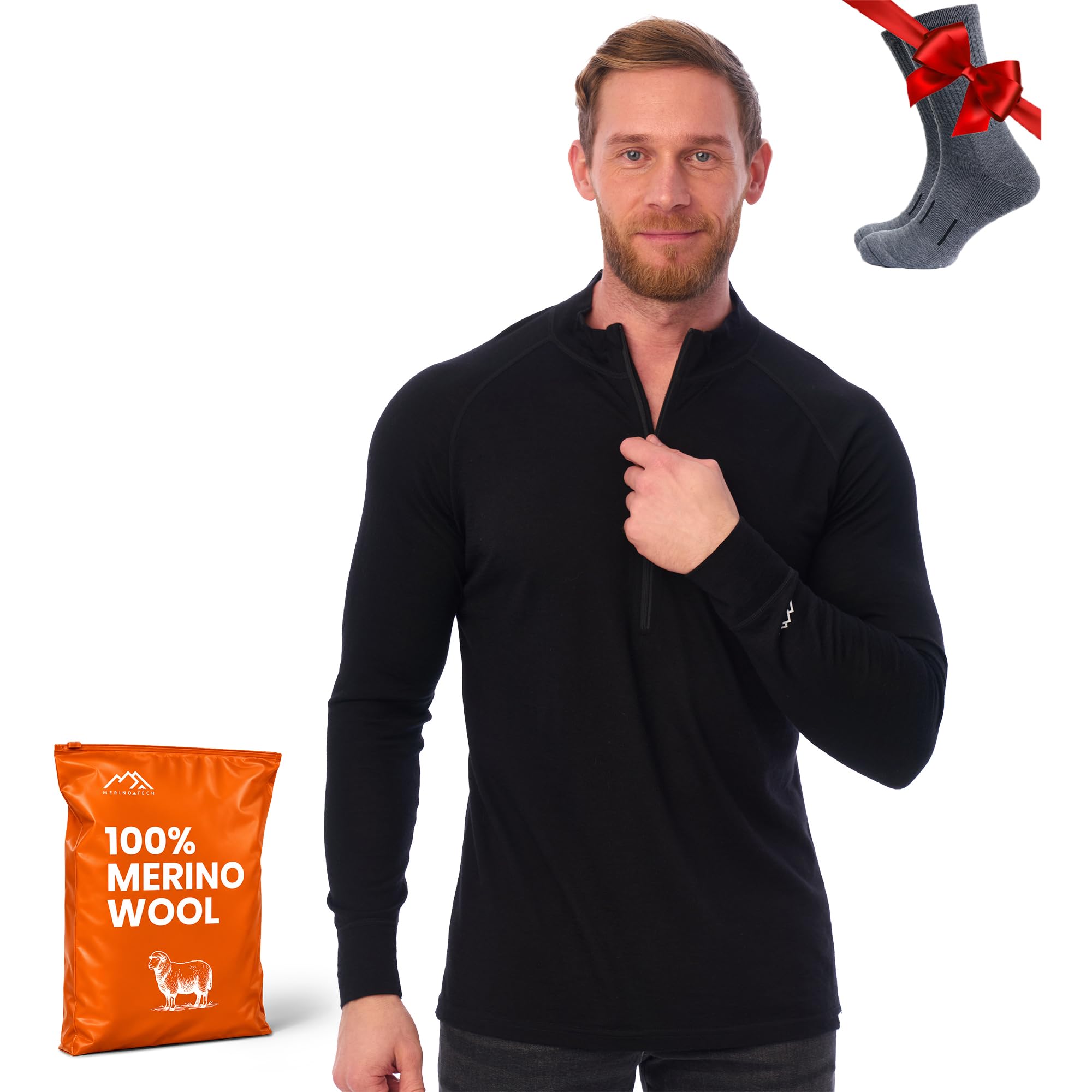
The zip-neck midlayer that adapts when the trail turns cold at the top.
A half zip is a small design decision with a big trail benefit: you can vent heat on the climb and seal it back in at the summit without taking off your pack. This 100% merino sweater adds that flexibility to your layer system. The 17.5 micron fiber is finer than human hair, which the maker points out means it does not itch even on sensitive skin. That is the number to check if wool has never worked for you before.
The Australian merino is RWS certified, meaning an independent farm audit confirms animal welfare and land management standards. Every component is tested against 100+ harmful substances under OEKO-TEX Standard 100. For a layering piece, the material quality draws strong positive feedback across cold and warm conditions, and it looks good on slim and tall frames.
Wash it cold at 30°C max on delicate cycle, inside out, and lay it flat to dry — tumble drying permanently damages merino fibers. The maker rates this 17.5 micron merino for 3–5 days of wear between washes thanks to its natural odor resistance. Sizing runs true, so choose your regular size; size down one for a snug fit under ski gear. The one split is durability, which is the standard merino care-and-handling caveat.
Layer system win: the half zip lets you dump heat on the climb and lock it in at the summit, which makes this the most adaptable piece here for changing conditions.
Care is non-negotiable: tumble drying permanently damages the fibers — lay it flat to dry and it will keep its shape.
Ideal for: hikers who want one versatile merino layer that works under a shell on cold days and looks sharp off the trail.
Not for you if: you refuse to air-dry wool — this piece will not survive a tumble dryer.
7. MERINNOVATION Merino Wool Base Layer Set for Men
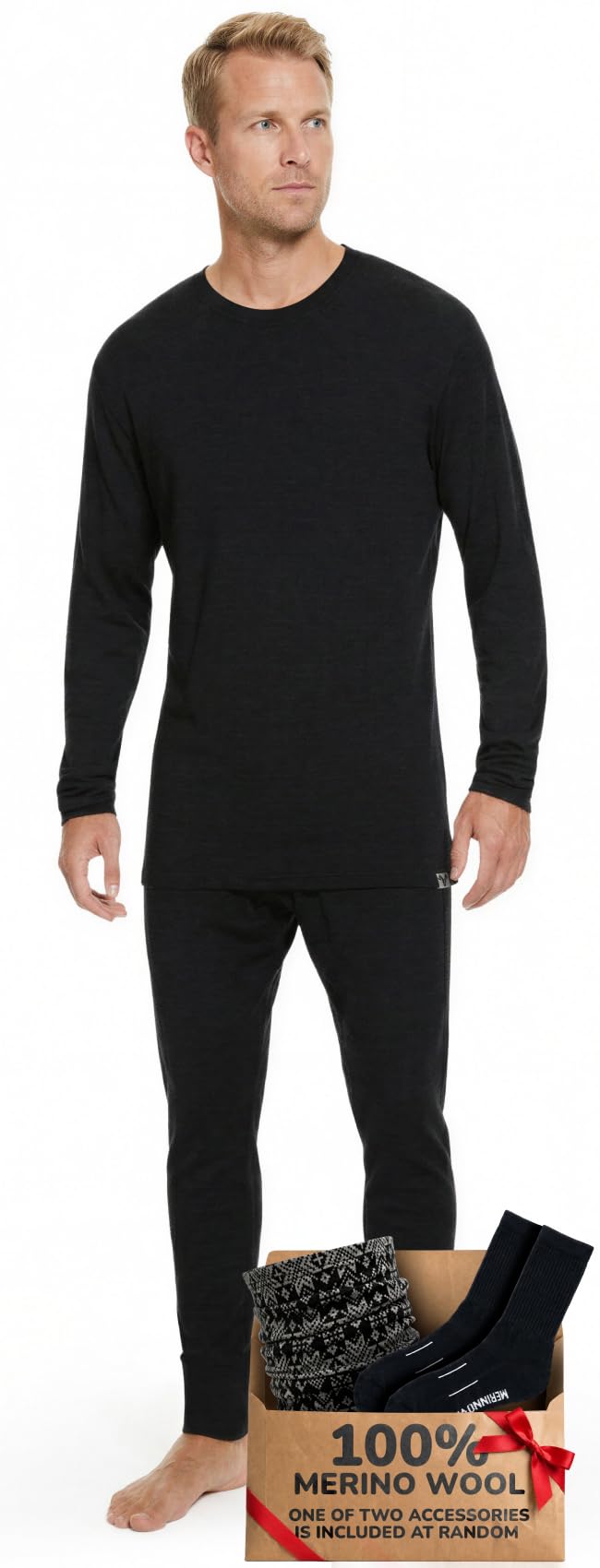
A full top-and-bottom merino system for multi-day trips and cold-weather sleep.
Buying a set changes the math on a wool hiking wardrobe — this package covers your top and bottom in 100% merino wool, so you are not assembling your system one piece at a time. It comes in two weights: a 165gsm lightweight option for running, skiing, and active hiking where you need warmth without bulk, and a 250gsm midweight for sustained cold and deep winter layering. Both share the same fiber grade; only the warmth level changes.
Merino’s temperature regulation is the reason this set works across seasons — the same properties that keep you warm in cold air prevent overheating during hard effort. The open knit construction ventilates and adjusts to your output. Odor resistance makes it practical for multi-day hikes and travel days with limited luggage, so you can wear it consecutive days without washing. The set functions as a standalone layer in moderate cold or as the foundation of a full layered system.
Quality is what buyers appreciate most, with warmth a close second; the set’s warmth holds up in genuinely harsh cold. Fit draws a mix of true-to-size and runs-small feedback, so check the chart. Durability feedback favors hand washing. For anyone building a cold-weather hiking system from scratch, this set covers the core of it in one purchase.
Full-system value: one purchase covers top and bottom in 100% merino, with a weight choice between 165gsm for active days and 250gsm for deep cold.
Sizing and care: the set runs small for some buyers, and hand washing extends its life — factor both into how you order and launder.
Choose this if: you want to build a cold-weather base layer system in a single order and value full merino coverage.
Look at singles if: you only need one layer, or you prefer to hand-wash — this set rewards careful care.
8. Minus33 100% Merino Wool Bottoms Men’s Base Layer Pants

The leg layer that keeps wind chill off when your top half is already covered.
Most wool hiking wardrobes stop at the torso, and legs suffer for it. These 100% merino long johns close that gap. The lightweight wool pulls moisture off your skin and lets it evaporate into the air, and wool insulates even when damp — it can take on up to 30% of its weight in moisture without feeling wet, according to the maker. Flat-lock seams (flat stitched joins that lie smooth against skin) sit smooth under pants. A UPF rating of 25 (UPF measures how much UV sun protection fabric blocks) on lightweight layers adds sun protection for high-altitude sun.
Warmth is the headline here — these lightweight bottoms cover 60 down to -20 F and block wind chill, so they work well beyond deep winter. They are comfortable, not itchy or tight, with a silky smooth feel. Winter campers in particular find them a versatile part of the kit. Minus33 traces back to textile engineers and a family wool business dating to 1916, and that heritage shows in the knit.
Quality is the aspect praised most, with warmth nearly tied. The trade-off is durability, which draws mixed feedback — merino this fine wants gentle washing to last. They are worth it for winter camping and cold-weather hiking where leg warmth is the difference between a good day and a miserable one.
What Makes Them Work
- 100% merino wool that insulates even when damp
- Rated for 60 to -20 F with a soft, non-itchy, non-binding fit
- Flat-lock seams stay smooth under pants
- UPF 25 on lightweight layers for high-altitude sun
Keep In Mind
- Fine merino calls for gentle washing to hold up
- Lightweight knit — not a heavy-duty winter layer on its own
Right for: winter campers and cold-weather hikers who want merino leg coverage that works across a wide temperature range.
Skip if: you only hike in summer heat — you will not get the cold-weather value these are built for.
9. Icebreaker Oasis Mid-Weight Merino Long Sleeve Crewe

The all-season long sleeve that works as both top and bottom layer in changing weather.
Mid-weight is the versatile middle ground in merino layering — warm enough to wear alone in cool weather, light enough to slide under a shell when conditions turn. This long-sleeve crew is the kind of piece you pack when you are not sure what the trail will throw at you. It works as a standalone top on a cool morning and as the base of a layered system when the afternoon turns cold and windy.
Warmth is the aspect buyers appreciate most, with value for money following close behind. The crew feels comfortable against skin and fits well, which is what you want from a layer that spends the whole day on your body. The merino’s natural regulation keeps it useful across a range of temperatures rather than locking it to one season.
Unlike the MERINNOVATION set with its 165gsm and 250gsm weight options, the Oasis is a single mid-weight choice — simpler to buy, less tailored to a specific temperature range. It works best for hikers who want one dependable long sleeve rather than a weight-specific system. For year-round hiking where conditions vary, that versatility is easy to justify.
One-layer flexibility: mid-weight sits in the middle of the warmth scale, so this crew handles a cool morning and a layered afternoon with equal ease.
Weigh your system: if you already know your exact temperature range, a weight-specific layer may suit you better than this all-rounder.
Pick it up if: you want one long-sleeve merino layer that adapts across seasons and conditions.
Consider an alternative if: you need a dedicated summer-light or deep-winter weight — this sits in the middle by design.
Know the Specs
Fabric Weight (g/m² and GSM)
Grams per square meter tells you how thick and warm a merino knit is. A 165gsm piece is light, breathable, and built for high-output activity or mild weather. A 170GSM tee like the SHEEP RUN suits running and fast hiking. A 250gsm midweight handles sustained cold and lower-movement days. A 400g heavyweight like the MERIWOOL is for deep winter and low output. The counterintuitive rule: the harder you work, the lighter your base layer should be, because your body generates its own heat.
Micron Count And Itch
Micron measures individual fiber thickness. Standard wool at 25+ microns feels scratchy; merino at 17.5–19.5 micron is fine enough to bend softly against skin instead of pricking. The MERIWOOL uses 18.5 micron fibers, the SHEEP RUN uses 17.5–19.5 micron, and the Merino.tech half zip uses 17.5 micron — all in the fine, non-itchy range. If wool has irritated your skin before, micron count is the first number to check on the spec sheet.
Moisture Wicking And Insulation When Wet
Merino moves sweat away from your skin and evaporates it into the air, so you stay dry instead of clammy. Maker data for the SHEEP RUN tee and Minus33 bottoms puts wool’s moisture hold at up to 30% of its weight before it feels wet. That matters on the trail: a wet cotton shirt chills you the moment you stop, while damp wool keeps insulating. This is why merino is the preferred base layer for cold-weather hiking.
Blends, Certification, And Care
A “merino” label does not always mean 100% merino. The DANISH ENDURANCE socks are a merino blend at 30% merino; the base layers here are mostly 100% merino wool. Certification matters too: the Merino.tech half zip is OEKO-TEX Standard 100 tested against 100+ harmful substances and RWS certified for the Australian wool supply. Care is the other spec: machine wash cold on delicate, lay flat to dry, and never tumble-dry merino — the heat permanently damages the fibers.
Common Questions
Will merino wool hiking clothes make me itch?
What fabric weight should I choose for winter hiking?
Is wool better than synthetic for hiking?
How do I wash merino wool hiking clothes without shrinking them?
Can I wear merino wool hiking clothes in summer heat?
Do merino wool socks work for hiking in cold and wet conditions?
How many days can I wear a merino base layer before washing?
What is the difference between a base layer and a mid layer in wool hiking clothes?
Is 100% merino wool better than a merino blend for hiking?
Which wool hiking layer should I buy first?
The Bottom Line
For most hikers, the pick worth starting with is the MERIWOOL 400g Heavyweight Base Layer — its 400 g/m² weight (grams of fabric per square meter, a heavyweight knit) and 18.5 micron fiber (micron measures fiber thickness; lower is softer) deliver serious cold-weather warmth with next-to-skin softness, and the warmth is exactly what owners praise it for. If you want a lighter layer for high-output or warm-weather hiking, the SHEEP RUN 170GSM Tee at 17.5–19.5 micron is the finer, more breathable choice. And for winter camping or cold-weather leg coverage, the Minus33 Merino Wool Bottoms close the gap most wool wardrobes leave open. Build your system in layers — a base, a mid, socks, and bottoms — and merino’s odor resistance and warmth-when-wet will keep you comfortable from the trailhead to the summit.
How we choose
We do not accept paid placement. Every pick is matched to a real buyer and a real use-case; we do not hands-on test units.
Sources
Specifications: manufacturer listings and product documentation. Review insights: verified customer reviews, as of November 2026. Pricing: not shown on this page (it changes often); check the current price via the retailer link.
As an Amazon Associate, Tactical Gear Guy earns from qualifying purchases. This does not affect which products we feature.