Specs are compiled from manufacturer listings and verified buyer reviews and can change over time — please confirm the key details on the product page before buying.
You have a tire off the bead and no shop compressor within reach — that is the exact moment a yellow air tank earns its keep. The short answer: match the tank to the pressure your biggest tire needs, because a 110 PSI blaster and a 145 PSI blaster look almost identical on the shelf but behave very differently at the sidewall.
This guide is built by comparing the manufacturers’ published specifications and the patterns across verified customer reviews, so you get each pick’s real strengths and trade-offs instead of marketing spin.
Below you will find the pressure ratings, tank sizes, and build materials compared side by side, so you can pick the right one on the first order. This breakdown of the best yellow air tank bottle covers bead seaters, portable tanks, and a dive pony bottle in one place.
Top Picks

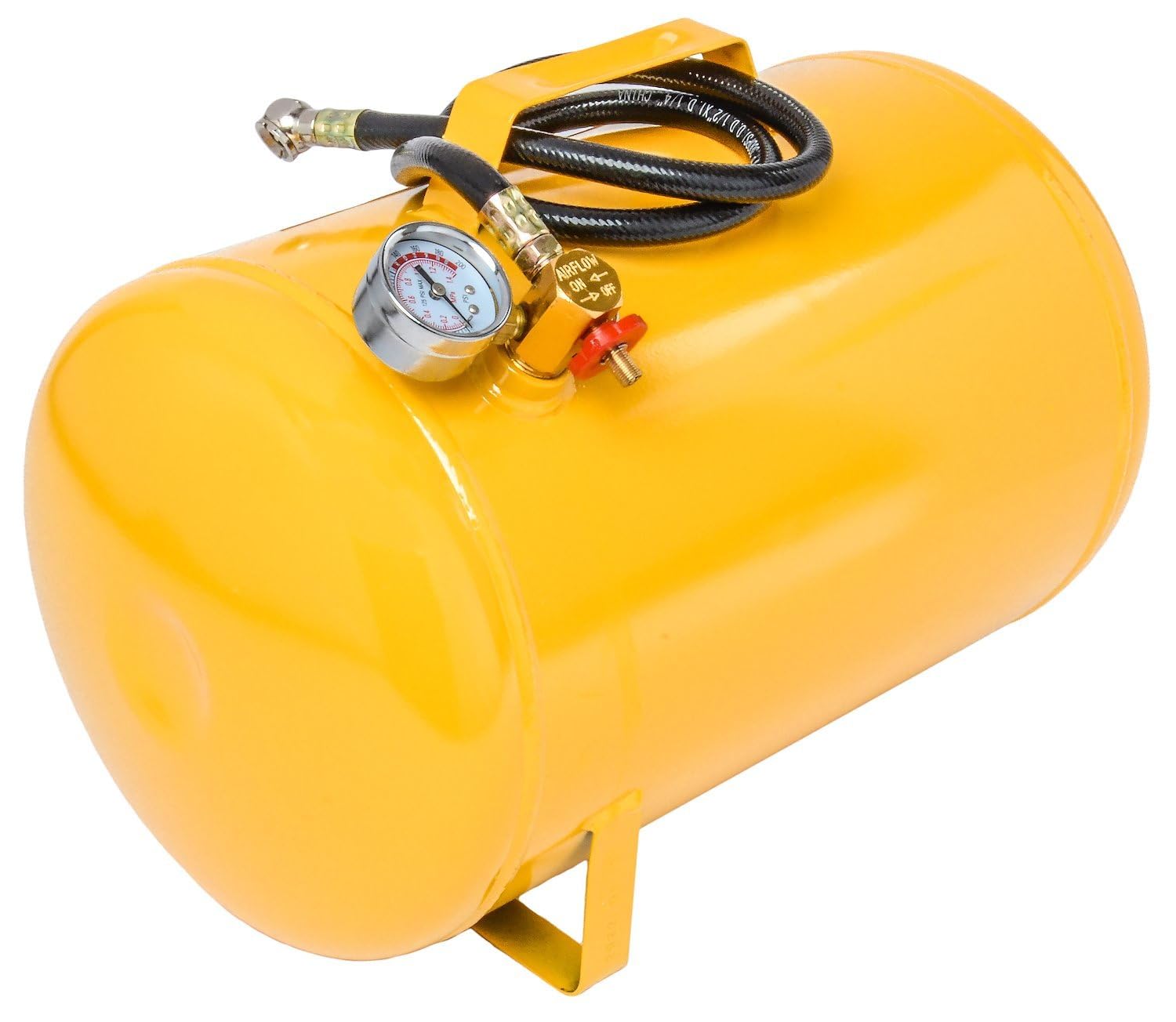
How To Choose The Best Yellow Air Tank Bottle
The mistake most first-time buyers make is shopping by gallon size. Gallons tell you how much stored air you carry; PSI tells you whether that air arrives with enough punch to push a tire sidewall onto the rim. Get the pressure wrong and a big tank still will not seat a bead.
Start with the pressure your heaviest tire demands
Work backwards from the vehicle you actually service. A tank rated to 145 psi (pounds per square inch — the force the air pushes with) gives you headroom for truck and tractor work. A 110 psi unit suits passenger cars and lighter ATV tires where less force is needed to pop the bead into place.
Think of psi as the strength of the shove and gallons as how many shoves you get. A blaster dumps its air in one fast burst to seat the bead, so pressure matters most there. A plain portable tank feeds a tire gradually through a hose, so capacity matters more.
Decide between a bead seater and a portable air tank
A bead seater fires a short, violent blast through a wide-mouth tube placed at the rim gap. It is the tool for a tire that has slipped off the wheel. A portable tank carries reserve air and connects to a standard tire chuck for topping off low tires around the garage, house, or farm.
If you do your own tire mounting, the blaster is the one you reach for. If you mostly top off tires and run small air tools, the plain tank with a hose is the more useful shape.
Check the build material against how you store it
Carbon steel and alloy steel tanks are solid and hold pressure well, but they want a dry spot so the finish stays intact. Stainless steel and aluminum resist corrosion better for damp garages or boat storage. All of these come in yellow, which is the point — a bright tank is easy to spot on a cluttered shelf and hard to lose behind the mower.
Look hard at the valve and gauge setup
A safety bypass valve releases air automatically once pressure climbs past the tank’s limit. A manual override lets you control that release by hand. An easy-to-read gauge lets you check the tank before you haul it out, so you are not discovering a slow leak mid-job. Wear ear and eye protection any time you dump a blaster — the discharge is loud and sudden.
Side-by-Side Comparison
| Model | Best For | Max Pressure | Capacity | Material | Amazon |
|---|---|---|---|---|---|
| GIANTEX 5 Gallon Air Tire Bead Seater★ Best Overall | Truck and tractor beads | 145 psi | 5 gallons | #235 steel | Amazon |
| JEGS 5 Gallon Air TankGarage Workhorse | Garage and farm top-offs | 125 psi | 5 gallons | Alloy steel | Amazon |
| TBAPFS 5 Gallon Bead Seater 110 PSI | Passenger car and ATV beads | 110 psi | 5 gallons | Stainless steel | Amazon |
| Performance Tool W10011 11-Gallon Tank | Reserve air for small compressors | 125 psi | 11 gallons | Steel | Amazon |
| Catalina Pony Bottle Tank | Dive reserve air | — | 6 cu. ft. | Aluminum alloy | Amazon |
Detailed Reviews
1. GIANTEX 5 Gallon Air Tire Bead Seater Blaster Tool
Our pick — 4.0+★ from 350+ verified ratings; the strongest balance of quality and price.
145 psi of bead-seating pressure — enough to pop a truck sidewall home where 110 psi blasters stall.
If your driveway sees anything bigger than a passenger car, this is the tank to start with. It carries a 145 psi maximum pressure rating — the highest of any blaster here and a step above the 110 psi TBAPFS model, which is the difference between a truck sidewall folding over or popping home. With the tube seated at the rim gap and the valve twisted open, the burst is quick and you shut it off right after.
The body is 2.5 mm carbon steel with a powder finish, so it holds up to shop-floor abuse and resists rust and corrosion as long as you store it dry. That is the whole game with a bead seater.
The honest catch is the discharge itself. The maker’s own instructions tell you to wear ear and eye protection before you inflate, and they are not being cautious for show — the air dump is startlingly loud and throws grit. Budget the extra seconds to put on safety glasses and muffs. Let the pressure do the work and this blaster earns its place in the corner of the garage.
What earns it the top slot
- 145 psi ceiling handles truck and tractor beads that lower-rated tanks struggle with
- Gauge plus a published pressure chart for each vehicle type takes the guesswork out
- 2.5 mm carbon steel with powder finish resists rust in normal garage storage
- Handle makes it genuinely carryable between jobs
Plan around this
- The pressure blast is loud — hearing and eye protection are a must, not a suggestion
- It is a bead seater first; topping off tires slowly is not what it is built for
Reach for this if: you mount your own tires on trucks, tractors, or RVs and want enough pressure headroom to stop fighting the bead.
Look elsewhere if: you only ever top off passenger car tires — a simpler reserve tank does that job with less noise.
2. JEGS 5 Gallon Air Tank
A 5-gallon reserve with its own 3-foot hose and shut-off valve, so you top off four tires without dragging out the compressor.
This one is a reserve tank, not a blaster, and that shape is exactly why it is useful. It holds 5 gallons at a 125 psi maximum and runs a 3-foot heavy-duty hose with its own on/off air adjustment valve and a separate shut-off valve. Fill it once from your compressor, carry it to the far side of the property, and top off tires on the track car, the mower, or the trailer. Alloy steel body, bright yellow finish, and a 13.3-pound dry weight you can lift one-handed.
Against the Performance Tool W10011, this is the lighter, smaller-capacity pick — 5 gallons versus 11 gallons, and 13.3 pounds versus 23.9 pounds. If your jobs are short top-offs and you want something you can carry without a second trip, the smaller tank is the friendlier companion. The safety pressure bypass with manual override gives you a way to release pressure by hand when you want it gone.
Where it gets mixed is the working end. Buyers describe the build as decent quality, but the day-to-day function draws a split verdict — some get exactly the performance they expected, some hit hiccups. Read it as a tank that rewards a careful first fill and a habit of checking the gauge before you head out, not one you can ignore in the corner for a season.
The case for it: a light, self-contained 5-gallon reserve with a real hose and its own valves — the simplest way to carry air to a tire that needs it.
Worth knowing: function is the split point here, so test it on a full charge at home before you depend on it trackside.
Right call for: the home or farm owner who wants a portable top-off tank that lives by the door.
Hold off if: you need a dedicated bead seater — this one feeds a tire through a hose, it does not blast a sidewall.
3. TBAPFS 5 Gallon Air Tire Bead Seater 110 PSI Blaster Tool

A stainless steel 5-gallon blaster rated to 110 psi, sized for car and ATV beads in a damp garage.
If your garage runs humid or damp, the stainless steel tank on this one is the reason to look. It is a 5-gallon blaster with a 110 psi maximum, and the all-steel construction with a powder coating finish is aimed at lasting through wet seasons. The safety valve pops off automatically once pressure passes its operating limit, which is the bit you want when you are filling alone with no one spotting for you.
This is the tank to pick when your work is passenger cars and ATVs, not trucks. It seats all tires up to 24.5 inch, and it has a long-reach lip that holds the threaded barrel at the right angle for air insertion, with a quick-release valve that spreads the burst for a full discharge into the tire. On pressure it is the lower of the two blasters — 110 psi against the GIANTEX’s 145 psi — so if you have truck tires in the mix, the higher-rated tank is the safer call.
The size is real, though: at 18.1 inches long, 15.3 wide, and 13.7 high, it takes up meaningful shelf room. Set it somewhere reachable before you need it. Same warning applies as any blaster — ear and eye protection go on first, because the air dump is sudden.
What stands out
- Stainless steel body shrugs off damp garage conditions
- Safety valve releases air automatically past its limit
- Long-reach lip keeps the barrel angled correctly for the blast
- Seats tires up to 24.5 inch
Trade-off to weigh
- 110 psi is below the 145 psi GIANTEX, so heavy truck beads want the higher-rated tank
- At 18.1 inches long it claims a real chunk of shelf
Suits you if: your tires are car, ATV, or light truck and your storage runs damp — the stainless shell is the selling point.
Skip past if: you regularly seat big truck or tractor beads and need the extra pressure headroom.
4. Performance Tool W10011 Air Tank

11 gallons of stored air versus 5 gallons in the smaller tanks, for topping off a whole fleet before a refill.
Capacity is the headline here. This tank holds 11 gallons against the 5 gallons of the GIANTEX and JEGS tanks — 11 gallons versus 5 gallons, the biggest reserve on this list. It is the pick for adding air capacity to a small compressor so you stop waiting for it to catch up, and the 125 psi maximum with a digital-style PSI and MPs gauge lets you see what is left before you start. A standard tire chuck handles the top-offs, and an on/off air adjustment dial plus a safety bypass valve with manual override gives you control at the tank.
The trade you make for that reserve is weight. At 23.9 pounds against the JEGS tank’s 13.3 pounds, this is a tank you wheel or carry with two hands, not one you tuck under an arm. It also takes up a long footprint — 12 inches by 23.4 inches by 14 inches — so plan a floor spot rather than a shelf. For a stationary garage setup, none of that matters. For grab-and-go, it does.
Owners like it most for the value — it is the cheaper way to add real air storage than buying a bigger compressor. The mixed signals show up in the pressure gauge and long-haul durability, so check the reading against a known-good gauge when it arrives and keep the tank dry. Bright yellow and simple to live with once it has a permanent floor spot.
Where it wins: the 11-gallon reserve dwarfs the small tanks and turns a modest compressor into a useful air station.
What to watch: check the gauge against a known-good one on arrival, because pressure accuracy is the recurring complaint.
Best for: a fixed garage setup where the tank stays put and capacity beats portability.
Think twice if: you plan to carry it up a ladder or across a field — at 23.9 pounds it wants a cart or a helper.
5. Catalina Pony Bottle Tank, Yellow with Pro Valve
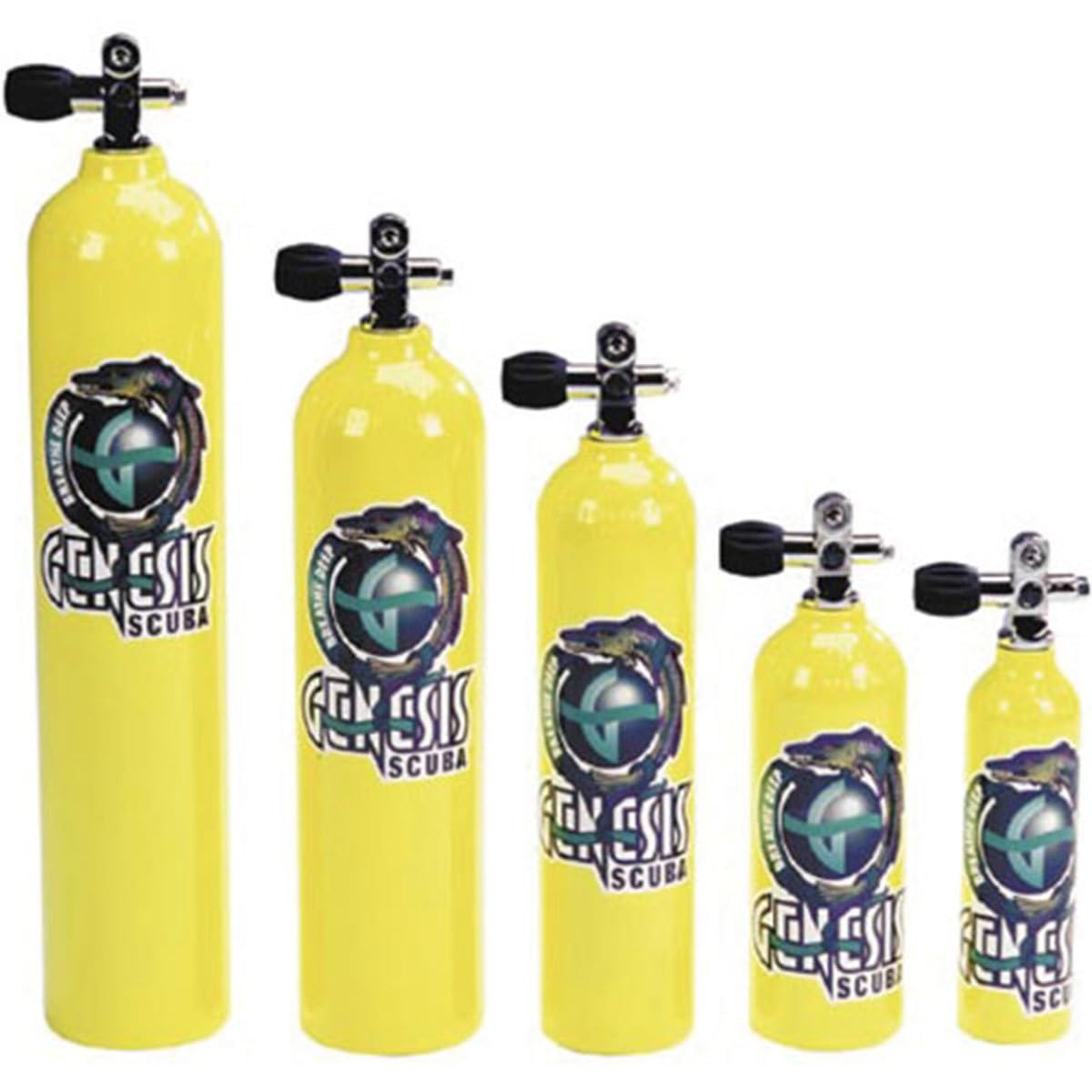
A 6 cu. ft. aluminum scuba pony bottle for underwater reserve air — not a tire tool.
This one is not a garage tool, and it is worth saying plainly: a pony bottle is a reserve scuba cylinder you carry alongside your main tank. The Catalina comes in a 6 cu. ft. size here, with other options up to 40 cu. ft., in aluminum alloy that will not rust the way a steel cylinder can. That rust resistance is the reason aluminum is the go-to for a bottle that lives in a dive bag and gets splashed in salt water.
The Pro Valve is the practical detail. It converts between Yoke and DIN systems, so it fits whatever regulator setup you already own instead of forcing you to buy new. The bottle is Nitrox ready up to 40% oxygen for enriched-air diving, and the aluminum body gives it favorable buoyancy in the water. Catalina backs the cylinder with a manufacturer lifetime limited warranty.
Here is the honest catch: a pony bottle is a safety item, and buying one is only half the job. You still need to arrange fills, keep the valve inspected, and know how you plan to carry it. Anyone shopping for a tire bead seater should look past this one entirely. For a diver who wants a bright yellow aluminum reserve cylinder that fits an existing Yoke or DIN regulator, it is a straightforward buy.
Why divers would pick it
- Aluminum alloy resists rust for wet, salt-heavy storage
- Pro Valve fits both Yoke and DIN regulators
- Nitrox ready up to 40% oxygen
- Backed by a manufacturer lifetime limited warranty
Setting expectations
- It is dive gear — a tire job needs one of the blasters above
- You still own the fills, valve checks, and carry setup
Choose it if: you dive and want an aluminum reserve cylinder that handles salt water and fits the regulator you already run.
Not your pick if: you came for tire inflation — every other tank on this list is the right tool for that job.
Know the Specs
Maximum Pressure (PSI)
PSI stands for pounds per square inch — the force the air pushes with. It is the number that decides whether a bead seater can pop a stubborn sidewall back onto the rim. A 145 psi tank carries more shove than a 110 psi one, which matters the moment a truck tire is involved. On a plain portable tank, PSI affects how fast it can top off a tire through the hose. Always stay within the maker’s stated maximum and use the gauge to confirm.
Tank Capacity (gallons or cubic feet)
Capacity is how much air you are carrying — gallons for garage tanks, cubic feet for dive cylinders. More gallons means more top-offs between refills and a longer feed for small air tools. It also means more weight, which is the trade every large tank makes. A 5-gallon tank is the carryable middle ground; an 11-gallon tank is a fixed-garage unit. Match the capacity to whether the tank travels or stays put.
Safety Valve and Manual Override
A safety bypass valve is a built-in release that dumps air automatically if pressure climbs past the tank’s limit. A manual override lets you open that release by hand when you want the pressure gone on your terms. Together they are the difference between a tank you trust in a closed garage and one you worry about. Look for both on any tank you buy.
Material: Steel vs. Stainless vs. Aluminum
Carbon and alloy steel are solid and hold pressure well but want a dry home to keep surface rust off. Stainless steel and aluminum resist corrosion, which matters for damp garages and saltwater dive gear. Aluminum is also lighter and gives a dive cylinder better buoyancy. Pick the material by where the tank will live, not by what looks toughest on the shelf.
Common Questions
Will a 110 PSI bead seater work on a truck tire?
How do I seat a tire bead with a blaster tank?
What is the difference between a bead seater and a portable air tank?
Do I need a safety bypass valve on an air tank?
How much does an 11-gallon air tank weigh compared to a 5-gallon one?
Can I use a steel air tank in a damp garage?
Is a pony bottle the same as a spare air tank for tires?
What does Nitrox ready up to 40% oxygen mean on a dive tank?
How many tires will a 5-gallon air tank top off?
Does a bead seater come with a gauge?
The Bottom Line
For most people who mount their own tires, the GIANTEX 5 Gallon Air Tire Bead Seater is the tank to buy — 145 psi clears the truck beads that smaller blasters stall on, and the published pressure chart takes the guesswork out of each vehicle. If you mostly top off tires and want something you can carry to the far side of the property, the JEGS 5 Gallon Air Tank is the lighter, simpler companion. And for a fixed garage setup where capacity beats portability, the Performance Tool W10011 brings 11 gallons of reserve air to the corner. The one nudge worth making: the GIANTEX sits highest on pressure here, so it is the smart first buy if you only ever want to buy one blaster.
How we choose
We do not accept paid placement. Every pick is matched to a real buyer and a real use-case; we do not hands-on test units.
Sources
Specifications: manufacturer listings and product documentation. Review insights: verified customer reviews, as of November 2026. Pricing: not shown on this page (it changes often); check the current price via the retailer link.
As an Amazon Associate, Tactical Gear Guy earns from qualifying purchases. This does not affect which products we feature.