Specs are compiled from manufacturer listings and verified buyer reviews and can change over time — please confirm the key details on the product page before buying.
You want a hood that looks like furniture and actually pulls smoke out of the room. The catch is that “wood vent hood” covers three very different things: a bare unfinished shell you stain yourself, a cabinet-mounted front that hides a separate blower, and a finished hood with the fan already inside. Buy the wrong type and you end up with a handsome wood canopy that moves no air.
This guide is built by comparing the manufacturers’ published specifications and the patterns across verified customer reviews, so you get each pick’s real strengths and trade-offs instead of marketing spin.
Below you’ll find the air-moving numbers, the real outer dimensions, and the install requirements that decide whether a hood fits your kitchen at all. Every pick here is wood-bodied, so the choice depends on finish, footprint, and how the blower connects — the three things that matter most when you’re shopping for the best wood vent hood.
Top Picks

How To Choose The Best Wood Vent Hood
A wood hood is a kitchen fixture, not an appliance you swap out in an afternoon. You order it, you wait, you cut a hole in a wall or hang it between two cabinets, and then you live with the look for a decade. Three questions decide which type you need: fan included or not, how much CFM your cooktop demands, and how the hood mounts.
Does it come with a fan, or just the wood
Fan-included versus shell-only is the split that catches most buyers. Some wood hoods are complete units with a blower, baffle filters and lights already inside. Others are decorative shells — you’re buying the wooden canopy and nothing else. The Castlewood front is the clearest example: it’s a shaker-style wood face built to sit between two wall cabinets and accept a separate T-shaped liner and ventilator. Order it expecting a working hood and you’ll be shopping again.
How much air you actually need
CFM means cubic feet per minute — the volume of air the fan pushes out every sixty seconds. The two ZLINE hoods here top out at 400 CFM, and both step down through four speeds. For a typical home cooktop doing everyday frying and boiling, that’s a sensible working range. Very high-output gas ranges and heavy wok cooking push past what a 400 CFM hood can clear, and then you’re looking at a bigger blower and a bigger duct.
Good to know: the hood should overhang the cooktop
A hood that’s narrower than the burners lets smoke escape around the sides before the fan ever sees it. Width and depth are the two numbers that decide capture, and a deep hood that projects far over the front burners catches far more than a shallow one. Compare the depth figures carefully — the numbers here range widely, and a slim front like the Castlewood’s is built to sit flush with cabinetry rather than reach out over the stove.
Finish and lead time
An unfinished hood arrives as raw wood and needs paint or stain before it goes up. That’s a plus if you’re matching an existing cabinet colour, and a job you have to schedule if you aren’t. Finished hoods skip that step but lock you into a colour. Also check how the hood ships — freight-truck delivery on a large wood canopy needs a scheduled drop-off, not a doorstep parcel.
Side-by-Side Comparison
| Model | Best For | Air Flow | Width | Blower Included | Amazon |
|---|---|---|---|---|---|
| Riley & Higgs Unfinished Curved Front★ Best Overall | Staining to match your own cabinetry | — | 31.5 in | No — wood shell | Amazon |
| ZLINE Wooden Wall Mount in Cottage White | A finished rustic look with a working fan | 400 cfm | 30 in | Yes | Amazon |
| Castlewood Shaker Style Front | Blending into a run of upper cabinets | — | 30 in | No — liner and ventilator sold separately | Amazon |
| ZLINE Designer Series KBCC-30 | A tall statement hood over a big cooktop | 400 cfm | 30 in | Yes | Amazon |
Detailed Reviews
1. Riley & Higgs Unfinished Wood Range Hood Cover
Our pick — 4.0+★ from 30+ verified ratings; the strongest balance of quality and price.
A bare wood canopy that arrives ready for your own stain — and reaches further over the stove than anything else here.
The number worth starting with is 20.25 inches of depth. That’s how far this hood projects from the wall, and it’s what makes it the strongest catcher in this group — smoke rising off your front burners has far more hood to run into. Set that against the Castlewood front’s 7.5 inches and the gap is enormous. The wider body helps too: 31.5 inches across, against 30 inches on both ZLINE hoods and the Castlewood.
It’s also the lightest build of the four at 35 pounds, and that matters on install day. Two people can lift this canopy into place without a crew. For comparison, the ZLINE Designer Series weighs 65 pounds — a full 30 pounds heavier, which turns the same job into a three-person lift. The construction is solid plywood with a maple veneer, finished with decorative strapping and crown molding along the curved front.
The two-piece design is the detail that keeps paying off after installation. The front section lifts away for cleaning and gives you access to the fan and ducting behind it, so servicing the blower doesn’t mean dismantling the hood. It’s built in the USA and ships unfinished, and the maker quotes quick-ship timing 3-4 weeks faster than standard hoods. One thing to plan for: this is a wood cover, not a vent hood. You supply the blower and liner, and you’ll be painting or staining the raw surface before it goes up.
What earns it the top slot
- The deepest canopy in the group at 20.25 inches, so it captures smoke across the whole cooktop
- 31.5-inch width covers a wider footprint than the 30-inch options here
- 35 pounds makes a two-person lift realistic — 30 pounds lighter than the ZLINE Designer Series
- Two-piece body opens up for filter cleaning and blower access
- Unfinished face means you colour-match your existing cabinets exactly
The parts you have to plan around
- No fan, no filters, no lights — those are separate purchases
- Raw wood needs staining or painting before installation
- Ships by freight truck and requires you to confirm delivery details promptly
Reach for this if: you’re building a custom kitchen and want the wood hood to match the cabinetry exactly, with the deepest smoke capture on this list.
Look elsewhere if: you want to unbox a hood, wire it up, and be done — you’d be buying a shell with no blower inside.
2. ZLINE 30 in. Wooden Wall Mount Range Hood

Pine on the outside, a working 400 CFM blower on the inside — the one that skips the stain-and-assemble stage.
Where the Riley & Higgs is a shell you finish yourself, this ZLINE arrives as a complete hood. The cottage white hand-crafted pine face sits over a stainless steel inner frame, and behind that frame is a four-speed fan pushing 120, 240, 320 or 400 CFM depending on what’s on the burner. Sear something and you go to the top speed; simmer a sauce and the low setting keeps the room quiet.
The useful part for anyone who cooks often is the filtration. Baffle filters — stainless steel panels with slots that catch grease as air slides past — go straight into the dishwasher, and they lift out without tools. That beats a mesh filter, which you scrub by hand. LED lighting under the canopy also means you can actually see what’s browning in the pan.
What sells the design is how much smaller it sits than the other hoods here. At 13.25 inches tall and 18 inches deep, it tucks under cabinetry rather than dominating the wall — a good fit for a low ceiling or a tight galley. The catch is that shallow 18-inch depth pulls in less smoke from the front burners than the Riley & Higgs’ 20.25 inches. Wiring is a dedicated 120V, 60Hz, 15-amp circuit, and it connects to standard 6-inch round ducting with the included transition piece.
Where it wins outright: no other pick here hands you wood, motor, baffle filters and LED lighting in one box. A 3-year parts warranty plus a lifetime motor warranty covers the fan and controls.
The honest trade-off: cottage white is the finish you get. If your cabinets are natural oak or deep walnut, this hood will fight them rather than blend.
Best for: a rustic or farmhouse kitchen where a whitewashed hood is the look you’re after and you’d rather not finish raw wood yourself.
Think twice if: your cooktop runs hot and often — 18 inches of depth and a 400 CFM ceiling leave less margin than the deep Riley & Higgs canopy.
3. Castlewood Shaker Style Range Hood Front

A shaker face built to disappear into your cabinet run, not to reach out over the burners.
Read the name carefully, because it’s doing a lot of work: this is a hood front, and the listing title also says “No Ventilator/Liner.” What arrives is a maple shaker-style wood face — hardwood plywood and solid lumber, sanded smooth so it takes paint or stain cleanly. You add the T-shaped liner (the metal inner shell that holds the fan) and a compatible ventilator (the fan unit) yourself, with the maker naming the Ascension 350SL, 350SS and 500SS among the options it accepts.
That 7.25-inch depth explains the whole product. It’s a slim front panel meant to be mounted between two wall cabinets so it sits flush with the doors either side of it. A hood that only projects 7.25 inches won’t grab much smoke on its own — which is exactly why the liner and blower underneath do the actual work. The payoff is a kitchen where the ventilation looks like cabinetry rather than an appliance bolted to the wall.
The footprint is honest about its job: 30 inches wide and 24 inches tall, which is the narrowest and shortest body in this group. Set it against the Riley & Higgs at 20.25 inches deep and 36 inches tall and you can see the two hoods are solving opposite problems — one reaches out and grabs air, the other tucks into a cabinet line. If you don’t already have cabinets flanking the cooktop, this front has nowhere to live.
The cabinetry-matching argument: maple with a shaker profile, sanded and ready for your finish, is how a wood hood stops reading as a hood.
What you’re signing up for: the blower, liner, filters and lighting are all on your shopping list, and this panel only works mounted between two wall cabinets.
Pick it when: you already have upper cabinets either side of the range and you want the vent to look like one more cabinet door.
Pass if: you’re working with a bare wall or an island — there’s no cabinet structure to mount a 7.25-inch front against.
4. ZLINE KBCC-30 Wooden Wall Mount Range Hood
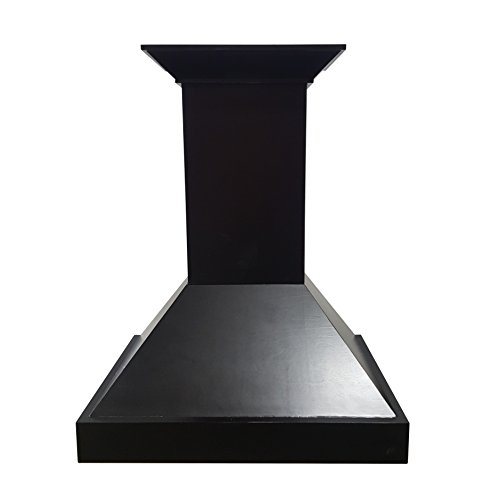
Thirty-six inches of wood canopy above the cooktop — the tallest, heaviest hood in the lineup.
Height is the first thing anyone notices here: 36 inches of wall-mounted wood canopy, which is 22.75 inches taller than the Cottage White ZLINE and 12 inches taller than the Castlewood front. That extra body gives the hood real presence over a cooktop instead of hugging the cabinets. Plan for a second pair of hands, or two.
Mechanically it’s the twin of the Cottage White ZLINE: push button controls, four fan speeds at 120, 240, 320 and 400 CFM, dishwasher-safe stainless steel baffle filters and LED lighting under the canopy. Ducting connects at the top and fits standard circular ductwork, with the same 3-year parts and lifetime motor warranty behind it. If you like the ZLINE blower setup, the choice between this and the Cottage White is essentially height and colour.
The recurring gripe on wall-mount wood hoods this size is the install, not the cooking. A tall, heavy canopy has to be levelled and anchored properly, and that’s a job worth handing to someone with the right anchors rather than improvising. Double-check your ceiling clearance before ordering — 36 inches of hood plus the duct run above it eats vertical space fast.
The case for the tall body
- 36 inches of canopy gives a big cooktop a proper centrepiece
- 400 CFM across four speeds handles everyday frying and boiling
- Baffle filters go in the dishwasher, no hand scrubbing
- Lifetime motor warranty and 3-year parts cover
Where it asks more of you
- 65 pounds is a two-or-three-person lift at ceiling height
- The tall canopy needs ceiling clearance above the duct run
- Sold in a single colourway, so it has to suit your cabinet tone
Go with it if: you’ve got the ceiling height and you want the hood to be the visual anchor of the kitchen wall.
Give it a miss if: your cooktop sits under low cabinetry — 36 inches of canopy simply won’t clear.
Know the Specs
CFM and fan speeds
CFM stands for cubic feet per minute — how much air the fan moves out of the room each minute. Both finished ZLINE hoods here step through 120, 240, 320 and 400 CFM across four speeds. Low speeds keep the kitchen quiet while you simmer; the top setting is for searing and smoke. A hood in this range suits a normal home cooktop, though very high-output burners often call for a larger blower and duct.
Depth and capture area
Depth is how far the canopy projects from the wall, and it decides how much rising smoke the fan actually catches before it curls past the edges. A deep hood like the Riley & Higgs at 20.25 inches reaches out over the front burners. A slim cabinet front like the Castlewood at 7.25 inches relies on the liner and ventilator beneath it, because the wood face itself barely overhangs the stove.
Baffle vs mesh filters
Baffle filters are stainless panels with slots that force air to change direction, so grease sticks to the metal instead of sailing into the duct. They typically lift out and go in the dishwasher. Mesh filters are woven screens that catch grease on the surface, and they usually need hand washing. Both ZLINE hoods use baffle filters; the Castlewood front lists a mesh filter type for the liner setup.
Mounting style
Wall-mount hoods anchor directly to the wall above the cooktop and vent straight up through standard circular ductwork. Cabinet-front hoods mount between two upper cabinets and sit flush with the doors. Unfinished covers are shells you fit over your own blower and liner. Check which one your kitchen is built for before you order, because none of them swap into another’s spot.
Common Questions
Does a wood vent hood come with the fan and motor?
Is 400 CFM enough for a gas cooktop?
Can I paint or stain an unfinished wood hood?
How deep should a wood hood be over the stove?
What duct size do these hoods use?
What electrical circuit does a wood range hood need?
Are the grease filters dishwasher safe?
Can a Castlewood hood front be mounted on a bare wall?
How is a large wood hood delivered?
What warranty comes with a wood range hood?
The Bottom Line
For most kitchens, the wood vent hood winner is the Riley & Higgs Unfinished Curved Front because 20.25 inches of depth and 31.5 inches of width give it the most smoke-catching reach here, and the unfinished maple-veneer face lets you match your cabinetry exactly. If you’d rather not finish raw wood or source a blower, the ZLINE Cottage White arrives complete with a 400 CFM fan (cubic feet per minute — how much air it moves), dishwasher-safe baffle filters (metal grease traps you can put in the dishwasher) and LED lighting in one box. And if your priority is a hood that vanishes into a run of upper cabinets, the Castlewood Shaker front is the one to reach for — just budget for the liner and ventilator separately. The Riley & Higgs leads this group at 4.0+ stars across 30+ owners, and if you have the ceiling height for a taller canopy, the ZLINE Designer Series pairs the same 400 CFM blower with a 36-inch-tall wood body.
How we choose
We do not accept paid placement. Every pick is matched to a real buyer and a real use-case; we do not hands-on test units.
Sources
Specifications: manufacturer listings and product documentation. Review insights: verified customer reviews, as of November 2026. Pricing: not shown on this page (it changes often); check the current price via the retailer link.
As an Amazon Associate, Tactical Gear Guy earns from qualifying purchases. This does not affect which products we feature.