Specs are compiled from manufacturer listings and verified buyer reviews and can change over time — please confirm the key details on the product page before buying.
A wrist mounted GPS navigator straps the map to your arm so you can read a bearing, backtrack a trail, or hit a waypoint without digging a phone out of a pack. The single thing that separates a good one from a frustrating one is how long it runs in full GPS mode — a navigation watch that dies mid-route is worse than no watch at all. Below you will find the picks sorted by what each one does best, with honest notes on the trade-offs.
This guide is built by comparing the manufacturers’ published specifications and the patterns across verified customer reviews, so you get each pick’s real strengths and trade-offs instead of marketing spin.
Navigation watches split into two camps: full smartwatches with color screens and app stores, and stripped-down navigators built for buttons and batteries. Knowing which camp you belong to saves you from buying features you will never touch. That single distinction shapes every recommendation in this roundup of the wrist mounted gps navigator options worth your attention.
Top Picks


How To Choose The Best Wrist Mounted GPS Navigator
The first question to answer is how long you actually need the GPS running. A day hike and a multi-day traverse need very different battery numbers, and the marketing “days of use” figure hides the real one — look for the GPS-mode hours specifically.
Read the GPS-mode hours, not the smartwatch days
GPS-mode hours tell you how long the watch can track and navigate with the satellite receiver active. That number is always far lower than the everyday smartwatch figure, because constant positioning drains the cell. If your routes run long, this is the spec that decides whether you make it back with a working screen.
Decide between a color touchscreen and a button navigator
Color AMOLED screens are easier to glance at and show full maps, but they cost battery. A monochrome LCD with physical buttons is readable in harsh sun and works with gloves on. Neither is better outright — match it to whether you navigate by map reading or by tapping through menus.
Understand multi-band GPS and satellite support
Multi-band reception means the watch listens on more than one GPS frequency, which improves position fixes in canyons, dense trees, and between tall buildings. Multi-GNSS support means it can use several satellite constellations rather than one. Together they keep your track from drifting off the trail you are actually walking.
Check the rugged ratings for your terrain
10 ATM water rating means the watch survives being submerged, and MIL-STD-810 is a military durability standard for thermal and shock resistance. If you are scrambling over rock or crossing streams, those two ratings matter more than any app feature.
Side-by-Side Comparison
| Model | Best For | GPS Battery | Display | Case Size | Amazon |
|---|---|---|---|---|---|
| Garmin Enduro 2★ Best Overall | Long expeditions | Up to 150 hours | 1.4″ Power Sapphire | — | Amazon |
| Garmin Instinct EBest Everyday Value | Everyday trail value | — | — | 45 mm | Amazon |
| Garmin Foretrex 801Field Navigator | Field navigation | Up to 100 hours | Monochromatic LCD | — | Amazon |
| Garmin Instinct 3 Solar | Solar charging | — | 1.1″ solar lens | 50 mm | Amazon |
| COROS Nomad | All-day wear | Up to 50 hours | 1.3″ MIP | — | Amazon |
| SUUNTO Race | Bright color maps | Up to 40 hours | 49 mm AMOLED | 49 mm | Amazon |
| Garmin epix Pro (Gen 2) Sapphire | Premium all-rounder | — | 1.4″ AMOLED | 51 mm | Amazon |
| SUUNTO Vertical | Extreme battery | Up to 500 hours | 49 mm color | 49 mm | Amazon |
| Garmin Foretrex 901 | Ballistic field work | Up to 500 hours | Monochromatic | — | Amazon |
Detailed Reviews
1. Garmin Enduro™ 2 – Ultraperformance Watch
Our pick — 4.5+★ from 300+ verified ratings; the strongest balance of quality and price.
A titanium navigator that runs full GPS for up to 150 hours between charges.
If your trips run longer than your phone battery, this is the watch to beat. Garmin rates the Enduro 2 at up to 150 hours in GPS mode with solar charging (assuming continuous use in 50,000 lux conditions), and up to 46 days in smartwatch mode under the same sunlight assumption. Against the COROS Nomad’s 50 GPS hours, that 150-hour rating means a multi-day route finishes with power to spare instead of a dead screen at dusk.
The build is titanium with a light UltraFit nylon band, so it holds a secure fit without dragging on your wrist over a long day. Navigation comes preloaded with TopoActive and ski maps, and SatIQ technology (which automatically picks the GPS mode that balances accuracy against battery life) keeps accuracy steady without you babysitting a settings menu. The NextFork map guide shows the distance to the next trail intersection, and grade-adjusted pace helps you read how the terrain is really affecting your effort.
Reviewers praise its sheer capability — it does an enormous amount and does it reliably. A superbright LED flashlight (rated twice as bright as the fēnix 7X) adds variable intensities and a strobe that can match your running cadence, plus a red safety mode for night work. The honest catch is the display: it draws mixed reactions, and some find it harder to read than they expected, so try to see one in person. Buyers call it the best Garmin watch yet, with battery life that lasts up to 4 weeks between charges. It holds 4.5+ stars across 300+ ratings.
Where it delivers
- Up to 150 hours in GPS mode with solar charging — versus the COROS Nomad’s 50 hours.
- Preloaded TopoActive and ski maps mean navigation works without a phone tether.
- Titanium case and nylon band keep it light on the wrist for long days.
- SatIQ mode adjusts GPS automatically so you never trade accuracy for runtime by hand.
What to weigh first
- The display splits opinion — some find it hard to read at a glance.
- Button controls plus a touchscreen ask you to learn two input styles.
Go for it if: your routes stretch across multiple days and you want a full map on your wrist without a charger in the pack.
Think twice if: screen clarity for quick glances is your top priority — the display is the one part that divides opinion.
2. Garmin Instinct® E, Rugged GPS Smartwatch, 45mm, Charcoal
The midsize workhorse that survives drops, water, and a full week of wear.
Sixteen days of battery life is the headline here, and it is a big part of why this watch suits someone who wants navigation without charging rituals. Compared with the Enduro 2’s 46 days of smartwatch mode, the Enduro 2 still leads on endurance. But this one costs a fraction of the premium tier and keeps the core navigation tools intact.
You get a 3-axis compass, barometric altimeter, and multi-GNSS support — meaning it can lock onto several satellite systems at once, so tracking stays reliable where one system alone would struggle. The 45 mm fiber-reinforced polymer case is rated 10 ATM for water and engineered to MIL-STD-810 for thermal and shock resistance, which is the spec that matters when the watch meets rock. The silicone band is 22 mm wide, narrower than the Instinct 3’s 26 millimeters.
Reviewers consistently praise the overall watch quality — it feels solid for the money. Health monitoring covers wrist-based heart rate, advanced sleep monitoring, and Pulse Ox. The trade-off is usability: the interface draws mixed feedback, and a few buyers find the menus less intuitive than they hoped. Best fit is the hiker or runner who wants dependable navigation and a rugged build without paying premium-tier money.
The value read: 16 days of battery, 10 ATM water rating, and MIL-STD-810 durability land together in a midsize 45 mm case that does not weigh down a smaller wrist.
The honest limit: menu navigation is the weak spot — it works, but it is not the smoothest interface in this group.
Worth grabbing if: you want a rugged, water-rated navigator that sips power and asks little of your wallet.
Pass over if: you expect the most polished, app-rich interface — the menu system is where it trails.
3. Garmin Foretrex 801, Wrist-Mounted GPS Navigation
A button-only navigator built for gloved hands and grid coordinates.
This is what a navigation tool looks like when it skips the smartwatch race. The monochrome LCD stays readable across all kinds of lighting, and you can read it through night vision goggles — a detail that tells you exactly who this was made for. Battery life runs up to 100 hours, so a long field exercise does not end with a blank screen.
Sensor load is serious: a 3-axis accelerometer, 3-axis compass, and barometric altimeter, plus upgraded multi-band signal reception for tighter position accuracy. Stealth mode stops storing and sharing GPS data and disables wireless connectivity, and the kill switch erases device memory if security is a concern. It pairs with a compatible inReach satellite communicator (active subscription required) to show messages right on the screen, and jumpmaster mode calculates high-altitude release points per military guidelines.
Owners describe it as accurate and worth the money, with great battery life and a crisp screen — one specifically notes it makes pulling grids or navigating to operations easier. The catch is that it is not a lifestyle watch: no app store, no health tracking, no color maps. The Garmin Explore app handles planning and review, so your routes are prepared ahead of time rather than on the fly.
Built for use, not display: 100 hours of battery, a monochrome screen readable through night vision, and a kill switch that wipes memory make this a purpose-built field tool.
The trade you accept: no color mapping and no everyday smartwatch features — it does one job and does it thoroughly.
Made for: field work, land navigation, and anyone wearing gloves who wants physical buttons over a touchscreen.
Not for: buyers who want a color map on their wrist or fitness tracking in the same device.
4. Garmin Instinct 3 Solar

A solar-charged trail watch in a limited-run color that tops up from daylight.
Solar charging changes the equation. The 1.1-inch display sits under a solar charging lens, and Garmin rates it at unlimited battery life in smartwatch mode with solar charging (assuming all-day wear with 3 hours per day outside in 50,000 lux conditions). That is the spec to lean on if you spend your days outdoors rather than under a roof. Note that the 1.1-inch screen is smaller than the Enduro 2’s 1.4-inch lens.
The case is fiber-reinforced polymer at 50 mm with a metal-reinforced bezel, matching the Foretrex-adjacent ruggedness expected of this family. Multi-band GPS with SatIQ technology handles positioning while optimizing battery, and the 10 ATM water rating plus MIL-STD-810 design cover thermal and shock resistance. A built-in LED flashlight with variable intensities and strobe modes rounds out the outdoors kit.
The 26 mm band is wider than the Instinct E’s 22 millimeters, and the 50 mm case is larger than that watch’s 45 mm — worth knowing if you have a smaller wrist. Garmin Pay contactless payments let you leave cards at home, and safety features include incident detection and Assistance that can message contacts with your live location when paired with a phone. This is a newer listing with fewer reviews behind it, so it suits the buyer who already knows the Instinct line.
Choose this when: you are outdoors daily and want the solar lens doing part of the charging work for you.
Look elsewhere when: you have a smaller wrist — the 50 mm case and 26 mm band are the largest proportions here.
5. COROS Nomad GPS Outdoor Smartwatch
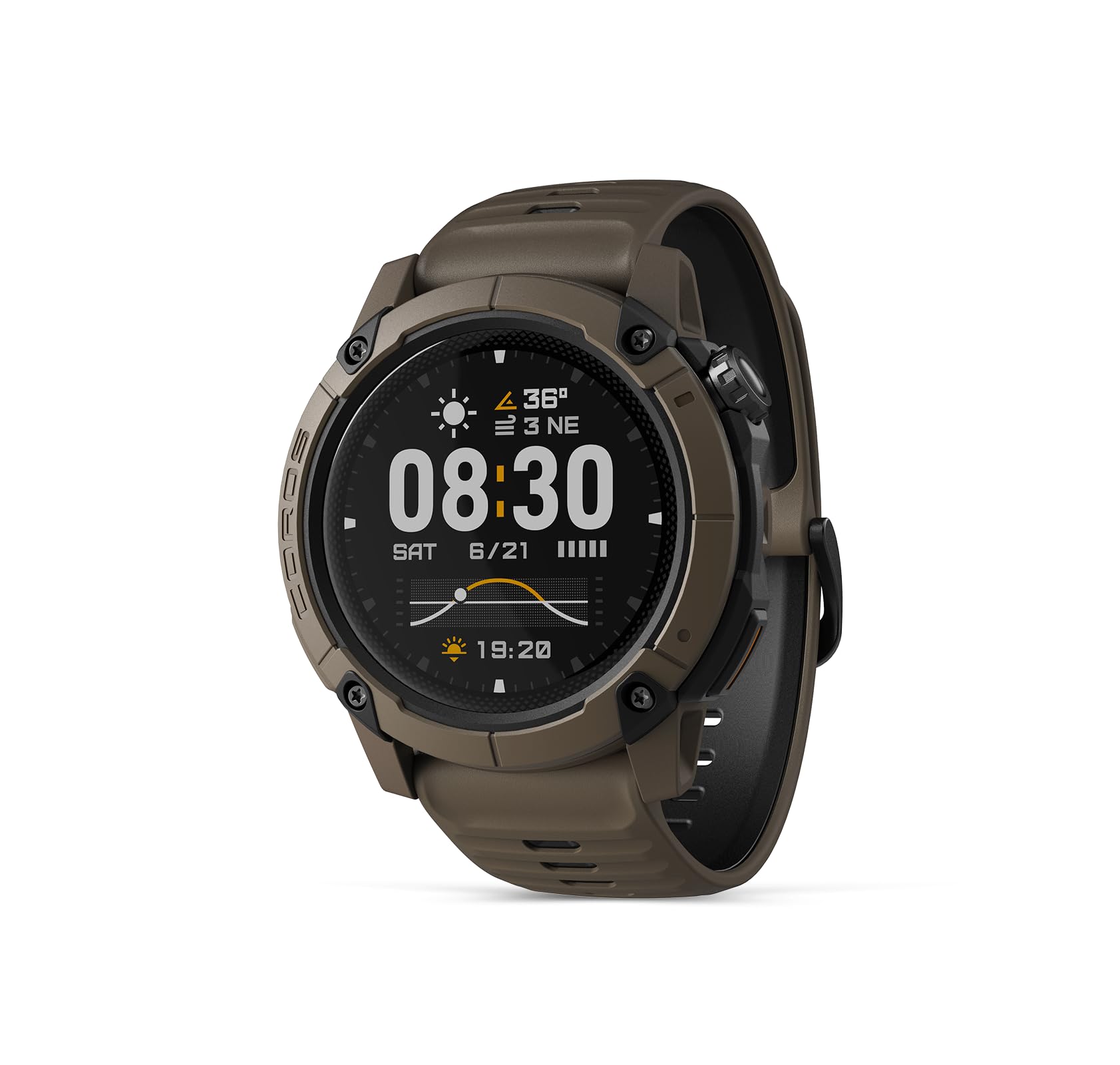
The lightweight trail watch with a journal feature that logs the trip itself.
Twenty-two days of daily use and 50 hours of GPS battery life set the Nomad up for multi-day wear without a charger. Against the Enduro 2’s 150 GPS hours, that is the gap you feel on the longest routes — COROS trails there by a wide margin. For most weekend and overnight trips, 50 hours is enough, and the lighter dual-layer polymer build with an aluminum alloy bezel keeps the wrist free.
The 1.3-inch Memory in Pixel screen (a low-power display type that holds high contrast in direct sun) stays readable in bright light and keeps color visible in low light. Free preloaded global maps with street names, Back-to-Start navigation, and safety alerts cover the navigation basics, while real-time data on sunrise, tides, and moon phase suits anglers marking spots. The built-in Adventure Journal records voice notes, tags locations, adds photos, and transcribes memos inside activities.
Reviewers praise the overall watch quality and the outdoor fit — trail runners take to it quickly. The recurring gripe is connectivity: Bluetooth pairing draws mixed feedback, with several reporting issues. That is worth knowing if syncing to your phone matters as much as the navigation itself.
Standout feature: the Adventure Journal turns your route into a record — voice memos, photos, and tagged spots saved right inside the activity.
Watch the pairing: Bluetooth connectivity is where the feedback turns mixed, so budget patience for the first sync.
Ideal for: trail runners and anglers who want a light, long-running navigator with a built-in trip journal.
Not ideal for: the longest unsupported routes, where 50 GPS hours falls well short of the premium tier.
6. SUUNTO Race: GPS Sports Watch, AMOLED Color Screen

A big, bright AMOLED screen with free offline maps and a digital crown.
The 49 mm color AMOLED display is the reason to look here. Numbers stay visible at a glance while running, and the sapphire lens resists scratching on rough ground. A digital crown lets you scroll menus quickly, which is a small thing that makes a big difference when you are moving. Free offline color maps show paths, contour lines, water, and landmarks, with breadcrumb trails, POIs, and bearings for navigation.
Battery runs 40 hours in the most accurate tracking mode and stretches to 120 hours in tour mode, with up to 10 days in daily mode with 24/7 heart-rate tracking. Dual-band GNSS (two GPS frequency bands working together) holds accuracy among cliffs, valleys, and tall buildings — the conditions that break a single-band fix. A barometer and 16 GB of storage round out the hardware.
Reviewers praise functionality and battery life first, with the appearance and display close behind. The honest note is accuracy: heart-rate readings draw mixed feedback, with some reporting issues. If you navigate and train on the same wrist, that is the one capability to weigh carefully before buying.
The draw: a 49 mm AMOLED screen and dual-band GNSS make this the clearest map reader in the group.
The caveat: heart-rate accuracy is the weak point — trust the GPS for navigation, not the pulse numbers alone.
7. Garmin epix Pro (Gen 2) Sapphire Edition, 51mm

A titanium-and-sapphire flagship that never asks for a nightly charge.
The 51 mm case is built for larger wrists, with an always-on 1.4-inch AMOLED display under a scratch-resistant sapphire lens and a titanium bezel. That combination is the premium formula: a big bright screen that does not get chewed up by rock. Preloaded maps cover thousands of golf courses and ski resorts worldwide, TopoActive maps keep trail explorations on track, and Up Ahead navigation prompts flag turns before you reach them.
Navigation accuracy comes from multi-band reception and multi-GNSS with SatIQ technology, which improves coverage in challenging terrain while optimizing battery. The built-in LED flashlight offers variable intensities and strobe modes for night training. Training features run deep — hill score measures running strength on ascents, endurance score combines data across sports, and wrist-based running power helps pace race day.
Owners say it exceeds expectations, running reliably with battery life that removes the nightly charging habit. This is a renewed unit, and its like-new condition earns praise from buyers who note the savings over new. If you want the brightest screen and the most training data in one package, this is the premium answer — just confirm the renewed condition fits your comfort level.
Why the premium price
- 1.4-inch always-on AMOLED with a sapphire lens and titanium bezel built to last.
- Preloaded maps for thousands of golf courses and ski resorts, plus TopoActive trails.
- Hill score, endurance score, and wrist-based running power give serious training depth.
- Built-in LED flashlight with variable intensities and strobe modes.
Points to check
- The 51 mm case is sized for larger wrists and will look big on smaller ones.
- It is a renewed unit, so condition is part of the purchase.
Right for you if: you want the brightest screen, the deepest training metrics, and a sapphire-and-titanium build in one watch.
Reconsider if: your wrist runs small — at 51 mm this is the largest case in the lineup.
8. SUUNTO Vertical GPS Sports Watch, Solar Charging, Sand Ti

Five hundred hours in tour mode for the trips that outlast everything else.
Up to 500 hours of continuous exercise tracking in tour mode is the number that defines this watch. In the most accurate tracking mode it runs up to 60 hours, and solar charging on sunny days boosts that further by 30 percent on this Titanium model. Compare that with the SUUNTO Race’s 40 hours in its most accurate mode — the Vertical stretches far beyond it on long outings. Free global offline maps show paths, contour lines, water, and landmarks, with breadcrumb trails, POIs, and bearings.
Dual-band GPS holds accuracy among cliffs, valleys, and skyscrapers. The 49 mm color display sits under a sapphire lens, a barometer tracks pressure changes, and the watch is made in Finland in Suunto’s own factory on renewable energy and fully carbon compensated. It covers 95+ sports, so the same device that navigates your route also logs the training.
Reviewers steadily praise the build quality and GPS accuracy, and report durability holds up over long use. The harder truth is value: this watch is considered overpriced by some, and battery life draws mixed feedback — while many call it superb, others see the charge lasting about 10 days. The responsiveness also earns mixed notes. If raw expedition run time is what you need, the trade is clear, but go in knowing you are paying a premium for it.
The expedition case: 500 hours in tour mode, 60 hours in the most accurate mode, and a 30 percent solar boost on sunny days make this the longest-running navigator here.
The honest catch: the price relative to what you get draws mixed feedback, so weigh the extreme battery against the premium tier you are buying into.
Built for: expeditions and ultra-distance efforts where run time matters more than anything else.
Step back if: you only day-hike — the extreme battery is here, but so is a price many find steep for the feature set.
9. Garmin Foretrex 901 Ballistics Edition

A purpose-built field navigator that also does ballistic calculations on your wrist.
Up to 500 hours of battery life makes this the longest-running of the Foretrex pair — the 801 tops out at 100 hours by comparison. The monochrome screen stays readable in a range of lighting and works through night vision goggles. Sensors include a 3-axis accelerometer, 3-axis compass, and barometric altimeter, with upgraded multi-band signal reception for tighter positioning.
The defining addition is Applied Ballistics software, which calculates the shot. You manage ballistic profiles wirelessly through the AB Synapse – Garmin app on a compatible phone. Stealth mode stops storing and sharing GPS data and disables wireless, and the kill switch wipes device memory when security is the concern. It connects to the Garmin Explore app for planning and review, and pairs with a compatible inReach satellite communicator (active subscription required) to show messages on screen.
If you want color maps and everyday smartwatch features, this is not that device. But for grid navigation plus ballistic profiles in one wrist unit, it stands on its own.
The specialist choice: 500 hours of battery, Applied Ballistics calculations, and night-vision readability in one field unit.
Not your tool if: you want a color map and fitness tracking — this is a focused navigator built around shooting data.
Know the Specs
GPS-Mode Battery Hours
This is how long the watch runs with the satellite receiver active and tracking your route. It is always far lower than the everyday smartwatch number because constant positioning drains the cell. When you compare models, put the GPS-mode hours side by side — a day hike and a multi-day trip sit at very different ends of that scale.
Multi-Band and Multi-GNSS
Multi-band reception means the watch listens on more than one GPS frequency, improving position fixes in canyons, trees, and between buildings. Multi-GNSS means it can draw on several satellite systems rather than one. Together they keep your track from drifting off the trail, which matters most in exactly the places navigation is hardest.
Water and Shock Ratings
A 10 ATM rating means the watch survives being submerged, and MIL-STD-810 is a military durability standard for thermal and shock resistance. These ratings tell you whether the watch can handle stream crossings, rock scrambles, and temperature swings. If your terrain is rough, they matter more than any app feature.
Solar Charging Lenses
A solar charging lens tops up the battery from daylight, which extends runtime on watches rated for it. The catch is that the charging assumes time outside in bright conditions, so it helps most when you are actually outdoors. It is a real bonus for daily trail use, not a replacement for plugging in.
Common Questions
How long does a wrist mounted GPS navigator last in GPS mode?
Will a wrist navigator work without a phone nearby?
Can I wear a wrist navigator for swimming or water crossings?
What does multi-band GPS actually do for navigation accuracy?
Is a button navigator better than a touchscreen for field use?
Do these watches charge from the sun?
Can a wrist navigator replace a handheld GPS?
What is the difference between the Foretrex 801 and the Foretrex 901?
Will a large-case navigator fit a smaller wrist?
Do these navigators track heart rate and sleep?
The Bottom Line
Most buyers should start with the Garmin Enduro 2, a wrist mounted gps navigator that keeps guiding you for up to 150 hours of GPS battery life — enough for multi-day routes without a charge. Its solar sapphire lens (a scratch-resistant glass face that also soaks up sunlight to top up the battery) and preloaded TopoActive maps (built-in trail and terrain maps) mean you can follow a route without loading anything first. The titanium build (a strong, light metal case) holds up on long trips. Want dependable navigation for less? The Garmin Instinct E runs 16 days per charge and carries a 10 ATM rating (waterproof to 100 meters of pressure, so rain and swimming are fine). For field work, the Garmin Foretrex 801 straps to your wrist with a monochrome screen (a simple black-and-white display that saves battery) and physical buttons you can press with gloves on.
How we choose
We do not accept paid placement. Every pick is matched to a real buyer and a real use-case; we do not hands-on test units.
Sources
Specifications: manufacturer listings and product documentation. Review insights: verified customer reviews, as of November 2026. Pricing: not shown on this page (it changes often); check the current price via the retailer link.
As an Amazon Associate, Tactical Gear Guy earns from qualifying purchases. This does not affect which products we feature.