Specs are compiled from manufacturer listings and verified buyer reviews and can change over time — please confirm the key details on the product page before buying.
For most home gyms, your first rope should be 1.5 inches in diameter and 30 to 40 feet long. The one feature that decides whether it lasts or fuzzes apart on concrete is a nylon or Oxford sleeve (a fabric cover that protects the rope). Skip the sleeve and you will pick fibers off your garage floor within a month. Go too long or too thick and your first waves feel like a wrestling match, not a cardio session.
This guide is built by comparing the manufacturers’ published specifications and the patterns across verified customer reviews, so you get each pick’s real strengths and trade-offs instead of marketing spin.
Three label checks separate a good rope from landfill fodder: strand count (how many fibers are twisted together), sleeve material, and handle construction. This breakdown of the work out rope market covers each pick so you can order once and train for years.
Top Picks


How To Choose The Best Work Out Rope
A workout rope is a heavy training rope you whip, slam, and pull to raise your heart rate and build grip and shoulder endurance. The wrong one frays on your driveway, slips in your hands, or is so long you cannot swing it in your garage. Here is what to check before you order.
Diameter and length decide who the rope is for
Diameter is how thick the rope is, and it controls how hard your hands work. A 1.5-inch rope is the common starting point for most home trainees and stays manageable for beginners. A 2-inch rope is harder to grip and better for people already conditioned to heavy pulling. Length is about space and difficulty: 30 feet fits a small garage or basement, while 40 and 50-foot ropes need more room and give you more rope weight to fight. Makers pitch the 40 and 50-foot versions at strength and fitness professionals for that extra rope weight.
The sleeve is the difference between years and weeks
The sleeve is a fabric or vinyl cover that wraps the rope where it meets the floor. Concrete, pavement, and gym mats grind away bare rope fibers fast. A protective sleeve — nylon, Oxford, or a double-layer cover — takes that abrasion instead of the rope. If you plan to train outdoors or on a hard floor, treat the sleeve as required, not optional.
Handles, anchor, and anchor straps
Heat-shrink handles are the plastic-coated ends that give you something solid to hold. They should stay put when your palms get sweaty and should not slide off mid-swing. Check whether an anchor strap or carabiner comes in the box — some ropes ship with an anchor kit, others expect you to wrap the rope around a post or tree yourself. A three-strand twisted construction is the standard build, and it is what keeps the rope from loosening and deforming under repeated slams.
Material: Poly Dacron and polyester
Poly Dacron, also written as Dacron polyester, is a strong synthetic fiber used in most battle ropes because it resists stretching and holds its shape. Plain polyester is the same family and shows up just as often. Both are heavier and more durable than a polypropylene blend. The label should tell you the material and the strand count; if it does not, that is a sign to keep looking.
Side-by-Side Comparison
| Model | Best For | Diameter | Length | Weight | Amazon |
|---|---|---|---|---|---|
| POWER GUIDANCE Battle Rope★ Best Overall | All-round home gym pick | 1.5 inches | 40 feet | — | Amazon |
| Amazon Basics Battle RopeBest Value | Budget-friendly first rope | 1.5 inches | 30 feet | 15.8 pounds | Amazon |
| Fitvids Battle RopeCompact Pick | Small-space storage | 1.5 inches | 30 feet | — | Amazon |
| SPRI Battle Rope | Short-space conditioning | 1.5 inches | 18 feet | 10.7 pounds | Amazon |
| GSE Gym Battle Rope | Long-rope strength work | 1.5 inches | 50 feet | — | Amazon |
| Keepark 30FT Sleeved Rope | Outdoor and garage use | 1.5 inches | 30 feet | — | Amazon |
| Yes4All Battle Ropes | Indoor and outdoor training | 1.5 inches | 50 feet | — | Amazon |
| SGT KNOTS Battle Rope | Heavy weightlifters | 1 inch | 50 feet | 6.46 kg | Amazon |
| Keepark 40FT Sleeved Rope | Intermediate and advanced | 1.5 inches | 40 feet | 15.5 pounds | Amazon |
Detailed Reviews
1. POWER GUIDANCE Battle Rope
Our pick — 4.5+★ from 2,500+ verified ratings; the strongest balance of quality and price.
A 40-foot rope that arrives with its own anchor and a cover built to survive floor slams.
What makes this the one most people should start with is the double-layer nylon protective cover. That cover wraps the rope where it grinds against concrete, pavement, or a gym mat, so the wear lands on the sleeve instead of the rope itself. That sleeve takes the abrasion from weekly garage-floor slams instead of the rope fibers.
The rope is 1.5 inches thick and 480 inches long, which works out to 40 feet of working length. That is the middle of the size range, long enough for real waves and slams, short enough for a normal garage or basement bay. The build is a 3-strand twist in Dacron, and the maker rates the rope as heavier and more durable than a polypropylene blend. A battle rope anchor is included, so you are not hunting for a strap on day one.
The 7.5-inch heat-shrink handles (a plastic coating that gives you a firm grip) are the quiet hero here. That extra length gives your palms a wider surface to lock onto, which matters when your grip fades in the last third of a session. Unlike the SPRI rope below, which comes in at 18 feet, this one gives you 40 feet of rope — a bigger arc, more rope weight in motion, and more room for a proper double wave. Buyers rate it 4.5+ stars across 2,700+ ratings, and the sleeve, handles, and anchor all arrive in one box.
What owners keep coming back to
- Double-layer nylon cover takes the abuse on hard floors, so the rope itself lasts
- 40 feet of 1.5-inch Dacron gives a real training arc without needing a giant space
- Anchor included means you can set up in minutes
- 7.5-inch handles give your hands room to stay locked in
Where it asks more of you
- At 40 feet it needs a decent open lane — a cramped apartment corner will feel short
- The Dacron build is heavier to roll and store than a shorter conditioning rope
Pick this if: you have a garage or basement bay and want one rope that covers waves, slams, and pulling without babysitting the floor damage.
Keep browsing if: you train in a tight space or want a shorter rope for travel.
2. Amazon Basics Battle Rope
The no-drama starter rope: 15.8 pounds of 1.5-inch Dacron with a waterproof sleeve already on it.
For a first battle rope, the intimidating part is usually not the workout, it is the guesswork: what length, what thickness, does it come with a cover. This one answers all three out of the gate. You get 1.5 inches of diameter and a 30-foot length, which is the standard beginner-friendly combination because there is enough rope for a proper wave but not so much that you are fighting it around a small room. At 15.8 pounds it is 48% more rope weight than the 10.7-pound SPRI below, so every rep carries a bit more resistance.
The 600D Oxford waterproof sleeve is the practical detail. That is a woven fabric cover that shields the rope from fraying and from soaking up moisture if you leave it outside. Heat-shrink end caps hold the ends together, and an orange and yellow tracking line runs down the rope so you can spot wear before it turns into a problem. The 3-strand twist in Poly Dacron is the standard heavy-duty construction, built for repeated intense sessions.
What is easy to miss at this tier is how much rope you give up for the savings. This one runs 360 inches, while the GSE Gym rope stretches to 600 inches — the GSE is 67% longer. Neither length is wrong; they simply serve different training spaces. What wins people over here is the combination of a real sleeve, predictable weight, and a build that holds up for cardio and strength rounds at home.
The honest trade-off: a 30-foot rope limits how far you can stand apart, so wide double-wave footwork will feel cramped compared with a 50-footer. If you have the room and want more rope to move, size up.
Start here: if you are buying your first rope and want a durable, sleeved 30-footer that will not eat your floor.
Step up if: you already know you have a long training lane and want more rope to fight.
3. Fitvids Battle Rope
Rolls up small, stores in a corner, and gives you seven length-and-thickness combinations to pick from.
If storage is your real obstacle — a shared apartment, a packed garage, a spare room that doubles as a gym — the flexible design here is the point. The rope rolls up compactly when you are done, so it does not permanently claim floor space the way a fixed anchor does. The 3-strand polyester blend is built to resist breaking, fraying, and loosening under tension, and the heat-shrink ends give you something solid to grip when your hands start to slide.
Fitvids sells this in seven configurations: 30ft x 1.5in, 30ft x 2in, 40ft x 1.5in, 40ft x 2in, 50ft x 1.5in, and 50ft x 2in. That spread is useful because it lets you match the rope to your room and your grip strength rather than guessing. The 30-foot, 1.5-inch version is the lightest option in the ladder and the most forgiving place to start. The package weight is 6.52 kg, making it a genuinely portable rope to carry to a park or a friend’s garage.
The thing to know before you click is that the handles divide opinion. Some hands lock in well; other buyers report the grips sliding off, and there are mixed reports on whether the size you order matches what arrives. Those are worth checking against your own fit rather than assuming the standard 1.5-inch works for every palm. Otherwise, the durability story is what earns the recommendation — the rope holds together through intense conditioning sessions.
Best for: anyone who needs a rope that disappears into a closet after training and comes back out without complaint.
Check before ordering: confirm the exact style code (length plus diameter) matches what you want, and give the handles a firm seat if they arrive loose.
Reach for this if: space-saving storage matters as much as the workout itself.
Look elsewhere if: you want a rope that ships with an anchor and a full sleeve kit in one box.
4. SPRI Battle Rope
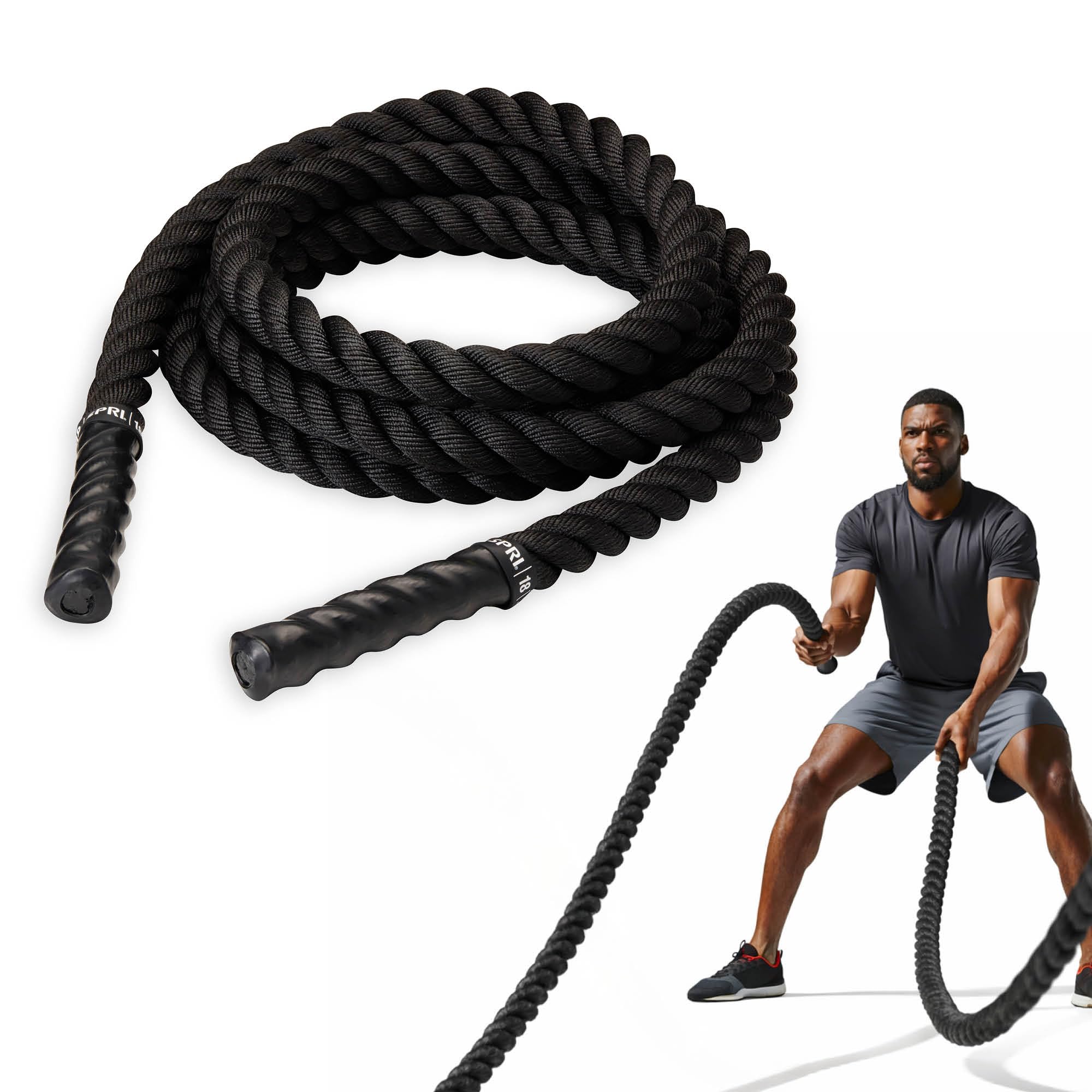
An 18-foot rope that fits a small floor plan and still delivers full-body conditioning.
Eighteen feet changes the math. That is 18 feet of 1.5-inch-thick rope at 10.7 pounds, which is 48% less rope weight than the 15.8-pound Amazon Basics. Less rope means a shorter arc, faster hand speed, and a lower ceiling on how much room you need. If your training area is a bedroom corner, a narrow basement, or a hotel gym floor, this is the length that actually fits without draping over furniture.
The handles are the detail worth pointing out. They are built from a thermoplastic elastomer with a PVC grip material, and the handle diameter is 38 millimeters. That 38mm diameter gives your palm a fuller grip surface during repeated hand exchanges. The rope itself is polyester with a high tensile strength, designed for repeated intense movement.
What to know before you commit: this is the shortest rope in the group by far. That is a strength for a tight gym, but it caps how much rope drag you can generate, so strength-focused athletes will want a longer option. A shorter rope also means shorter rest between waves; the intensity per rep goes up, but the total work capacity you can build goes down. As long as your goal is conditioning and grip endurance rather than maximum resistance, the SPRI earns its place.
Why it fits a tight space
- 18 feet of working length means it fits where a 40 or 50-footer cannot reach
- 1.5-inch diameter and 10.7 pounds give a manageable starting resistance
- Thermoplastic elastomer handles with PVC grip keep sweaty hands locked in
What you give up
- The short length limits total resistance compared with longer ropes
- Fewer reps before you fatigue in the same rep scheme
Buy it if: your training floor is measured in feet, not yards, and you still want a serious conditioning tool.
Size up if: your main goal is raw pulling resistance rather than cardio and grip endurance.
5. GSE Gym Battle Rope

Fifty feet of Dacron, two anchor straps, and a carabiner — the full setup in one box.
The headline number is 600 inches, which is 50 feet of rope of 1.5-inch diameter. That is 67% longer than the 360-inch Amazon Basics, and the difference is not cosmetic. More length gives you a bigger arc, more rope weight in motion, and a longer wave to drive toward the anchor. For strength-oriented training where you want the rope to push back, this is the configuration that does it. The package weight lands at 12.86 kg, a substantial rope to haul out and anchor down.
The accessory list is what earns this spot above the purely size-focused picks. The box includes a nylon sleeve cover, two heavy anchor straps, and a stainless steel carabiner. The anchor straps are reinforced nylon, double-sewn, and designed not to deform under load. That means you can wrap around a post, tree, or outdoor fitness frame without improvising. The rope itself is 100% polyester with a 3-strand twist, heat-shrunk vinyl end sleeves, and a build that resists fraying, stretching, corrosion, and rain.
The harder part to love is the durability chatter. Some owners find it holding up well over time; others report fraying early, and views on whether the rope lives up to its price divide. That does not make it a bad rope — it makes it one to inspect on arrival and to use with the sleeve in place rather than bare. For a 50-foot option at this point in the list, it remains among the most complete setups you can buy.
The draw: two reinforced anchor straps, a carabiner, and a sleeve in the same order — you can be training within minutes of opening the box.
The caveat: 50 feet needs real space and real anchoring, so measure your lane before ordering. An indoor room that fits a 30-footer will not comfortably hold this one.
Built for: outdoor trainers and garage gyms with a long lane and a post or tree to anchor to.
Not for: tight apartments or buyers who want the shortest, most manageable rope.
6. Keepark 30FT Sleeved Rope
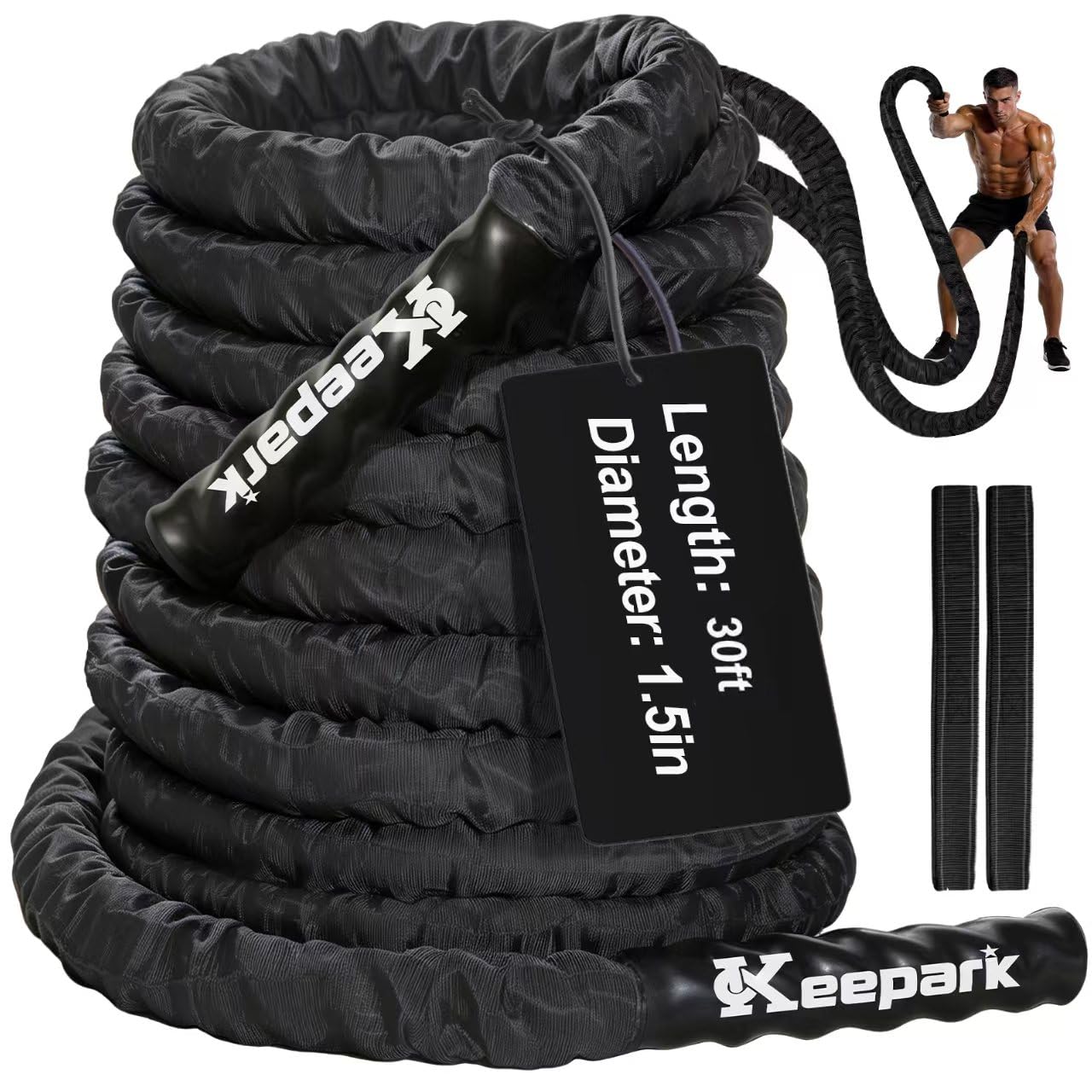
A 30-foot rope wrapped in a nylon sleeve and built for concrete, pavement, and garage floors.
The selling point here is the nylon sleeve, and it is worth understanding why. A sleeve is a fabric wrap that takes the friction when the rope drags across concrete, pavement, or a gym mat, so the fibers underneath stay intact. Without one, every slam on a rough surface turns into slow fiber loss. Bare rope on concrete fuzzes apart within weeks; the sleeve is what gets you through a season of driveway training. The 3-strand, 100% polyester construction underneath resists fraying, unraveling, and loosening under repeated slams and pulls.
At 1.5 inches in diameter and 30 feet long, this is the size that fits a garage or backyard without demanding a stadium. The 7.5-inch heat-shrink handles are textured to reduce calluses and abrasion, which matters when you are doing long sessions and your palms are the first thing to give out. A battle rope anchor strap comes in the box, so you can secure it to a tree, pole, post, or outdoor gym frame without hunting for hardware.
One thing to be clear about: this is not a rope for someone chasing maximum length. Thirty feet is the practical balance for a home setup, and the anchoring works best with something solid to wrap around. If you have a slick gym floor and no post or tree nearby, plan a way to lock it down before you start swinging.
What it gets right
- Nylon sleeve absorbs abrasion on concrete and pavement
- 7.5-inch handles keep long sessions comfortable
- Anchor strap included so setup is a few minutes, not a project
What to plan around
- 30 feet is limiting if you want a long strength-training arc
- You need a solid post, tree, or anchor point to secure it
Matches best with: driveway and backyard trainers who run a rope over rough surfaces and want it to survive it.
Might frustrate: buyers who want the longest possible rope for heavy-strength work.
7. Yes4All Battle Ropes

A 50-foot Poly Dacron rope with handles that stay put even when your palms do not.
What makes this one stand out is the handle design. The heat-shrink handles are built to hold firm and not slip off, which is the failure point that can turn a good rope into a frustrating one. Combined with the 3-strand twisted 100% Poly Dacron construction, the rope is designed to resist loosening and deformation under intense pulling. That means fewer mid-set re-grips when your palms get sweaty.
The 50-foot length and 1.5-inch diameter put it in the serious training bracket. Fifty feet gives you a long arc for double waves and heavy slams, and the 27.3-pound package weight is telling — this is a rope with real mass. If you have a garage or basement gym, it is a natural fit for daily conditioning rounds. The maker also offers it in 30ft, 40ft, and 50ft lengths with 1.5-inch and 2-inch thickness options, so you can downsize if your space is tighter than a full 50-footer allows.
The one surprise that shows up in owner feedback is weight. Some find the rope lighter than they expected, which reads as either good news or a letdown depending on how much heft you were chasing. Pair that with the need to measure your lane before committing to 50 feet, and you have a rope that rewards planning. For buyers who want a firm grip and a long, stable build, it is a strong match.
Why it earns a spot: the grip stays put, the Poly Dacron holds its shape, and the length gives you room to grow into serious conditioning.
Worth knowing: the 50-footer is physically large and needs a real anchor point; a smaller space will make the 30 or 40-foot version the better call.
Good fit for: garage gyms that want a long Poly Dacron rope with handles that do not slide.
Reconsider if: you want a compact rope or do not have room to stretch out 50 feet.
8. SGT KNOTS Battle Rope

Industrial-strength Dacron built for weightlifters, boxers, and MMA training, not casual weekends.
The spec that matters here is material. The rope is made from 100% industrial-strength Dacron Polyester, a fiber DuPont developed and known for consistency and a long service life. PolyDac is resistant to moisture, UV rays, abrasion, and chemicals, which is why it holds up in a garage or an outdoor training setup where humidity and sun are real factors. The 3-strand twisted construction adds stability and grip quality, so the rope does not deform under repeated heavy work.
This is also the most configurable rope in the group. The maker offers diameters of 1 inch, 1.5 inches, and 2 inches, and lengths of 20ft, 30ft, 40ft, and 50ft, plus weight options from 16 to 46 pounds. That range means you can dial the resistance up or down to fit your own strength level rather than settling for one size fits all. The 1-inch diameter is the easiest to grip and the 2-inch is the hardest — a useful detail if your hands need a break or a challenge.
The honest note is on longevity at the edges. Some owners mention the rope beginning to fray slightly over time, so treat the sleeve and storage as part of upkeep rather than an afterthought. That is a fair caveat, not a fault — the rope is built for hard use, and hard use has a cost. If you want a rope that grows with your training and you do not mind a little maintenance, this one delivers.
what separates it
- Dacron Polyester resists moisture, UV, abrasion, and chemicals
- Five length and three diameter options for tailoring resistance
- 3-strand twist keeps the rope stable under heavy pulling
The fine print
- Some report slight fraying with heavy long-term use
- The heavier weight options can be a lot of rope to handle
Suits: weightlifters and combat-sport athletes who want a tough Dacron rope and will maintain it.
Might not suit: buyers who want zero upkeep or the lightest possible rope.
9. Keepark 40FT Sleeved Rope

Forty feet of sleeved polyester with a 15.5-pound working weight for intermediate and advanced trainees.
This is the middle rung of the Keepark ladder, and the number to focus on is 40 feet. That length gives you a longer arc than the 30-foot version without the space demands of a 50-footer, and it is a natural step up once the basics feel easy. The 15.5 pounds of rope weight adds resistance across every wave and slam, so the workout scales with your fitness. The maker describes it as ideal for intermediate and advanced trainees, and the specs back that placement.
The build is 3-strand twisted 100% polyester with an outer protective cover, so the abrasion lands on the sleeve instead of the fibers. High tensile strength keeps the exercise rope from breaking, wearing out, or loosening. The heat-shrink handles are designed to prevent slipping even when your palms get sweaty, which is the difference between a controlled set of waves and a rope that slides through your hands after the first thirty seconds.
Setup flexibility is where this one shines. Indoors you can use it alone or as part of a team for waves, pulls, and climbing-style movement; outdoors you can secure the included accessories to a tree, fixed post, or outdoor fitness equipment. That range makes it a good pick for a home gym that occasionally moves to the yard. Be honest with yourself about the 40-foot lane requirement — if your training floor is short, the rope will bunch up and the workout suffers.
The case for it: 40 feet and 15.5 pounds give you a serious middle ground that suits intermediate and advanced training without the bulk of a 50-footer.
The trade-off: the same length that makes it versatile also demands real floor space, and the sleeve needs to stay in place to protect the rope on hard surfaces.
Worth it for: intermediate and advanced trainees who want a sleeved 40-footer that works indoors and outside.
Not ideal for: beginners or small spaces where a 30-foot rope fits better.
Know the Specs
Diameter and Length
Diameter is how thick the rope is, and it sets how hard your hands work. A 1.5-inch rope suits most beginners, while a 2-inch rope is tougher to grip and meant for conditioned athletes. Length decides space and resistance: 30 feet fits a garage or basement, while 40 and 50-foot ropes give you more arc and more rope weight but need a longer lane. Match both to your room and your grip strength before ordering.
Sleeve and Material
A sleeve is the protective cover that takes abrasion when the rope meets concrete, pavement, or a mat. Nylon, Oxford, and double-layer covers are the common types, and they are what keep the fibers underneath from fraying. The rope material matters too: Poly Dacron and polyester are the durable standards, and a 3-strand twist is the build that keeps the rope stable under repeated slams.
Handles and Grip
Heat-shrink handles are the plastic-coated ends you hold. A longer handle such as 7.5 inches gives your palm more surface to lock onto, and textured or non-slip coatings help when your hands get sweaty. Handles that slip off mid-swing are the most common gripe, so check for heat-shrink construction that stays put rather than a loosely fitted grip.
Anchor and Storage
An anchor strap, carabiner, or both lets you secure the rope to a post, tree, or gym frame in seconds. Some ropes include these; others do not. Storage matters too — a long rope rolls up and needs somewhere dry to live, and keeping it off damp floors helps with longevity.
Common Questions
What size workout rope should a beginner buy?
How much space do I need for a 50-foot battle rope?
Does a protective sleeve really stop fraying?
What is the difference between Poly Dacron and polyester?
Will a workout rope damage my garage floor?
How do I anchor a battle rope without straps?
What does 1.5-inch versus 2-inch diameter change?
Should I dry my rope after outdoor training?
How long does a battle rope usually last?
The Bottom Line
For most home setups, the work out rope worth grabbing is the POWER GUIDANCE Battle Rope — 40 feet of 1.5-inch Dacron with a double-layer nylon cover, 7.5-inch handles, and an anchor in the box. Sleeve, handles, and anchor in one box mean you can set up and train the day it arrives. If your first priority is a budget-friendly entry point, the Amazon Basics Battle Rope gives you a sleeved 30-footer with 15.8 pounds of resistance. And if you train outdoors on rough ground, the Keepark 30FT Sleeved Rope is the one built for concrete and pavement. Its 4.5+ star rating across 2,700+ buyers backs up the top spot.
How we choose
We do not accept paid placement. Every pick is matched to a real buyer and a real use-case; we do not hands-on test units.
Sources
Specifications: manufacturer listings and product documentation. Review insights: verified customer reviews, as of November 2026. Pricing: not shown on this page (it changes often); check the current price via the retailer link.
As an Amazon Associate, Tactical Gear Guy earns from qualifying purchases. This does not affect which products we feature.