Specs are compiled from manufacturer listings and verified buyer reviews and can change over time — please confirm the key details on the product page before buying.
If you want one microphone that handles Xbox party chat and music games without a driver disc or a software download, the HyperX Quadcast 2 Frost is the pick that gets the most right at once. It is a plug-and-play USB microphone that your console recognises the moment you connect it. Everything below is sorted by what you actually do with a mic on an Xbox: talk to your squad, sing in Rock Band, or record a voice track. Most people should start with the Quadcast 2 Frost and only move down this list for a two-player karaoke set or a 13ft-plus cable.
This guide is built by comparing the manufacturers’ published specifications and the patterns across verified customer reviews, so you get each pick’s real strengths and trade-offs instead of marketing spin.
Singing-game mics and voice-chat mics are not interchangeable, and buying the wrong type is the most common mistake here. Each pick below is labelled by its job — party chat, two-player karaoke, or long-cable living-room play. Here are the six Xbox USB mics worth buying, sorted by what you’ll actually do with them.
Top Picks


How To Choose The Best Xbox USB Microphone
Before sound quality, settle what your Xbox will actually accept. A microphone that lists Xbox One and Series X|S in its own compatibility line will connect. One that only lists PC and PlayStation may not, no matter how good the specs look.
Connection style: controller jack versus direct USB
Some Xbox mics connect through the 3.5mm headphone jack on your controller, which means the mic goes where you go. Others plug straight into a USB port on the console or a PC. Controller-jack mics suit party chat and handheld singing. Direct-USB desktop mics suit streaming and recording, where you want the mic to stay put on a stand.
How many people are singing
Music games like Rock Band and Guitar Hero often want two mics at once. A single-pack desktop mic will not cover that. Two-packs exist precisely for this, and they usually trade audio polish for the convenience of having two handheld units in the box.
Cable length and freedom to move
A short cable pins you to the console. Longer cables and wireless links let you stand up and perform. Cables of 13ft and 15ft appear on this list, and the wireless option reaches up to 15m in open space. Measure how far you stand from the TV and pick a cable or range that covers it.
Side-by-Side Comparison
| Model | Best For | Connection | Cable / Range | Mic Form | Amazon |
|---|---|---|---|---|---|
| HyperX Quadcast 2 Frost★ Best Overall | Party chat and streaming | USB Type-A | — | Desktop condenser | Amazon |
| ZealSound BD9 Xbox MicBest For Chat | Xbox party chat on a desk | USB Type-C plus 3.5mm to controller | Dual 3.5mm audio cable included | Desktop with stand | Amazon |
| Mcbazel 2 Pack Wireless | Two-player wireless singing | Wireless 2.4G via USB receiver | Up to 15m barrier-free | Handheld | Amazon |
| Lioncast Pair Of Universal USB Mics | Karaoke and music games | USB Type-A | 3m per mic | Handheld | Amazon |
| Drimoor 2Pack 13ft Wired | Long-cable living-room play | USB | 13ft | Handheld | Amazon |
| Mad Catz Rock Band / Guitar Hero Mic | Rhythm-game vocals | USB | 15ft | Handheld | Amazon |
Detailed Reviews
1. HyperX Quadcast 2 Frost USB Microphone
Our pick — 4.5+★ from 450+ verified ratings; the strongest balance of quality and price.
The one mic here that treats Xbox voice chat like a proper broadcast desk.
What makes this the top pick is not a single number — it is that the everyday desktop controls live on the body of the microphone. You tap the top to mute, and a tap-to-mute that does not require software is the difference between silencing a sneeze mid-stream and broadcasting it. It connects over USB Type-A, so it plugs into a console or a laptop without an adapter. The enclosure is aluminium, which is why it feels heavier in the hand than a plastic mic.
The size question is real. At 4.02 x 5.28 x 9.51 inches this is a tall desktop mic, and it is roughly 2.7 times the size of the Mcbazel two-pack in overall dimensions. Weighing 335 g, it is about 2.1 times the weight of that same Mcbazel mic. The trade-off is honest: this is a mic you park on a boom or a stand and leave there, not one you hand around a room. Its frequency response reaches 20 KHz, which is well past the range of a human voice — you are paying for headroom and detail, not for a number you will hear directly.
Voice quality is genuinely what people respond to. The most-praised thing about it is simply how the microphone captures a voice — clean, full, and loud enough without shouting. LED lighting and the removable shock mount round it out, and the shock mount is the part that matters practically: it isolates the capsule from desk knocks, so a controller dropped on the table does not thud through your chat. A word of caution on the lighting, though — the colour is not adjustable, so plan your setup around the light it ships with rather than assuming you can match it to your rig.
What works in your favour
- Tap-to-mute on the body, no software needed to silence it
- Aluminium enclosure that stays put on a desk
- Removable shock mount keeps desk knocks out of your voice
- 20 KHz frequency response for detailed vocal capture
Where it asks something of you
- The LED colour cannot be changed
- Tall footprint at 4.02 x 5.28 x 9.51 inches, so check your desk space
- At 335 g it is a desktop fixture, not a handheld mic
Reach for this if: you want one mic for Xbox party chat, streaming, and voice recording, and you are happy with it living on a desk stand.
Pass it by if: you need two mics in the box for Rock Band, or you want to hand a mic around a room.
2. ZealSound Gaming Microphone
A desktop mic that plugs into your controller jack instead of hunting for a console port.
This one is designed around a specific annoyance: people who want a desk microphone for Xbox party chat but cannot run a cable to the console. You connect it to your controller with the included 3.5mm audio cable, and that is your voice link. No Bluetooth pairing, no drivers, no splitter, no external sound card. For a Series X or Xbox One player who wants to stop wearing a headset, that single cable is the whole pitch.
Underneath the convenience sits a 192kHz/24-bit audio chipset and a cardioid condenser capsule — that pattern means the mic listens mostly from the front and pushes down sound from the sides and behind, so your game audio and your roommate’s TV stay out of the channel. There is a front gain knob for setting how hot the mic runs. Real-time monitoring is built in through a 3.5mm headphone jack on the mic itself, so you hear your own voice with minimal delay and can adjust headphone volume from the same front controls.
The battery is the part to plan around: an 800mAh cell rated at up to 12 hours with RGB lighting on, or up to 35 hours with the lighting off, and about 1.5 hours to a full charge. It charges while in use. One practical note from the maker — when you charge it from a wall outlet while running Xbox audio, use the wall rather than a computer, or the charging can interfere with the console audio. On sound, the recurring complaint is that the noise reduction and the value do not always land as strongly as the clarity does. Treat the DSP noise reduction button as a handy tool for a noisy room, not a magic filter.
Where the money goes: into the 192kHz/24-bit chipset and the controller-jack design, both of which solve real Xbox problems rather than adding flash.
The honest caveat: noise cancellation is the mixed part of this mic’s reputation, so buy it for clarity and connection convenience, not for the DSP button.
Good match: an Xbox player who wants a desk mic and will happily run a 3.5mm cable to the controller.
Less of a fit: anyone expecting the noise-reduction button to fully bury a loud room.
3. Mcbazel 2 Pack Wireless USB Gaming Microphone

Two handheld mics, no cables, and a receiver that does the pairing for you.
The headline here is the freedom: two 2.4G wireless microphones in one box, running through a USB receiver that needs no driver. The maker puts the working distance at up to 15m barrier-free, which is enough to stand back from the TV without dragging a cable across the carpet. Latency is listed at 25ms, so your voice comes back through the game with a delay short enough to sing against. Two mics means a friend can join, or two of you can trade verses in a music game.
How you physically handle this mic matters. It comes as a handheld unit weighing 160 g — light enough to pass around, and far less of a desk fixture than the 335 g HyperX above. Just as your ear notices the difference, the numbers tell a story too: this mic lists an audible noise figure of 90 db against 10 db on the Lioncast set, and an audio sensitivity of 51 db against 10 db there. Those are the two figures that separate the two two-packs, and they point to the Mcbazel as the louder, more sensitive of the wireless pair.
The reputation is genuinely split, and it splits along compatibility. Some players plug in and get exactly what they expected; others, particularly on PS5, find it will not connect at all. The fix the maker gives is worth writing down: there is a small hole on the receiver, and poking it resets and re-pairs the mic. An LED on the unit flashes blue while connecting, goes solid blue when connected, and shows red when off — a quick way to tell whether the problem is pairing or power. Snapping up a two-pack in this price tier means accepting that setup can be fussy on some consoles.
Buy it for: family karaoke or two-player music games where cables would be a trip hazard.
Think twice if: you want a guaranteed zero-fiddling setup on day one, since pairing can take a re-set on some consoles.
4. Lioncast Pair Of Universal USB Microphones
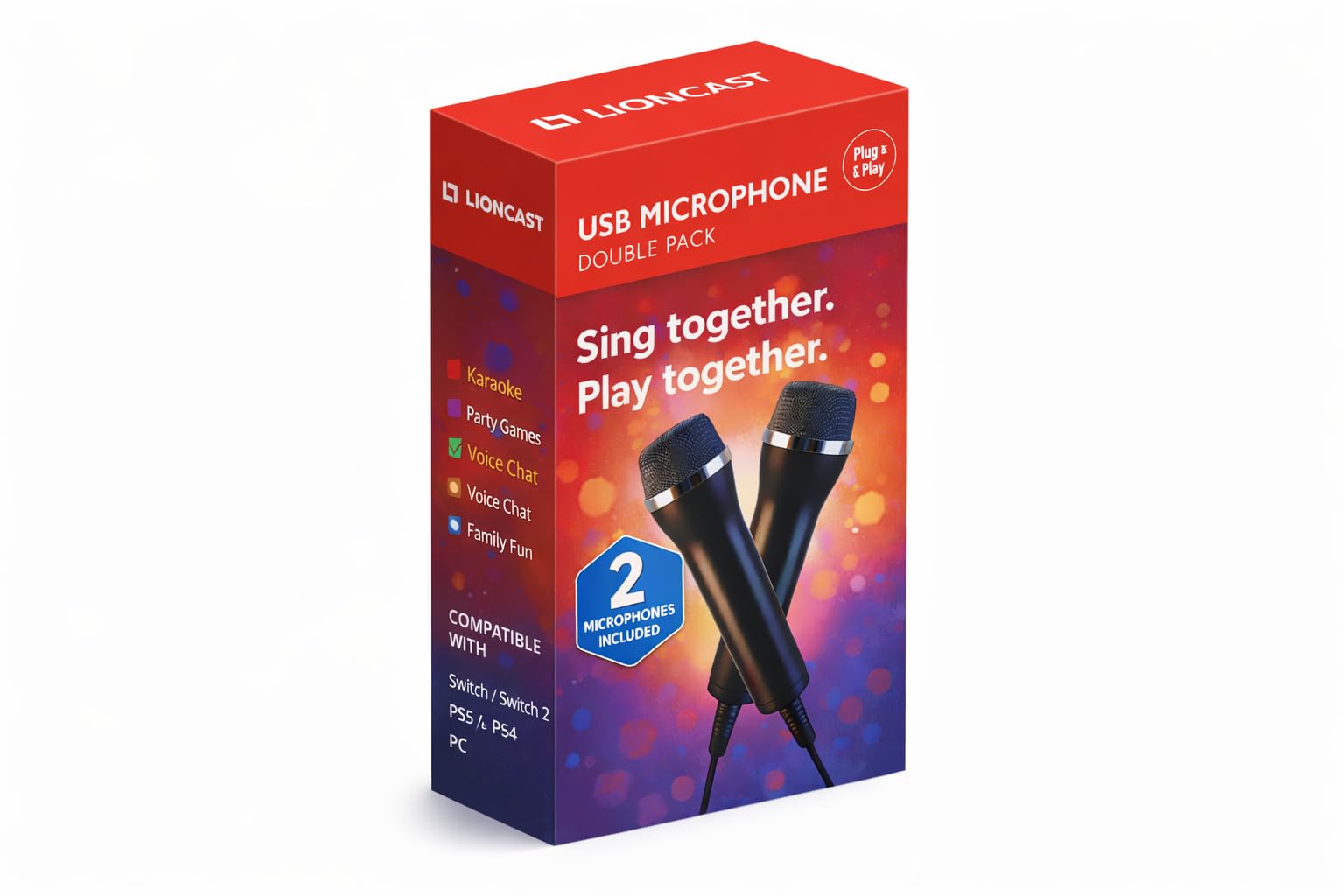
The straightforward singing pair: slim handles, plug-and-play, and one cable per singer.
Start with the cable, because it decides how this mic actually gets used. Each of the two USB cables runs 3 meters — just over 8 feet — so you can stand, dance to the beat, and still reach the console. It is a USB Type-A connection with plug-and-play behaviour, and the maker lists compatibility with PlayStation 5 and 4, Xbox One, Nintendo Wii, and PCs. The aluminium enclosure gives the slim handle a bit more substance than a plastic tube.
What this pair is built for is traditional singing games: Rock Star, Guitar Hero, SingStar, Let’s Sing, We Sing. The two-mic setup is the reason to choose it over a single desk mic — two or more people can sing at once, which is the whole point of a singing competition night. At 7.04 ounces each it stays light in the hand for a long session. The noise and sensitivity figures sit at 10 db on both counts, a quiet, low-sensitivity spec that suits close singing rather than picking up a whole room.
Compatibility is where this mic earns its keep — working across the devices people actually own is the thing it does best, and the reviews bear that out, with Nintendo Switch and Wii both coming up as devices it handles. Quality is the more divided topic: plenty of singers are happy with it, while a portion would like more from the sound. That is a fair reading of a two-pack built for fun rather than studio work — the pleasure is in two people singing together, not in audiophile detail.
The defining spec: two 3m cables and two handheld mics in one box, so a pair of singers can both stand up and move.
What to accept: sound quality divides opinion, so pick it for the two-player experience rather than for vocal polish.
Ideal owner: a household that plays SingStar, Let’s Sing, or We Sing and wants two working mics for the room.
Look elsewhere: if a single-player stream mic with fine control is what you actually need.
5. 2Pack 13ft Wired USB Microphone

Thirteen feet of cable on each mic, so nobody has to stand next to the TV.
If your living room has the console on one wall and the singers on the other, cable length stops being a detail and becomes the deciding spec. Each of these two mics carries a 13ft cord — long enough to let family and friends move around and interact without crowding the screen. The polycarbonate handle is built for handheld singing, and at 14 ounces per mic it sits mid-weight between the light Lioncast pair and a desk-mounted unit.
Sound is handled by an upgraded frequency response paired with a wide dynamic range — in practice, that means it picks up the shout of a chorus line and the quiet of a spoken verse without you having to reset anything. There are no drivers to install; you plug in and it works. The make-up includes a 12-month warranty and a free replacement or refund policy on quality issues, which is the kind of backup that matters when the mic is being passed around a party.
The compatibility list is broad — PC, PS2 through PS5, Wii, Wii U, Switch, and the Xbox 360 and One families — but it is not universal. The feedback splits clearly: some players report it working perfectly with the Wii and delivering good sound, while others find the Wii side of that same pairing does not work and the audio disappointing. The plug-and-play ease is the consistently praised part. So this is a mic to buy for the cable length and the warranty, with an eye on the device you personally own.
Suits you if: you need two mics with serious cable reach for a family room and want a warranty behind them.
Not the one for: anyone who needs a guaranteed match to one specific console model without checking that model first.
6. Rock Band or Guitar Hero USB Microphone

A metal-handled 15ft mic aimed squarely at the rhythm-game crowd.
Fifteen feet of cable is the longest here, and it is the honest reason to pick this one: a singer can get right out into the room before the cord tugs. The handle is metal rather than plastic, so it feels like a real microphone in the hand instead of a game accessory. It runs one channel over USB and lists itself as working with PS2 through PS4, the Nintendo Switch, and the Xbox 360 and Xbox One. Setup is plug-and-play, with no driver step.
The vocal engineering is what the maker sells hardest. An improved dynamic range is meant to catch loud and quiet performances in the same take, and a high signal-to-noise ratio (the gap between your voice and background hiss) is there to reproduce your voice accurately. That is a sensible spec set for a music-game mic, where the game is listening for pitch across a whole song’s range. It also does duty as a podcast, lecture, or interview mic, and the maker suggests it works as a backup-singer mic alongside another.
Now the part to weigh honestly. Compatibility is the most-discussed issue with this mic, and the PS3 comes up specifically as a device that has not worked for some buyers. On top of that, functionality is mixed — some units work great, some do not. What people do agree on is the quality of the thing itself. So the smart move is to check this mic against the exact console you own before buying, because when it connects, the metal build and the 15ft cable make it a satisfying rhythm-game mic.
The standout: a 15ft cable in a metal shell — the most physical, stage-like mic in this list.
The catch: compatibility with older consoles is uneven, so confirm your model before you commit.
Pick this one when: your game is Rock Band or Guitar Hero and you want a metal mic on a genuinely long cable.
Give it a miss when: you own a PS3 or a console this listing’s owners have had trouble with.
Know the Specs
Cardioid pickup pattern
A cardioid pattern means the microphone is most sensitive from the front and less sensitive to the sides and rear. For Xbox voice chat, that translates to less game audio and less room noise entering your channel, so your teammates hear you and not the TV. It is a directional design, so you aim the front of the mic at your mouth and keep it there.
Audio sensitivity and noise figures
Sensitivity describes how strongly a mic turns sound into a signal, and the noise figure describes the mic’s own background hiss. Both are listed in db on these products. Higher sensitivity suits quiet singers who need the mic to work harder; a lower noise number means less self-noise in a quiet recording. These two figures are the fairest way to compare two mics in the same tier.
Latency in a wireless mic
Latency is the delay between your voice and hearing it in the game or headset. The wireless set here lists 25ms, a figure short enough that you can sing against a track without the timing fighting you. Wired mics tend to have lower delay by their nature, which is one reason karaoke pairs still use cables.
Cable length and wireless range
Cable length sets how far you can stand from the console before you tug. A 3m cable is close-quarters; a 13ft or 15ft cable reaches across a room. Wireless 2.4G works differently: the maker lists up to 15m barrier-free, meaning line of sight without walls in the way. Pick the format that matches the distance you actually perform at.
Common Questions
Will a USB microphone work with my Xbox Series X or Xbox One?
Do I need to install drivers for an Xbox USB microphone?
Can I use a USB microphone for Xbox party chat instead of a headset?
How many microphones do I need for Rock Band or Guitar Hero?
What is the difference between a wired and a wireless 2.4G Xbox microphone?
Why will my wireless microphone not connect, and how do I fix it?
Does a longer cable actually matter for a singing-game microphone?
Can I use an Xbox microphone on a PC or a Nintendo Switch instead?
What does the 192kHz/24-bit rating on a gaming microphone mean?
How long does the ZealSound microphone’s battery last?
The Bottom Line
For most people the answer is the HyperX Quadcast 2 Frost, because it does the job that matters on an Xbox — captures your voice clearly over USB, lets you mute with a tap, and stays quiet on the desk thanks to its removable shock mount. If party chat on a controller jack is what you need, the ZealSound BD9 is the one built around that setup. And if two singers are the point, reach for the Lioncast pair for a straightforward plug-and-play two-mic set, or the Drimoor 2Pack when you want 13ft of cable on each mic. Whatever you choose, check the Xbox compatibility line first — a mic that doesn’t list your console may never connect.
How we choose
We do not accept paid placement. Every pick is matched to a real buyer and a real use-case; we do not hands-on test units.
Sources
Specifications: manufacturer listings and product documentation. Review insights: verified customer reviews, as of November 2026. Pricing: not shown on this page (it changes often); check the current price via the retailer link.
As an Amazon Associate, Tactical Gear Guy earns from qualifying purchases. This does not affect which products we feature.