Specs are compiled from manufacturer listings and verified buyer reviews and can change over time — please confirm the key details on the product page before buying.
Your Yamaha G1 won’t pull a hill, or it cranks but never catches. Either way, the fix is almost always one specific worn part — a stretched belt, a fouled carb, a tired CDI — not a whole new cart. This guide covers the nine G1 parts worth buying, matched to the exact years and OEM numbers that matter.
This guide is built by comparing the manufacturers’ published specifications and the patterns across verified customer reviews, so you get each pick’s real strengths and trade-offs instead of marketing spin.
G1 parts live or die on fitment, so every pick below is checked against its stated year range and its OEM replacement number first. Here is the shortlist of Yamaha G1 Golf Cart Parts that owners actually bolt on and keep running.
Top Picks

How To Choose The Best Yamaha G1 Golf Cart Parts
The G1 stayed in production from 1978 through 1989, and Yamaha changed things along the way. That long run is why fitment, not brand name, is the whole game. A part that is perfect for a late-80s cart can be useless on a first-year one.
Match the year before you match the part
Every listing below carries a year window, and those windows are not marketing garnish. The drive belt here covers 1978-1989 G1 and the 1986 G3 only. The carburetor covers 1983-1989 directly but needs the throttle lever ball removed on 1979, 1981 and 1982 carts. Read your cart’s year plate first, then read the listing’s window, then buy.
Check the OEM number against your old part
The safest purchase you can make is one where the listing’s OEM number matches the number on the part you are removing. Numbers like J17-46241-00-00 or J10-85540-20-00 are Yamaha’s own identifiers, and aftermarket makers publish the ones they replace. If the seller lists no OEM number at all, that is your signal to keep looking.
Know which failures travel together
A worn belt slips and the cart loses power — that is a belt problem, not a clutch problem, until you have ruled the belt out. A cart that cranks but will not fire usually points at the ignition chain: switch, CDI, coil, plug. Buying the whole tune-up set at once saves a second shipping wait and a second teardown on the same engine.
Side-by-Side Comparison
| Model | Best For | Fits (Years) | Part Type | OEM Number | Amazon |
|---|---|---|---|---|---|
| A.A Drive Belt★ Best Overall | Slipping, weak pulling power | 1978-1989 G1 / 1986 G3 | Rubber drive belt | J17-46241-00-00, J10-46241-00-00 | Amazon |
| Standard 68mm Piston Gasket KitTop-End Rebuild Pick | Top-end rebuild | 1978-1989 G1 | Piston, ring and gasket kit | J10-11631-00-96, J10-11610-00-00 | Amazon |
| 10L0L CarburetorBest Fuel Fix | Rough idle, fuel delivery | 1983-1989 direct; 1979-1982 with mod | Carburetor + tune-up kit | J24-14101-00, J24-14101-01 | Amazon |
| SUPGCPER Brake Shoes | Weak or grinding stopping | 1978-1981 G1 (also Club Car, EZGO) | Brake shoes, 4-pack | J10-W2536-00, J10-25330-00 | Amazon |
| YUTOCOOL Ignition Switch | No crank, dead key | 1979-1989 G1 | Key switch with harness | J17-82508-20 | Amazon |
| Igniter CDI & Coil Kit | No spark at the plug | 1979-1986 G1A | CDI, coil and spark plug | J10-85540-20-00, 355-82310 | Amazon |
| Golf Cart King Tune-Up Kit | Routine seasonal service | G1 gas | Plug, fuel filter, air filters | 10967 | Amazon |
| 10L0L Brake Drum | Rear hub / drum replacement | 1978-up G1 through G29 | Rear hub with drum washer, 2-pack | JU0-G6521-00-00, J17-46521-00 | Amazon |
| SHICHU Starter Generator | Charging and starting failure | 1978-1982 G1 | Starter generator, 12V | J10-81100-10-00 | Amazon |
Detailed Reviews
1. A.A Drive Belt Yamaha G1 G3
Our pick — 4.5+★ from 150+ verified ratings; the strongest balance of quality and price.
One rubber belt quietly decides whether your G1 pulls a hill or whines up it.
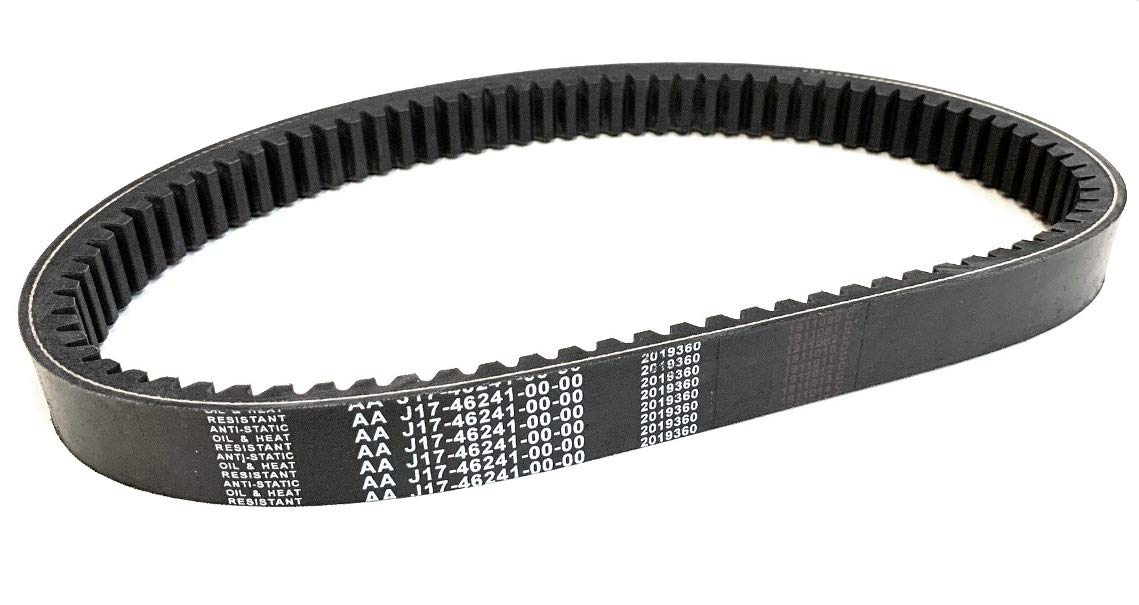
If your cart has gone soft — slow to build speed, sluggish on an incline, a faint slipping sensation under throttle — the belt is the first thing to rule out. A dry-rotted or stretched belt slips on the pulley, and the engine revs without the cart moving any faster. This one is a single rubber replacement belt matching OEM numbers J17-46241-00-00 and J10-46241-00-00.
That 1978-1989 window is wide, but it is not universal. It covers the G1 gas 2-cycle run and the 1986 G3, and nothing else. If your cart’s year plate does not land in that range, this is the wrong belt no matter how good it looks. On weight, it comes in at 0.41 kg; the ignition kit further down the list is 0.44 kg. Both are small numbers if you are tallying a parts order.
It is a one-count package: one belt, no clips, no tools. Belt swaps on a G1 are about as forgiving as golf cart work gets, so basic hand tools cover it. What you get is a cheap, correct-fit part that restores the power you thought you had lost — and what you don’t get is any cushion if you misread your model year.
What earns it the top slot
- Matches two OEM numbers, so cross-checking against your old belt is straightforward
- Covers the full 1978-1989 G1 run plus the 1986 G3
- Rubber construction and a 0.41 kg weight — light enough to ship without drama
- Fixes among the most common G1 complaints: slipping under load
The honest catch
- Sold as one belt only — no retained hardware in the box
- No fit for G2 and later carts, or for the electric G1
Right call for: anyone whose G1 still starts fine but has lost pulling power on hills.
Think twice if: your cart is a G2 or newer, or you have not yet confirmed the model year.
2. Standard 68mm Piston Gasket Kit
The rebuild kit for the cart that smokes, sips oil, and has lost its compression.
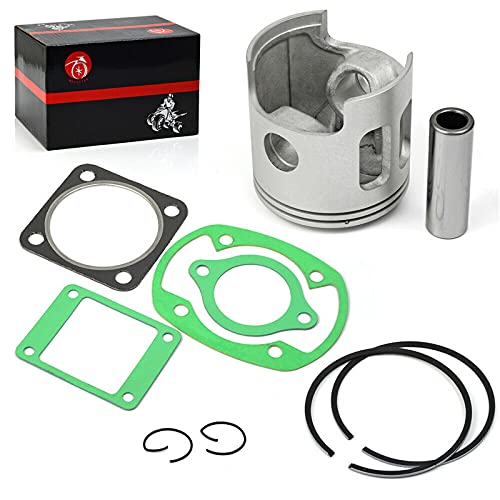
A 68mm piston kit is the deepest repair on this list. You buy it when the engine is tired — hard starting when cold, blue smoke, oil disappearing between fills, that flat feeling where a 2-cycle should be snappy. The piston is aluminum with an oxide film, a surface treatment the maker lists for corrosion and high-temperature resistance, and the bore size is stamped right in the name.
The box is a set, not a single part: piston kit, piston ring set, and gasket kit together. That matters on a 2-cycle teardown, because you do not want to have the cylinder off and discover the gasket is a separate order. The fit covers the G1 2-cycle gas cart across 1978-1989, and the OEM numbers J10-11631-00-96 and J10-11610-00-00 give you something concrete to check against your old piston.
This is not a bolt-on for a beginner. It is engine work — the cylinder comes apart, tolerances matter, and getting the ring orientation wrong undoes the whole job. Buy it if you have done top-end work before or you have a mechanic you trust. Otherwise the tune-up kit further down fixes more carts for far less effort.
Where the money goes: a full three-part set — piston, rings, gaskets — that removes the mid-job parts-run on a 2-cycle rebuild.
Set your expectations: the kit covers the mechanical parts only. It is an engine-out job, and the outcome depends on your bore condition as much as the parts.
Built for: the owner with a smoking, weak G1 who is ready to open the engine.
Not the starting point if: you have not yet ruled out the carb, belt, and ignition — all cheaper, easier fixes.
3. 10L0L Carburetor Yamaha G1
A pre-adjusted carb that arrives with a whole tune-up kit riding along with it.
Hunting idle, a cart that dies at low speed, a fuel smell with no obvious leak — those are carburetor symptoms, and they are the ones this part is aimed at. The aluminum body is precision-machined, which is the reason idle stays stable rather than wandering. Performance is the most-discussed aspect of this carb by a wide margin, with reviewers repeatedly noting the cart runs smoother.
Fit is the second thing buyers talk about, and it splits by year. The 1983-1989 carts take it as a direct swap. The 1979, 1981 and 1982 carts will fit it too, but only after you remove the throttle lever ball — and that is the detail that turns a five-minute job into a twenty-minute one if you did not plan for it.
The kit is what makes this the smart pick rather than just a carb. In the box you get the carburetor, a cleaning brush, a tube, a fuel filter, two fuel lines and eight clamps. That is the whole fuel-side refresh in one order, and it saves you from reusing a cracked line or a tired filter. Cross-check J24-14101-00 and J24-14101-01 against your old unit before you order.
The full picture: a carb plus the fuel filter, lines, clamps and brush you would otherwise buy separately.
One year-range wrinkle: the 1979-1982 carts need the throttle lever ball removed first.
Pair it with: a cart that runs rough, idles high, or stumbles off throttle.
Check first: whether your cart is one of the 1979-1982 models needing the throttle lever mod.
4. SUPGCPER 4 PCS Long Golf Cart Brake Shoes
Four long brake shoes that cover a surprising spread of carts, G1 included.
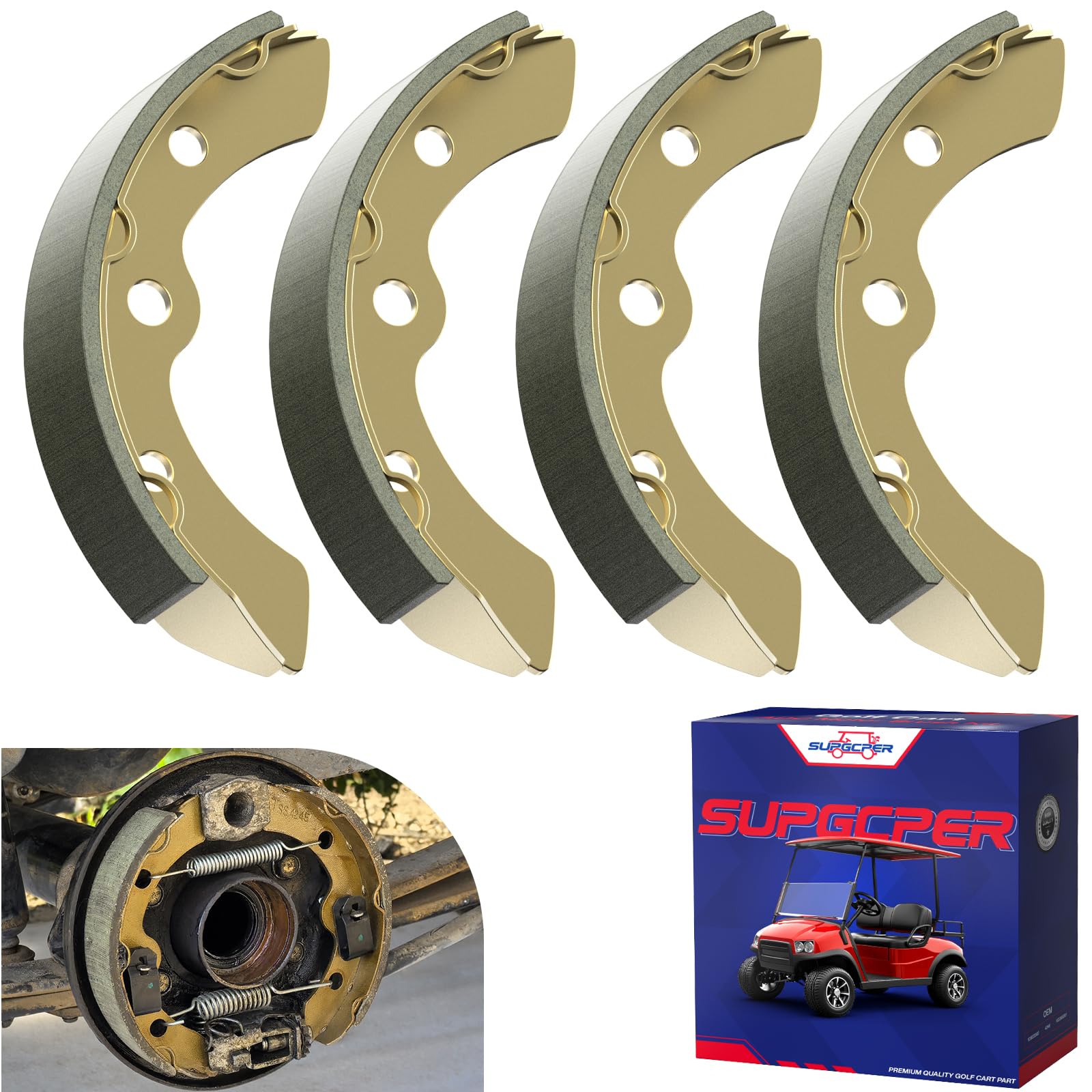
Brakes on a golf cart fade quietly. You notice the pedal travels further, then you notice you are planning your stops earlier, and by then the shoes are thin. This set gives you four long shoes of the same size — the whole axle end, not half of it. The friction material is chosen to keep the coefficient consistent, which in plain terms means predictable stopping rather than grab-and-release.
Here is the useful part: this shoe fits more than one cart family. It covers Club Car DS and Carryall from 1981-1994, EZGO XI models from 1983-1986, and the 1978-1981 Yamaha G1 gas 2-cycle. If you keep more than one cart around, that overlap is genuinely handy. For the G1 specifically, the OEM numbers to check are J10-W2536-00, J10-W2536-00-00, J10-W2536-01, J10-W2536-01-00 and J10-25330-00-00.
Two things to know before you click. First, the G1 coverage stops at 1981, so a 1985 cart is out. Second, the set ships as four identical shoes in a single package weighing 0.82 kg, and there is a 1-year warranty attached. At this outlay, that is a fair deal for a safety part.
Why it beats buying singles
- Four same-size long shoes — both sides done in one job
- Cross-fits Club Car DS, EZGO XI and the 1978-1981 G1
- 1-year warranty on a wear item
- Package weight of 0.82 kg keeps shipping simple
Where it stops short
- Only covers G1 carts through 1981 — later years need a different shoe
- All four shoes are identical, so there is no left/right differentiation to sort
Grab this when: your early G1 pedal is going long and you want both sides refreshed together.
Skip the hunt if: your cart is a 1982-or-later G1 — this set’s coverage ends at 1981.
5. J17-82508-20 Ignition Switch Yamaha G1

When the key turns and nothing at all happens, start here before you replace anything else.
A dead ignition switch is easy to misdiagnose as a dead battery or a dead CDI. The tell is silence: you turn the key and there is no click, no crank, no relay chatter. This switch replaces J17-82508-20 and ships with its wire harness, so you are not splicing a new connector onto old wiring. The contacts are brass, rated for 3 A on a 1-way circuit.
Installation is a plug-in job. YUTOCOOL states the switch is inspected and tested before shipping and backs it with a 12-month warranty — a useful cushion on a part that sits in the weather and takes a key turned thousands of times. The fit covers all G1 2-cycle gas models from 1979 through 1989, which is nearly the whole production run.
If the switch does not solve the silence, the next suspect is upstream in the ignition chain — the CDI and coil kit below. Buying both at once is not wasteful if your cart has been sitting; old switches and old coils tend to fail in the same season.
What makes it easy: harness included, plug-in connector, and a broad 1979-1989 fitment window.
Know what it is not: it is one switch for one circuit, not a wiring harness or a starter repair.
Best fit for: a G1 where the key does nothing and the battery is known good.
Try elsewhere first if: the cart cranks but will not fire — that points at the coil or CDI, not the switch.
6. Igniter CDI Ignition Coil Spark Plug Yamaha G1

The three parts that decide whether your G1 has spark at all, bundled together.
No spark is the single most frustrating G1 failure because everything looks fine. The engine turns, fuel is there, and nothing lights. This kit attacks that chain at three points: one CDI box, one ignition coil, and one spark plug, all in a single package. The CDI is the brain that times the spark, the coil is the muscle that delivers it, and the plug is where it happens.
Installation is plug-in, and the kit is vehicle-specific rather than a generic aftermarket box. The OEM numbers to match are J10-85540-20-00, 355-82310 and 8H4-82310-20-00, which gives you a clean cross-check against whatever is on your cart now. Coverage is the G1A gas 2-cycle from 1979 to 1986 — narrower than the belt or switch above, so the year check matters more here.
The box weighs 0.44 kg, and the belt at the top of this list lists at 0.41 kg, so neither adds meaningful shipping heft. MOTO1988 attaches a 90-day warranty. That is the shortest window on this list, and note if you are planning to run the cart hard. Replacing all three at once, rather than chasing a spark fault one component at a time, is the reason this kit exists.
The case for the bundle: CDI, coil and plug together remove the guess-and-replace cycle on a no-spark diagnosis.
Weigh the window: a 90-day warranty is thinner than the 12-month coverage on the switch above.
Reach for it if: you have confirmed no spark and want the whole ignition chain settled in one order.
Look at the switch instead if: your cart will not even crank — the fault is earlier in the chain.
7. Yamaha Complete Tune-Up Kit for G1 Gas 2-Cycle Golf Cart
Four consumables in one box, for the cart that runs fine but deserves a seasonal reset.
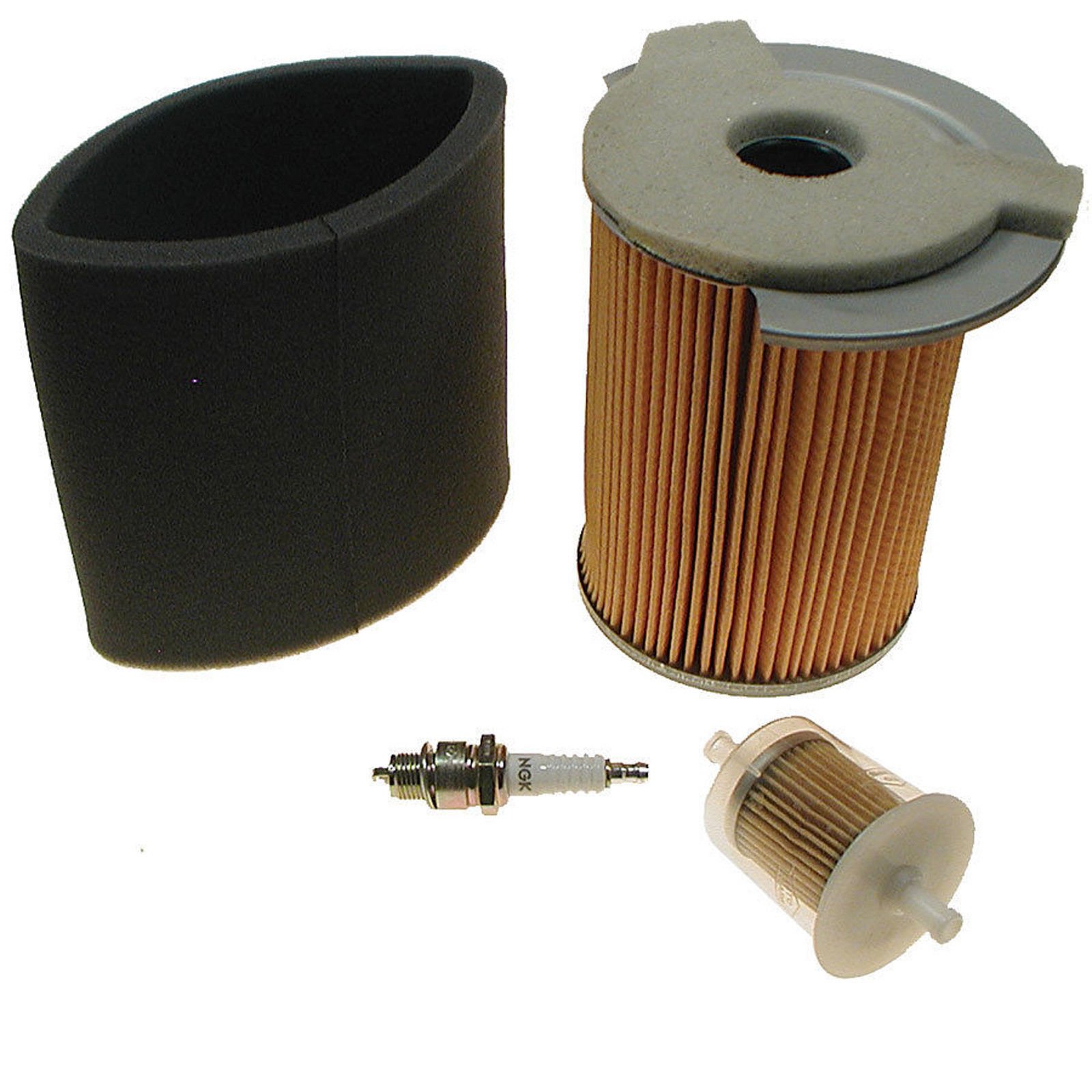
Not every G1 purchase is a repair. Sometimes the cart is running well and you simply want it to keep running well. This kit is that purchase. Inside are four parts that all degrade quietly with use: one spark plug, one in-line fuel filter, one foam pre-filter, and one canister air filter. Each one is a small thing; together they are the difference between a cart that starts on the first turn and one that needs coaxing after a cold night.
The bundle price is what seals it. Buyers consistently report that this kit costs less as a bundle than the same four parts bought individually, and that the pieces fit the G1 as described.
The box weighs 14.4 ounces, which tells you there is nothing bulky inside — these are small consumables, and that is exactly right. Golf Cart King lists it under part number 10967. The one thing to keep straight is that this kit does not address a fault; it prevents one. If your cart is already down, you need the carb or the ignition kit, not a tune-up.
What you are actually buying
- Four matched consumables in one order — plug, fuel filter, foam pre-filter, canister air filter
- Genuinely cheaper as a set than as four separate buys
- 14.4 oz total weight, so a single easy shipment
- Made specifically for the G1 gas cart, not a universal fit
Know before you order
- Maintenance only — it will not fix a cart that is already running poorly
- No belt, no ignition parts, no carburetor included
Buy this if: your G1 is healthy and you want to keep it that way through the season.
Hold off if: the cart is down right now — this resets a running engine, it does not revive a dead one.
8. 10L0L Brake Drum Yamaha G1-G29

Two stamped-steel rear hubs for the G1 and just about every Yamaha cart after it.
This is the longest fitment list on the page. The drum covers the G1 plus the G2, G8, G9, G11, G14, G16, G19, G22 and G29 from 1978 up, in both gas and electric form, and it also cross-fits Club Car DS 1981-1994 alongside the 2018-up Tempo and Villager models. If you maintain a mixed fleet, that is a part worth keeping on the shelf. Fit is the most-discussed positive here, and buyers report the drums seat as expected.
The construction is stamped steel, and the box holds two rear hubs with drum washers — enough for a standard rear brake drum replacement. OEM numbers to match are JU0-G6521-00-00, J17-46521-00, J55-G6521-00, J55-G6521-01, JU0-G6521-00 and J55-G6521-19-00.
Here is the honest bit. Quality has been mixed in owner feedback, with the drum itself drawing both praise and some sharp criticism. The bigger issue is fitment discipline: 10L0L warns that the hub spline and the rear axle shaft spline must match tight, and that if either is worn you should replace both at the same time. Skip that step and a new hub can strip its spline early. Check your axle before you blame the drum.
Where it earns its place: a two-pack of steel hubs with the broadest year coverage on this list, gas or electric.
The catch to plan around: inspect the axle spline first — a worn shaft will wear out a fresh hub, whatever the drum quality.
Suits you if: you are refreshing the rear brakes on any 1978-up Yamaha cart and want both hubs in one box.
Pause if: you have not checked the axle spline for wear — that pairing decides how long these last.
9. Starter Generator Yamaha G1
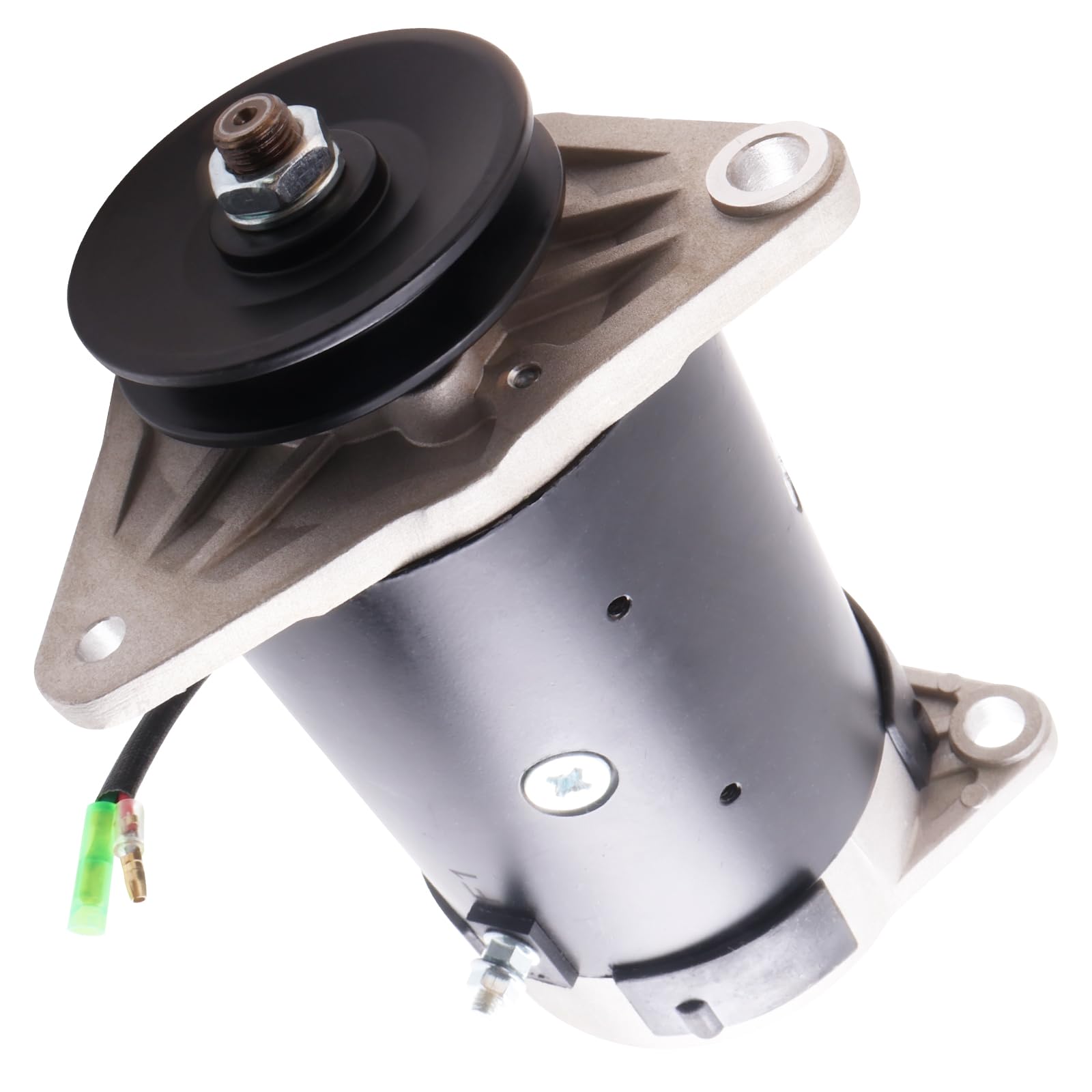
The biggest, heaviest part on the list — and the one with the narrowest year window.
On a 2-cycle golf cart, one unit does double duty: it spins the engine to start it and then charges the battery while you drive. When it fails you get a cart that will not crank, or one that cranks and then drains flat. This replacement runs 12V at 22 amps, with reversible rotation and a keyway on the shaft. It arrives with a harness carrying two bullet terminals on a four-terminal, two-wire setup.
At roughly 18.1 pounds it is the heaviest item here, and that is physics rather than padding — a starter generator is a real motor. The listed dimensions put the field housing at 113 mm and the overall length at 246 mm, with a 17 mm shaft. The fit is tight: this covers the G1 2-cycle from 1978 to 1982 only, and replaces Hitachi GSB107-02 along with Yamaha numbers 10-81100-10-00 and J10-81100-10-00.
The caution is real. Owners praise the build quality, but durability is the weak spot, with several carts losing the unit after very little use. That is the honest trade-off on this part. It is still the right replacement if your original has failed and you have an early G1, but go in knowing this is the one component on the page where longevity is in question.
What’s genuinely solid
- 12V, 22-amp output matching the original spec
- Reversible rotation and a keyed 17mm shaft
- Harness with two bullet terminals included
- Build quality is the part owners speak well of
The trade-off to weigh
- Durability is the weak link, with early failures reported
- 18.1 lbs listed weight — a two-hand install, not a one-hand swap
- 1978-1982 only, the narrowest window of the whole list
Pick it when: you have an early G1 whose starter generator has genuinely failed and you need the correct 12V unit.
Look elsewhere first if: your symptoms are no-spark rather than no-crank — that is the CDI kit’s job.
Know the Specs
Year range and OEM part number
The two lines that decide whether a part fits. The year range tells you which G1 production years the seller built for, and the OEM number tells you which Yamaha original it replaces. Check both against your cart’s year plate and your old part. A match on one but not the other is a red flag — return shipping costs more than doing the check now.
2-cycle vs 4-cycle parts
The G1 is a 2-cycle gas cart, which means it mixes oil into the fuel and has a different top end, ignition and carburetor than a 4-cycle machine. Parts built for a 4-cycle cart will not simply cross over. Every listing above states 2-cycle explicitly, and that is the phrase to look for in any part you buy beyond this list.
What “OEM-equivalent” actually means
It means the aftermarket part is built to the original Yamaha part’s dimensions and function, not that it came out of a Yamaha box. It does not mean it came out of a Yamaha box. That distinction matters for warranty and for how closely the fit is checked — which is why the sellers who publish OEM numbers are the safer buys.
Voltage and amperage on charging parts
A starter generator’s voltage and amperage — 12V and 22 amps here — describe its charging output to the battery. Too low, and your battery never fully recovers between trips. Too high, and you risk cooking it. Match the original spec rather than upsizing.
Common Questions
Will a drive belt for a Yamaha G1 also fit a G2 or G9?
How do I know if my G1 needs a carburetor or just a tune-up?
Does the 10L0L carburetor bolt straight onto a 1981 G1?
Why does my G1 turn over but never fire?
Can I replace just one brake shoe instead of all four?
Do I need to replace the axle shaft when I fit a new brake drum?
Is the starter generator the same as a starter motor on a G1?
How often should a G1 tune-up kit be replaced?
Will a rebuild piston kit fix a weak, smoking G1 on its own?
Are 2-cycle and 4-cycle Yamaha parts interchangeable?
The Bottom Line
The yamaha g1 golf cart parts winner is the A.A Drive Belt because it fixes the most common G1 complaint — lost pulling power — and its 1978-1989 window covers nearly the whole production run. If your cart is running rough or idling poorly, grab the 10L0L Carburetor — it’s the fuel fix that arrives with a kit already in the box. And for a cart that’s running well but due for service, the Golf Cart King Tune-Up Kit is the part to reach for.
How we choose
We do not accept paid placement. Every pick is matched to a real buyer and a real use-case; we do not hands-on test units.
Sources
Specifications: manufacturer listings and product documentation. Review insights: verified customer reviews, as of November 2026. Pricing: not shown on this page (it changes often); check the current price via the retailer link.
As an Amazon Associate, Tactical Gear Guy earns from qualifying purchases. This does not affect which products we feature.