Specs are compiled from manufacturer listings and verified buyer reviews and can change over time — please confirm the key details on the product page before buying.
You want your glutes to actually work, and you want your lower back and knees to stop paying for it. That is the whole decision. A dedicated glute machine holds your hips in a fixed path so the resistance lands on the glutes instead of your spine, and the models below differ mainly in load ceiling, footprint, and pad stability. Below are the eleven worth your attention, sorted so the strongest all-rounder sits first.
This guide is built by comparing the manufacturers’ published specifications and the patterns across verified customer reviews, so you get each pick’s real strengths and trade-offs instead of marketing spin.
Resistance bands, plate-loaded sleds, and foldable benches all train the same muscle group in very different ways. This breakdown of the workout machine glutes options matches each type to your room size and current strength.
Top Picks

How To Choose The Best Workout Machine Glutes
Start with the question nobody asks first: where will this thing live? A glute machine you have to fold away every session tends to get used twice and then abandoned. A machine that stays set up in a corner gets used for years. Measure the floor space before you read a single resistance spec.
Resistance type: bands versus plates
Band-driven machines come with elastic straps that stack to a set ceiling — the FEIERDUN, for example, tops out at 160 lbs across seven levels. Plate-loaded sleds have no built-in ceiling; you slide on your own weight plates and the machine’s rated capacity becomes the limit. Bands are gentler at the top of the rep and cheaper to own. Plates feel heavier and more linear, which most serious lifters prefer for progressive overload.
Weight capacity is not the same as resistance
A machine rated for 600 lbs is telling you what the frame survives, not what you will feel in your glutes. The HA1 carries a 600-pound rating but its bands only deliver 108 lbs of tension. Read both numbers, then match the tension figure to your current strength.
Footprint and storage
The compact end of this category sits around 27 inches deep by 45 inches wide, and the big plate-loaded sleds run past 70 inches on one side. In a garage bay, that gap is meaningless. In a bedroom corner, it decides everything.
Pad and back support
Hip thrusts press your pelvis into a pad under load, so padding thickness and a backrest that adjusts to your torso length matter more than they sound. Look for multiple backrest angles and a non-slip surface — the difference between a stable rep and a sliding one.
Side-by-Side Comparison
| Model | Best For | Resistance / Capacity | Footprint (D x W) | Weight | Amazon |
|---|---|---|---|---|---|
| HVO Hip Abductor Machine★ Best Overall | Full commercial-style setup | 2000 lbs tension / 2000 lbs max | 54.33″D x 64.96″W | — | Amazon |
| Lifepro GluteBlastBest Folding | Small spaces, folding away | 220 lbs max | 27.2″D x 45.3″W | 16.7 kg | Amazon |
| BODYRHYTHM Hip Thrust MachineAll-In-One | Bands included, all body types | 400 lbs max | — | 19.66 kg | Amazon |
| BootySprout Hip Thrust Machine | Travel and floor-level training | 45 lbs tension / 400 lbs max | 29″D x 25″W | 14.92 kg | Amazon |
| FEIERDUN Hip Thrust Machine | Six lower-body movements | 40–160 lbs bands / 350 lbs max | 40.95″D x 26.77″W | 64.7 lbs | Amazon |
| COBA Board Plus | Knee-friendly incline work | 12 resistance levels / 350 lbs max | 21″D x 28″W | 12 lbs | Amazon |
| HA1 2-in-1 Abductor | Inner and outer thigh both | 108 lbs tension / 600 lbs max | 16.1″ x 34.8″ footprint | 44 lbs | Amazon |
| FLYBIRD 2-in-1 Abductor | Quiet apartment sessions | 36 / 72 / 108 lbs / 600 lbs max | 34.8″ front-to-back base | 48.5 lb frame | Amazon |
| HVO Hip Thrust Machine | Plate loading on a budget | 880 lbs capacity | 50.59″D x 57.17″W | 85 lbs | Amazon |
| GMWD Multi-Hip Machine | Fixing left-right imbalances | 450 lbs capacity | 54″D x 38″W | — | Amazon |
| GMWD HRTQ Hip Thrust Machine | Heavy plate-loaded thrusts | 800 lbs capacity | 71″D x 30.98″W | 192 lbs gross | Amazon |
Detailed Reviews
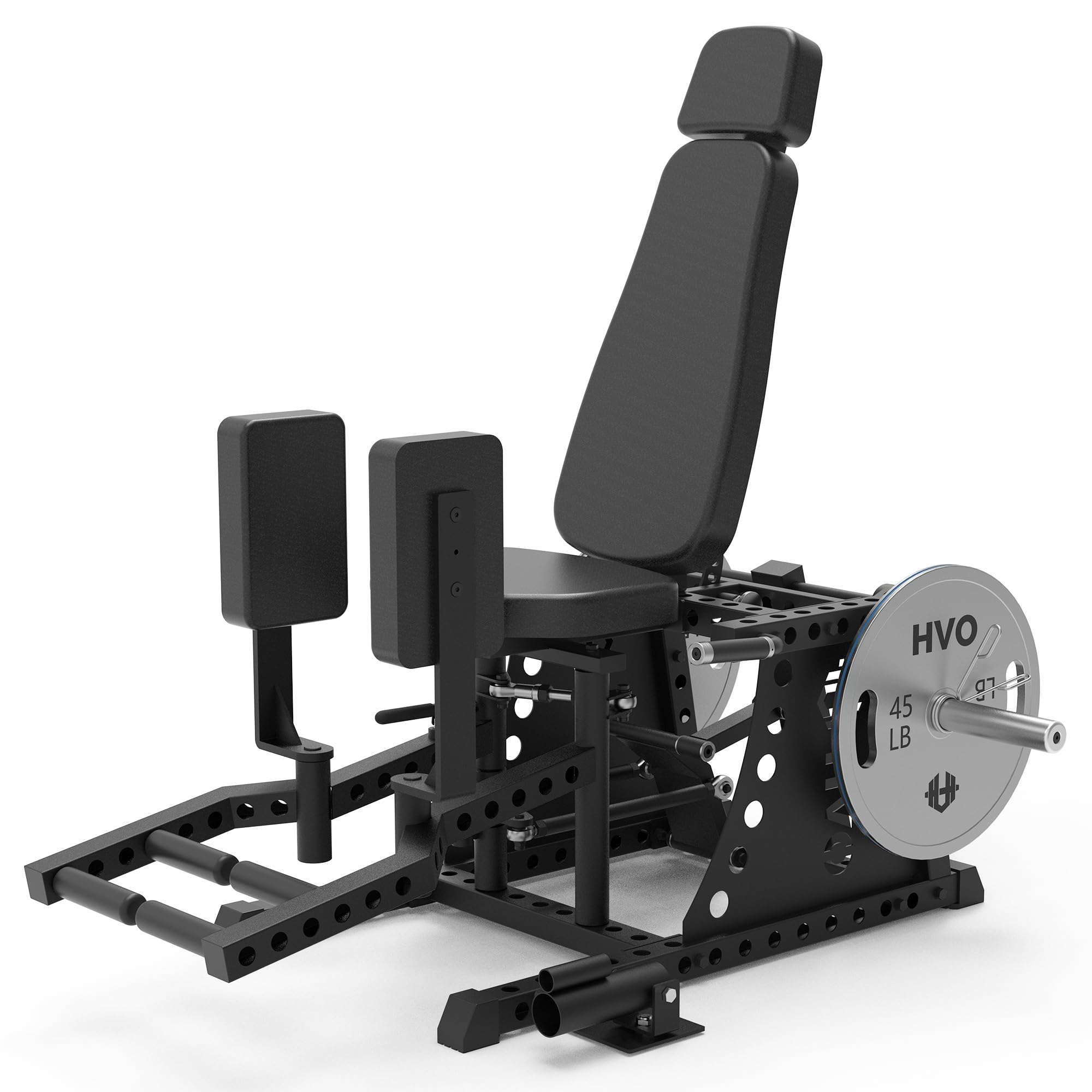
1. HVO Hip Abductor Machine
Our pick — 4.5+★ from 90+ verified ratings; the strongest balance of quality and price.
A commercial-grade hip abductor with a 2000-pound ceiling, built for people who train hard at home.
Of every machine here, this one is the heaviest and most heavily rated for abuse. The 2000-pound tension figure dwarfs the 45-pound tension the BootySprout starter band offers, and the 2000-pound maximum-weight recommendation sits far above the 400-pound rating on the BootySprout or the 350-pound rating on the FEIERDUN. Translated to daily life: you are not going to outgrow the frame, and you are not going to hear it flex under you mid-set. The alloy steel build and the widened, thickened seat and backrest back that up.
The resistance comes in six levels through a lever system rather than stacked bands or loose plates. You flick the lever and you are on the next step of load — no unclipping elastic, no walking to the plate tree. The backrest itself moves through six angle settings, so you can sit upright for a strict hip abduction or recline to shift tension onto a different part of the glute. There is also a landmine attachment on board for compound work with the same frame.
The thing that wins people over is that it genuinely replaces a gym run. The catch is footprint and assembly: this is a large commercial machine, not a fold-away, so it needs a dedicated corner and a real setup session before first use. Fewer ratings than the smaller picks have racked up, but the score is higher — the crowd favorite of the budget options has more volume, yet this holds the stronger position.
What It Brings
- 2000 lbs tension and 2000 lbs max weight recommendation — commercial durability on a home floor
- Six lever-adjustable resistance levels without touching bands or plates
- Six backrest angles plus a built-in landmine attachment for compound movements
- Targets abductors, adductors and all three glute muscles in one seat
What To Weigh
- 54.33″D x 64.96″W takes serious floor space and does not fold
- Build quality draws split views among owners — inspect on arrival
- Assembly is a project, not a five-minute job
Built for: someone who wants a gym-grade abductor and will give it a permanent corner.
Hold off if: your training space has to double as something else between sessions.
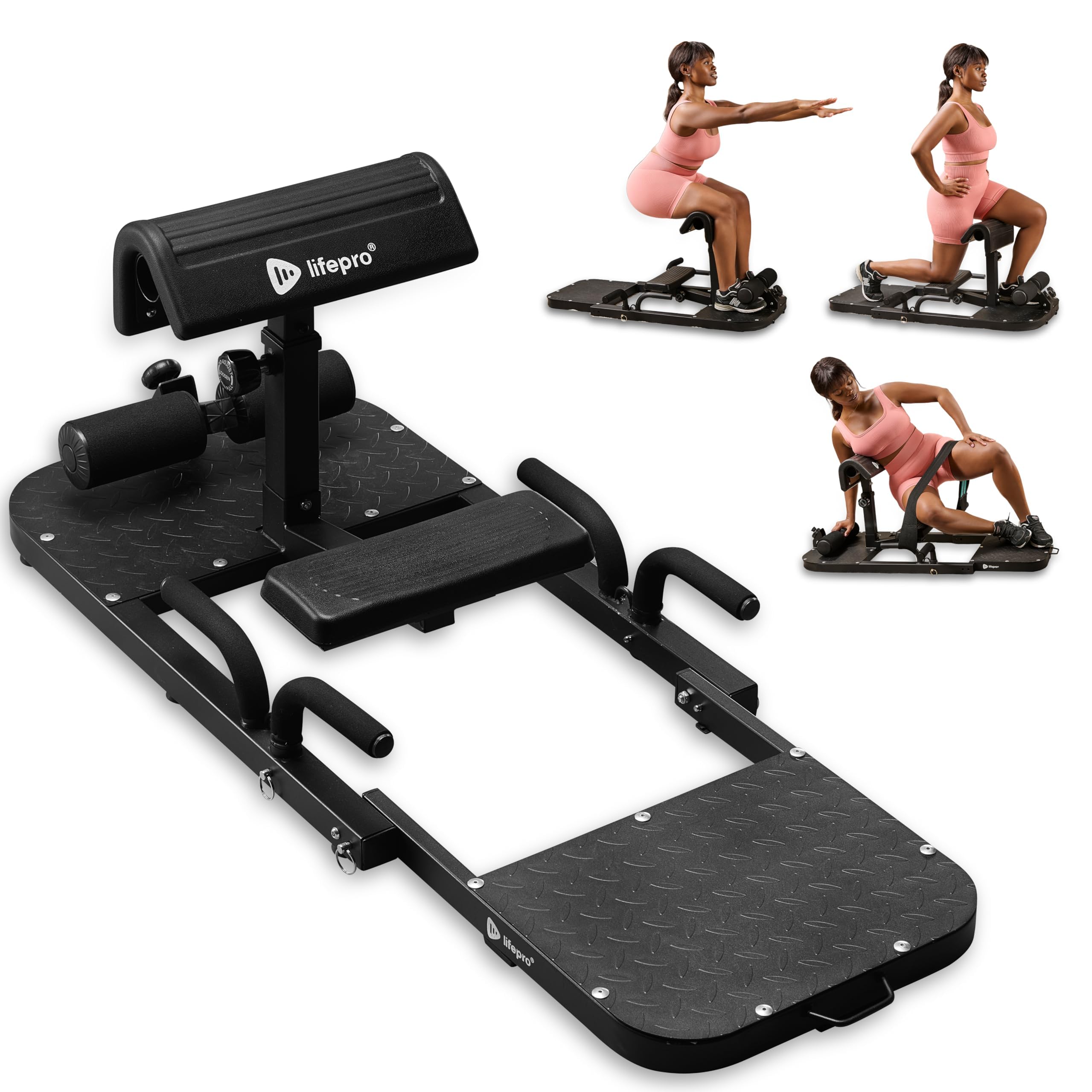
2. Lifepro GluteBlast Hip Thrust Machine – Foldable, Home Gym
The bench that folds to 39 inches and rolls away, so your living room stays a living room.
If the deciding factor is not strength but storage, this is the pick. Open, it measures 27.2″D x 45.3″W x 21.3″H; folded, it shrinks to 39.0″ x 27.2″ x 18.9″, and built-in wheels let you roll it to a closet. Compared with the HVO abductor’s 54.33″D x 64.96″W footprint, this is a machine you can put away. For an apartment or a shared room, that single difference decides which one you actually use.
The powder-coated steel frame carries up to 220 lbs, and the PU leather cushion keeps your hips comfortable through thrusts, squats and core moves. It doubles as a sissy squat machine and a hip thrust bench, plus it handles lunges, planks, tricep dips and push-ups. Adjustable handles and a foot plate are included in the box, and the whole unit weighs 16.7 kg, so one person can move it.
Here is the honest trade: the 220-pound ceiling is the lowest in this group, well under the 350- to 400-pound ratings on the FEIERDUN and BODYRHYTHM, so a heavy lifter will feel capped. The other recurring gripe is a wobbly backrest and bolts that work loose — check and retighten the hardware after the first few sessions. Keep the load within spec and this is a versatile, space-smart glute station.
The folding advantage: Open-and-close portability with wheels is the feature nobody else here matches, and it turns a big-equipment purchase into something a renter can own.
Know the ceiling: At 220 lbs max, this rewards moderate load and high reps rather than heavy loading. Treat the backrest hardware as a maintenance item.
Pick this one if: space is tight and you train with bodyweight and moderate resistance.
Pass if: you plan to load heavy and want a frame rated well past 220 lbs.
3. BODYRHYTHM Hip Thrust Machine
Four resistance bands in the box, an extended frame for taller lifters, and rollers to wheel it aside.
The band package is the reason to look here. You get two hip-thrust bands at 35 lb and 50 lb, plus two bonus 30 lb bands, which lets you stack for progressive overload without buying anything extra. The reinforced steel frame is rated to 400 lbs with anti-slip foot pads, and at 19.66 kg it is about 32% heavier than the BootySprout’s 14.92 kg — a sturdier feel on the floor, at the cost of being less of a carry-along.
The extended design is meant to fit a wider range of body types, with foldable adjustable cushions and foam foot holders you can reposition. Front rollers mean you lift the tail and roll it to storage rather than dragging it. It arrives roughly 70% pre-assembled, which shortens the setup considerably.
It handles hip thrusts, deep sissy squats, lunges and push-ups on one frame. The caveat is the smaller owner base — this is a newer listing, so long-term durability is less documented than on the higher-volume picks. If you want a full band kit and a 400-pound frame from day one, the value is there.
Band kit value: Four bands totalling multiple resistance steps means you start training the day it lands, with no separate band purchase.
Where it asks patience: It ships 70% assembled, so expect a short build session, and the frame’s long-term record is thinner than the established names.
Suits: a lifter who wants bands included and a frame that adjusts to a taller body.
Think twice if: you want a machine with years of owner history behind it.
4. BootySprout Hip Thrust Machine

At 7 inches tall and 14.92 kg, this is the glute trainer that slides under a bed.
This is the travel option. It measures 29″D x 25″W x 7″H — low enough to store against a wall or under furniture — and its lightweight alloy steel frame still handles up to 400 lbs. The band set runs 45, 90 and 135 lbs of resistance, with 45- and 75-lb add-on bands sold separately for more load later. It isolates all three main gluteal muscles, which makes it a complement to lifting, running or swimming rather than a replacement for a squat rack.
Setup is quick and the movement itself is simple: lie back, hook the straps over your hips, and thrust. The NBR foam backrest keeps the spine supported through the range, and the linear bearing straps pull evenly so the resistance does not grab. It is the easiest machine on this list to actually keep using on a busy week.
The recurring caveat is the straps — a few owners have had bands wear or break under sustained use, so check the webbing for fraying and replace rather than patch. It is also the lightest-capacity band unit here at a 45-pound base tension, so advanced lifters will want the heavier band set from the start.
The storage win: A 7-inch profile and 14.92 kg weight mean this machine fits where others cannot go at all.
The wear point: Bands are the consumable part. Inspect the webbing regularly, and plan on the heavier add-on bands if you are strong.
Ideal for: renters, travelers and anyone whose gym has to disappear between sessions.
Look elsewhere if: you want the frame to hold heavy plates instead of elastic.
5. FEIERDUN Hip Thrust Machine
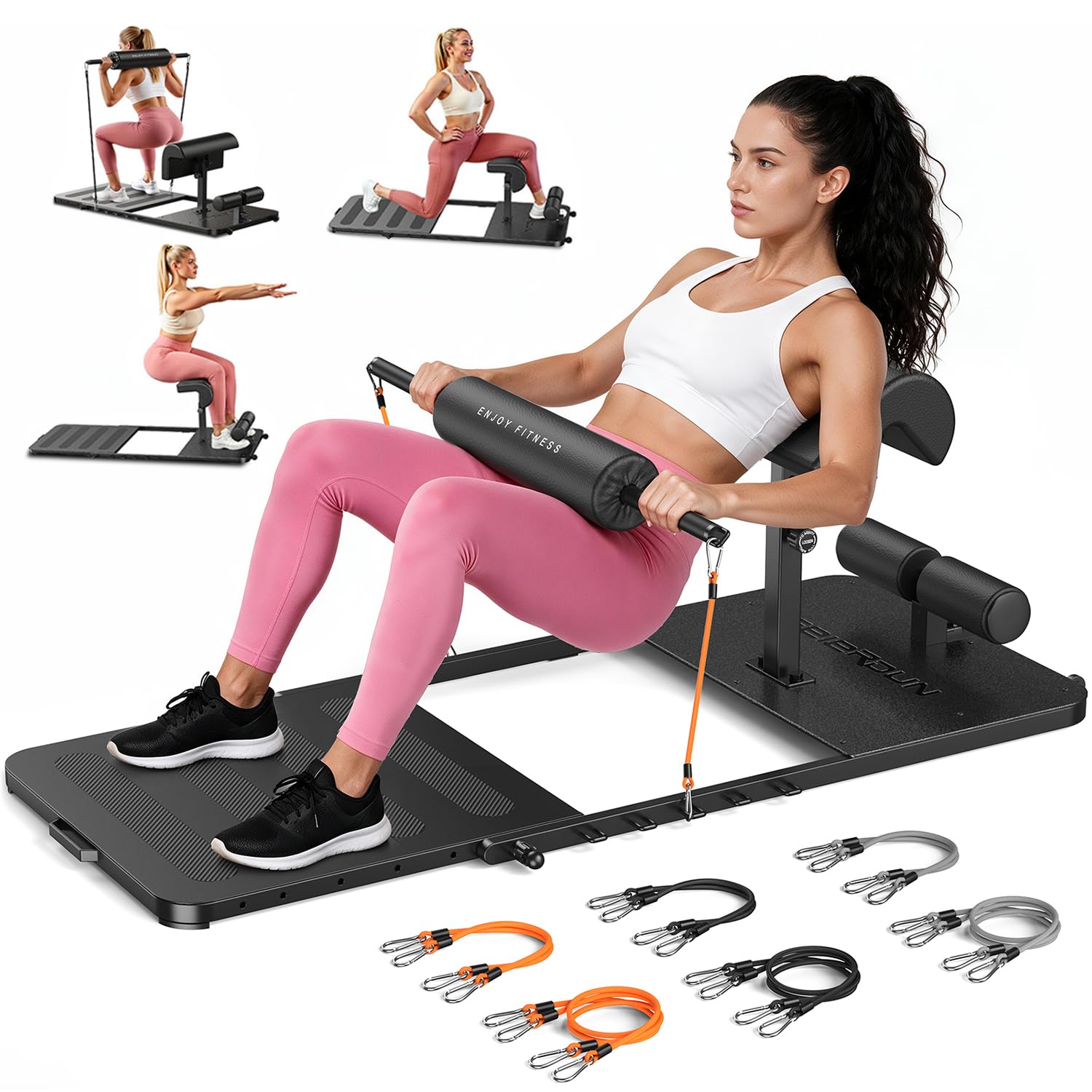
Six lower-body movements, seven resistance steps, and a back pad that tracks your spine.
Where the abductor machines work one plane, this frame covers hip thrusts, glute bridges, sissy squats, Bulgarian split squats, lunges and barbell-style squats on one platform. The resistance comes from three pairs of bands (40, 50 and 70 lb) clipped to five side anchors, and stacking them open up seven levels spanning 40–160 lbs. Short bands load the top of a thrust; long bands add tension through squats and lunges.
Two specs earn their keep in daily use. The first is the 350-pound frame rating on reinforced 2 mm alloy steel with safety lock pins and a wide non-slip rubber front base. The second is the oversized 50 × 19.5 cm back pad, which locks into four fixed angles or a dynamic follow mode that moves with your spine. Fully adjustable across a 7-position backrest, 6-position base length, 5-position connector bar and 3-position foot hook, it fits users from 4’8″ up to 6’4″.
At 64.7 pounds it stays planted rep after rep, and it ships 90% pre-assembled with a stated setup time of roughly 10 minutes. The honest limit is the 160-pound band ceiling — plenty for most home lifters, but short of what a plate-loaded sled allows. The dual-function pad locks your pelvis stable for thrusts and doubles as neck and shoulder cushioning for squats.
Why It Earns Its Spot
- Six exercises on one frame — thrusts, bridges, sissy squats, split squats, lunges, barbell squats
- Seven resistance levels from 40 to 160 lbs using three band pairs and five anchors
- Back pad with four fixed angles plus dynamic follow mode; fits 4’8″ to 6’4″
- Ships 90% pre-assembled with a stated 10-minute setup
Where It Tops Out
- 160 lbs of band tension is the ceiling — no plate loading
- At 64.7 pounds it is a two-person move to reposition
- Band anchors need periodic checks for wear
Best fit for: a home lifter who wants one machine to cover the whole lower body.
Not for: anyone who needs to load past 160 lbs of resistance.
6. COBA Board Plus
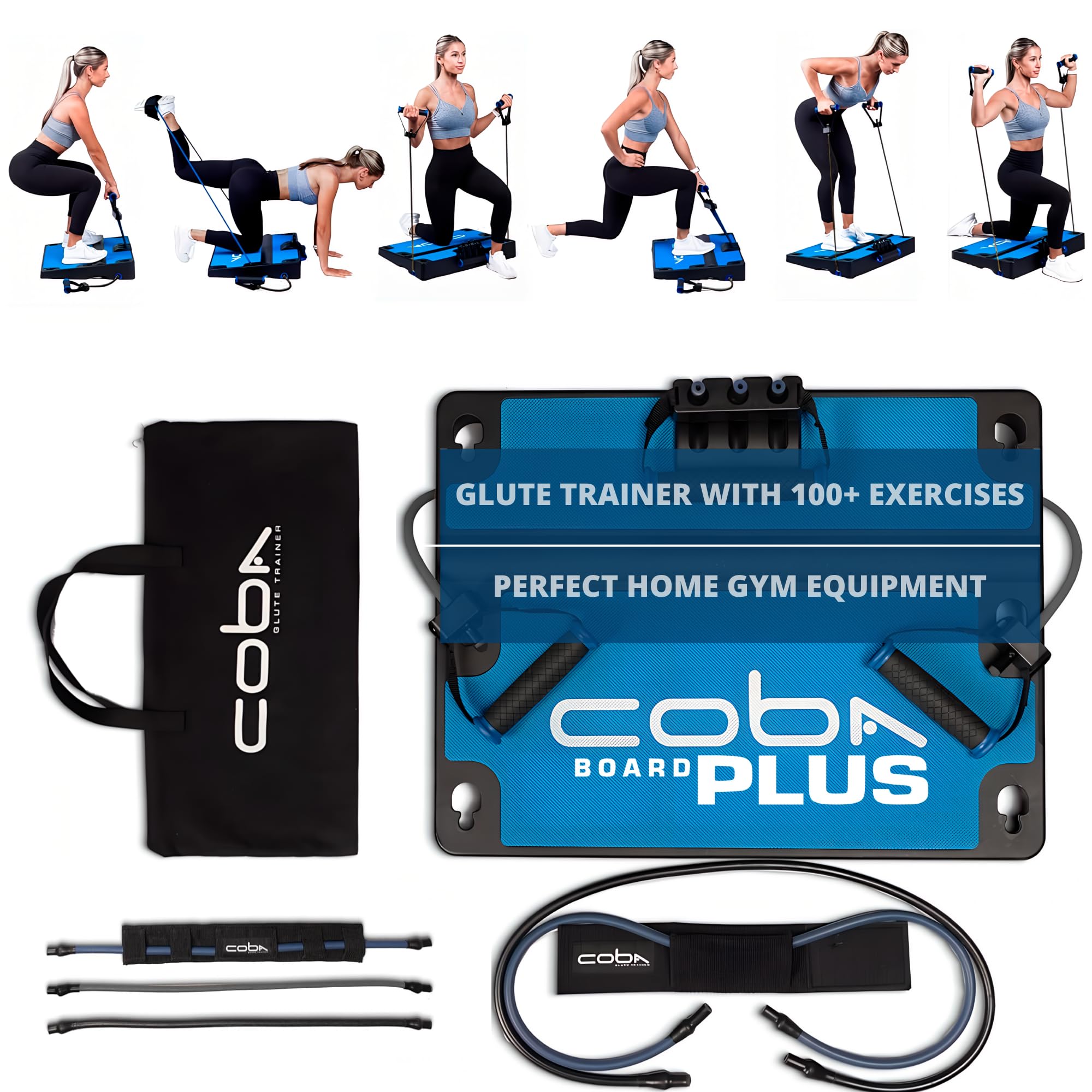
A 12-pound board with a 7-degree tilt that puts your hips in the driver’s seat for squats.
The defining number here is seven degrees. That patented incline positions you so the work lands on the glutes rather than the knees and quads, which is the reason to choose this over a hip thrust bench if your knees complain. It is also 12 pounds and folds flat enough to slide under a bed or sofa, so it stores where a full frame cannot.
Twelve resistance levels and stackable bands let you scale from light activation to harder strength work, and it covers squats, lunges, deadlifts, hip thrusts, kickbacks and bridges — plus dozens of upper-body and core exercises. The platform has an anti-slip surface and reinforced anchors, and it ships with three handles, a glute bridge strap, a kickback strap, nine resistance bands, a nylon carry bag and an instructional booklet. A free video library with over 100 workouts is included.
The catch is what a board can and cannot do. With a 350-pound max weight recommendation but no mechanical sled, resistance is entirely band-based — you will not feel the same heavy load a plate-loaded machine delivers. It rewards consistency and controlled reps, not maximal lifting.
The incline logic: Seven degrees of tilt is a small angle with a real effect — glute-dominant positioning that eases knee and quad strain on every squat.
Set your expectation: Bands only, no plates. Great for rep work and joint comfort, less so if you want to chase a heavy single.
Choose it if: your knees dictate the training style and you want a full kit that packs into a bag.
skip it if: progressive plate loading is the point of the purchase.
7. HA1 2-in-1 Hip Abductor and Adductor Machine
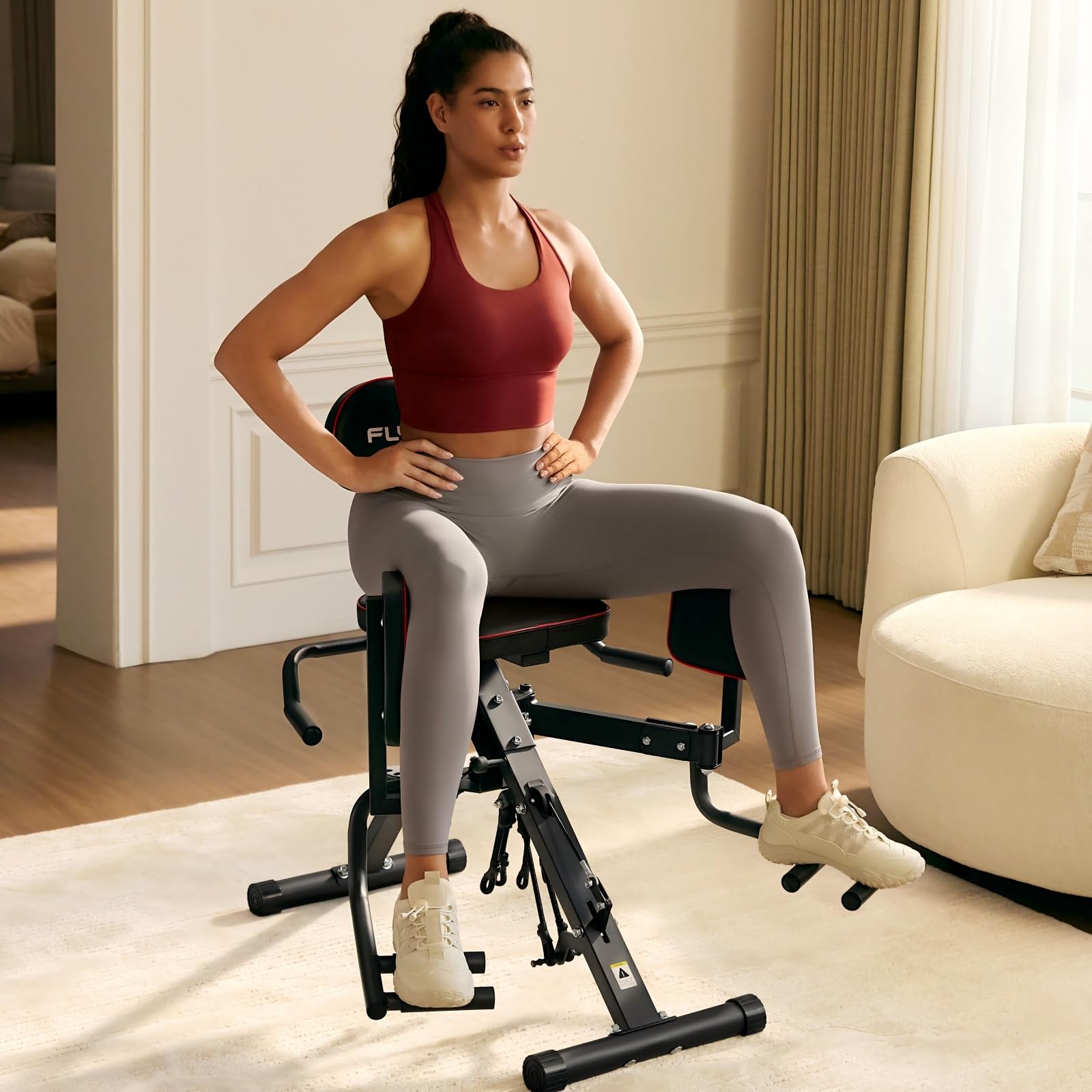
Abduction and adduction on one seat, with 108 pounds of band tension to share between them.
Most machines here work one direction. This one flips: pull the spring-lock pin to switch between abduction and two adduction start angles, and flip the thigh pads 180 degrees to change modes without leaving the seat. The narrow start suits beginners or limited flexibility; the wide start adds range of motion as you progress. Six 18-lb bands bring the total to 108 lbs, and you add or remove them to set intensity.
The 600-pound maximum weight recommendation is the highest of the seated band machines here, and the oversized 13.2 × 13.6 inch seat keeps you planted through each rep. Dual-row foot bars let you shift foot placement and torso position to bias the upper, mid or lower glutes, and the 16.1 × 34.8 inch footprint fits an apartment, bedroom or garage corner. At 44 pounds it is steady on the floor without being immovable.
The design is aimed at desk workers, postpartum training and older adults, with a recommended height up to 6 ft. The limitation is inherent to the format: 108 lbs of band tension, split between two movements, will feel light to a strong lifter. The frame is covered for a year and the bands for six months.
The mode switch: Changing from abductor to adductor by pulling a pin and flipping the pads means a full inner-and-outer session without moving your body to a second machine.
Watch the tension ceiling: 108 lbs total is a modest load. Factor in the band warranty if you train often.
Right for: a compact home setup that needs both thigh directions from one seat.
Not the one if: you already lift heavy and need more than 108 lbs of resistance.
8. FLYBIRD 2-in-1 Hip Abductor & Adductor Machine

Built to move without a sound, so you can train at six in the morning in an upstairs flat.
The steel frame and smooth mechanical structure are tuned for quiet travel through the full range, with no jerking and no rattle. If your machine shares a wall with someone else’s bedroom or sits above a downstairs neighbor, that is the spec that matters. The spring-lock pin switches between abduction, min adduction and max adduction in seconds.
Six on/off elastic bands give 36, 72 and 108 lb settings, enough for rehab and activation work, endurance sets, or harder strength blocks. The dual foot bar keeps your feet locked and your body stable, and shifting your upper body angle forward, upright or back — combined with different foot and toe positions — lets you bias the upper, mid or lower glutes. The 34.8-inch front-to-back base and 48.5 lb frame support up to 600 lbs.
Comfort is handled with evenly distributed padding that is easy to clean. The honest note is the same limit the HA1 shares: 108 lbs of band tension will not satisfy a heavy lifter, though the 600-pound frame rating means the machine itself is not the weak link.
Built for quiet: A 48.5 lb frame and a smooth mechanical path mean apartment-friendly sessions without the clatter of a plate sled.
Frame versus bands: The 600 lbs frame rating outclasses the 108 lbs the bands can deliver — the resistance is the narrow point, not the build.
A match for: anyone training early or late in a shared building.
Different machine needed if: your strength work runs heavier than 108 lbs.
9. HVO Hip Thrust Machine
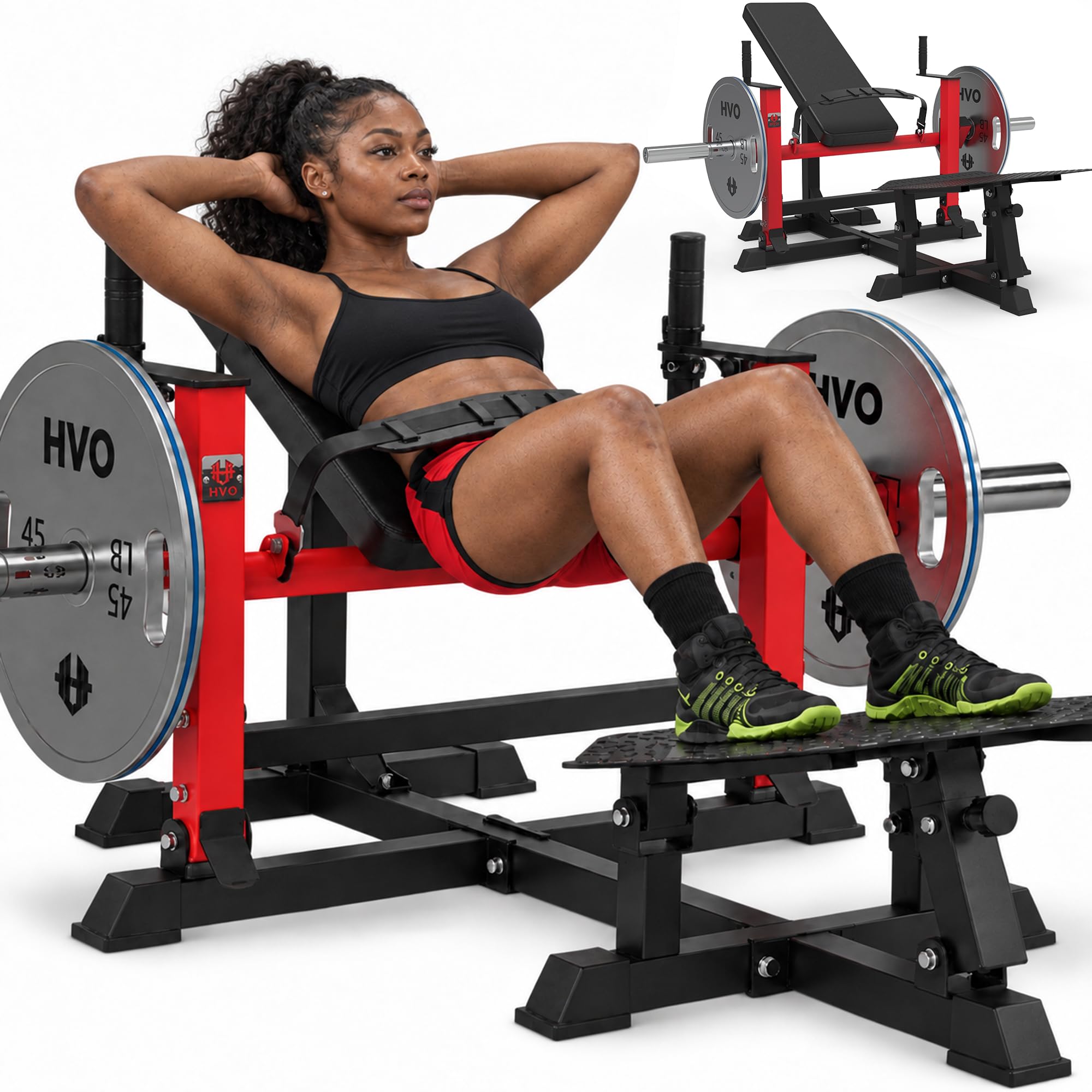
A plate-loaded sled rated to 880 pounds, with a back pad that follows your spine through the rep.
This is the highest-rated machine on the list for a reason: it does the one job that matters with almost no fuss. The 880-pound capacity accepts both 1-inch standard and 2-inch Olympic plates, so your existing weight stack transfers straight over — no new bands to buy. A body-following back pad and a hip-fitting waist belt move with your motion instead of pinning you to a fixed arc, which is where free-weight setups fall short.
The adjustable waist pad and a four-level textured foot platform let different heights find a workable position, and the non-slip footplate plus integrated grip handles keep you stable under load. The footprint is roughly 50.6″ D × 57.2″ W, so it suits a garage gym or a dedicated room. Assembly is straightforward and it works as intended out of the build.
Two things to plan for. At 85 pounds it is a heavy, planted machine — good during training, less fun when you want to move it. And it is plate-loaded only, meaning the weight plates are not included and you supply your own. If you already own plates, this is the most efficient path to loaded hip thrusts.
Where It Shines
- 880 lb capacity with 1-inch and 2-inch plate compatibility — your plates carry over
- Body-following back pad and waist belt track your motion instead of fighting it
- Four-level textured foot platform and non-slip footplate for stable positioning
- Straightforward assembly for a plate-loaded sled
The Trade-offs
- Weight plates are not included — budget for those separately
- 85 pounds and a 50.6″ x 57.2″ footprint mean a permanent spot
- Not a fold-away design in any sense
Made for: a home lifter with plates already on the floor and a permanent gym space.
Consider another pick if: you have no plates yet or need to reclaim the floor between workouts.
10. GMWD Multiple Hip Abductor Machine with 9 Height Settings
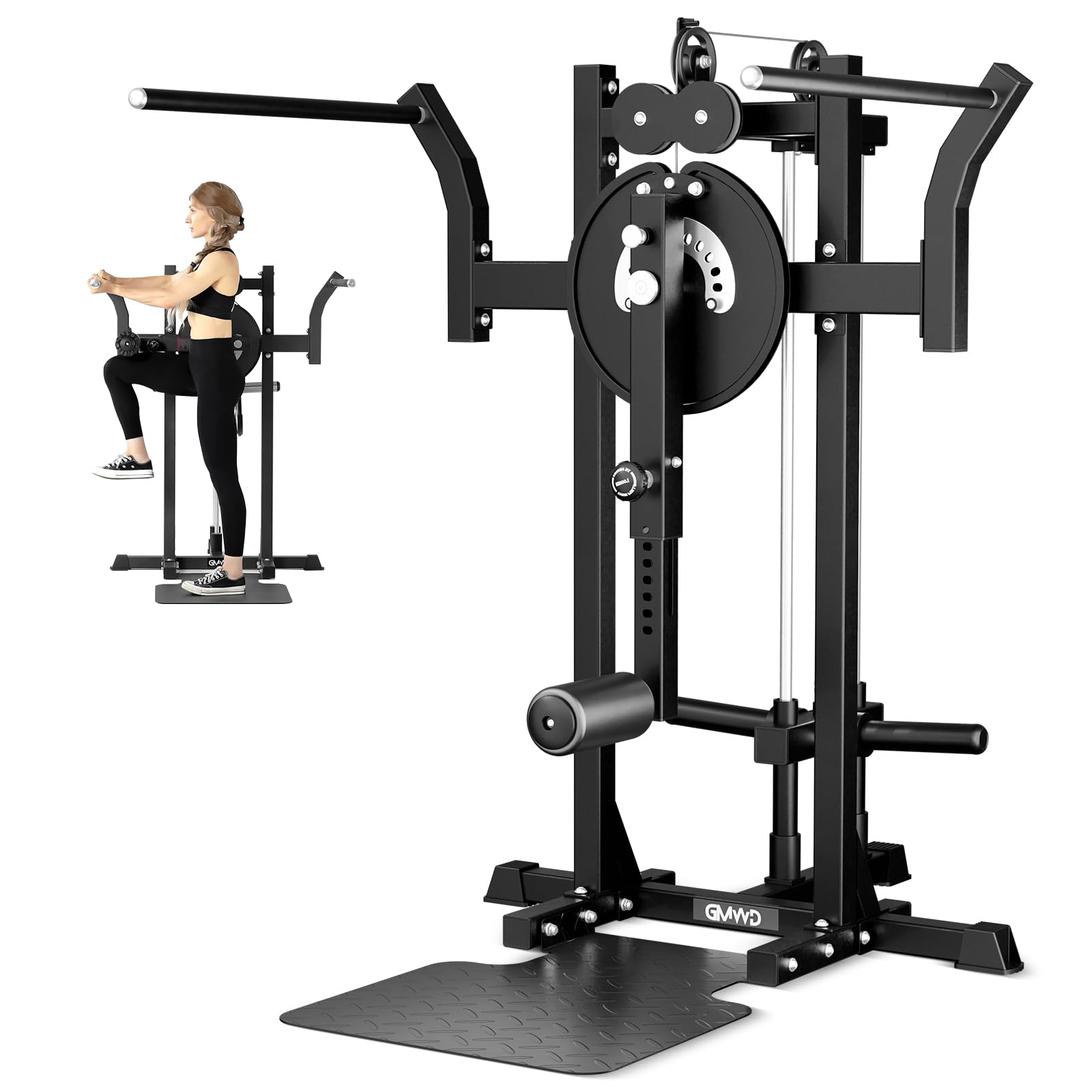
One hip at a time, which is exactly how you find out one side is stronger than the other.
The whole design premise is unilateral work. You train each hip independently, which exposes and corrects left-right strength gaps that a two-legged machine hides. You stand on the platform, set the starting position for the movement you want, grab the handles for stability, and go — plate-loaded up to a 450-pound rating, with nine height settings to dial the start point to your frame.
Using plates rather than bands matters here. The stable environment lets you add working weight more efficiently than an ankle strap on a cable stack, so progressive overload is easier to chase. The footprint is 54″D x 38″W x 56″H and the design keeps it space-friendly, and the handles let you brace so you can focus on the working hip rather than balancing.
Build quality and functionality carry this machine, and it stays compact for a plate-loaded frame. The installation manual is the weak point — expect to work through the instructions carefully or find a video, and check the frame’s stability on your floor once assembled. Built right, it is the most precise tool here for hip balance.
The imbalance fix: Training one hip at a time is the only way to see whether the left or right side is lagging, and this machine is purpose-built for it.
Setup patience: The manual is not the clearest. Budget extra time on assembly and verify stability before you load it.
Best for: lifters chasing balanced hip strength and plate-loaded progression.
Weigh the effort if: you want a quick build and a two-legged movement.
11. GMWD Hip Thrust Machine
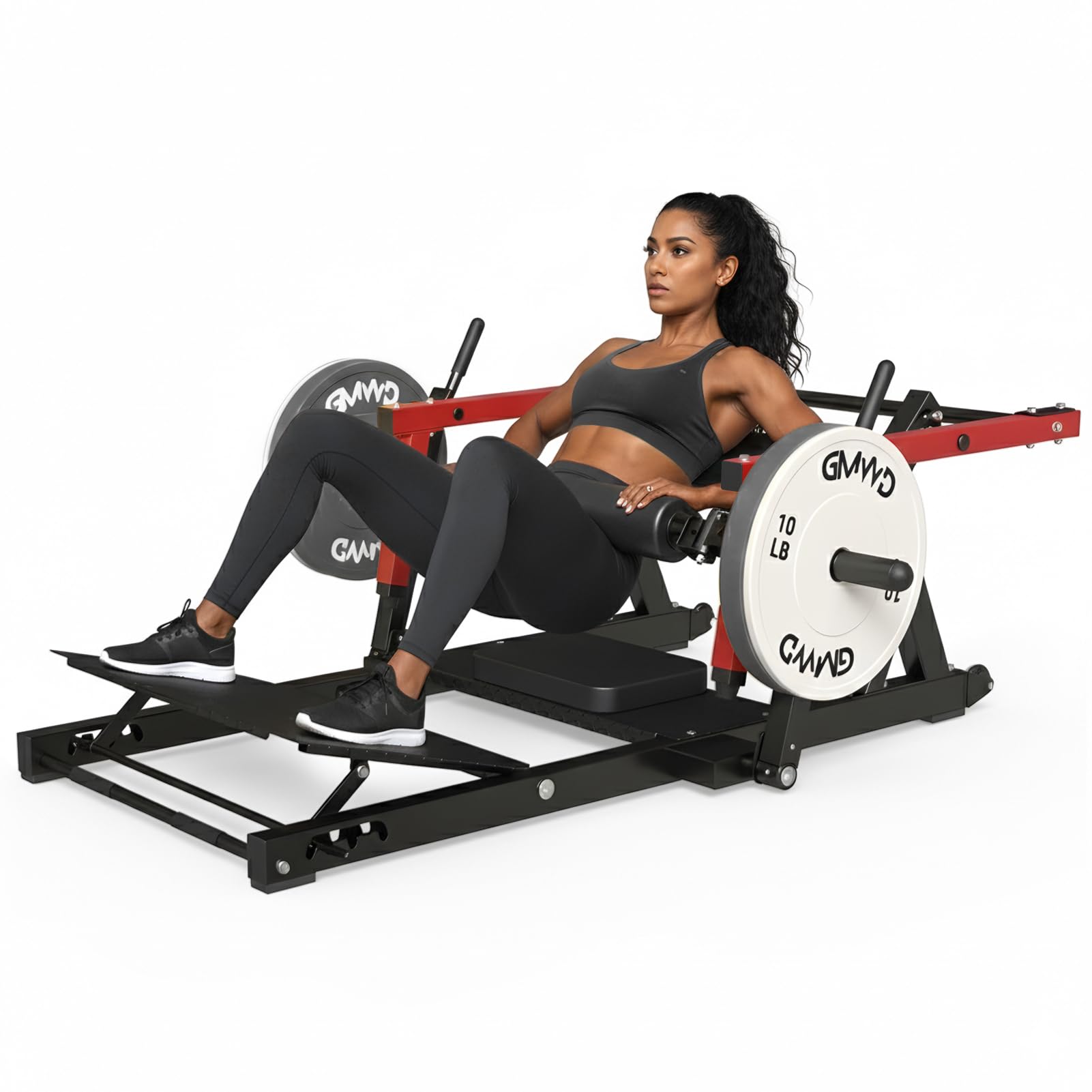
Fourteen-gauge steel, an 800-pound rating and a weight holder built to swallow 500 pounds.
This is the machine for someone who intends to load it heavy and leave it standing. The 14-gauge steel frame carries up to 800 lbs, and the weight holder accepts up to 500 lbs (250 lbs each side) with a three-position adjustable pedal and both 1-inch and 2-inch plate compatibility. The padded back pad supports the full length of the spine, which is harder to achieve with a barbell setup.
A safety limiter is built in: grip handles sit on each side of the shoulder pad frame, and controlling one handle brings the machine to a precise stop. Commercial-grade dual pivot bearings keep the movement smooth, and two rear support frames brace the base. The footboard is 21.8″ × 31.1″ with three angle positions to suit your height.
The obvious consideration is size. The assembled dimensions run 31″ L x 71″ W x 22″ H with a gross weight of 192 lbs, so this is a garage-gym purchase, not a bedroom one — it is the longest machine here next to the HVO abductor’s 54.33-inch depth. The support bar also draws mixed feedback, so plan the setup carefully and test that stop mechanism before you load up.
The load story: An 800-pound frame rating and a 500-pound weight holder mean the ceiling is your strength, not the steel.
The floor story: 71 inches of width and 192 lbs gross weight need a real space, and the support bar deserves a careful test run.
For the lifter who: has a garage bay, a plate stack, and heavy hip thrust ambitions.
Better to reconsider if: your training corner is measured in feet rather than a bay.
Know the Specs
Maximum Weight Recommendation
This is what the frame is built to survive, not what you will feel in your glutes. A 600-pound rating on the HA1 tells you the steel holds up; the 108 lbs of band tension tells you what the movement actually delivers. Match your training load to the tension figure and treat the frame rating as your safety margin.
Tension Supported
This is the resistance your muscles work against. Band machines cap out — the FEIERDUN at 160 lbs, the HA1 at 108 lbs — while plate-loaded sleds have no built-in ceiling and you add your own plates. Pick the tension figure that matches where you are now and where you expect to be in a year.
Footprint
A compact band machine sits around 16 to 27 inches deep; a plate-loaded sled runs past 50 and sometimes 70 inches. This is the number that decides whether the machine lives in the room you train in or stays folded in a closet. Measure your space before choosing.
Foot Platform and Backrest Adjustment
Multiple foot positions let you shift tension across the upper, mid and lower glutes. Adjustable backrest angles serve the same purpose and also fit the machine to your torso length. Three-, four-, six- and seven-position setups appear across this list, and more adjustment means a better fit for more bodies.
Common Questions
Will a hip thrust machine fit in a small apartment bedroom?
Do I need to buy weight plates separately for a plate-loaded machine?
How long does the assembly take on these glute machines?
Is a band hip thrust machine or a plate-loaded machine better for building glutes?
What does a hip abductor machine train compared with a hip thrust machine?
Can I use a glute machine if my knees bother me during squats?
What resistance bands come with the BODYRYTHM Hip Thrust Machine?
How much floor space does the HVO Hip Abductor Machine need?
Will a glute machine help correct one hip being stronger than the other?
Are the resistance straps on a hip thrust machine replaceable?
The Bottom Line
The winner for most people is the HVO Hip Abductor Machine, because its 2000-pound tension and load ratings mean you will never outgrow it and its six lever-set levels are adjustable mid-set without touching a band. If your space is the real constraint, reach for the Lifepro GluteBlast — it folds to 39 inches and rolls on wheels, which is the difference between a machine you store and a machine you use. And if you already own a stack of plates, the HVO Hip Thrust Machine at 880 pounds of capacity with both 1-inch and 2-inch compatibility is the most efficient route to loaded hip thrusts at home. Whichever you pick, check the tension figure against your current strength — that number, not the frame rating, is what your glutes will actually feel.
How we choose
We do not accept paid placement. Every pick is matched to a real buyer and a real use-case; we do not hands-on test units.
Sources
Specifications: manufacturer listings and product documentation. Review insights: verified customer reviews, as of November 2026. Pricing: not shown on this page (it changes often); check the current price via the retailer link.
As an Amazon Associate, Tactical Gear Guy earns from qualifying purchases. This does not affect which products we feature.