Specs are compiled from manufacturer listings and verified buyer reviews and can change over time — please confirm the key details on the product page before buying.
Your feet go numb around the second hour, the slush creeps in at the seam, and by lunch you are stomping your toes just to feel them again. That is the winter jobsite tax — and it is avoidable. Below you will find the pairs that actually hold heat on a frozen pour, keep water out at the welt, and survive a steel toe meeting a dropped beam.
This guide is built by comparing the manufacturers’ published specifications and the patterns across verified customer reviews, so you get each pick’s real strengths and trade-offs instead of marketing spin.
Two things decide whether a winter work boot earns its keep: how much insulation is packed around the toe box, and whether the waterproofing is a real sealed build or a spray-on promise. This page lays out both, along with what the best work winter boots for men actually feel like after a full shift on cold concrete.
Top Picks

How To Choose The Best Work Winter Boots for Men
Numb toes on a jobsite are a safety problem, not just a comfort one. When your feet go cold you stop feeling the ladder rung, the rebar, the uneven gravel. Four things decide whether a pair keeps you safe: how much insulation is inside, what the toe cap is made of, whether the waterproofing is sealed into the build, and how the sole grips ice.
Insulation grams: the number that decides your shift
Boot makers rate warmth in grams of synthetic insulation, written as a number followed by “G”. A 600G boot is a moderate winter build — fine for active work above freezing. A 1200G boot carries 1200 grams of fill in that same shell, which keeps toes comfortable on a frozen slab where you are standing still. If you are mostly moving, moderate fill breathes better. If you stand at a machine or a gate, go higher.
Steel toe or composite toe
Both protect the same way — they meet the ASTM F2413 impact and compression standard. Steel is heavier but thinner, so it leaves more room inside the toe box. Composite is lighter and does not conduct cold the way steel can, which matters in a boot you wear through February. Neither one is safer; the choice is about weight and warmth.
Rubber shell versus leather build
Rubber and neoprene boots are the simplest waterproofing you can buy — the whole shell is the barrier, so there is no seam to leak. Leather work boots are more breathable and more supportive underfoot, but they depend on sealed construction. Match the material to the job: wet slush and standing water favor rubber; dry cold and dry concrete favor leather.
Fit and the thick-sock question
Winter boots get worn with thicker socks, and a jammed toe against a steel cap is uncomfortable all day. Size for the sock, not the bare foot. Every pick below has sizing notes from real buyers, so check those before you commit to a half size.
Side-by-Side Comparison
| Model | Best For | Insulation | Toe Protection | Waterproof Build | Amazon |
|---|---|---|---|---|---|
| TIDEWE Rubber Work Boots (6mm Neoprene)★ Best Overall | Wet slush and standing water | 6mm neoprene, comfort rated -4°F to 50°F | Reinforced toe | 100% waterproof CR Flex-Foam shell | Amazon |
| ANGRYRAM Winter Steel Toe BootsBudget Safety Pick | Cold construction sites on a tight budget | Fleece lining | ASTM F2413-18 steel toe | Waterproof build | Amazon |
| TIDEWE Steel Toe & Shank Work BootsPuncture-Proof Pick | Puncture risk on debris-strewn ground | 6mm neoprene | Steel toe plus steel shank | 100% waterproof rubber and neoprene | Amazon |
| FREE SOLDIER Snow Boots | Snow removal and deep-drift walking | 3M insulation cotton plus graphene insole | — | EVA-sealed shell with waterproof nylon upper | Amazon |
| ROCKY Sport Utility 600G | All-day walking on a mixed winter site | 600g 3M Thinsulate Ultra | Composite safety toe | Rocky waterproof construction | Amazon |
| ROCKY Blizzard Stalker 1200G | Extreme cold, standing work | 1200g 3M Thinsulate Ultra | Steel toe, 75 lb impact rated | Rocky waterproof construction | Amazon |
| SAFETOE Cow Leather Safety Boot | Leather feel with a safety toe | Thermal insulation tech | Composite toe, ASTM F2413 | Sanvlar-Tex WR tech | Amazon |
| Timberland PRO Endurance 8″ | Long factory and warehouse shifts | Insulated build | Steel safety toe | Waterproof leather | Amazon |
| Wolverine I-90 Durashocks 6″ | Comfort on hard floors | Insulated build | — | Water-resistant leather | Amazon |
| Timberland PRO Direct Attach 6″ | Cold-weather warehouse and outdoor work | 200 grams insulation | Steel safety toe | Seam-sealed waterproof leather | Amazon |
| Carhartt Ground Force 10″ Wellington | Pull-on convenience in rain and mud | Insulated build with FastDry lining | Composite toe, ASTM rated | Storm Defender technology | Amazon |
Detailed Reviews
1. TIDEWE Rubber Work Boots for Men and Women, 6mm Neoprene
Our pick — 4.5+★ from 6,500+ verified ratings; the strongest balance of quality and price.
A full rubber shell and 6mm neoprene that shrugs off slush, standing water, and a frozen hose line.
The one number worth memorizing here is the comfort rating: -4°F to 50°F (-20°C to 10°C). That is a boot built for genuine winter, not a three-season rubber boot with a warm lining added as an afterthought. The 6mm neoprene (a thick, flexible foam that traps body heat) wraps your whole foot, and TIDEWE claims the neoprene reflects up to 90% of your body heat back to your foot. In practice that means you can stand in a puddle at the loading dock and not feel it through the sole.
The waterproofing is the strongest part of the design. Because the CR Flex-Foam rubber shell is the boot, there is no seam to fail and no leather to re-treat — you hose them off and they are done. Owners repeatedly say they outperform rubber brands costing far more. The reinforced toe adds a layer where you kick pallets and push scrapers.
What wins people over is the build itself — the shell quality is the single thing buyers talk about most, followed closely by how comfortable that neoprene feels over a long shift. The honest catch is fit. Ordering advice in the listing is blunt for a reason: check the size chart first, and note that the 11-14 sizes displayed are men’s. Some buyers land a pair that feels too big, so measure rather than guess.
Where This Shell Earns Its Keep
- Rating spans -4°F to 50°F, so it covers real winter work
- No seam means no leak point — hose it clean and move on
- 6mm neoprene stays flexible as the temperature drops
- Reinforced toe for kicking and kneeling
- Slip-on design with a heel protrusion that helps you peel them off
What To Sort Before You Order
- Sizing runs generously — the listing itself says to mind the chart
- Fully sealed neoprene holds heat and does not breathe like leather
- Not the boot for dry-indoor warehouse work
Settle on this one: anyone standing in wet slush, mud, or standing water for a shift, and who wants a boot they can rinse clean.
Keep shopping instead if: your day is dry and indoor — the trapped heat becomes a nuisance fast.
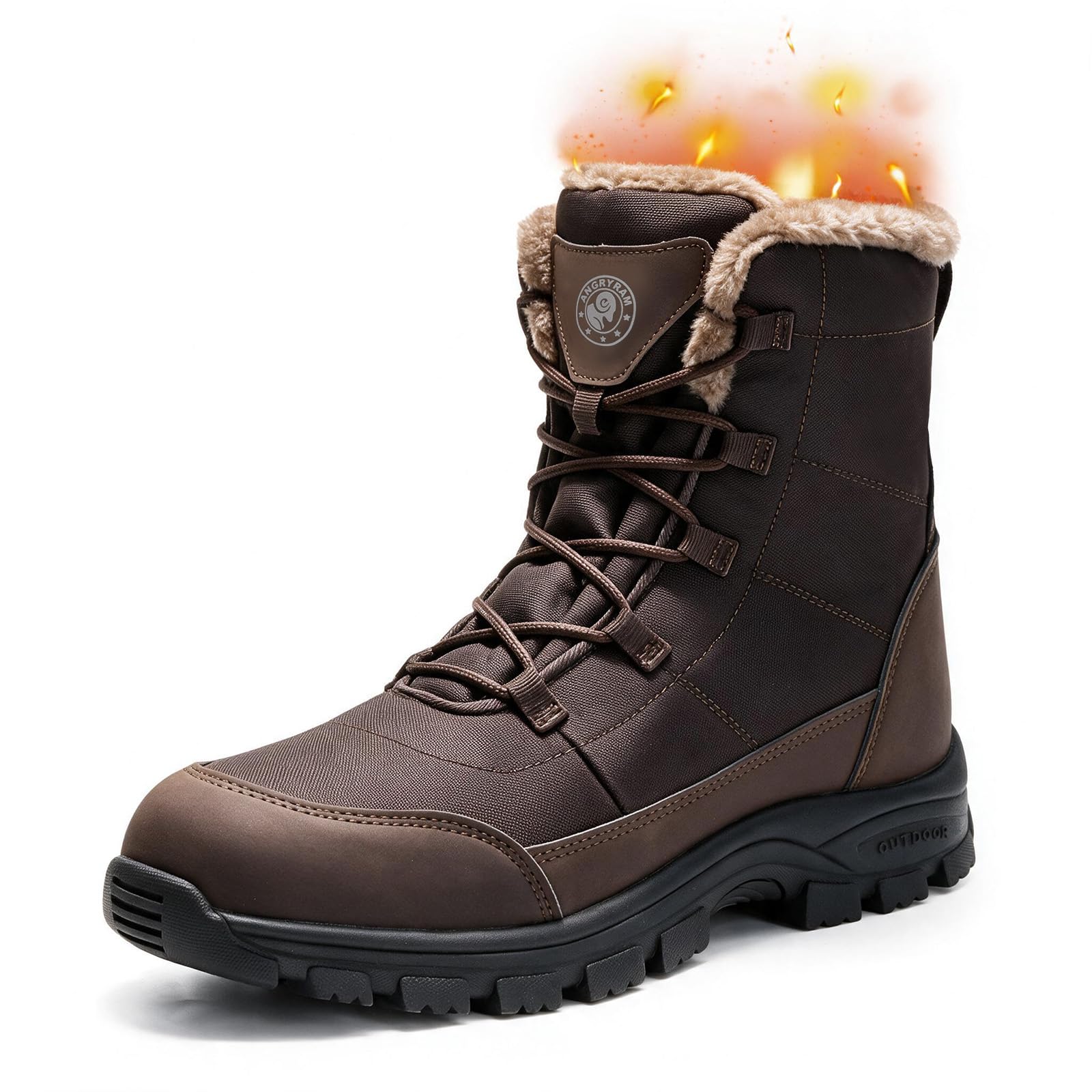
2. ANGRYRAM Winter Steel Toe Boots for Men
The entry point for a certified steel cap without giving up on winter warmth.
Buying your first pair of safety-toe winter boots on a tight budget? Start here. The toe cap is certified to ASTM F2413-18 (the standard that sets impact and compression resistance for protective footwear), so it has been tested to a defined level rather than just looking tough. Under the foot sits a puncture-resistant midsole — a plate that stops a nail or screw from pushing up through the sole.
Warmth comes from a fleece lining rather than a gram-rated synthetic fill. That is a lighter winter build than the insulated leather boots further down this page, and it is best suited to cold-but-not-brutal days and active work where you generate your own heat. The slip-resistant outsole rounds out the package for icy walkways and wet shop floors.
It is a newer listing with a smaller review history behind it, so weigh that when you compare it against the well-established picks. The trade-off is straightforward: you get certified protection and fleece warmth at the lowest tier here, but you do not get the 1200g fill or the leather support of a premium winter work boot. Treat it as the sensible starter pair, not the last pair you will buy.
Who this fits: cold-weather construction, warehouse, and outdoor jobs where the safety cap is non-negotiable and warmth is a secondary want.
Suits you if: the steel-toe certification is your must-have and you want to spend as little as possible to get it.
Walk past if: you stand still in sub-freezing air all shift — fleece alone will not carry you through it.
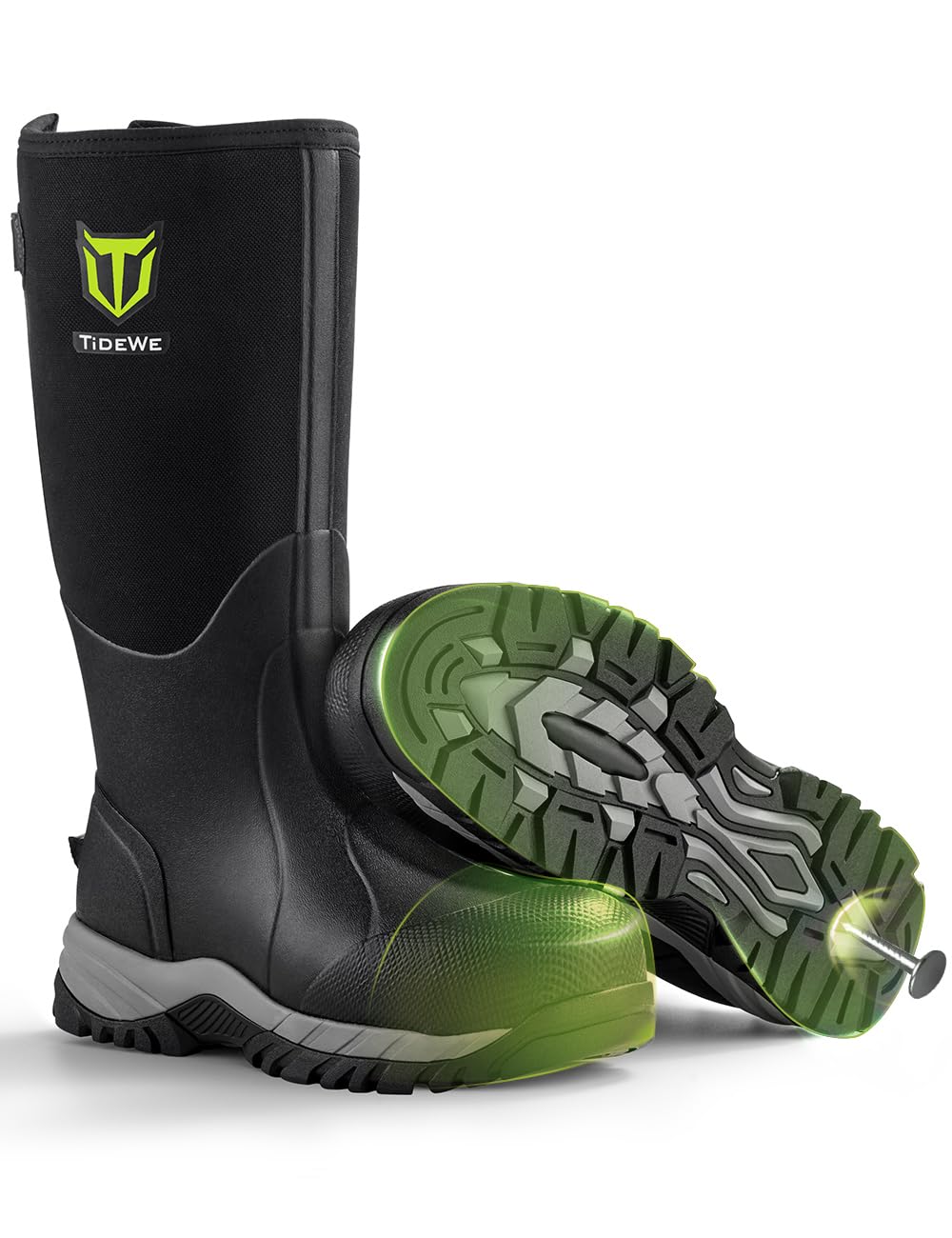
3. TIDEWE Rubber Work Boots
Three layers of protection stacked under one rubber shell: puncture plate, steel shank, steel toe.
Debris is the winter jobsite’s quiet hazard — a nail in a snowbank, a scrap of sheet metal under a drift. This boot answers that with a stack of protection. A puncture-proof layer sits underfoot for secondary protection. Above it, a steel shank (a stiff metal strip between the insole and outsole) spreads load across your arch and stops a sharp object from driving up. And the steel toe handles impact from falling or rolling objects. That is a lot of armor for a rubber boot.
Warmth and waterproofing come from the same formula as the pick above: 100% waterproof rubber and neoprene, with 6mm neoprene added inside for warmth as the temperature drops. A breathable inner lining keeps air moving so the boot does not turn into a sauna when the day warms up. The shell is a slip-on with a pull-on and kick tab, so you are out the door faster. A 10-inch shaft circumference keeps snow from dropping in over the top.
Buyers call the build excellent for the price, with feet staying dry and warm and plenty of room inside. Water resistance is the honest caveat, and opinions split: the shell is built to keep water out, but a few buyers report getting wet quickly. So keep the shaft clear of a deep submerge, and treat the fit as critical. TIDEWE’s own sizing advice is unusually precise — aim for roughly 0.16 inches over your measured foot length — and it is worth following exactly.
The armor-to-comfort ratio: a puncture plate, a steel shank, and a steel cap in one pull-on rubber boot is a rare combination at this tier.
Concrete read: the anti-slip rubber sole with deep tread is the feature you will notice on a frozen ramp, and the kick tab is the one you will notice every morning.
Built for: farm, fishery, construction, and manufacturing work where something sharp might be under your foot.
Not your pair if: you want a boot you can wade deep in — the water resistance is the one spec with mixed reports.
4. FREE SOLDIER Snow Boots for Men, Waterproof Anti-Slip
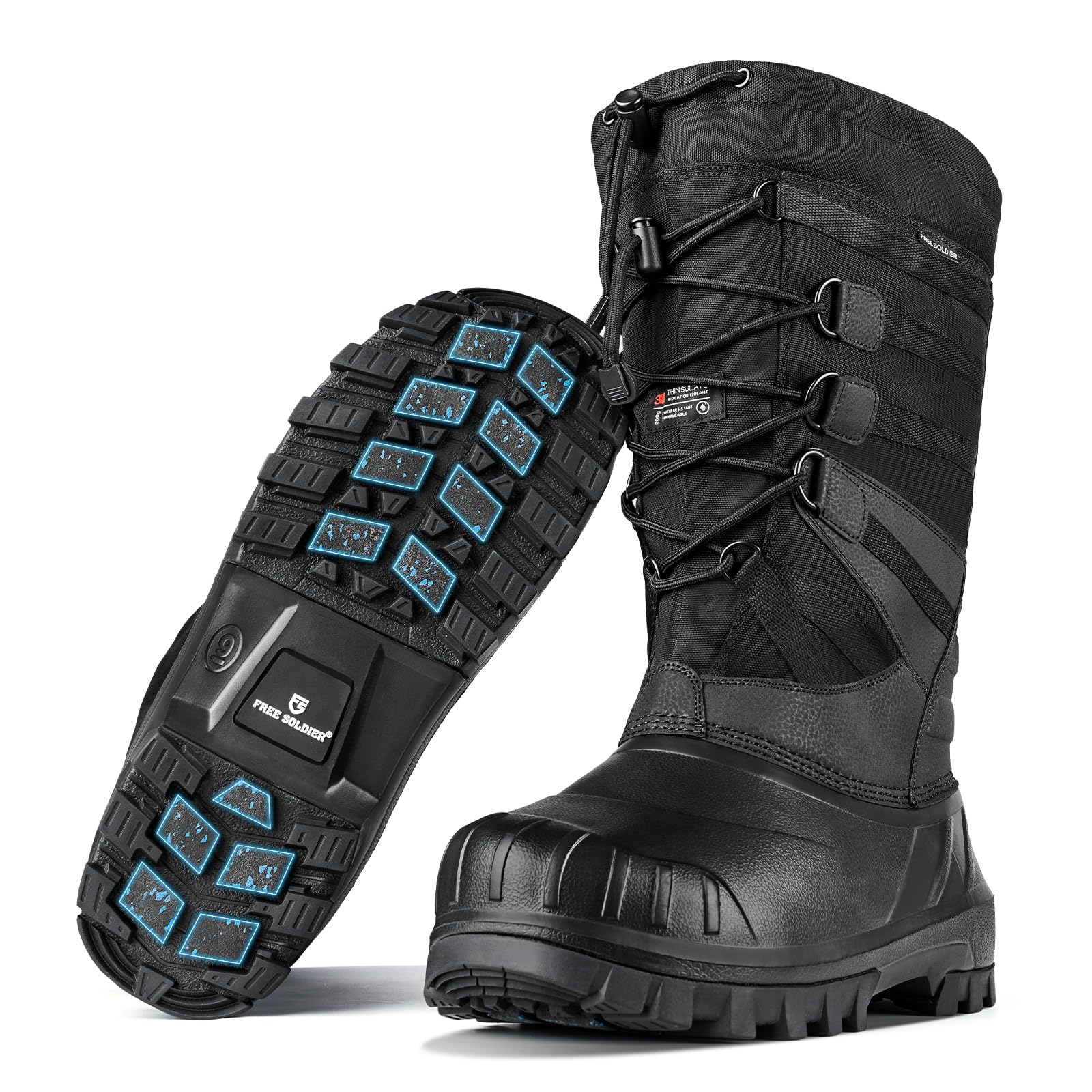
A tall-shaft snow boot that handles a driveway before it handles a concrete pour.
What sets this boot apart is the graphene insole. Graphene is a thin carbon material, and the maker uses it to spread heat fast under your foot — FREE SOLDIER describes it as rapid heating. It is paired with 3M insulation cotton to hold that warmth in, plus a removable thickened inner lining for a second layer. The payoff: the boot warms quickly when you pull it on.
The shell is an EVA-sealed waterproof construction (EVA is a lightweight foam-like material) over a waterproof nylon upper, and the whole thing is designed to be light. The high cylinder design covers more of your shin, which is what keeps drifted snow from finding the gap at your laces. An adjustable collar and lacing system lets you tighten the shaft down.
The honest sizing note comes first here, because it is the most consistent thing owners mention: several report these run a full size too small, and the fit category is the one with mixed feedback. Order up. Beyond that, quality and warmth lead the praise — Customers note staying warm and dry through a long night shift, and more than one compares the light build to a running shoe. Upstate New York snow removal is exactly the kind of job these were bought for.
What Makes It Different
- Graphene insole spreads heat fast underfoot
- 3M insulation cotton plus a removable thickened lining
- EVA-sealed shell and waterproof nylon upper
- Tall shaft design that keeps snow from dropping in
- Adjustable collar and lacing to dial in the fit
Size Before You Commit
- Buyers consistently report it runs a full size small
- No safety toe cap — this is a snow boot, not a certified work boot
- Lighter build than a leather jobsite boot
Reach for it: plowing, dog walking, ice fishing, and snow hiking where warmth and lightness matter more than a steel cap.
Pass on it if: your site requires a certified safety toe — you need a different pick entirely.
5. ROCKY Sport Utility 600G Insulated Waterproof Boot

Moderate insulation and a composite cap for the shift where you never stop moving.
Here is a direct comparison worth holding onto. The ROCKY Blizzard Stalker further down this list carries 1200g of 3M Thinsulate Ultra. This Sport Utility carries 600g. That is 1200g versus 600g of fill — which in plain terms means the Blizzard Stalker is built for standing still in brutal cold, and this boot is built for movement. If your day is pacing a site, hauling material, or walking between buildings, 600g is the smarter heat level because you will not cook.
The upper is full-grain leather, which is what makes this boot supportive underfoot over a long day in a way a rubber shell is not. A composite safety toe handles the cap duty — composite is lighter than steel and does not conduct cold into the toe box. The Sport Utility outsole is the traction layer, built for stable footing on mixed terrain.
The place this boot has quietly won a following is fit. Fit is the single most-praised thing about it, and it earns that with buyers who lace up the same pair season after season — one reviewer reports a pair still going after two and a half years. Water resistance and warmth hold up too, per the pattern across the reviews. The trade-off is weight. It has a heavier, more substantial feel than a rubber neoprene boot, and that is the cost of the leather support. It also runs into sizing variance, so confirm your size rather than assuming.
Why it earns the spot: leather support plus a composite cap plus moderate warmth is a combination that suits the working day better than a pure cold-weather boot.
The fit story: if you have struggled to find a work boot that actually sits right, this is the pick to try first.
Your boot if: you are on your feet and moving all shift, and want a leather boot that feels broken-in early.
Look elsewhere if: you stand motionless in deep cold — you want the higher gram rating instead.
6. ROCKY Blizzard Stalker Steel Toe
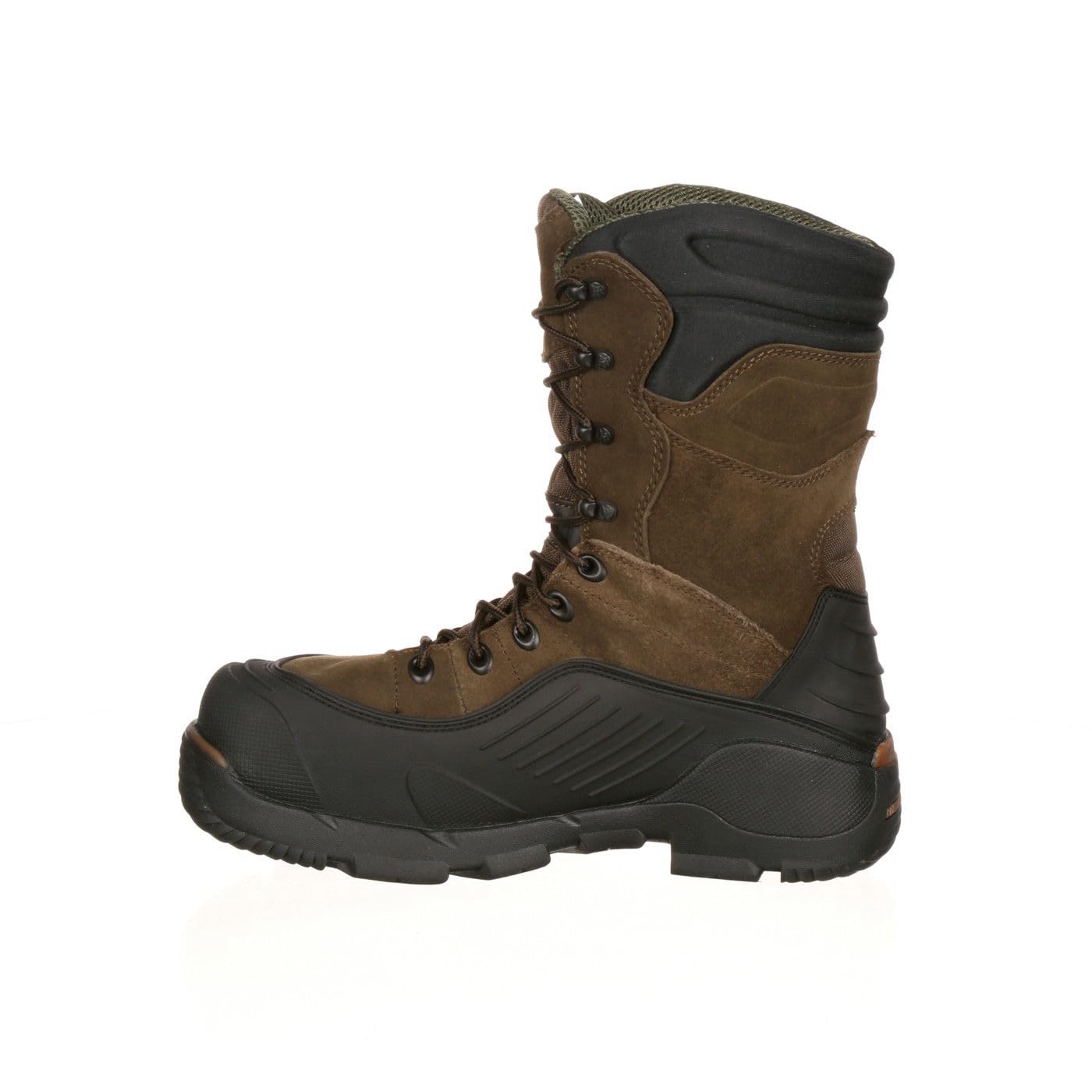
The heaviest fill on this page at 1200g — built for the crew that stands still in the cold.
Start with the number: 1200 grams of 3M Thinsulate Ultra insulation. That is 1200 grams versus 600 grams on the ROCKY Sport Utility above, and it is the reason this boot exists. It is designed for exactly the scenario that defeats most winter boots — standing at a gate, a machine, a lift, or a pour, in air cold enough to make your toes ache. Rocky’s waterproof construction keeps the moisture out while the insulation holds the heat in.
The build around that fill is serious. The steel toe is rated to withstand up to 75 pounds of impact and compression. The nine-inch upper blends split suede with 900 Denier high-abrasion fabric — denier is a measure of fabric thickness, so higher means tougher, and 900 Denier resists scrapes against rebar and rough edges. An extended tongue acts as a buffer to stop snow, dirt, and debris from getting down inside the boot. Under your foot, a polyurethane footbed cushions the stand-all-day shift, and a TPU heel stabilizer (a firm plastic cup around the heel) supports each step.
Warmth is exactly what buyers talk about most with this pair, and it shows in the name. The multi-directional Blizzard Max outsole is the grip layer for uneven or snow-covered ground. What you should know before ordering: fit leans oversized, so come down rather than up. The boot is also genuinely bulky and heavy, which is the direct cost of 1200g of insulation and a steel cap — a trade most people working outdoors in deep cold will gladly make.
The core claim: the 1200g fill versus 600g on the Sport Utility is the whole reason to choose this one.
Footing note: the multi-directional outsole and TPU heel stabilizer are what keep you upright on packed snow.
Best matched to: outdoor work in genuinely bitter cold where you are not constantly moving.
Think hard if: you are active all day or want a light boot — the bulk and weight are real.
7. SAFETOE Cow Leather Safety Boot

Top-layer nubuck leather with a composite cap and a memory foam insole underneath.
Leather people, this is the one. The upper is carefully selected top-layer nubuck cow leather, which is the outer surface of the hide — it takes abrasion better than corrected leather and looks better as it wears. Behind it, a Sanvlar-Tex WR tech layer handles water resistance, and a thermal insulation layer handles warmth. The toe cap is composite and meets ASTM F2413, the protective footwear standard.
Underfoot is where SAFETOE put its design effort. The Four Layer Rebound (4LR) technology is built for stability, and the lightweight memory foam insole absorbs immediate impact as your heel lands. That matters on a concrete floor where every step is a small shock. A pair of work boot socks is included as a gift in the box.
Straight from the maker on sizing: these run in men’s sizes even though they are described as unisex, so check the detail chart. That chart is the whole game for a leather boot — get it right and the break-in is short. Weigh one trade-off honestly: this is a newer listing with a smaller track record than the long-established brands further up this page. Its water resistance also rests on a treated leather upper rather than a full rubber shell. Good for cold and damp; not the boot for wading.
Worth knowing: the 4LR stability build and memory foam insole target the fatigue of a long stand, not just impact protection.
Made for: truck drivers, welders, warehouse staff, mechanics, carpenters, and construction crews who want leather feel with a certified cap.
Look past it if: you need a boot rated for standing water — this is a leather build.
8. Timberland PRO Endurance 8 Inch

An eight-inch steel-toe work boot tuned specifically for the long-shift grind.
Timberland PRO has been building for tradespeople since 1999, and the Endurance line is aimed squarely at the person who never leaves the floor. The eight-inch shaft gives you ankle coverage that a six-inch boot does not, which is a real difference when you are walking on uneven ground with a load. The steel safety toe covers the impact protection requirement, and the waterproof leather upper keeps the winter wet out.
The comfort story is what carries this pick. Buyers call it well worth the money and single out warmth, comfort, and the puncture resistance alongside the safety toe. Arch support gets mentioned, and the boot earns its reputation on demanding jobs. Factory work is the natural home for it; the twelve-hour shift is the use case it was bought for.
Where the Endurance separates itself from a plain safety boot is that it does not treat protection as the whole job. The trade-off is that it is a dedicated work boot first — if you want a boot that doubles as a cold-weather snow boot for weekends, the taller insulated picks above serve that better. Confirm your size on this model, since it is a newer release with less sizing history behind it than the legacy ROCKY and Wolverine designs.
Why Shift Workers Gravitate Here
- Eight-inch shaft for more ankle coverage
- Steel safety toe with puncture-resistant protection
- Waterproof leather upper for winter wet
- Arch support that holds up through a long stand
- Built by a brand that has focused on trades since 1999
Where It Stops Short
- A work boot first — not a weekend snow boot
- Newer model, so sizing history is thinner than the legacy brands
- Steel toe conducts cold more than a composite cap
Pick it for: factory, warehouse, and heavy-duty job sites where you are on your feet for the entire shift.
Skip the fit gamble: verify your size before ordering, because the model is new on the market.
9. Wolverine Men’s I-90 Durashocks 6″ Insulated

A six-inch insulated boot whose calling card is how little your feet hurt at the end.
Wolverine has been making boots out of Rockford, Michigan since 1883, and Durashocks is one of its patented cushioning systems. That technology is the reason to look here — the boot is built around reducing the shock of each step on hard ground, and it shows in how people describe the wear. Comfort is the aspect buyers talk about most by a wide margin, and the recurring comparison is to a sneaker rather than a work boot.
Durability backs that up. One reviewer reports a pair holding up through pesticide spraying, chemical exposure that eats cheaper uppers. Water resistance, functionality, and a lightweight feel all show up in the praise, and the six-inch height keeps it agile compared to an eight- or ten-inch shaft. For an insulated winter work boot, that lighter feel is the point.
Two things to weigh honestly. Value for money draws split opinions — some find it well worth it, others feel it is overpriced, so decide based on how much the cushioning matters to you. And sizing is the weak spot: as a group, fit is the least-loved part of this boot. Get fitted properly or order through a channel that handles exchanges cleanly. This is a comfortable boot, not a forgiving one on the wrong size.
The comfort case: Durashocks cushioning plus an insulated build plus a light six-inch cut is a combination that keeps your feet fresh through a long day on concrete.
The honest limit: sizing is the one thing that trips people up, and the value question has two sides.
For you if: concrete floors, long shifts, and sore feet are your daily reality.
Reconsider if: you need a certified safety toe — this model does not list one.
10. Timberland PRO Direct Attach 6 Inch

200 grams of insulation tucked into a seam-sealed leather boot that handles ankle-deep water.
The number to note is the 200 grams of insulation. That is the lightest fill on this page — a deliberate choice, because the Direct Attach is built for cold-weather work rather than deep-freeze standing. If your site is cold and wet but not arctic, 200g keeps you warm without turning your feet into a furnace during activity. The upper is premium Timberland seam-sealed waterproof leather with padded collars — seam-sealed means the stitching itself is treated, so water cannot track in through the join.
Underfoot, the Anti-Fatigue Technology polyurethane footbed delivers shock absorption and energy return, and the moisture-wicking lining is made from ReBOTL fabric containing at least 50% recycled plastic. The outsole is a rubber lug pattern rated heat-, oil-, slip-, and abrasion-resistant, so it holds grip on an oily shop floor as well as a snowy walkway. Electrical hazard protection is built in as well. Built around a classic Timberland silhouette, it looks like a boot and not a work shoe.
The honest fit warning is consistent: some find the fit great, others report it runs about half a size too large. Try before you commit, or order with a return path in mind. Beyond that, the waterproofing and warmth deliver — buyers describe standing in ankle-deep water without getting wet.
Where it lands: warehouse and general outdoor work in cold, wet conditions where a 200g boot is the right heat level.
And what it is not: a deep-winter standing boot — 200g will not carry you through a frozen night watch.
Fits the bill: warehouse and cold-weather outdoor work, especially when puddles are the daily hazard.
Size-down caution: it may run about half a size large, so confirm before you commit.
11. Carhartt Ground Force 10″ Waterproof Wellington Boot

A ten-inch pull-on Wellington in oil-tanned leather that breathes while it blocks water.
The feature that defines this boot is Storm Defender technology, which is engineered to keep water out while still letting your feet breathe. That is a different approach from a rubber shell — instead of sealing you in, it manages moisture from both directions. A FastDry lining wicks sweat away and keeps odor down, and the Insite footbed gives your arches real support. Ten inches of shaft means snow and mud stay out of the boot entirely, and there is nothing to lace in the morning.
The upper is oil-tanned leather with rugged fabric panels that stand up to wear. Under your foot sits a shock-absorbing EVA midsole, and the Ground Force rubber outsole grips and flexes with you. The abrasion-resistant heel adds life in the highest-wear area. The composite toe meets ASTM safety standards for impact and compression, and the boot is rated for electrical hazard protection too. Cement construction keeps it from feeling stiff.
What people notice first is the look — appearance is the most-praised aspect by a wide margin, with comfort right behind it. The support is what keeps you reaching for them: arch support and easy on-and-off both come up, and people describe their feet not hurting after a long day in them. Your size is the open question. Some find them true to size, others hit sizing issues, so try a pair before you rely on them for a full shift. It is a premium Wellington and the most substantial build on this list, which is the honest trade for the comfort and the look.
The Case For The Wellington
- Storm Defender keeps water out and lets feet breathe
- Ten-inch pull-on shaft — no laces to tie in the dark
- Composite toe meets ASTM safety standards plus EH protection
- EVA midsole and Insite footbed for arch support
- FastDry lining controls moisture and odor
The Honest Questions
- Sizing is inconsistent — verify before a full shift
- Pull-on design fits differently than a lace-up
- The heaviest, most substantial build here
Made for you when: you are pouring concrete, hauling equipment, running a yard, or managing a site in rain and mud.
Try it on first if: you have a wide or narrow foot — pull-ons are less forgiving than laces.
Know the Specs
Insulation grams (600G vs 1200G)
Insulation is measured in grams of synthetic fill, shown as a number with a G. A 600G boot suits active work in moderate cold; a 1200G boot suits standing still in deep cold. The ROCKY Sport Utility at 600g and the Blizzard Stalker at 1200g sit at opposite ends — the higher fill is the one for a machine-side shift in February. More fill also means more bulk and less breathability, which is why it is not automatically the better choice.
ASTM F2413 and what a safety toe really proves
ASTM F2413 is the standard that sets the test levels for protective footwear, covering impact and compression on the toe cap. A boot marked ASTM F2413-18 has been tested to those levels — the same standard applies whether the cap is steel or composite. The differences are practical: steel is thinner and heavier, composite is lighter and does not conduct cold. Choose based on how much room you want in the toe box and how long you spend in freezing air.
Waterproof versus water-resistant
Waterproof means the boot is built to keep water out entirely — a rubber shell, or a seam-sealed leather upper. Water-resistant means the surface resists water but can eventually soak through. For slush and standing water, choose a sealed build. For dry cold and damp days, a treated leather boot is lighter and more breathable. Both hold up in the cold; only one is designed to stand in a puddle.
Steel shank, puncture plate, and footbed support
A steel shank is a stiff strip between the insole and the outsole that spreads load across the arch and protects against sharp objects from below. A puncture-resistant midsole is a separate plate for the same job. Neither replaces the toe cap — they protect different parts of the foot. On a debris-strewn winter site, you want both, which is what the TIDEWE steel shank model offers.
Common Questions
How many grams of insulation do I need for winter work boots?
Are steel toe winter work boots warmer than composite toe?
Can I wear regular work socks with insulated winter boots?
How long do waterproof work boots stay waterproof?
Should I size up or down in winter work boots?
What does ASTM F2413-18 mean on a work boot?
Are rubber work boots better than leather for winter slush?
Do I need a steel shank or puncture plate in a winter work boot?
Can I wear pull-on Wellington boots on a construction site?
How heavy are insulated winter work boots?
The Bottom Line
For most people shopping for the best work winter boots for men, the TIDEWE Rubber Work Boots are the pair to start with. The sealed CR Flex-Foam shell is fully waterproof with no seam to fail, the 6mm neoprene holds heat down to a -4°F comfort rating, and the reinforced toe takes the abuse a jobsite hands out. If your shift is standing still in the coldest air, grab the ROCKY Blizzard Stalker — 1200g of 3M Thinsulate Ultra is the heaviest fill here, and that is the whole reason to choose it over the 600g Sport Utility. And if you want a pull-on Wellington that keeps water out while letting your feet breathe, reach for the Carhartt Ground Force 10″.
The one honest nudge: the TIDEWE rubber boot earns the top spot on the strength of its shell quality and the sheer volume of owners who keep re-buying it, not on a marketing claim. Measure your foot against the size chart before you order — a boot this good deserves to fit.
How we choose
We do not accept paid placement. Every pick is matched to a real buyer and a real use-case; we do not hands-on test units.
Sources
Specifications: manufacturer listings and product documentation. Review insights: verified customer reviews, as of November 2026. Pricing: not shown on this page (it changes often); check the current price via the retailer link.
As an Amazon Associate, Tactical Gear Guy earns from qualifying purchases. This does not affect which products we feature.