Specs are compiled from manufacturer listings and verified buyer reviews and can change over time — please confirm the key details on the product page before buying.
What you actually need to know before buying a wood lathe with tools is simple: the bundled chisels are rarely the deciding factor. The machine’s spindle through-hole, its swing over the bed, and whether the motor holds speed under a catch decide whether you finish bowls or fight vibration all afternoon.
This guide is built by comparing the manufacturers’ published specifications and the patterns across verified customer reviews, so you get each pick’s real strengths and trade-offs instead of marketing spin.
We break down swing, motor wattage, and speed ranges in plain terms, then show which bundled tool kits are genuinely usable and which are filler. If you want the short answer on the best wood lathe with tools for a home shop, it is the small benchtop unit with the widest accessory bundle.
Top Picks
How To Choose The Best Wood Lathe With Tools
A wood lathe spins a workpiece while you press a chisel into it, so every purchase decision comes back to one question: can this machine hold a steady spin while you cut? Here is what actually separates the picks.
Swing over the bed sets your maximum bowl size
Swing is the distance from the spindle centerline down to the bed, doubled. In plain terms, it is the largest diameter blank the lathe will accept without hitting the rails. A small benchtop machine limited to a few inches of diameter will turn pens, rings, and handles happily. A 12-inch machine can spin a small bowl blank. If bowls are the goal, swing is the first number you check.
Motor wattage tells you how it handles a catch
A catch is when the chisel digs in and stalls the workpiece. A weak motor stalls with it. Look at the wattage and horsepower figures: a 96W motor is a hobby-class unit, while a 560W or 2 HP motor carries through roughing cuts in hard wood. Neither is wrong — it depends on whether you are turning pens or platters.
Step pulleys versus a variable-frequency drive
Most budget machines use step pulleys, meaning you move the belt to one of several fixed speed settings. A variable-frequency drive (a control box that changes motor speed electronically) lets you dial any speed in the range without touching the belt. Pulleys are cheaper and simple. A drive is smoother and quicker to adjust mid-project.
Side-by-Side Comparison
| Model | Best For | Capacity | Motor | Speed Range | Amazon |
|---|---|---|---|---|---|
| Mini Lathe WM101A-Plus★ Best Overall | Small-part turning at a bench | 3 in diameter, 8 in length | 96W (24V DC) | Infinitely variable | Amazon |
| VEVOR 14 in x 40 in | Long spindles on a budget | 14 in x 40 in | 0.5 HP / 370W | 885–2425 RPM, 4 speeds | Amazon |
| VEVOR 3/4 HP 12 in x 18 in | Mixed soft and hard woods | 12 in x 18 in | 3/4 HP / 560W | 780–3840 RPM, 5 speeds | Amazon |
| Powermatic 3520C | Serious bowl and spindle work | 20 in x 35 in | 2 HP | 15–3200 RPM, variable | Amazon |
Detailed Reviews
1. WM101A-Plus Mini Wood Lathe
Our pick — 4.0+★ from 100+ verified ratings; the strongest balance of quality and price.
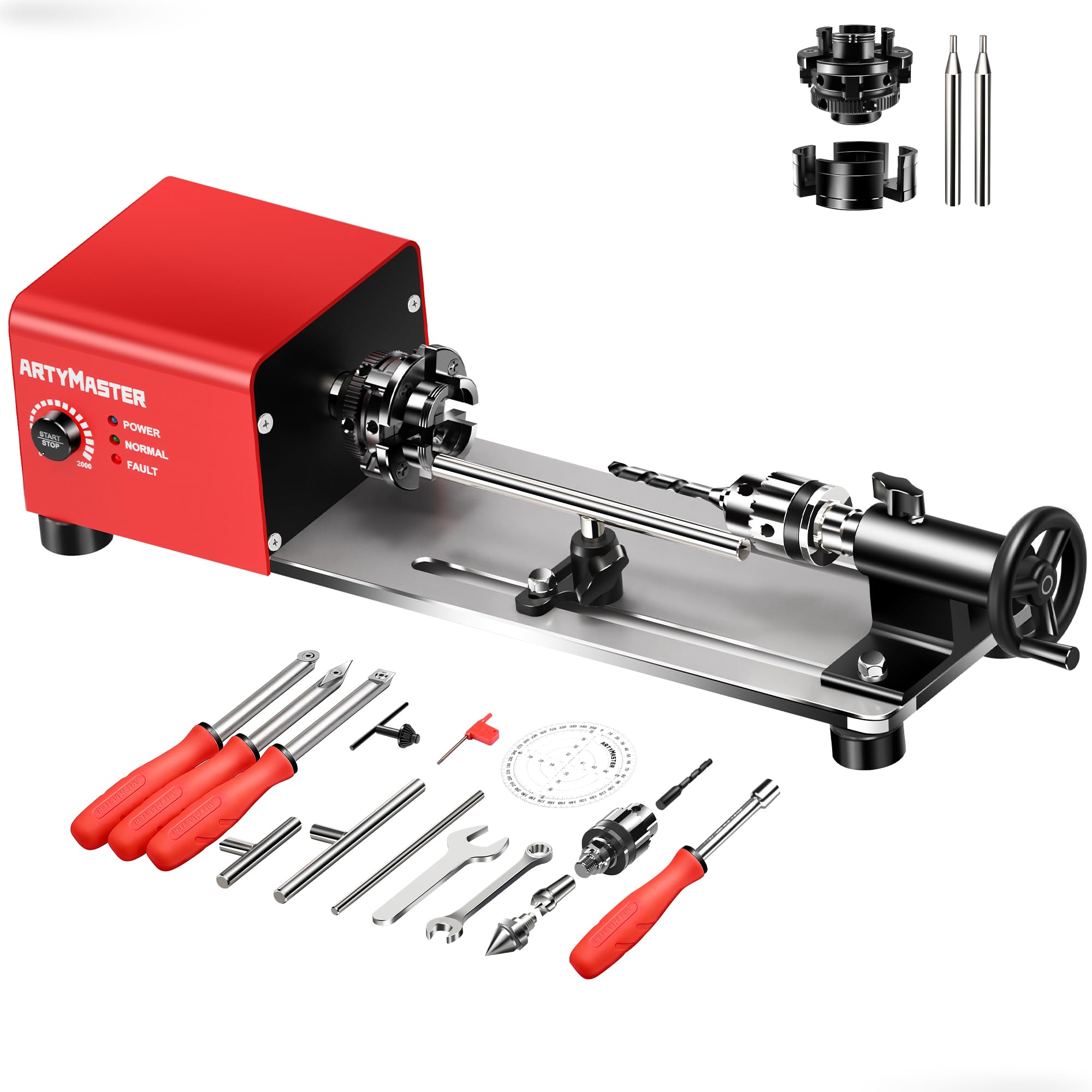
The bench lathe that arrives with a real chisel kit, a chuck, and centers already in the box.
This is the small-shop machine for anyone who wants to turn pens, rings, bracelets, or tool handles without bolting a heavy cast-iron bed to the bench. It weighs 17.03 pounds, so it lifts onto a workbench and tucks away when the project is done. The working range is listed at 3 inches in diameter by 8 inches in length, which tells you in plain terms this is a small-parts lathe, not a bowl lathe.
What makes it the pick here is the accessory load. The box includes a turning tool combo with round, square, and diamond-shaped cutters that swap heads, a 2-inch chuck set with a clamping range of 0.1 to 2.16 inches, a drive center, a live center, a centering ruler, a drill chuck, and three adjustment wrenches. That is genuinely unusual for a machine in this class. Owners rate it a real tool rather than a toy, praising build quality over price.
Speed control is infinitely variable, meaning you twist through a continuous range instead of moving a belt to a fixed step. The tool rest adjusts in position, height, angle, and stationary length, so you can set a fine cut without fighting the rest. The motor is a 96W unit running on a 24V/4A supply that is UL certified, and the maker lists over 2000 hours of continuous full-load operation for the motor and bearings.
Head-to-head against the Powermatic, the gap is plain: 17.03 pounds versus 726 pounds, and 96W versus 2 HP. This one is a different tool for a different shop. The honest limit is noise. The compact steel base keeps vibrations low, but the motor note splits opinion — some find it very quiet, others hear a whine at low speeds on the dial.
The bundle that earns its place
- Chuck, drive center, live center, drill chuck, and swappable-cutter tools all included.
- Weighs 17.03 pounds, so it moves from shelf to bench without help.
- Infinitely variable speed removes the belt-change step entirely.
- UL-certified 24V/4A supply and a stated 2000-hour full-load motor rating.
Where it stops
- 3-inch diameter by 8-inch length capacity rules out larger bowl blanks.
- Motor tone at low speed is the split point in owner feedback.
Reach for this if: your projects are pens, rings, chess pieces, and handles that fit inside an 8-inch length.
Look elsewhere if: you want to spin a bowl blank wider than 3 inches — you will need real swing.
2. VEVOR Wood Lathe 14 in x 40 in

Forty inches of bed for long spindles, and an aluminum alloy base that fights vibration.
If your work runs long rather than wide — table legs, canes, chair parts, long-handled tools — the bed length is the number to care about. This machine runs 14 inches by 40 inches, which gives you room for a long workpiece between centers. Compare that to the WM101A-Plus at 5 x 16.5 x 5.5 inches overall, and the footprint difference explains itself: this is a bench machine that expects a real bench.
The motor is a 0.5 HP unit at 370W with a top speed of 2425 RPM. Speed is set in four fixed steps — 885, 1245, 1715, and 2425 RPM — which is belt-pulley territory, not a dial. You pick the step based on the wood and the cut, then leave it. The headstock is solid steel and the base is aluminum alloy, a pairing meant to keep vibration down during the cut.
The kit includes three chisels, a faceplate, a hex wrench, a double open end wrench, a tooth-shape center point, a movable center point, a plastic handle, a plastic handwheel, and a locking bolt. Three chisels is a starter set, not a full rack — plan on adding a bowl gouge and a roughing gouge if you get serious. It runs on 120 volts AC and weighs 50.6 pounds.
What the feedback reads like: this lands as a small-project and beginner machine, and the variable speeds get called adequate for that job. The value question is where it splits — some owners find it a nice machine for the money, others read the build quality as short of what they hoped.
Set your expectation first: 0.5 HP against the Powermatic’s 2 HP is a difference in motor class, and a four-step pulley system against a variable drive is a different workflow. Go in expecting a starter machine that turns long spindles, and the trade-off makes sense.
Built for: the turner who needs 40 inches of bed and a fixed-speed workhorse without stepping into professional money.
Pass it by if: you want to dial speed continuously mid-cut — the four belt settings will feel limiting.
3. VEVOR Wood Lathe 12″ x 18″
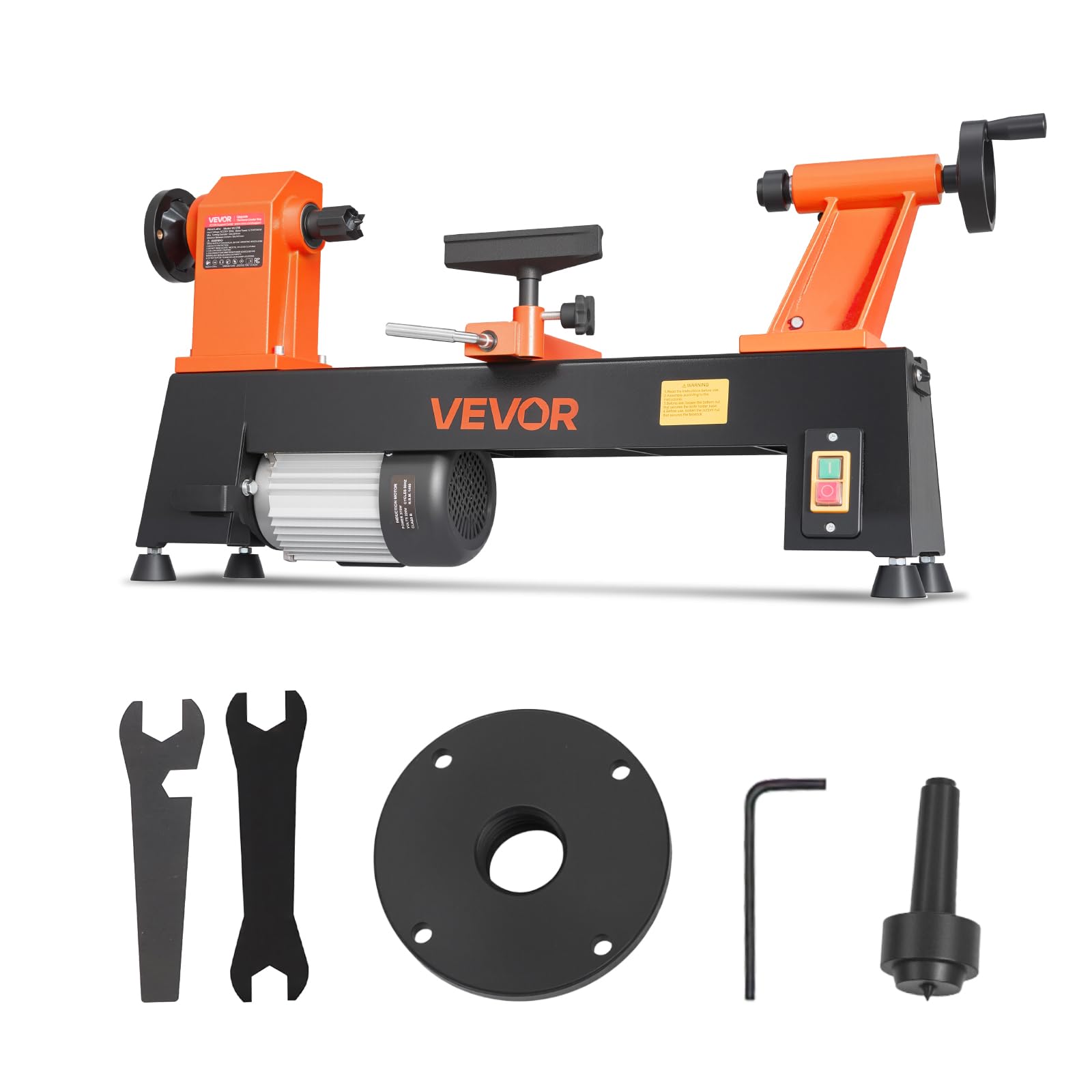
Twelve inches of swing and a 560W motor that carries through hard-wood roughing cuts.
Twelve-inch swing is the line where a benchtop lathe starts accepting real work. This one is rated 12 inches by 18 inches, which covers table legs, canes, and long-handled tools in one pass. The published purpose is roughing and fine finishing on both soft and hard woods, and the motor backs that claim up at 3/4 HP, or 560 watts.
Speed runs in five fixed steps: 780, 1320, 1920, 2640, and 3840 RPM. That top end is higher than the 2425 RPM ceiling on the 14-inch VEVOR, which helps on small-diameter work where you want surface speed without a stall. The frame is a mix of cast iron and sheet metal, built to cut vibration and hold precision. A thermal protection circuit shuts the motor down automatically if it overheats, which matters on long continuous sessions.
It arrives as a ready kit with an accessory kit and the lathe, on 110 volts AC, weighing 59.8 pounds. Before you commit, read the owner feedback honestly: quality and value both land as mixed views, with praise for the value sitting alongside disappointment. That is a machine that satisfies some buyers and not others — worth knowing going in.
Where the spec sheet wins
- 12-inch swing opens up bowls and legs a 3-inch mini cannot touch.
- 560W carries harder cuts than the 96W mini’s motor class.
- 5 steps up to 3840 RPM give a high-speed option for small diameters.
- Thermal cutout protects the motor during continuous turning.
The trade-off to size up
- Owner sentiment on build quality splits rather than unites.
- Still a step-pulley machine — no continuous dial like the mini or the Powermatic.
Worth it when: you need 12-inch swing and hard-wood capability and accept a belt-change workflow.
Think harder if: you want proven consistency across owners — this one reads as a mixed bag.
4. Powermatic 3520C Woodworking Lathe
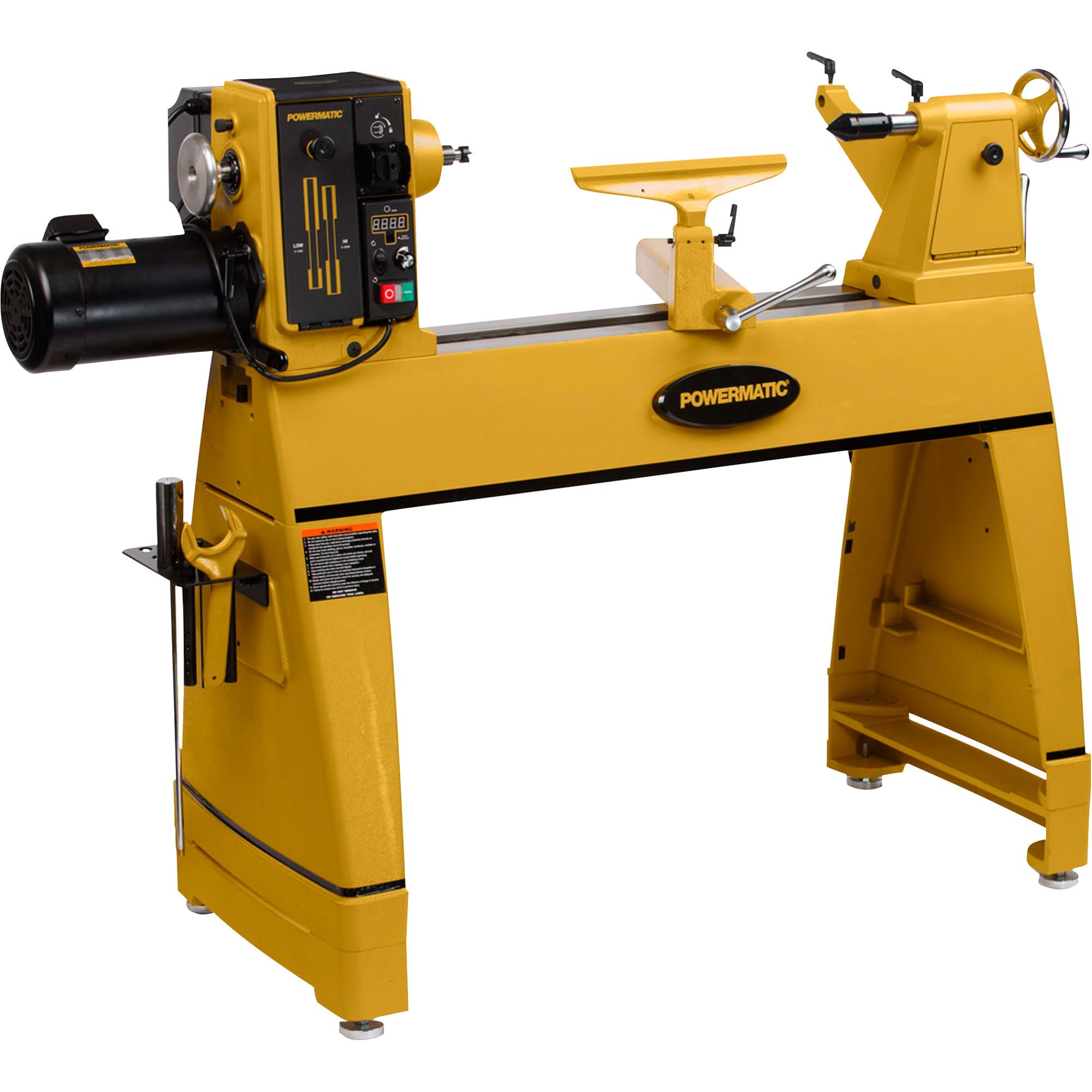
Twenty-inch swing, 2 HP, and a cast-iron bed that stays put while you turn.
Capacity is the whole story here. The Powermatic is rated 20 inches by 35 inches, against 12 inches by 18 inches on the VEVOR 3/4 HP machine — that is the difference between a bowl blank that fits and one that does not. It weighs 726 pounds in cast iron, so it does not walk across the floor when an unbalanced blank spins up. You level it and it stays.
Speed is fully variable from 15 RPM to 3200 RPM. That low end matters: 15 RPM lets you start an out-of-balance blank slowly and bring it up as it rounds, which a fixed-step pulley cannot do. The drive electronics sit in a fully enclosed VFD, and the control box is magnetic-backed and moveable, so you position it where your hands already are. A digital indexing readout takes the guesswork out of indexing for fluting and detailing.
Comfort and control details are where a premium machine separates. Two riser blocks give 4 inches of height adjustment so you can set the spindle at your own elbow height. The banjo uses a non-marring, pinch-style clamp for solid toolrest placement without scarring the bed. The spindle nose is extended for better access to the workpiece. It ships with four centers, a 3-inch faceplate, a tool caddy with tools, a 14-inch tool support, two leg assemblies, and four levelers, and the maker lists a 5 Year warranty.
The reality of 726 pounds: this is not a machine you move on a whim. Weight is the one point where feedback splits — several note how heavy it is — but that same mass is what kills vibration. Plan the shop floor spot before delivery, not after.
Motor headroom against the field: 2 HP against the 0.5 HP on the 14-inch VEVOR is a gap in motor class, and 20 inches of swing against 12 inches on the 3/4 HP model is more capacity. For bowls and heavy spindle work, that headroom is the reason to spend here.
The short version: a cast-iron 2 HP lathe with variable speed from 15 RPM up — built for turners whose work has outgrown a benchtop frame.
Know before you buy: it needs 220V single-phase power, so check your shop’s circuit before it arrives.
Know the Specs
Swing and bed length
Swing is twice the distance from the spindle centerline to the bed, so it caps the diameter of a blank you can spin. Bed length is the distance between centers, which caps the length of a spindle. A 12 x 18 machine handles a small bowl or a table leg. A 20 x 35 machine takes a large bowl blank. Read both figures together before you buy.
Fixed pulley speeds versus a variable drive
A step-pulley lathe offers several fixed RPM settings you reach by moving the belt — four on the 14-inch VEVOR, five on the 3/4 HP model. A variable-frequency drive lets you dial any speed in a continuous range, as on the Powermatic from 15 to 3200 RPM. Pulleys are simpler and cheaper. A drive is faster to adjust and lets you start an unbalanced blank slow.
Motor wattage and horsepower
Wattage and horsepower describe how much cutting load the motor can carry before it stalls on a catch. A 96W motor suits pen and ring work. A 370W or 560W motor takes harder roughing cuts in dense wood. A 2 HP motor carries large blanks. Match the motor to the size of blank you plan to spin, not to the biggest number on the page.
What a bundled tool kit really includes
Tool kits vary widely. Some machines ship a full set — swappable cutters, a chuck, drive and live centers, and wrenches — while others include only three chisels and a faceplate. Check the included-components list closely. A full kit saves you a separate purchase. A starter set means budgeting for a bowl gouge and roughing gouge later.
Common Questions
What is the difference between swing and bed length on a wood lathe?
Can a mini lathe turn a bowl?
What does infinitely variable speed mean compared with a 4-speed lathe?
Do I need 220V power for a full-size lathe?
What chisels come with each of these lathes?
Is a heavier lathe better for turning?
Can I turn hard woods on a 96W mini lathe?
What is a toolrest banjo and why does it matter?
How much noise does a benchtop lathe make?
Does a wood lathe come with a warranty?
The Bottom Line
The wood lathe with tools that suits most home shops is the Mini Lathe WM101A-Plus — it arrives with a chuck, drive and live centers, a drill chuck, and swappable-cutter tools, so you can start turning pens and rings the day it lands. If your work needs a long bed, the VEVOR 14 in x 40 in gives you 40 inches for spindles. And when bowls and heavy blanks are the plan, the Powermatic 3520C at 20 inches by 35 inches and 2 HP is the machine to build the shop around.
How we choose
We do not accept paid placement. Every pick is matched to a real buyer and a real use-case; we do not hands-on test units.
Sources
Specifications: manufacturer listings and product documentation. Review insights: verified customer reviews, as of November 2026. Pricing: not shown on this page (it changes often); check the current price via the retailer link.
As an Amazon Associate, Tactical Gear Guy earns from qualifying purchases. This does not affect which products we feature.