Specs are compiled from manufacturer listings and verified buyer reviews and can change over time — please confirm the key details on the product page before buying.
If your knees throb the moment you drop into tabletop, the fix is a small pad that sits under you — not a whole new mat. A good yoga knee cushion puts a layer of foam between your kneecap and the floor, so kneeling poses stop being a countdown to the moment you have to come up. Below are nine real options, sorted by what each one does best, so you can match a pad to your body and your practice instead of guessing from a product photo.
This guide is built by comparing the manufacturers’ published specifications and the patterns across verified customer reviews, so you get each pick’s real strengths and trade-offs instead of marketing spin.
Three specs decide whether a pad works for you: thickness, footprint, and whether the surface grips when you sweat. This breakdown of the yoga knee cushion category covers all three, so your knees stop deciding how long you can hold a pose.
Top Picks


How To Choose The Best Yoga Knee Cushion
Knee pain in yoga is rarely about fitness — it is about pressure. It is about pressure — the full weight of your upper body pressing a kneecap into a thin mat over a hard floor. A knee cushion spreads that weight across a soft layer, and the right one stays put under you so you can think about your breath instead.
Start with thickness, not brand
Thickness is the spec that decides whether a pad helps you at all. A 0.6-inch pad is a modest lift — enough for most people on a decent mat, and easy to balance on. A 1-inch or 1.57-inch pad adds serious foam, which suits bony knees, older joints, or anyone practicing on tile or hardwood directly. The trade-off is stability: a 1.57-inch pad can feel like a wobbly platform under a single knee.
Match the pad’s footprint to your poses
A long strip — the 24-inch pads on this list — runs under both knees at once and still leaves room for your forearms in poses like puppy or forearm plank. A compact square pad covers one knee and stows in a tote. If you flow quickly between poses, a 24-inch strip saves you from chasing a small square around the mat.
Foam type decides grip and cleanup
NBR (nitrile butadiene rubber) is the dense, rubbery foam most of these pads use — it grips well and shrugs off sweat. TPE (thermoplastic elastomer) is lighter and often textured for extra hold on a glossy floor. Memory-foam builds feel plusher at first touch but can compress over a long session. Whichever foam you pick, a closed-cell surface that does not soak up sweat stays fresher and wipes clean.
Side-by-Side Comparison
| Model | Best For | Thickness | Footprint | Foam | Amazon |
|---|---|---|---|---|---|
| Kinesis Yoga Knee Pad Cushion★ Best Overall | Everyday home practice | 0.6 in | 24 x 9.8 in | NBR | Amazon |
| Ewedoos Yoga Knee Pad CushionWidest Coverage | Travel and grippy surfaces | 0.6 in | 24 x 9 in | NBR | Amazon |
| Yes4All Yoga Knee Pads (Set of 2)Two-Pad Set | Two-knee and elbow support | 0.81 in | 7.81 x 7.81 in each | Polyurethane | Amazon |
| yflingjie 4-Pack Kneeling Pads | Sharing and multi-room use | 0.79 in | 7.9 x 7.9 in each | TPE | Amazon |
| IUGA Yoga Knee Pads Cushion | Long floor sessions | 0.5 in | 25.6 x 10.3 in | TPE | Amazon |
| MRO Yoga Knee Pad Cushion | Full-length joint protection | 0.6 in | 24 x 10.6 in | NBR | Amazon |
| Impulse Fitness Extra Thick Pad | Deepest foam on a full strip | 1 in | 24 x 12 in | NBR | Amazon |
Detailed Reviews
1. Kinesis Yoga Knee Pad Cushion
Our pick — 4.5+★ from 400+ verified ratings; the strongest balance of quality and price.
The one pad that lands the balance between cushion and floor coverage for most practices.
Here is a pad built for the buyer who kneels on a hard floor every day and wants the simplest possible fix. It measures 24 inches long, 9.8 inches wide, and 0.6 inches thick — a long strip that runs under both knees at once, so you are not re-centering a small square between poses. That 24-inch length is over three times the 7.81-inch footprint of the Yes4All squares below, which is why it suits a flowing practice better than a compact pad. And at 4.64 ounces it rolls up small enough to live in your mat bag without adding noticeable weight.
The foam is NBR — a dense, rubbery material that resists sweat and liquids, so a wipe-down with a damp cloth keeps it fresh. The maker lists it as odor-less and non-slip, and the closed-cell surface is why that holds up under a sweaty session. What wins people over most is the overall build — quality is the trait that comes up again and again in the feedback, with knee support right behind it. Owners describe the cushioning as supportive without being rock-firm, which is exactly the feel that lets you settle into all-fours positions instead of hovering above them.
The honest catch is care and finish. It is hand wash only, so it will not survive a washing machine cycle. And because it is a single 0.6-inch strip, someone with very bony knees or a tile floor may still want more foam than this gives. The crowd numbers back the design — 4.5+ stars across 400+ ratings — one of the strongest showings on this list.
What lands well
- 24-inch length covers both knees in one placement
- NBR foam resists sweat and wipes clean fast
- 4.64 ounces rolls up into a mat bag easily
- Supportive cushioning that still lets you feel the floor
What to weigh first
- Hand wash only — no machine cleaning
- 0.6 inches may be thin for very sensitive knees on tile
Reach for this if: you want one long pad that protects both knees and forearms through a full floor session.
Think twice if: you need heavy cushioning directly on a hard surface — a thicker pad will serve you better.
2. Sargoby Fitness Yoga Knee Pad 0.6 inch Thick Pilates Cushion
Built for the yogi who practices in three different places a week.
Ewedoos designed this pad for people who keep moving — the studio, the gym, a hotel room. It weighs less than 6 oz and measures 24 inches by 9 inches at 0.6 inches thick, so it slides into a tote alongside a water bottle. The grippy textured surface is the feature that earns its place: on a glossy studio floor or a slick rented mat, the texture keeps the pad put instead of skating away mid-flow. The NBR foam is water-repellent as well, so a sweaty class does not become a soaked pad.
For beginners avoiding kneeling poses out of fear of slipping, this is a sensible first pad. Fit and knee support lead the conversation in the feedback, and comfort follows close behind. You can also flip it into other roles — a seat pad, a gardening cushion, even a mat extension to rest your head on. That flexibility is why it appeals to people who only sometimes kneel.
The trade-off is honest: at 0.6 inches it is a moderate cushion, and the maker leans on grip and durability over raw plushness. Someone with significant knee sensitivity may find it too thin on bare tile. If you want depth, look at the ECOESPTI or Impulse pads. If you want a grippy, light, go-anywhere strip, this is the fit.
Where it shines
- Textured grippy surface holds on slick floors
- Under 6 oz for easy travel
- Water-repellent NBR resists sweat
- Doubles as a seat or gardening cushion
Where it stops short
- 0.6 inches is modest for very sensitive knees
- One pad, so it protects one area at a time in tight poses
Pick it when: grip and portability matter more to you than deep foam.
Pass it over if: you need a plush barrier between your knee and a hard tile floor.
3. Yes4All Yoga Knee Pads Set of 2
Two firm squares that push cushioning past the strip pads without going soft.
Yes4All takes a different route to protection: instead of one long strip, you get a set of 2 pads, each 7.81 inches square and 0.81 inches thick. That thicker build beats the 0.6-inch strips from Kinesis, Sargoby, Ewedoos, and MRO — 0.81 versus 0.6 inches of foam under each knee. The slightly concave top is shaped to cup the joint, and the anti-slip surface keeps the pad planted while you hold a kneeling posture. For longer practice sessions, that extra 0.21 inch of depth is the difference between a red mark and a comfortable hold.
What people count on most is how effective the pads are in class — quality and functionality are the traits that dominate the feedback, with knee support close behind. The pads protect elbows and hands as well as knees, so the same set handles a forearm plank or a wrist-heavy arm balance. The polyurethane foam grips when the material warms up, another reason the pads stay put.
How thick you want your padding is personal — some find this thickness perfect, a few feel it is not enough. That is a fit note, not a flaw, and it tells you the set works best when you know how much padding your own knees want. You also get a 1-year warranty for confidence, a detail the strip pads do not offer.
The real draw: two separate pads mean you can place one under each knee or slide one under an elbow without dragging a long mat around.
The honest limit: each pad is only 7.81 inches wide, so if your knee drifts, you will want to reset it rather than rely on a wide landing zone.
Best matched to: yogis who want a firmer, thicker cushion and like the flexibility of two independent pads.
One caveat: the 0.81-inch depth is a step up, but not the deepest option here — if you want real plush, see the ECOESPTI pad below.
4. yflingjie 4-Pack Yoga Kneeling Pads, TPE Cushion
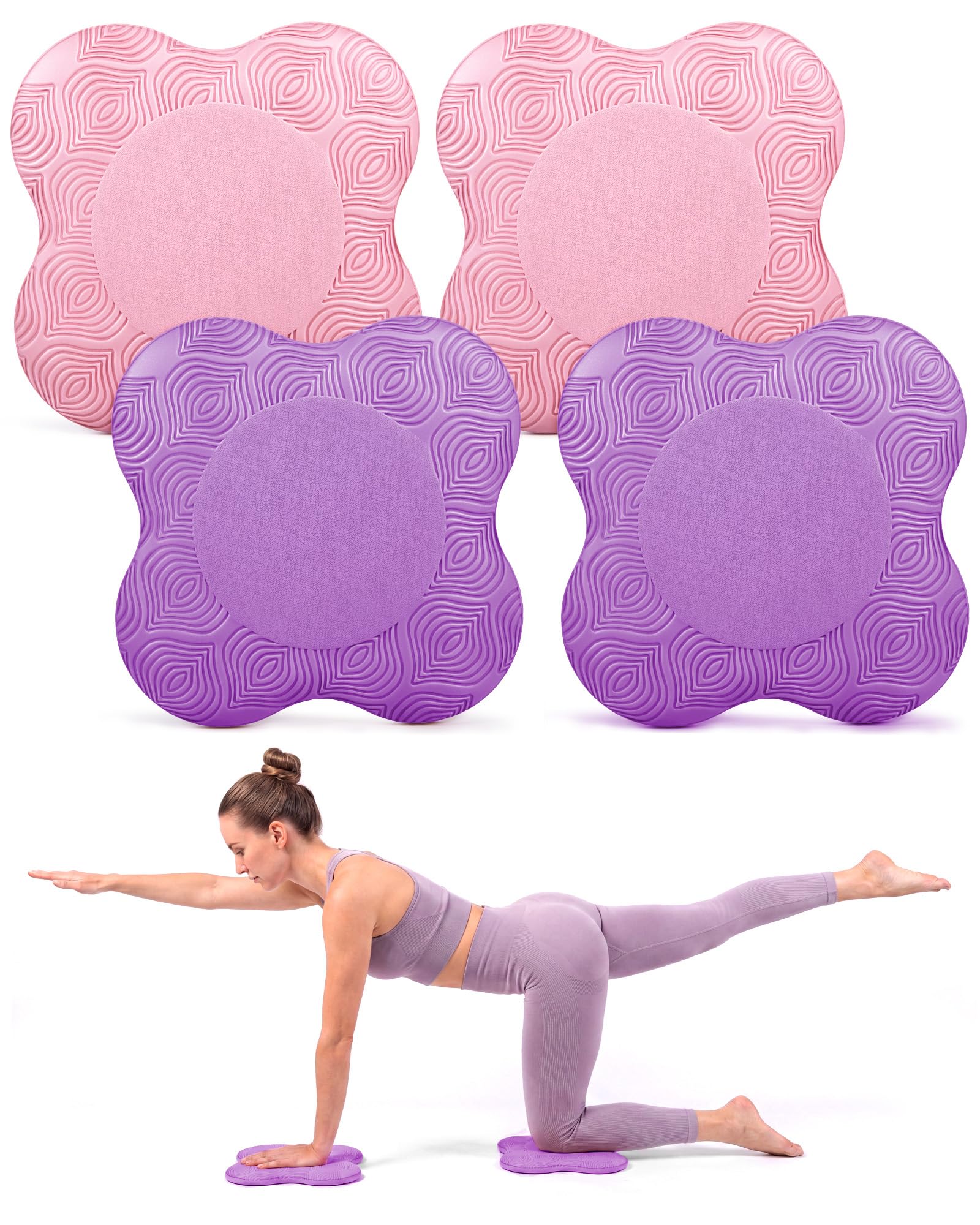
Four compact pads that turn one purchase into a cushion for every room.
If you share a home with other exercisers or want a pad wherever you happen to kneel, four pads beat one. Each measures 7.9 inches square at 0.79 inches thick — the 4-pack smashes the 1-count strip pads from Kinesis and MRO by sheer quantity, with four pads to the one strip you would otherwise get. The TPE foam is soft-but-firm, and the ergonomic concave shape cups your knee, elbow, wrist, or hand. The textured anti-slip surface grips hardwood, tile, and studio mats, which is why shifting and sliding drop away.
Knee support and quality are the strengths owners rely on, and stability comes up as a direct win — the pads do not travel once you set them. They double as picnic seats, gardening kneelers, and floor-sitting cushions, so a spare pad always has a job. The TPE resists sweat and liquid, and a wipe with soapy water is all the cleaning it needs.
Where the fit note sits: cushioning and comfort split opinions, and some find the material on the firm side. That is a good match for stability but a mismatch for anyone hunting for plush. Four pads at this build make it a strong group or family pick rather than a single-practice one.
Why it earns its place
- 4 pads for multi-room or shared use
- Textured anti-slip surface grips hard floors
- TPE foam wipes clean with soapy water
What to expect
- Cushioning and comfort divide opinion; on the firm side
- Each pad is small — one knee per pad
Made for: families, shared studios, or anyone who wants a pad in every space they use.
Not for: a single user who wants a soft, deep cushion — the TPE leans firm.
5. IUGA Yoga Knee Pads Cushion Non-Slip Knee Mat
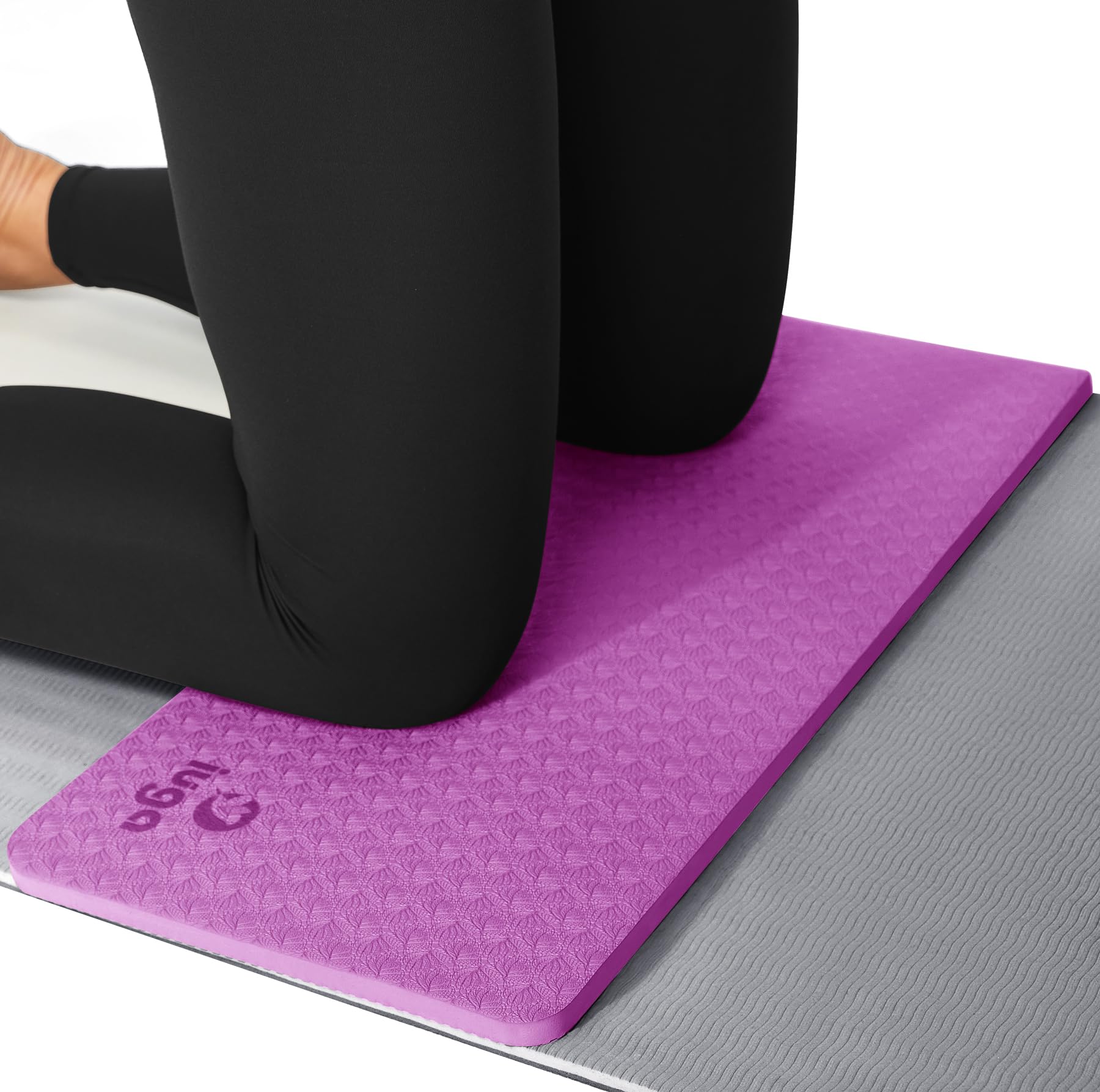
The longest pad here, made for people who stretch out in plank and puppy pose.
That length matters for poses where your forearms hit the floor as well as your knees: plank, forearm plank, puppy pose, and stretches that roll you forward. It is 0.5 inches thick, the slimmest build on this list, so it is best over a mat rather than bare tile. The ridged non-slip surface is designed to keep traction on hard flooring.
Effectiveness is what buyers lean on — the pad makes tricky poses doable, and comfort and cushioning back that up. The TPE material lists as non-toxic and wear-resistant, and cleaning is a wipe with a damp cloth and mild soap. One practical tip from the maker: roll it with the marked surface facing outward so the edges do not curl.
The size-and-thickness split is the honest part. Some find the dimensions perfect for a long practice; others feel it is small and very thin. At 0.5 inches it is the last pad to pick if you want deep cushioning — the ECOESPTI at 1.57 inches sits at the other end. Choose this for length and coverage, not for plush.
Roll it, stuff it in a backpack, and it travels to bike-to-yoga commutes and camping trips without complaint. The Violet colour and 0.5-inch build finish a pad that is about coverage and portability in equal measure.
The length story: the extra 1.6 inches over a 24-inch pad is what gets your forearms onto cushion in a long puppy-pose hold.
The honest gap: 0.5 inches of TPE is thin — treat this as a mat topper, not a stand-alone floor barrier.
Go with it for: long, forearm-involving poses where coverage beats depth.
skip it if: deep knee cushioning is the whole point — you will want at least 0.6 inches or more.
6. MRO Yoga Knee Pad Cushion 24 x 10.6 x 0.6 Inch
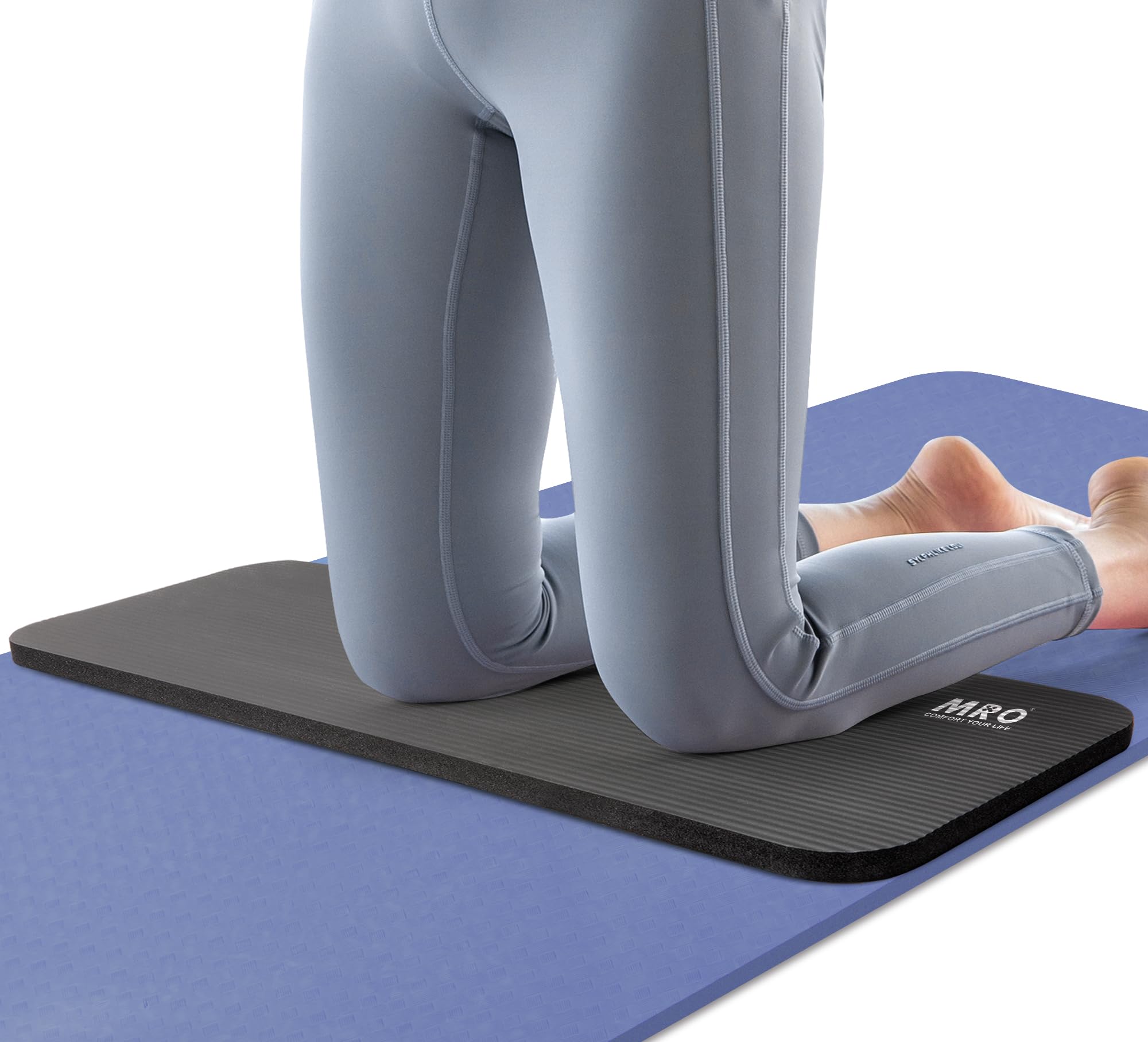
A wide 24-inch strip that shields knees, sit bones, wrists, and head in one placement.
MRO’s pad measures 24 inches long and 10.6 inches wide — wider than the Kinesis and Ewedoos strips, so it leaves more room for your arms or sit bones to land on foam. Thickness is 0.6 inches of high-density NBR, the same modest lift the Kinesis pad offers, and the closed-cell foam keeps sweat and liquids on the surface instead of inside. For a home practice on a mat, that combination is a solid everyday shield.
What buyers respond to is the quality and the knee support — the pad cushions knees, elbows, and wrists and reads as comfortable for sore joints. The eco-friendly NBR is listed as PVC-free and latex-free, and it wipes clean and stays odor-less. Use it under knees in tabletop, under forearms in plank, or under sit bones in a long meditation sit. It even works as a kneeling mat for gardening, chores, and auto repair.
The fit notes are worth knowing. Some find the thickness just right; others feel it does not last as long or stays a little flat. It is a firm 0.6 inches, not a deep cushion, so if you need real lift, the Impulse pad at 1 inch is a better match. For a wide, honest everyday strip, this one delivers.
The coverage win: at 10.6 inches wide, this is the roomiest 0.6-inch strip here for dropping a forearm or a hip onto it.
The durability question: reports on longevity are mixed — treat it as a daily-use pad, not a heavy-duty one, and it will serve you well.
Choose it for: a wide, firm, wipe-clean strip that protects several joints in one go.
Pick another if: you want plush foam or a guaranteed lasting build over years of use.
7. Impulse Fitness Extra Thick 1 Inch Workout Mat Cushion
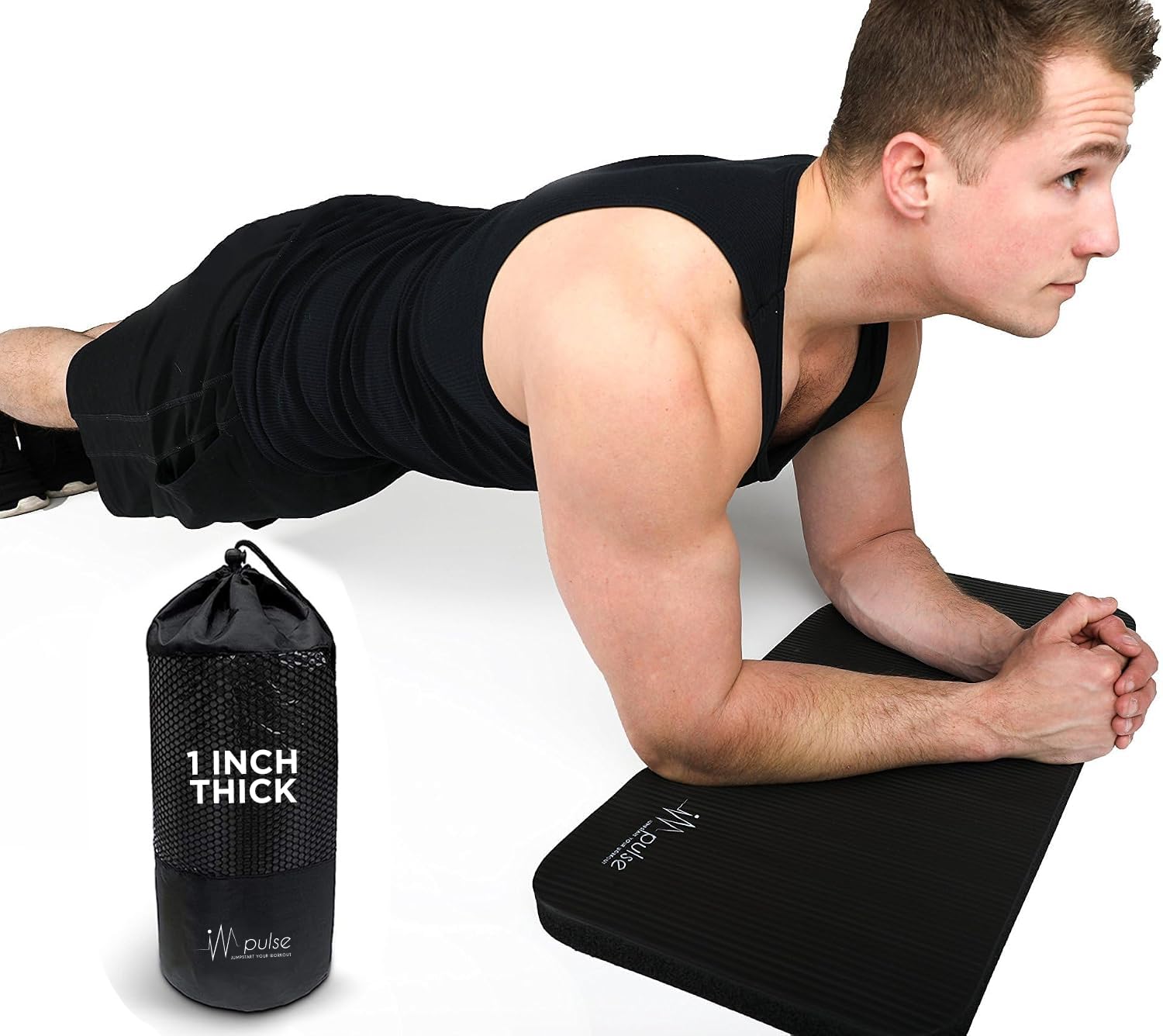
A full 1 inch of foam across a wide 24-inch strip — the most cushion you can buy in strip form here.
If you want deep padding and wide coverage together, this is the pad that gives you both. It measures 24 inches long and 12 inches wide at a full 1 inch thick — thicker than the 0.6-inch Kinesis, Sargoby, Ewedoos, and MRO strips, and wider than most of them too. The 24 x 12 surface is big enough to take the pressure off knees, elbows, and wrists in sit-ups, push-ups, planks, and yoga. A breathable mesh carry bag is included, so it packs away easily.
Quality and cushioning are what lead the response — the 1-inch foam reads as great on the knees and lets you do pain-free planks and knee dips. Comfort and knee support follow right behind, and buyers report the size fits neatly whether they use it for yoga, Pilates, or a desk-side stretch. The NBR foam is non-slip and wipes down, so cleaning is quick. It doubles as a meditation mat, a gardening kneeler, or a portable mat for a parked-car workout.
The one note is durability — some feel it wears over time while others report it holding up, so treat it as a pad to store properly rather than crumple into a bag. A single 1-inch pad does not fold small like a compact square, so it is best if you practice in one place or drive to class with room for it.
The standout numbers
- 1-inch foam — deep cushion in a wide strip
- 24 x 12 inches covers knees, elbows, wrists
- Breathable mesh bag included for storage
- Doubles as meditation, gardening, or desk mat
Weigh before you buy
- 11.68 ounces — the heaviest pad here
- Durability reports are mixed; store it flat
This is the one if: you want the deepest cushion plus wide coverage without carrying two separate pads.
Think about travel before you commit: at 11.68 ounces and 24 inches long, it does not tuck into a small tote like a square pad does.
Know the Specs
Thickness (mm and inches)
Thickness is the single spec that decides whether a knee cushion helps you. A pad listed as 0.6 inches, 15mm, or 1.5cm gives a modest lift — good over a yoga mat for most people. A 0.81-inch or 15mm pad adds a bit more. A 1-inch or 1.57-inch pad adds deep foam for bony knees and bare floors. The taller the pad, the less stable it feels under a single knee, so match thickness to your joints and the surface you practice on.
Footprint (length x width)
Footprint decides how many joints one pad can shield at a time. A long 24-inch strip runs under both knees and still leaves room for forearms in plank. A compact 7-to-8-inch square suits one knee or one elbow and travels easily. Mathematically, a strip like the Kinesis at 24 inches is far more than triple the 7.81-inch Yes4All square. Pick the footprint by your poses: a flowing practice with forearm work favors a strip.
Foam material (NBR, TPE, memory foam)
NBR foam (nitrile butadiene rubber) is dense and rubbery, resists sweat and liquids, and wipes clean — the reason most strips here use it. TPE (thermoplastic elastomer) is lighter and often textured for grip on glossy floors. Memory foam plus EPE (expanded polyethylene) builds feel plusher and distribute pressure, though memory foam can compress across a very long hold. Closed-cell foam keeps sweat out; open or absorbent foam gets heavy and stale.
Grip and care
A non-slip surface — textured or ridged — keeps the pad from sliding when you sweat or shift between poses. Grip matters most on hardwood, tile, and studio mats. Care is simple on every pad here: they are hand wash only, so wipe with a damp cloth or mild soap and air dry. None should go in a machine. A grippy bottom plus a quick wipe is what keeps a knee cushion stable and fresh over daily use.
Common Questions
Is a 0.6-inch knee pad thick enough for yoga on a hardwood floor?
Should I get one long knee pad or a set of two small pads?
Will a yoga knee cushion help with elbow and wrist pain too?
How do I stop my knee pad from sliding during a sweaty class?
Can I wash a yoga knee cushion in the machine?
Does a thicker knee pad make balancing harder?
Which is better for sensitive knees, memory foam or NBR foam?
Can a yoga knee cushion be used for gardening or bathing kids?
How long will a foam knee pad last with daily use?
Do I need a knee pad if I already have a thick yoga mat?
The Bottom Line
For most people, the yoga knee cushion that gets the balance right is the Kinesis Yoga Knee Pad Cushion — 24 inches of NBR foam (a dense, rubber-like foam) that covers both knees in one placement and wipes clean after a sweaty session. If deep cushioning matters more than coverage, reach for the ECOESPTI 2-Pack at 1.57 inches of memory foam (foam that slowly springs back to shape). And when you want the deepest foam across a full strip, the Impulse Fitness pad at 1 inch thick and 24 by 12 inches is the one to grab.
How we choose
We do not accept paid placement. Every pick is matched to a real buyer and a real use-case; we do not hands-on test units.
Sources
Specifications: manufacturer listings and product documentation. Review insights: verified customer reviews, as of November 2026. Pricing: not shown on this page (it changes often); check the current price via the retailer link.
As an Amazon Associate, Tactical Gear Guy earns from qualifying purchases. This does not affect which products we feature.