Specs are compiled from manufacturer listings and verified buyer reviews and can change over time — please confirm the key details on the product page before buying.
Most wood-cutting mistakes happen before the saw is even switched on. You buy a saw that cuts beautifully on a test scrap, then discover it cannot handle the 4×8 sheet or the crown molding you actually came to build with. The fix is matching the tool to the cut — a miter saw for crosscuts and trim, a circular saw for framing and decking, a table saw for ripping sheets, a scroll saw for curves, and a CNC router for repeatable carved parts. This guide sorts all of that out, tool by tool, so you buy the saw that fits your bench and your projects.
This guide is built by comparing the manufacturers’ published specifications and the patterns across verified customer reviews, so you get each pick’s real strengths and trade-offs instead of marketing spin.
Each entry below names the exact cut it is built for, the motor and capacity numbers that decide whether it keeps up, and the honest limits owners run into. The right pick for your bench starts with knowing which of these cuts you make most, and the comparison below settles that question tool by tool.
Top Picks

How To Choose The Best Wood Cutter Machine
The first question is not which brand — it is which cut. A miter saw crosscuts boards to length and bevels trim. A circular saw breaks down sheet goods anywhere. A table saw rips long boards and sheet goods against a fence. A scroll saw cuts curves and inside shapes. A CNC router carves repeatable designs from a file. Buy for the cut you make most, then let blade size, amperage and miter range decide the model.
Blade diameter sets your depth and your reach
A bigger blade reaches deeper into the material. A 12-inch miter saw blade cross-cuts 2-inch by 8-inch dimensional lumber at 90 degrees, while a 10-inch saw works through smaller stock. A compact cordless circular saw with a 6-1/2-inch blade is built for framing and quick breakdowns, not for thick posts. Match blade size to the thickest thing you plan to cut, then stop.
Amperage and RPM decide whether the motor bogs down
Amperage is the muscle. A 15-amp motor holds speed through hardwood, while a smaller cordless motor leans on battery voltage instead. No-load RPM tells you how fast the blade spins free — 4500 RPM and 5000 RPM saws both cut clean when the blade is sharp and the feed is steady. Hardwood punishes a weak motor with burning and stalling, so buy the amps your wood demands.
Bevel and miter range open up trim work
Miter angle is the side-to-side swing that cuts a corner; bevel is the tilt of the blade head for an angled face. A saw that miters 0-52 degrees left and right covers more trim joints than one that only goes one way. Positive stops lock common angles so you do not have to eyeball 45 degrees every time.
Corded power or battery freedom
A corded saw runs all day on a wall outlet and never asks for a charge. A cordless circular saw goes where the work is — a deck, a fence line, a driveway — but a 4.0Ah battery pack has a finite run time. If your cutting happens at a bench with power nearby, corded is the simpler choice. If it happens on a job site, cordless buys you the reach.
Side-by-Side Comparison
| Model | Best For | Blade Size | Power Source & Rating | Key Range | Amazon |
|---|---|---|---|---|---|
| DEWALT DWS715 12-Inch Miter Saw★ Best Overall | Trim, crosscuts, and heavy stock | 12 inches | Corded, 15 A | Bevel 0°–48° left, 0°–3° right | Amazon |
| Metabo HPT C10FCG2 10-Inch Miter SawTop Performer | Balanced all-round miter work | 10 inches | Corded, 15 A | Miter 0–52° left and right | Amazon |
| DOVAMAN 10-Inch Sliding Miter SawMost Versatile | Wide crosscuts on big material | 10 inches | Corded, 15 A | Dual speed 5000/3200 RPM, cut up to 4 x 13 in | Amazon |
| MarvTool 10-Inch Compound Miter Saw | Portable trim work around the house | 10 inches | Corded, 15 A | Miter 0°–45° left, bevel 0°–45° | Amazon |
| WORKPRO 20V Mini Circular Saw | One-handed cuts in tight spots | 4-1/2 inches | Cordless, 20 V / 4.0Ah | Depth 1-11/16″ at 90°, 1-1/8″ at 45° | Amazon |
| DEKOPRO 20V Circular Saw | Framing and sheet breakdown | 6-1/2 inches | Cordless, 20 V / 4.0Ah | Bevel 0°–45°, 4500 RPM | Amazon |
| WEN 3921 16-Inch Scroll Saw | Curves, crafts, and beginner work | 16-inch throat | Corded | 400–1600 strokes per minute | Amazon |
| Dremel MS20-01 Moto-Saw | Small detail cuts and hobby work | 3.8 inches | Corded | Variable speed, 0°–90° cutting | Amazon |
| DEWALT DWE7485 Table Saw | Ripping sheets and long boards | 8-1/4 inches | Corded, 15 A | 24.5 in. rip capacity | Amazon |
| Twotrees TTC450 Pro CNC Router | Carved parts and repeat runs | 10 cutting tools included | Corded electric | 460 x 460 x 80 mm work area | Amazon |
| FoxAlien Masuter Pro CNC Router | First CNC setup for hobbyists | 10 engraving bits included | Corded, 5 A | 400 x 400 x 60 mm work area | Amazon |
Detailed Reviews
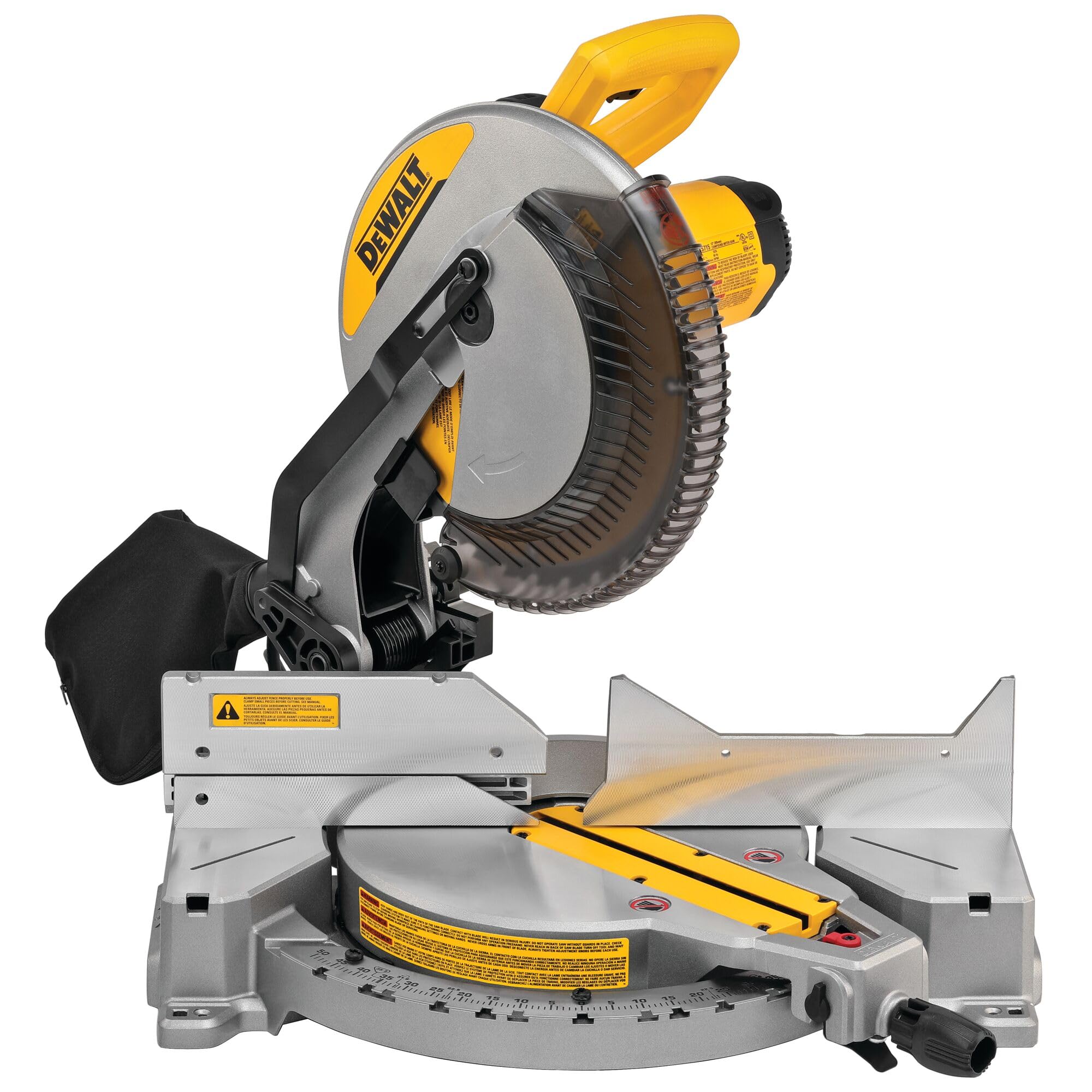
1. DEWALT DWS715 Miter Saw
Our pick — 4.5+★ from 6,500+ verified ratings; the strongest balance of quality and price.
The 12-inch blade that swallows a 2×8 in one pass and still hits 45 degrees clean.
If your cutting list is trim, deck framing, and the occasional 4×4, this is the saw that covers all of it without a second trip to the store. The 12-inch carbide-tipped blade cross-cuts 2-inch by 8-inch dimensional lumber at 90 degrees and 2-inch by 6-inch stock at 45 degrees. That extra reach is the whole point of stepping up from a 10-inch saw, and it is why this DEWALT takes the top spot across 6,000+ owners.
What wins people over is the miter system. The stainless-steel detent plate carries 14 positive stops, so 0, 15, 22.5, 31.6 and 45 degrees all click into place instead of being guessed at. The tall sliding fence supports 5-1/2-inch base vertically, which is the difference between cutting crown molding flat and fighting it. And the bevel swings 0 to 48 degrees to the left for angled faces. The one trade-off on the bevel side: right-hand bevel only goes 0 to 3 degrees, so left-tilted compound cuts are this saw’s home turf.
Owners describe the 15-amp motor pushing through 2×8 stock without bogging, and the out-of-box accuracy is what keeps the saw in service for years. One thing to plan for: at 42.8 pounds, it is a bench saw rather than a grab-and-go saw. It is the heaviest corded saw on this list by a wide margin. Keep it on a stand in the shop and you will never notice the weight; lug it up a ladder and you will.
Where this saw earns its keep
- 12-inch blade cuts 2×8 at 90° and 2×6 at 45° in a single pass
- 14 positive stops on a stainless-steel detent plate keep common angles locked
- Tall sliding fence holds 5-1/2-inch base vertically for crown work
- Left bevel to 48 degrees covers compound trim cuts
What you give up
- 42.8 pounds makes it a bench fixture, not a portable saw
- Right-side bevel stops at 3 degrees
- Dust bag catches some, not all, of the chips
Made for: anyone cutting trim, dimensional lumber and compound angles at a fixed bench.
Think twice if: your saw needs to travel up stairs every weekend — the 42.8-pound frame will wear you down.
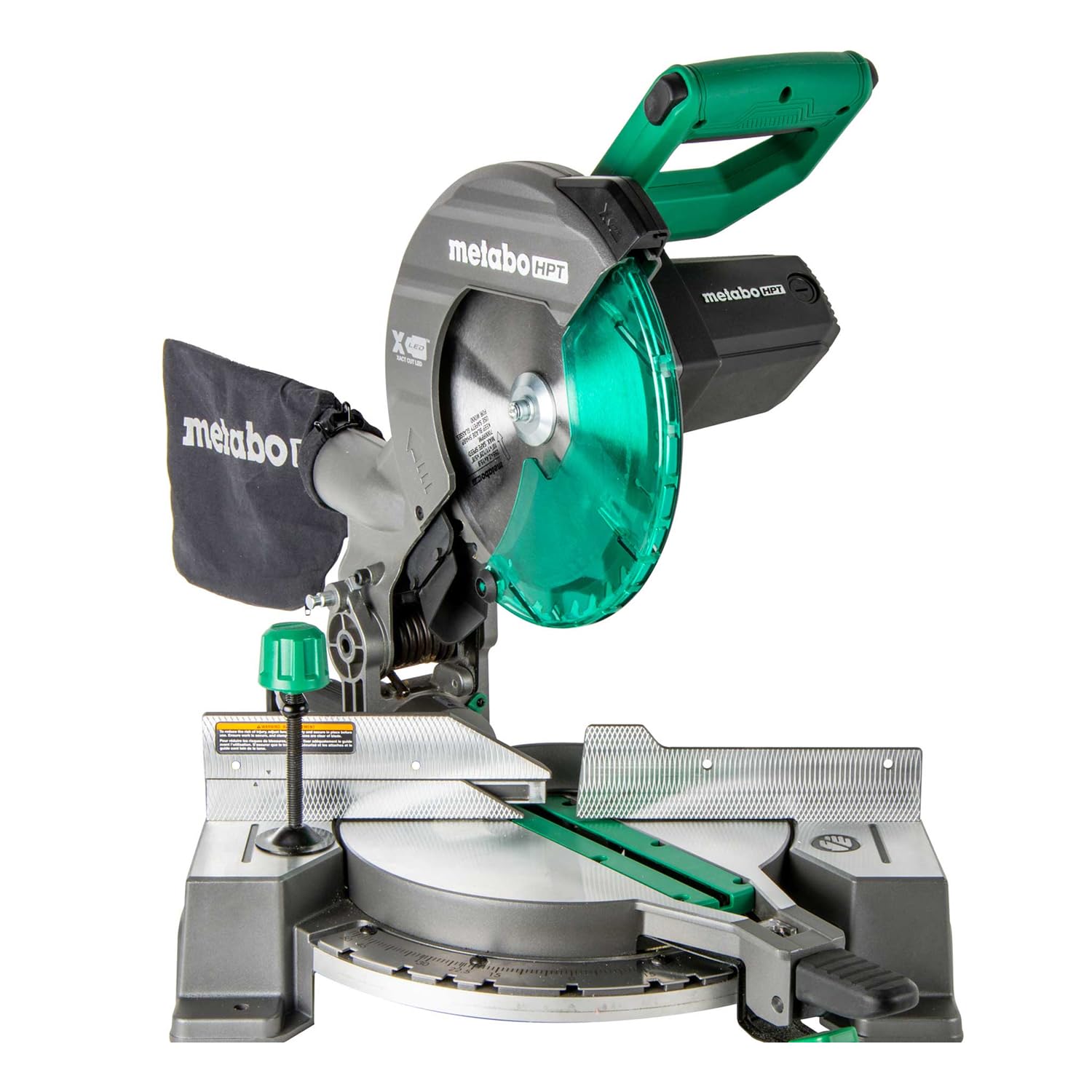
2. Metabo HPT C10FCG2 Miter Saw
A 15-amp motor in a 24.2-pound frame — the trim saw you can actually carry.
Here is the direct read against the DEWALT above: the Metabo HPT gives up blade size, 10 inches against 12, but drops the weight to 24.2 pounds from 42.8. If you work out of a truck or a basement, that is the number that matters more than raw capacity. The 15-amp motor spins to 5000 RPM no-load, which is enough to push a 24-tooth tungsten carbide blade through 4x4s and 2x6s without stalling.
The angle range is where this saw surprises people. It miters 0 to 52 degrees left and right, versus the DEWALT’s single-direction bevel setup on the right side. Adjustable bevel stops run 0 to 45 degrees left. Combine that with the large table and vice clamping system and you get a saw that holds the work steady while you hunt for the cut. The improved miter scale and controls keep adjustment from feeling like a wrestling match.
What buyers focus on most is the cut quality on both straight and beveled passes — this saw handles a 4×4 and a 2×6 without complaint. The durability and adjustability aspects get a more mixed read, so treat the detents like a precision instrument and recheck your angles after heavy use rather than assuming they stay perfect forever. First-time miter saw owners tend to settle in fast with this one, and the 5-year warranty backs the frame.
The weight-to-power trade: 24.2 pounds with a 15-amp motor and 5000 RPM is a rare combination — you get jobsite muscle without needing two hands and a dolly.
One honest catch: the 10-inch blade caps your crosscut at smaller stock than the 12-inch DEWALT, so thick timber framing is not its job.
Reach for this if: you want a portable trim saw that still cuts 4x4s and 2x6s cleanly.
Look elsewhere if: your material list includes 2×8 crosscuts — that needs the 12-inch saw above.
3. DOVAMAN 10-Inch Sliding Miter Saw
A sliding rail that turns a 10-inch saw into a 4×13-inch crosscut machine.
Sliding miter saws solve the one problem fixed-head saws cannot: reach. The 13-inch sliding rail plus extendable side tables push this DOVAMAN’s cutting range to 4 x 13 inches, with a max cut of 3.5 x 13.4 inches and 9 positive stops to lock angles. A fixed 10-inch saw simply cannot span that width. If you regularly crosscut wide boards, shelving, or fascia, the rail is the feature you are paying for.
Then there is the multi-material angle. Two 40-tooth and one 48-tooth TCT blade ship in the box, and the dual-speed setting switches between 5000 RPM and 3200 RPM. The lower speed is the one you want for PVC and soft metals, where a fast blade can grab or melt instead of slice. The 15-amp pure copper motor carries the load, and the built-in laser guide throws a line where the blade will travel so you are not guessing at layout marks.
The honest limitation is spin-up. The motor takes a while to reach speed, and that pause between squeezing the trigger and cutting gets noticed. Blade durability, accuracy and material options all land in mixed territory, so budget for a fresh blade sooner than you might on a premium saw. The ambidextrous design, though, is genuinely useful — left-handed operators do not have to reach across the machine.
Why the rail changes things: a 4 x 13 inch crosscut capacity from a 10-inch blade class is the standout spec here — that is wide-shelf and fascia territory.
The pause you will feel: the motor takes its time winding up to speed, which is the most-noticed drawback on this model.
Best fit: woodworkers who crosscut wide stock and want one saw that also handles PVC and soft metal.
skip it if: you need instant trigger response for rapid repetitive cuts.
4. MarvTool 10-Inch Compound Miter Saw
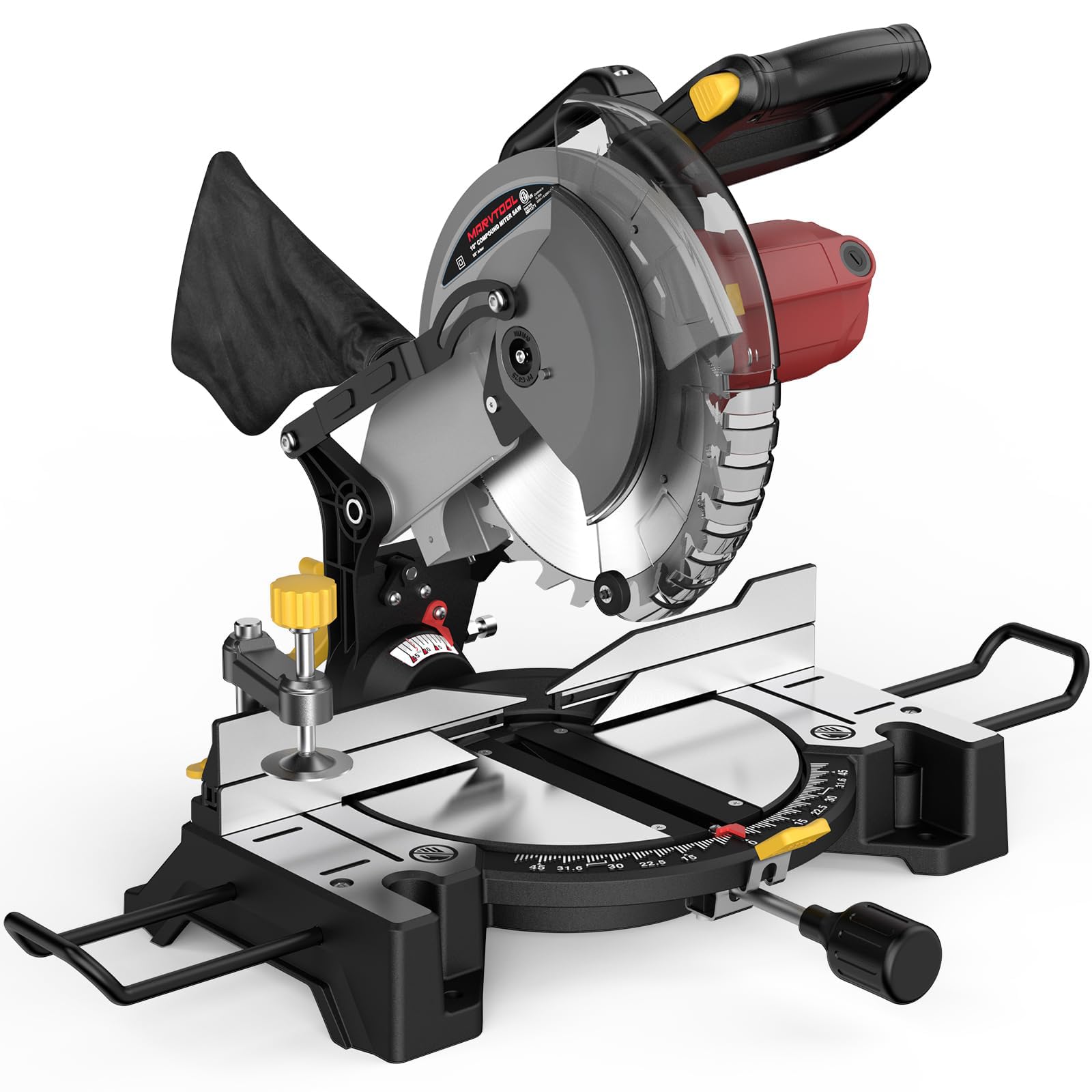
The 20.5-pound miter saw you can set up alone in under a minute.
Weight is the spec that decides whether a miter saw gets used or gets buried. At 20.5 pounds this MarvTool is the lightest corded miter saw here — 4.2 pounds under the Metabo HPT’s 24.2 and less than half the DEWALT’s 42.8. The head locks down into the base with a release knob, so it stores flat and rides in a truck bed without a wrestling match. For a homeowner doing baseboards, casing and a deck rail, that portability is the whole argument.
The 15-amp motor runs to 5000 RPM no-load, and the saw miters 0 to 45 degrees left with a bevel range of 0 to 45 degrees. A transparent blade guard keeps the cut visible while the vise clamp pins your workpiece. The dust collection bag catches what it can. An extension table adds support for longer boards so they do not droop and bind mid-cut.
Performance and value are the two things owners talk about most, and the cutting accuracy and power back that up. The blade adjustment features are the mixed read — expect to dial in the bevel and check square yourself rather than trusting the factory setting from the start. Do that once and the saw settles into reliable service.
Why portability wins here
- 20.5 pounds — lightest corded miter saw on this list
- Head locks into the base for flat storage and transport
- 15-amp motor at 5000 RPM no-load speed
- Extension table supports longer stock
Where it asks you to work
- Blade adjustment needs checking before first use
- Miter travel is left-only at 0-45 degrees
- Dust bag leaves some chips behind
Pick this one if: the saw has to be carried, stored and set up by one person.
Move on if: you need right-side miter angles or bevel cuts beyond 45 degrees.
5. WORKPRO 20V Cordless Mini Circular Saw

A 4.36-pound saw that reaches where a full-size circular saw cannot fit.
Replacing a fence board or trimming a door bottom rarely leaves room for a 6-1/2-inch saw. This WORKPRO is the answer to that: a 4-1/2-inch blade on a 4.36-pound body, designed to be run one-handed with a rubberized handle. The 20V motor spins at 4500 RPM no-load, and the package includes three blades — a 24T alloy blade for wood, a 60T blade for wood and plastic, and a diamond blade for tile. One kit covers framing touch-ups, plastic trim and a bathroom tile repair.
Cutting depth is the honest limit to understand before you buy. Maximum depth reaches 1-11/16 inches at 90 degrees and 1-1/8 inches at 45 degrees. That handles 2-inch nominal boards and plywood, but it will not cut through a 4×4. The angle adjusts freely from 0 to 45 degrees, and the laser and parallel guides keep the cut tracking straight. Buyers report it going through 2-inch boards easily and working well on Trex decking.
A 4.0Ah lithium-ion battery pack ships with the saw, and the 2.4A fast charger fills one in as little as 2 hours. The dust hose connects to a vacuum through the included adapter, which keeps fine dust out of your lungs and your line of sight. The switch locking mechanism prevents an accidental start. Add the 2-year manufacturer warranty and the kit is a sensible entry point for anyone who needs a second saw for detail work.
The depth number to remember: 1-11/16 inches at 90 degrees is the ceiling — plan around it rather than discovering it mid-cut on a thick post.
What makes it useful: one-handed control plus three included blades means it earns its place even after you own a full-size saw.
Suits you if: your jobs are repair-scale — fence boards, door bottoms, tile patches, decking touch-ups.
Not for: cutting thick posts or framing lumber in quantity; that needs a full circular saw.
6. DEKOPRO 20V Cordless Circular Saw
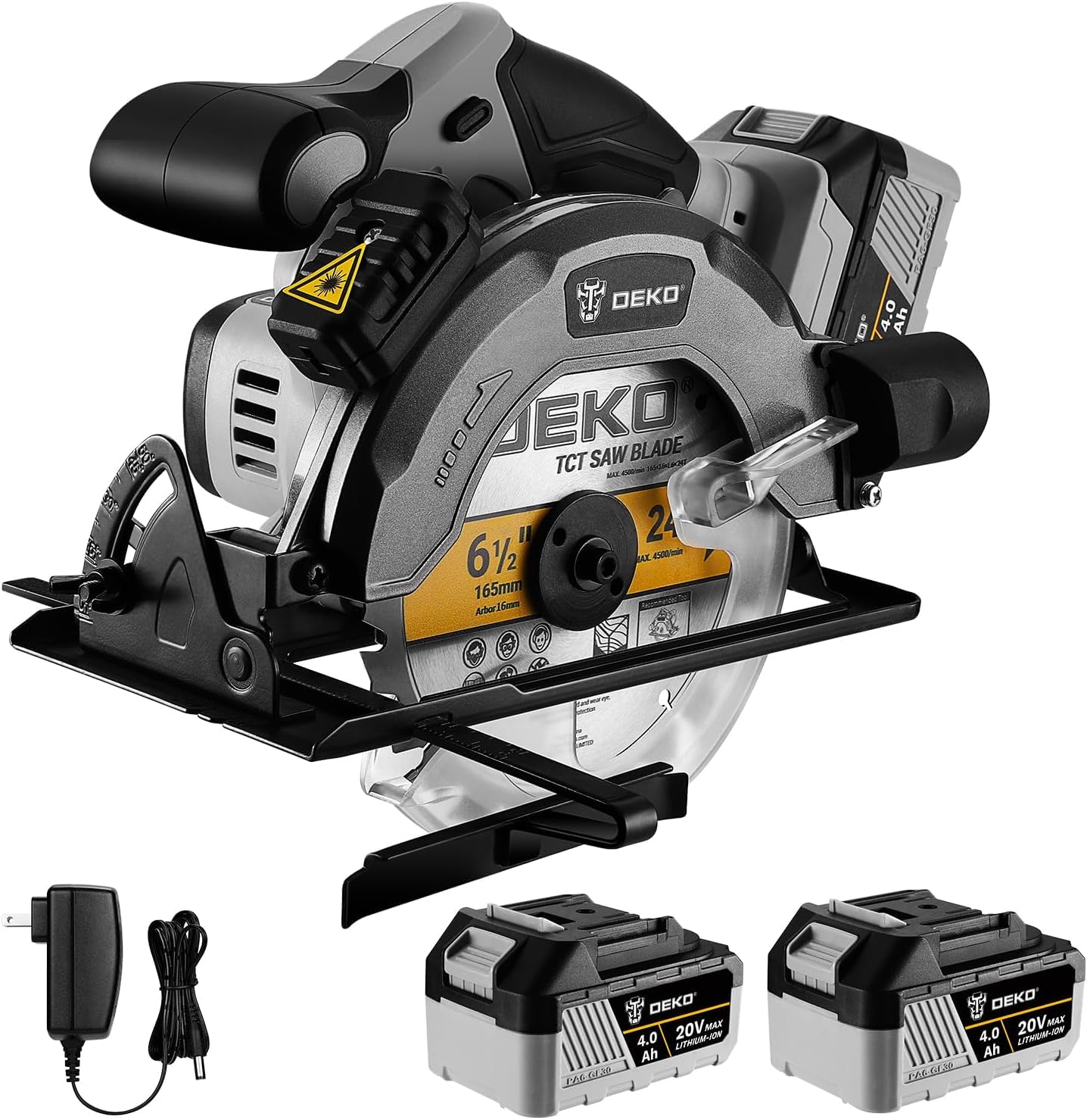
Two batteries, a 6-1/2-inch carbide blade, and no cord to trip on.
The blade size gap is the first thing to understand: this DEKOPRO runs a 6-1/2-inch blade against the WORKPRO’s 4-1/2, which is exactly what buys the extra depth for sheet goods and framing. The 20V motor hits 4500 RPM no-load, and the 24-tooth carbide-tipped blade leaves clean edges in hardwood and softwood. Two 4.0Ah batteries ship in the kit, so one charges while the other cuts — the smartest way to live with a cordless saw.
The bevel adjusts 0 to 45 degrees, and the laser projects a line onto the material for better visibility when you are cutting away from your mark. The ergonomic handle keeps the saw controllable through a long rip in plywood.
Battery life is the split opinion on this model. Some owners get through a project on a pack, others find the run time short. Charging both batteries and keeping one on the charger is simply how you should plan to work. The other recurring gripe is blade replacement — a few owners found changing the blade harder than expected. If you rarely swap blades, neither point will bother you; if you change blades for every material, look at the WORKPRO kit with three blades instead.
Why the twin batteries matter: a second 4.0Ah pack is the difference between a cordless saw that finishes the deck and one that dies halfway.
The maintenance catch: blade changes are fussier than they should be on this model.
The right buyer: someone breaking down plywood and cutting framing away from an outlet.
Look at a different kit if: you swap between wood and metal blades constantly.
7. WEN 3921 Scroll Saw

Sixteen inches of throat depth, twelve hundred strokes of speed range, and a light where you need it.
A scroll saw is the wrong tool for straight rips and the right tool for everything else that has a curve in it. The WEN 3921 runs a 16-inch throat depth and cuts wood up to 2 inches thick in its standard position. The variable speed dial moves from 400 to 1600 strokes per minute, so you can slow down for tight turns in thin stock and speed up for long sweeping curves. The 16-by-11-inch table bevels up to 45 degrees to the left for angled cuts.
The clever part is the blade mounting. The saw accepts blades in two directions — standard and rotated 90 degrees — which gives you ripping capacity you would not expect from a scroll saw. Blade changes run off a thumb screw adapter, so no tools are needed to swap a blade. There is a cast iron base for stability, an air pump to blow dust off your cut line, a flex light, a dust port, a foot lock clamp, onboard storage and three blades in the box.
What owners respond to is the value and the versatility — this saw is popular with beginners learning curve work and with crafters cutting small decorative pieces. Ease of use and cutting performance get split verdicts. The saw cuts beautifully once you learn its rhythm, and fights you while you are still learning to feed the work. Vibration is the most-discussed drawback; bolt the cast iron base down and the machine settles considerably.
The case for this scroll saw
- 400 to 1600 strokes per minute covers delicate and fast curve work
- 16-inch throat depth and 2-inch cut thickness
- Blades mount in two directions for ripping capacity
- Tool-free blade changes with the thumb screw adapter
The honest cons
- Vibration is the most-noticed issue — it wants a secured base
- Blade changes split opinion on ease
- Curve accuracy takes practice before it feels natural
Good match for: crafters and beginners cutting curves, letters and decorative shapes.
Wrong tool if: your work is straight crosscuts all day — a miter saw is faster and cleaner at that job.
8. Dremel MS20-01 Moto-Saw Variable Speed Compact Scroll Saw

The scroll saw that lifts off its base and comes to the workpiece.
Blade size tells the whole story of how this saw differs from the WEN above: 3.8 inches here against a 16-inch throat there. The Moto-Saw is a detail tool, not a shop saw. Its 3.8-inch blade handles intricate cuts in thin stock, and the body measures 9.84 inches long by 8.5 wide by 10.6 tall, so it tucks onto a shelf or a corner of the bench. The quick-change mechanism auto-tensions each blade as you swap it, which takes the fiddling out of blade changes.
The feature that justifies the design is the detachable coping function. Lift the saw off its fast-clamp base and you can carry it to the work — cutting a coping joint on a piece of installed trim, or trimming a dowel already in place. The variable-speed control lets you slow down for plastics and delicate wood. A dust port adapter keeps the cut line visible, and the fast-clamp base attaches to tables, benches and other surfaces. Four cutting blades ship in the kit along with a storage case and vacuum adapter.
One packaging note worth knowing before you open the box: the blue edge-guide locking levers shown on the packaging are not included and do not affect how the tool performs. Owners find this a fantastic tool for small projects and hobby work, though the cutting performance and value for money split opinion — patience and the right blade for the material make the difference. Blade durability is the main wear item, so keep spares on hand.
Its real superpower: detaching from the base and cutting where the work already is — no unbolting trim to bring it to the saw.
What to know going in: the edge guide levers on the packaging are not in the box and are not needed.
Built for: hobbyists and detail work in tight spaces, especially trim already in place.
Not the one if: you need to cut thick stock or long straight runs — the 3.8-inch blade will not get you there.
9. DEWALT DWE7485 Table Saw

Twenty-four and a half inches of rip capacity from a saw that folds down and rolls away.
A table saw earns its place by ripping, and ripping is measured in capacity. This DEWALT carries 24.5 inches of rip capacity, which is the number that lets you break down a 4×8 sheet of plywood or OSB. The rack and pinion telescoping fence rails are the mechanism behind that — the fence slides smooth and locks square, so each pass tracks true. An 8-1/4-inch 24-tooth blade ships on the arbor.
Where a jobsite table saw lives or dies is setup and safety. The Site-Pro Modular Guarding System lets you adjust the guarding without tools. The metal roll cage base takes the knocks of a truck bed and a rough floor. Onboard storage holds the guard, fence, wrenches and miter gauge so nothing gets lost between jobs. The power-loss reset is the quiet win: it stops the saw from restarting itself after an outage if the switch was left on, which is exactly the accident you never want to walk into.
Owners describe the cut as clean and precise and the setup as straightforward, and the durability holds up across years of home projects. At 54 pounds this is not a saw you carry one-handed up a flight of stairs; the roll cage base assumes you roll it. Treat that as its design, not its flaw.
The number that sells it: 24.5 inches of rip capacity means full sheets break down at the saw instead of on sawhorses with a circular saw.
Design assumption: 54 pounds plus a roll cage base means this saw rolls to the work rather than being carried.
Ideal for: anyone ripping plywood, shelving and cabinet parts at a shop or driveway.
Different tool needed if: you never rip and only crosscut — buy a miter saw instead.
10. Twotrees TTC450 Pro CNC Router Machine
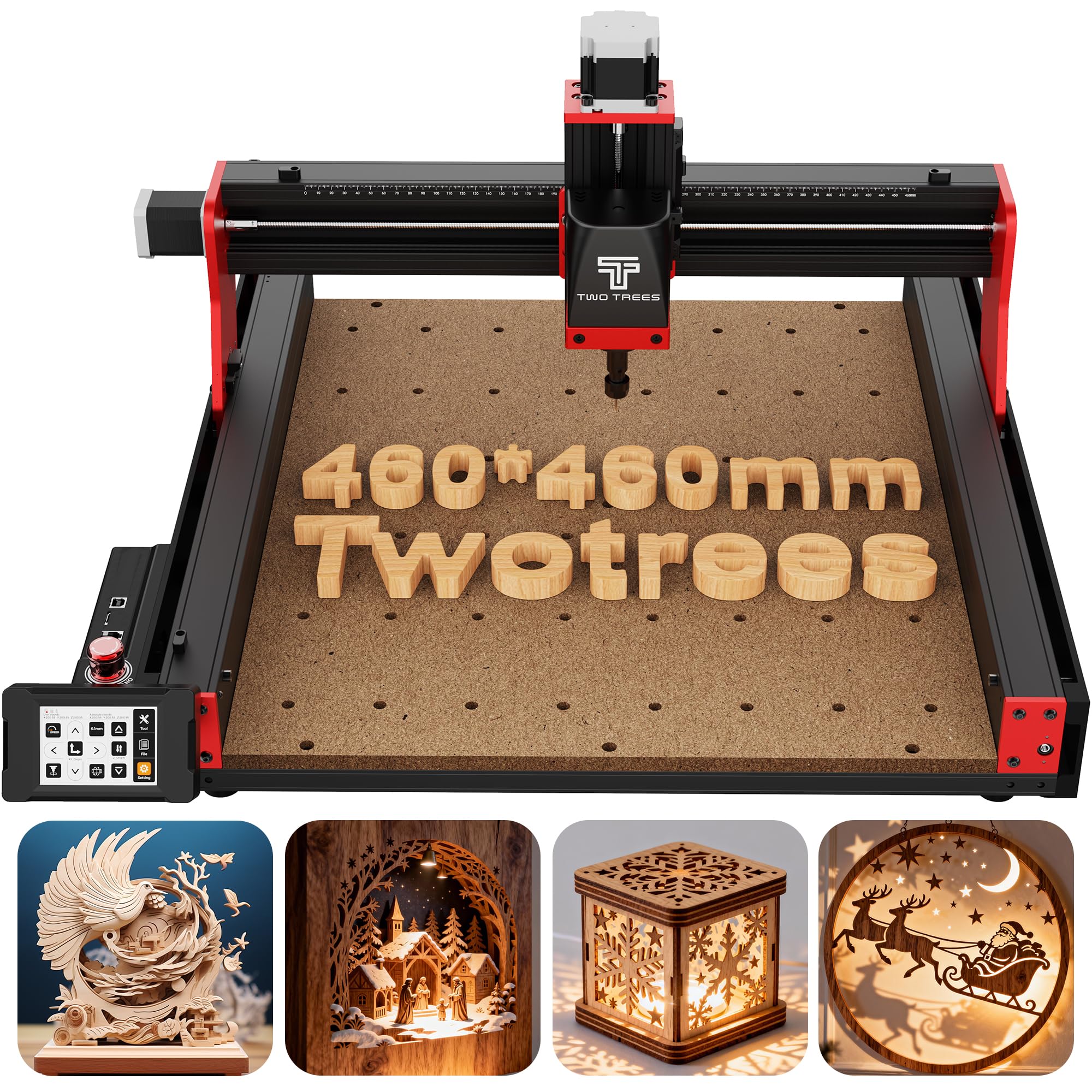
A 460 x 460 x 80 mm work envelope with a Z-axis that holds 0.0025 mm positioning accuracy.
This is where the list leaves hand-guided cutting entirely. The TTC450 Pro is a three-axis CNC router — a computer moves the cutting bit along X, Y and Z — so the same carved panel comes out identical every run. The working area is 18.1 inches square at 460 x 460 x 80 mm, large enough for furniture panels and signage. The 57 stepper motor drives the Z-axis with positioning accuracy up to 0.0025 mm, which is the figure that decides whether multi-layer relief work looks crisp or muddy.
The control side is unusually approachable for an entry-level machine. A 3.5-inch IPS capacitive touch screen runs the show without a computer tethered mid-job, and the control box carries a 4th-axis rotation port, a laser module port and a 500W spindle speed control port. The open-source GRBL system works with ArtCam, Fusion 360, Easel and Carveco Maker across Windows, macOS and Linux. The aluminum and stainless steel frame uses dual limit switches on XYZ to keep travel safe, and the solid structure suppresses vibration during long jobs.
Setup honesty matters here more than on any saw on this list. You assemble the machine, then install the CH340 driver before connecting to a computer. Windows 11 users need the CH341 driver from the WCH site instead, because CH340 is not fully compatible. The quality control wins the most praise, and setup is well regarded, but functionality splits opinion — some units run clean, others fail basic tests, and durability and power draw their share of criticism. Buy this for what CNC adds, not as a replacement for a saw.
What CNC buys you here
- 460 x 460 x 80 mm work area handles furniture panels and signage
- 0.0025 mm Z-axis positioning accuracy for fine relief work
- 3.5-inch IPS touch screen plus 4th-axis and laser ports
- Open-source GRBL works with mainstream design software
What you are signing up for
- Assembly plus driver install before the first cut
- Windows 11 requires the CH341 driver instead of CH340
- Functionality is inconsistent machine to machine
Right for: makers and small shops that need repeatable carved parts, not one-off cuts.
Wrong turn if: you want to plug in and cut the same day — assembly and software setup come first.
11. FoxAlien Masuter Pro 3-Axis CNC Router Machine

Pre-wired, pre-assembled, and cutting in the time it takes to make coffee.
Assembly is the barrier that stops most people from ever running a CNC router, and this FoxAlien attacks it head-on. The main parts arrive pre-assembled with the wiring already run to the controller, plus a step-by-step manual that puts setup in the 10-15 minute range. Against the Twotrees above, the trade is work area for simplicity: 400 x 400 x 60 mm here versus 460 x 460 x 80 mm there. For hobby carving and signage, that smaller envelope costs you very little.
The frame is all-aluminum with a linear rail Z-axis, which is what gives it the stability that CNC needs to cut clean lines in wood, acrylic, MDF and nylon. Two spindle clamps ship in the box — 52mm and 65mm — and they fit 60W and 300W spindles, with upgrade paths to a 65mm router or a 1.5KW spindle. The 69mm clamp is sold separately. A dust-resistant controller box carries an emergency stop and home buttons in easy reach, which matters when something goes wrong mid-cut.
You get a 1/8-inch collet, ten engraving bits and a Z probe in the kit, so there is no separate tooling order before the first job. What owners praise most is the build quality — the assembly and stability read as solid. Value for money and ease of use split opinion, and the learning curve is genuine: the machine is straightforward to bolt together and a real skill to run well. Give it a weekend of practice files before you judge it.
Its shortcut: pre-wired parts and a 10-15 minute setup turn the CNC learning curve into a software problem instead of a hardware one.
The fair caveat: a 400 x 400 x 60 mm envelope and an honest software learning curve mean this is a starter machine, not a production one.
Choose this if: you want to learn CNC on a machine that is bolted together before the first afternoon ends.
Go bigger if: your designs need more than 60 mm of Z travel or a 460 mm work envelope.
Know the Specs
Cutting Depth and Blade Size
Blade size and cutting depth are the two numbers that decide which jobs a saw can take. On a miter saw, the blade diameter sets the widest board you can crosscut: a 12-inch blade handles 2-inch by 8-inch lumber at 90 degrees. On a circular saw, depth is listed by angle, so the WORKPRO reaches 1-11/16 inches at 90 degrees and 1-1/8 inches at 45 degrees. On a table saw, the depth of cut is set by how far the blade rises above the table. Read the depth spec against your thickest material first, and the rest of the decision gets simpler.
Amperage, RPM, and Strokes Per Minute
Amperage is how much electrical current the motor draws — think of it as muscle for the blade. A 15-amp corded motor holds speed through hardwood, while a cordless saw leans on battery voltage and pack capacity instead. RPM is no-load speed: how fast the blade spins with nothing touching it. A scroll saw is measured differently, in strokes per minute, because the blade moves up and down rather than spinning. The WEN runs 400 to 1600 strokes per minute so you can match the speed to the thickness of stock. Higher RPM is not automatically better — a 3200 RPM setting cuts PVC cleaner than 5000 RPM, and a scroll saw’s 400 strokes per minute beats 1600 on tight curves.
Miter Angle and Bevel Range
Miter angle is the side-to-side swing of the blade that lets you cut a corner. Bevel is the tilt of the saw head, which cuts an angled face. Positive stops are the preset notches that lock common angles, so a saw with 14 stops clicks into 0, 15, 22.5, 31.6 and 45 degrees rather than asking you to eyeball them. A wider miter range means more trim joints covered; a wider bevel range means more angled faces covered. Check both ranges against the joints you actually cut, not against the widest number on the box.
Rip Capacity and Throat Depth
Rip capacity is how wide a board a table saw can cut against its fence — the DEWALT DWE7485 carries 24.5 inches, which covers a 4×8 sheet of plywood or OSB. Throat depth on a scroll saw works differently: it is the distance from the blade to the back of the table, which sets how far into a piece you can turn a curve. The WEN 3921 offers 16 inches of throat depth. Neither number can be faked with a bigger blade, so choose based on the size of the material you bring to the machine.
Common Questions
Will a 10-inch miter saw cut a 4×4 post?
What is the difference between a miter saw and a circular saw?
Can a sliding miter saw cut wider boards than a fixed-head saw?
How deep can a compact circular saw cut?
Do I need a table saw if I already own a circular saw?
Is a scroll saw good for cutting straight lines?
How much difference does 15 amps make on a miter saw?
What does a CNC router do that a saw cannot?
Can a cordless circular saw cut through a 2×4?
Which wood cutter machine should a beginner buy first?
The Bottom Line
The wood cutter machine that covers the most ground for the most people is the DEWALT DWS715 12-Inch Miter Saw — a 12-inch blade that cuts 2×8 stock at 90 degrees, 14 positive stops on a stainless-steel detent plate, and a tall fence that takes crown molding standing up. It earns the top spot on a 4.5+ star score across 6,000+ ratings, and its 12-inch capacity is why owners keep it for years rather than outgrow it.
If the saw has to travel, take the Metabo HPT C10FCG2. It gives you a 15-amp motor and a 0-52 degree miter range in a 24.2-pound frame, which is the portable-versus-heavy tradeoff made in your favor.
One practical note before you buy: buy for your most common cut and borrow or rent for the rest. A single saw that does everything well does not exist, but the DEWALT miter saw, Metabo HPT and DEWALT table saw cover trim, jobsite work and sheet goods between them. Start with the DEWALT miter saw if you are unsure — its 12-inch blade and 14 positive stops cover the widest range of trim and framing cuts.
How we choose
We do not accept paid placement. Every pick is matched to a real buyer and a real use-case; we do not hands-on test units.
Sources
Specifications: manufacturer listings and product documentation. Review insights: verified customer reviews, as of November 2026. Pricing: not shown on this page (it changes often); check the current price via the retailer link.
As an Amazon Associate, Tactical Gear Guy earns from qualifying purchases. This does not affect which products we feature.