Specs are compiled from manufacturer listings and verified buyer reviews and can change over time — please confirm the key details on the product page before buying.
Buy the wrong sander and you will feel it in your wrists before you see it in the wood. The tools that make a project miserable are the ones that buzz your fingers numb, clog their own paper, and leave a spiral of pigtails under the stain. The right one keeps the pad flat, pulls dust into a bag instead of your lungs, and leaves a surface that takes a finish without a fight.
This guide is built by comparing the manufacturers’ published specifications and the patterns across verified customer reviews, so you get each pick’s real strengths and trade-offs instead of marketing spin.
Below you will find a corded twin for heavy stock removal, a cordless option for the ladder work, and hand blocks for the molding no machine can reach. Here are the woodworking sanding tools worth your bench space.
Top Picks


How To Choose The Best Woodworking Sanding Tools
Most first-time buyers assume a sander is a sander and pick on price alone. Then they discover the machine’s orbit, its motor, and its dust port decide almost everything about the finish they get. Start with the shape of the work in front of you, then match the tool.
Match the tool to the surface, not the catalog
Flat panels and tabletops want a random orbit sander, because the pad spins and orbits at the same time so it cuts fast without gouging straight lines. Curved trim, crown molding, and profiled edges want a contoured hand block with hook-and-loop paper, since no spinning disc will follow those shapes. Inside corners and between slats want a detail sander with a pointed finger pad. Buying one tool for all three jobs means compromising on two of them.
Understand the paper-attachment system before you commit
Hook-and-loop pads let you swap grits in seconds by peeling one sheet and pressing on the next. PSA means pressure-sensitive adhesive — sticky-backed discs that hold tighter and sit flatter but leave residue and take longer to change. Neither is wrong. Hook-and-loop suits a hobbyist running through 80, 120, and 220 grit in one afternoon. PSA suits someone who wants a paper that never slips mid-stroke.
Dust is half the job
A sander that fills the air with fine dust will coat your finish, your shop, and your lungs. Look for a built-in bag or canister at minimum, and a port you can hook to a shop vacuum if you sand indoors. A dust-sealed switch matters too — it keeps grit out of the electricals so the tool survives the environment it lives in.
Side-by-Side Comparison
| Model | Best For | Power / Speed | Pad Size | Weight | Amazon |
|---|---|---|---|---|---|
| Festool 576070 ETS 125 REQ-Plus★ Best Overall | Fine finishing and overhead work | 2.5 A corded | 5 in | 8.2 lb | Amazon |
| Metabo HPT SV13YSTRefinisher’s Pick | Variable-speed furniture refinishing | 230W 2.8 A, variable speed | 5 in | 3.1 lb | Amazon |
| DEWALT DWE6420Panel Workhorse | Flat panels with PSA paper | 3.0 A, 12,000 OPM | 5 in | 3.4 lb | Amazon |
| BUCKTOOL BK150VS | Big surfaces in a small shop | 3.0 A brushless, 4000–10000 OPM | 5 or 6 in | — | Amazon |
| FLEX FX3411-Z | Cordless work away from an outlet | 24V, 13,000 OPM | 5 in | 3 lb | Amazon |
| BLACK+DECKER BDERO100 | First sander on a tight budget | 2.0 A, 12000 OPM | 5 in | 3.2 lb | Amazon |
| BLACK+DECKER BDEMS600 | Corners, slats, and detail work | 1.2 A, 16,000 OPM | Detail pad | — | Amazon |
| CRAFTSMAN CMCW221B | Vertical and overhead cordless sanding | 20V MAX, 9,000–12,000 OPM | Detail pad | 1.18 kg | Amazon |
| Dura-Gold DUR HB-BS-20 | Molding and contoured edges | Hand powered | 5 in long blocks | 2.35 lb | Amazon |
Detailed Reviews
1. Festool 576070 Random Orbital Sander ETS 125 REQ-Plus
Our pick — 4.5+★ from 500+ verified ratings; the strongest balance of quality and price.
The sander you can hold over your head for an hour without your hand going numb.
Festool builds this one around a 2.5 A corded motor and a body shaped to sit in any size hand. The part that matters on a finishing sander is what happens to your wrist after twenty minutes of vertical work, and the low-vibration action keeps that from turning into a fight. It arrives in a SYSGEN3 case with a StickFix soft backing pad, a longlife dust bag, and a protector, so you are not chasing accessories on day one.
Dust is where this tool separates itself from a budget orbit sander. The bag and pad work together to pull the fine powder off the surface as you go, which keeps your finish clean and your shop breathable. Sanding performance sits right behind build quality in what buyers value here, and the two feed each other — a flat, stable pad gives you a finish that takes stain evenly instead of blotching.
The honest catch is weight. At 8.2 pounds it is a substantial tool, while the Dura-Gold hand block set weighs 2.35 pounds. That mass is deliberate — it is what keeps the pad planted — but if you flinch at holding a heavier tool through long overhead sessions, rent before you commit. The value question is the other split: this is a premium buy, and how you weigh that against the build is a personal call.
Where it earns its keep
- Low vibration keeps your hand from fatiguing during extended vertical and overhead work.
- The longlife dust bag and backing pad control fine dust instead of scattering it.
- Ergonomic body is shaped to fit comfortably in any size hand.
- Ships in a SYSGEN3 case with the pad, bag, and protector included.
Where it asks something of you
- 8.2 pounds is real mass to hold through a long finishing session.
- Premium-tier build means it sits well above the entry-level orbit sanders here.
Reach for it if: you sand finished cabinetry, do overhead work, and want the smile to stay off the surface.
Look elsewhere if: you want a first power sander to learn on — the budget orbit options below do that job.
2. Metabo HPT SV13YST Random Orbit Finishing Sander
A speed dial, a 2.8 A motor, and a soft grip that takes the tingle out of long shifts.
Here is the comparison that decides it for a lot of buyers: this Metabo HPT runs a 2.8 A motor where the BLACK+DECKER detail sander runs 1.2 A. More current means the pad keeps turning under load instead of bogging down on a dense hardwood, which is exactly what a refinisher needs on a cabinet door. The variable speed dial lets you slow the orbit down for a delicate veneer and open it up for stock removal.
What you get in the box is unusually complete: five sheets of 5-inch P120 paper, a dust bag, a vacuum adapter, and a rubber adapter. The hook-and-loop pad lets you change grits without a wrench. The dust-sealed rocker switch keeps grit out of the mechanism, and the 230W motor is matched to a compact palm-style body that is 3.1 pounds — light enough to steer one-handed along a rail.
The trade-off is the dust path. The bag does the job for light sessions, but the port and adapter are there because a shop vacuum does it better and the bag alone gets mixed reports on heavier removal. Think of the bag as a partner to your vac, not a replacement. The long cord draws real praise from buyers, which matters when your bench sits far from the outlet.
Power-to-dollar read: a 230W motor, a full accessory kit, and a 5-year professional tool warranty put this among the strongest mid-range values on the list.
The honest limit: if you plan to sand indoors for hours, budget for a shop vacuum to pair with the port.
The case for it: furniture refinishers and finish carpenters who want dial-controlled speed and a warranty that stretches to five years.
The case against: anyone who expects the stock bag to capture everything — pair it with a vac or look at the FLEX below.
3. DEWALT Random Orbit Sander, PSA, 5-Inch (DWE6420)
A 3.0 A motor on a low-slung body that gets your hand down close to the wood.
DEWALT builds this around a shorter height, so your hand sits nearer the work piece and you get more control over where the pad lands. The 3.0 A motor spins the pad at 12,000 OPM, and a separate counterweight design cuts the vibration that otherwise creeps up your arm. Rubber over-mold sits in all the critical grip areas, so a sweaty hand still holds on.
The PSA pad is the defining choice here. Pressure-sensitive adhesive discs sit flat and stay put, which is why finish carpenters who sand a lot of flat panel reach for this style. The trade is paper changes — you peel and press instead of snapping a hook-and-loop sheet, so it rewards buyers who plan their grit progression and run it straight through.
Dust routing is the other strength. The one-handed locking dust bag attaches quickly, and the port is built to fit directly to DEWALT’s DWV010 or DWV012 dust collectors. For other vacuum systems with 1-1/4″ hoses, the DWV9000 connector bridges the gap. Durability is the recurring question on this one — it draws mixed reports, with some units holding up well and others giving out early. The three-year limited warranty is your backstop if you draw an unlucky one.
What makes it cut clean
- 3.0 A motor at 12,000 OPM for steady stock removal.
- Short body height puts your hand close to the surface for control.
- Separate counterweight reduces vibration.
- Dust port fits directly to DEWALT DWV010 or DWV012 collectors.
What to go in knowing
- PSA discs take longer to swap than hook-and-loop sheets.
- Longevity on this model varies — lean on the three-year limited warranty.
If your bench is flat stock all day: the PSA pad and low body make this a natural choice.
If you switch grits every few minutes: a hook-and-loop pad will save you real time.
4. BUCKTOOL 6-Inch Random Orbital Sander
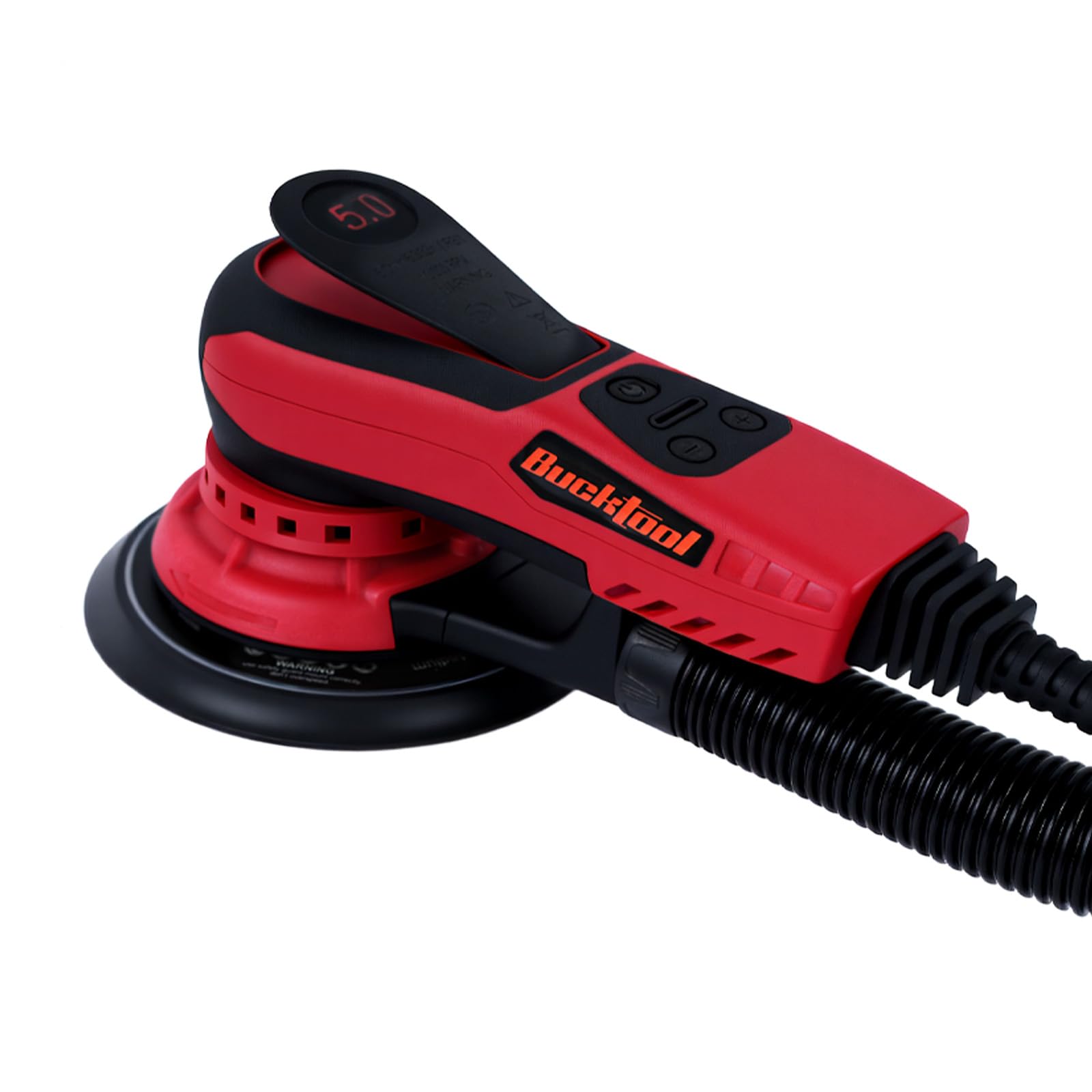
One backing pad that takes both 5-inch and 6-inch paper, so you buy discs once.
That dual-size pad is the reason this sander earns a spot. The included 6-inch backing pad supports both 5-inch and 6-inch sanding configurations, which means the stack of 5-inch discs already on your shelf still fits. The 5mm orbit — the diameter of the circle the pad traces — balances fast cutting against a clean finish, which suits cabinetry, furniture, and craft pieces.
The motor is a 1/2HP 3.0 Amp brushless unit, and the speed range runs from 4000 to 10000 OPM at the dial. A brushless motor replaces the carbon brushes of a conventional motor with electronics, so the tool runs longer between service. A one-hand push switch keeps your other hand on the body during long sessions, and the integrated dust port is a universal fit for a vacuum hose.
from the start you get four sanding discs at 80, 120, 180, and 220 grit — a full progression from stock removal to finish, which is rare on a tool in this tier. Smoothness and low noise both land well, though vibration draws mixed reports, with some buyers noting more chatter than expected. Pair it with a light touch and it does the work.
Standout spec: a 6-inch sanding surface plus brushless power in one body, with 5-inch compatibility built in.
Fair warning: that dual-size pad design is only as good as the paper you press onto it — check the disc diameter before you peel a fresh sheet.
Pick it for: medium benches where a bigger pad means fewer passes across a tabletop.
Pass it by for: delicate profile work, where the FLEX or the hand blocks below do the finer job.
5. FLEX FX3411-Z Random Orbital Sander

The cordless sander that matches a corded tool for speed — no extension cord to trip on.
The 13,000 OPM Turbo mode is the headline, and no other sander on this list tops it. No other orbital sander here tops it, which means aggressive stock removal without dragging a power lead up a ladder. The sensor-free brushless motor eliminates friction by design, so it runs cooler and more efficiently. Battery and charger do not come in the box, so this is an add-on for anyone already in the FLEX 24V system.
Run time frames the trade. FLEX quotes up to 30 minutes on Speed 3 with a 3.5 Ah Stacked Lithium battery (sold separately), so you plan your sanding in bursts and swap batteries rather than run all afternoon. Per FLEX, the 24V lithium platform claims 20% more power than its 12-volt counterparts, and its dual-fan chargers deliver up to 50% faster charging. The low-profile body weighs 3 pounds, the pad brake stops the disc fast, and the switch is dust and water resistant.
Buyers point to the power and the smooth running as the reason it earns its keep — the vibration is genuinely low for a tool this fast. The honest catch is the arithmetic: a tool-only listing, a separate battery, and a separate charger all add up before you have sanded a single board, so it only makes sense inside the FLEX 24V ecosystem. Register within 30 days and the warranty runs five years.
Why the cord comes off
- 13,000 OPM Turbo mode leaves no cord to manage on a ladder or scaffold.
- Brushless motor eliminates friction for cooler, longer running.
- Low vibration and a 3-pound body keep overhead work bearable.
- Dust and water resistant switch protects the tool where it lives.
The arithmetic to check
- Sold tool-only — battery and charger cost extra.
- Runtime is quoted at up to 30 minutes on Speed 3, so plan for swaps on whole-room jobs.
Worth it when: you already own FLEX 24V batteries and want speed without a cord.
Think twice when: you have no FLEX platform — the battery and charger investment may tip you toward a corded pick.
6. BLACK+DECKER BDERO100 Orbital Sander
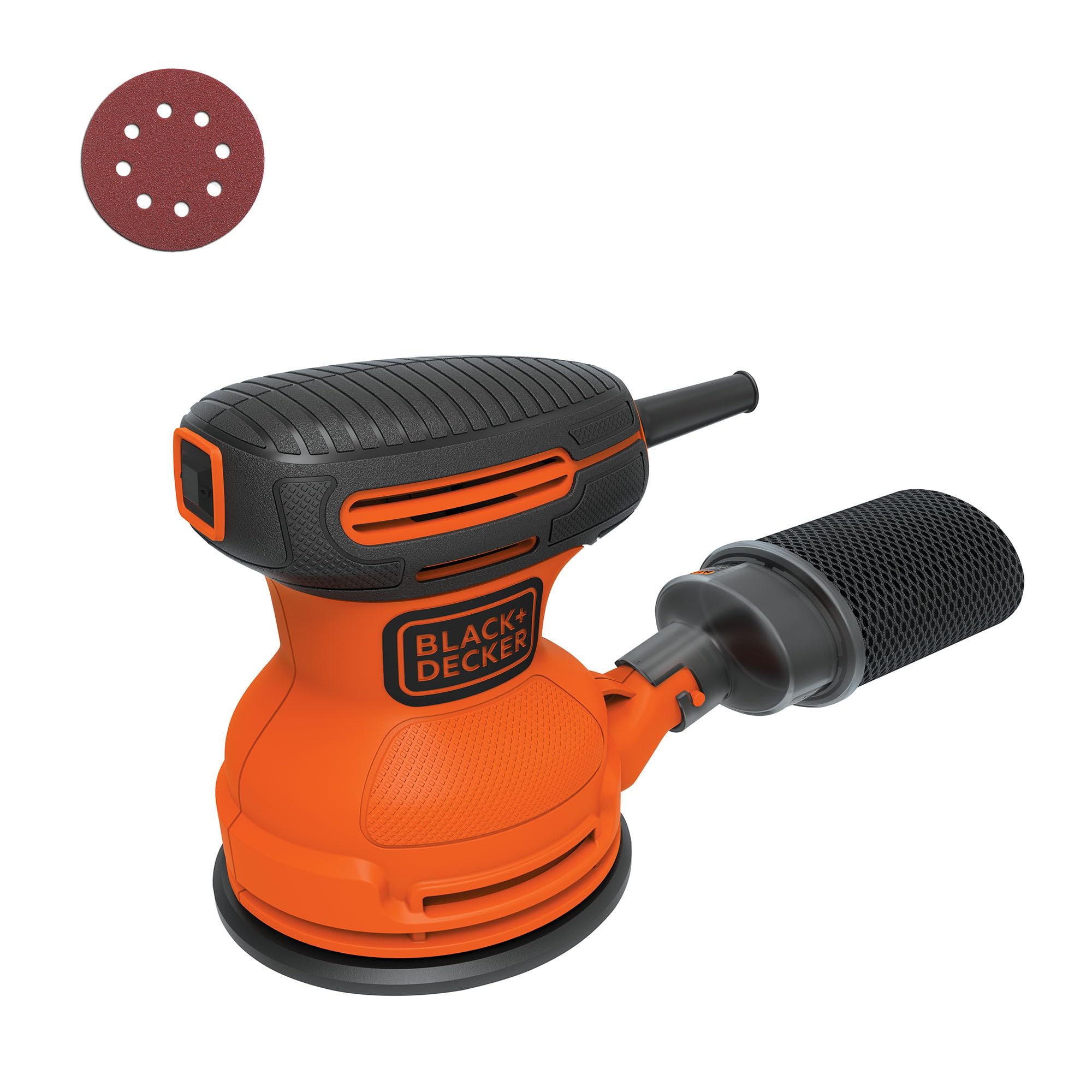
A 2.0 A entry sander that makes a swirl-free start on a first project.
The random orbital action on this 2.0 A corded tool cuts fast while breaking up the scratch pattern, so it leaves no swirl marks. It spins at 12000 OPM and runs on standard household current, so there is no battery to top up between passes. It is 3.2 pounds, compact, and comes with a 5-inch hook-and-loop pad plus one sanding sheet and dust bag in the box.
Where it shines is small household work — sanding a shelf, touching up a chair, smoothing a patch before paint. The dust-sealed switch keeps grit out of the mechanism, and the comfort grip handle reduces fatigue on the shorter jobs this tool suits. Two years of limited warranty covers the motor side of things.
Two honest limits. The dust bag is a basic catch system, so plan on a shop vacuum or a mask if you sand indoors. And this is a 2.0 A tool — it does the light and mid jobs well but is no match for a 3.0 A machine on a dense hardwood tabletop. Buyers do note durability varies, so a gentle hand and a clean switch go a long way. Still, for its price, the value is hard to argue with.
Where it fits: a first power sander, a second sander for the small jobs, or a backup on the shelf.
Where it stops: whole-tabletop stock removal and daily pro use belong to the corded DEWALT and Metabo HPT above.
Reach for this if: you are a hobbyist on a budget and need one reliable sander for furniture touch-ups.
Look further if: your project list includes a full tabletop refinish — the extra amps earn their keep on the DEWALT.
7. BLACK+DECKER Detail Sander, 1.2 Amp, 16,000 OPM (BDEMS600)

Built to reach into slats and corners that a round pad simply cannot touch.
A 1.2 A motor spinning 16,000 OPM in a body this compact is a detail tool, not a flat-panel tool. The pointed sanding pad and detail finger attachment get into odd and awkward angles — window mullions, between fence slats, the inside of a drawer frame. The three-position grip lets you roll the tool onto its side for different reaches, and the compact dimensions make it 7″L x 5″W x 6″H overall.
Here is the comparison that frames it: the Metabo HPT runs 2.8 A where this runs 1.2 A. That is a deliberate split — less current in a smaller machine is how B&DE0 keeps the body compact enough to fit into a corner at all. Where the machine wins hearts is quality and size; the tighter the space, the more obvious the choice.
The dust canister is a mixed bag — useful during a quick pass, less so on long sessions, so a shop vacuum or mask helps. Durability of the dust collector is a recurring note, so treat the plastic parts gently and empty it often rather than letting it pack. The dust-sealed switch is there for the same reason. On corners and slats, this is the tool the flat sanders cannot reach.
What makes it a keeper
- Compact body and pointed pad fit corners and slats nothing else on this list can.
- 16,000 OPM on a 1.2 A motor gives quick, thorough sanding in tight spots.
- Detail finger attachment reaches into odd and awkward angles.
- Three-position grip and comfort handle keep control steady.
What to plan around
- Built for detail rather than open panel work.
- The dust canister and its rigid parts are the weak link — empty often and handle with care.
Worth it when: your work is trim, slats, and frames where a flat pad will not fit.
Not the one when: you need to level a whole tabletop — that is a job for the round-pad orbit tools above.
8. CRAFTSMAN CMCW221B Cordless Detail Sander

A variable-speed detail sander with a D-handle made for sanding a wall on a ladder.
The 9,000 to 12,000 OPM speed range on this detail sander is a variable dial, so you can dial it down to feather an edge and open it up to take down stock. The D-handle grip is the ergonomic point — it is built for vertical and overhead sanding, where a horizontal palm grip fights your wrist. The body is 1.18 kg, light enough to hold steady away from your body.
The dust path is unusually flexible. It comes with a dust bag and a 1-1/4 in vacuum connection, so you can run it bag-only on quick jobs or hook up a shop vac for the bigger ones. The dust-sealed switch adds durability, the same trick the corded sanders on this list use to keep grit out of the internals. It is a 20V MAX tool only — no battery or charger in the box, so it only makes sense if you are already in the CRAFTSMAN 20V system.
In use, the power surprises people for a cordless model — it does not feel like a step down. Battery life is a mixed report, so budget for a spare cell on long jobs and use the variable dial to stretch it. Versatility is the other strength: it handles small items, fence slats, and tight spots without needing a fresh pad.
Performance note: smooth and quiet for a sander this size, with enough power to sand down a small project without stalling.
The trade: tool-only listing — factor in a battery and charger if you are starting fresh.
Buy it if: you already have CRAFTSMAN 20V batteries and want a detail sander you can take up a ladder.
skip it if: you have no 20V platform yet — the corded detail sander above plugs in with no battery investment.
9. Dura-Gold 20-Piece Hand Sanding Block Set

Twenty contoured blocks for every crown molding, baseboard, and chair rail in the house.
No machine on this list can sand a molding profile cleanly — that is what these blocks are for. Twenty pieces in convex, concave, and rectangle shapes, each made from medium-density polyurethane foam and measuring 1-3/4″ to 2-1/2″ wide by 5″ long, give you a block for nearly every contour. A base handle attaches quickly to any of them.
The paper is the second half of the value. You get 40 sheets at 5″ x 2-3/4″ with hook-and-loop backing — five each of 60, 80, 120, 180, 220, 320, 400, and 600 grit, made with super-coated aluminum oxide corundum fused with zirconia alumina. That is a full run from coarse stock removal through extra-fine finish on wood, metal, drywall, and fiberglass. The whole package comes in at 2.35 pounds, so you can carry the set to the work without a bench trip.
Where the set earns its keep is tight trim, contoured furniture edges, and any surface a flat pad cannot follow. Hook-and-loop paper presses on and peels off in seconds. The one caveat is paper size — these blocks take the 5″ x 2-3/4″ sheets, so standard 5-inch orbital discs will not fit them directly. Additional base handles are sold separately if you want to run two grits side by side.
The big win: a 20-block profile set plus 40 hook-and-loop sheets across 8 grits in one package.
Where it plays second fiddle: no powered motor, so this is for detail and trim, not for leveling a panel.
Best for: trim carpenters, restoration work, and anyone sanding crown molding or chair rail by hand.
Overkill if: your projects are all flat panel — a random orbit sander will do the job without twenty blocks of storage.
Know the Specs
Orbit size and OPM
Orbit size (the diameter of the circle the pad traces) decides how aggressive a sander is. A larger orbit cuts faster but can leave flatter, deeper scratches; a smaller orbit leaves a smoother finish. OPM — orbits per minute — measures how fast the pad completes those circles. A high OPM on a small orbit can feel fast but remove less stock than a lower OPM on a big orbit. Match the two together.
Amps, watts, and motor type
Amperage tells you how much current the motor pulls; wattage is the power that current produces. More amps generally mean more sustained torque under load, so the pad keeps spinning when you press. A brushless motor eliminates carbon brushes for cooler, longer running. On cordless tools, the voltage platform (e.g. 24V) and battery capacity set how long you can work before swapping.
Hook-and-loop vs PSA paper
Hook-and-loop sheets peel off and press back on in seconds, ideal for running through a grit progression. PSA discs are adhesive-backed and sit flatter and tighter, which suits flat panel work and high-speed cutting. Both systems are fine — pick based on how often you change grits during a project.
Dust extraction and switch seals
A dust-sealed switch keeps grit out of the electrical mechanism for longer tool life. Dust collection itself comes in three tiers: a bag or canister for light work, a port for a shop vacuum, and a direct-fit collector on premium tools. For indoor sanding, plan on a vacuum or a mask — a basic bag is not a substitute.
Common Questions
Will a 5-inch orbital sander take standard hook-and-loop paper?
How often should I change belts or pads on a random orbit sander?
Can a cordless sander match a corded one for stock removal?
Do I need a shop vacuum or does the dust bag do the job?
What is the difference between a random orbit sander and a detail sander?
Can a random orbit sander gouge wood if I press too hard?
What grit should I start with on a sanding block set?
How do I sand crown molding and baseboards without rounding the profile edges?
Do I need to register my tool to get the full warranty?
Can I use a 5-inch pad on a sander that also takes 6-inch paper?
The Bottom Line
For most people on this list, the woodworking sanding tools pick that earns its place first is the Festool ETS 125 REQ-Plus. The low vibration, the 8.2-pound planting weight, and the longlife dust bag together hand you the finish quality you notice when the stain goes on. It is a premium investment and a heavier tool — but it is the one that turns finishing from a chore into a step you trust. If you want a variable-speed dial and a five-year warranty at a mid-range point, the Metabo HPT SV13YST is the strongest alternative. And for the crown molding and chair rail no machine can touch, the Dura-Gold 20-piece contour set fills the gap with a full grit run in one box. Pick by the surface you sand most often — flat panels, trim, or corners — and the rest falls into place.
How we choose
We do not accept paid placement. Every pick is matched to a real buyer and a real use-case; we do not hands-on test units.
Sources
Specifications: manufacturer listings and product documentation. Review insights: verified customer reviews, as of November 2026. Pricing: not shown on this page (it changes often); check the current price via the retailer link.
As an Amazon Associate, Tactical Gear Guy earns from qualifying purchases. This does not affect which products we feature.