Specs are compiled from manufacturer listings and verified buyer reviews and can change over time — please confirm the key details on the product page before buying.
If you are cutting sheet metal by hand, the yellow handles are doing more than looking bright in a toolbox drawer. A yellow aviation snip is the straight-cutting tool in the colour-coded family, so you can grab the right jaw without checking the blades. Blade steel, pivot action, and grip span decide whether a duct run goes clean or ends in a jagged edge. This guide breaks down six yellow-handled snips by what they do well and where each one asks you to compromise.
This guide is built by comparing the manufacturers’ published specifications and the patterns across verified customer reviews, so you get each pick’s real strengths and trade-offs instead of marketing spin.
You will see how blade length, cutting capacity, and handle span change the job in your hand. Match the snip to the gauge you cut most often, which is how each pick below is framed. Here is the practical breakdown of the best yellow aviation snips for metalwork, ducting, and light fabrication.
Top Picks

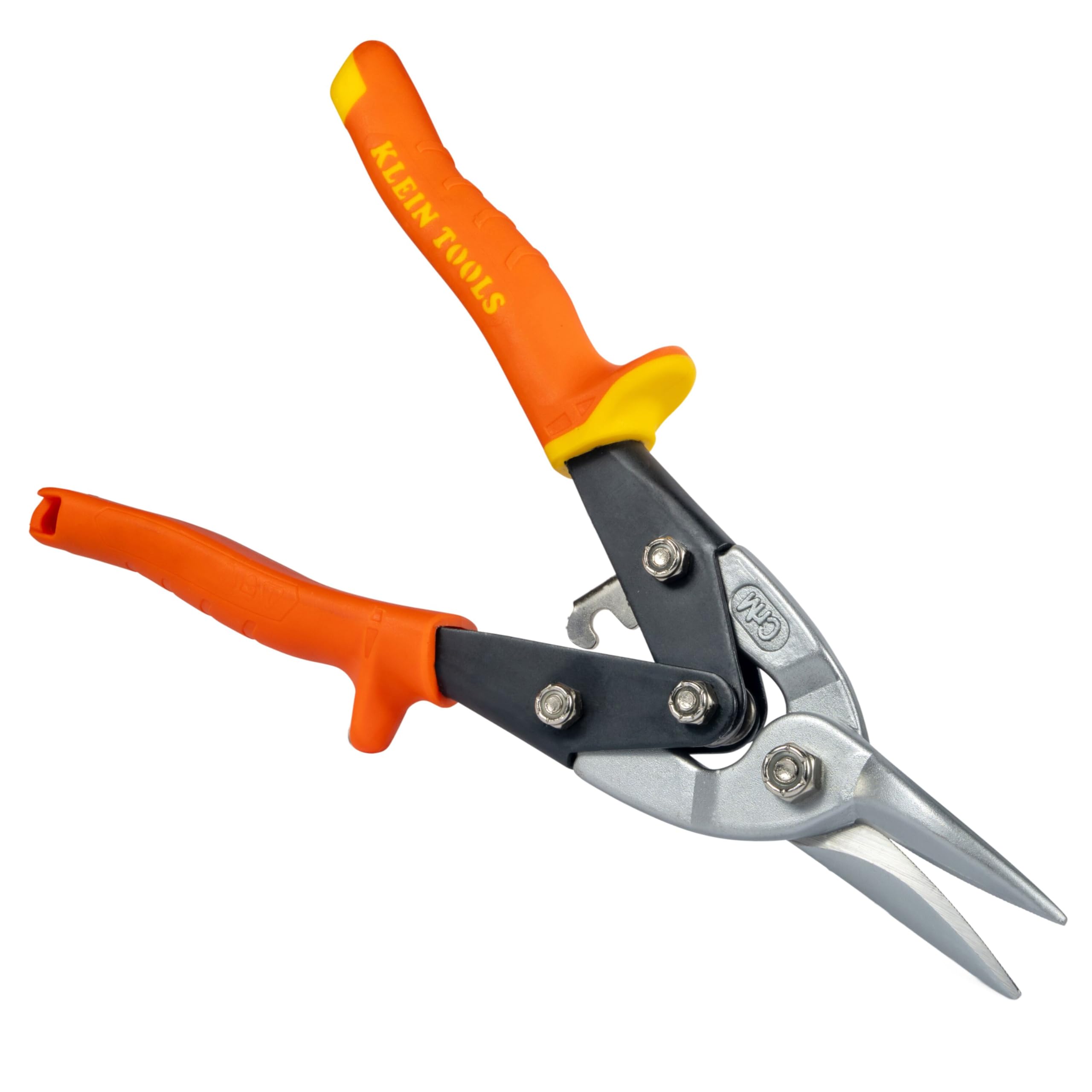
How To Choose The Best Yellow Aviation Snips
The first thing to settle is what the yellow handle means on your bench. In the colour code that snip makers use, yellow usually marks the straight-cutting tool, while left and right versions carry their own colours so you can grab the right jaw without squinting at the blades. If your work is mostly long straight runs down a duct or a flat panel, yellow is the one you reach for.
Match the cutting capacity to your metal gauge
Gauge is a backwards number: the higher it goes, the thinner the metal. A snip rated for 18-gauge cold-rolled steel handles a chunkier sheet than one limited to thinner stock. Stainless is tougher than mild steel at the same gauge, so a tool that lists 22-gauge stainless is telling you it can bite through harder material. Check the rating against the metal you actually buy before you commit.
Serrated versus smooth blades
A serrated edge grips the sheet so the blade does not skate off your cut line. That matters most on curved work and on smooth galvanised panels where a plain edge slides. The trade-off is a slightly rougher cut line, which usually disappears once you dress the edge.
Offset blades versus straight blades
Offset blades sit below the handles so the tool flows material away and keeps your knuckles above the sheet. Straight blades put the cutting edge in line with your hand, which many people find easier to aim on flat work. If you have ever scraped a knuckle on a duct seam, offset is worth a look.
Hand span, weight, and pivot action
A lower handle span means less muscle effort per squeeze, which shows up on long cuts through tough material. Double pivot action is a compound linkage that multiplies your squeeze force into the blades. Weight matters too — a heavier snip tires your wrist faster when you are working overhead.
Side-by-Side Comparison
| Model | Best For | Cutting Capacity | Blade Edge | Weight | Amazon |
|---|---|---|---|---|---|
| Stanley 2-14-563 MaxSteel Straight★ Best Overall | All-round straight cutting | — | Serrated, Straight | — | Amazon |
| Klein Tools 1202SBest All-Round Capacity | Ambidextrous everyday snips | 18-ga steel / 22-ga stainless | Serrated, Straight | 14.4 oz | Amazon |
| Klein Tools 2402S Offset | Knuckle clearance on flat sheet | 18-ga cold-rolled / 22-ga stainless | Straight, offset | 15.5 oz | Amazon |
| DeWalt DWHT14681 Long Cut | Long runs through sheet metal | 18 to 22 gauge | Straight | 16 oz | Amazon |
| Stanley 2-14-566 MaxSteel Straight | Longer reach and heavier build | — | Serrated, Straight | — | Amazon |
| Aviation Tin Snips Set (2 Piece) | Two-tool straight/left/right kit | 18-ga cold-rolled steel | Serrated, forged | 2.19 lb | Amazon |
Detailed Reviews
1. Stanley 2-14-563 “MaxSteel” straight Aviation Snips, 9.84″, Black/Yellow
Our pick — 4.5+★ from 15,000+ verified ratings; the strongest balance of quality and price.
A workhorse straight cut that keeps its bite long after cheaper snips go dull.
This is the one yellow-handled straight cutter to buy if you want a single snip that handles most jobs. The blades are forged chrome molybdenum alloy, a steel mix that resists wear under repeated cuts, and the edges are serrated so the tool grips the panel instead of skating sideways. Double pivot action works as a force multiplier: your squeeze gets translated into a stronger bite at the jaw, which is exactly what you want when the sheet starts to fight back.
The serrations do the quiet work here. On a Texas licence plate, a real-world test of thin stamped steel, the snip goes through instead of stalling — the kind of result that explains why this pick is the crowd favourite with 4.5+ stars across 15,000+ owners. The black-and-yellow handle scheme keeps the tool easy to spot in a dark toolbox, and the 11.81-inch overall length gives you reach without turning the snip into a two-handed tool. What wins people over is that it cuts cleanly through the 18-gauge sheet most home shops buy.
The catch is one you should know before the first cut: the razor edge is only as good as your storage. Throw it loose in a drawer with wrenches and the serrations get dinged. The 2.95-inch handle width is also fairly wide, so if you have smaller hands, plan on short sessions rather than one long continuous run. Neither is a defect — both are the normal cost of a heavy, forged build.
Where it earns its keep
- Double pivot action turns a normal squeeze into a strong cutting bite
- Serrated forged blades grip the sheet so the cut stays on line
- Long 11.81-inch body for reach across a panel
- Works as a one-handed tool once you are set up
What to plan around
- 2.95-inch handle width suits larger hands better
- Serrated edges need careful storage to keep their bite
Best fit: anyone who wants a single straight-cutting snip that handles duct, trim, and light panel work without drama.
Think twice if: your hands are on the small side or you only ever cut the thinnest stock.
2. Klein Tools 1202S Aviation Snips
The ambidextrous straight cutter with a latch that opens the jaws one-handed.
Klein builds this snip around a simple promise: cut 18-gauge steel and 22-gauge stainless, and do it with either hand. The serrated blades are forged from heat-treated steel, so the cutting edge holds its shape after a long run. A self-open latch springs the jaws apart after each squeeze, letting you keep the tool in one hand while your other hand holds the panel steady.
That one-handed latch is the feature you notice most on a ladder with a duct section balanced against your hip. The contoured grips are colour-coded, which on this model means full yellow, and the shape spreads pressure across your palm rather than digging into one spot. The blade itself is short at 1.5 inches, so you get control on tight curves but less travel per squeeze than a long-cut design. Set against the DeWalt DWHT14681, this snip is the more compact and more targeted tool.
Here is the honest limit. Multiple buyers report blades breaking under hard use, and durability is the one place this model takes real criticism. Treat it as a precision cutter for the gauge it is rated for rather than a demolition tool, and the odds stay in your favour. The quality of the build is what most people talk about, and the 4.5+ star standing across 600+ ratings reflects that balance.
Blade toughness caveat: reports of cracked blades cluster around cutting above the rated gauge, so stay inside 18-gauge steel or 22-gauge stainless and the tool behaves.
Grip feedback: the contoured handle draws mixed reactions — comfortable for many, a touch chunky for others. Try the span at the counter if you can.
Reach for this if: you switch between left and right hand and want a snip that opens itself between cuts.
Look elsewhere if: you need to push past the rated gauge on thick stock all day.
3. Klein Tools 2402S Aviation Snips

Offset jaws that push the metal down and keep your knuckles riding above the seam.
If you have scraped a knuckle on a duct seam, the offset jaws are the fix. The blades sit offset from the handles, so the tool flows the cut material away from the jaws and keeps your hand riding above the sheet. Klein forges and heat-treats the steel for strength, and the tool is rated to cut up to 22-gauge stainless steel and 18-gauge cold-rolled sheet metal. For reference, this snip’s 8-inch width sits against the 2.5-inch width of the straight 1202S — a much broader stance on the panel.
A spring-action lock opens the jaws between cuts, and a safety clasp holds them shut in the toolbox so the edge does not get knocked around. It is a compact package at 10.2 inches long, so it fits in a standard tool bag without forcing you to empty everything else out. What people praise most is how cleanly it goes through the metal — the cutting action is the star, with build quality right behind it, which is the reputation that sells this snip to sheet metal workers.
One thing worth stating plainly: this is a newer tool, so the long-term track record on the edge is shorter than the older Klein designs. At 15.5 ounces it is also a touch heavier than the 14.4-ounce 1202S, so overhead work asks a bit more of your wrist. Neither is a dealbreaker for most buyers, but they are real differences when you compare the two Kleins side by side.
Strengths that show on the job
- Offset jaws keep your hand clear of sharp sheet edges
- Cuts up to 22-gauge stainless and 18-gauge cold-rolled steel
- Spring-action lock with a safety clasp for storage
- Compact 10.2-inch body fits in a standard tool bag
Points worth weighing
- 15.5 oz is a bit heavier than the 14.4-oz Klein straight snip
- Shorter market history than the long-running Klein models
Right tool when: overhead or flush-panel cutting has been leaving marks on your knuckles.
Second thought if: you want the lightest snip for long sessions.
4. DeWalt DWHT14681 Straight Long Cut Aviation Snip (1 Pack)

A long, extended blade that eats more metal with each squeeze than a standard snip.
The reason to pay more for this DeWalt is the extended blade. It travels a longer distance per cut than a standard-length snip, which means fewer squeezes down the same seam and less work for your forearm. The blades are forged chrome vanadium steel, a tough alloy that holds an edge, and the serrated edge prevents the material from slipping. It cuts 18-gauge to 22-gauge sheet metal, so it sits in the same capacity class as the Klein Tools 1202S.
At 13.3 inches long, this is a big tool. Set against the 10.2-inch Klein 2402S, you get noticeably more reach and leverage in exchange for a longer object to store. The 16-ounce weight is heavier than the 14.4-ounce Klein 1202S, so overhead jobs ask a little more of your hand. DeWalt counters with a reduced handle span and a slip-resistant bi-material cushion grip, so less muscle effort goes into each squeeze even though the tool itself is heavier. Flush hardware on the cutting side removes snag points, which is a difference you feel on smooth sheet.
The external latch is a deliberate choice — easier to find with a gloved hand than a recessed design. The performance side is what carries this pick: it cuts through screen material easily, and the tool’s quality is what people talk about most. On long straight runs across flat panels, the extra blade length means fewer squeezes per seam. If you mostly cut small notches and curves, a shorter snip is easier to aim.
Where it pays off: long straight runs on flat sheet, where fewer squeezes per foot of seam translates into a job that ends sooner.
Trade-off to accept: the 13.3-inch length and 16-ounce weight are the cost of that extra reach. Budget storage space and hand stamina accordingly.
Built for: duct installers and fabricators cutting long straight seams who want maximum travel per squeeze.
Not ideal for: tight curves, notches, or anyone who wants a snip that disappears into a small pouch.
5. Stanley 2-14-566 Aviation Snips MaxSteel Straight, Black/Yellow

The long-bodied MaxSteel that trades extra reach for an ambidextrous hand orientation.
This is the sibling of the top pick, built on the same double pivot action and the same serrated straight edge for grip. The 11.81-inch length gives you a longer reach across a panel, and the alloy steel blade holds its shape under regular cutting. Where the 2-14-563 is set up with one-handed operation as the default, this one lists ambidextrous hand orientation along with the double pivot linkage, so you can work either hand without swapping tools. The black-and-yellow colour scheme makes it easy to pick out in a busy toolbox.
This is the model for the buyer who wants a longer-reach snip with a familiar straight cut. Set against the DeWalt DWHT14681 at 13.3 inches, you lose some reach but gain a shorter overall package that stores more easily. The serrated edge prevents slippage, and the double pivot action keeps the cutting force high when the steel fights. If you have worked with a Stanley MaxSteel before, this one behaves the way you expect.
What it lacks is a long public track record in the review data — fewer owners have weighed in on this specific model than on its shorter sibling. That is not a sign of weakness, just a shorter sample. Line it up against the top pick and choose by reach: if you need the length, take this one; if you want the tighter one, take the 2-14-563. The 4.5+ star standing across 600+ ratings tells you the build itself has held up.
Picks itself when: you want the MaxSteel build with extra reach and either-hand operation.
Consider the alternative if: you want a snip with more owner feedback behind it.
6. Aviation Tin Snips Set 2 Piece
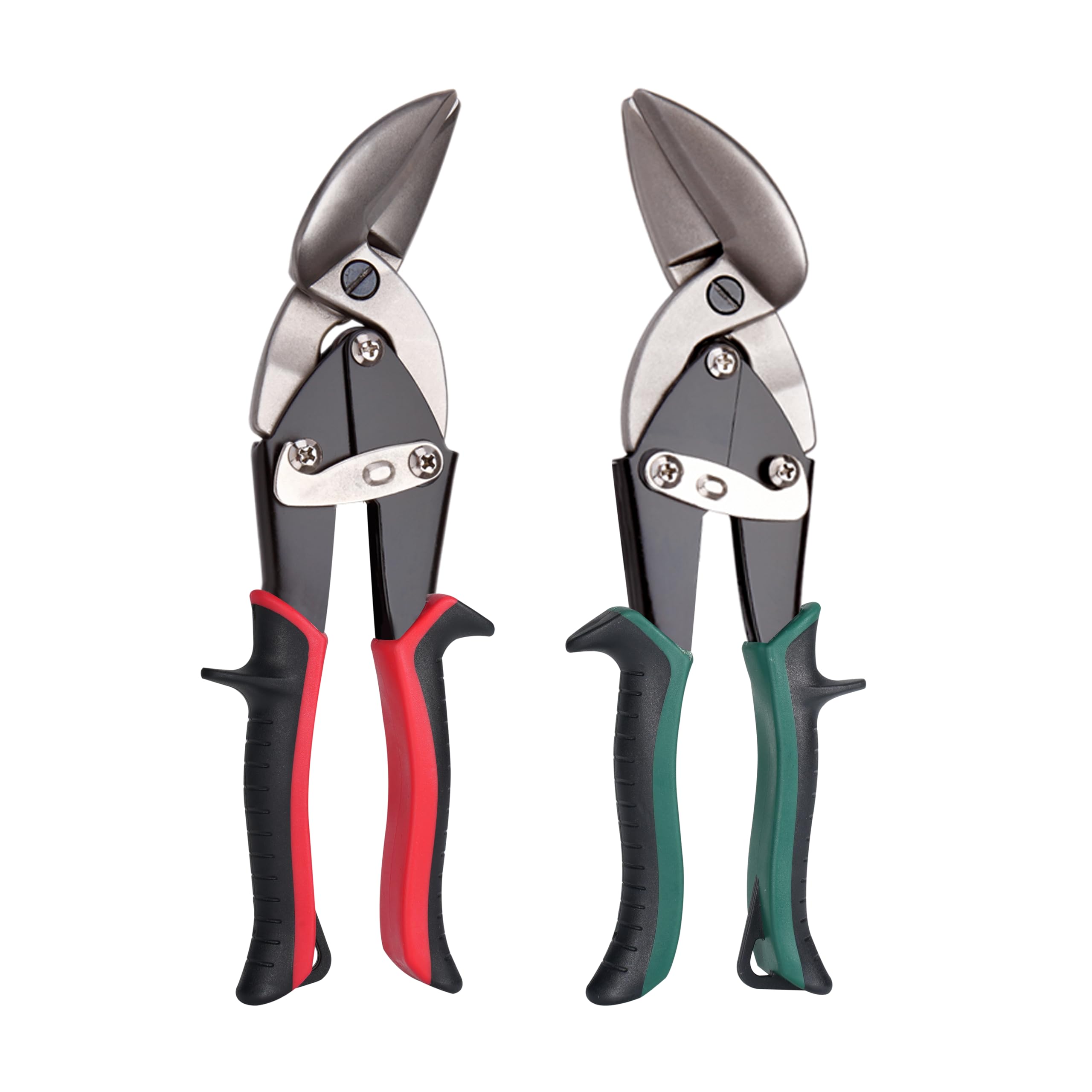
Two snips for the price of one — a straight and a directional pair in one box.
If you want a yellow-handled snip for straight cuts and one for left or right work, this kit puts both in your hands at once. The blades are hot drop-forged chrome vanadium steel with a serrated edge, and the tempering process is described as austemper heat-treated. The high-leverage design and precision cast molybdenum blades are rated to cut cold rolled 18-gauge steel from the base of the blade all the way to the tip. That is the part that matters — a snip that only bites near the pivot forces you to reposition constantly.
The spring-assisted latch opens the jaws with one hand, and the locking latch protects the cutting edge in storage while preventing accidental cuts. The non-slip rubber grip handles are shaped to reduce hand strain across a long run. At 2.19 pounds for the pair, this is a heavier package than a single snip, but you get two cutting configurations from the start, and the maker’s own note asks you to always wear gloves while working.
The honest read: the value is the strongest thing here, and that is what owners talk about. Quality and cutting performance draw a split response — some find it smooth-cutting, others come away less impressed. That makes this the right pick if you want two yellow-handled snips for occasional home jobs and light sheet work, and a risky choice if you cut professionally every day. This is a job kit rather than a daily driver.
Why the kit makes sense
- Two snips in one set for straight plus directional work
- Cuts cold rolled 18-gauge steel from the base to the tip
- Spring-assisted latch with a locking safety catch
- Non-slip rubber grips shaped to reduce strain
The caveats to know
- Quality and cutting performance get mixed responses
- 2.19 lb for the pair is heavy to carry all day
Best for: a home workshop that wants both a straight and a directional snip without buying two tools separately.
skip it if: you cut sheet metal professionally and need consistent edge performance on every job.
Know the Specs
Cutting Capacity and Gauge
Gauge measures sheet thickness, and the number goes down as the metal gets thicker. A snip rated for 18-gauge steel handles a chunkier panel than one limited to thinner stock, while 22-gauge stainless is harder to cut than mild steel at the same number. Match the rating to the metal you buy, and never force a snip past its listed gauge — that is where blades crack.
Blade Steel and Edge Type
Forged chrome vanadium and forged chrome molybdenum are two tough alloys used for snip blades; forged heat-treated steel is the third common recipe. All three resist wear better than stamped blades. Serrated edges grip the sheet so the tool does not slip, while a straight edge leaves a cleaner line. Pick serrated for grip and straight for a smoother finish.
Pivot Action
Double pivot action uses a compound linkage to multiply your squeeze into a stronger bite at the jaw. It matters most when the metal is thick or the cut is long. On a standard single pivot, more of your effort is lost in the linkage rather than delivered to the blade.
Handle Span and Grip
A reduced handle span means less muscle effort per squeeze, which shows up on long runs through tough material. Cushion grips spread pressure across your palm, and a lighter tool tires your wrist less when you work overhead. Try the span against your hand before you commit — a wide handle on small hands makes every cut harder.
Common Questions
What does the yellow handle mean on aviation snips?
What gauge sheet metal can yellow aviation snips cut?
Should I choose serrated or smooth blades for sheet metal?
What is double pivot action on aviation snips?
Are offset aviation snips better than straight snips?
Can I use aviation snips on stainless steel?
Do aviation snips come in left and right versions?
How do I stop aviation snip blades from going dull?
How much hand strain do aviation snips cause on long cuts?
Are aviation snips safe to use without gloves?
The Bottom Line
If you want one yellow-handled snip that you will reach for on most jobs, the Stanley 2-14-563 MaxSteel is the pick to start with. Its serrated forged chrome molybdenum blades and double pivot action handle duct, trim, and light panel work with a stronger bite per squeeze than a plain single-pivot snip. If you want maximum travel with each cut on long straight seams, the DeWalt DWHT14681 gives you the extended blade and a lower handle span to match. And if overhead cuts have been scraping your knuckles, the offset jaws of the Klein Tools 2402S keep your hand above the sheet. Any of these is a sensible buy, and the top pick’s 15,000+ owners tell you the build holds up.
How we choose
We do not accept paid placement. Every pick is matched to a real buyer and a real use-case; we do not hands-on test units.
Sources
Specifications: manufacturer listings and product documentation. Review insights: verified customer reviews, as of November 2026. Pricing: not shown on this page (it changes often); check the current price via the retailer link.
As an Amazon Associate, Tactical Gear Guy earns from qualifying purchases. This does not affect which products we feature.