Specs are compiled from manufacturer listings and verified buyer reviews and can change over time — please confirm the key details on the product page before buying.
You bought a Yamaha outboard with a smart computer inside it, and right now that computer is talking to nobody. A Yamaha engine interface cable is the single lead that lets your engine send live data to your GPS or chartplotter screen. Without it, you are running a modern four-stroke blind, guessing at fuel burn and RPM by ear. This guide sorts the eight cables worth your money by what they actually connect, how they behave in a wet bilge, and which engines they truly fit.
This guide is built by comparing the manufacturers’ published specifications and the patterns across verified customer reviews, so you get each pick’s real strengths and trade-offs instead of marketing spin.
The best and most proven pick of the eight is the Lowrance cable, rated 4.5+ across 400+ ratings. Here is how each option fits a real boat, so you can pick the right lead for your Yamaha.
Top Picks

How To Choose The Best Yamaha Engine Interface Cable
The mistake most buyers make is buying a cable before they know what the engine already has. Some Yamaha outboards ship with a CommandLink or CommandLink Plus display system built in. Those engines do not need this lead at all. The cable you are shopping for is the bridge for engines that lack CommandLink Plus and need to join an NMEA 2000 network. Confirm that first, because everything else follows from it.
Match the cable to your engine’s year and model
Nearly every listing here spells out a long list of four-stroke and two-stroke model codes. Check that list against your cowling, not against your memory. The F-series codes cover the four-strokes, and the Z, VZ, and LZ codes cover the HPDI two-strokes. Every cable in this guide that names compatibility is aimed at the 2006 and newer family, so an older engine sits outside the group unless its listing says otherwise.
You still need a backbone to plug into
This is the part that stops installations cold. The cable itself does not create a network. It taps your engine into one. Your boat needs at least a basic NMEA 2000 backbone installed — a starter kit with power cable, tees, drop cables, and terminators — for the GPS or chartplotter to see anything. Some picks here include a T-connector, and one pick bundles the whole starter kit. Factor that into which cable you actually want.
Connector pins, sealing, and length
The engine end of these leads is a multi-pin plug, and the pin count tells you what it mates with. Sealing matters in a bilge that takes spray, so an IP67 rating on the connectors is a genuine plus. Length is the other quiet decider. A short lead may not reach from the cowling to your backbone drop point, and a long one gives you slack to route cleanly.
Side-by-Side Comparison
| Model | Best For | Connector | Cable Length | Included | Amazon |
|---|---|---|---|---|---|
| Lowrance Yamaha Engine Interface Cable★ Best Overall | Most buyers, proven track record | 3 Pin, male-to-female | 22.61 centimeters | Cable only | Amazon |
| EV-RBUL 16 Ft Interface CableLong-Run Pick | Long runs with signal shielding | Rotating circular joint | 16 Ft | Cable + T-connector | Amazon |
| Garmin Adapter CableGarmin Match | Garmin GPSMAP owners | Standard Yamaha bus connector | — | Adapter cable | Amazon |
| Baieasy NMEA 2000 Starter Kit Bundle | Boats with no backbone yet | 5-pin, Deutsch DT | 4.5 meter engine cable | Full network kit | Amazon |
| SuperOBD 3-Pin Diagnostic Adapter | YDS diagnostics, not live display | 16-pin female to 3-pin female | — | Adapter only | Amazon |
| XYgdhqpt 3.3 Ft Interface Cable | IP67 sealing on a tight run | NMEA 2000 connector | 3.3 Feet | Cable only | Amazon |
| usvehj Engine Interface Cable | Corrosion-resistant materials | 4-Pin Data Connector | 4.5 m / 15 ft | Cable + T-connector | Amazon |
| besttruck 15 Ft Interface Cable | Copper core and PVC sheath | Cable connector | 15-foot | Cable + T-connector | Amazon |
Detailed Reviews
1. Lowrance Yamaha Engine Interface Cable
Our pick — 4.5+★ from 450+ verified ratings; the strongest balance of quality and price.
The proven veteran of the group — a 3-pin plug-and-play lead with the longest track record here.
What puts this one at the top is not an extra feature but the number of boats that have run it without drama. It is the sheer number of boats that have run it without drama. It carries a 4.5+ rating across 400+ ratings, and reviewers consistently report it delivers engine data without fuss. Getting engine data onto a network is the whole job, and on that measure this lead has the deepest track record of anything in this guide.
The fit is wider than you might expect. It has been paired successfully with a 2004 300 HPDI and a 2017 F115 XB, which tells you it spans both the older two-stroke family and the newer four-strokes. One happy owner described it as a clean way to display technical data from a Yamaha F150 four-stroke outboard. Expect plug-and-play behavior: a 3-pin, male-to-female connector that joins the engine to a NMEA 2000 network without adapter gymnastics.
Physically it is a round cable about 22.61 centimeters in overall length, finished in beige, and confirmed for outdoor use. That shorter run is worth thinking about. If your cowling sits far from your network drop point, you may need to plan the route or add cable, where the 16 Ft EV-RBUL below gives you far more slack. At 8.48 ounces it is a solid, substantial lead rather than a flimsy flashing.
What Earns It First Place
- Functionality is the quality buyers single out most — it does the core job without fuss.
- Proven across both a 2004 300 HPDI and a 2017 F115 XB.
- Plug-and-play 3-pin male-to-female connection to NMEA 2000.
- Confirmed for outdoor marine use.
Read Before You Order
- The listed length is 22.61 centimeters, so long routing needs planning.
- The cable ships on its own — no T-connector or backbone in the box.
Go with this if: you want the safest bet in the category and your engine-to-network run is short.
Measure your run first: the 22.61 centimeter length is the one spec that can trip up a long install.
2. EV-RBUL Engine Interface Cable with T-Connector (16 Ft)
Sixteen feet of shielded cable for boats where the cowling and the screen live far apart.
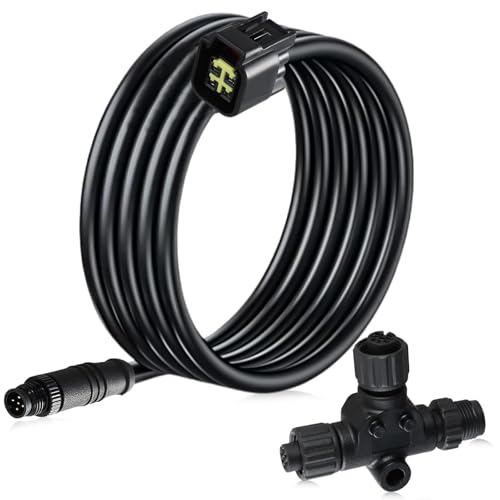
The number that decides it here is 16 Ft. Where the Lowrance above gives you a compact run, this one lets you route from the engine to a distant chartplotter without splicing. Inside, the cable is thickened to keep the signal stable, and a shielding mesh runs the length to resist electromagnetic interference and radiation — the electrical noise from other gear on a boat.
Two install details stand out. The circular joint at the connector can rotate and move slightly up and down, which is a small thing that saves real time when you are working in a tight cowling. It also ships with a T-connector for tying into an NMEA 2000 backbone. The connector set is listed as Compatible with Yamaha engines from 2006 onward across the F-series four-strokes and the Z, VZ, and LZ two-strokes.
Once wired, the payoff is a screen full of live readings: speed, engine hours, engine temperature, AC generator voltage, oil pressure, trim, water pressure, fuel pressure, and fuel rate. The honest catch is the same one that hits every cable here — it suits engines without the CommandLink Plus system, and your boat needs an NMEA 2000 network already in place. If you are starting from nothing, add a starter kit or look at the Baieasy bundle below.
Where it wins: length plus shielding. If a short lead would leave you short, the 16 Ft run plus the interference-resisting mesh solves the two most common install headaches at once.
The fit check: non-CommandLink Plus engines only, and a network backbone must already exist.
Reach for this if: your chartplotter sits well away from the engine and you want built-in shielding.
Look elsewhere if: you have no backbone yet — you will need the starter kit as well.
3. Garmin Adapter Cable
The brand-matched adapter for Garmin chartplotter owners who want one ecosystem, no guesswork.
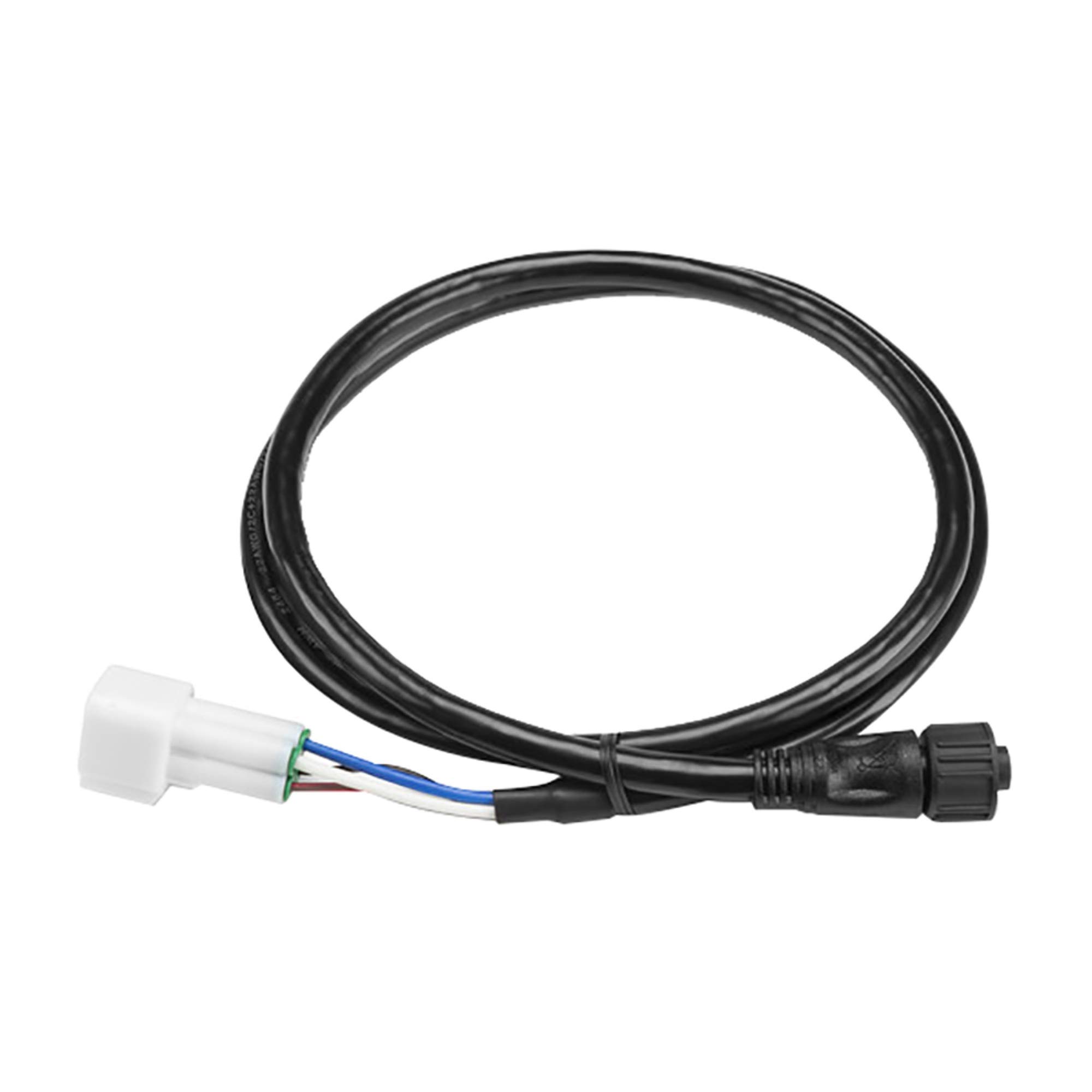
If your helm already has a Garmin GPSMAP unit, this cable speaks its language. Garmin built it around a standard connector for Yamaha engine bus multi-hubs and Garmin GPSMAP chartplotters, so the handshake between engine and screen is the intended pairing rather than a workaround. The part number is 010-12770-00, which makes it easy to cross-check against your manual.
It is a single-port adapter cable, black, and sold as one item. At 22.68 grams it is the lightest lead in the lineup — a short, tidy piece rather than a long run of cable. That is the design intent: it adapts at the hub, and you supply the routing. Brand-name Garmin marine parts also tend to be the ones your dealer and manual will name directly.
Here is the honest trade-off. This is a specific adapter, not a full engine interface cable with a long run, so it suits a setup where the Yamaha bus hub and the Garmin plotter are already near each other. If you need a long protected run, the EV-RBUL 16 Ft above does that job. If you are brand-loyal to Garmin and wiring into its multi-hub, this is the clean, matched-piece answer.
The case for it: brand matching removes doubt. A Garmin part number printed for the job is exactly what you want in a Garmin helm.
Choose this if: you run a Garmin GPSMAP plotter and want the manufacturer’s own adapter for the Yamaha bus.
Think twice if: you need long cable slack — this is a compact single-port adapter, not a long run.
4. Baieasy NMEA 2000 Starter Kit Bundle
The all-in-one box for a boat with no network at all — backbone, tees, terminators, and engine lead.
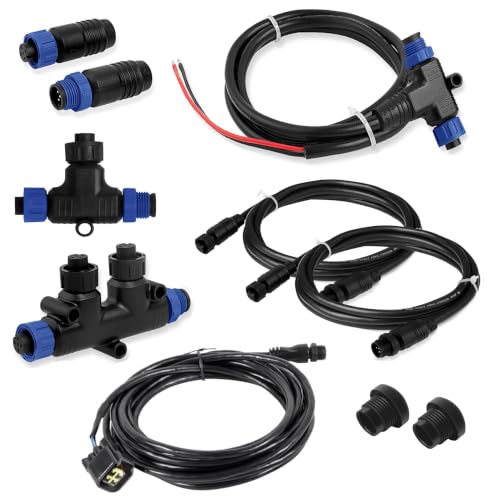
Every other cable here assumes you already have an NMEA 2000 backbone (the main network cable that carries data between your engine and your screen). This one brings it. The box holds a 1-meter NMEA 2000 power cable with tee, two 2-meter drop cables, a 4.5 meter engine interface cable, a dual tee connector, a T-connect, male and female terminators, and two blanking caps — eight pieces that cover a full starter network plus the engine link in one purchase.
The build leans on premium rubber, plastic, copper, and steel, aimed at corrosion and rust resistance in harsh marine air. The engine cable replaces part numbers 000-0120-37 and 3004.6865 and fits the 2006-and-newer Yamaha family, both the F-series four-strokes and the Z, VZ, and LZ HPDI two-strokes. The connector spec is listed as 5-pin, Deutsch DT.
The Lowrance is the better-known name here, but if you are building from scratch this bundle supplies the backbone, tees, terminators, and engine lead in one box. It is not just a lead — it is the network the lead plugs into. The one thing to weigh is scope: if your boat already has a backbone installed, you are buying parts you do not need, and a plain cable above is the smarter buy.
Why it earns a spot: completeness. For a boat starting from zero, this removes the separate-backbone step that trips most people up.
Who should skip the bundle: hulls that already have a wired NMEA 2000 backbone — you would be paying for network parts twice.
Best for a bare boat: the only pick that hands you the backbone and the engine cable together.
Already networked: buy one of the plain cables instead and keep the difference.
5. SuperOBD 3-Pin Female Diagnostic Cable Adapter

A different job entirely — this one talks to diagnostic software, not your chartplotter screen.
Before you buy, understand what this is. It is not an NMEA 2000 engine data cable. It is a 16-pin female to 3-pin female Yamaha plug adapter built for the YDS diagnostic system on WaveRunners, jet boats, and outboard engines. Its purpose is to let diagnostic software read the engine, not to feed live data to a plotter. If your goal is on-screen engine gauges, this is the wrong tool.
What it does, it does with intent. The 3-pin female lead is a professionally factory-moulded piece, built durable for long life, and it is designed to work alongside the newest YDS software — which is not included. It also pairs with a USB to OBDII diagnostic cable built on an original FTDI chip. Note the words “hardware only”: the software side is your responsibility.
The honest caveat is firmly on the software. You bring the YDS software and, if you need it, the USB-to-OBDII FTDI cable separately. Buy it if you are a home mechanic chasing fault codes on a Yamaha outboard or jet boat. skip it if what you actually want is live fuel rate on a GPS screen — the Lowrance or EV-RBUL cables above are the right road.
Read it right: this is a diagnostic adapter, not a network data cable. Knowing that before you click saves a return.
Bring your own software: YDS software is not in the box, so budget for that step separately.
Meant for: the home mechanic running YDS diagnostics on a Yamaha outboard or WaveRunner.
Wrong for: anyone who wants engine gauges on a chartplotter — this one reads codes, not live data.
6. XYgdhqpt Engine Interface Cable (3.3 Feet, IP67)
A short, sealed lead with a copper core — budget-friendly and built for spray-heavy installs.
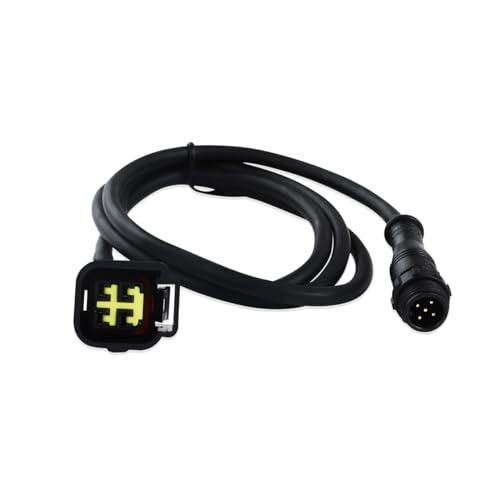
The IP67 rating on the connections is the headline here. That is a sealing rating that means the plug connections are protected against dust and against water immersion, which matters on a boat that takes spray or sits in a damp bilge. The core is copper, and the run is 3.3 Feet — short, so plan your routing around it rather than stretching it.
The compatibility list is broad and clearly written. It covers the F-series four-strokes and the Z, VZ, and LZ HPDI two-strokes, all 2006 and newer, and it is designed for NMEA 2000 compliant units (devices that speak the standard boat network language). It interfaces a Yamaha engine that lacks the CommandLink Plus system to an N2K network. Two things are worth pinning to the fridge: your boat needs at least a basic NMEA backbone (starter kit) installed for the cable to reach the GPS, and it connects to engines without CommandLink Plus — not those already running it.
This is an entry-level pick, and the price tier matches that. It does the core job of feeding engine data to an NMEA 2000 network, with IP67 sealing as a real bonus in a wet location. If a short run fits your layout, it is a sensible, low-cost way onto the network. If you need length, the EV-RBUL 16 Ft is the grown-up version.
The gain: IP67 connection sealing plus a copper core at the entry tier — a lot of the essentials without extra weight.
The catch: a 3.3 Feet run is genuinely short, so route carefully or it will not reach.
Pick this when: your engine sits close to your network drop and you want sealed, IP67 connections.
Pass if: the run is long — 3.3 Feet leaves little room for detours.
7. usvehj Engine Interface Cable (4.5 m)

Rubber, plastic, and steel — built to shrug off salt air and let you read engine parameters live.
The build is the story with this one. It is made of rubber, plastic, and steel, and the maker claims waterproofing with strong corrosion resistance and anti-rust performance — note because a bilge is exactly where plain wiring gives up. It ships as a full interface set: the interface sensor, a 4.5 m (15 ft) cable, and a network bus T-connector.
The connector is a 4-Pin Data Connector, and it works with NMEA 2000-compliant GPS and chartplotting units. It connects directly to the NMEA 2000 connector under the engine’s cowling and is designed for engines without CommandLink or CommandLink Plus systems. Fit covers the 2006-and-newer Yamaha range from the F-series four-strokes through the Z and VZ and LZ two-strokes.
The payback once wired is real-time engine parameters — speed, temperature, oil pressure, trim, and fuel rate — on your NMEA 2000-compliant chartplotter screen. The thing to keep in mind is the same backbone requirement as the rest: the boat must have at least a basic NMEA 2000 backbone (starter kit) installed for this cable to interface with the GPS. Since a 15 ft run and a T-connector are both included, you are most of the way there if the backbone is already in place.
What It Brings to the Table
- 15 ft of 4-pin cable plus the network bus T-connector in the box.
- Rubber, plastic, and steel build with corrosion and anti-rust claims from the maker.
- Reads engine parameters live on a NMEA 2000-compliant chartplotter.
What to Keep in Mind
- Still needs a basic NMEA 2000 backbone installed first.
- Not for engines already running CommandLink or CommandLink Plus.
Suits: saltwater boats where corrosion is the real enemy and you want a 15 ft run with a T-connector included.
Keep in mind: non-CommandLink engines only, and the backbone still has to exist.
8. besttruck Engine Interface Cable (15 ft)

The clearest data list in the group — nine engine readings spelled out, copper core, 15-foot run.
What makes this one easy to trust is the specificity. It lists exactly what appears on screen once connected: RPM, engine hours, alternator voltage, engine temperature, fuel rate, fuel pressure, oil pressure, trim angle, and water pressure. If your reason for buying is a live engine dashboard, this listing names all nine readouts up front.
The materials are solid for the job. It uses excellent quality copper for the conductor, sheathed in PVC (polyvinyl chloride) for corrosion resistance. The box includes the 15-foot engine interface cable and a T-connector for integrating into an NMEA 2000 backbone. It is listed as waterproof, connects by NMEA 2000 protocol, and is intended for boat use on the 2006-and-newer Yamaha outboards across four-stroke F-series and HPDI two-stroke Z, VZ, and LZ models.
Its core purpose is bridging an engine that lacks CommandLink Plus into an NMEA 2000 network. The catch is the familiar one that runs through this whole category: the boat must have a working NMEA 2000 network for it to talk to the GPS. If you have that, this is a balanced mid-tier choice — long enough to route, copper-cored, with a T-connector in the box and the fullest data readout listed of any pick.
The plain-English payoff: RPM, fuel rate, oil pressure, trim and more, all spelled out, all fed to your screen over copper and a PVC jacket.
The one honest limit: no NMEA backbone yet means this cable has nothing to plug into, so budget for a starter kit.
Worth it if: you want the fullest listed data output and a 15-foot run over copper — the clearest picture of what you get.
pass on it if: you still need to build a network — pair it with a starter kit or choose the bundle above.
Know the Specs
CommandLink and CommandLink Plus
These are Yamaha’s own digital display systems. If your engine already has CommandLink Plus, it can already show data without this cable. The cables here are for engines without those systems, so confirm yours first. Buying a cable for a CommandLink Plus engine is the most common mismatch in this category.
NMEA 2000 Backbone
This is the shared network that carries data around a boat, like a spine with drop points. An interface cable taps the engine into it, but it does not build the spine. You need a basic backbone — power cable, tees, drop cables, terminators — before any engine data reaches the screen.
Connector Pins
The plug at the engine end of the cable has a fixed number of pins, and that count has to mate with your engine’s socket. Picks here list 3-pin, 4-pin, and 5-pin variants. Check your engine’s connector before ordering so the plug physically fits.
IP Rating and Material
An IP rating describes how well the connections resist dust and water; IP67 signals protection against dust and water immersion, useful in a bilge that takes spray. Materials like copper, PVC, rubber, and steel affect how well a cable resists corrosion over time in salt air.
Common Questions
Will this cable work with my Yamaha if it already has CommandLink Plus?
Do I need a separate starter kit for the cable to work?
What part numbers do these cables replace?
What engine data will I actually see on my screen?
Is a diagnostic adapter the same as an engine interface cable?
Which years and models do these cables fit?
How long should the cable be for my boat?
Are the connectors sealed for marine use?
Does the cable come with a T-connector?
Will one of these cables work with a Garmin or Lowrance chartplotter?
The Bottom Line
For most people shopping for the best Yamaha Engine Interface Cable, the Lowrance is the pick with the deepest track record — a 4.5+ rating across 400+ ratings from owners who got engine data onto their network. If your engine and screen sit far apart, the EV-RBUL 16 Ft with its shielding mesh solves the long-run problem. And if you are starting from a bare hull with no network at all, grab the Baieasy starter kit bundle and get the backbone and the engine lead in one box.
How we choose
We do not accept paid placement. Every pick is matched to a real buyer and a real use-case; we do not hands-on test units.
Sources
Specifications: manufacturer listings and product documentation. Review insights: verified customer reviews, as of November 2026. Pricing: not shown on this page (it changes often); check the current price via the retailer link.
As an Amazon Associate, Tactical Gear Guy earns from qualifying purchases. This does not affect which products we feature.