Specs are compiled from manufacturer listings and verified buyer reviews and can change over time — please confirm the key details on the product page before buying.
You want a router table that holds its settings while the bit chews through hardwood — not one that shifts a hair and ruins a rail. The short answer: the Bosch RA1181 is the pick most people should start with, because its aluminum top and extra-tall fence give you a stable work surface with featherboards on both fence and table. The rest of this list sorts out who needs a cabinet-style base, who needs a small benchtop footprint, and who needs a cast-iron top that bolts onto a table saw.
This guide is built by comparing the manufacturers’ published specifications and the patterns across verified customer reviews, so you get each pick’s real strengths and trade-offs instead of marketing spin.
Every router has a base plate, and that plate has a diameter. Below you will find the specs that actually decide whether a table works for your router, plus the honest limits of each one. Match the insert plate opening to your router’s base, the fence to your joinery, and the footprint to your bench.
Top Picks

How To Choose The Best Woodworking Router Table
A router table is a flat surface with a hole in it, a fence to guide the wood, and a way to hold your router upside down underneath. The differences between models come down to how flat the top stays, how solidly the fence locks, and whether the router you already own will fit in the opening. Get those three right and you stop thinking about the table and start thinking about the cut.
Start with your router’s base plate, not the table’s brand
Your router mounts to a removable plate that sits in the table opening — called the insert plate. If your router’s base is wider than that plate’s opening, the router will not seat, and no amount of adjustment fixes it. One table on this list states plainly that it accepts routers with a base plate up to 6 inches in diameter; anything larger will not fit. Check your router’s base diameter before you order anything.
The other half of that equation is mounting holes. Some tables ship with pre-drilled patterns meant to line up with common routers, and others ask you to drill the removable board to match your machine. A pre-drilled plate saves you an afternoon; a drill-your-own plate asks for patience and a steady hand.
Fence quality is where precision lives
The fence is the straightedge the wood rides against. A good one has faces that slide independently so you can offset one side and joint an edge, locking levers that hold the setting under vibration, and a dust port built into it so chips fly away from the cut instead of into your face. Featherboards — those springy fingers that press the wood down and against the fence — add guidance and guard against kickback.
Table material changes weight, flatness, and noise
Laminated MDF is quiet and low-friction, and it keeps cost down. Aluminum is lighter and shrugs off moisture. Cast iron is the heaviest and the most vibration-resistant, and it is usually designed to bolt onto a table saw. Heavier tables move less; lighter tables move more easily between jobs. Neither is wrong — they suit different shops.
Dust collection, storage, and the small stuff
Look for a port that matches your shop vac or dust hose size, such as a standard 2-1/2 inch port. Storage pockets for wrenches, bits and rings keep the small parts where you can find them. Above-table adjustment lets you raise the bit without reaching underneath. None of these show up in the spec sheet, but each one saves you a reach, a hunt or a crouch on every pass.
Side-by-Side Comparison
| Model | Best For | Table Top | Fence Length | Weight | Amazon |
|---|---|---|---|---|---|
| Bosch RA1181★ Best Overall | Most shops | Aluminum, 27″ x 18″ | Extra-tall aluminum, adjustable faceplates | 30 lb | Amazon |
| Kreg PRS2100Top Performer | Portable full-size routing | Edge-banded MDF with micro-dot skin | Sliding faces, jointing capability | 12 kg | Amazon |
| POWERTEC 72374Biggest Surface | Large workpieces | Laminated MDF, 24″ x 32″ | Full fence system with flip stop | 33.2 lb | Amazon |
| Bosch RA1171 | Storage and dust control | Laminated MDF, cabinet style | Extra-tall aluminum, MDF faceplates | 35 lb | Amazon |
| Rockler Bench Dog ProMAX | Table saw extension | Cast iron | 28″ ProFence | 60 lb | Amazon |
| POWERTEC 71402V | Complete table and stand | Laminated MDF, 24″ x 16″ | 24″ with bit guard and flip stop | 27.5 lb | Amazon |
| SKIL SRT1039 | SKIL router owners | MDF, 26″ x 16″ | 24″ with adjustable MDF faceplates | 24.2 lb | Amazon |
| VIYUKI Universal | Small-shop portability | Die-cast aluminum with iron extensions | Aluminum with retractable guard | 14.5 lb | Amazon |
| Yeivzwba Multifunctional | Light DIY use | Compact, 16.92″ width | Anodized aluminum, sliding faces | — | Amazon |
Detailed Reviews
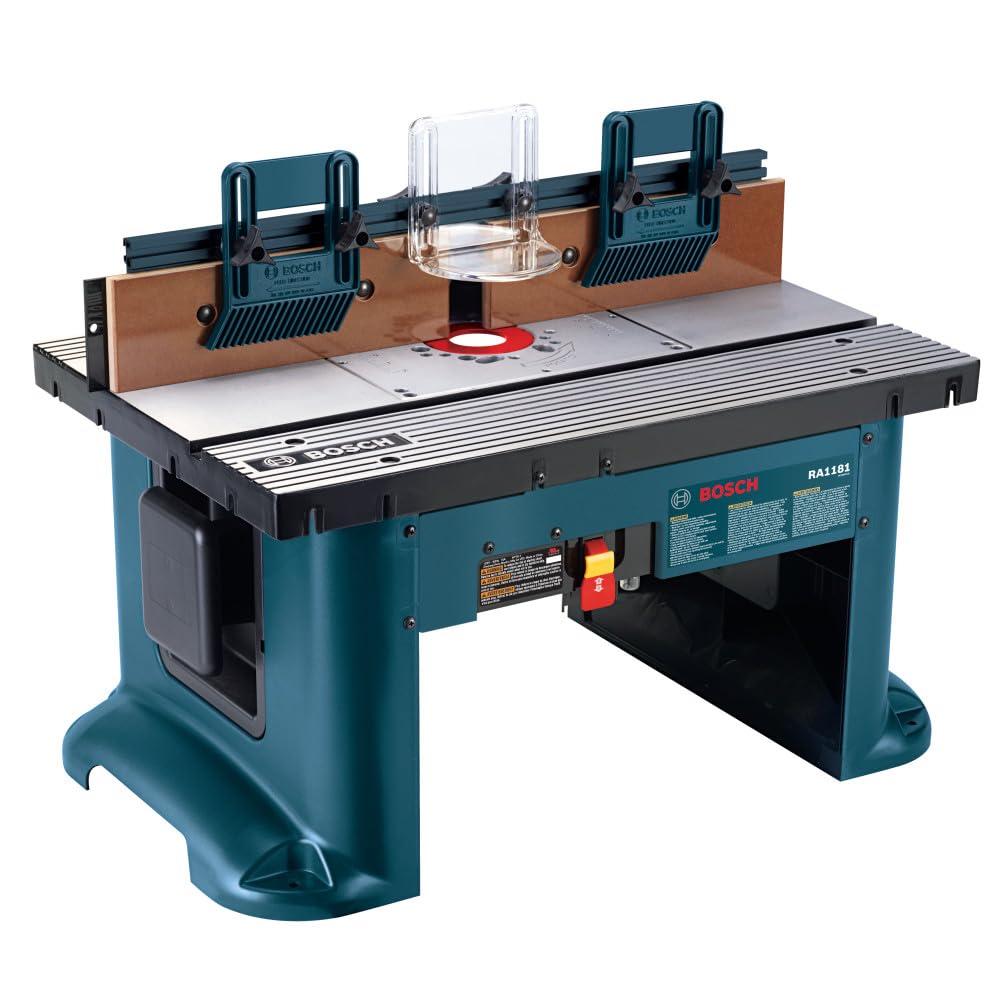
1. Bosch RA1181 Benchtop Router Table
Our pick — 4.5+★ from 5,000+ verified ratings; the strongest balance of quality and price.
A 27-by-18-inch aluminum top that stays put while the fence does the guiding.
The aluminum work surface is the reason to start here. At 27 inches by 18 inches, it gives you more room to run longer stock than most benchtop tables, and aluminum resists the dents and sag that softer tops pick up over years of use. It weighs 30 pounds, light enough to lift onto a bench yourself but heavy enough to sit still while you push a board through a raised-panel bit.
What makes this table usable for real joinery is the fence package. The extra-tall aluminum fence has adjustable faceplates, so you can set a tall sub-fence for vertical work or offset a face for jointing. Featherboards attach to both the fence and the table and press the workpiece down and in — that is the part that stops a board from climbing up the bit. There is also a storage pocket for wrenches and rings, which sounds trivial until you spend ten minutes hunting a collet wrench.
Dust control is handled by a dedicated port sized for standard 2-1/2 inch vacuum hoses. That is the common shop-vac size, so you probably already own a hose that fits. The insert plate is pre-drilled for a range of routers and allows above-table height adjustment, which means you can raise the bit from the top instead of crouching under the bench. Its accessory slot takes featherboards and 3/4 inch accessories such as an optional miter gauge.
What earns it the top spot
- Large 27″ x 18″ aluminum top — more work area than most benchtops and resistant to sag
- Extra-tall fence with adjustable faceplates handles tall, vertical pieces
- Featherboards on both fence and table add guidance and kickback protection
- 2-1/2″ dust port fits the standard shop-vac hose most shops already own
Where it asks for a little
- The fence works as a stout benchtop unit; it wants to be clamped to a solid surface
- Aluminum stands above the flex of a folding portable table
- The table wants to be clamped to a solid surface for larger routing
Built for: the woodworker who wants one reliable benchtop table with a real fence and a dust port that matches their vac.
Think twice if: you want an enclosed cabinet with built-in storage — this is an open benchtop unit.
2. Kreg PRS2100 Bench Top Router Table
A low-friction MDF top with a micro-dot skin that quiets the whole operation down.
Kreg built this table around vibration. The top is an edge-banded MDF board with a micro-dot skin, a textured surface designed to lessen vibration and let stock slide with less drag. A quiet table is not a luxury — feed a long rail across a chattering top and you will see the marks in the finished cut. At 16 inches tall it sits low enough to clamp onto a workbench rather than demanding its own bench space.
The fence here is the Kreg signature: sliding faces with locking levers and jointing capability. Independent faces let you set one side flush with the bit bearing and the other side offset, which is how you joint an edge square on a router table. That is a different job than a plain fence can do. The included insert plate with leveling rings keeps the plate flush with the table, so a board does not catch on a proud lip.
Compare it to the Bosch RA1171 below and you see the design split: the Kreg is a lighter, quieter top that clamps down and slides onto a shelf, while the Bosch brings a cabinet base and its own storage. The Kreg’s 12 kg weight makes it the easier one to put up on a job site. An integrated dust-collection port sits in the fence to catch chips at the source.
Fence in the details: the sliding faces and locking levers are what let you joint an edge square, and the micro-dot top is built to reduce vibration under a long cut.
Room to know: the assembly process divides opinion — some find it quick, others take their time with it — so budget an unhurried afternoon.
Reach for this if: jointing and a low-vibration top are the two things you want most from a benchtop.
Look elsewhere if: you would rather not assemble anything complex — the Bosch below arrives as a different kind of animal.
3. POWERTEC 72374 Benchtop Router Table
Thirty-two inches of melamine-coated MDF for stock that needs elbow room.
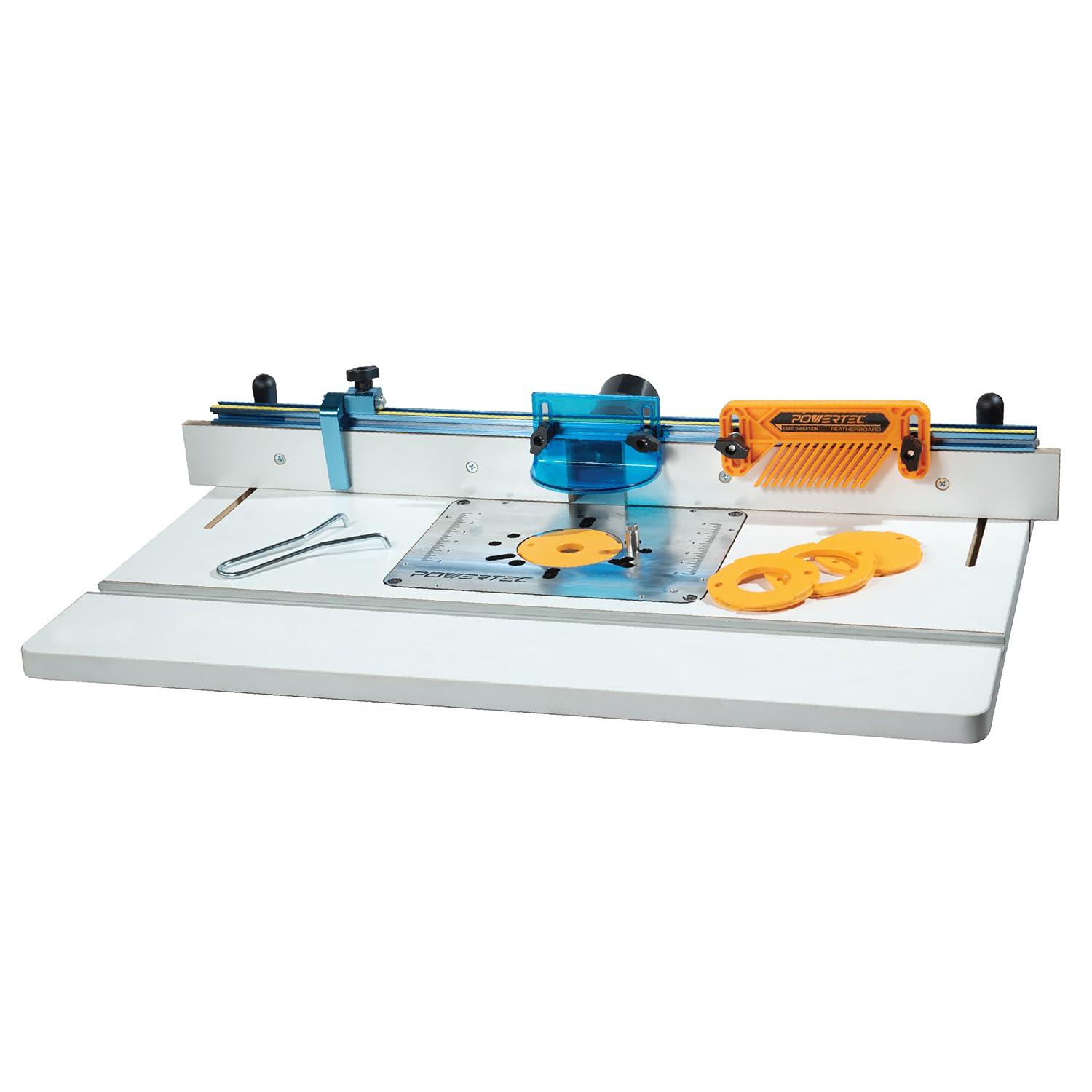
Big panels and long rails need somewhere to land, and this POWERTEC gives you a 24 inch by 32 inch melamine-coated MDF top — the largest surface on this list. The extra area does two things: it supports the back half of a long workpiece so it does not tip off the edge, and it gives your hands room away from the bit. Melamine laminate is also low-friction and scratch-resistant, so stock glides.
Router fit is deliberately broad. Multiple pre-drilled hole patterns are built to match most trim routers, including Bosch, DeWalt, Makita, Porter Cable, Craftsman, Ryobi, Ridgid, Milwaukee, Hitachi, Fein, Elu and Triton. If you are planning to put a compact trim router in a table rather than a full-size plunge unit, this is the table that has done the hole-spacing homework for you. The mounting slot range runs from 26-1/8 inches to 31-3/8 inches to accommodate most fences.
Four reducing insert rings — solid, 1 inch, 1-7/8 inch and 2-5/8 inch — let you close the gap around the bit so small stock does not drop into the hole. The screwless design swaps with the included ring wrench. A 2.5 inch dust port matches common shop vac and dust hose fittings. The kit also includes a knob-adjustable bit guard, featherboard and reversible flip stop.
The surface story: at 24″ x 32″ this is the biggest top here, and the melamine coating keeps cuts sliding without scuffs.
Adjustment caveat: the adjustability draws mixed feelings, including a wish for micro adjustment on the fence — set it carefully and check with a square.
Best fit for: shops routing long stock or running a compact trim router that needs a wide hole-pattern selection.
Not the first pick if: you are short on bench real estate — this top wants room around it.
4. BOSCH Cabinet Style Router Table RA1171
Two dust ports and a cabinet base — the tidy-shop answer to router mess.
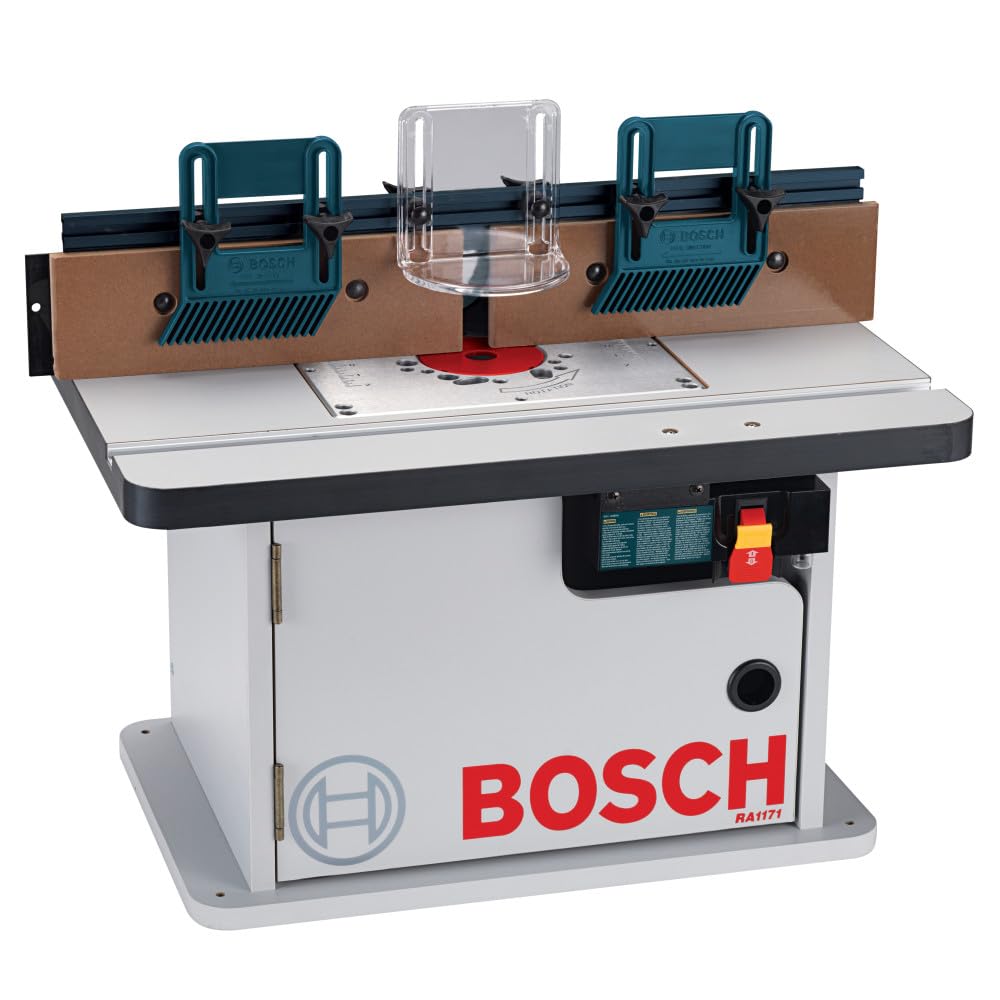
Most router tables give you one place to hook a vacuum. This one gives you two: a port at the fence to catch chips as they leave the bit, and a second port at the cabinet to pull the dust that falls through. Running both takes a Y-fitting and a machine with enough pull, but if your shop doubles as a garage, two ports is the difference between sweeping up and not.
The top is a smooth laminated MDF surface set in a cabinet-style frame, which gives you stability and a place to store accessories. The rigid aluminum mounting plate is pre-drilled for a range of routers and allows above-table height adjustment. Its extra-tall aluminum fence carries adjustable MDF faceplates and featherboards, and the accessory slot accepts 3/4 inch accessories like an optional miter gauge.
This is the heaviest Bosch here at 35 pounds compared to the RA1181’s 30 pounds, so it plants itself. The prescriptive note from owners is about mounting: getting your router bolted to the plate is the step that draws the most friction, so read that section twice and test-fit before you tighten anything down. If that step goes smoothly, most of the rest follows.
Why the cabinet wins people over
- Two dedicated dust ports — one at the fence, one at the cabinet
- Extra-tall aluminum fence with adjustable MDF faceplates and featherboards
- Cabinet frame adds stability and gives you somewhere to keep accessories
- Pre-drilled aluminum plate allows above-table bit height adjustment
The honest trade-offs
- At 35 pounds it is heavier to move than the benchtop models
- Fitting the router to the mounting plate is the step that trips people up
- A cabinet base takes more floor or bench space than a bare top
Pick it for: a permanently set-up shop station where dust control and storage matter as much as the cut.
Pass on it if: you move your table between sites — 35 pounds and a cabinet will get old fast.
5. Rockler Bench Dog ProMAX Cast Iron Router Table
A 60-pound slab of cast iron that turns your table saw into a routing station.
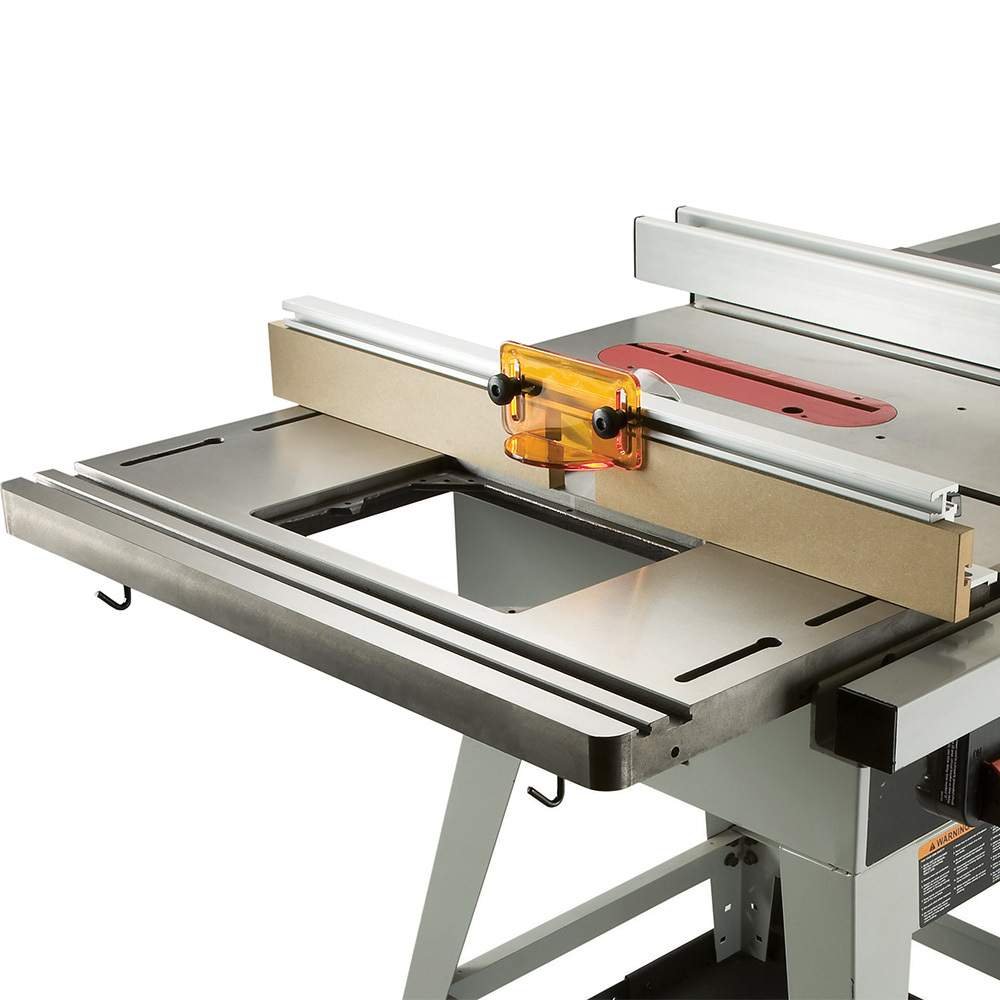
This is not a benchtop you carry around. It is a cast iron top designed to replace the extension wing on your table saw, which is why it weighs 60 pounds — the heaviest product here by a wide margin. That weight is the whole point: cast iron on your saw’s rails kills the vibration and noise that a light top transmits, and it uses the saw’s own frame as the anchor instead of demanding another stand in your shop.
The dual fence slot configuration lets you rotate the 28 inch ProFence and work from either side of the table. A third miter slot lets you run crosscut sleds that otherwise only fit your saw. A miter gauge track adjusts for a no-slip fit. If you already own a table saw and space is tight, this converts one machine into two without adding a footprint.
Installation is the bright spot — buyers report it going on in about 15 minutes. Hole alignment gets mixed feedback, so test-fit the bolt pattern before you commit. The heavy cast iron is exactly what you want for stability and exactly what makes it a two-person lift.
Where it shines: cast iron plus your saw’s frame equals a rock-steady, low-vibration routing surface, and the install is quick.
What to plan for: aligning the mounting holes can take some nudging.
The right call when: you own a table saw, want router capability without another stand, and can handle a two-person lift.
Mismatch if: you need a standalone table or a portable one — this only works bolted to a saw.
6. POWERTEC 71402V Benchtop Router Table with Steel Stand
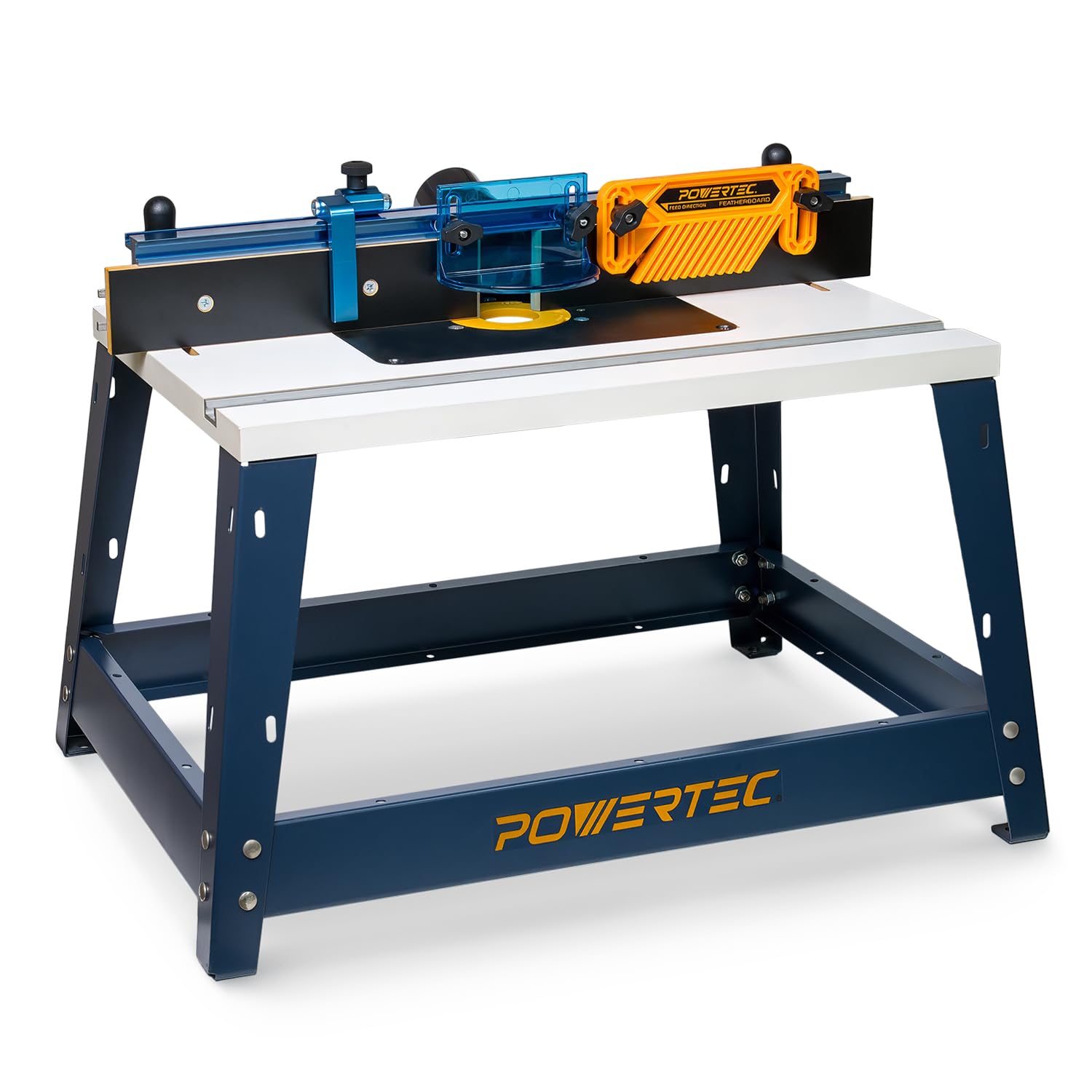
The one that arrives with its own steel stand instead of borrowing your bench.
A 24 inch by 16 inch MDF laminated top on a rugged steel stand with vibration-absorbing rubber feet — that is a free-standing routing station rather than a top you clamp down. The stand matters: rubber feet soak up the shake that otherwise travels into your cut, and you get a level, dedicated workspace instead of clearing off the bench every time.
Eight leveling points with 3/8 inch or 5/8 inch leveling screws let you dial the insert plate until it is flush with the top. That is more adjustment points than most tables offer, and it is the fix for the single most annoying router table problem: a plate that sits a hair proud and catches the edge of every board. The 24 inch fence brings an adjustable bit guard, featherboard, reversible flip stop, measuring scale and a 2-1/2 inch dust port.
Four reducing rings — solid, 1 inch, 1-7/8 inch and 2-5/8 inch — swap tool-free with the included wrench. A starting pin is included for freehand profile work where you pivot the workpiece into the bit instead of running it along the fence. Setup is the point of disagreement: some find it straightforward, others wrestle with it, so set aside a calm session to get the plate dead flat.
What you get in the box
- Steel stand with vibration-absorbing rubber feet — free-standing, no bench required
- Eight leveling points for a genuinely flush insert plate
- Fence with bit guard, featherboard, flip stop and measuring scale
- Four reducing rings and a starting pin for profile work
What to budget time for
- Setup divides opinion — the leveling and assembly reward patience
- The 24″ x 16″ top is smaller than the biggest surfaces here
- It occupies floor space as a stand-mounted unit
Suits you if: you want one box that arrives with a stand, a full fence kit and serious plate leveling.
Skip the queue if: you would rather clamp a top to an existing bench than give up floor space.
7. SKIL SRT1039 Benchtop Portable Router Table

Above-table bit adjustment plus a bit case that lives right on the table.
If your router lives underneath a table, every bit change means reaching into the dark. The SRT1039 answers that with above-table adjustment, so you raise and set the bit from the top. The other neat trick is dual-sided integrated bit storage with a quick latch — your bits sit in a central case on the table instead of scattered across the bench. For anyone who has lost a 1/4 inch roundover in a pile of sawdust, that is a small but real pleasure.
The work surface is a smooth 26 inch by 16 inch MDF top with an aluminum miter gauge slot and a router mounting plate. The fence runs 24 inches with adjustable MDF faceplates for taller work, and two featherboards attach to the fence and table to add guidance and guard against kickback. A quick clamp attaches your router underneath and is made to fit most major router brands.
SKIL lists this for its own RT1323-00 and RT1322-00 routers, so if you own a SKIL router the fit question is already answered. At 24.2 pounds it is light enough to shift, and the included kit is generous: two featherboards, three inserts, a miter gauge, a hex key, a starting pin and ten screws. Build quality is the point of debate — some find it well-built, others find it flexes — so treat it as a hobbyist table rather than a production machine.
Convenience that shows up daily: above-table bit adjustment and on-table bit storage save real time on every changeover.
Size your expectations: the MDF top is aimed at home shops, and it can flex under heavy stock — keep your cuts modest.
Made for: SKIL router owners and hobbyists who want quick bit changes and integrated storage.
Steer clear if: you run production volumes and need a top that never gives.
8. VIYUKI Universal Electric Benchtop Router Table

A 14.5-pound table that folds away into a cabinet when the job is done.
Space is the constraint this table solves. At 14.5 pounds it lifts off a shelf with one hand, and its die-cast aluminum top with iron extension tables resists rust in a damp garage. The wide-stance iron stands give it more stability than the weight alone suggests, and the aluminum surface shrugs off moisture that would swell an MDF top.
There is one hard limit to know before you buy: it is designed for routers with a base plate up to 6 inches in diameter. If your router’s base is wider than that, it will not fit, regardless of the mounting holes. Check that number first. The plainer note in the listing also says the removable board needs to be punched to match your router, so you will drill your own mounting pattern.
It handles a bit more than routing — the table can be equipped with a router, jig saw or circular saw. A retractable guard in the fence contains chips and debris while you cut. Assembly gets a split reaction: some find it easy, others find the manual thin. The best-read outcome here is to set it up once, carefully, and leave it assembled.
Why it earns a spot
- 14.5 lb and rustproof aluminum — easy to store in a small shop
- 6 in. base-plate limit rules out oversized routers, so check yours first
- Retractable guard in the fence keeps chips contained
- Can hold a router, jig saw or circular saw
What to expect
- You drill the removable board to match your own router
- Assembly is easy for some, fiddly for others — the manual is thin
- The compact top gives less room for long workpieces
Worth it when: your shop is a corner of a garage and your router’s base plate is 6 inches or under.
Out of its depth if: you plan to route long rails or use a big plunge router.
9. Yeivzwba Multifunctional Benchtop Router Table

A compact starter table for DIY carvers who want to try routing first.
This is the entry point: a small table meant for home use, personal DIY and carving workstations, with an overall width of 16.92 inches. It will not dominate a bench or a shelf, and for someone testing whether routing is for them, that is the right shape of commitment. The anodized-aluminum fence has independent sliding faces and locking levers, plus jointing capability — the same functional idea the pricier tables use.
The stand is rugged steel with vibration-dampening rubber feet, and the manufacturer says the small size still carries every function it needs for hobby work. There is one setup step to know about: the removable board must be punched to match your router, because router models vary. That is a drill-and-fit job rather than a bolt-in, so have a bit and a punch ready.
The hardware package is the part that impresses first-time buyers — an anodized aluminum fence, sliding faces and a steel stand in a compact body. What it will not do is match the surface area or the rigidity of the big tops for long stock; treat it as a trim, chamfer and edge-profile table. Setup draws the most comment, and the general takeaway is that a careful first setup pays off.
The beginner’s case: real fence features — sliding faces, locking levers, jointing — in a compact, low-commitment package.
Know before you unbox: you drill the removable board to match your router, and assembly wants patience.
A good start if: you are new to routing and want to try it on small decorative and trim work without big spend.
Not for you if: you plan to run long boards or need a large, dead-flat surface.
Know the Specs
Base Plate Diameter and Mounting Holes
The base plate is the flat disc on the bottom of your router that bolts into the table’s insert plate. If that disc is bigger than the opening, the router will not seat. One table here is rated for routers with a base plate up to 6 inches; anything wider is a no-go. Mounting holes are the second half of the puzzle. Pre-drilled patterns suit the routers the maker lists, while a drill-your-own plate lets you match any router but asks for careful work with a punch and bit.
Insert Plate, Reducing Rings, and Leveling
The insert plate is the removable panel your router hangs from, and it must sit flush with the table. A plate sitting proud catches the edge of the stock. Leveling screws let you fine-tune that flush fit — some tables here use eight leveling points. Reducing rings are the round inserts that close the gap around the bit, with solid, 1 inch, 1-7/8 inch and 2-5/8 inch sizes letting you support the stock whether you are cutting a tiny chamfer or a wide raised panel.
Fence Faces, Featherboards and Jointing
The fence is your straight edge. Independent sliding faces let you offset one half so you can joint an edge — running the whole board past a flush face, then offsetting the outfeed face to take off a hair. Featherboards press the stock down and against the fence, and they add kickback protection. Look for a fence with locking levers that hold under vibration, and a built-in dust port so chips do not load up against the bit.
Table Material and Weight
Laminated MDF is quiet and low-friction, but it is the lightest-duty option. Aluminum resists moisture and dents, and it stays flat. Cast iron is the heaviest and the most vibration-resistant, and it usually mounts to a table saw. Weight runs from 14.5 pounds on the smallest table here to 60 pounds on the cast iron top, so the heavier the table, the less you move it and the more quietly it cuts.
Dust Ports and Shop Vac Matching
A 2-1/2 inch port is the common size that fits standard shop vac hoses and many dust hoses. One port at the fence catches chips as they leave the bit; a second port at the cabinet catches what falls through. Check the port size against your hose before you buy, and plan on a Y-fitting if a table has two ports and you have one shop vac.
Fence Scales, Flip Stops and Above-Table Adjustment
A measuring scale on the fence and a reversible flip stop make repeatable cuts quicker: set the stop once and every piece comes out the same. Above-table adjustment means you raise the router bit from the top of the table rather than reaching underneath. On a benchtop that sits low, that is the difference between a two-second tweak and a crouch-and-grope every time.
Common Questions
Will my router fit in any router table?
What is the difference between a benchtop router table and a cabinet style router table?
What are reducing rings used for on a router table?
Can a router table be too heavy to move around a small shop?
Do all router tables have dust collection ports?
What does above-table adjustment actually let me do?
Is my table saw a better base than a separate router table?
How long does it take to install a router table top on a table saw?
Should I buy a router table with a fence scale and flip stop?
Can I use a trim router in a benchtop router table?
The Bottom Line
For most shops, the woodworking router table winner is the Bosch RA1181 because it pairs the biggest aluminum surface in its class with a tall, adjustable fence, featherboards, and a dust port that fits a standard shop-vac hose. If jointing and a quiet, low-friction top top your list, the Kreg PRS2100 is the one, thanks to its micro-dot MDF surface and independent sliding fence faces. And for table saw owners who want routing capability without another stand, the Rockler Bench Dog ProMAXstands ready to bolt on as a cast iron extension wing. One honest nudge: the RA1181 holds a 4.5+ rating across a deep pool of owners, and its price-to-feature package is hard to argue with once you factor in the extra-tall fence and 2-1/2 inch dust port. Whichever you pick, check your router’s base plate diameter first — that single measurement decides whether any of these tables can hold your machine at all.
How we choose
We do not accept paid placement. Every pick is matched to a real buyer and a real use-case; we do not hands-on test units.
Sources
Specifications: manufacturer listings and product documentation. Review insights: verified customer reviews, as of November 2026. Pricing: not shown on this page (it changes often); check the current price via the retailer link.
As an Amazon Associate, Tactical Gear Guy earns from qualifying purchases. This does not affect which products we feature.