Specs are compiled from manufacturer listings and verified buyer reviews and can change over time — please confirm the key details on the product page before buying.
Most people shopping for a wrought iron bird cage get the wrong thing first: they buy the tallest cage they can find, then discover the bar spacing is too wide for their bird or the frame arrived bent. Bar spacing and frame strength matter more than cage height. Get them wrong and you own a wobbly tower your bird can squeeze through.
This guide is built by comparing the manufacturers’ published specifications and the patterns across verified customer reviews, so you get each pick’s real strengths and trade-offs instead of marketing spin.
Below you will find picks sorted by what they actually do well — flight space, rolling mobility, seed control, and build quality — so you can match bar spacing and footprint to your species instead of guessing. Every cage here is wrought iron, and each one has a clear job, which makes choosing the Best Wrought Iron Bird Cage far simpler than the listings suggest.
Top Picks

How To Choose The Best Wrought Iron Bird Cage
Start with your bird, not the cage. A cage with the wrong bar spacing for your species is unsafe no matter how good the welds are. Bar spacing and cage footprint settle most of the decision before you look at anything else.
Match the bar spacing to your bird’s body
Bar spacing is the distance between two vertical bars. It is the safety number, because a bird can push its head through an oversized gap and get stuck. Small birds like budgies and parakeets need the tightest gaps, while a large parrot needs heavier bars and more room. The cages here run from 1/2 inch up to 1 inch, and that single figure tells you which species the cage is safe for.
Decide if you want a play top or a flat top
An open play top is a dome or arch that opens into a perching area on the roof, so your bird climbs out and sits above the cage with you. A flat top gives you a solid surface and a simpler silhouette. Play tops add interaction time; flat tops add usable shelf space and cost less complexity. Both need a lock on the top opening if your bird is left alone.
Look at how the mess is managed
A slide-out tray lets you pull the base out for cleaning without opening the main door. A seed guard is a metal skirt around the base that catches flung food before it hits your floor. If your bird is a thrower — and most parrots are — the seed guard matters as much as the tray.
Check the stand and the wheels
Wrought iron cages are heavy, so casters do the moving for you. Four swivel casters let the whole thing roll between rooms or out to a patio. Some stands detach so the cage can sit on a table, and some carry a storage shelf for food and supplies. Locking casters keep the cage still once it is in place.
Side-by-Side Comparison
| Model | Best For | Bar Spacing | Cage Footprint (L x W x H) | Frame Weight | Amazon |
|---|---|---|---|---|---|
| Yaheetech 63-Inch Rolling Flight Cage★ Best Overall | Small to medium birds, first big cage | 10 millimeters | 30.3″ x 18.3″ x 36.4″ | 36.4 pounds | Amazon |
| VINGLI 53-inch Bird Cage with WheelsBest Value | Budget-friendly start for small birds | 0.6 inches | 25.4″ x 16.5″ x 53″ | 28.7 pounds | Amazon |
| Mcage 54-Inch Flight Parrot Breeder CageBest for Breeding | Breeding pairs and finch flocks | 12.7 millimeters | 24″ x 17″ x 31″ | — | Amazon |
| VEVOR Flat Top Wrought Iron Flight Cage | Three to four medium birds | 0.6 inches | 31.5″ x 20.5″ x 37.6″ | 33.1 pounds | Amazon |
| Mcage Open Play Top Stand Cage | Play-top interaction in a corner | 0.63 inches | 24″ x 22″ x 50″ | 80 pounds | Amazon |
| Yaheetech 63” Open Play Top Cage | African Greys and large parrots | 1 inch | 24″ x 22″ x 40.5″ | — | Amazon |
| Mcage 64-Inch Corner Flight Cage | Corner placement in a small room | 12.7 millimeters | 30″ x 30″ x 63.5″ | 70 pounds | Amazon |
| Mcage Extra Large Ladder Play Top Cage | Maximum space for small birds | 0.75 inches | 32″ x 23″ x 36.5″ | — | Amazon |
Detailed Reviews
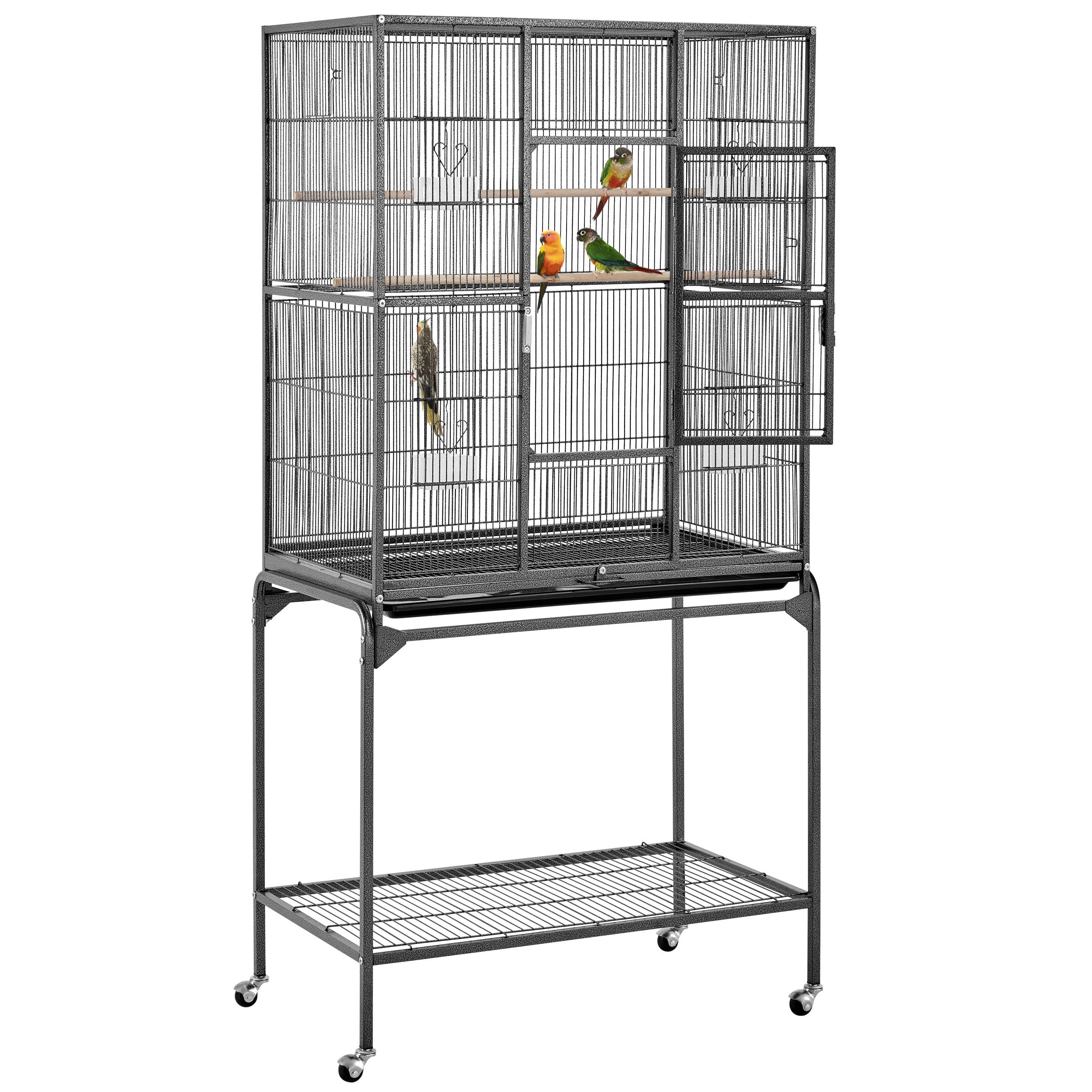
1. Yaheetech 63-Inch Wrought Iron Rolling Bird Cage
Our pick — 4.5+★ from 850+ verified ratings; the strongest balance of quality and price.
The flight cage that lifts off its own stand and rolls wherever the sunlight is.
This is the one to buy if you want a single cage that works in a living room on Monday and a patio on Saturday. The upper cage detaches from the stand, so you can set it on a tabletop or the floor when the layout changes. The full unit on its stand measures 32″L x 18.5″W x 63″H, and the cage interior alone gives you 30.3″L x 18.3″W x 36.4″H of climbing space.
The 10-millimeter bar gap is tight enough for small and medium birds — parakeets, budgies, cockatiels, conures and lovebirds — to climb without slipping a head through. Feeding happens through separate food and water doors, so you refill without swinging the main door open and risking an escape. The main door carries its own lock. What wins people over most is the build: the powder-coated wrought iron frame is the thing buyers come back to praise, and the sheer size of the interior is the close second. It also arrives ready to use, with two wooden perches and four feeding bowls in the box.
Here is the honest catch. The same heft that keeps it stable means you need two people to lift it once you separate the cage from the stand. The stand also adds a storage shelf, so plan to keep it within reach of the room where the cage lives. Buyers report that assembly and cleaning both go smoothly, but a bent piece or a cracked dish can turn up in transit, so check the frame before you load it with perches. For the money, it is the most complete package here, which is why it takes the top slot.
What earns it the top spot
- Upper cage detaches from the rolling stand for tabletop or floor use
- Four 360° swivel casters roll it between rooms and out to the patio
- 10-millimeter bar gap suits parakeets, budgies, cockatiels, conures and lovebirds
- Separate feeding doors and a locked main door cut escape risk
- Two wooden perches and four bowls included, so no extra shopping
Where it asks for care
- 36.4 pounds of wrought iron means lifting the cage body takes two hands
- Slide-out tray and bottom grate need pulling and wiping regularly to stay tidy
- An occasional bent piece or cracked dish shows up in transit
Go for it if: you keep small or medium birds and want one cage that rolls indoors and out.
Think again if: you need to move the cage up and down stairs alone — the wrought iron body is heavy.
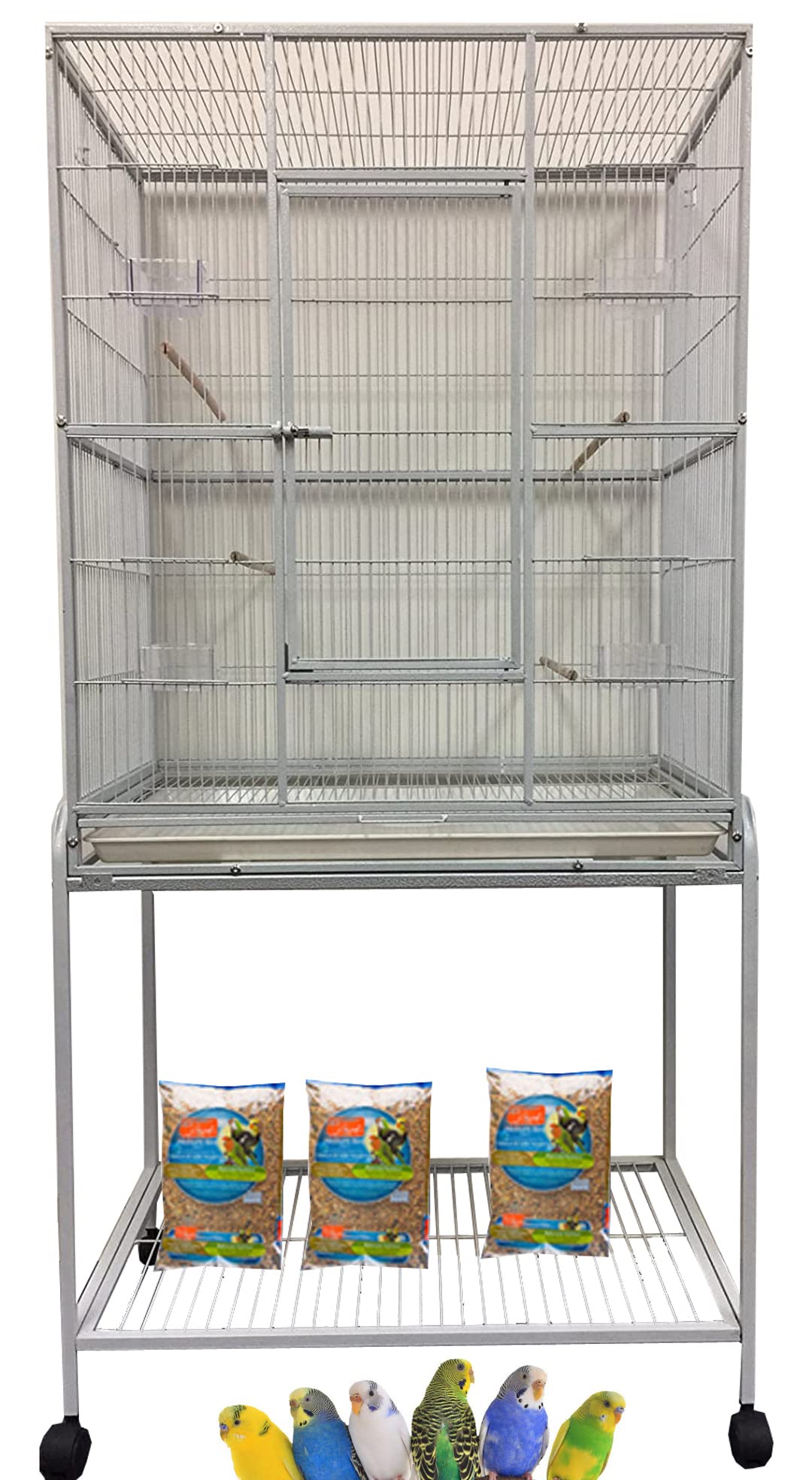
2. VINGLI 53-inch Bird Cage with Wheels
The entry-level pick that still gives a budgie room to fly, not just perch.
If the big flight cages feel like more than you need, this is the sensible start. At 28.7 pounds it is the lightest cage on this list, and it rolls on its own wheels so a single person can shift it around the room. The 0.6-inch bar spacing keeps budgerigars and small long-tailed parrots from slipping through the gaps, and a sturdy latch holds the door shut behind them.
What earns it a place is the space-to-footprint ratio. The cage stands 53 inches tall on a 25.4″L x 16.5″W base, and owners describe it as roomy enough for a pair of birds rather than a single occupant. A parakeet that came in nervous and cage-bound reportedly settled in and grew livelier once it had the wider run. Cleaning is the other quiet win — the double-tray system catches droppings on a slide-out tray with a safety grille, so a quick pull and wipe handles the daily mess.
The coating is the part to trust: a corrosion-resistant finish over the wrought iron resists chewing and scratches, which matters for birds that test the bars with their beaks. What it does not have is a play top or a seed guard, so flung food lands where it lands. The stand also detaches, giving you the same tabletop option as pricier cages. It is the right call if you want a spacious small-bird cage without paying for features you will not use.
The best-value read: for a small flock of budgies or lovebirds, this delivers the room and the easy tray without the bulk of a full flight cage. It is also the lightest frame in this lineup, which makes the wheels genuinely useful rather than decorative.
What you give up: no play top and no seed guard, so plan on sweeping around the base.
Reach for this if: you keep one or two small birds and want easy movement and easy cleaning first.
Look elsewhere if: you need a play top or a seed skirt to contain mess.
3. 54-Inch Wrought Iron Bird Flight Cage
Five doors, two of them for nesting boxes, make this the breeder’s working cage.
Most cages here give you one front door and a feeder flap. This one runs five doors, and two of them are side breeding nest doors sized for attaching a nesting box. Four pull-up feeder doors handle daily refills without a full open. If you are raising pairs or running a small finch setup, that door layout is the whole reason to pick it.
The bar gap (the space between bars) runs 12.7 millimeters, which is noticeably wider than the 10 millimeters on the Yaheetech above. That matters if your bird is on the tiny side, because the tighter gap is the safer one for the smallest species. What the extra width buys you is a sturdier bar for small and medium birds like parakeets, canaries and finches. The cage body measures 24″L x 17″W x 31″H, and the stand takes it to 54 inches overall.
Owners describe it as genuinely roomy — enough flight room for toys and a good sweep of wing. The rolling stand with its bottom shelf turns the base into storage for treats and toys, and it moves easily on casters between rooms. The color and finish draw steady compliments. The recurring gripe is durability: bars can arrive bent and trays can crack, so inspect on arrival and ask for a replacement before you stock it. For breeding work where door access is the priority, it earns its place.
Why breeders pick it
- Two side breeding nest doors plus four pull-up feeder doors
- 12.7-millimeter bar gap suits parakeets, canaries and finches
- Rolling stand with a bottom shelf for toys and treats
- Ample interior space for wing-stretching and toys
The trade-off to size up
- Wider 12.7-millimeter gap is less suited to the tiniest species
- Bars and trays can arrive damaged, so check before assembling
- No play top, so all interaction happens at the doors
Worth it for: breeders and finch keepers who need nest-box doors and quick feeder access.
Not the one for: a single small parrot that would do better with tighter bars and a play top.
4. VEVOR Bird Cage 31.5 x 20.5 x 52 in

A wide flat-top flight cage built to hold three or four medium birds at once.
The interior here runs 31.5 x 20.5 x 37.6 inches, and the listing puts that at enough room for three to four medium birds — conures, lovebirds, budgies, monk parakeets, long-tailed parakeets. The 0.6-inch bar gap matches that same medium-bird sizing. With the stand it reaches 52 inches tall and 33.1 pounds.
Construction is the selling point. Thickened tubes and a stable frame structure are meant to withstand deformation from a beak that leans on the bars, and the powder-coated finish adds water and rust resistance. The casters swivel a full 360°, so moving it from the living room to the balcony is a push rather than a lift. Feeders are plastic rather than metal, which cuts down on beak damage when a bird works at the food cup.
A slide-out tray and a bottom metal grate keep droppings away from the birds’ feet, and perches at several heights along the horizontal wires give them resting spots. The honest note is on sturdiness and the door mechanism — those are the areas where feedback splits, so check the lock and the door swing when it arrives and adjust before you stock the cage. For a flat-top setup with real flight width, this is a strong middle-of-the-line choice.
The width wins: 31.5 inches of length across the front gives medium birds a run to hop along, which a narrow tall cage cannot.
Check the hardware: sturdiness and the door mechanism get mixed feedback, so give both a once-over on delivery.
Pick this for: three or four medium birds that need horizontal flight room and a flat top.
Pass if: you want a play top and a locked dome rather than a solid roof.
5. Wrought Iron Open Play Top Stand Bird Cage

An open dome, a standing perch on top, and metal seed guards all around the base.
This is the cage that puts your parrot above the bars rather than behind them. The roof opens into a dome play area with a standing wooden perch, so the bird climbs out and sits with you instead of climbing the front wire. The overall unit runs 30.5 inches long by 29.5 inches wide by 63 inches tall including seed guard and open play top. The cage interior is 24 by 22 by 50 inches.
Bar spacing is 5/8 inch, which suits medium-to-large parrots better than the tight half-inch cages. The big front swing-out door measures 10 by 34 inches and carries a metal safety lock, and there is a smaller pull-down top front door at 10 by 8 inches for getting a bird in and out quickly. Four stainless steel cups sit behind swivel solid metal feeder doors so you can refill without spillage. It also runs a solid metal breeding door, usable as a breeding door or an extra feeder door.
Around the base is a full metal seed guard — a real advantage over cages that leave the sweep to you. The four swivel casters are heavy duty, and the bottom slide-out metal grate and tray make cleaning a quick pull. The finish is a non-toxic powder coat, and the fit and finish earn genuine praise. Where it falls short of its own photos is the sense of size — the interior reads smaller in person than the wide-angle shots suggest, so measure your space against the 24 by 22 inch footprint first. That is the trade-off on an otherwise well-built play-top cage.
The play-top case
- Open dome play area with a standing wooden perch on top
- Full metal seed guards contain flung food around the base
- Four stainless steel cups behind swivel metal feeder doors
- Non-toxic powder coat and a locked 10″ x 34″ front door
What to weigh first
- Interior reads smaller in person than product photos suggest
- Sturdiness and seed-tray fit split feedback, so check on arrival
- Instructions and assembly can test patience
A good fit for: parrot owners who want the bird out on a play top and a seed guard doing the tidying.
Measure first if: you expect the interior to feel as vast as the photos — check the 24 by 22 inch footprint against your room.
6. Yaheetech 63” Open Play Top Bird Cage
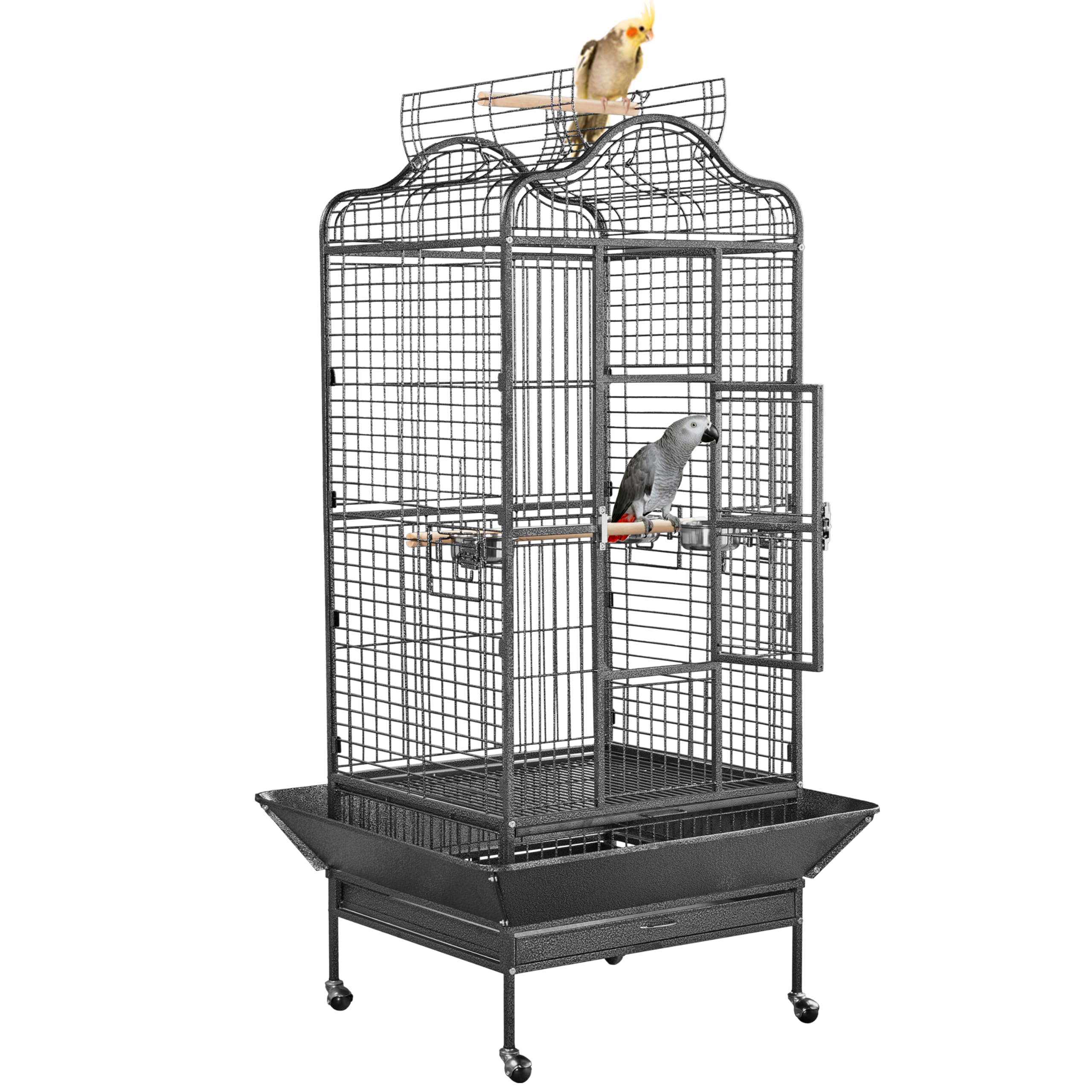
The one-inch bar spacing that finally fits an African Grey properly.
Here is the head-to-head that matters most for big birds. This cage runs a full 1-inch bar spacing, and that is the heaviest bar gap in this lineup — set against the 0.63 inches on the Mcage play top above, it is built for a much stronger bird. It is rated for African Greys, Amazon Parrots, Sun Conures and Cockatiels, so a large parrot gets bars it cannot bow. The overall unit with open top, stand and seed guard measures 32″L x 30.5″W x 63″H.
The Victorian archtop opens into an improve perching space outside the cage, and the top door locks so the bird stays put when you step away. Every door here has a lock, including the feeder doors, which is the kind of all-round coverage you want with a parrot that has learned to nudge a latch. The stand rolls on four ball-shaped casters, so it moves indoors and outdoors without effort. The slide-out tray handles droppings, and the seed guard around the base catches scattered food.
What owners talk about most is the build — it is described as well made and stylish, with assembly that goes together cleanly. The one thing to know before you buy is the food bowl doors: they can be stiff to open, so a little adjustment on the latch helps. Size suits medium-to-large birds specifically, which is exactly the point of the wide bars. For a large parrot in a play-top cage, this is the strongest match in the group.
Built for the big birds: a 1-inch bar gap is the widest here, and every door — top opening included — carries a lock.
The small snag: the food bowl doors can resist opening; work the latch before you count on quick refills.
Best matched to: African Grey, Amazon Parrot and Caique owners who need heavy bars and locked doors.
Wrong pick for: budgies or parakeets, which would find a 1-inch gap far too wide.
7. 64″ Corner Bird Flight Rolling Parrot Cage

The corner cage that turns dead space into a flight run for small birds.
A corner cage is the answer when your room has an awkward angle and no wall long enough for a straight run. This one runs 30 inches x 30 inches x 63.5 inches without the seed skirt, or 37.5 by 37.5 by 63.5 inches with it. That corner-to-corner shape tucks into the angle and gives flight room where a rectangular cage would not fit.
Bar spacing is 12.7 millimeters, and the listing names budgies, parakeets, cockatiels, canaries, lovebirds, parrotlets, conures, Pionus, Senegals and Jenday — so it is a small-to-medium bird’s cage, not a large parrot’s. A large swing front door plus a small pull-down door handle placement, and four swivel solid metal feeder doors carry four stainless cups between them. Two wooden perches give the birds resting spots. The epoxy coating is bird-safe, and slide-out metal trays and grates with an all-around metal seed skirt keep the floor around it cleaner.
Where this cage asks for patience is build consistency. It is genuinely roomy in the interior, and the corner footprint is the reason to choose it. The frame is heavy wrought iron at 70 pounds, so it takes two people to position. Feedback splits on sturdiness, with bent bars and broken perches turning up, so inspect the frame and the perches on delivery. If you have a corner to fill and small birds to fill it, this is the shape that makes the room work.
Why the corner design works
- 30″ x 30″ corner footprint fills dead room space
- 12.7-millimeter gap covers budgies, cockatiels, conures and more
- Four swivel metal feeder doors with four stainless cups
- All-around metal seed skirt and slide-out metal trays
What to inspect on arrival
- Bent bars and broken perches show up in some shipments
- 70 pounds of wrought iron means a two-person setup
- Not suited to large parrots despite the extra-large footprint
Choose it when: a room corner is your only space and small-to-medium birds need a flight run.
skip it if: you keep a large parrot that needs heavier bar stock.
8. Wrought Iron Play Top Ground Bird Cage

A climb-out ladder on top turns the roof into a second play space.
This cage takes the play top idea one step further with a walk ladder on the roof, plus a natural wooden stand perch. Your bird climbs out, works the ladder, and comes back down when it wants to. The 3/4-inch bar spacing is the middle setting of this group, and the front swing-out door measures 14 by 21 inches with an improved safety metal lock. Overall it reaches 38.5 inches long by 30.5 inches wide by 69 inches tall including the play top and seed guards.
Underneath sits a storage shelf measuring 32 by 23 by 11 inches, which is real room for food and toys. Two large 5-inch stainless steel feeder cups sit behind swivel solid metal doors so you refill without opening up. The casters are heavy duty swivel type, and two of them lock — a detail that keeps the whole tower still once you have positioned it. The bottom has a slide-out grate and metal tray, plus an all-around seed guard to contain flung food.
The plain truth is that this one takes time to build. Assembly can run for hours before the instructions make full sense, and the hardware has drawn criticism for not fitting cleanly, so lay every bolt out before you start. Feedback also flags bent parts and broken dishes turning up. In return you get one of the largest frames here at 32 by 23 by 36.5 inches of cage interior, at a price that undercuts the play-top competition. Plan on a patient afternoon with a helper and it rewards you.
The storage advantage: a 32 by 23 by 11 inch shelf under the cage is bigger than anything else here, and the locking casters keep the tower still.
Know before you buy: assembly runs long and hardware fit gets flagged — plan the build day and check every part up front.
Worth the effort if: you want the biggest cage interior with a ladder play top and serious under-cage storage.
Second thoughts if: you want a quick build — this one takes hours and patience.
Know the Specs
Bar spacing in inches and millimeters
The gap between bars is the number that keeps your bird safe. Tighter gaps suit small birds that could work a head through a wider opening. Wider gaps come with heavier bar stock for large parrots that can bow thinner bars. The cages here run from 10 millimeters up to 1 inch, so the spacing alone tells you which birds belong inside.
Play top versus flat top
A play top is an open dome or arch in the roof that becomes a perching area, often with a standing perch or ladder. It lets a bird climb out and sit above the bars with you, and the opening should lock when you step away. A flat top gives a solid roof and more shelf space. Pick by how much out-of-cage time your bird gets.
Slide-out tray and seed guard
A slide-out tray pulls out from the base so you can clean without opening the main door. A seed guard is a metal skirt around the base that catches flung food before it hits the floor. Together they cut down on the daily wipe-down and the sweep around the cage. Not every cage here includes a seed guard, so check before you buy.
Casters, detachable stands and storage
Wrought iron cages are heavy, so four swivel casters do the moving. Some casters lock to hold the cage in place. Some stands detach, letting the cage sit on a table or floor. A storage shelf underneath adds usable space for food and toys. Match the mobility features to how often you plan to move the cage between rooms or out to a patio.
Common Questions
What bar spacing is safe for a budgie or parakeet?
Can I use a large parrot cage for a small bird?
How long does it take to assemble a wrought iron bird cage?
Do I need a seed guard around the cage base?
Is a corner cage better than a straight flight cage?
How do I clean a slide-out tray on a wrought iron cage?
Do the wheels lock so the cage stays put?
What is the difference between a play top and a flat top cage?
How much room does a cage need around it in a room?
Are wrought iron cages safe for birds that chew?
The Bottom Line
For most bird owners, the wrought iron bird cage winner is the Yaheetech 63-Inch Rolling Flight Cage. It pairs a tight 10-millimeter bar gap for small and medium birds with a detachable rolling stand and a full accessory set. If you keep an African Grey or another large parrot, the Yaheetech 63” Open Play Top Cage gives you the 1-inch bar spacing and locked doors that big birds need. And for breeding pairs, the Mcage 54-Inch Breeder Cage with its side nest doors is the working choice.
How we choose
We do not accept paid placement. Every pick is matched to a real buyer and a real use-case; we do not hands-on test units.
Sources
Specifications: manufacturer listings and product documentation. Review insights: verified customer reviews, as of November 2026. Pricing: not shown on this page (it changes often); check the current price via the retailer link.
As an Amazon Associate, Tactical Gear Guy earns from qualifying purchases. This does not affect which products we feature.