Specs are compiled from manufacturer listings and verified buyer reviews and can change over time — please confirm the key details on the product page before buying.
If your toes go numb twenty minutes into a winter walk, the fix is almost always the wool content, not the price tag. A sock that is mostly merino holds heat even when damp, while a thin synthetic blend leaves your feet cold the moment they sweat. Below you will find the nine wool thermal socks worth your attention, sorted by what each one actually does best — deep cold, all-day work boots, skiing, or small feet that need real warmth.
This guide is built by comparing the manufacturers’ published specifications and the patterns across verified customer reviews, so you get each pick’s real strengths and trade-offs instead of marketing spin.
Wool percentage, cushioning, and shaft height decide whether a sock works in a boot or bunches at the ankle. Each pick below is matched to a real use, so you can skip the guesswork and buy the pair that fits your winter. These are the wool thermal socks that hold warmth where it counts.
Top Picks


How To Choose The Best Wool Thermal Socks
Most people buy thermal socks by squeezing the package, and that tells you almost nothing. The number that actually predicts warm feet is the wool percentage printed on the back — that is the share of the sock made from wool fiber, and it is what traps heat when your feet get damp. The second factor is cushioning: terry loops (the soft raised pile inside the sock) create air pockets that hold warmth and absorb impact.
Read the wool percentage before anything else
A sock at 80% merino wool, like the Merino Wool Thermal Socks 3-pair set, puts far more insulating fiber against your skin than a 27% wool blend like the Carhartt pack. Higher wool means more warmth per thickness and better moisture handling — merino wicks sweat away from skin so your feet stay dry instead of clammy. Lower-wool blends lean on synthetic fibers for durability and shape, which is a fair trade for heavy work boots but a weaker choice for deep cold.
Match the shaft height to your footwear
A crew or mid-calf sock sits above the boot collar and keeps the shin covered; a knee-high shaft adds protection under ski and snowboard boots. Tall boot socks work under rubber boots and hunting footwear but can bunch if they don’t hug the calf. Measure your boot height and pick a shaft that clears it by an inch or two so the sock stays put when you walk.
Check the sizing note before you order
Wool socks often run large or shrink slightly after the first wash. Some makers post a plain warning to size down, and others list a tight calf fit as a known feedback point. Read the size chart, trust the maker’s own note, and when you are between sizes on a sock that runs big, go smaller rather than swimming in it.
Side-by-Side Comparison
| Model | Best For | Wool Content | Pairs Per Pack | Shaft Height | Amazon |
|---|---|---|---|---|---|
| Merino Wool Thermal Socks, Men & Women, 3 Pairs★ Best Overall | Deep cold everyday wear | 80% merino wool | 3 pairs | Winter boot (crew) | Amazon |
| Women’s Thermal Knee High Merino Wool SocksBest for Ski Days | Skiing and snowboarding | Merino wool blend | — | Knee high | Amazon |
| Josnown Mens Thermal Wool Blend Socks 5 PairsBest Multi-Pack Value | Stocking up cheaply | Wool blend | 5 pairs | — | Amazon |
| MOGGEI Kids Merino Wool Hiking Socks 6 Pairs | Kids in cold weather | 70% merino wool | 6 pairs | — | Amazon |
| Carhartt Men’s Heavyweight Synthetic-Wool Blend Boot Sock 2 Pack | Work boots and long shifts | 27% wool | 2 pairs | Boot (below calf) | Amazon |
| 3 Pairs Merino Wool Ski Socks Winter Thermal Sock | Skiing with compression | Merino wool blend | 3 pairs | — | Amazon |
| MUCK Boot Mens Merino Wool Blend Camo Tall Boot Socks | Hunting and rubber boots | Merino wool blend | 2 pairs | Tall (up to knee) | Amazon |
| DANISH ENDURANCE Hiking Socks, Merino Wool | Rugged trail hiking | Merino blend (30% merino) | — | — | Amazon |
| J.B. Field’s -40 Below Arctic Trail Thermal Winter Socks | Extreme cold and trekking | 85% preshrunk wool | — | Crew (mid-calf) | Amazon |
Detailed Reviews
1. Merino Wool Thermal Socks, Men & Women, 3 Pairs, Winter Boot
Our pick — 4.5+★ from 750+ verified ratings; the strongest balance of quality and price.
The 80% merino blend that turns a cold winter boot into a warm one.
The wool number is what wins here: 80% merino wool, with the rest split between 12% acrylic, 2% polyester, 5% rubber, and 1% spandex. The Carhartt pack, for comparison, is 27% wool, so this sock puts more insulating fiber against your skin. Merino also wicks moisture away, so if your feet sweat on a long walk they dry instead of turning cold. You get three pairs in the pack, in Black and Grey, across four sizes from 5–8 up to 13–15.
You get cushioning through the whole sock, so every step in your winter boots feels padded. The build adds a smooth toe — the joined part at the front is smoothed flat so nothing rubs against your toes — plus reinforced heel and toe sections, the spots where socks wear out first. Buyers who wear them walking the dog in cold weather report they are thick enough to hold heat without feeling like a sponge in the boot. Reviewers praise the overall quality of the knit most, then how warm they stay — which is what you want from a sock labeled thermal.
The one thing to plan around: the fit around the calf draws mixed feedback, and a few wearers find it snugger there than expected. If you have wide calves or are between sizes, size up. Otherwise this is the pack that does the most for the money at the mid-range level.
Where This Sock Pulls Ahead
- 80% merino wool — far more insulating fiber than most blends in this group.
- Reinforced heel and toe hold up through a full winter of daily wear.
- smooth toe cuts rubbing for anyone on their feet for hours.
- Three pairs and four size options cover the whole household.
What To Plan Around
- Calf fit runs snug for some wearers — size up if you are between sizes.
- Only Black and Grey colorways are offered.
Grab these if: you want the highest wool content at a mid-range price and a sock built for winter boots, hiking, or everyday cold.
Size up if: your calves run wide, because the fit here is reported on the snug side.
2. Women’s Thermal Knee High Socks Merino Wool
A knee-high shaft that stays put where a crew sock leaves the shin bare.
Ski and snowboard boots come up high, so a short sock leaves the shin exposed to the liner edge. This pair is built for that gap — the knee-high shaft runs all the way up rather than stopping at the calf. The knit is a merino wool blend that keeps the leg warm and breathable on the hill. For a woman who spends a day in boots on the slopes, that length and wool content together are the whole point.
The wear reports back it up. Buyers praise warmth most, then comfort — no pinching at the cuff, and the shaft stays up without squeezing. The shaft does not slip down mid-run, and the material looks fresh after repeated washing.
Because the shaft is long, this is not the pair to wear with low shoes — it will rise above the ankle. That knee-high build is a ski and winter-boot tool, and for that job it earns its place in the lineup. At the entry level it is also the most affordable way to get length and warmth together.
Where the length pays off: knee-high coverage protects the shin under ski and snowboard boots, and a merino blend wicks sweat so the leg stays dry through a whole day on the hill.
One honest note: being a tall shaft, it leaves little use for low shoes — this is a winter-boot and ski companion, not an everyday trainer sock.
Pair it with: ski boots, snowboard boots, and tall winter footwear where shin coverage matters.
Leave it for: warm-weather wear or low-cut shoes, where that long shaft has nowhere to go.
3. Josnown Mens Thermal Wool Blend Socks 5 Pairs
Five pairs of warm wool-blend socks, enough to fill a drawer and skip laundry day.
If you want warmth on a budget and don’t need the highest wool content on the shelf, this five-pack gets the job done. The knit is a wool blend, thick enough to feel soft and warm against the foot, with a heel and toe reinforced to resist abrasion and a sweat-wicking finish to move moisture off the skin. Sizes run 7–12 and 12–15 for men, so most guys can find a fit.
Reviewers rank warmth first and the value of five pairs per pack a close second. The softness gets a nod too. Pour a couple into a work bag and you can rotate through a week without washing, which is exactly what a five-pair pack is for. For a guy who wants warm feet from door to door and doesn’t fuss over fiber percentages, this is a sensible buy.
Two things to be honest about. The thickness draws feedback that these read leaner than expected, and sizing is split — some find them true to fit while others say they run small. Order up if you are on the fence. They are durable and warm, but not the pack to grab when the forecast drops into the deep freeze or you need max insulation.
What earns a spot in the drawer: five pairs in one buy with a wool-blend knit, reinforced heel and toe, and a soft feel that reviews praise for warmth.
Where the knit is leaner: thickness runs lighter than some of the sock pack expects, and sizing is split — check the chart and size up if unsure.
Go for it if: you want several serviceable warm pairs without paying for a premium single pair.
Look higher if: you face sub-zero conditions or need the marshmallow-thick cushion that this pack is not known for.
4. MOGGEI Kids Merino Wool Hiking Socks 6 Pairs
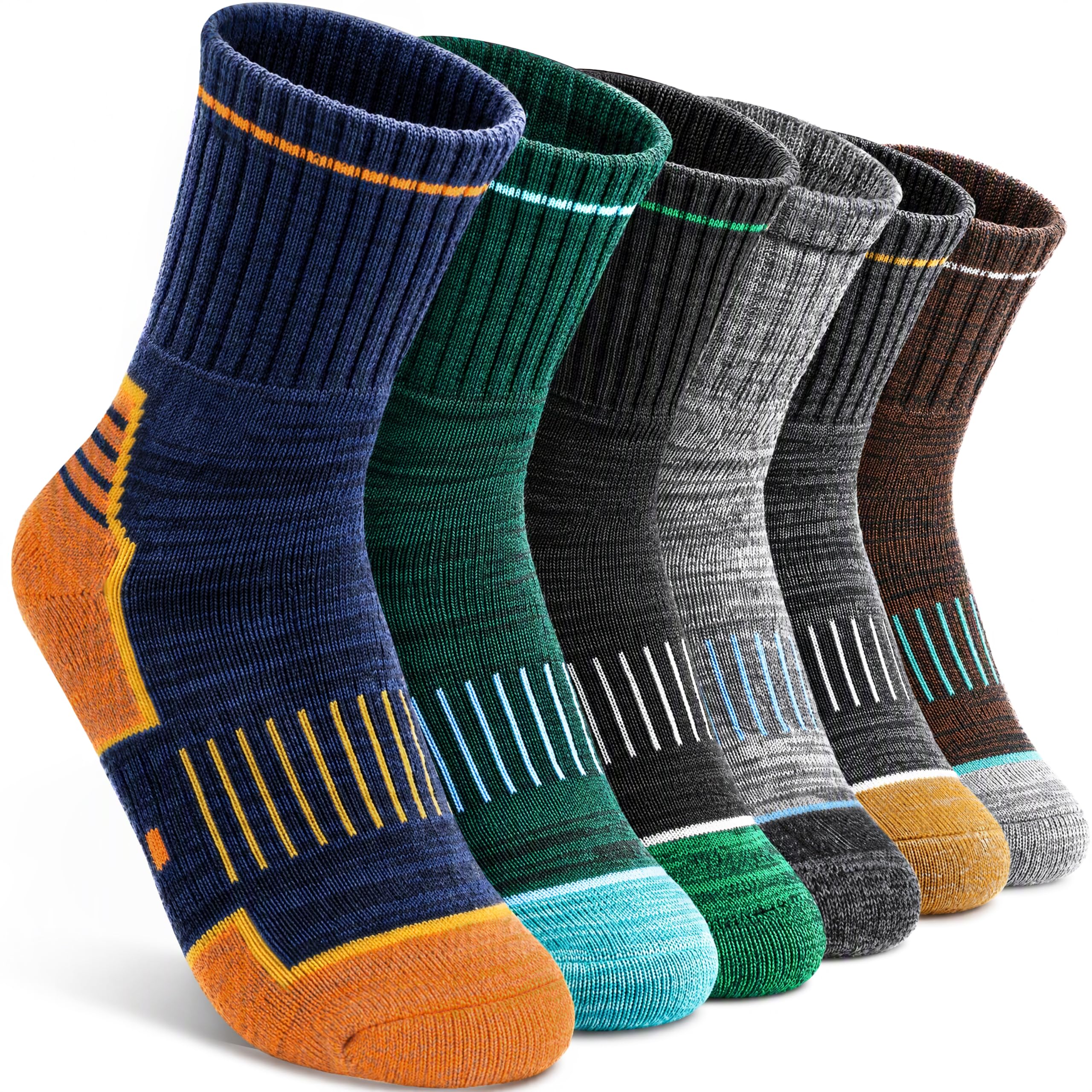
Six pairs of 70% merino wool for small feet that hate cold and bulk.
Little feet lose heat fast, and a cotton sock does nothing about it. These are 70% merino wool, blended with 23% polyester for shape, 5% spandex for stretch, and 2% nylon to strengthen the heels and toes — so they warm without the bulk a thick synthetic sock carries. Wearing them should feel like a normal sock, just warmer. Six pairs per pack means spare dry ones when a pair comes home wet from the snow.
Parents single out the overall quality of the knit first, which matters here because kids wear through a sock’s heel and toe quickly. Warmth comes next — they keep feet warm and dry in cold weather without turning into a heavy boot sock. Softness and fit get consistent praise for the 4 to 6 age range. The 70% merino leaves a lot of warmth in the material, so the kids can run and play outside without the socks ballooning around the ankle.
Machine washable, according to the maker, which is the line every parent scans first. Treat that as a fair trade for how soft and breathable they are, and a child who is hard on socks will still get plenty of wear from the six-pair pack.
What Parents Appreciate
- 70% merino wool keeps small feet warm despite thin bulk.
- Six pairs per pack — more than a single sock purchase covers.
- Machine washable for easy winter laundry.
- Blend holds shape via polyester and stretches with spandex.
What To Keep in Mind
- Long-term durability gets mixed notes — a soft merino trade-off.
- Best matched to the 4 to 6 age range reported in feedback.
Best for households with: active kids who need warm, non-bulky socks for snow days and outdoor play.
Set expectations on: durability — the soft merino knit is gentle, not a heavy work sock.
5. Carhartt Men’s Heavyweight Synthetic-Wool Blend Boot Sock 2 Pack

Built to survive steel-toe boots and twelve-hour shifts, not just a snowy walk.
This sock is built to survive a work boot. It is a 27% wool blend with synthetics — less insulating wool than the 80% merino pack up top, but the synthetics add abrasion resistance at the heels, arches, and toes and help the sock hold its shape under a heavy boot. You get a 2-pack in men’s Large, sized for US men’s shoe size 9–11.5, with cushioning at the heels, arches, toes, insteps, and legs.
Durability is the reason to pick them. Wearers report the reinforced heels and toes outlast the boots they’re worn in. The 27% wool still regulates temperature and stays soft against the foot, while the sweat-wicking finish moves moisture away during a long shift. Buyers describe them as thick, cushiony, and soft, and one notes they prevent rubbing inside steel-toe boots through 12-hour shifts.
The catch is the shaft height. Being a boot sock, it does not run up the calf, and a few wearers note they fall short of the calves — fine under a work boot, less ideal if you want shin coverage. Size Large covers 9–11.5, so anyone outside that range will need a different option. For the every-day work boot wearer, this is the durability pick.
Why Work Boots Like It
- Synthetic-wool blend with abrasion-resistant heels, arches, and toes.
- Cushioning across the heel, arch, toe, instep, and leg.
- Sweat-wicking finish keeps feet dry through long shifts.
- Reports of outlasting the boots they are worn in.
The Honest Caveats
- 27% wool is far thinner insulation than an 80% merino sock.
- Shaft stops below the calf — not a knee-high option.
- Sized in Large for men’s 9–11.5 only.
Reach for these if: you wear steel-toe or heavy work boots for long shifts and need a sock that survives the daily grind.
Skip them if: you want deep-freeze insulation or knee-high coverage — this pack trades wool content for ruggedness.
6. 3 Pairs Merino Wool Ski Socks

Moderate compression and arch support for skiers who tire in the boot.
Three pairs of merino wool blend ski socks built with a wide compression cuff and arch support. The compression is described as moderate — enough to keep the sock from slipping in the boot without squeezing the leg. Arch support gathers the fabric under the foot to reduce fatigue through a long day on your feet. The merino blend wicks moisture to keep feet dry, and the stretchy knit makes them easy to pull on. Sizing covers US men’s 8–11 and women’s 9.5–12.
The quality of the knit gets consistent praise, and the warmth holds up with regular boots as well as ski boots. Colors draw their share of compliments, which matters in a three-pack you may wear openly around the lodge. The moderate compression is the practical detail for anyone who has felt their arches ache after a full day clipped into ski boots.
The fit and thickness are where opinions split — some find them just right, others call the sock generous or the knit lighter than expected. It is a ski-focused sock, so treat the fit note as a prompt to check the size chart before you order. If your priority is a comfortable, dry day on the slopes plus arch support, this three-pack delivers.
Standout build detail: a wide compression cuff and arch support team up on this merino blend so the sock stays planted and the arch feels supported through a full day in ski boots.
The split report: fit and thickness draw both praise and pushback — if you are between sizes, confirm the chart rather than guess.
Fits your winter if: you ski or hike in boots and want moderate compression with a merino blend that stays put.
Consider a different knit if: you want a plush, thick sock or a very precise fit — this one splits opinions on size.
7. MUCK Boot Mens Merino Wool Blend Camo Tall Boot Socks

A tall merino blend that reaches the knee and stays up in rubber boots.
Rubber boots and tall hunting footwear sit high on the leg, so a short sock leaves the shin cold or the boot lining chafing. This merino wool blend sock runs tall — up to the knee — and its shaft is built for that height. Two pairs come in a camo pattern for the field. The merino blend gives warmth and moisture handling through snow, rain, and cold ground.
Comfort is the first thing that comes across in the feedback, along with warmth that reaches up the knee and a fit that does not slide down. Hunting is the use case where owners say it shines — it pairs cleanly with Muck boots, the tall rubber style the brand is known for. For a pair meant for the field, the fit staying put is the difference between a warm day and a miserable one walking back with a sock bunched at the ankle.
As a tall sock, it is a niche pick: it belongs in tall boots, not low shoes. And it is a blend rather than a high-wool sock, so it trades some insulation depth for durability. For the hunter who pulls on tall boots on a cold morning, that trade is sensible.
Field-Ready Strengths
- Tall shaft reaches up the knee for full shin coverage.
- Merino blend keeps feet and legs warm in snow and cold.
- Fit stays put and does not slide down the calf.
- Two pairs per pack in a camo pattern for hunting.
Fit Notes
- Tall design is best in boots, not low shoes.
- Blend wool content means thinner insulation than the high-merino pick.
Built for the field: tall rubber boots and hunting footwear where the leg needs full coverage and the sock has to stay put.
Not the one for: everyday low shoes or deep-freeze work sites where maximum wool insulation matters.
8. DANISH ENDURANCE Hiking Socks Merino Wool

Heavy heel-to-toe cushioning for people who hammer uphill trails in stiff boots.
Stiff hiking boots punish your feet on long trail days, and this sock is shaped to absorb that. Heavy heel-to-toe cushioning softens each step, and the anatomy is built for the outdoors — an anatomical left and right shape plus arch support keeps the sock in place, and a smooth toe cuts rubbing on uneven ground. The merino blend breathes through ventilation zones that move moisture and airflow, so feet stay dry rather than overheated on steep climbs.
Thousands of buyers report in, and quality and comfort rank highest, followed by warmth and trail suitability. The socks are warm without feeling bulky and work across seasons for trail use. The breathable merino and ventilation zones are the reason a long climb does not turn your feet into a sweat bath.
The honest caveat is that the wool content is lower than the top pick — this is a merino blend described as 30% merino, so it is a performance knit rather than a deep-cold wall of insulation. The fit and thickness also split opinion, with some running big and some finding the knit thin. It is made in Portugal, packed in recycled paper, and the merino is mulesing-free, which matters to anyone shopping with animal welfare in mind.
What Trail Hikers Get
- Heavy heel-to-toe cushioning absorbs impact on rocky ground.
- Anatomical left/right shaping and arch support keep it planted.
- Ventilation zones wick moisture on long climbs.
- Made in Portugal from mulesing-free merino, packed in recycled paper.
Trade-Offs to Weigh
- 30% merino is a blend, not a wall of wool insulation.
- Some report sizing large and the knit running thin.
Made for the trail: hikers who want thick shock absorption and arch support under stiff boots on long, rocky routes.
Not a deep-freeze sock: with 30% merino it favors breathability over maximum warmth.
9. J.B. Field’s -40 Below Arctic Trail Thermal Winter Socks

85% preshrunk wool and full terry cushion built for below-zero boots.
If your winter is genuinely brutal, this is the sock aimed at it. The blend is 85% preshrunk wool with 15% nylon — the highest wool content in this group, well above even the 80% merino top pick. Preshrunk means the wool is stabilized before it reaches you, so it holds its size better after a wash. Full terry cushioning runs through the sock to trap warmth and regulate temperature in extreme cold, with a reinforced heel and impact support zones that add foot protection. It is crew length, at mid-calf.
Warmth is what owners note most, and the sock performs in winter boots built for below-zero weather. The high wool content earns praise on its own, and its functionality under harsh conditions leaves people ready to buy again. That insulation level is why this is the deep-cold pick. — If a standard wool blend leaves your toes cold, the jump to 85% wool is the difference.
Two practical notes. The maker warns the sock fits large, so size down if you can, and the fit, thickness, and value all draw split opinions — some want a tighter feel, some expect a lighter sock. It is also premium-tier pricing, so it is the investment for the deep cold, not the everyday sock. Wash it warm, inside out, and tumble dry low.
Why it goes deep: 85% preshrunk wool plus full terry cushioning makes this the heaviest insulation in this set for below-zero boots and trekking.
Order a size down: the maker says this sock runs large, and fit and thickness both split buyer opinion.
Worth it if: your winters drop hard and you need the highest wool content for real below-zero boots.
Overkill if: you only need mild-weather warmth — this is a heavy-duty sock at a premium tier.
Know the Specs
Wool Percentage
This is the share of the sock made from wool fiber, and it is the single best predictor of warmth. A sock at 80% or 85% wool puts far more insulating fiber against your foot than a 27% blend, so it holds heat better when conditions turn cold. Higher wool also handles moisture better, because wool wicks sweat away from skin instead of trapping it. Synthetics mixed in add shape and durability, so lower-wool blends suit heavy work boots while high-wool blends suit deep cold.
Cushioning and Terry Loops
Terry cushioning is the soft raised pile knit inside the sock, and those loops trap air that holds warmth. Full terry runs the length of the sock, while targeted cushioning sits in high-impact zones like the heel, arch, and toe. More cushioning means more warmth and shock absorption under a stiff boot, but it also adds thickness — which is why some sock wearers report a plush sock as too bulky for tight shoes. Match the cushion level to your boot, not just the temperature.
Common Questions
How much wool do thermal socks need to actually feel warm?
Are merino wool socks warmer than regular wool socks?
Will wool thermal socks shrink in the washing machine?
What is the difference between crew, knee-high, and tall boot socks?
Do wool thermal socks need a liner sock underneath?
Can kids wear adult wool thermal socks?
Are these wool thermal socks good for wearing inside steel-toe work boots?
Should wool thermal socks fit tight around the calf?
Is a higher wool percentage always the better thermal sock?
Why do some wool thermal socks run large or small?
The Bottom Line
For most buyers, the best wool thermal socks are the Merino Wool Thermal Socks, 3 Pairs — the 80% merino blend gives the highest wool content in the mid-range, with a smooth toe and reinforced heel and toe built for everyday winter boots. Spend your day in steel-toe or heavy work boots? The Carhartt Heavyweight Blend is the workhorse. Winters that drop hard? The J.B. Field’s 85% preshrunk wool sock is the deep-cold pick.
How we choose
We do not accept paid placement. Every pick is matched to a real buyer and a real use-case; we do not hands-on test units.
Sources
Specifications: manufacturer listings and product documentation. Review insights: verified customer reviews, as of November 2026. Pricing: not shown on this page (it changes often); check the current price via the retailer link.
As an Amazon Associate, Tactical Gear Guy earns from qualifying purchases. This does not affect which products we feature.