Specs are compiled from manufacturer listings and verified buyer reviews and can change over time — please confirm the key details on the product page before buying.
Buying wool felt polishing wheels and grinding bits is mostly a matching game, not a shopping spree. You need a shank that fits your rotary tool, a head size that reaches the spot you are working on, and a felt density that polishes instead of scuffs. Get those three wrong and even a good kit will just smear compound around. This list sorts out which kits actually match common rotary tools, which ones cover coarse grinding through final shine, and which ones suit small detail work like jewelry and frets rather than big flat panels.
This guide is built by comparing the manufacturers’ published specifications and the patterns across verified customer reviews, so you get each pick’s real strengths and trade-offs instead of marketing spin.
Most buyers get tripped up by one thing: grit number and felt hardness pull in opposite directions, and a kit that is wonderful on jade can be too soft on steel. Below you will find the felt wheel and grinding bit set that fits your exact bench, whether you are restoring a watch case or cleaning up a mold cavity. These are the wool felt polishing wheels and grinding bits worth putting in your rotary tool drawer.
Top Picks

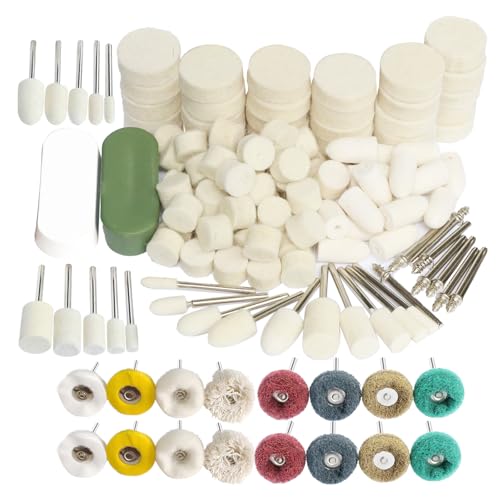
How To Choose The Best Wool Felt Polishing Wheels and Grinding Bits
The first thing to settle is fit, not piece count. A box of 246 bits is useless if the shanks do not seat in your tool. Most rotary tools and hobby drills take a 1/8-inch shank, which is the standard across nearly every kit here. Check your collet size before you buy, because a loose shank wobbles and a wobbling wheel scratches instead of polishes.
Grit number tells you the job, not the quality
Grit is a count of abrasive particles per area — lower numbers mean coarser, faster cutting, and higher numbers mean finer, gentler work. A 60-grit bit chews through burrs and rust. A 2000-grit felt wheel is for the final mirror shine and removes almost nothing. The kits that cover both ends let you go from rough cleanup to a bright finish without buying twice. If you only ever polish soft metals and jewelry, a fine-only kit is plenty.
Wool felt density changes how the wheel behaves
Compressed wool felt is dense, holds polishing compound well, and stays together at speed. Softer wool conforms to curved and carved surfaces better but wears faster. A wheel described as moderate hardness is the middle ground — firm enough to flatten a semi-rough finish but not so stiff that it gouges. Very stiff wheels are the right tool for flat metal and the wrong tool for delicate plastic.
Match the head diameter to the reach you need
Small heads, in the 4mm to 6mm range, get into grooves, fret slots, and inside ring bands. Larger 10mm to 25mm wheels cover flat panels and bigger surface areas faster. Mixed-size kits are the practical buy, because most real jobs need both. A one-diameter set forces you to work a big flat area with a tiny head, which wastes time and compound.
Side-by-Side Comparison
| Model | Best For | Piece Count | Grit Number | Head Sizes | Amazon |
|---|---|---|---|---|---|
| Luo ke 100 Pcs 1/8 Inch Rotary Wool Felt Polishing Bit Kits★ Best Overall | All-round detail polishing | 100 pieces | 150 (fine) | 4mm / 5mm / 6mm / 8mm / 10mm | Amazon |
| 146PCS Abrasive Wheel Buffing Polishing Wheel SetBudget Champion | Biggest piece count on a budget | 146 PCS | 120 (fine) | — | Amazon |
| Merryland 125 Pack 1 inch Felt Polishing WheelBest With Paste | Flat-surface buffing with paste included | 125 pieces | 120 (medium) | 1 inch diameter | Amazon |
| Keadic 100Pcs Rotary Grinding Stone Bits Set | Mixed grinding head variety | 100Pcs | 60 (fine) | 4mm / 5mm / 6mm / 8mm / 10mm | Amazon |
| ODOMY 100Pcs Felt Polishing Wheels Wool Buffing Pads | Hard surfaces and tight spots | 100 pieces | 180 (medium) | 10 millimeters | Amazon |
| YURINWOO 114 PCS Polishing Kit with 2Pcs Polishing Compound | Wide shape variety plus compound | 114 pieces | 400 (medium) | 1 inch / 1/2 inch / 0.37 inch | Amazon |
| Pihemum 90-Piece Abrasive Buffing & Polishing Wheel Set | Graded grit progression in one box | 90 pieces | 80 to 800 (graded) | 25 millimeters | Amazon |
| TEMO 100p 1″ Dia Felt Polishing Wheel Wool Buffing Pad | Guitar frets and fine finishing | 100 pieces | 2000 (very fine) | 1 inch diameter | Amazon |
| Wonys 246PCS Polishing Buffing Wheel Polishing Kit | Largest starter kit with three compounds | 246PCS | — | 1 inch / 1/2 inch | Amazon |
Detailed Reviews
1. Luo ke 100 Pcs 1/8 Inch Rotary Wool Felt Polishing Bit Kits
Our pick — 4.5+★ from 400+ verified ratings; the strongest balance of quality and price.
Five head diameters on one 1/8-inch shank — the detail kit that reaches into the groove
What wins people over here is the five-diameter range on one 1/8-inch shank for small work. This is a 100-piece set of compressed wool felt bits, split between bullet and cylinder shapes, and both shapes come in 4mm, 5mm, 6mm, 8mm and 10mm head diameters. That spread is why it belongs at the top: a 4mm cylinder cleans out a mold cavity or ring setting, and the 10mm head polishes a flat plate without swapping tooling. The 1/8-inch shanks seat in standard rotary tool collets, so it drops straight into a Dremel-style tool.
The grit is rated 150, which is fine — it brightens and smooths rather than cutting material away. On jewelry, glass, jade and non-metallic surfaces that is exactly the behavior you want, and the compressed wool holds compound instead of shedding it. Piece count does the rest of the argument. One hundred heads means you are not rationing the small ones for the last part of a job, and the storage box keeps the shapes sorted so you can grab the diameter you need by eye.
The honest limit: fine grit means this is a polishing and waxing kit, not a material remover. If your burr or scratch needs real stock removal, you need a coarser abrasive first. And the value question answers itself once you price out the individual heads — the price-per-piece math is what lifts it above the thinner kits. At 4.5+ stars across 400+ ratings, it is the crowd favorite and the kit most buyers should start with.
What earns it first place
- Five head diameters from 4mm to 10mm cover detail and flat work in one box
- 150 fine grit polish is the right finish grade for jewelry, jade and glass
- Compressed wool felt holds compound without breaking down at speed
- 100 pieces means the small heads are always at hand
Where it stops short
- Fine grit polishes but does not remove stock — you still need a coarser bit for burrs
- Small heads wear faster than the large ones on heavy use
Reach for this if: you polish jewelry, jade, glass or small metal parts and want the full diameter range in one tidy box.
Look elsewhere if: the job is aggressive deburring — this is a finishing kit, not a cutting kit.
2. 146PCS Abrasive Wheel Buffing Polishing Wheel Set
The bulk box that hands you the most pieces for the least money
If you want your money to buy the maximum number of heads, this is the one. It runs 146 PCS against the 100Pcs in the Keadic set — a 46% larger box of rotary heads. The set mixes wool felt pads with scouring pad and cotton components, so you get a range of grinding heads rather than one uniform shape. Grit is rated 120, a fine grade, and the materials listed cover wood, metal, stone, glass and ceramics.
The construction is coated, and the listed material type is ceramic with ceramic grit. That is a sturdier feel than pure felt, and the maker rates it for good wear resistance. It is aimed at DIY creation and detail work rather than full-scale restoration. For someone building out a first rotary tool station, the piece count alone means you will not run dry halfway through a weekend project.
Here is the catch, and the maker is upfront about it. Run the tool too fast and the wheels wear out quickly — the recommendation is the lowest gear. Treat the box as a supply of consumables rather than something to lean on hard. As a high-volume, entry-level set it does its job; it just rewards a gentle touch.
The value read: 146 pieces covering wool felt, scouring pad and cotton is a lot of bench stock for a low-tier outlay, and the 120 fine grit is a sensible all-round finish grade for wood, stone and glass.
Throttle down: the maker’s own guidance is to run at the lowest gear, since high speed shortens the life of the buffing heads.
Best fit: first-time rotary tool owners who want a deep drawer of heads without committing much.
Less ideal: anyone planning heavy continuous work where wheel life matters more than piece count.
3. Merryland 125 Pack 1 inch Felt Polishing Wheel for Dremel
Ships with its own polishing paste so you can start the same day
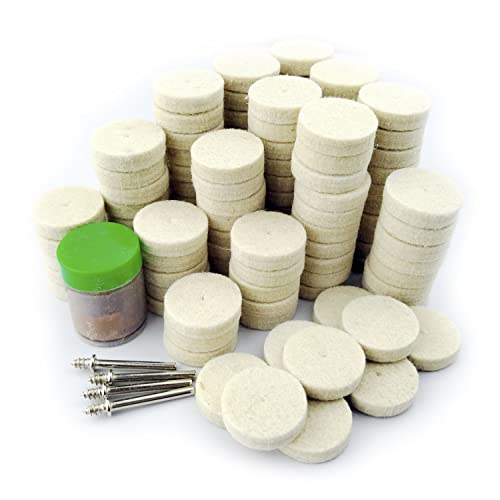
Most felt wheel kits leave you to source compound separately. This one doesn’t. The 125-piece pack contains 120 of the 1-inch felt buffing wheels, 4 mandrels in 1/8-inch, and a polishing paste — everything needed to load a wheel and go. That bundle is why it earns a place: the paste is the ingredient that actually turns felt into a polish, and having it in the box removes a second order.
The wheels are rated moderate hardness, described as neither too soft nor too hard. That balance takes a semi-rough surface and brings it to a smooth finish, which fits the general polishing of ferrous metals, stone, glass, ceramics and small jewelry parts. Mounting is quick and the wheel seats tightly on the mandrel without peeling loose. Grit is 120 at medium grade, aimed at finishing rather than stock removal.
The practical note is the 1-inch diameter. It is a flat-surface wheel, so it covers panels and larger faces well but does not tuck into a narrow groove the way the small 4mm heads do. The bulkier overall pack reflects that — it is a large box. Buyers report the wheels and paste match the listing, which matters when you buy sight unseen.
Why the paste matters: a 1-inch felt wheel with compound does the actual cutting of the polish; buying a kit that includes paste saves a separate purchase and a wait.
Size reality check: at 1 inch across, these are flat-work wheels — great on panels, awkward in deep grooves.
Pick this if: you are polishing flat faces, jewelry backs and general small parts and want compound in the same box.
Keep looking if: your work lives inside slots and carved detail where only sub-6mm heads reach.
4. Keadic 100Pcs Rotary Grinding Stone Bits Set

Five material families in one box — wool, sesame, rubber, jade and cowhide
This is the kit for someone who grinds as much as they polish. The 100 pieces break down into 50 cylinder-shaped heads and 50 bullet-shaped heads, and the material mix runs wool felt, sesame, rubber, jade and cowhide. Each material has a job: the pink sanding head handles chamfering, the sesame bits rough-grind aluminum and copper, the cowhide heads suit agate and jade, and the rubber heads quick-polish hardware. Head diameters span 4mm to 10mm and the shank is 3mm.
Grit is the coarsest on this list at 60, which means it actually removes material rather than just brightening. For stainless steel and other metals that translates to less dust and a faster cut. The length range of 40mm to 47mm gives you enough reach to work comfortably above the workpiece. It fits electric drills, hanging mills and grinders as well as rotary tools.
Durability is the split opinion. Some of these heads hold their edge through long sessions; others wear faster than premium abrasive. That is a fair trade for the variety on offer, and it is why this sits as a grinding kit rather than a pure finishing kit. If you want one box that deburrs, shapes and polishes, the range delivers. If you want heads that outlast everything else, this is not that box.
Why the variety earns its place
- 60 grit is the coarsest here — real stock removal on steel and aluminum
- Five head materials each tailored to a different task
- 50 cylinder plus 50 bullet shapes in 4mm to 10mm diameters
- Works in drills and grinders, not just rotary tools
The honest trade-off
- Head life is inconsistent — some last, some wear early
- At 3mm shank diameter, check your collet before buying
Worth it for: bench workers who need cutting, shaping and polishing heads from a single box.
Think twice if: you want maximum head longevity and only ever do fine finishing.
5. ODOMY 100Pcs Felt Polishing Wheels Wool Polishing Buffing Pads

Firm 180-grit wool that holds its shape on metal and plastic
The grit number is the tell here. At 180 fine, this set runs finer than the 120-rated wheels and coarser than the 2000-grit finishers, sitting right where general polishing pays off. It is a 100-piece kit split between 50 cylindrical and 50 bullet-shaped heads, with heads measuring 10mm across — larger than the tiny detail bits, suited to broad surfaces and hard materials. The wool is described as high hardness with strong toughness, built to stay together under pressure.
Polishing performance is what carries it, and it holds up on hard surfaces and plastic alike. For molds, glass, jewelry, gemstones, watches and metal with a bit of resistance to it, the firm wool gives you the pressure you need without crumbling. It also handles the tougher non-metal jobs — this listing names car and motorcycle work among its applications, which fits a wheel that will not fold over on a contoured panel.
The one sticking point is stiffness. These wheels run firm, and some users want something more forgiving on soft or delicate finishes. If you are polishing something easily marked, work at low speed and light pressure, or step to a softer felt. For everything with a bit of backbone to it, the firmness is an asset rather than a nuisance.
The firmness question: high-hardness wool presses into hard surfaces without collapsing, which is why it shines on metal and plastic — but on delicate finishes the same firmness needs a light touch.
Size in perspective: 10mm heads are a broad, stable polishing face; they cover area faster than the micro bits but reach less far into tight grooves.
Go for this if: your polishing targets are metal, plastic, gems or contoured parts that need pressure.
Steer away if: your material scratches easily and needs a very soft buffing wheel.
6. YURINWOO 114 PCS Polishing Kit with 2Pcs Polishing Compound
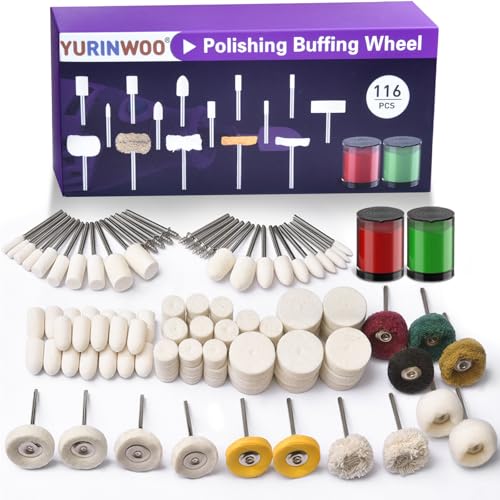
Fifteen 1-inch wheels, thirty-five half-inch wheels, and a compound to load them
Shape count is where this kit separates itself. You get 15 of the 1-inch polishing wheels, 35 at 1/2 inch, 20 at 0.37 inch, plus 10 mandrels in 1/8-inch, 20 polishing heads, and a spread of felt, cashmere, cotton-thread and cloth wheels. That is a size ladder from broad faces down to fingertip detail, all under one 400-grit rating. The 400-grit compound is the finishing grade — it smooths and brightens rather than cutting.
The flexible wool is the reason to like it for awkward shapes. Rather than fighting a contoured surface, the wheel molds to it and keeps working the compound into the crevice, which suits hinges, edges, corners and the kind of detailed metalwork that a rigid wheel rides right over. Watches, jewelry, glass, resin and gold are all within its range. The compound itself can be refreshed with jeweler’s rouge or a homemade mix.
Fine-grit means fine work. This is not the box to grab when a pipe needs re-polishing down through rust. The 400-grit compound is forgiving and leaves a good shine, but the heavier cutting belongs to a coarser abrasive. For a clean-up and brighten job on detailed pieces, the shape and material variety does the heavy lifting.
What the size ladder buys you: fifteen 1-inch wheels cover flat faces, while thirty-five 1/2-inch and twenty 0.37-inch pieces get into hinges, corners and jewelry detail without changing tools.
The finishing-grade limit: 400 grit smooths and shines; it will not strip heavy rust or reshape metal.
Suits you if: you restore detailed metalwork — watches, jewelry, hinges — and want a full spread of wheel sizes.
Not the pick if: you need coarse cutting power on rusted or pitted metal.
7. Pihemum 90-Piece Abrasive Buffing & Polishing Wheel Set
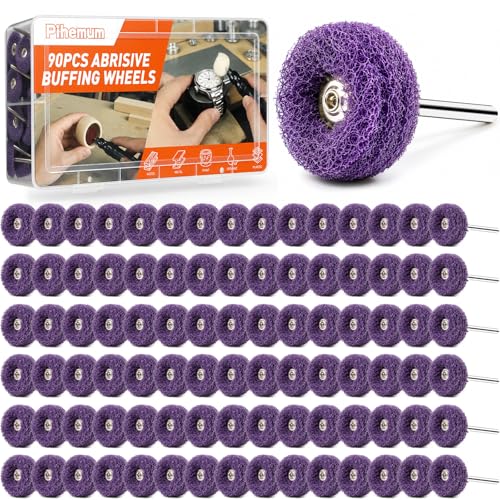
Colour-coded wheels that walk you from 80 grit down to a mirror shine
This set solves the hardest part of polishing — knowing which grade comes next. The 90 pieces are colour-coded across six grit steps: brown at 80–120, green at 120–180, red at 240–320, black at 320–400, purple at 600–800, plus 15 white wool felt buffing wheels for the final shine. Five grit bands from 80 to 800 in one box means you never have to guess the next step; the colour tells you.
The abrasive wheels are a composite of aluminum oxide and bonded nylon fibre, built to resist tearing and clogging. That non-scratch aluminum oxide and nylon construction suits metal, plastic and lacquer, where you want to polish without gouging. The wheels measure 25mm across with a 3mm shank, so they fit rotary tools, grinders, polishers and hand drills. The flexible design conforms to curved and irregular profiles rather than chattering across them.
Each colour has a dedicated job. Brown and green deburr, strip rust and take out dents. Red and black handle fine surface cleaning and oxide removal. Purple does precision smoothing before the white felt brings up the gloss. Work through them in order and you get a repeatable finish. The one thing to know is that the softer grades reward a lighter touch — lean on them and they wear faster.
The progression logic: colour-coded bands from 80 to 800 grit remove the guesswork — start brown for a dent, finish white for the shine, and the sequence stays consistent job after job.
Handling note: the finer purple and white wheels are the softest and reward light pressure at lower speed.
Made for you if: you want a step-by-step grit system for restoring metal, lacquer or plastic without buying tiers separately.
Pass on this if: you only need one finish grade and want a big box of a single wheel type.
8. TEMO 100p 1″ Dia Felt Polishing Wheel Wool Buffing Pad

A 2000-grit finisher that turns compound into a glass-clear shine
Very fine is the whole point of this one. The grit rating is 2000 — by far the finest on this list, above the 180-rated wool wheels and worlds apart from the 60-grit cutters. At 1 inch diameter and a quarter inch thick, the 100 wheels are built for the last pass: load them with compound, run them lightly, and they leave a bright, clean surface. Guitar frets are the standout use, and that tells you the wheel is firm enough to ride a narrow crown without rolling off.
The wheels ship with two screw mandrels (401) and a 1/8-inch shank, so they mount securely and stay put while you work. Made of top-quality wool, they are described as firmer than most, which is exactly what a fine-grit finisher needs to keep pressure even over a small contact patch. Metal, ceramics and glass are all in their wheelhouse. The brand lists US-based customer support, a small reassurance if a mandrel goes missing.
The size is the sticking point. At 1 inch the wheel covers a decent area, but it is not a micro bit, and fit varies by tool — some buyers find it does not seat the way they expect on their Dremel. Check your collet and mandrel compatibility before ordering. On the right tool it is a repeatable finisher; on the wrong one it is an awkward fit.
Why frets love it
- 2000 very-fine grit is the finest here — a true final-stage polisher
- Firmer wool holds even pressure on a narrow fret crown
- Ships with two screw mandrels and a 1/8-inch shank
- Works with polishing compound on metal, ceramics and glass
What to check first
- Fit is inconsistent across tools — confirm collet and mandrel match
- Fine grit removes nothing; it only brightens and smooths
Buy it for: fret polishing and any job that needs a final mirror shine on metal or glass.
Skip if: you need a head that reaches deep into narrow slots — at 1 inch, this is a surface finisher.
9. Wonys 246PCS Polishing Buffing Wheel Polishing Kit
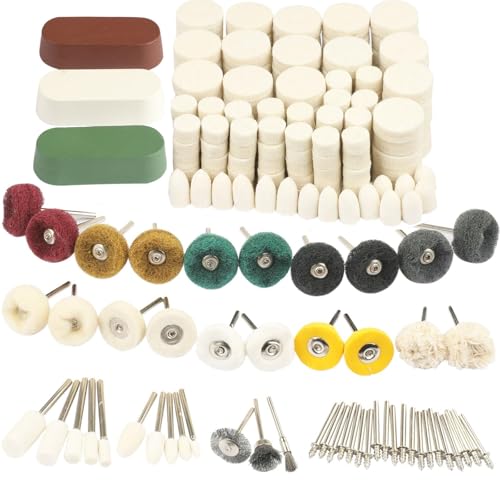
The biggest box on the list — 246 pieces and three compounds to load them with
Piece count is the headline: 246PCS, more than double the 100-piece kits. The wheels come in 1-inch and 1/2-inch diameters on 1/8-inch shanks, with an assortment of shapes and materials — compressed wool, cotton, cloth and metal — that fit rotary tools, grinders, polishers and hand drills. Throw in three polishing compounds and you have a full bench stocked from one order.
The compounds are the detail worth knowing. Brown is the rougher compound for stainless steel, aluminum and wood, cutting through surface marks. White handles intermediate polishing on soft metals and jewelry. Green brings up a high-gloss finish on metal. That three-stage progression means you can load the right compound for the stage of the job, which is what separates a real polishing kit from a pile of identical wheels.
The compressed wool holds up over time, and its toughness lets the 1-inch and 1/2-inch heads work tight spots and uneven surfaces. The one rule the maker sets: keep the tool at the lower gear. Run too fast and the softer heads come apart. Respect that, and the box lasts. Buy it if you want a full arsenal in one go; pass if you want a small, focused kit for one specific job.
Why the compounds matter: brown for cutting marks, white for soft-metal and jewelry polish, green for gloss — three grades let you match the compound to the stage instead of using one paste for everything.
The speed rule: run fast and these heads break apart; the maker’s guidance is the lower gear.
Great for: anyone stocking a rotary tool bench from scratch who wants options on hand.
Overkill if: you polish one type of small part and want a tight, simple kit.
Know the Specs
Grit Number
Grit is a count of abrasive particles — the lower the number, the coarser and faster the cut. A 60-grit bit grinds burrs and shapes metal. A 150 or 180-grit wool wheel smooths and brightens. A 2000-grit felt wheel is a pure finisher and removes almost nothing. The trick is to work in order: coarse to remove, fine to polish. Buying a kit that spans a range lets you step through the grades without ordering twice.
Shank Diameter
The shank is the metal post that seats in your rotary tool’s collet. The 1/8-inch shank is the common standard and most kits here use it. A 3mm shank is close but not identical, so check your collet before buying. A shank that is too small wobbles, and a wobbling wheel scratches instead of polishing. Firm seating is the difference between a clean line and a wandering one.
Wool Felt Density
Compressed wool felt is dense and holds compound without shedding it at speed. Moderate-hardness felt is the middle ground — firm enough to flatten a rough finish, soft enough to conform to curves. High-hardness wool presses into hard surfaces and suits metal and plastic; softer felt suits delicate finishes that might mark. Choose density to match the material you are polishing, not just the grit.
Head Diameter and Shape
Small heads, in the 4mm to 6mm range, reach into grooves, fret slots, ring settings and carved detail. Larger 10mm to 25mm heads cover flat panels and broad faces faster. Bullet shapes get into corners; cylinders work flat and recessed areas. A mixed set with several diameters is the practical buy because most real jobs need both reach and coverage.
Common Questions
Will these wool felt wheels fit my Dremel rotary tool?
What grit should I use to polish jewelry?
Why did my felt polishing wheel come apart at high speed?
Do I need polishing compound with felt wheels?
What is the difference between the 60 grit and 2000 grit wheels on this list?
Can these grinding bits handle stainless steel and hardened metal?
Are smaller head sizes better for tight spots and carved detail?
How long do wool felt polishing wheels last before they wear out?
Will these wheels polish plastic and lacquer without scratching?
Do I need separate bits for grinding and polishing?
The Bottom Line
For most people, the winning wool felt polishing wheels and grinding bits pick is the Luo ke 100 Pcs 1/8 Inch Shank Rotary Wool Felt Polishing Bit Kits — five head diameters from 4mm to 10mm on a standard 1/8-inch shank cover detail and flat work in one box, and the 150 fine grit is the right finish grade for jewelry, glass and jade. If grabbing the most pieces for the least outlay matters more to you, the 146PCS Abrasive Wheel Buffing Polishing Wheel Set hands you a 46% larger box than a 100-piece kit. For guitar frets and anything that needs a true mirror shine, the 2000-grit TEMO 100p 1″ Felt Polishing Wheel is the finisher to reach for.
How we choose
We do not accept paid placement. Every pick is matched to a real buyer and a real use-case; we do not hands-on test units.
Sources
Specifications: manufacturer listings and product documentation. Review insights: verified customer reviews, as of November 2026. Pricing: not shown on this page (it changes often); check the current price via the retailer link.
As an Amazon Associate, Tactical Gear Guy earns from qualifying purchases. This does not affect which products we feature.