Specs are compiled from manufacturer listings and verified buyer reviews and can change over time — please confirm the key details on the product page before buying.
You want one board that swallows a whole brisket, a 25lb turkey, or a full Sunday meal prep without anything rolling onto the counter. The nine big boards here all clear that bar on pure surface area. What separates them is what happens after month six — whether the wood stays flat, whether the grain holds up under a heavy cleaver, and whether the thing stays put while you cut. So pick on grain construction and thickness first, then size and juice groove, and you will land on a board you keep for a decade instead of two years.
This guide is built by comparing the manufacturers’ published specifications and the patterns across verified customer reviews, so you get each pick’s real strengths and trade-offs instead of marketing spin.
Start with the end-grain options if your knife edges matter, and check the thickness and weight numbers before anything else. This rundown covers what actually separates a big wooden cutting board worth owning from one that cups and cracks within a season.
Top Picks


How To Choose The Best Big Wooden Cutting Board
Big boards fail for boring, predictable reasons. They cup in the middle, split along a glue seam, or slide around while you are trying to break down a chicken. None of that is about how pretty the grain looks in the listing photos. It depends on four things you can read off a spec sheet before you buy.
End grain versus edge grain changes everything about your knives
An end grain board is built with the wood fibers standing up vertically, so the blade slips between fibers instead of slicing across them. That is what sellers mean by “self-healing” — the fibers close back up rather than holding a visible cut. An edge grain board has the fibers running flat, which is quicker and cheaper to build but shows knife marks sooner and dulls an edge faster. If you cook daily and care about your knives, end grain is the version to hunt for.
Thickness and weight decide whether it stays flat and stays put
A thicker board resists warping and stays where you set it. The trade-off is lifting it to the sink. A board in the 1.25-inch range is manageable for most people; a board at 1.75 inches deep is a two-hand job. Neither is wrong — just match it to how often you move the board versus how much counter space it needs to cover.
Species and moisture resistance
Walnut, teak, acacia, and suar are the four woods you will see across big butcher blocks. Teak and acacia are both naturally moisture resistant, which matters on a board that lives beside a sink. Walnut is dense and resists deep scoring. Whatever the species, the care routine — hand wash, dry upright, oil it periodically — matters more than the label on the wood.
Side-by-Side Comparison
| Model | Best For | Dimensions (L x W x Thick) | Material | Weight | Amazon |
|---|---|---|---|---|---|
| Babilonia Large Walnut End Grain★ Best Overall | Everyday chef board | 20″ x 16″ x 1.4″ | Walnut | 5.58 kg | Amazon |
| Saffron & Sage Extra Large AcaciaBest for Entertaining | Entertaining and serving | 23″ x 17″ x 1.5″ | Acacia | 12.7 pounds | Amazon |
| Winco WCB-1824Heaviest Duty | Heavy carving and restaurant duty | 24″ x 18″ x 1.75″ | Natural hardwood | 17.8 pounds | Amazon |
| Beefurni Large Teak with Juice Groove | Edge-grain teak on a budget | 22″ x 16″ x 1.25″ | Teak | 9 pounds | Amazon |
| HexClad Walnut Rectangle | Sleek countertop showpiece | 19.5″ x 13.75″ x 1.25″ | Walnut | 8 pounds | Amazon |
| SHUMARU XL End Grain | Dough, pizza, and meal prep | 20″ x 13″ x 1.6″ | Suar | 11 pounds | Amazon |
| Cookaholic Acacia End Grain | Pizza slicing and gifts | 20″ x 15″ x 1.5″ | Acacia | 9.1 pounds | Amazon |
| Babilonia American Walnut | Two-person kitchens | 19.7″ x 12.2″ x 1.7″ | Black walnut | 8.8 pounds | Amazon |
| Beefurni Extra Large Teak End Grain | Big-batch meat carving | 24″ x 17″ x 1.5″ | Teak | 7.69 kg | Amazon |
Detailed Reviews
1. Babilonia Large Walnut Wood Cutting Board, End Grain
Our pick — 4.5+★ from 350+ verified ratings; the strongest balance of quality and price.
End grain walnut at 1.4 inches thick, priced like a mid-range board and finished like a display piece.
If you cook most nights and want one board that does the chopping, the carving, and the cheese plate afterward, this is the shape to buy. It measures 20″ x 16″ at 1.4″ thick — room for a full chicken breakdown without pushing trimmings onto the counter. End grain construction means the fibers stand vertically, so your knife slips between them instead of slicing across. That is why owners keep praising how the end grain surface holds up after months of daily chopping.
The weight comes in at 5.58 kg, which translates to a board that does not skate while you work but still lifts out of the way when you need the counter back. It arrives already seasoned and pre-oiled with a free organic oil bottle included, so you can cut on it the day it lands. Walnut’s density resists deep scoring, and the built-in groove catches juice from a roast. The darker walnut grain and the included oil are what set it apart.
What wins people over is the build quality — far and away the thing the review pages lead with — followed by the sense that it is worth the price. One honest note: a handful of owners mention that any wood board shows scratches over time, walnut included. That is the nature of a cutting surface, and light sanding plus oil brings it back. It is hand wash only, never the dishwasher.
What earns it the top slot
- End grain fibers close back up instead of holding deep cuts, which is gentle on knife edges
- 20″ x 16″ x 1.4″ gives real carving room without needing a whole counter
- Arrives pre-oiled with a free organic oil bottle — usable the same day
- Reversible with built-in groove on one side and smooth face on the other
The trade-offs to know
- 5.58 kg is a two-hand lift to the sink
- Hand wash only — the dishwasher will wreck it
- Like any wood, it develops surface scratches that need occasional sanding
The right call for: cooks who want one board doing prep and serving duty, and who will oil it once a month.
Think again if: you need a board you can toss in the sink and forget — this one wants a drying rack.
2. Saffron & Sage Extra Large Acacia Wood Cutting Board
Twenty-three inches of acacia that goes from carving board to cheese platter without leaving the table.
This is the board for the person who hosts. At 23″ x 17″ x 1.5″ it is one of the largest surfaces in this group, which means a whole brisket or a big charcuterie spread fits without crowding. It weighs 12.7 pounds, so it stays planted once you set it down, and the inset handles let you carry it from kitchen to table without wrestling it. Against the Winco’s 17.8 pounds, this board weighs 12.7 pounds, a difference that matters when you are moving platters in front of guests.
Acacia is naturally resistant to moisture, and the board comes pre-seasoned with a food-grade mineral oil and beeswax blend, giving it a water-resistant finish out of the gate. The deep juice groove catches runoff from a cooked roast. Flip it over and the flat side works for bread, cheese, or appetizers. The four-step sanding process shows in the finish — the surface reads smooth and the grain patterns vary board to board.
Where it gets more nuanced: the craftsmanship and long-term durability come with mixed reports. Some owners say the board is well built and will last years; a smaller group have had boards starting to split. Treat that as a signal about care — acacia needs mineral oil periodically, and it should never sit submerged. Hand wash and pat dry, and this board holds its finish.
The hosting argument: at 23″ x 17″ it is one of the largest serving surfaces here, and the reversible design means one board handles both carving and presentation.
The care factor: acacia is moisture resistant but not indestructible — periodic oiling is what keeps the seal intact and keeps the splits away.
Reach for this if: you cook for a crowd and want the board to double as the serving piece.
Look elsewhere if: you chop daily with heavy knife work and want end grain construction for edge preservation.
3. Winco WCB-1824 Wooden Cutting Board, 18″ x 24″ x 1.75″
Restaurant-grade hardwood that weighs 17.8 pounds and does not care how big the turkey is.
This is the board the commercial kitchens buy. At 24″L x 18″W x 1.75″Th it is the deepest and thickest board in this lineup, and the size story is real: buyers report fitting a 25lb turkey or a full bone-in ham on it. The solid hardwood construction is built to not bend, warp, or crack under daily restaurant use. Two recessed handles along the edges let you lift it with both hands.
At 17.8 pounds, this is the heaviest board here — the Saffron & Sage weighs 12.7 pounds. That weight is the point. It sits dead still during heavy chopping, and the 1.75-inch thickness gives the solid feel that prevents the flex that leads to warping. The natural finish reads upscale enough for the kitchen island, not just a back prep station.
What buyers value most here is the sturdiness for the price, then the sheer size and weight. The single caveat is that weight: for anyone with grip or shoulder issues, hauling 17.8 pounds to the sink is a two-hand job. It is hand wash only and comes with a one-year manufacturer’s warranty against defects in workmanship.
Carving capacity: 24 inches long and 18 wide with a 1.75-inch depth — the biggest physical footprint on the list.
The heft trade-off: all that wood means 17.8 pounds, so plan a dedicated counter spot for it rather than moving it every night.
Best for: holiday carvers, hunters breaking down game, and anyone who wants a board that stays exactly where they put it.
skip it if: you have a small kitchen and move the board between counter and cabinet every meal.
4. Beefurni Large Teak Wood Cutting Board with Juice Groove

Edge grain teak, nine pounds, and a maintenance kit thrown in — the sensible everyday board.
If the -plus end grain boards feel like a stretch, this teak board covers the same jobs at the entry point of this group. At 22″L x 16″W x 1.25″Th it is roughly the same footprint as the Babilonia end grain above — a fraction thinner but just as usable for everyday cooking. It weighs 9 pounds, light enough for one person to move, heavy enough to stay stable while chopping.
Teak is naturally moisture resistant, which suits a board that lives beside a sink, and the edge grain construction is gentler on blades than bamboo or plastic. You get two sides: one with a deep juice groove for roasting juices and fruit, the other flat for routine cutting. The built-in side handles turn it into a serving piece when guests show up. It arrives with a care instruction sheet and a free maintenance kit.
What people notice first is how it looks — buyers describe the teak grain patterns as warm and eye-catching, and the size gets noticed often as well. The edge grain does show knife marks sooner than end grain, which is the honest trade-off of this price tier. It comes with a one-year replacement for manufacturing defects.
Standout specs
- 22″ x 16″ x 1.25″ teak surface that handles full meal prep
- Reversible: deep juice groove on one side, flat cutting on the other
- Ships with a free maintenance kit and care instructions
- 9 pounds — manageable weight for a board this size
Worth knowing
- Edge grain shows knife marks faster than end grain construction
- Thinner 1.25″ profile is less resistant to warping than a 1.75″ board
- Hand wash only
Pick it when: you want teak’s moisture resistance and a good-sized board without the sticker of an end grain build.
Step up if: you are particular about your knife edges and want the fiber-closing property of end grain.
5. HexClad Rectangle Large Walnut Solid Wood Cutting Board
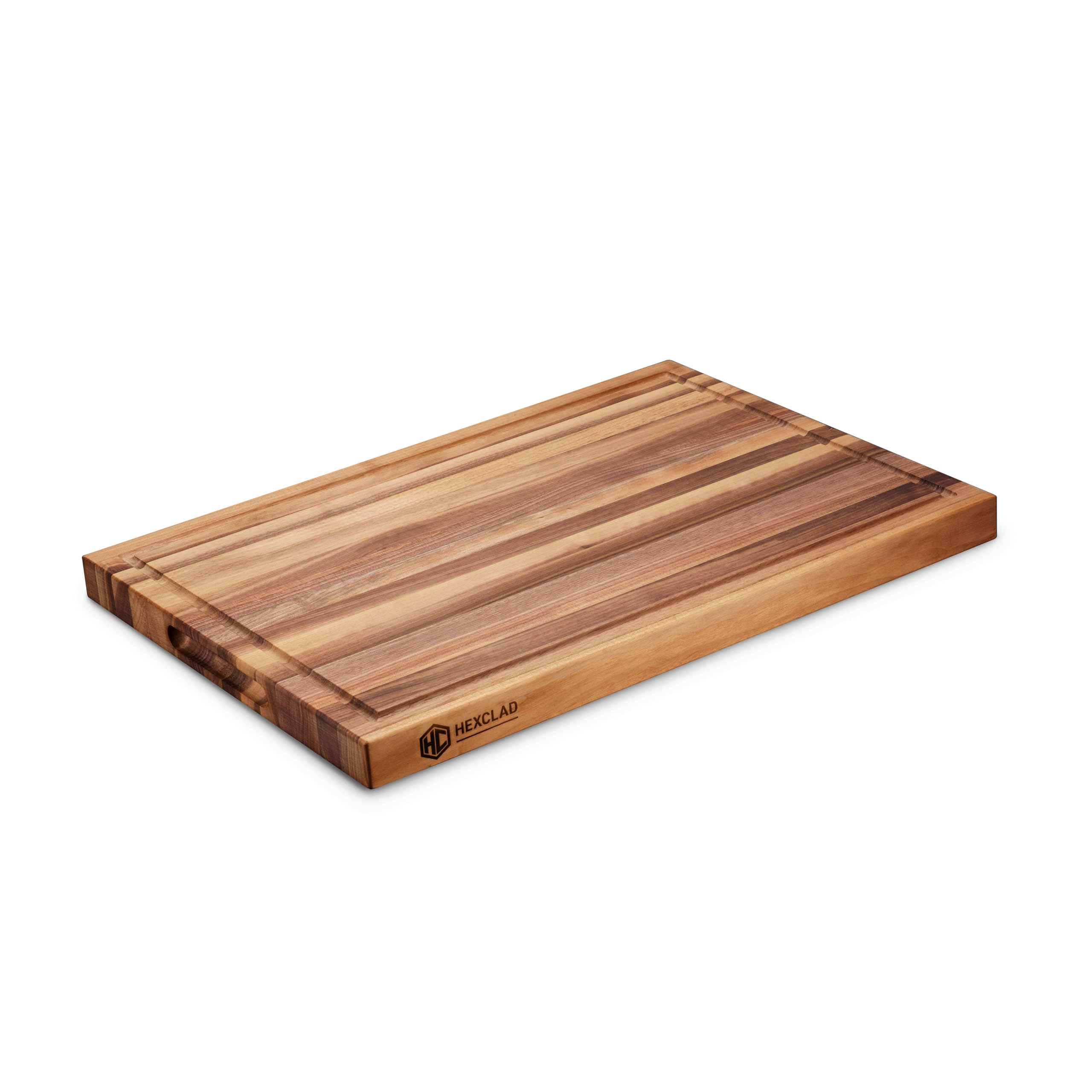
Walnut so dark and tight-grained it earns countertop display status while still taking a daily chop.
Walnut’s density is the headline: it resists deep knife marks, helps prevent staining, and the tight grain is what keeps odors from garlic and onions from lingering. The board is 19.5″L x 13.75″W x 1.25″Th and weighs 8 pounds — the smallest surface in this group, but also the lightest board to lift. That makes it a good fit for a kitchen where counter space is at a premium and the board lives on display.
You get two work surfaces in one board: flip it to the grooved side to catch roast and fruit juices, or use the smooth side for slicing and plating charcuterie (a spread of cured meats and cheese). Recessed handles (cut-in grips on the edges) make flipping and carrying easy. Compared to the Babilonia end grain walnut, you give up a few inches of length and a bit of thickness — 13.75″ wide versus 16″ — but you also drop from 5.58 kg to 8 pounds, so you are far more likely to actually lift it out of the cabinet.
Buyers come away mostly talking about quality and appearance, with this walnut board’s contrasting grain reading modern against a countertop. The recurring note is durability: the board resists scratching well at first, then scratches start showing with steady use. That is walnut being walnut, and regular oiling helps it self-heal. It is hand wash only.
The showpiece argument: 19.5″ x 13.75″ at 8 pounds is the easiest board in this group to handle, and walnut’s grain does the decor work by itself.
The size limit: it is the smallest surface here — great for two people, tight if you are roasting for a crowd.
Suits you if: you want a beautiful walnut board that lives on the counter and handles two-person meals.
Not the one if: your definition of big is carving a whole brisket — you want the 24-inch boards instead.
6. SHUMARU XL End Grain Cutting Board, 20″ x 13″ x 1.6″
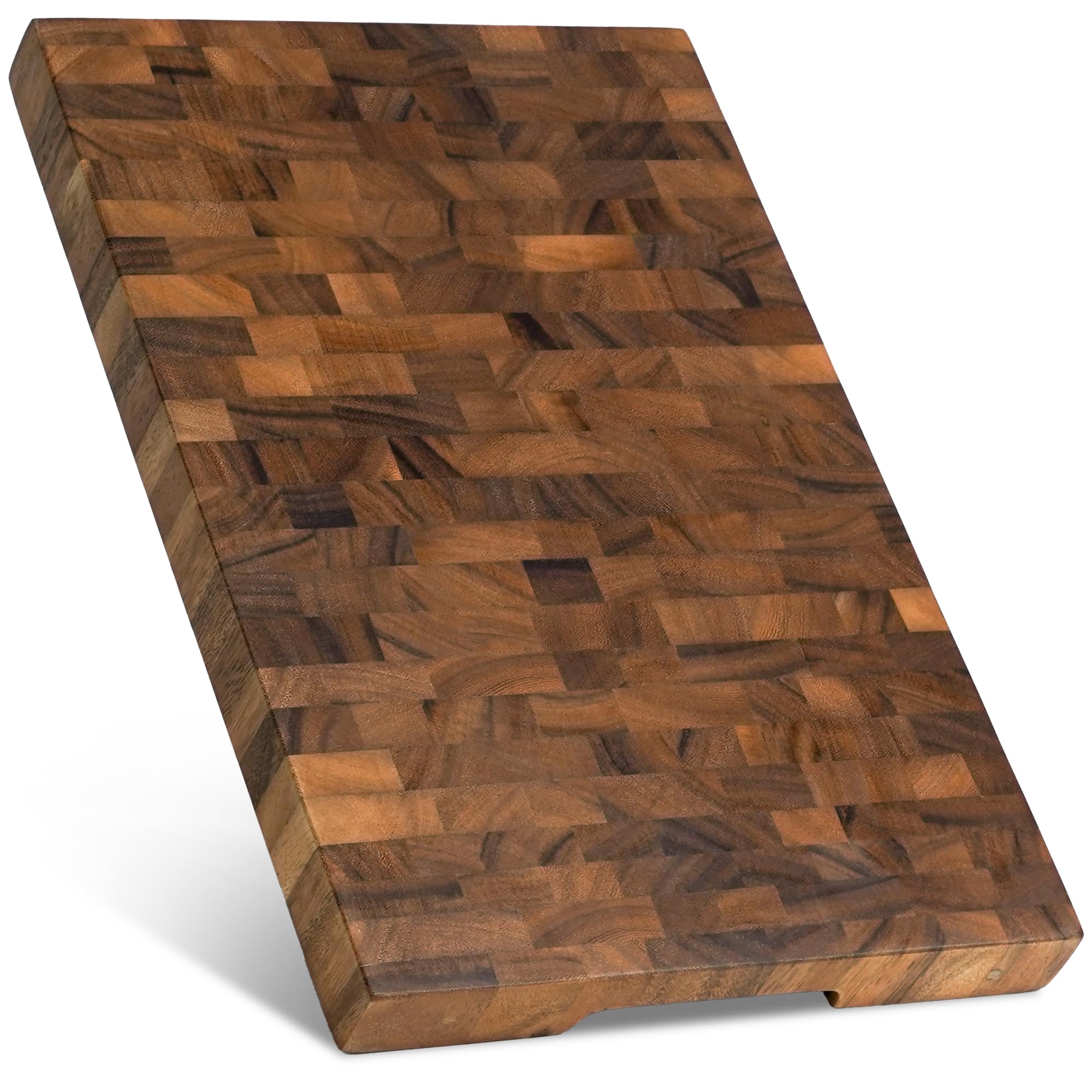
A flat, groove-free suar slab built for kneading dough and rolling pizza without a lip in the way.
Most boards in this group carry a juice groove, and for dough work that groove is a nuisance — dough catches in it and your rolling pin hits the edge. This board skips it entirely. At 20″ x 13″ you get 260 square inches of uninterrupted, flat surface for kneading, rolling pastry, or building pizza. The 1.6″ thick end grain construction gives self-healing fibers that close back up after chopping, preserving knife edges and reducing visible cut marks.
The heft is the feature: 11 pounds of dense suar heartwood stays dead flat while you push down on a rolling pin or split a squash. The built-in handles help you move it, and the non-slip feet keep it from walking across the counter. No two boards look the same thanks to the suar grain’s natural variation.
Buyers consistently call the quality excellent and like that the weight steadies the cutting surface. The honest note is warping: while many report the board stays flat, a smaller group report buckling. Suar is dense, and it needs to be kept dry and oiled regularly — the manufacturer recommends food-grade mineral oil every 3-4 weeks. Follow that and the board stays true.
The dough argument: 260 square inches of flat, groove-free surface — the only big board here purposefully built for rolling and kneading.
The honesty note: suar responds to regular conditioning, and a few owners have seen buckling — keep up the oiling routine.
Best fitted for: bakers who prep dough weekly and want a board that does not have a lip interrupting the work.
Not for you if: you want a juice groove for carving — you will need a different board for that job.
7. Cookaholic Acacia Wood Cutting Board, 20″ x 15″ x 1.5″

The color-contrast acacia board — checked grain, deep groove, and a coconut oil finish already on it.
At 20″L x 15″W x 1.5″Th and 9.1 pounds, this board sits in the useful middle of the size range. It is a solid acacia end grain build, so the fibers flex back after chopping and preserve your blade edge. The deep juice groove catches liquid from roasted meat and juicy fruit before it hits the counter, and the built-in handles let you carry it to the table as a serving board.
The finish is the detail that differs from other boards in this group: it is cured with coconut oil, so the surface is conditioned for use after a quick wash, and it carries a subtle coconut scent from the start. The checkered grain pattern gives the board a strong visual personality — you either like the look or you do not, and it does look like something people put out on purpose.
Appearance and overall quality are the two things buyers point to most, with size called out for handling something as big as a whole pizza. One recurring, minor note: knife marks show on the surface. Acacia is a pliable wood, so the marks are shallow and oiling brings the finish back. It is hand wash only.
What makes it worth a look
- 20″ x 15″ x 1.5″ gives a good multi-purpose footprint
- End grain fibers reduce visible knife marks compared to edge grain
- Cured with coconut oil and ready after a quick wash
- Deep groove and built-in handles support carving and serving
What to weigh
- Acacia shows surface knife marks over time, like any wood board
- The checkered grain is a strong look, not a neutral one
- Hand wash and oil periodically to keep the finish
Calls out to you if: you want a big end grain board with standout looks for under the mid-range ceiling of this group.
Think twice if: you want walnut’s darker, quieter grain instead of acacia’s high-contrast checkering.
8. Babilonia American Walnut Wood Cutting Board, End Grain
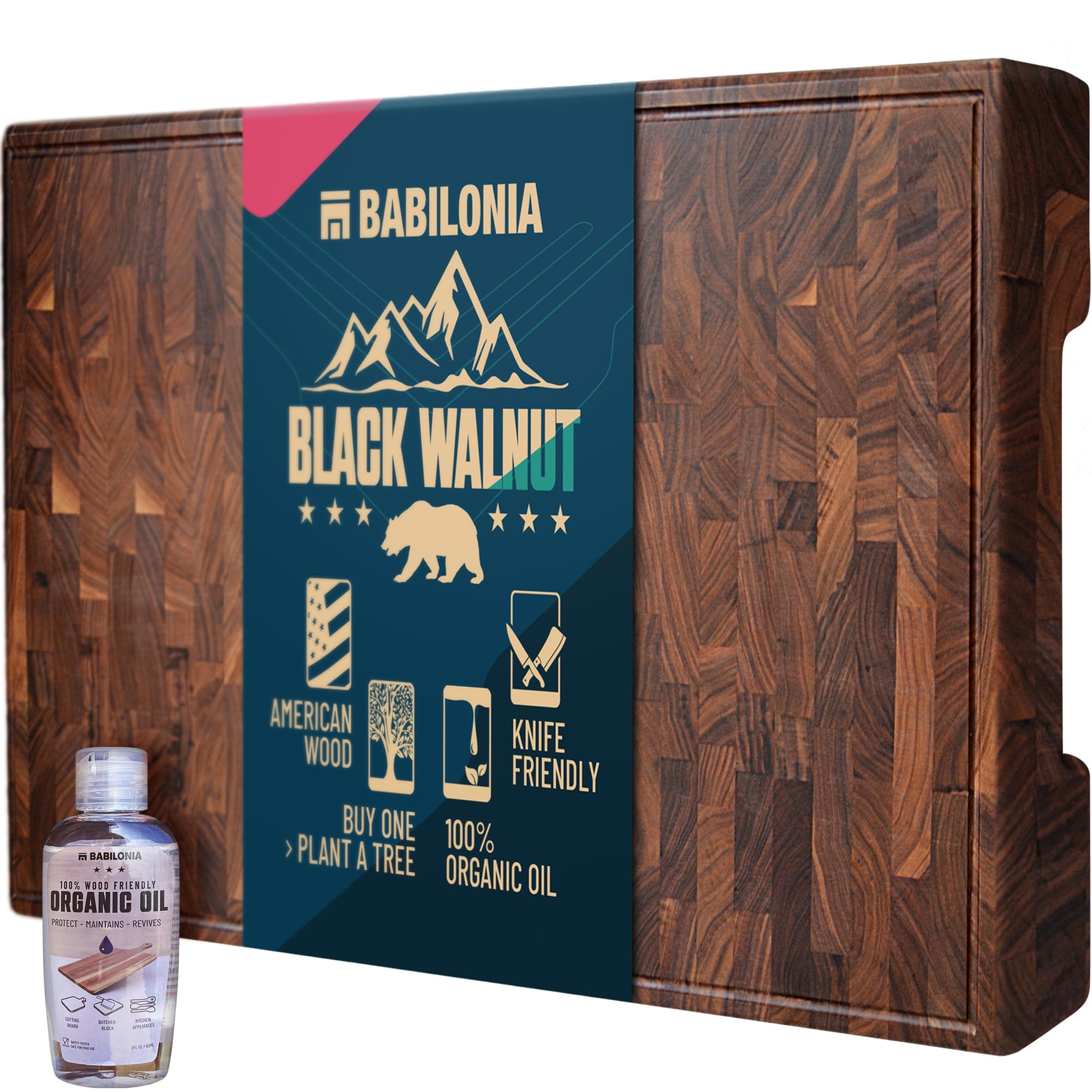
A 3-in-1 walnut board with a slide-out notch so you never lift a full board over the pot again.
The feature that sets this board apart is not the wood — though the 100% sustainable black walnut grown in America is dense and takes a knife edge well — it is the notch-and-plate design. You chop, then slide chopped produce directly into your pot or bowl through the notch rather than lifting the whole board. At 19.7″L x 12.2″W x 1.7″Th, it is narrower than most of the big boards here, which suits a two-person kitchen where counter space is tight and the board lives on the counter.
That 1.7″ thickness gives it real stability for chopping, and 8.8 pounds makes it the easiest board in the Babilonia lineup to move. It comes pre-oiled with a free organic oil bottle, plus a 2-year warranty and a money-back guarantee. The end grain technique is the same as its larger sibling above, so knife friendliness carries through.
People get drawn in by the finish first — the black walnut reads as a display piece — then stay for the smooth surface that goes easy on blades. The one limit is the 12.2-inch width: perfect for a two-person kitchen, tight for carving a holiday bird. Hand wash only.
The clever-not-gimmick detail: the notch and plate genuinely save lifting, which matters more than you would guess on a board this thick.
The width limit: at 12.2″ wide it is a prep board first — big roasts want more surface than this offers.
Worth grabbing if: you cook for two and want a walnut end grain board with a smart way to move chopped food.
Pass if: your meals involve oversized cuts that need the 24-inch boards above.
9. Beefurni Extra Large Teak Wood End Grain Cutting Board

Twenty-four inches of Southeast Asian teak end grain, with a free oil-and-sanding maintenance kit at the top of the range.
If the priority is maximum cutting surface, this is the board to look at: 24″L x 17″W x 1.5″Th, teak end grain construction, and side handles that make an extra-large board moveable. The end grain fibers keep the surface gentle on knives and reduce visible marks. It is the only board here that ships with a maintenance kit — 1 oz of food-grade oil and 320-grit sanding paper — so you can retouch the surface as needed instead of guessing what to buy.
Teak is naturally moisture resistant and helps the board resist warping and cracking when properly cared for. The care interval is longer than most here — every 6-12 months with food-grade mineral oil or beeswax — which is a relief when you own a big board you want to keep in service. It is reversible, with a deep juice groove on one side and a flat surface on the other.
The buyer signal is mostly positive on quality, appearance, and construction, with teak’s warm grain giving the board a timeless look. The recurring honest note is durability: while many owners mention the board holding up well over time, a smaller group report arriving with surface cracks. That is on delivery and worth checking on arrival — the 1-year replacement covers manufacturing defects. Weight is substantial, so plan a fixed home for it rather than moving it nightly.
Why it earns a spot
- 24″ x 17″ x 1.5″ — the largest end grain teak board here
- Free maintenance kit included: 1 oz food-grade oil and 320-grit sanding paper
- Reversible with deep juice groove and side handles
- Teak is naturally resistant to moisture and warping
The real limits
- Heaviest teak board here — a fixed counter home makes sense
- A small group report surface cracks on arrival, so inspect on delivery
- Hand wash only, with oiling every 6-12 months
Right for: people who carve big cuts and want a full end grain teak board with the maintenance kit included.
Look at the others first if: counter space or lifting weight is a daily concern — the smaller teak and walnut boards above win there.
Know the Specs
End Grain vs. Edge Grain
End grain means the wood fibers stand vertically, so a knife slips between them instead of cutting across. That is what makes a board “self-healing” — the fibers close after a cut. Edge grain boards have fibers running flat and are faster and cheaper to make, but they show knife marks sooner. If you cook daily and care about your knife edges, look for end grain in the listing title.
Thickness and Weight
Thickness drives stability. A 1.25-inch board is manageable; a 1.75-inch board is heavier and resists warping better but needs two hands to lift. Weight works the same way: a lighter board moves easily, a heavier board stays put while you chop. Neither is better — just match the weight to how often you move the board versus how much surface you need.
Wood Species
Walnut is dense and resists deep scoring and staining. Acacia and teak are both naturally moisture resistant, which suits a board kept near a sink. Suar is dense with a distinct grain pattern. Whatever the species, hand wash, dry upright, and oil periodically to keep the finish and keep the board flat.
Juice Groove and Handles
A juice groove catches liquid from roasted meat and fruit so it does not run onto the counter. Handles come in recessed, inset, and side forms; all of them make a big board easier to carry and serve. If you primarily knead dough or roll pastry, a flat groove-free surface is actually better because dough does not catch in the channel and your pin does not snag.
Common Questions
Why does an end grain board cost more than an edge grain board?
Will a big wooden cutting board fit in a standard kitchen sink?
How often do I need to oil a wooden cutting board?
Will walnut or teak dull my knives faster?
Is acacia wood safe for raw meat prep?
How do I keep a big board from warping?
Can I use one board for both raw meat and vegetables?
What is the difference between a butcher block and a cutting board?
How do I remove deep scratches from a wood cutting board?
Is a heavy wooden board worth it if I cook mostly for two?
The Bottom Line
The big wooden cutting board to build your kitchen around is the Babilonia Large Walnut End Grain. It measures 20″ x 16″ at 1.4″ thick, and its end grain fibers (wood cut so the grain faces up) go easy on your knives. It arrives oiled with a free bottle of organic oil, so it is ready to use. It also carries one of the highest review scores in this group, which is why it sits at the top. If you need more carving length for a holiday bird or game, the Winco WCB-1824 gives you 24″ x 18″ at 17.8 pounds of solid hardwood, built for heavy use. For dough work and pizza, reach for the SHUMARU XL End Grain — 260 square inches of flat surface with no groove getting in your way. Whichever you pick, oil it, dry it upright, and hand wash — that routine is what keeps a good board good for years.
How we choose
We do not accept paid placement. Every pick is matched to a real buyer and a real use-case; we do not hands-on test units.
Sources
Specifications: manufacturer listings and product documentation. Review insights: verified customer reviews, as of November 2026. Pricing: not shown on this page (it changes often); check the current price via the retailer link.
As an Amazon Associate, Tactical Gear Guy earns from qualifying purchases. This does not affect which products we feature.