Specs are compiled from manufacturer listings and verified buyer reviews and can change over time — please confirm the key details on the product page before buying.
A workstation case has one job that gaming cases usually fail: holding lots of drives while still feeding cool air to a big motherboard. You do not need the flashiest tower here. You need one that fits an E-ATX board, keeps a stack of hard drives cool, and lets you reach the parts without removing half the case. The short answer up front: the Antec Performance 1 FT is the crowd favorite, holding 4.5+ stars across 600+ owners, and its 4 internal bays and 370mm GPU clearance make it the safest starting point for most builds.
This guide is built by comparing the manufacturers’ published specifications and the patterns across verified customer reviews, so you get each pick’s real strengths and trade-offs instead of marketing spin.
Some cases here are built for a dozen spinning drives, others for a huge radiator and a single GPU. The trick is matching the chassis to your actual workload — drive count, board size, radiator room — and this breakdown of every workstation PC case worth your bench space makes that match far easier. It covers drive cages, radiator clearance, and the specs that actually matter when your rig does real work instead of just running games.
Top Picks


How To Choose The Best Workstation PC Case
A workstation build lives or dies on a few measurements, not on how the glass looks lit up. You are fitting a large motherboard, possibly a stack of drives, and cooling that has to run for hours at a time. Get board size, bay count, radiator room and noise tolerance right and the rest falls into place.
Motherboard support comes first
An E-ATX board is wider than a standard ATX board, so it needs a case built to take it. Some chassis here go further and accept SSI-EEB, a server-grade board size that is wider still. Check the board size your build uses and confirm the case lists it — a board that does not fit cannot be forced. The Phanteks Enthoo Pro 2 Server Edition and the Fractal Design Define 7 XL both name SSI-EEB in their support lists.
Count the drive bays you actually need
A workstation that stores footage, backups, or virtual machines needs physical room for drives. Internal bay counts on this list run from 2 up to 21, so the spread is huge. If you plan a NAS or a media server, the bay count is the single number to study. A case with plenty of bays can hold a big array; a case with few bays caps how much storage fits inside.
Match radiator size to your cooling plan
Liquid cooling is measured by radiator size, and a bigger radiator needs a bigger mounting area. Some cases here take a single 420mm radiator, while others fit two 420mm units or three radiators at once. If you are staying on air, focus on fan positions and mesh instead. Either way, confirm the radiator size in the case’s own spec list before you commit.
Decide how much noise you will tolerate
A workstation often sits beside you for a full workday, so fan noise matters. High-airflow mesh fronts cool well but let more sound out. A case with a solid front door and sound-dampening intent runs quieter but moves less air. Neither is wrong — pick mesh for cooling headroom or a solid door for quiet, depending on where your rig sits.
Side-by-Side Comparison
| Model | Best For | Case Type | Internal Bays | Max Radiator | Amazon |
|---|---|---|---|---|---|
| Antec Performance 1 FT★ Best Overall | Most workstation builds | Full Tower | 4 | — | Amazon |
| Antec Flux ProMost Versatile | Six fans included, big cooling | Full Tower | 10 | 420mm + 360mm | Amazon |
| Rosewill Thor NASBudget Storage | DIY NAS and server builds | Full Tower | 11 | — | Amazon |
| Phanteks Enthoo Pro 2 Server Edition | Server boards and huge drive arrays | Full Tower | 21 | 480mm + 360mm | Amazon |
| Corsair FRAME 4500X RS | Showcase builds with curved glass | Mid Tower | 3 | — | Amazon |
| be quiet! Light Base 900 FX | Inverted or horizontal layouts | Tower | 2 | 2x 420mm + 360mm | Amazon |
| Fractal Design Define 7 XL | Quiet builds with massive storage | Full Tower | — | 480mm | Amazon |
| JONSBO N5 | Home server with hot-swap drives | Full Tower | 16 | 240mm / 280mm | Amazon |
| LIAN LI O11D EVO XL | Triple 420mm water loops | Full Tower | 7 | 3x 420mm | Amazon |
| ASUS ProArt PA602 | Airflow-first pro builds | Full Tower | 9 | 420mm | Amazon |
| Cooler Master HAF 700 | Maximum airflow and fan count | Tower | 8 | 480mm + dual 360mm | Amazon |
Detailed Reviews
1. Antec Performance 1 FT Full Tower E-ATX PC Case, 3 PWM Fans
Our pick — 4.5+★ from 600+ verified ratings; the strongest balance of quality and price.
The full tower that reads your temps back to you while you work.
This is the pick that makes the most sense for a general workstation build, because it pairs a full-tower frame with a built-in temperature display so you can glance at system status without opening software. It takes E-ATX, ATX, Micro-ATX and ITX boards, plus graphics cards up to 370mm long, which covers the roomiest professional cards. The chassis measures 20.55 inches deep and wide, so plan bench clearance before it arrives.
What wins people over is the sheer build quality, and the case also ships with two cable covers to tidy the routing and dual 4mm tempered glass panels on both sides. Those thick glass panes mean your hardware stays visible from either side of the desk. Antec’s iUnity software pulls instant data on your PC specs, and the Type-C port runs at 10Gbps for quick transfers from an external drive.
The catch is weight and footprint: at 12.55 kg with a 20.55-inch depth, this is a heavy tower that needs a solid desk or floor spot. It is also a 4-bay internal case, so a NAS-scale drive array belongs in something with a higher bay count. For a workstation running a few drives and a big GPU, the balance is right.
three PWM fans included
- Built-in temperature display shows system status at a glance.
- Dual 4mm tempered glass panels on both sides for a clean showcase.
- Two cable covers included to keep the routing tidy.
- Takes GPUs up to 370mm and all mainstream board sizes.
full tower footprint
- At 12.55 kg it is a genuinely heavy case to move.
- 4 internal bays limit how many drives fit inside.
- 20.55-inch depth needs real bench space.
airflow builders: a first serious workstation where you want visibility into temps and a tidy glass build.
tight desk spaces: you need a dozen drives inside — the bay count will stop you.
2. Antec Flux Pro Full-Tower E-ATX PC Case
Six fans already spinning before you buy a single extra one.
Here is the cooling-heavy option: it arrives with six PWM fans pre-installed — three Tranquil 140 PWM at the front, two P12R PWM reverse fans on the power supply shroud, and one Tranquil 140 PWM in the rear. That fan count is the headline, and the case supports up to 12 fans and 10 internal drive bays at the same time. The multi-directional vent design and removable cooling brackets on the top, front and shroud let you rearrange airflow as the build changes.
For liquid cooling it takes a 420mm radiator and a 360mm radiator installed together, which is a lot of cooling headroom for a workstation that renders or compiles all day. The iShift PSU 90° mount rotates the power supply a quarter turn for cleaner cable runs, and a CPU/GPU dual temperature display shows both readouts on the chassis. Buyers report the six-fan airflow keeps systems noticeably cooler, and the walnut front panel gives it a texture most towers lack.
The honest limit is size: 21.45 inches tall and 29 pounds, so it is a floor-standing tower rather than a desktop ornament. The walnut front is a taste call, and some buyers want pure mesh instead. Neither is a flaw — just know if you want walnut or mesh before you buy.
six fans out of box: six fans at the factory plus dual-radiator room means the thermal side is handled from the start, with no fan shopping required.
weigh the price: 29 pounds and 21.45 inches of height put it firmly in floor-tower territory, and the wood front panel is a style decision, not a neutral one.
cooling-first builds: you want maximum cooling with zero extra fan purchases and a workstation that will grow.
budget shoppers: your space only fits a compact tower on the desk.
3. Rosewill Thor NAS Full Tower Workstation Server Chassis
Eleven spinning drives inside one aluminum-and-steel tower.
This is the drive-dense pick for a DIY NAS or media server, built around 11 bays that each take a 3.5-inch hard drive or a 2.5-inch SSD, up to 13 SSDs total. It also carries 11 external 5.25-inch bays for optical drives and extra storage expansion, and takes expansion cards up to 400mm for a long professional GPU. A single 140mm PWM fan handles the airflow, and a USB 3.2 Gen Type-C port sits up front for fast transfers.
It supports E-ATX boards for a large workstation motherboard, and Rosewill names AI servers, NAS systems and media hubs as its targets. The enclosure mixes aluminum and stainless steel, which gives it a server-rack look rather than a gaming one. Assembly is where opinions split — several buyers flag the engineering as rough, so budget patience for the build itself.
A 400mm card limit and a single stock fan mean this case rewards careful planning more than quick assembly. If you are comfortable with a server-style build and need the bays, it earns its spot.
NAS builders: a storage-first build where the drive count is the whole point.
gaming rigs: rough assembly engineering means the build takes longer and rewards patience.
4. Phanteks Enthoo Pro 2 Server Edition

Twenty-one internal bays and room for a server-grade motherboard.
If your workstation doubles as a storage server, this is the roomiest path on the list. It holds 21 internal bays — the most here, far ahead of the Corsair FRAME 4500X RS at 3 — and supports SSI-EEB motherboards alongside E-ATX, ATX, Micro-ATX and Mini-ITX. The open interior takes both 480mm and 360mm radiators, and 11 PCI slots leave room for add-in cards.
Cooling is where it gets serious: up to 15 fans can go in, with 3 of them positioned directly over the PCI and CPU area to push air right where the hot parts sit. The case itself measures 22.05 inches deep and 22.83 inches tall, so it stands tall next to a desk. At 13.19 kg it is only a little heavier than the Antec Performance 1 FT, though the two inches of extra height are what you notice.
The catch is that this case assumes a big build. If your board is standard ATX and you run two drives, most of that capacity sits empty. It also posts a modest amount of buyer feedback compared to the top pick, so the proven track record is thinner.
dual-system capacity: 21 internal bays against the Corsair FRAME 4500X RS’s 3 is the widest gap on this list, and the SSI-EEB support is what makes it a true server chassis.
storage math limits: a smaller board and a couple of drives will leave most of this interior unused, and the buyer base is smaller than the top pick’s.
storage hounds: a server board, a big drive array, and a build that needs 15 fan positions.
small builds: your build is modest — the extra space is wasted capacity.
5. CORSAIR FRAME 4500X RS ARGB Panoramic Mid-Tower PC Case
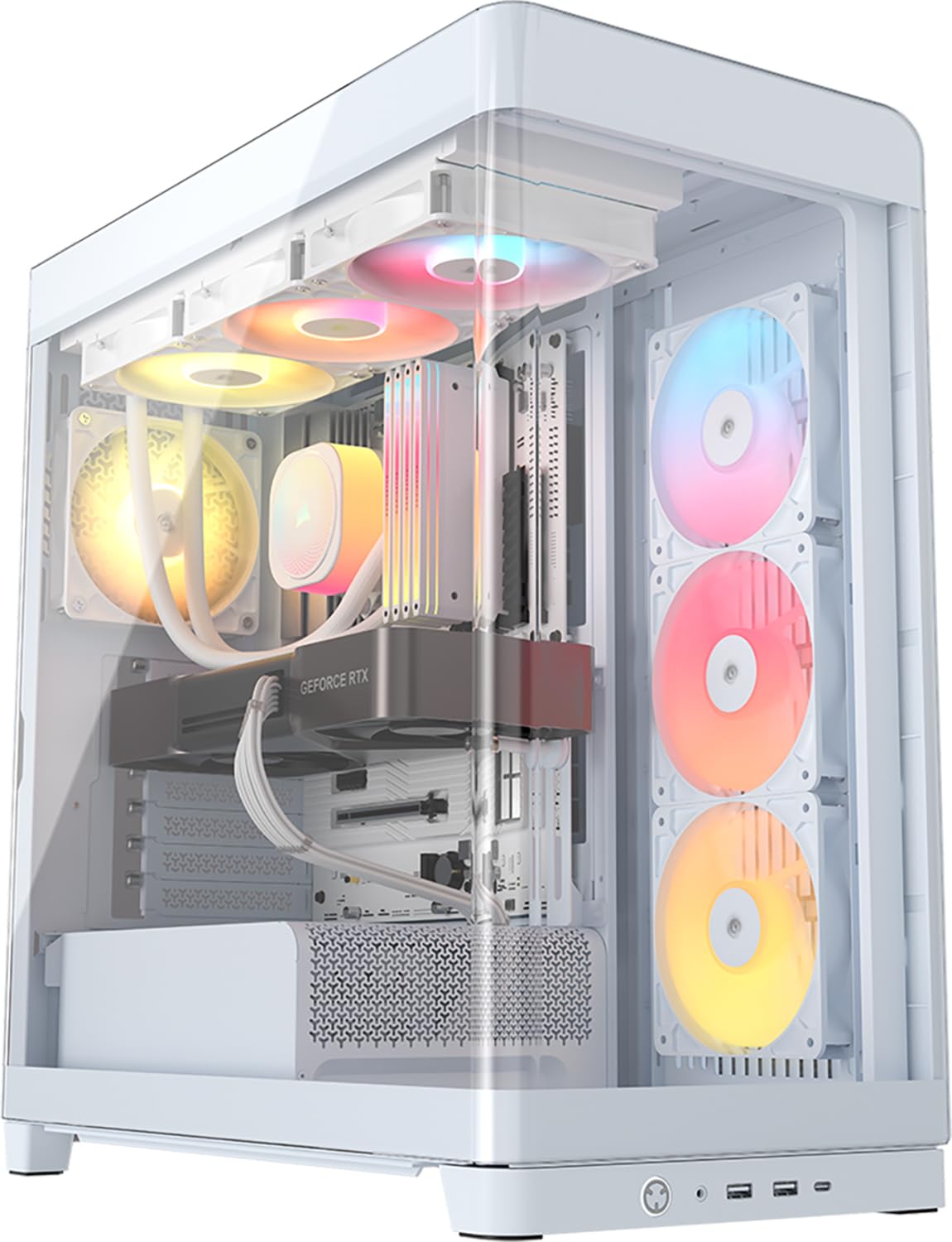
A single curved glass pane that wraps your build in one sweep.
The appeal here is visual: the front and side panels are cut from one piece of curved glass, giving an unobstructed wraparound view of the hardware. It is the smallest case on this list by volume, at 19.65 inches deep, 10.08 inches wide and 18.54 inches tall — 10.08 inches wide against the Antec Performance 1 FT’s 9.06. It still takes E-ATX, ATX, Micro-ATX and Mini-ITX boards and graphics cards up to 460mm.
Three 120mm reverse-rotor RGB fans are pre-installed, and the reverse design blows cool air in while keeping their LEDs visible. The FRAME modular system lets you swap the motherboard tray, change the side fans to a cable cover, or fit a PSU shroud with vertical GPU mounting points. CORSAIR’s InfiniRail mount slides to place 120mm or 140mm roof fans wherever you want them.
Two caveats sit inside a strong 4.5+ star package. The case holds only 3 internal bays, so it is not the chassis for a drive array. Cable management draws mixed notes — some builds tidy up easily, while an iCUE hub is not included, so plan for that.
panoramic glass view
- Single-piece curved glass gives a smooth wraparound view.
- Takes GPUs up to 460mm in a compact footprint.
- Modular FRAME system swaps tray, fans and shroud.
- Three reverse-rotor RGB fans included.
ARGB cable clutter
- Only 3 internal bays, so it caps storage.
- No iCUE hub included, so lighting control needs planning.
showcase builds: a workstation with a stunning glass front sitting on the desk.
silent seekers: a rig that needs more than a few drives inside.
6. be quiet! Light Base 900 FX White PC Case
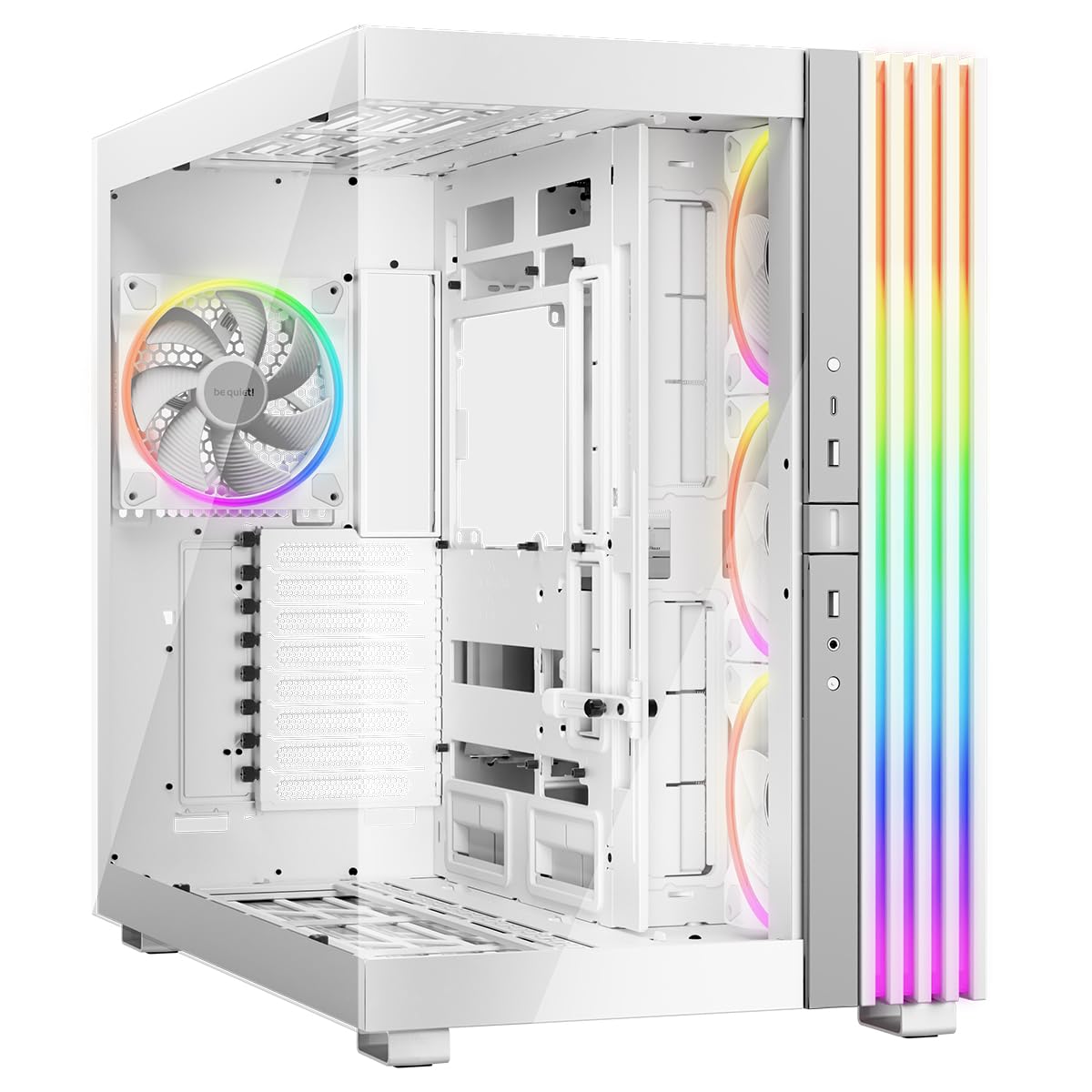
Flip it upside down or lay it flat — the case follows your room.
No other case here can be turned inside out the way this one does. Removable feet let you invert the tower in seconds, and you can set it horizontally just as fast when desk depth is tight. It takes E-ATX boards, up to 7 expansion slots and up to 10 fans, with two removable radiator and fan holders in the lid and base that each take a radiator up to 420mm.
Add a 360mm radiator on the side and you can run three radiators at once, which is a lot of liquid-cooling headroom for a workstation. Two ARGB and PWM hubs with 12 ports between them sit top and bottom for easy connections, and 4 Light Wings 140mm PWM fans ship with the case. The dual-chamber frame is steel, and buyers who like it talk about build quality and airflow first.
Ease of use draws mixed reactions — some builds go together cleanly, others find the adjustability takes getting used to. It also lists only 2 internal drive bays, so it is a cooling-first case rather than a storage one. Both are fit questions, not faults.
clean white builds: your desk setup needs an inverted or flat layout with triple-radiator room.
dark setups: a separate solution if you need a large internal drive array.
7. Fractal Design Define 7 XL Black Silent Modular Full Tower
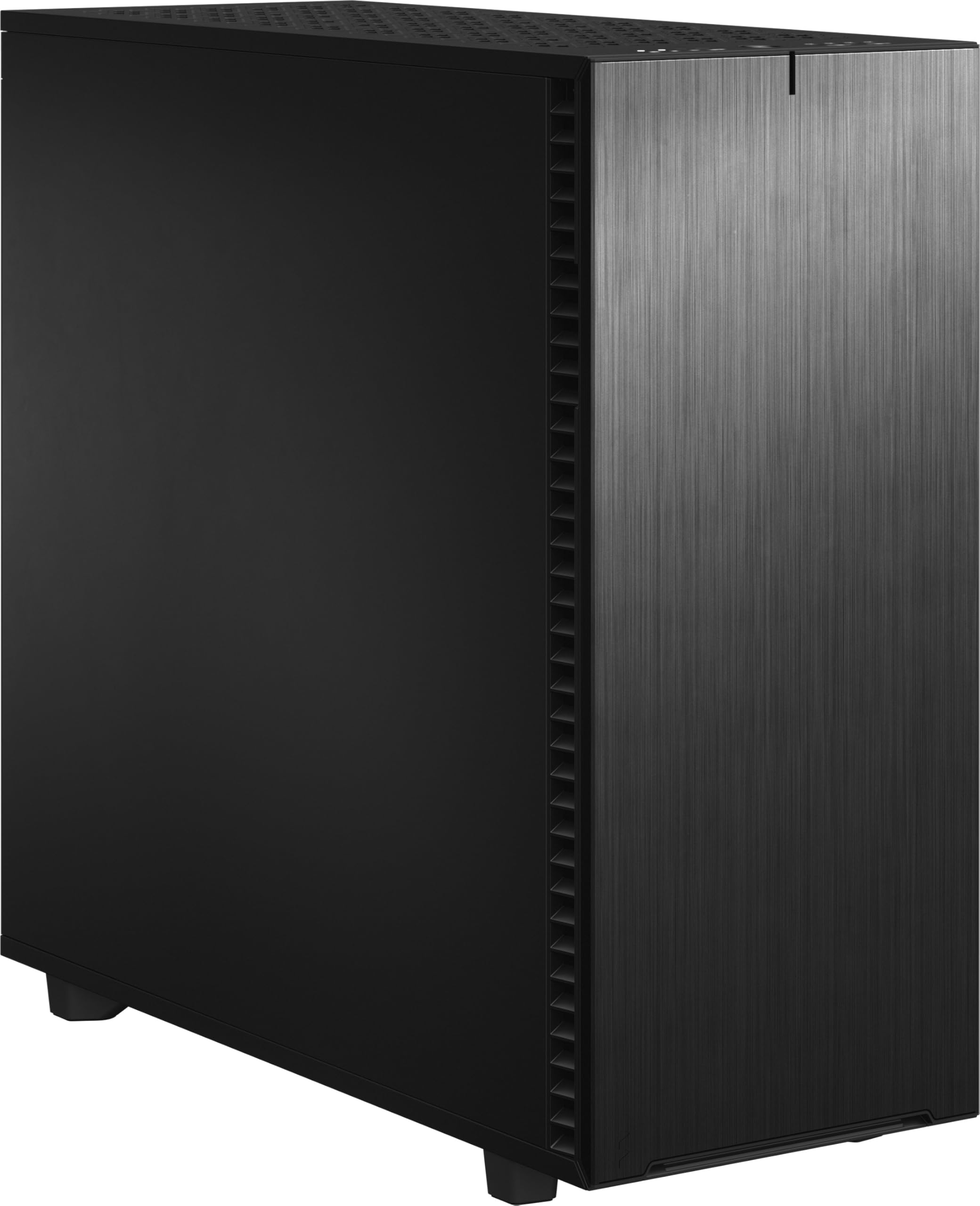
Eighteen drives in a chassis quiet enough for a working office.
This is the case for a workstation that has to hold a serious archive and stay quiet while it does it. In its default storage layout it installs up to 18 HDDs alongside 5 SSD mounts, and the brushed aluminum front door has reversible dual-handed hinges and a magnetic latch. It takes E-ATX and SSI-EEB boards, CPU coolers up to 185mm tall, and graphics cards up to 530mm long.
Switch to its open layout and you get room for a custom water loop with large reservoirs and radiators up to 480mm. Multi-brackets convert any unused fan position into an HDD, SSD or pump mount, which is why owners talk about versatility so much. Owners praise its build quality most of any case here, comparing it to a bank vault, and the solid front door keeps operating noise in check.
At 18.73 kg this is the heaviest case on the list, and a solid front with a filter door means airflow is measured rather than gushing. If your workload is storage-heavy and noise-sensitive, both are the right trade.
silent modular panels: 18 HDDs plus 5 SSD mounts, a magnetic front door, and multi-brackets that turn spare fan slots into drive or pump mounts.
heavy steel frame: 18.73 kg makes it the heaviest pick here, and the vented solid front favors noise control over maximum gale-force airflow.
quiet archives: silence and a big drive archive both matter and the tower sits on the floor.
lan party haulers: 18.73 kg is a two-person lift, not a one-hand carry.
8. JONSBO N5 NAS PC Case, E-ATX, 12 HDD + 4 SSD

Twelve drives you can pull from the front without opening the lid.
For a home server that lives on the shelf, front hot-swap access changes how you maintain it. This case supports 12 x 3.5-inch hot-swap HDDs in front and 4 x 2.5-inch SSDs side-mounted, giving 16 internal bays in total. It takes ITX, M-ATX, ATX and E-ATX boards, up to 4 GPUs, 8 PCI expansion slots, and a 240mm or 280mm AIO.
The solid wood decoration is North American black walnut veneer, which is a warmer look than the metal boxes around it. The one-piece top cover removes for easy access, and the removable 4-bay HDD cage makes the layout easy to change. Three fans are built in, and the front interface carries USB 3.2 Gen2 Type-C plus a pair of USB 3.0 ports.
One planning note matters before you buy: PSU length decides the drive count. With an ATX power supply at 170mm or under, the front takes 12 disk slots; above 170mm and it drops to 8. GPU, CPU cooler and fan placement also draw mixed reactions, so measure against the listed limits — 160mm for the cooler and 325mm to 350mm for the GPU — before ordering.
home servers: a home server where pulling a failed drive from the front saves real time.
airflow fanatics: your PSU length, because it changes whether you fit 12 drives or 8 in front.
9. LIAN LI O11D EVO XL Black E-ATX Full Tower Case

Three 420mm radiators in a case you can open to the front.
This is the case for a workstation with a full custom water loop. It fits 3 x 420mm radiators at once, up to 11 fans, 7 storage drives and graphics cards up to 460mm long, all inside an E-ATX-ready frame. The front pillar comes off to open the view to the hardware without weakening the structure, and the ARGB strip syncs to the motherboard.
Airflow gets real attention: the top mesh panel opening is 14.5% larger and the side mesh opening 14% larger, with a fully open bottom panel and three dust filters. The adjustable motherboard tray shifts up and down across three levels to fit different fan and radiator combinations. Cable routing runs through 3 dual-layer clips that mount anywhere along the vertical grommets.
Two areas to plan for: it lists 7 internal bays so a NAS-sized array is out of scope, and the removable panels and pillar are praised for flexibility but split opinion on how easy they are to refit. Neither takes away from the cooling case this is built to be.
EVO XL flexibility
- Runs three 420mm radiators at the same time.
- Removable front pillar opens the view to the hardware.
- Adjustable tray with three height levels for fan and radiator mixes.
- Larger top and side mesh openings with three dust filters.
large desk footprint
- 7 internal bays mean it is not a storage-server chassis.
- Removable parts split opinion on how easy they are to refit.
custom loopers: a custom loop build that needs three big radiators and a wide view.
compact fans: your build relies on a large internal drive array.
10. ASUS ProArt PA602 E-ATX Full-Tower PC Case

Two oversized front fans shoving air at a mesh cut with 45% porosity.
Built for people who care about thermals more than glass, this case runs two extra-thick 200 x 38 mm front fans and a 140 mm rear exhaust fan behind a 15.5 mm grill with 45% porosity. Two deflectors send incoming air toward the motherboard and internal components, and a built-in fan hub handles fan management. One 420mm radiator fits for AIO or custom loops, and big graphics cards have room for horizontal or vertical mounting.
The front panel has an IR dust indicator that reminds you when to clean the filter, which keeps the airflow up without guesswork. The I/O carries a USB Type-C 20Gbps port, a Power Lock Latch and 2-section PWM control. It holds 9 internal bays and takes E-ATX boards, and the build quality is the thing owners talk about most, with plenty of room for large CPU coolers.
The obvious limit is mass: at 35.5 pounds it is the heaviest tower here, so plan where it lands before it arrives. The airflow-first design also means it is built to move air, not to hush it. For a workstation that runs hot all day, that is the right priority.
ProArt airflow design: two 200 x 38 mm front fans, a 140 mm exhaust, two deflectors and a 45% porosity grill make thermal headroom the whole design brief.
noticeable heft: 35.5 pounds is the heaviest on this list, and a mesh-forward case moves air rather than muffling sound.
creator workstations: your workload pushes heat hard and you want the cooling handled by oversized stock fans.
weight worriers: 35.5 pounds needs a sturdy spot and a second set of hands to place it.
11. Cooler Master HAF 700 E-ATX High Airflow PC Case

Eighteen 120mm fan mounts in a chassis built for movement.
The HAF name is about airflow, and this tower pushes it hard: it takes eighteen 120mm fans, dual 360 radiators or a 480mm radiator, with two 200mm Sickleflow ARGB fans pre-installed behind a mesh front panel. It carries 8 internal bays, a USB 3.2 Gen 2 Type-C port and 4 USB 3.2 Gen 1 ports, and it is built for extended ATX boards.
The tool-less design is the other selling point — panels and mounts come apart without hunting for a screwdriver, which makes a rebuild far quicker. ARGB Gen 2 lets each LED be controlled on its own for custom lighting. Owners go for the look and the space first, and many like the huge dimensions because the build is easy to work in.
Size is the honest trade: at 26.22 inches deep and 24.65 inches tall it is the biggest case here, and it is genuinely heavy. One buyer found it too big to fit under a desk, so measure your space first. If you have the room, the airflow potential is enormous.
overclocked rigs: has floor space and wants maximum airflow with a tool-less rebuild.
small rooms: 26.22-inch depth and 24.65-inch height rule out tight desk spots.
Know the Specs
Internal bays
This is the count of drive slots built into the case, and it decides how much storage lives inside. A workstation that stores footage or runs a NAS needs a high number — 21 bays on one case here, 2 on another. If your build is one system drive plus a GPU, a low count is fine. Match the bay count to the drives you actually plan to install.
Radiator support
Radiator size is how liquid cooling is measured, and it must fit in the mounting area the case provides. Cases here range from a single 420mm or 480mm radiator up to three 420mm radiators at once. A bigger radiator dissipates more heat but takes more space. Confirm the size on the case’s own spec list before you buy a cooler.
Motherboard form factor
E-ATX and SSI-EEB boards are larger than standard ATX, and they need a case built to accept them. Every case here supports E-ATX, and the widest go further to SSI-EEB for server-grade boards. Check the size your board uses against the case’s support list — there is no fitting a wider board into a narrower case.
Airflow and fan count
Airflow is how much air moves through the chassis, driven by fan count, fan size and how open the front panel is. A mesh front with large fans moves more air; a solid door runs quieter but moves less. Fan counts here run from a single 140mm unit up to support for 18 fans. Pick the balance that matches the hours your workstation runs.
Common Questions
Will an E-ATX motherboard fit in every case on this list?
How many hard drives can a workstation case actually hold?
Is a mid tower enough for a workstation build?
Do I need a 480mm radiator for a workstation?
What is the difference between a NAS case and a workstation case?
Can a workstation case be laid flat or inverted?
How loud is a mesh-front workstation case?
Does case weight matter for a tower that sits on the floor?
Will my power supply length affect the case I choose?
How much GPU clearance do I get in these workstation cases?
The Bottom Line
For most workstation builds, the workstation pc case winner is the Antec Performance 1 FT because it balances a full-tower frame, E-ATX support, GPU room up to 370mm and a built-in temperature display without asking you to overbuy. It is the pick most people should start with, and the one to beat on proven owner satisfaction.
If cooling headroom is your priority, the Antec Flux Pro arrives with six PWM fans and room for two radiators, so the thermal side is already handled. For a quiet archive that holds 18 drives, the Fractal Design Define 7 XL is the one to reach for. And if front hot-swap access matters for a home server, the JONSBO N5 puts 12 drives within arm’s reach.
For a general workstation build, the Antec Performance 1 FT earns the top spot: it holds 4.5+ stars across 600+ owners, and its built-in temp display lets you check heat without opening the case.
How we choose
We do not accept paid placement. Every pick is matched to a real buyer and a real use-case; we do not hands-on test units.
Sources
Specifications: manufacturer listings and product documentation. Review insights: verified customer reviews, as of November 2026. Pricing: not shown on this page (it changes often); check the current price via the retailer link.
As an Amazon Associate, Tactical Gear Guy earns from qualifying purchases. This does not affect which products we feature.