Specs are compiled from manufacturer listings and verified buyer reviews and can change over time — please confirm the key details on the product page before buying.
You want a full-body cardio burn at home without waking the neighbours or wrecking your knees. The right rower pulls that off; the wrong one leaves you with a wobbly frame, a squeaky rail, or a resistance knob that stops mattering after week two. What separates them is how the resistance is made — a water tank, a magnetic wheel, or an air flywheel — and how much floor space the frame eats when you are not on it.
This guide is built by comparing the manufacturers’ published specifications and the patterns across verified customer reviews, so you get each pick’s real strengths and trade-offs instead of marketing spin.
Below you will find honest trade-offs on nine rowers, from a 500-pound-capacity air machine to a handcrafted wood water rower. This is the practical shortlist of the best workout rower machine for a real home gym.
Top Picks


How To Choose The Best Workout Rower Machine
The mistake most first-time buyers make is shopping by looks or by a single resistance number instead of rail length and resistance type. A rower is a lever system you sit inside for twenty minutes at a time. If the rail is too short for your legs or the resistance disappears at the top of the stroke, the machine ends up in the spare room. Here is what actually decides whether you keep rowing.
Match the resistance type to your body and your building
Water resistance gets harder the faster you pull, because you are spinning a paddle wheel through a tank — that is what gives the smooth catch and the swooshing sound. Magnetic resistance runs a wheel past magnets with no physical contact, which keeps it very quiet and lets you dial in a fixed level. Air resistance spins a flywheel fan, so the harder you pull the more air it moves and the more drag you feel. Neighbours below you will notice an air rower far sooner than a magnetic one.
Check rail length and seat height before anything else
The rail is the track the seat slides on, and its length caps how far your legs can extend. A short rail crowds tall rowers at the catch and forces a hunched stroke. Seat height matters too: a taller seat is easier on your back to climb onto and off of, while a low seat changes the angle of your drive. Look for the manufacturer’s stated leg-length or user-height range, not just the rail number.
Work out your real floor footprint, stored and in use
Rowers are long. A machine that folds or stands upright between sessions gives you back most of that length when you are not training. Some break into two pieces, some fold at a hinge, and some simply lift onto their nose against a wall. Measure the wall you plan to stand it against, then check the stored depth the maker lists — that is the number that decides whether it lives in your living room or your garage.
Decide whether the monitor and app support matter to you
A basic LCD monitor tracks distance, time, strokes per minute, and calories. That is enough to pace yourself. Bluetooth and app support add guided classes, virtual routes, and logged history, which helps if you need structure to stay motivated.
Side-by-Side Comparison
| Model | Best For | Resistance Type | Max User Weight | Item Weight | Amazon |
|---|---|---|---|---|---|
| Concept2 RowErg with Tall Legs★ Best Overall | Serious training and data tracking | Air flywheel | 500 pounds | 29 kg | Amazon |
| YPOO Rowing MachineBest for Apartments | Apartments and shared spaces | Magnetic, 16 levels | 350 pounds | 40.1 pounds | Amazon |
| Merach Q1SSmartest Resistance | Auto resistance with app courses | Electromagnetic, 16 levels | 350 pounds | 45 pounds | Amazon |
| YOSUDA Water Rower | Water feel on a budget | Water tank, 5.8 Gal | 420 pounds | 57.5 pounds | Amazon |
| YOSUDA Magnetic Rower | Tight corners and small rooms | Magnetic, 16 levels | 350 pounds | 59 pounds | Amazon |
| JOROTO MR280PRO | Furniture-grade looks, folding storage | Water tank | 400 pounds | 52 pounds | Amazon |
| Sunny Health & Fitness SF-RW522067 | Full-motion upper-body emphasis | Magnetic, 16 levels | 330 pounds | 91.8 pounds | Amazon |
| Merach R60N | HIIT and taller rowers | Air + magnetic dual | 500 pounds | 33.3 kg | Amazon |
| WaterRower S4 BLE | Loud-and-proud water purists | WaterFlywheel | — | 38 kg | Amazon |
Detailed Reviews
1. Concept2 RowErg Indoor Rowing Machine with Tall Legs
Our pick — 4.5+★ from 550+ verified ratings; the strongest balance of quality and price.
The rowing machine gyms actually buy, now with taller legs for a friendlier climb-on.
The number that decides everything here is the 500-pound maximum weight recommendation — the highest in this lineup, matched only by the Merach R60N. That is the welded steel and aluminum frame talking, not a marketing line. The tall-leg version lifts the seat to a 20-inch height, so you sit down onto the machine rather than squatting into it, and your drive angle is easier on a stiff lower back. For bigger rowers, or anyone who wants a machine that will outlast three apartment moves, this is the one the shortlist is built around.
The PM5 monitor is the other reason people gravitate here. It measures distance, speed, pace, calories burned, and watts (the actual power you put into each stroke), so your numbers are comparable session to session. During a row it draws power from the spinning flywheel, and otherwise it runs on two D cell batteries. The flywheel design is also what keeps this machine quieter than an open air fan — you get a smooth, even pull without a roar. Owners talk about the workout first and the build second, which tells you the training feel is what keeps people coming back.
The catch is the footprint. Concept2 lists a 24″D x 96″W x 20″H size and a required 9×4 feet of space — that is a full wall of your room while it is set up. It separates into two pieces and rolls on caster wheels, so clearance is reclaimable, but you need somewhere to stand it. Straight-line storage is the trade-off you accept for gym-grade construction at 29 kg.
Where it delivers
- 500-pound weight capacity — the stoutest frame on this list alongside the Merach R60N
- PM5 monitor tracks watts, pace, and calories for comparable data every session
- Tall-leg design puts the seat at 20 inches, so mounting is a sit-down, not a squat
- Splits into two pieces with caster wheels for moving and standing storage
What you give up
- Needs 9×4 feet of clear floor while in use — the longest footprint here
- Air flywheel makes more noise than the magnetic options
- Weighs 29 kg, so it is a two-hand lift to reposition
Reach for this if: you want a durable training machine with real power numbers and plan to use it hard, not occasionally.
Look elsewhere if: your only spot is a shared bedroom wall and you need a rower that folds small and rows near-silent.
2. YPOO Rowing Machine 350 LB
Forty pounds of steel that rows below a whisper and folds into bare corners.
If you live above someone, the spec that matters is the under-25dB noise rating — decibels measure loudness, and 25dB sits around the level of a quiet room. That comes from the magnetic resistance system, which runs a wheel past magnets with no contact, so there is no paddle slap and no fan roar. The frame is much lighter than the water rowers here, at 40.1 pounds versus the YOSUDA water rower’s 57.5 pounds, which is what makes it practical to haul out and fold away rather than leave setup.
The 46-inch dual slide rail is rated to fit users from 4’5″ to 6’3″, and the overall footprint is listed at just 2.9 sq.ft. With the 350-pound max capacity and a heavy-duty steel frame, this is a stable platform for most households. The resistance comes in 16 levels through a smart knob, and the monitor reads time, distance, strokes per minute, and calories. One neat touch: it is self-powered, generating energy as you row, so the LED display lights the moment you pull — no outlet, no charging cable, no dead monitor on row day two.
The honest catch is stability. The footrests don’t always snap in snug on some units, and a few owners find the base a touch less planted than a heavier dual-rail frame. It is also a compact machine, so very tall or very heavy rowers may feel the rail length before they feel the workout. For a small apartment and a sub-6’3″ rower, though, the value is hard to argue with.
The quiet that wins: under-25dB magnetic operation plus a 2.9 sq.ft. footprint makes this the easiest rower to live with in a shared building.
The honest gap: a compact, lighter frame means the very tall or the very heavy will want a longer dual-rail machine — and the footrests on some units need a firm press to seat.
Right call for: apartment rowers under 6’3″ who want silent, cordless, fold-and-store sessions.
Wrong call for: anyone who wants a heavy, immovable platform to plant in a dedicated gym room.
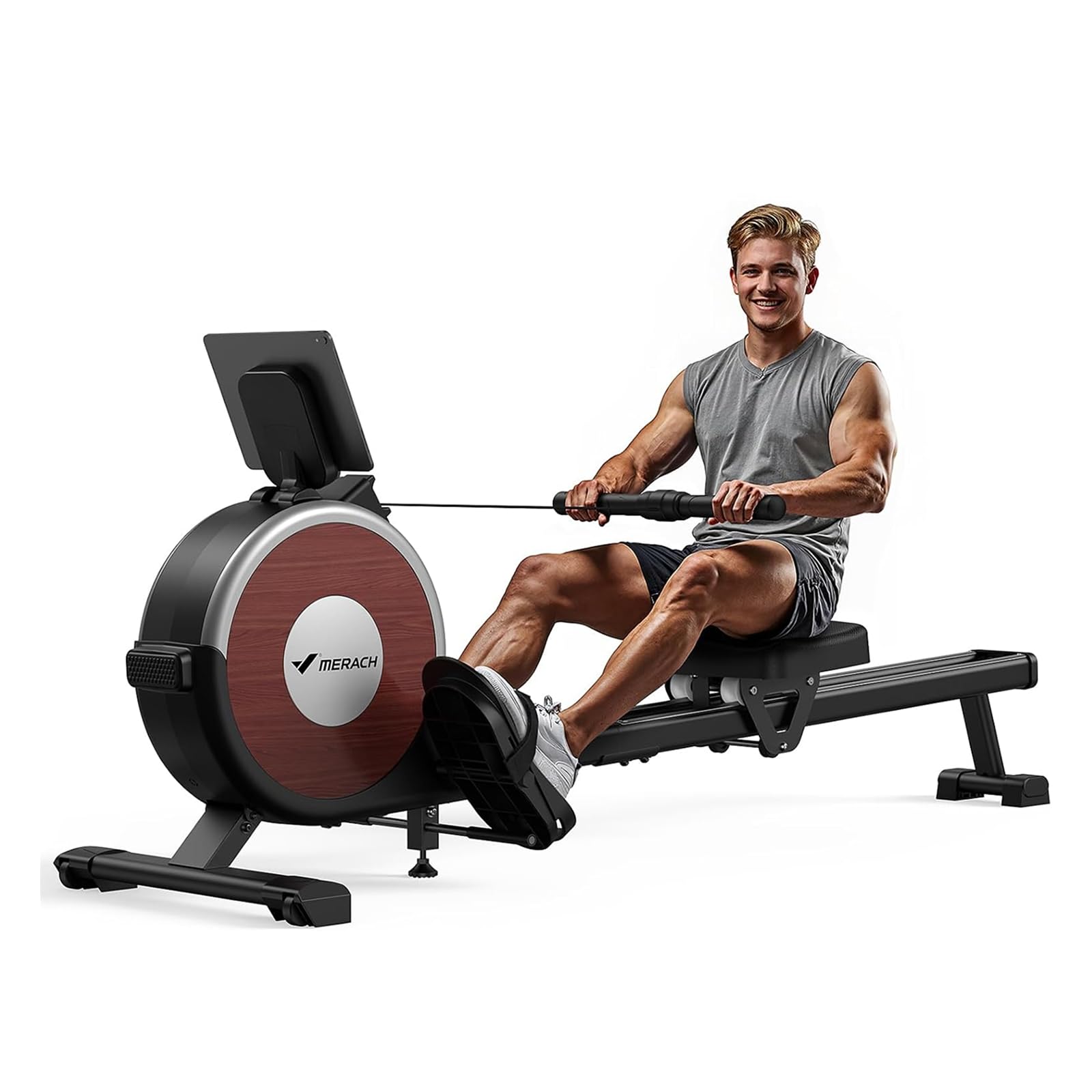
3. Merach Q1S Magnetic Rowing Machine Indoor
The rower that changes its own resistance while your hands stay on the handle.
Most magnetic rowers ask you to twist a knob every time you want a harder stroke. The Q1S runs an electromagnetic flywheel — the resistance is generated by magnets you control electronically — so you get 16 levels that shift automatically through the MERACH app while you keep rowing. Pull to start, then let the guided courses take over the resistance changes. That auto-adjust is the defining feature and it changes how interval sessions feel, because your hands never leave the handle mid-set.
The dual slide rail is designed to imitate a wood rower’s track and is more stable than a single-rail frame, rated to 350 pounds. Owners rave about the build and the value here above anything else — the aluminum frame at 45 pounds feels planted for its weight. Measuring that against the Concept2’s 500-pound ceiling, this one taps out at 350 pounds, so a heavier rower should look up the list. Noise is kept low by the magnetic flywheel, and the 30-minute assembly is partly pre-built, so it goes together without swearing.
The recurring honest note is size. Some rowers find it more compact than the listing suggests, so check your leg length before committing. Resistance is also a matter of taste — the electromagnetic wheel feels stronger than a plain magnetic one, but a few wish the top level pushed harder. Storage is good, though: it lifts onto built-in base wheels to stand on its nose.
Best fit for: app-driven trainees who want resistance that shifts on its own during guided classes.
Second thoughts if: you are at the top of the 350-pound range or you like to feel the resistance climb well past a moderate pull.
4. YOSUDA Water Rowing Machine Foldable for Home Use

Beech wood and a big tank bring the sound of moving water to a foldable frame.
Water resistance gives you a catch that builds the faster you pull, because you are spinning a paddle through a tank rather than fighting a magnet. This one holds 5.8 gallons in an oversized tank, and YOSUDA claims its patented sealing means you don’t have to drain it after use and it won’t leak when stored upright. The frame is 25% thicker solid beech wood, FSC-certified, and rated to 450 pounds in the marketing copy — though the spec sheet lists 420 pounds, so go with the lower number. It supports users up to 6’7″.
Where this earns its spot is convenience. It arrives 98% pre-assembled and sets up in about 10 minutes, which is faster than several machines here that arrive in more pieces. The 180° fold lets you stand it against a wall to reclaim floor. Build quality and the wood’s appearance win people over — it reads more like furniture than gym gear, which matters if it lives in a living room. Bluetooth then pipes your rowing data to a phone or tablet.
The catch is reliability over the long haul. Some units only held up for a short stretch before issues surfaced, and the water sound gets a mixed reception — relaxing to most, but a squeak develops on a few. Ease of use and resistance are also debated. It is a lovely machine when it is running well; go in knowing the water tank and hinges are the parts that need care.
Why it earns a slot
- 5.8 Gal water tank delivers the rising-resistance catch water rowers love
- 98% pre-assembled, about 10 minutes to start rowing
- 180° fold and FSC-certified beech frame that looks like furniture
- Room for users up to 6’7″
Where to be careful
- Long-term durability isn’t guaranteed — a handful of units faulted early
- Water sound is soothing to most, but a squeak can develop
- Tank and hinges are the parts that live longest and need the most care
Buy it when: you want genuine water resistance and a beautiful wooden frame without jumping to the top of the price range.
Think twice when: you want bulletproof long-term reliability and would rather not think about tank seals at all.
5. YOSUDA Rowing Machine Magnetic
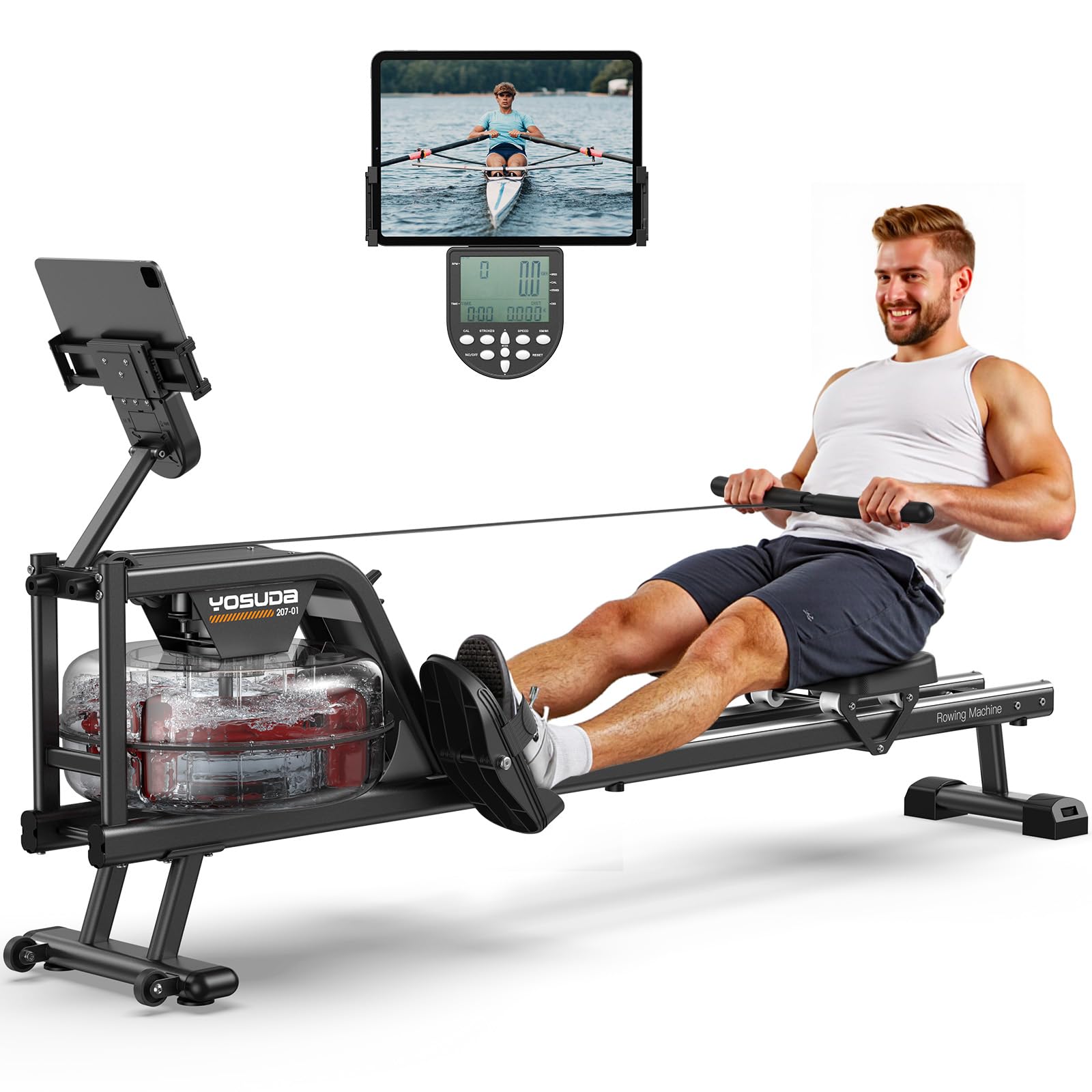
The corner-hugging magnetic rower that frees up almost half your floor.
At 4.27 ft² of footprint, this is the most space-efficient rower on the shortlist — the 71.66″D x 13″W x 24.81″H frame slides into a gap a lot of machines can’t. Two wheels let you move it around with little effort, and the double aluminum alloy rails keep the glide smooth. The 16-level magnetic resistance gives you a quiet, adjustable pull, and a Bluetooth connection lets you join live classes or follow a virtual trainer. For a home where the rower has to live in a corner, that footprint does a lot of the deciding.
The metric that earns the slot is quality. Owners praise the build above everything else, and the rower earns its place on solid construction and smooth operation rather than a headline spec. The seat is super soft and shaped to the hip curve, and the rowing-dedicated monitor tracks your data without distraction. The swishing sound that some describe feels like a water rower even though this is magnetic — a nice touch that takes the edge off a working session.
The trade-off is stability. Some owners find the narrow 13-inch stance less planted than a wider dual-rail frame when they row hard, and a 350-pound max weight caps heavier users. The seat sits fairly high, which helps climbing on but can feel twitchy at speed. It’s a compact machine designed for a compact space, so if you row with sudden power moves, a wider frame might suit you better.
Compact-first engineering: 4.27 ft² and a 13-inch width make this the most discreet rower to tuck into a tight room, while the 16-level magnetic resistance keeps it quiet.
The stability trade: narrow rails mean a rower who pulls with force may feel the frame shift — fine for steady work, less so for aggressive intervals.
Worth grabbing if: floor space is your hard limit and you want a quiet, adjustable magnetic rower that disappears into a corner.
Leave it if: you row with heavy power strokes and want a wide, immovable base under you.
6. JOROTO Water Rowing Machine, Foldable with 400LBS Capacity
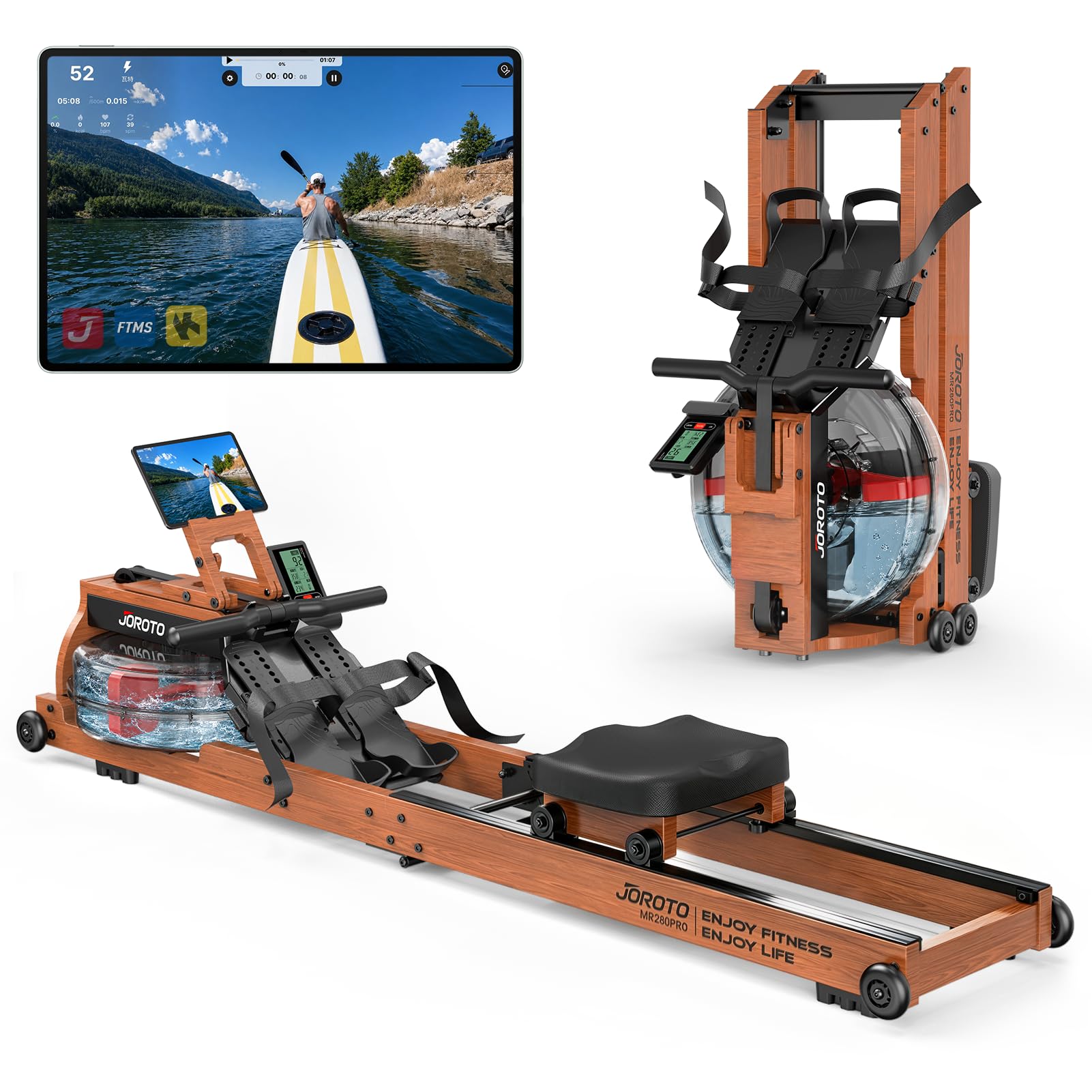
Solid oak, a leak-proof tank, and a 180° fold that hides 60% of your floor.
Of the two water rowers on this list, the JOROTO is the one that folds. The 180° vertical folding design is claimed to save up to 60% of space, and the tank uses a leak-proof system so it can stand upright without draining. That solves the biggest complaint about water rowers — that they are long, heavy things you can’t put away. The FSC-certified solid oak frame is rated to 400 pounds, and the extended rail fits a maximum leg length of 39 inches, which is generous for taller households.
Water resistance adjusts with both water level and pulling speed, so the faster you pull the harder the catch, and the sound of moving water runs through each stroke. Assembly is quick: it arrives 90% pre-assembled and sets up in about 15 minutes. A Bluetooth monitor links to the JOROTO app with lifetime free guided workouts, virtual routes, and performance tracking. The wooden frame’s build quality and smooth glide are what owners talk about most, and the rower holds up as a daily-use machine.
The honest trade is that leak-proof does not mean maintenance-free. Water rowers need their tanks checked periodically, and a 400-pound rating sits below the 420 pounds the YOSUDA water rower lists — so heavier users should weigh the two carefully. It is also a heavier, floor-hungry machine than the compact magnetic options. But for anyone who wants the real water feel on a frame they can hide, this is the one.
Pick this if: you want a genuine water rower that looks like furniture and folds away, and you keep it in a room you actually show people.
Pass if: you are near the top of the weight range or you would rather never think about tank seals.
7. Sunny Health & Fitness Smart 360° Magnetic Rowing Machine

A double-cord handlebar that pulls in 360 degrees, so your shoulders do more than hang on.
Most rowers treat the handlebar as a fixed bar you pull straight back. It is the defining difference here, and it makes the machine feel less like a rower and more like a resistance trainer with a sliding seat. The 51.3-inch rail with a stainless steel cover keeps the glide long and smooth, and the seat sits at a high-profile 17.6 inches, which is easier on your back to mount.
You get a quiet workout from 16 levels of magnetic resistance (a braking system that uses magnets instead of air or water). The digital monitor tracks distance, time, count, total counts, strokes per minute, and calories, and it pairs with a heart-rate monitor if you own one. Value for money is the theme with this rower — owners talk about assembly and workout quality together. The 330-pound weight limit is the lowest on this list, so it suits lighter, higher-rep training rather than powerlifting rowers.
The honest catch is the resistance ceiling. Some rowers find the top level stops feeling hard, and durability has its question marks over heavy daily use. The machine is also heavy at 91.8 pounds, so moving it around is a two-hand job despite the upright storage. It suits someone who wants a full-body, shoulder-focused workout with a long rail and can live with moderate resistance.
The case for it
- 360° dual-cord handlebar opens up shoulder and upper-back movement a straight pull misses
- 51.3-inch stainless-covered rail and 17.6-inch seat height for an easy, long glide
- 16-level magnetic resistance and a complete LCD monitor readout
The counterweight
- 330-pound max weight — the lowest capacity here
- Top resistance level stops feeling hard for stronger rowers
- 91.8 pounds of steel makes it a heavy machine to move and store
Pairs well with: a shoulder-and-core routine where you want circular, full-range pulls and a long rail.
Less ideal for: a power rower who wants a hard resistance ceiling or a lightweight machine to haul around.
8. Merach R60N Rowing Machine Indoor

Two resistance systems on one machine: an air wheel for warm-up, magnets for the burn.
The R60N runs two resistance systems at once. Speeds 1-7 use pure air resistance (a fan that spins as you pull) for a smooth, easy warm-up. Speeds 8-10 add magnetic resistance for heavier HIIT and weight-training strokes, with peak magnetic lifting force of 45% or more claimed for professional-level load. That layered approach is what separates it — you get the fast catch of air plus the quiet load of magnets. The 53-inch extended aluminum guide rails with an I-beam structure are rated to 500 pounds, matching the Concept2’s ceiling and beating the 350- and 400-pound water rowers here by a wide margin.
For taller or heavier rowers, the 53-inch rail gives real legroom, and the 17.7-inch seat height with adjustable footplates helps keep your pelvic alignment natural through long sessions. MERACH claims each stroke engages up to 86% of the muscle groups. The backlit display connects to the MERACH app with over 20 training modes and real-time data sync, and the track separates in 2 seconds for two-part storage, with built-in rollers for moving. This is a serious piece of kit for the rower who lifts as much as they row.
The catch is the display. It is criticized for being hard to read in low light, and the backlit panel doesn’t rescue a dim room. The resistance also splits opinion — excellent for some, not enough for those who want a single heavy setting. Built quality itself is praised, and assembly is quick, so the fuss is mostly about the screen and the top-end load.
Dual-system strength: air from speeds 1-7 and magnet-assisted load from 8-10 gives you a genuine warm-up-to-HIIT progression, and 500 pounds of capacity covers bigger bodies.
The screen caveat: the backlit display is harder to read in low light, so plan on decent room lighting during your session.
Choose it for: heavier or taller rowers doing serious HIIT who want one machine to warm up and then go heavy on.
Keep looking if: you sometimes row in dim light or you prefer one clean, hard resistance setting over a layered system.
9. WaterRower Water Rowing Machine with S4 BLE Monitor
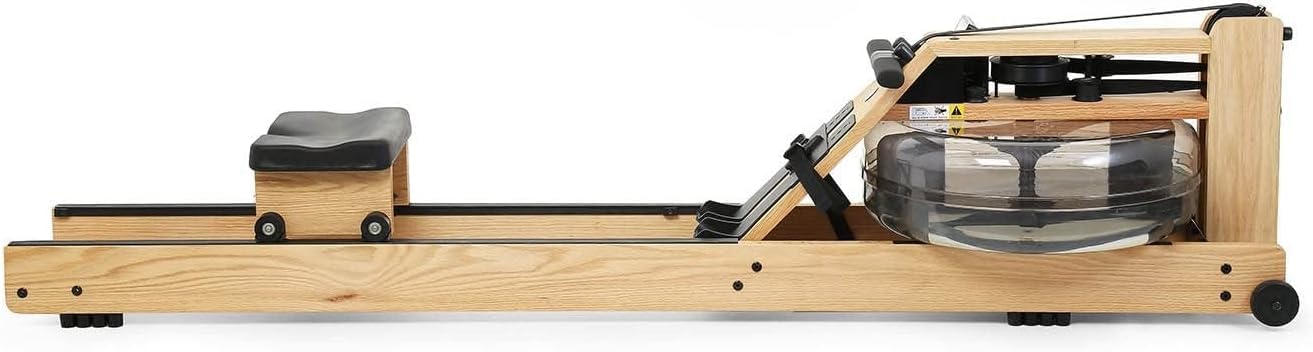
Hand-built Appalachian hardwood and the original WaterFlywheel, standing upright when you’re done.
This is the rower that started the water flywheel concept, and it shows. The frame is handcrafted in the USA from Appalachian-sourced hardwoods, and it can be stood on its nose between sessions — the frame is about 82 inches long, 22 inches wide, and 20 inches high, so it tucks against a wall when not in use. WaterRower says more than 100,000 machines have gone into commercial gyms over the past 25 years, which is the scale of a real training institution rather than a single home unit.
The WaterFlywheel resistance rises with your effort, so a light warm-up feels fluid and a hard stroke bites back — that natural load curve is the feel water rowers are imitating. The S4 BLE monitor tracks distance and heart rate, and Bluetooth connects to WaterRower Connect and CITYROW, with a wide range of available upgrades and accessories so the setup can grow. Build quality and the handle feel are the star, and owners find it both quiet in operation and a visually striking piece of furniture.
The honest catch is size and weight. It is a long 87.75-inch footprint at 38 kg, so it is the most permanent-feeling machine here despite the upright storage. Water maintenance is a way of life, and the S4 monitor tracks distance and heart rate rather than the full watts-and-pace suite of the Concept2. You are paying for craftsmanship and the water experience, not for a spec-for-spec winner. For a home where the rower is a piece of furniture you keep, that trade is the whole point.
This is your rower if: you want a hand-built wood machine with the original water flywheel and a strong quiet glide you can stand in the corner.
You’d rather not if: you need the full watts-and-pace data of a training machine or you have no floor space for a long frame.
Know the Specs
Maximum Weight Recommendation
This is the highest user weight the frame is built to support, in pounds. It matters because the frame, seat, and rail share that load through every stroke. A 500-pound rating on the Concept2 and Merach R60N gives bigger rowers headroom, while the 330-pound Sunny Health & Fitness cap suits lighter, high-rep training. Pick a machine whose rating leaves you some margin, not one you sit exactly on top of.
Water vs Magnetic vs Air Resistance
Water resistance uses a paddle wheel in a tank, so the load rises the faster you pull — that is the smooth catch and the swoosh. Magnetic resistance runs a wheel past magnets without contact, so it is quiet and gives you fixed, switchable levels. Air resistance spins a flywheel fan, so effort and noise both climb together. Choose water for feel, magnetic for quiet, and air for a hard training load.
Rail Length and Seat Height
The rail is the track the seat rolls on. A longer rail fits taller users and a fuller leg extension; a short one forces a cramped catch. Seat height decides how easily you climb on and the angle of your drive — a 17.6- to 20-inch seat is friendlier on the back and knees than a low seat. Check the maker’s user-height or leg-length figure against your own before you commit.
Space and Storage
Rowers are long machines. Many fold at a hinge, split into two pieces, or lift upright on rollers to free floor space between sessions. The in-use footprint and the stored footprint are different numbers — measure both against your room. A machine that stores upright reclaims a lot of floor but still needs a wall; a compact magnetic rower like the YOSUDA pair tucks into a corner without the fold.
Common Questions
Will a water rower leak or need draining after use?
Is a magnetic rower quiet enough for an apartment?
How tall a person will the rails fit?
Does the Concept2 need electricity to run its monitor?
What is the difference between air and magnetic resistance on a rower?
How much floor space does a rower take when stored?
Can I do HIIT on a rower or is it only steady cardio?
Is a wooden rower as strong as a steel frame?
How long does assembly take on these rowers?
Do I need an app to get a good workout on these rowers?
The Bottom Line
For most home trainees, the workout rower machine winner is the Concept2 RowErg with Tall Legs. Its 500-pound frame and PM5 monitor give you a machine that will take years of hard use and still log honest watts and pace. If you live in an apartment and need near-silent sessions, the YPOO is the one to reach for. And if you want the water rowing feel and a foldable wooden frame, the JOROTO MR280PRO is the pick worth grabbing. The true measure is whether the machine fits your body, your floor, and your noise tolerance.
How we choose
We do not accept paid placement. Every pick is matched to a real buyer and a real use-case; we do not hands-on test units.
Sources
Specifications: manufacturer listings and product documentation. Review insights: verified customer reviews, as of November 2026. Pricing: not shown on this page (it changes often); check the current price via the retailer link.
As an Amazon Associate, Tactical Gear Guy earns from qualifying purchases. This does not affect which products we feature.