Specs are compiled from manufacturer listings and verified buyer reviews and can change over time — please confirm the key details on the product page before buying.
You want to hit record, see yourself in the frame, and end up with footage that looks like it came off a real channel. That is the whole job of a YouTube vlogging camera, and only a handful of models deliver it without a fight. The short answer: the Canon EOS R50 is the safest all-round pick for most people, the DJI Osmo Pocket 3 is the one that kills shaky footage, and the LUMIX S5IIX is the serious step up when you want a big sensor and unlimited recording. Everything below explains who each one actually suits.
This guide is built by comparing the manufacturers’ published specifications and the patterns across verified customer reviews, so you get each pick’s real strengths and trade-offs instead of marketing spin.
First decide if you want a flip-out screen or a gimbal (a motorized mount that keeps the camera steady). Then check the mic input and how long it records before it overheats. Below you’ll find the specs that matter most when choosing a youtube vlogging camera.
Top Picks


How To Choose The Best YouTube Vlogging Camera
The mistake most first-time buyers make is shopping by megapixels. Your viewers never see your sensor count — they see whether you are in focus, whether the audio is clean, and whether the frame is shaking. Pick a camera that nails focus, audio and stability, and the rest falls into place.
Can you see yourself while you record
A flip-out or articulating screen lets you frame your own face instead of guessing. Some cameras swing the screen out to the side, others rotate the whole body or use a retractable front-facing display. Check which style you get, because a screen that only tilts up is awkward when you mount the camera low.
The audio path decides your production quality
On-camera microphones pick up wind, traffic and room echo. A camera with a 3.5mm mic jack (the standard round plug for external microphones) or a hot shoe (the metal mounting plate on top that powers accessories) lets you add a real mic or a light later. Without one of those, you are stuck with whatever the built-in mic hears.
Stabilization versus sensor size
A 3-axis mechanical gimbal physically holds the lens steady, which smooths out walking shots in a way software alone struggles to match. A larger sensor, meanwhile, gathers more light so night footage stays clean. Deciding if you need gimbal-smooth walking shots or a larger sensor for low light is the single most useful choice you will make.
Side-by-Side Comparison
| Model | Best For | Video Top Frame Rate | Sensor | Self-Framing Screen | Amazon |
|---|---|---|---|---|---|
| Canon EOS R50★ Best Overall | All-round first camera | 4K 30fps / Full-HD 120fps | 24.2MP APS-C | Vari-angle touchscreen | Amazon |
| 64MP 8K Digital CameraBudget Kit | Kit on a tight budget | 8K | 64MP | 2.8-inch flip IPS | Amazon |
| Canon PowerShot V10Pocket Pick | Pocket carry | 4K 30fps / Full-HD 60fps | 15.2MP 1-inch | Retractable front-facing | Amazon |
| Xtra Muse | Gimbal on a budget | 4K 120fps | 1-inch CMOS | 2-inch touchscreen | Amazon |
| DJI Osmo Pocket 3 | Steadiest footage | 4K 120fps | 1-inch CMOS | 2-inch rotating touchscreen | Amazon |
| DJI Osmo Pocket 3 Enhanced Bundle | Long shoot days | 4K 120fps | 1-inch CMOS | 2-inch rotating touchscreen | Amazon |
| Sony ZV-1 | Talking-head creator | 4K HDR | 20.1MP 1-inch | Side flip-out 3.0-inch | Amazon |
| Canon PowerShot V1 | Wide all-in-one | 4K 60fps | 22.3MP 1.4-inch | Vari-angle touchscreen | Amazon |
| LUMIX S5IIX | Unlimited recording | 6K / 5.8K Pro-Res | 24.2MP full-frame | Not listed | Amazon |
Detailed Reviews
1. Canon EOS R50 Mirrorless Camera
Our pick — 4.5+★ from 1,500+ verified ratings; the strongest balance of quality and price.
The do-everything first camera that shoots 4K and still swings its screen around to face you.
This is the pick for someone who wants one camera for talking-head videos and stills, without learning a broadcast workflow. Its 24.2 Megapixel CMOS APS-C sensor (a sensor bigger than the one in a phone) pairs with a DIGIC X processor, the chip that handles the image. Together they give you clean detail in good light, which is exactly what a talking-head channel needs. The 6K oversampled uncropped 4K movie at up to 30 fps means your video is built from more picture data than it outputs, so edges and text stay sharp.
Autofocus is the reason this sits first. Dual Pixel CMOS AF II covers up to 100% x 100% of the frame across 651 AF zones, meaning almost nothing can drift out of focus unnoticed. It detects and tracks people, animals and vehicles, so when you step toward the lens mid-sentence, the camera keeps your face sharp without you touching anything. Recording Full-HD at up to 120 fps gives you slow motion for demos, and Movie for Close-up Demo Mode automatically pulls focus to whatever is closest — genuinely useful when you hold a product up to the lens. For the record, 120 fps Full-HD is double the PowerShot V10’s 60 fps ceiling.
The vari-angle touchscreen (a screen that flips out and rotates so you can see yourself) makes self-framing simple, and a 2.36-million-dot EVF (an electronic viewfinder you look through) is there for bright outdoors. Bluetooth and Wi-Fi, with the free Canon Camera Connect app, let you pull clips to your phone. What owners talk about most is the sheer quality of the thing — the image that comes out of it — and it is the trait that carries the reputation. The honest catch: the compact size draws mixed feelings, and some find the body small in the hand for long handheld sessions. Add a grip or cage if you shoot for hours.
What earns it the top spot
- 651 autofocus zones across up to 100% x 100% of the frame keep your face locked in
- 6K oversampled uncropped 4K at 30 fps for crisp, detailed video
- Full-HD recording up to 120 fps for real slow motion
- Vari-angle touchscreen plus a 2.36-million-dot EVF for any lighting
- Bluetooth and Wi-Fi transfer through the free Canon Camera Connect app
Where it asks more of you
- The small body divides opinion — some hands want more to grip
- You are buying into the Canon RF lens mount, so glass is a separate budget
Reach for this if: you want one camera that handles both your talking-head channel and your stills, with autofocus that will not let you down.
Look elsewhere if: you shoot long handheld sessions and know you prefer a chunkier grip in your palm.
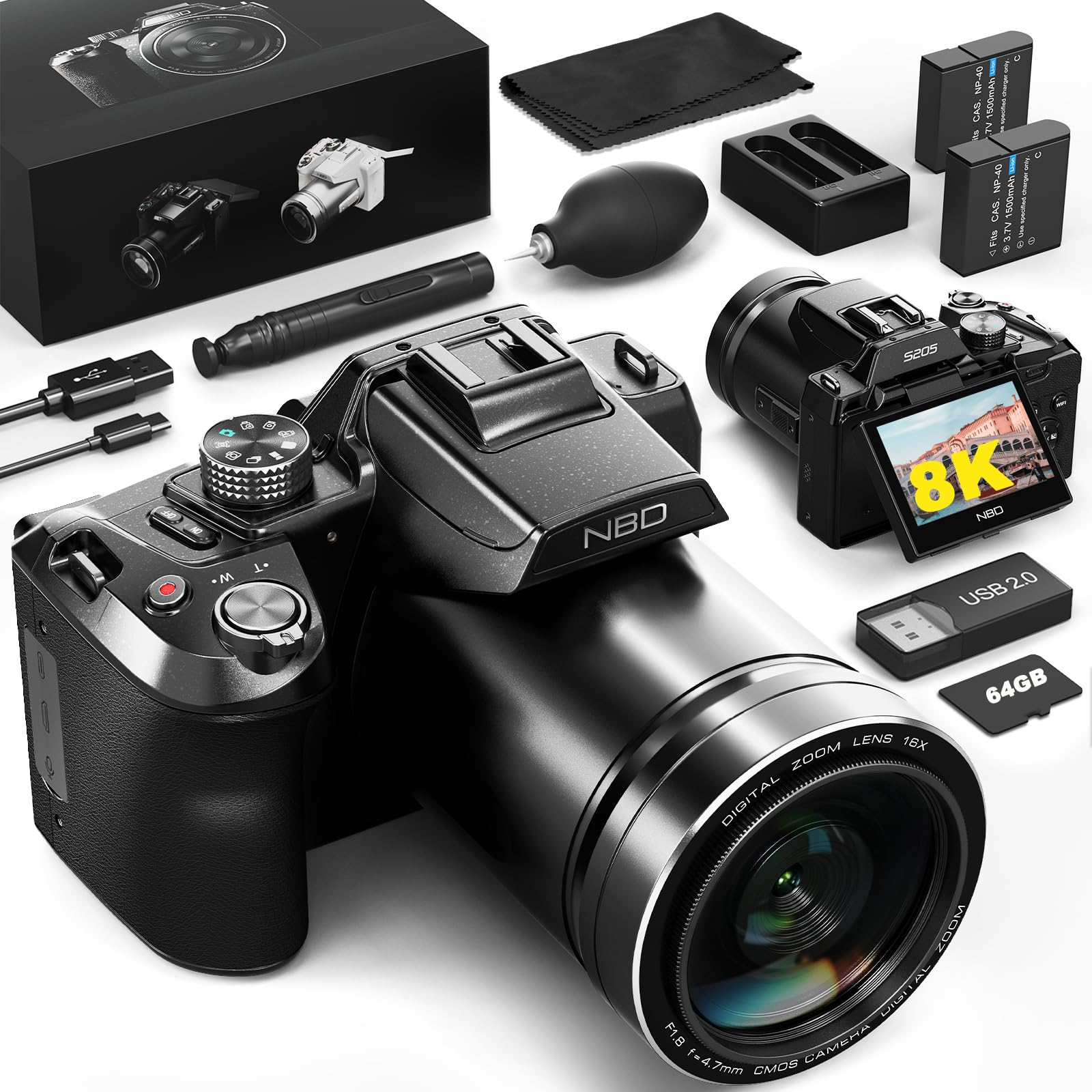
2. 64MP 8K Digital Cameras for Photography,16X Zoom,Hot Shoe
A complete starter box — two batteries, a 64GB card and a hot shoe — for the smallest outlay here.
If the budget is the hard limit and you still want a flip screen and a mic mount on day one, this is the one to look at. The 2.8-inch flip IPS screen turns to face you for self-recording, so you can frame yourself without guessing. The built-in hot shoe (the top mounting plate that can power a mic, light or flash) lets you add audio gear that most cheap cameras cannot accept at all. That hot shoe is the detail that separates it from a toy.
The numbers are big on paper. A 64MP sensor is listed, and digital zoom reaches 16x — compare that to the Canon PowerShot V10’s 3x, a very wide gap in zoom reach. Be clear about what that means: digital zoom crops into the image rather than magnifying optically, so distant subjects lose detail as you push in. It is genuinely handy for framing a far-off subject, less so for pixel-perfect close-ups.
The bundle is where this earns its place — a 64GB TF card, two rechargeable batteries and a fast charger are all in the box, so you can film a full day without buying extras. WiFi transfer to your phone, a 1080p webcam mode for streaming, and Micro HDMI for playback on a TV round it out. The trade-off is honest: it is a low-cost camera with a small review base, so treat it as a learning tool rather than a long-term workhorse. Learn framing, audio and exposure on this before you spend more on a serious body.
The sensible read: buy it for the included card, spare batteries and hot shoe — the accessories alone justify it for a first-timer who wants to start filming this week.
Set your expectations: the 16x zoom is digital, so keep subjects reasonably close and the footage will hold up far better.
Good starting point for: a new creator who needs a screen that faces them and a mic mount without stretching the budget.
Not the long game: plan to upgrade once your channel and your skills both grow.
3. Canon PowerShot V10 Compact Vlogging Camera
Small enough for a fanny pack, with a stand that folds out so you can just set it down and talk.
For street vloggers and travel creators who hate carrying a bag of gear, this is the carry-anywhere answer. The body is pocket-sized, and the folding stand flips out front or back so the camera stands on a table hands-free while you record. A fixed 19mm wide-angle lens (35mm equivalent) pulls in a whole room or a tight interior without you backing into a wall.
The 15.2-megapixel 1-inch back-illuminated CMOS sensor is the star — a 1-inch sensor gathers far more light than a phone’s, which is why low-light clips stay usable. Video runs 8-bit 4K at up to 30 fps and Full HD at up to 60 fps, with 14 movie color filters for setting a mood without editing. Audio gets real attention too: a pair of stereo microphones plus a third mic in the middle that helps cut unwanted background noise. You also get an external mic auxiliary port, micro-HDMI output and USB-C charging.
What wins people over is the size — it disappears into a pocket or small bag, and that portability is why it gets carried when bigger cameras stay home. Recent firmware (version 1.2.0 or later) adds three image stabilization modes: IS Off, IS On and IS Enhanced. The trade-off is real and worth knowing up front: battery life is rated around 2 hours, and buyers have reported units failing after about four months, so buy with a returns window in mind and carry a power bank. It is a wonderful everyday vlogger, not a bombproof one.
Best matched to: the creator who films on the move and wants a camera that lives in a pocket, not a bag.
Worth knowing first: the roughly 2-hour battery and the reported long-term reliability mean you should keep your receipt handy.
4. Xtra Muse Vlogging Camera

A stabilized pocket gimbal that records 4K at 120fps — the same headline numbers as the DJI, for less.
The Xtra Muse is aimed squarely at people who want the smooth gimbal look but find the DJI Osmo Pocket 3 more than they want to spend. Its 1-inch CMOS sensor records 4K at 120fps, matching the DJI’s top frame rate exactly, and a 3-axis gimbal mechanically holds the lens steady while you dance, run or hike. The stabilizer is the whole point here — it is what turns handheld chaos into watchable footage.
The 2-inch touchscreen switches between horizontal and vertical shooting, so you can go from a wide YouTube frame to a vertical Short without remounting. True 10-bit X-Log color gives you up to one billion colors to grade in post, which is a real advantage for sunrise and sunset shots. Master Follow keeps you centered while you move on a tripod, and battery life is rated at 161 minutes. The included handle with a 1/4-inch thread means it mounts to standard tripods from the start.
Owners consistently describe the picture and video quality as excellent in 4K and call the 3-axis stabilization a highlight. The catch is the ecosystem — the DJI has a deeper accessory and app story, and if you already film with DJI mics, the Osmo Pocket 3’s direct connection to two DJI Mic 2 or Mic Mini transmitters is something the Xtra Muse cannot offer. If you are starting clean with no existing gear, the Xtra Muse does the core job for noticeably less.
Where it shines: the 4K at 120fps and mechanical 3-axis gimbal put the two most important stability and slow-motion specs in your hands.
The honest gap: no direct DJI mic pairing and a thinner app ecosystem than the DJI option above it.
Pick it when: smooth walking shots and 4K slo-mo matter and you are building your kit from scratch.
Pass if: you already own DJI wireless mics and want them to pair without extra gear.
5. DJI Osmo Pocket 3 Vlogging Camera
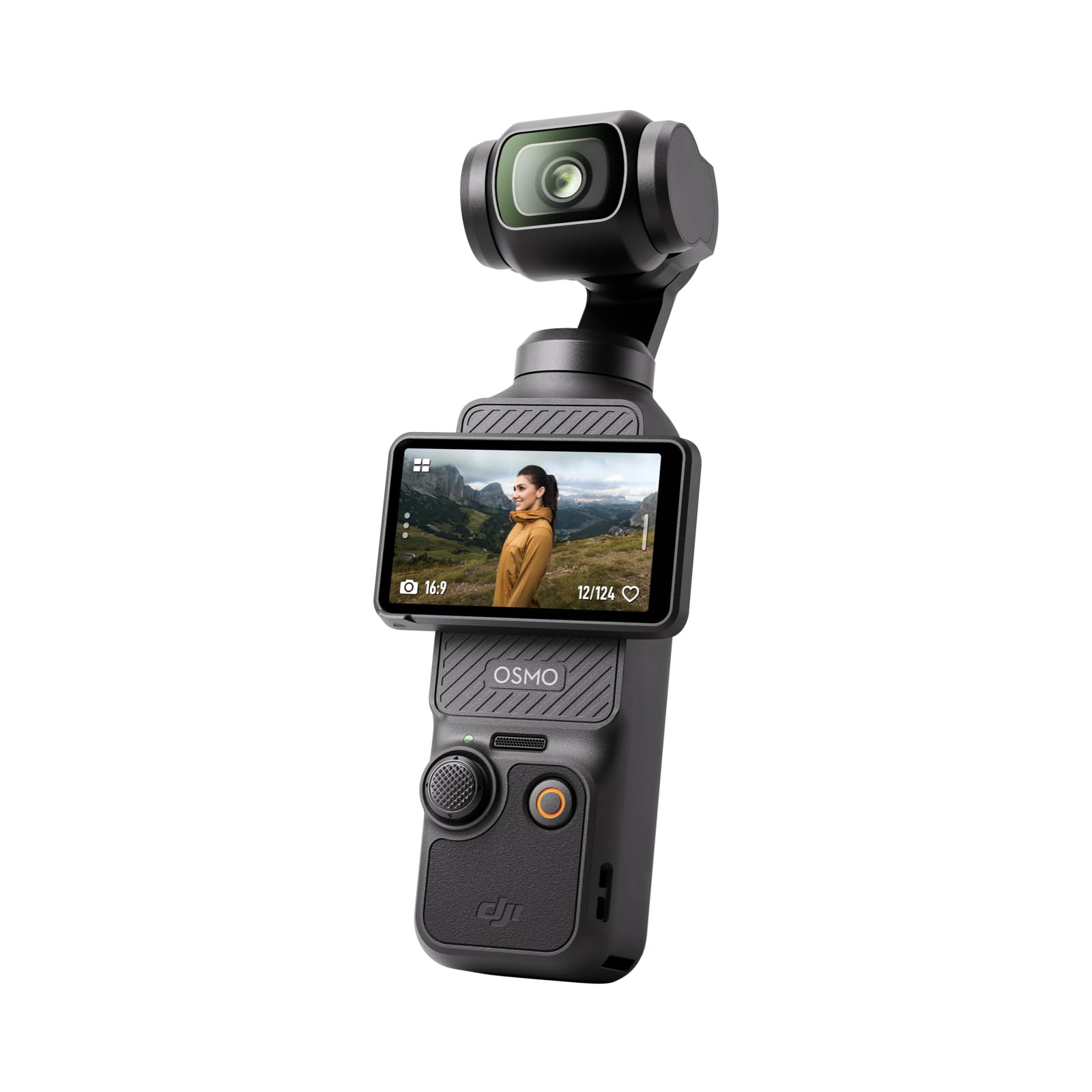
The pocket gimbal that makes walking-and-talking look like it was shot on a rail.
Filming while you move is the hardest thing to get right, and the Osmo Pocket 3 solves it with hardware. A 3-axis mechanical gimbal physically counteracts your footsteps, so dancing, chasing pets or hiking produces smooth footage rather than a wobble you try to fix in editing. A 1-inch CMOS sensor records 4K at 120fps, which is four times the Canon EOS R50’s 30 fps 4K ceiling — that is the head-to-head that matters for slow-motion and fast action.
Framing is handled by a 2-inch touchscreen that rotates for both horizontal and vertical shots, and ActiveTrack 6.0 keeps you centered while you spin or jump on a tripod. Focus locks onto your subject and holds. D-Log M and 10-bit color depth capture up to one billion colors for grading sunrises and sunsets. Audio is stereo, and DJI OsmoAudio lets the camera connect directly to two DJI Mic 2 or Mic Mini transmitters — a big win for interviews and livestreams without a separate receiver. The battery is rated at 166 minutes, and Bluetooth and Wi-Fi handle transfers.
The consensus among owners is that the video quality is genuinely impressive and the compact body slips into a small pocket or bag, which is why it travels so well. The mixed feedback centers on value and reliability — it is not cheap, and a small number of units arrive with faults, so buy from a seller with a clear return path. A few also wish for longer battery life. None of that changes the reality that this is the most reliable way to get steady footage without a rig.
Why creators reach for it
- 3-axis mechanical gimbal smooths walking, running and dancing shots
- 4K at 120fps for true slow motion
- Direct pairing with two DJI Mic 2 or Mic Mini transmitters
- 166-minute rated battery plus Bluetooth and Wi-Fi transfer
- Rotating 2-inch touchscreen for horizontal and vertical shooting
What to weigh first
- Value and reliability draw mixed feedback — it is an investment, so protect the return window
- Some owners want more than the rated 166 minutes between charges
Ideal for: the creator whose biggest problem is shaky handheld footage.
Think twice if: you want the lowest cost route to 4K — the Xtra Muse above covers the core specs for less.
6. DJI Osmo Pocket 3 Enhanced Vlog Bundle

The same steady Osmo Pocket 3, boxed with a battery handle, tripod and case for all-day filming.
If you already know the Osmo Pocket 3’s footage is what you want, this bundle removes the shopping list. You get the camera, a carrying case, a tripod, a screen protector and — the piece that matters — a 4000mAh battery handle that screws into the 1/4-inch thread and powers the camera far longer than the internal cell alone. That makes it the version for travel days, interviews and livestreams where stopping to charge is not an option.
Everything from the standard model carries over: the 1-inch CMOS sensor, 4K at 120fps, the rotating 2-inch touchscreen, ActiveTrack 6.0 and the 3-axis mechanical gimbal that keeps running and hiking shots smooth. Stereo audio and direct pairing to two DJI Mic 2 or Mic Mini transmitters are here too, and Bluetooth and Wi-Fi handle file transfer. The tripod in the box means hands-free tracking is ready the moment you unzip the case.
Buyers praise the footage and the portability while flagging two things honestly. Functionality and value get mixed feedback — some units reportedly fail to power on, and some consider the price high for what it is. Connectivity also divides opinion. Given the camera’s core quality, the sensible read is to buy from a seller with a straightforward return policy and treat the tripod and battery handle as the real upgrade that justifies this version over the base model.
The bundle’s real value: the 4000mAh battery handle plus tripod turn a good pocket camera into a shoot-all-day kit.
Fair warning: mixed reports on units failing to power on mean you should test it thoroughly inside the return window.
Choose this version if: your filming days run long and you want the tripod and extra power in the same box.
Stick with the standard model if: you mostly film shorter clips and would rather add accessories only as you need them.
7. Sony ZV-1 Digital Camera

Built from the ground up for the person talking straight into the lens, with a bright F1.8 lens.
Sony designed the ZV-1 for creators, and it shows. The 20.1MP stacked back-illuminated 1-inch Exmor RS CMOS sensor pairs with a 24-70mm F1.8-2.8 ZEISS Vario-Sonnar T lens — that F1.8 aperture (a wide opening that lets in lots of light) is what blurs your background and keeps you bright in dim rooms. The side flip-out 3.0-inch LCD screen also tilts up and down, so selfie framing works at almost any angle.
The autofocus features are tuned for faces: Fast Hybrid Autofocus, Real Time Eye Autofocus and real-time tracking across 425 autofocus points. Product Showcase Setting flips focus from your face to an object you hold up, then back again — a genuinely useful one-button move for reviews and unboxings. The automatic exposure tracks faces to keep them lit, and the forward-directional on-board mic with a detachable wind screen captures decent audio in one take. A 3.5mm mic jack and MI shoe open the door to better sound, and HLG and S-Log3/2 give you pro color options.
Owners rate the picture and video quality as outstanding and often note it is friendly to beginners. The autofocus draws mixed feedback, though — most find it quick, but some report it stopping properly. If sharp, reliable eye autofocus is your whole reason for buying a dedicated camera, weigh that. For a talking-head channel with controlled lighting, it is a superb fit.
Made for: the presenter who films indoors, holds products up to the lens and wants a bright F1.8 look without a light kit.
Consider the catch: autofocus reliability divides opinion, so test that first if razor-sharp tracking is non-negotiable.
8. Canon PowerShot V1 Digital Camera Bundle

An ultra-wide 16-50mm zoom that fits you, your friends and the whole scene into frame.
The problem with filming at arm’s length is that you either crop your own head or lose the surroundings. The PowerShot V1’s integrated 16-50mm equivalent ultra-wide zoom solves that in one lens — wide enough at 16mm to hold you and your location in the shot, tight enough at 50mm for portraits, food and product close-ups, with no lens swapping. The 22.3MP 1.4-inch-type CMOS sensor is larger than a 1-inch sensor, which helps it hold detail in a compact body.
Video-wise it records oversampled 4K up to 30p or 4K up to 60p with a crop for fast action, and Canon Dual Pixel CMOS AF II tracks people and keeps subjects sharp while you film yourself or follow movement. A vari-angle touchscreen makes self-framing easy. The detail that matters for long tutorials is the built-in cooling fan, which supports longer recording sessions so you are not cut off mid-explanation. Wireless connectivity transfers clips to your phone or tablet through Canon’s app.
This one arrives as a bundle — a Canon LP-E17 battery, windscreen, wrist strap, cover, shoulder bag and a 64GB card are all included, so it is a complete kit on day one. If the wide lens and the cooling fan match how you film, that is a reasonable bet.
The standout spec: that 16-50mm F2.8-4.5 zoom is the widest all-in-one here, and it means no lens changes between a wide vlog and a close-up.
What to weigh: a limited track record compared with the Sony and DJI picks, so buy where returns are easy.
Reach for it if: you film in tight spaces or want your whole surroundings in the shot without a second lens.
Hold off if: you would rather buy a camera with a long, proven owner history behind it.
9. LUMIX S5IIX Mirrorless Camera
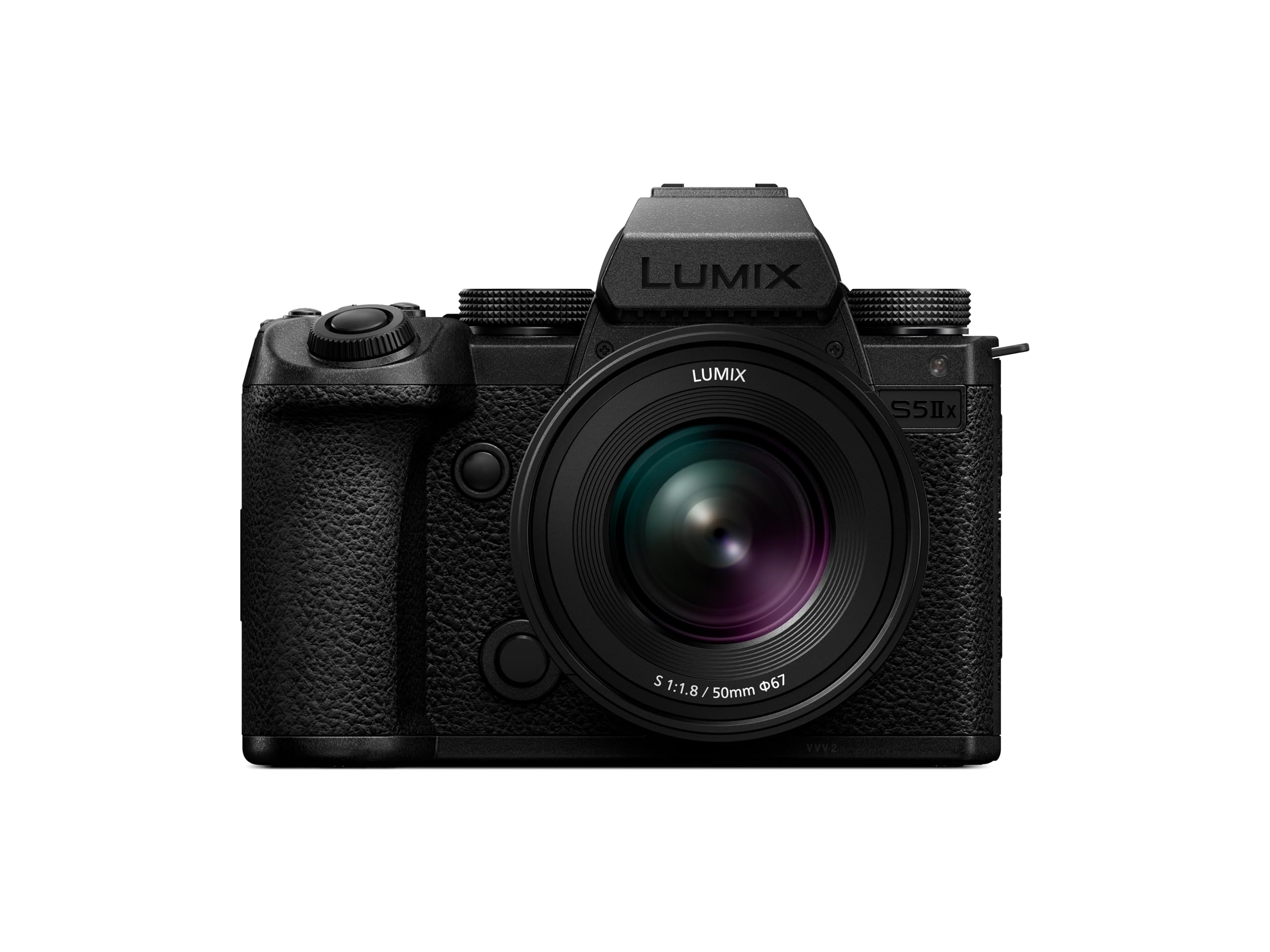
The full-frame step-up for creators who want unlimited recording and serious color grading.
This is the pick for someone whose channel is already earning and who needs the footage to look a tier above a pocket camera. A 24.2MP 35mm full-frame CMOS sensor describes scenes naturally and processes roughly twice as fast, according to Panasonic. Full-frame (a sensor the same size as a frame of 35mm film) gives you cleaner low light and shallower depth of field for that blurred-background look. Phase Hybrid Autofocus uses 779 autofocus points to lock onto subjects, and Active I.S. supports walking shots.
The video tools are what set it apart. 14+ stop V-Log/V-Gamut captures high dynamic range and color, with in-camera photo and video color grading, 5.8K Pro-Res, RAW over HDMI and wireless or wired IP streaming. A heat dispersion mechanism — a small fan plus a high-efficiency heat sink — enables unlimited video recording and livestreaming while keeping the body compact. That means no more hitting a recording limit mid-session, which is the exact wall many vloggers run into.
It comes with an S-R2060 lens and an S-S50 lens, so you have a zoom and a fast prime from day one. Be clear about the trade-off: this is a full interchangeable-lens system, so it demands more from you — more weight, more setup, more learning — than a flip-screen compact. If you want one-button simplicity, the Canon EOS R50 or Osmo Pocket 3 will feel far easier than a full-frame rig. If you want a camera that grows with a serious channel — unlimited recording, V-Log grading, two lenses in the box — this is it.
Why it earns the premium tier: unlimited recording via the built-in fan and heat sink, plus 14+ stop V-Log for grading, removes the two biggest limits of small vlogging cameras.
The real cost: it is a full interchangeable-lens system, so expect to spend time learning the settings and carrying more gear.
Right for you if: you need unlimited recordings and genuine color grading for a channel you are investing in.
Not for you if: you want pick-up-and-vlog simplicity — the compact picks above will serve you better.
Know the Specs
Sensor size: 1-inch versus APS-C versus full-frame
A 1-inch sensor gathers much more light than a phone, so night footage stays clean. APS-C and full-frame sensors are even larger, which means even better low light and more background blur. Full-frame, like the LUMIX S5IIX’s 24.2MP full-frame sensor, is the largest here and gives the most cinematic look — at the cost of size and complexity. A larger sensor rarely means more pixels; it means each pixel is bigger and catches more light.
Frame rate: what 30fps, 60fps and 120fps change
Frame rate is how many still pictures the camera captures each second. 30fps gives you normal-looking motion and is fine for talking-head. 60fps smooths fast action and gives some slow-motion room. 120fps lets you slow footage way down and still keep it smooth, which is why the Osmo Pocket 3 and Xtra Muse offer 4K at 120fps — useful for action, dance and product spins.
Common Questions
Do I need a camera with a flip-out screen for vlogging?
Is a gimbal camera better than a flip-screen camera for walking shots?
Can I connect an external microphone to these vlogging cameras?
How long can these cameras record before overheating?
What is the difference between digital zoom and optical zoom on a vlogging camera?
Do I need 4K at 120fps, or is 30fps enough?
Will these cameras work as a webcam for livestreaming?
How much battery life should I expect from a pocket vlogging camera?
Can I shoot vertical video for Shorts and Reels on these cameras?
The Bottom Line
The crowd favorite and the smartest first buy is the Canon EOS R50 — 4.5+ stars across 1,600+ ratings — because 651 autofocus zones and oversampled 4K keep your face sharp in talking-head videos and still deliver 24.2MP stills from the same body. If shaky footage is your main headache, the DJI Osmo Pocket 3 and its 3-axis mechanical gimbal will fix it faster than any editing trick. And for a channel that has outgrown pocket cameras, the LUMIX S5IIX pairs a full-frame sensor with unlimited recording. Pick the one that matches how you actually film — talking-head, walking, or long-form — and start recording.
How we choose
We do not accept paid placement. Every pick is matched to a real buyer and a real use-case; we do not hands-on test units.
Sources
Specifications: manufacturer listings and product documentation. Review insights: verified customer reviews, as of November 2026. Pricing: not shown on this page (it changes often); check the current price via the retailer link.
As an Amazon Associate, Tactical Gear Guy earns from qualifying purchases. This does not affect which products we feature.