Specs are compiled from manufacturer listings and verified buyer reviews and can change over time — please confirm the key details on the product page before buying.
Buying a balance mat is really a question of stiffness, thickness, and footprint — get those three right and the pad does the work for you. Get them wrong and you end up with a squishy slab that bottoms out under your heel, or a pinhole-sized square you cannot stand on with both feet. This guide sorts nine real balance pads and instability mats by what they are actually good at, so you can match one to your knees, your floor, and the way you train.
This guide is built by comparing the manufacturers’ published specifications and the patterns across verified customer reviews, so you get each pick’s real strengths and trade-offs instead of marketing spin.
Below you will find how thickness and density change the difficulty of a standing drill, which pads suit sensitive knees, and how much floor space each one really takes up. Every pick is chosen to hold up under daily standing, squatting, and single-leg work — the true test of any yoga balance mat.
Top Picks


How To Choose The Best Yoga Balance Mat
A balance pad looks like a slab of foam, and that is exactly why so many people buy the wrong one. The differences that matter are dull on paper and obvious the moment you stand on the thing: how firm the foam is, how tall the pad sits, how much room your two feet get, and whether the surface grabs your socks or lets them skate.
Firmness: the number that decides your workout
Firm foam gives your foot something to push against, so your ankle has to correct and your calf has to fire. Soft foam swallows the foot and asks less of you. If you are new to balance work, a firmer pad is often easier to control than a mushy one, because you can feel where your weight is. A pad that sinks to the floor under your heel stops being a balance tool and becomes a cushion.
Thickness and how much wobble you actually want
Thickness sets the difficulty. A 2-inch pad gives a gentle, controlled rock that most adults can hold for a full minute. A 6cm-thick pad (about 2.4 inches of dense foam) tips further and works the small muscles in your ankles, knees, and hips harder. Thicker is not automatically better — it is harder, and harder is only useful if you can stay on it without grabbing a wall.
Footprint: the quiet dealbreaker
A 15-inch by 12-inch pad handles one foot comfortably and two feet in a narrow stance. A 19-inch by 15-inch pad gives you room to stand shoulder-width, kneel on it for gardening, or set it under a standing desk. If you plan to do lunges, squats, or planks on the pad, measure your stance first — a too-small pad turns every drill into a careful shuffle.
Surface grip and what it means in a sweaty session
Textured, sweat-proof surfaces keep a bare foot from sliding when your hands get clammy and your focus drops. That matters more on a hard floor than on carpet, where the foam bites into the pile anyway. A pad that shifts across the floor mid-lunge is a sprained-ankle waiting to happen, so look for a textured underside as well as a textured top.
Material and how you will clean it
TPE foam (a rubbery, flexible foam) and EVA foam both resist moisture and wipe clean with a damp cloth. Closed-cell foam keeps sweat and water on the surface instead of soaking in, which is why it tends to stay fresh longer. Whichever you pick, store it flat and out of direct heat, because a warped pad rocks in a way you cannot train around.
Side-by-Side Comparison
| Model | Best For | Footprint (L x W x H) | Foam / Material | Stated Weight | Amazon |
|---|---|---|---|---|---|
| Yes4All Exercise Balance Pad XL★ Best Overall | Wide-stance balance, kneeling, desk use | 19″ x 15″ x 2.25″ | TPE foam | 1.5 pounds | Amazon |
| HAPBEAR Exercise Balance PadBest for Therapy | Physical therapy drills and daily balance work | 15″ x 12″ x 6″ | TPE foam | 320 g | Amazon |
| Milky House Foam Balance Board PadCompact Pick | Small-space balance work and knee cushioning | 12″ x 9.4″ x 2.4″ | EVA foam | 0.16 kg | Amazon |
| Aiweitey Stability Trainer Pad | Pilates, dance and therapy sessions | 15.7″ x 13″ x 2″ | TPE foam | 0.28 kg | Amazon |
| Fragraim Balance Pad | All-level standing drills and gym use | 15.7″ x 13″ x 2″ | TPE foam | — | Amazon |
| NEXFIT High-Density Balance Pad | Sweat-heavy workouts and core training | 15.5″ x 12.75″ x 2.25″ | High-density TPE foam | 0.58 kg | Amazon |
| THERABAND Stability Trainer Pad | First-timers building basic coordination | 14.5″ x 8″ x 1.75″ | PVC foam | 8.8 ounces | Amazon |
| Vive Oval Balance Pad | Core work and rehab on a thicker pad | 16″ x 12″ x 2.5″ | TPE foam | — | Amazon |
| Therapist’s Choice X-Large Balance Pad | Large feet, big stances, standing desk | 19″ x 15″ x 2.3″ | Closed-cell foam | 0.7 kg | Amazon |
Detailed Reviews
1. Yes4All Exercise Balance Pad XL
Our pick — 4.5+★ from 850+ verified ratings; the strongest balance of quality and price.
A full 19 inches of dense foam that fits both feet, your knees, and your standing desk without a shuffle.
The thing that makes this pad easy to live with is the footprint: 19 inches long, 15 inches wide, and 2.25 inches thick — measured out in foam, that is enough room to stand shoulder-width, drop into a lunge, or kneel for gardening without your heel hanging off the edge. Compare that with the Vive Oval pad at 16 by 12 inches and you can see where the extra real estate goes. It weighs 1.5 pounds, so it is easy to fling into a corner or under a desk between sessions.
What wins people over is the firmness. The TPE foam (a rubbery, flexible foam that holds its shape) gives a solid, controlled rock rather than a spongy sink, so you feel your ankles and hips correcting instead of just wobbling. Buyers report the dense TPE foam keeps its shape through daily standing and kneeling without flattening in the middle. The top surface is textured for grip and stays put on hard floors, which matters when you are balancing on one leg and your socks are starting to slide.
The recurring gripe is simple: no storage or carry features, and the purple XL is a bigger slab than some small living rooms want to give up. If you need something that lives in a drawer, this is not the one. For everyone else — standing drills, knee support, or a wobbly base under the desk — it does the whole job at a fair price, and its 4.5+ star rating reflects that track record.
Where It Wins
- 19″ x 15″ surface gives two feet, a kneeling position, or a desk stance real room
- Dense TPE foam holds a firm rock instead of sinking to the floor
- 1.5 pounds makes it easy to move from workout spot to workspace
- Textured non-slip surface stays put on hard floors
What To Weigh First
- No carry handle or strap — this is a stay-in-one-place pad
- The XL footprint claims real floor space in a small room
Go for it if: you want one pad for standing drills, kneeling work, and desk use without buying twice.
Think twice if: the pad has to tuck into a bag or a drawer every day — the 19-by-15-inch body will not cooperate.
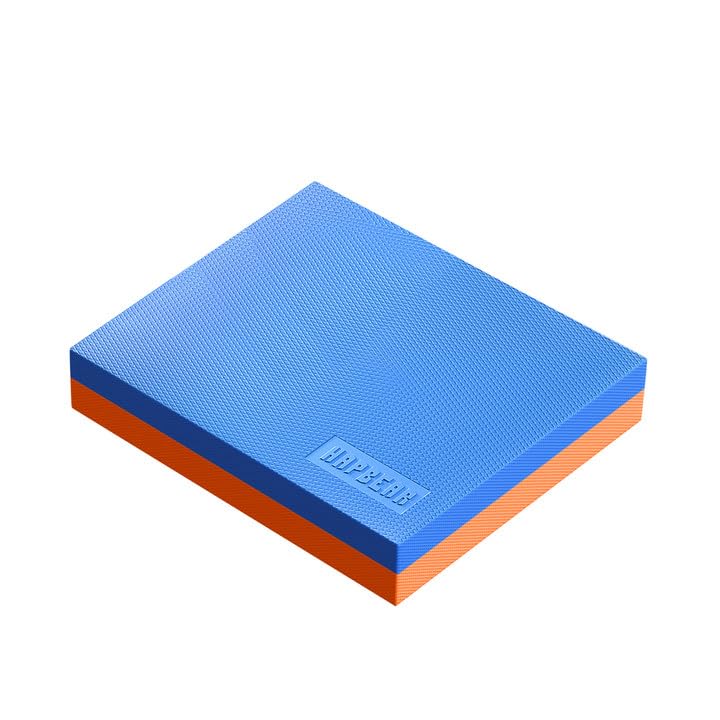
2. HAPBEAR Exercise Balance Pad
A double-sided pad built for the rehab room, with a diamond-grid grip that holds a clammy foot in place.
Here is the number that shapes everything: 6cm of dense TPE foam, roughly 2.4 inches of cushion. That is thicker than the Aiweitey Stability Trainer Pad at 2 inches, so the rock is gentler on the ankle and the bottoming-out point sits farther down. The dual-colour surfaces both grip, meaning you flip the pad and get a fresh face without losing traction. At 320 g it travels light enough to take to a clinic appointment and back.
What owners praise most is how well it holds up for balance and therapy drills — the firmness lands right in the middle, supportive without being a brick. The diamond-grid pattern keeps the pad from creeping across a hard floor mid-set. It is a single pad at 15 by 12 inches, so it handles one foot or a narrow two-foot stance, not a wide lunge.
One thing to check before you buy: the listing shows both a 15″x12″x6″ size and a 15.8″ x 13″ x 2.4″ size in the same product data, so confirm the dimensions on the variant you pick. Beyond that sizing wrinkle, the pad wipes clean, resists stains, and earns its keep for daily therapy sessions.
The cushioning read: 6cm of dense foam sits between your joints and the floor, so long knee-focused sets feel less punishing than on a thin mat.
The sizing catch: two different dimension figures appear on the listing, so match the variant to the footprint you actually need before ordering.
Reach for this if: you are running a therapy or rehab routine and want a thick, grippy pad that wipes clean.
Look elsewhere if: you need a wide surface for lunges or squats — this is a one-foot-at-a-time pad.
3. Milky House Balance Board Foam Pad, 12 x 9.4 x 2.4 inch
The lightest pad here at 0.16 kg, small enough to live under a chair and soft enough for a sore knee.
This is a deliberately small pad: 12 by 9.4 inches of EVA foam, 2.4 inches deep, and just 0.16 kg in weight — the Stability Trainer Pad by Aiweitey weighs 0.28 kg, so this one is the lighter of the two. EVA foam (a firm, springy foam used in mats and shoes) is tear-resistant and soft to the touch, which makes it a comfortable seat cushion, meditation pillow, or knee support as much as a balance trainer.
Owners praise the EVA foam and find it effective for single-leg balance and knee-supported work. The slip-resistant top and textured base mean you can use it barefoot or in shoes without it skating. It is also remarkably easy to stash — a real advantage if your training space is a corner of a bedroom.
The honest trade-off is size. A number of buyers find it narrower than advertised, and the small footprint limits you to a single foot or a very narrow stance. Treat the 12-inch length as a one-foot pad and you will be happy; expect a wide two-foot stance and you will be disappointed.
Best at its real job: a knee cushion, seat pad, or single-leg balance trainer that slides under furniture and costs very little.
Where it stops short: the compact 12-inch length and reported narrower-than-advertised width rule out wide stances and lunges.
Pick this one when: space is tight and you want a soft, light pad for knee work and one-foot drills.
Pass if: your routine needs two feet planted wide — the small footprint will cramp it.
4. Aiweitey Stability Trainer Pad – Foam Balance Exercise Pad
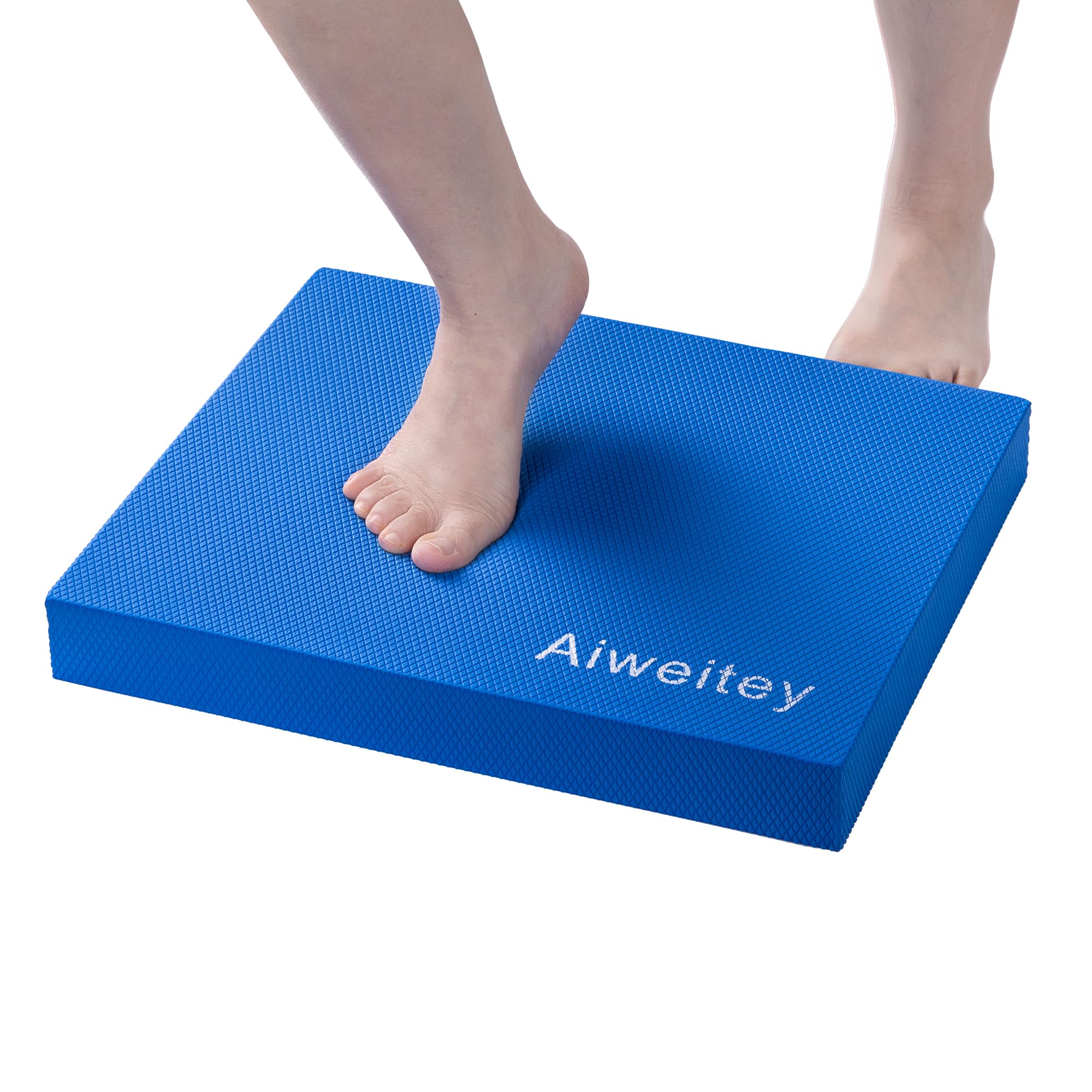
Soft, thick, and built to follow you into dance, Pilates, and therapy work without a wobble too far.
At 15.7 by 13 inches and 2 inches thick, this pad gives a moderate, forgiving rock — it tips enough to challenge you but not so far that you feel like you are falling. The foam is soft and thick enough to cushion knees and elbows, which is why it fits Pilates, dance, and standing drills equally well. It weighs 0.28 kg and carries a 300-pound stated weight capacity, so it stays put under a full standing load.
The design is simple and practical: a non-slip, water-resistant surface that will not soak up moisture, and an easy wipe-clean finish. Owners find it useful for therapy and appreciate the firmness — one describing the material as firm rather than mushy — while several note the size lands on the smaller side.
If your routine is mostly standing balance and knee-supported drills, this is a smart, sturdy choice. If you want to kneel across the pad or do wide squats, measure your stance first — 13 inches of width gets tight fast.
What you get: a soft-topped, water-resistant TPE pad that suits Pilates, dance, and light balance work, with a 300-pound weight capacity.
The catch: mixed feedback on size — the 15.7-inch length is fine for standing but snug for wide kneel or squat positions.
Suits you best if: your training blends Pilates, dance, and balance drills and you want a soft, sturdy pad.
Skip if: you need one pad to kneel on fully and squat wide on — the 13-inch width runs short.
5. Fragraim Balance Pad, Non-Slip Foam Mat, 15.7 x 13 x 2 Inch
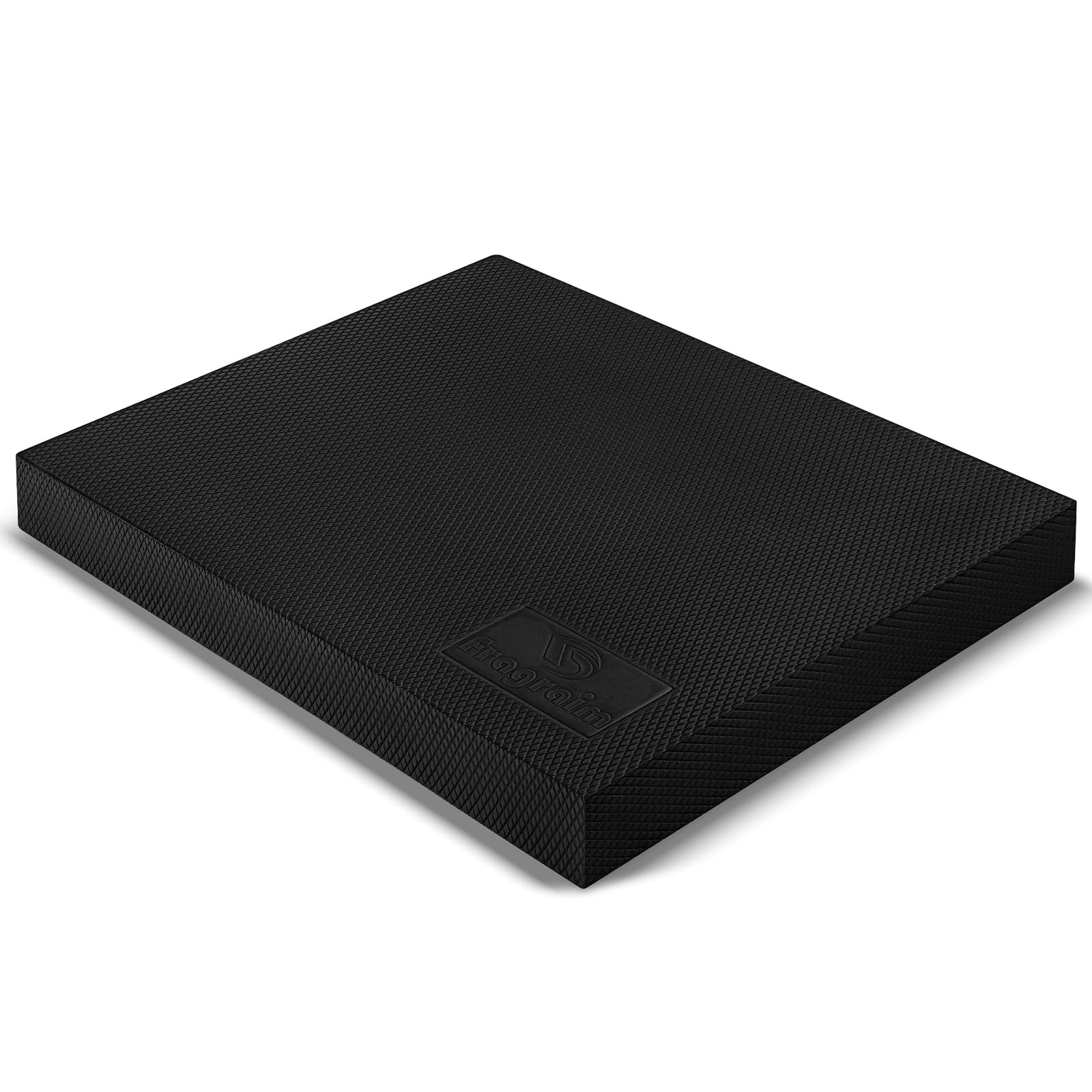
A do-everything pad that supports your knees, your stance, and even your standing desk without complaint.
The surface is where this one earns its keep: a textured, sweat-proof top that holds a bare foot during planks and squats. Owners consistently call the TPE foam solidly made and rate it highly as a general balance and workout platform. It measures 15.7 by 13 inches at 2 inches thick, thick enough to cushion your sit-bone, knees, and ankles without feeling like a mattress.
It is also a chameleon. Use it as a seat cushion, a gardening knee pad, a foot pad under a standing desk, or a meditation pillow — the same 2-inch foam does all of it. The TPE foam wipes clean with a damp cloth. Two inches of this pad is firm enough to challenge a standing drill but soft enough that a beginner can stay on it for a full minute.
The honest split in feedback is comfort and size — some find the dimensions perfect, others want an inch more, and comfort depends on exactly what you are resting on it. If you plan to use it heavily for kneeling, that is the case to weigh. For mixed standing and seated use, it is one of the more versatile pads in this list.
Why it earns a spot: a textured sweat-proof top, a 15.7-by-13-inch working surface, and a stand-in as seat pad, knee pad, and desk cushion.
Honest note: size and thickness draw mixed reactions — some want it an inch bigger, and comfort varies by use.
This is your pad if: you want one piece of foam for standing drills, kneeling, and desk support without picking a specialist.
Leave it if: you need a large kneeling surface — the 13-inch width and 2-inch depth are sized for standing and light kneeling.
6. NEXFIT High-Density Balance Pad

A high-density slab that stays firm under sweat and hard use — the pad you want for planks and lunges.
What owners rave about is the balance challenge — this pad is built around an unstable surface that keeps your core switched on during standing poses, plank holds, and single-leg drills. The high-density TPE foam is non-toxic and sweat-proof, so it does not go slick the moment your session heats up. It measures 15.5 by 12.75 inches at 2.25 inches thick, with a 300-pound stated weight capacity and a weight of 0.58 kg.
It suits everyone from athletes doing planks to beginners doing standing balance work. The non-slip surface keeps your footing secure during lunges and squats, and the same foam doubles as a seat, knee, or foot pad. The extra density is the reason it holds firmness and thickness over long sessions rather than slowly squashing down.
The trade-off is that a firmer, denser pad is less forgiving under a sensitive knee — if you want a plush landing, the Aiweitey or Milky House pads are softer. If you want a training surface that fights back, this is the one to grab.
The density argument: high-density TPE foam holds its firmness and thickness through sweaty sessions, so the balance challenge does not fade as you train.
One to weigh: denser foam means a firmer feel — soft landing it is not, so sensitive knees may prefer a plusher pad.
Your pick if: you want a firm, sweat-proof surface for planks, lunges, and core training.
Not your pick if: you want a soft cushion under sore knees — this pad prioritizes firmness over plush.
7. THERABAND Stability Trainer Pad

A narrow, firm beginner slab that asks less of you and fits in almost any corner.
The green beginner version is graded firm, and that firmness is the point: it introduces balance work without the deep wobble that sends beginners reaching for a wall. It measures 14.5 by 8 inches at 1.75 inches thick, so it is a one-foot pad by design. The PVC foam (a firm, dense foam) holds a steady platform, and the textured surface keeps your foot planted. At 8.8 ounces it is light enough to store in a closet or carry to a class.
Owners praise its firm PVC platform and build quality, and more than one finds it more challenging than standing on a pillow. It suits users building coordination, movement awareness, and confidence, and it works in a clinic, gym, or home equally well.
The limit is the footprint. Eight inches of width means one foot, not two, and 1.75 inches of thickness gives a shallower challenge than the thicker pads here. For a first taste of balance training or a travel pad, that is a fair trade. For wide standing work, it will feel cramped.
The beginner logic: a firm, shallow 1.75-inch platform that builds confidence before the deeper wobble of a thicker pad.
The size reality: 8-inch width and 14.5-inch length make this a one-foot pad, not a two-foot stance.
Start here if: you are new to balance work and want a firm, portable pad you can store anywhere.
Move on if: you already train single-leg stands comfortably — the shallow 1.75-inch depth will not challenge you for long.
8. Vive Oval Balance Pad
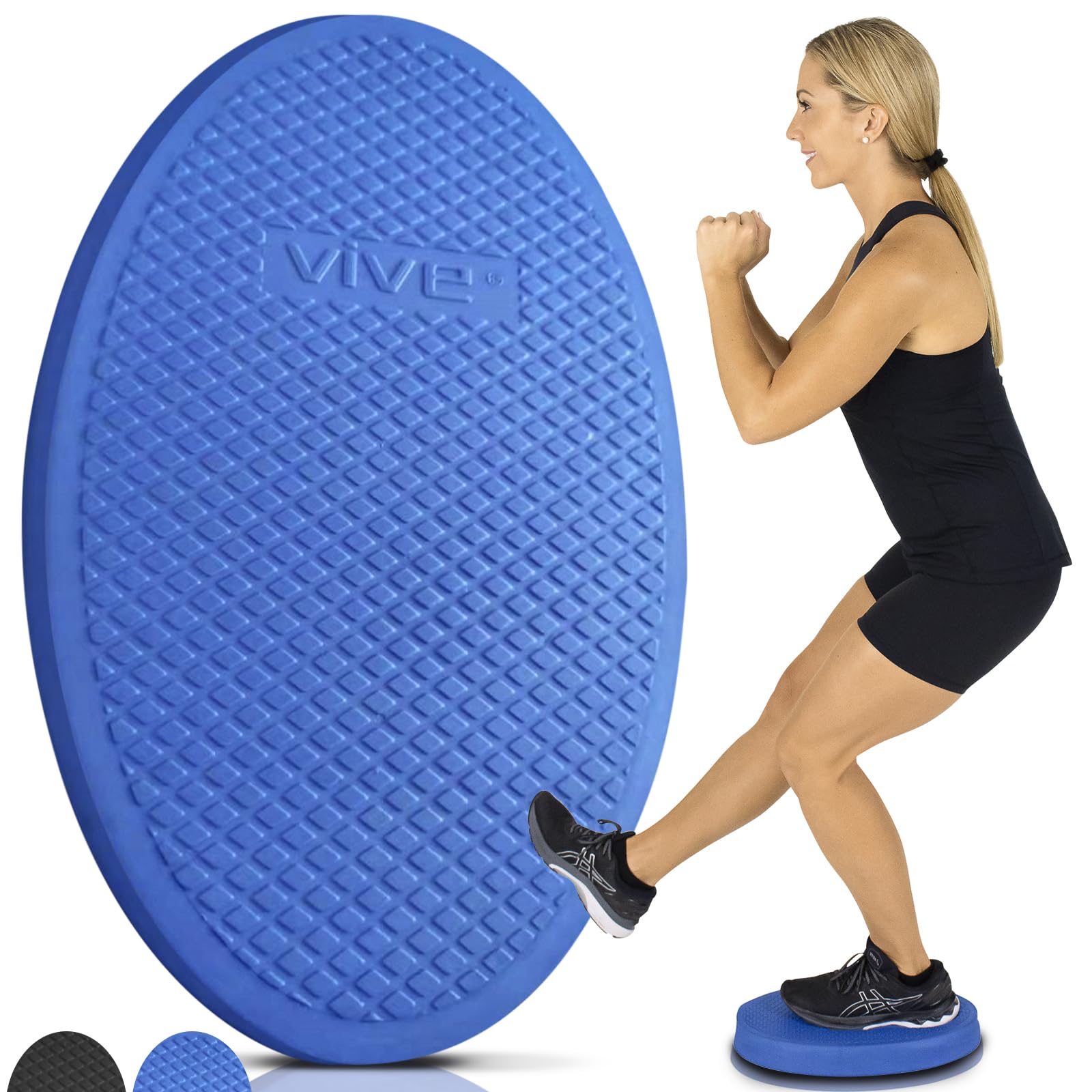
A thick oval pad that hides a firmer challenge than its soft look suggests.
At 2.5 inches thick, this is the tallest pad on the list after the HAPBEAR — it tips further and works your ankles harder than a 2-inch pad. It measures 16 by 12 inches, so it handles a standing stance and light kneeling, and the grippy surface holds a bare or socked foot. The TPE foam carries a 300-pound stated weight capacity, and the portable design moves easily between rooms.
Owners rate the build quality highly and report it works well for core and stability drills, with gains showing up quickly. The oval shape and grippy top make it easy to rotate between standing drills, plank work, and Pilates. A firmer pad means a controlled challenge — it is not a squishy cushion, and that is what buyers like about it.
The honest note is durability. While most find it tough, a few report wear issues with extended hard use. Treat it as a dedicated training pad rather than a multi-year garden kneeling cushion and it will serve you well.
Why it stands out: 2.5 inches of grippy TPE foam with a 300-pound stated capacity — more wobble than the 2-inch pads here.
The wear question: durability draws mixed reactions, so keep heavy kneeling sessions on a dedicated knee pad instead.
Worth grabbing if: you want a thicker pad for core and stability drills and like an oval shape.
Consider another if: you plan to kneel on it daily — the wear reports point to using it as a trainer, not a permanent cushion.
9. Therapist’s Choice X-Large (19″x15″x2.3″) Balance Pad
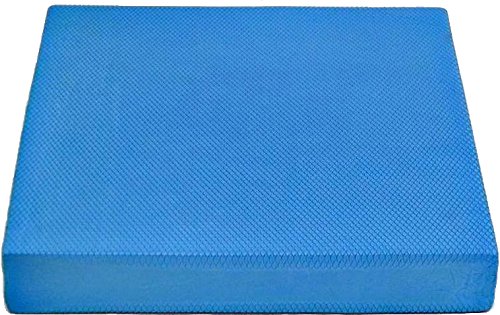
X-large closed-cell foam with room for big feet, deep stances, and a long day at the standing desk.
Match this against the Yes4All XL and the numbers are close: 19 by 15 inches of surface, but 2.3 inches deep instead of 2.25. The foam is closed-cell and latex-free, which keeps sweat and spills on the surface where a damp cloth can reach them. It weighs 0.7 kg. The 19-inch length is a real advantage for average to large feet — there is no heel hanging off the back.
Owners value its versatility most — it works as a balance pad, rehab pad, standing-desk mat, and sitting cushion. It works as a balance challenge for standing poses and arm balances, a rehab pad for gentle strengthening, a standing-desk mat, and even a sitting cushion for low back and pelvis support. The destabilizing surface switches on your back and abdominal muscles while you stand.
The firmness is where feedback splits — some find it firm and supportive, others want a softer feel. At 2.3 inches and closed-cell construction, it is not a plush cushion. If you want a soft landing for knees, look at the Aiweitey or Milky House pads; if you want a large, durable platform for standing and desk work, this is the premium answer.
The case for it: 19 by 15 inches of closed-cell, latex-free foam with a 2.3-inch depth — plenty of room for large feet and wide stances.
What to know: firmness is a split opinion, so do not expect a plush, sink-in cushion.
Choose it when: you have big feet or a wide stance and want a large, durable pad for standing and desk use.
Look elsewhere if: you want a soft, deep-sink cushion under your knees — this foam stays on the firm side.
Know the Specs
Foam Density and Firmness
Density decides how much the pad fights back. High-density TPE foam holds its shape under a standing load, so your ankle has to correct and your calf has to fire. A softer foam sinks under your heel and asks less — comfortable, but a gentler balance challenge. Firm does not mean hard; it means the pad supports you rather than swallowing you.
Thickness and the Wobble Scale
Thickness sets difficulty. A 1.75-inch pad gives a shallow, beginner-friendly rock. A 2-inch or 2.25-inch pad tips enough to challenge most adults. A 2.5-inch or 6cm-thick pad tips further and works the small stabilizing muscles harder. Thicker is harder, not better — only useful if you can stay on it without grabbing a wall.
Footprint and Stance Room
Length and width decide what you can actually do on the pad. A 12-inch by 9-inch pad is a one-foot tool. A 15-inch by 13-inch pad handles a narrow two-foot stance. A 19-inch by 15-inch pad gives you shoulder-width standing, kneeling, and desk use. Measure your stance before you buy — a too-small pad turns every drill into a careful shuffle.
Surface Grip and Material
TPE and EVA foams both resist moisture and wipe clean. A textured, sweat-proof top holds a bare foot during a sweaty session, and a textured base stops the pad from sliding on a hard floor. Closed-cell foam keeps moisture on the surface so the pad stays fresh longer. Store it flat and out of direct heat to keep it from warping.
Common Questions
Is a firmer balance pad harder or easier to stand on?
How thick should a balance pad be for a beginner?
Can I use a balance pad barefoot or with shoes?
Will a balance pad fit under a standing desk?
How do I clean a foam balance pad?
Is a balance pad the same as a yoga mat?
What is the weight limit on these pads?
How much floor space does a balance pad take up?
Can a balance pad help with ankle strength?
The Bottom Line
For most people, the yoga balance mat that does the most jobs is the Yes4All Exercise Balance Pad XL, because its 19-by-15-inch footprint and dense TPE foam cover standing drills, kneeling work, and desk use in one slab. If your priority is sweat-proof firmness for planks and lunges, grab the NEXFIT High-Density Balance Pad. And for a beginner who wants a firm, portable, one-foot pad, the THERABAND Stability Trainer Pad is the gentle place to start — a smart first buy if you want a firm, shallow 1.75-inch platform before moving up to a thicker pad.
How we choose
We do not accept paid placement. Every pick is matched to a real buyer and a real use-case; we do not hands-on test units.
Sources
Specifications: manufacturer listings and product documentation. Review insights: verified customer reviews, as of November 2026. Pricing: not shown on this page (it changes often); check the current price via the retailer link.
As an Amazon Associate, Tactical Gear Guy earns from qualifying purchases. This does not affect which products we feature.