Specs are compiled from manufacturer listings and verified buyer reviews and can change over time — please confirm the key details on the product page before buying.
If you want one board that will last through years of daily chopping, buy the thickest end-grain board you can afford and treat it well. A board roughly 1 inch or thicker stays put while you chop, cushions the knife edge instead of dulling it, and resists warping when it gets wet. The picks below range from 1.25 inches to 1.75 inches thick, and every one of them is a real board with real specs listed for you to compare.
This guide is built by comparing the manufacturers’ published specifications and the patterns across verified customer reviews, so you get each pick’s real strengths and trade-offs instead of marketing spin.
You’ll see how wood species, grain direction, and thickness change how a board cuts, cleans, and holds up. By the end you’ll know which board fits your counter space and your knife.
Top Picks

How To Choose The Best Thick Wooden Cutting Boards
Thickness is the first number you check, because a board only counts as thick if it is around 1 inch or more. Every board here clears that bar. The real decision depends on three things: how the grain is cut, which wood you pick, and whether the board physically fits where you chop. Get those three right and the board should last for years.
End grain versus edge grain
End grain means the wood fibers stand upright like a bundle of straws, so your knife edge slips between them instead of slicing across them. That is why end-grain boards are softer on blades and show fewer permanent marks. Edge grain runs the fibers lengthwise; it is denser-looking and often less expensive, but it tends to show scratches sooner. Both types are in this list, and both are legitimate.
Picking the wood species
Walnut is dark, dense, and resistant to deep knife marks. Teak naturally resists moisture absorption thanks to a tight grain structure. Maple is the traditional butcher-block wood — dense but gentle on knives. Suar is a dense exotic hardwood with bold grain patterns. None of these is wrong; the choice is about look, weight, and how much maintenance you want to do.
Size and weight on your actual counter
A 20-inch by 15-inch board is generous for carving a whole bird or prepping a family meal. A 16-inch by 10-inch board fits a smaller counter and is easier to lift. Weight matters more than you think: a heavy board stays planted while you chop, but you still have to move it to the sink for hand washing. Look for built-in handles or finger grips if the board is on the heavier side.
Side-by-Side Comparison
| Model | Best For | Thickness | Wood / Grain | Weight | Amazon |
|---|---|---|---|---|---|
| Babilonia Large Walnut End Grain★ Best Overall | Overall end-grain value | 1.4″ | Walnut / End Grain | — | Amazon |
| Yes4All Teak Edge GrainBest Carving Surface | Big carving surface | 1.5″ | Teak / Edge Grain | 9.1 lb | Amazon |
| John Boos Prestige MapleCompact Standard | Compact everyday prep | 1.25″ | Maple / Edge Grain | 5.4 lb | Amazon |
| Beefurni Teak with Juice Groove | Carving and serving | 1.25″ | Teak / Edge Grain | 9 lb | Amazon |
| Winco WCB-1824 | Commercial-grade volume | 1.75″ | Hardwood / Solid | 17.8 lb | Amazon |
| HexClad Walnut | Counter showpiece prep | 1.25″ | Walnut / Solid | 8 lb | Amazon |
| Babilonia American Walnut End Grain | Two-person portions | 1.7″ | Walnut / End Grain | — | Amazon |
| Shumaru XL End Grain | Maximum flat workspace | 1.6″ | Suar / End Grain | 11 lb | Amazon |
| Bevel & Bond Maple End Grain | Made-in-USA craftsmanship | 1.75″ | American Maple / End Grain | 10 lb | Amazon |
Detailed Reviews
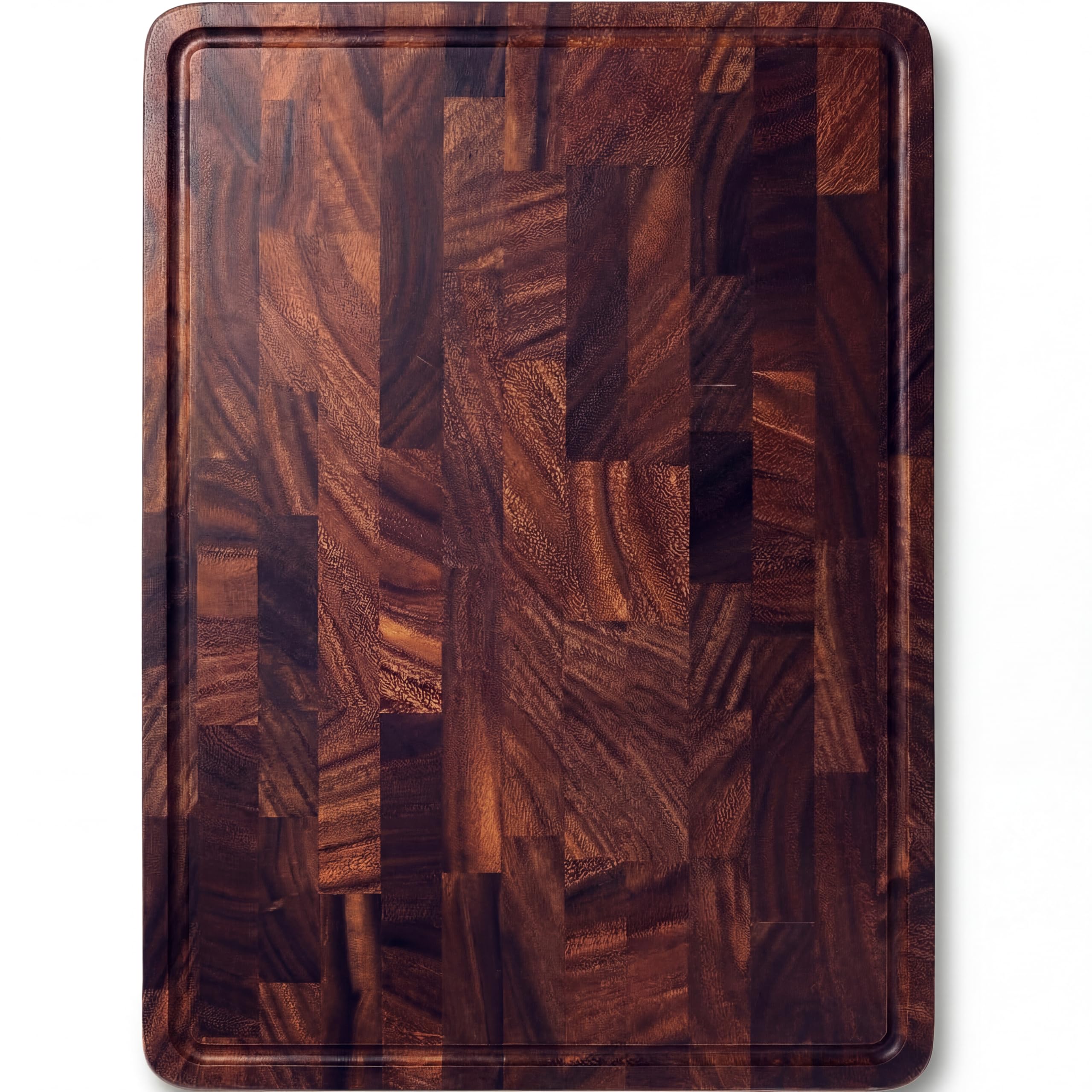
1. Babilonia Walnut Wood Cutting Board
Our pick — 4.5+★ from 350+ verified ratings; the strongest balance of quality and price.
A dark walnut end-grain block that turns chopping into a pleasure and doubles as your serving board.
This is a 20-inch by 16-inch board at 1.4 inches thick, cut using end grain so the wood fibers stand upright and let your knife edge slip between them. In plain terms, that means your blades stay sharper longer and the surface shows fewer deep gouges than a flat-grain board would. The walnut construction is solid and dense, which is exactly what you want under heavy chopping — it does not slide or shift while you work.
What wins people over most is the build quality, and the dark walnut face genuinely looks like a piece of furniture rather than a tool. It arrives pre-seasoned and pre-oiled with a bottle of organic oil included, so you can use it straight away. One side has a built-in groove for catching juices and it has a built-in handle for lifting. The board is hand-wash only, which is the standard for any quality hardwood board — never put it in a dishwasher.
The one catch: walnut is dense, so it resists deep marks better than softer woods but it still develops scratches with heavy daily use over time. That is normal for any wood cutting board used seriously. Oil it regularly and those marks stay surface-level rather than becoming deep cuts. If you want a board that looks like furniture on the counter and holds up to daily chopping, this is the pick.
What earns its keep
- End-grain construction protects knife edges and resists deep marks
- Arrives pre-oiled with organic oil bottle included
- Built-in groove and handle for easy lifting and juice control
- Walnut density delivers stability under heavy chopping
What to keep in mind
- Hand-wash only — never dishwasher
- Dense walnut still shows scratches with heavy daily use
- 1.4 inches thick rather than the fullest 1.75-inch height
Best for: Anyone who wants a do-it-all end-grain board that looks as good on the table as it performs at the counter.
May not suit: Cooks who want to be able to toss their board in the dishwasher after every meal.
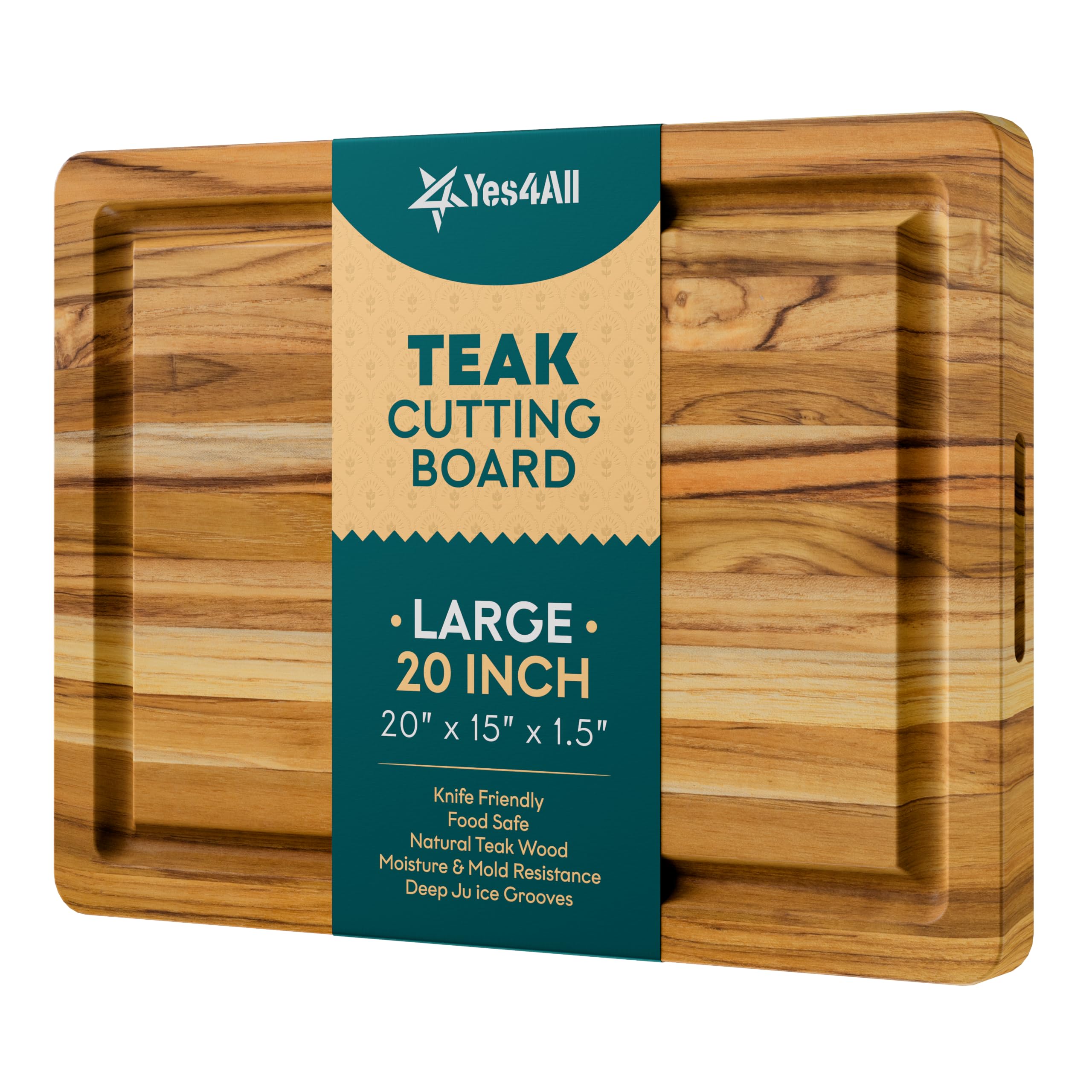
2. Yes4All Teak Cutting Boards 20″ x 15″
A thick teak slab that takes up serious counter space and carves a 25-pound bird without flinching.
Here is the board to reach for when Thanksgiving arrives. This teak board measures 20 inches long by 15 inches wide by 1.5 inches thick and weighs 9.1 pounds — heavier than the John Boos at 5.4 pounds, which is exactly what you want when you are bearing down through a roast. Compare that to the Boos at 16 by 10 by 1.25 inches: the Yes4All gives you a meaningfully bigger surface for carving, at a thicker 1.5-inch profile versus 1.25 inches. That extra surface makes a real difference when you are working around a bone-in ham.
Teak naturally resists moisture, which is a benefit for a board that sees a lot of wet washing. The tight grain helps keep surface wear slow, and the edge-grain construction gives it a clean look. A deep juice groove on one side catches runoff from carving, and built-in handles make it easy to carry from counter to table. The scrubbed surface is gentle on your knife edges.
The honest trade-off: at 9.1 pounds, it is not a board you will toss around casually. It is heavy and unwieldy for a quick onion chop, and hand-wash only applies here as with every wood board on this list. A few people mention the weight being a challenge when moving it to the sink. If your counter space is small or you want something lighter for quick prep, this might not be your daily board. For big cuts and holiday cooking, it earns every ounce.
Built for big cuts: With a 20 x 15 inch face at 1.5 inches thick and 9.1 pounds of teak underneath, this board holds steady while you carve a large roast or whole bird. The juice groove catches the runoff so your counter stays clean.
The weight question: Nine pounds of teak is the point here — it is what keeps the board planted. It is also what you lift every time you need to wash it. Expect to wash in place or carry it with both hands.
Pick this: For people who carve whole birds, roasts, or big family meals and want a board that holds still under pressure.
Look elsewhere if: Counter space is tight or you want a lightweight board for quick everyday chopping.
3. John Boos Block MPL1610125-FH-GRV Cutting Board
The compact maple classic that fits a small counter and handles onion-and-garlic prep without hassle.
At 16 inches long by 10 inches wide by 1.25 inches thick, this Boos is the smallest board on the list, and that is its strongest argument. It weighs 5.4 pounds and sits comfortably on a narrow counter or next to a stove. Maple is the wood professional kitchens have leaned on for generations — dense enough to last, gentle enough that your knives do not suffer. The edge-grain construction gives it a clean surface with a finger-hole grip for easy lifting.
Both sides are reversible, and one side has juice grooves for catching liquid from fruit or small cuts. It arrives with an oil finish from the factory, so it is ready to use once you give it a quick once-over. Hand-wash only, and Boos recommends their Mystery Oil and Board Cream (sold separately) to keep the surface conditioned. What the board offers that the big teak boards above do not is a footprint that actually fits a small counter without dominating it.
The honest note: this board is 1.25 inches, so it is on the thinner end of the thick-board range. If you regularly carve whole roasts or heavy cuts, you will want more mass underneath you. This one is built for everyday prep — onions, garlic, vegetables, bread, and light meat work — and it does that job well. For a compact kitchen or a first real wood board, it is a sensible starting point.
Small-counter friendly: The 16 by 10 inch face at 1.25 inches thick and 5.4 pounds means it does not crowd your workspace. Reversible sides with a finger-hole grip make it easy to flip, lift, and store.
Where it holds back: With 1.25 inches of thickness, it lacks the mass for heavy carving. It is a prep board, not a butcher block. Expect to reach for a heavier board when a whole chicken is on the counter.
Your match if: You cook in a small kitchen, need a board that fits easily, and mostly do vegetable and light-meat prep.
Think twice if: You want a single board that can handle carving a whole turkey or breaking down large cuts.
4. Beefurni Teak Wood Cutting Board
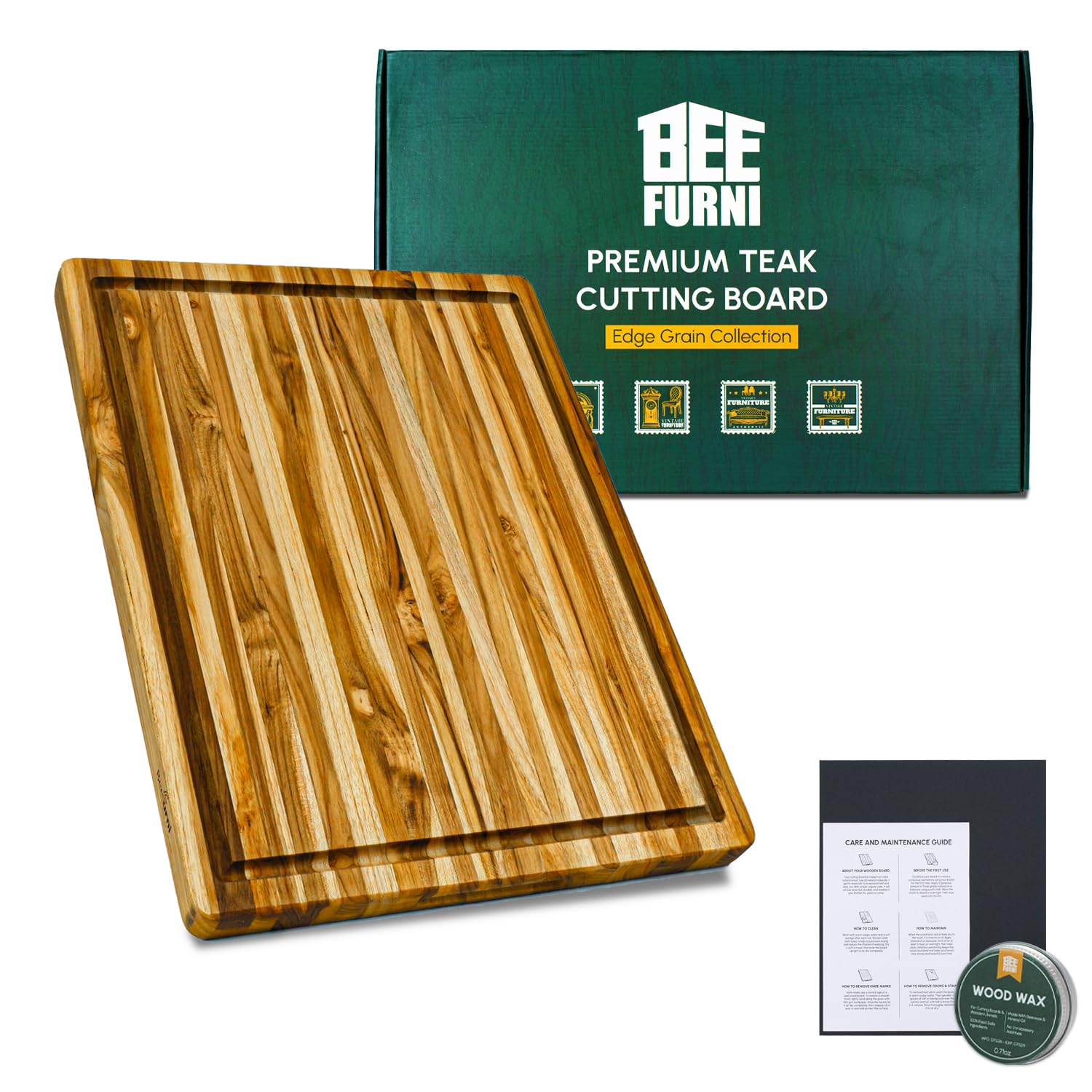
A big teak board that goes from chopping board to charcuterie platter without skipping a beat.
What draws people to this board is how it looks. The rich teak grain and warm tones give it a presence that most cutting boards lack. It measures 20 inches by 15 inches by 1.25 inches and weighs 9 pounds, giving you a substantial surface to work with. Two built-in handles on the sides make it easy to carry, and one side carries a deep juice groove for carving meat or serving juicy fruit while the other side is flat for everyday chopping.
Teak resists moisture naturally thanks to a tight grain structure, and the edge-grain construction keeps the surface stable. It comes with a free maintenance kit and a one-year replacement policy against manufacturing defects. The board is gentle on knife edges compared to bamboo or plastic, and its size makes it ideal for carving a smoked brisket or laying out a cheese spread for guests.
The catch: at 1.25 inches, this sits on the thinner side of thick, similar to the Boos above. It handles everyday prep fine but you will not get the same heavy, planted feel as the 1.75-inch boards on this list. Also, this is hand-wash only, and the wood needs regular oiling to keep its looks. If you want a board that doubles as a serving piece and looks great doing it, this is a strong choice.
Looks and function together: Teak grain gives it a beautiful face, and the reversible design lets you chop on one side and serve on the other with a deep groove catching every drop.
Thickness trade-off: At 1.25 inches it is thick enough for everyday prep but not as substantial as the 1.75-inch boards. Keep it oiled and it will serve you well for years.
Reach for this if: You want one board that transitions from kitchen prep to table-side serving and looks good enough to display between meals.
skip it if: You need maximum thickness and mass for heavy butchering — the 1.25 inches here are not built for that job.
5. Winco WCB-1824 Wooden Cutting Board, 18″ x 24″ x 1.75″

A 17.8-pound hardwood workhorse built for restaurant kitchens and big holiday spreads.
Start with the number that defines this board: 1.75 inches thick. That is the same full thickness as the Bevel & Bond at the premium end, but on a much bigger 18-inch by 24-inch footprint. It weighs 17.8 pounds versus the Yes4All at 9.1 pounds. That mass is the whole point. The board will not slide, flex, or shift under a heavy cleaver, and the solid hardwood construction is dense enough to keep your knife edges from dulling quickly.
What earns this board its following is value for the size and heft you get. The wood handles a whole 25-pound turkey or a bone-in ham without running out of room, and the natural finish gives it an upscale look that suits both the back kitchen and the front-of-house carving station. Two recessed handles along the edges make it maneuverable for its weight, and the smooth finish cleans up without drama.
The catch is obvious from the weight number: 17.8 pounds is not a board you grab one-handed. It is a two-hand lift to the sink, and it needs a storage spot where you can leave it out. Hand wash only, and the wood needs periodic oiling. If you have the counter space and you cook big meals regularly, this is the most board you can get for the money.
Why cooks go big
- 1.75 inches thick and 17.8 pounds of solid hardwood for rock-steady chopping
- 18 x 24 inch surface fits a 25-pound bird or a whole ham with room to work
- Two recessed handles for moving a board this heavy
- Commercial-kitchen durability
The weight reality
- 17.8 pounds means it is a two-handed lift to the sink
- Hand wash only and needs periodic oiling
- Needs dedicated storage space on or near the counter
Built for: Serious home cooks and big-family kitchens where a board earns its counter footprint through daily heavy use.
Not for: Small kitchens or anyone who wants a board they can pick up and store in a cabinet.
6. HexClad Walnut Solid Wood Cutting Board
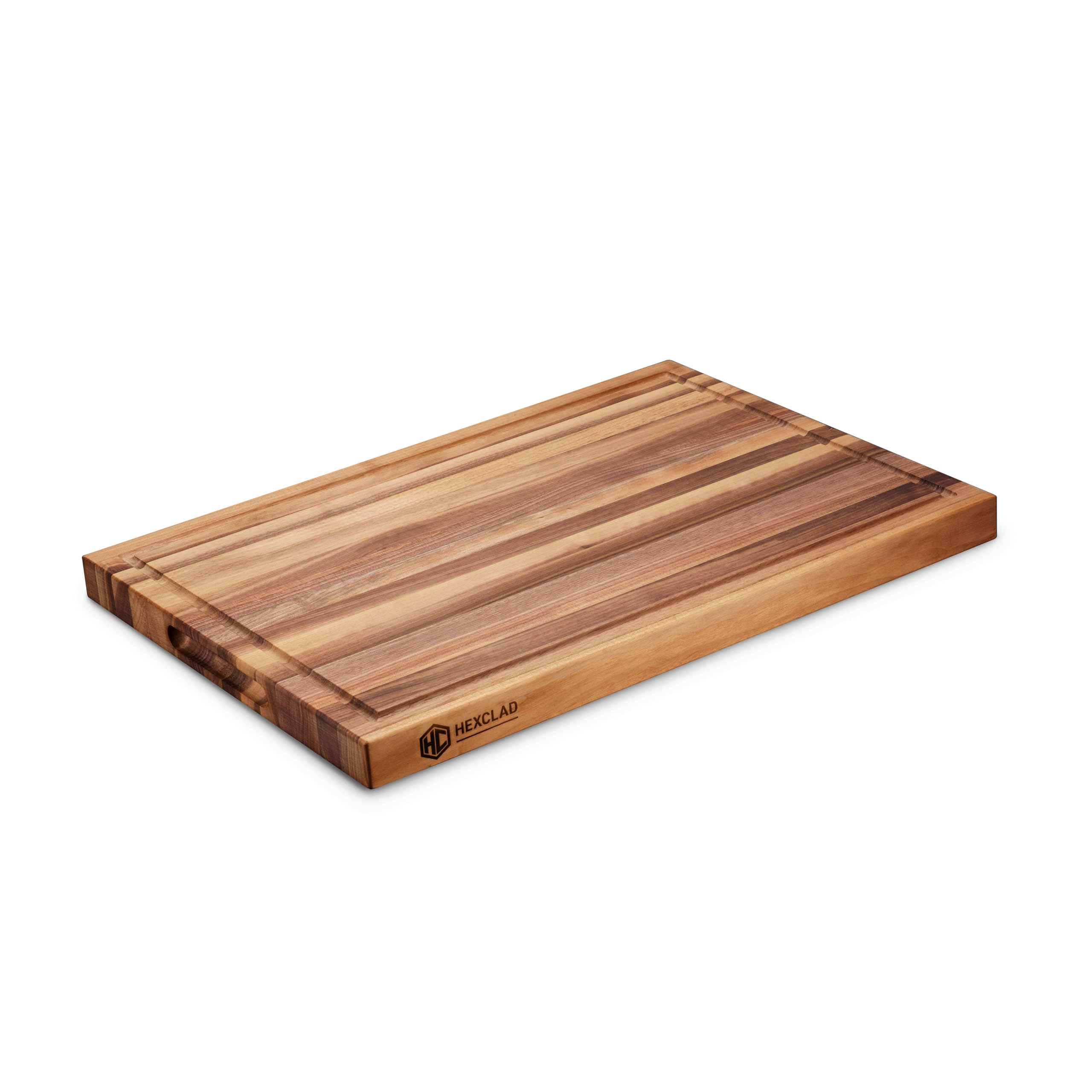
Walnut so dark and dense it looks like a design piece until you start chopping on it.
HexClad’s walnut board measures 20 inches long by 13.75 inches wide by 1.25 inches thick and weighs 8 pounds. Walnut’s density is what the board is selling: it resists deep knife marks, helps keep staining down, and carries natural properties that suit raw meat prep. The tight grain also helps block lingering odors from garlic, onions, and aromatic herbs, which is a practical benefit for a board that sees a lot of action.
The design is clearly meant to be seen. Contrasting walnut grain, recessed handles for flipping and lifting, and a two-sided build with a grooved side for juices and a flat side for dicing or plating charcuterie. What wins people over most is the look of the thing — it earns the counter display spot. It hand-washes easily and the dense structure means it takes normal wear better than softer woods.
The honest caveat: walnut this dense can still scratch up over time with hard use, and the size leaves less room for error than the widest boards here. A 20-inch by 13.75-inch surface is a comfortable prep size for most meals but not a whole-turkey carving station. Hand-wash only and oil it regularly. If you want a good-looking board that works hard and you mostly prep vegetables and proteins, this is the one to put on the counter.
The design edge: Walnut grain with warm contrast against the darker face makes this board a legitimate serving piece. Recessed handles and a grooved side let it do real work as well as visual work.
Scratches are part of the deal: Dense walnut resists gouging but does show marks with time and heavy use. That is normal for wood. Keep it oiled and those marks stay surface-level.
Made for you: Cooks who want a board that looks good enough to leave on the counter and handles daily vegetable and protein prep.
Not ideal: Whole-bird carving sessions or anyone who wants the biggest possible surface under a heavy cleaver.
7. Babilonia American Walnut Butcher Block
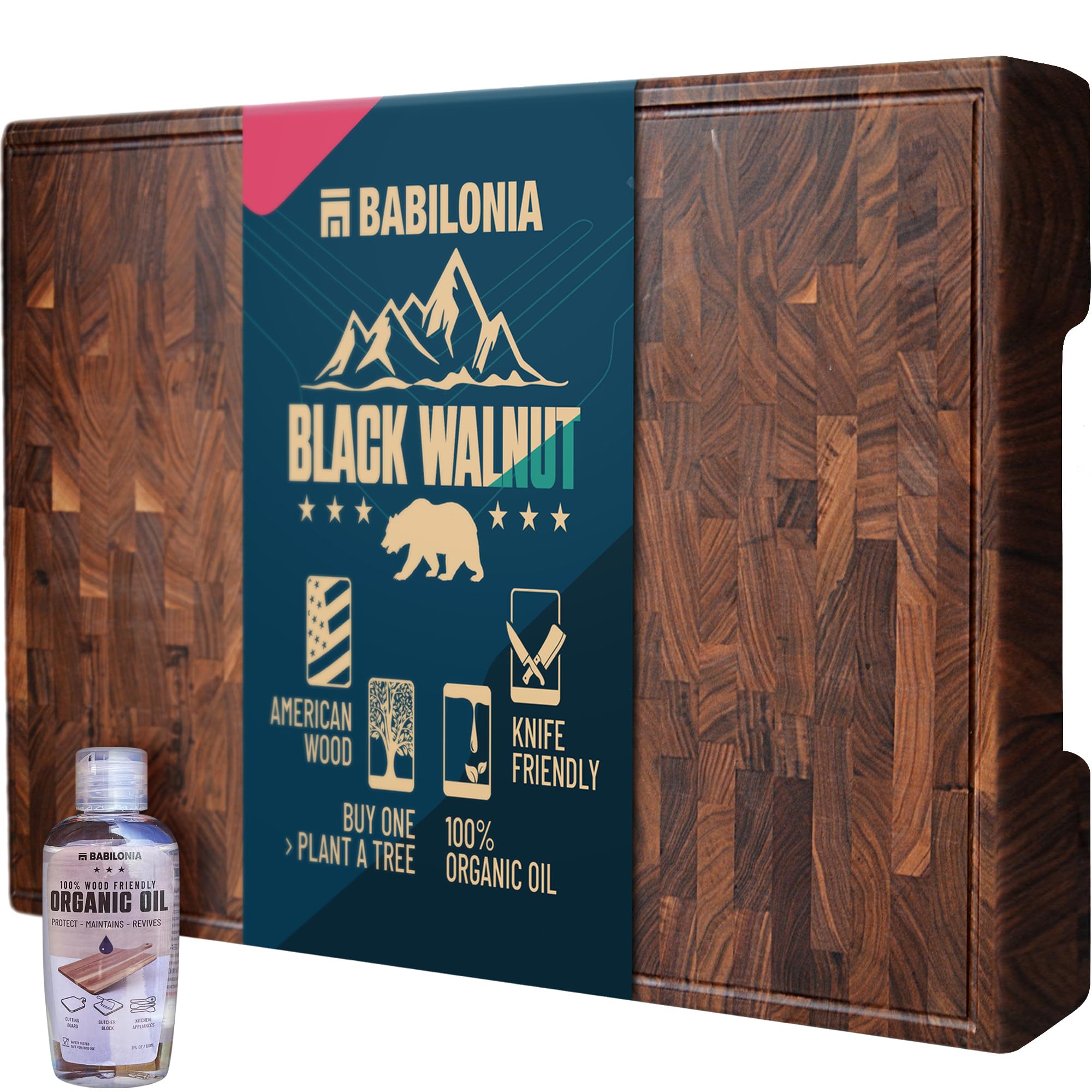
A 1.7-inch end-grain block with a clever notch that lets you slide chopped food straight into the pot.
This board is 15.7 inches by 10.2 inches at a full 1.7 inches thick — nearly as thick as the biggest boards here — but in a footprint sized for a two-person household and a modest counter. Using sustainable black walnut grown in America, it has the dense, dark look that end-grain walnut delivers. The 3-in-1 design is the standout: a notch and slide-off plate let you push chopped produce into your pot or bowl without picking the board up. No more lifting a heavy block just to transfer an onion.
What makes it appealing is the combination of the look and the thought-through design. The board is reversible so you can flip it and use the underside as a serving tray, with a hidden handle integrated into the build. It comes pre-seasoned and pre-oiled with a free bottle of organic oil included, plus that slide-off plate. The maker offers a 2-year warranty with money-back guarantee and 24/7 customer support.
Where it compromises: the 10.2-inch width and 15.7-inch length make it a two-person board by design — it will not swallow a large brisket or a whole turkey. If you are cooking for a crowd, go bigger. For everyday meals and a board that stays handy without eating your whole counter, this size is actually a plus. At 1.7 inches thick, it gives you real heft without the bulk.
The 3-in-1 advantage
- Slide-off plate and notch let you transfer chopped food without lifting the board
- 1.7 inches of end-grain walnut for real thickness in a compact size
- Reversible with hidden handle for use as a serving tray
- Includes organic oil and a 2-year warranty
The size ceiling
- 15.7 x 10.2 inches is a two-person board — not a carving surface for big roasts
- Hand wash only and needs periodic oiling
Great fit for: Couples and solo cooks who prep meals for one or two and want thickness without a counter-blocking board.
Go bigger if: You regularly cook for a crowd or carve large cuts — this footprint will not hold a holiday roast.
8. SHUMARU XL End Grain Cutting Board
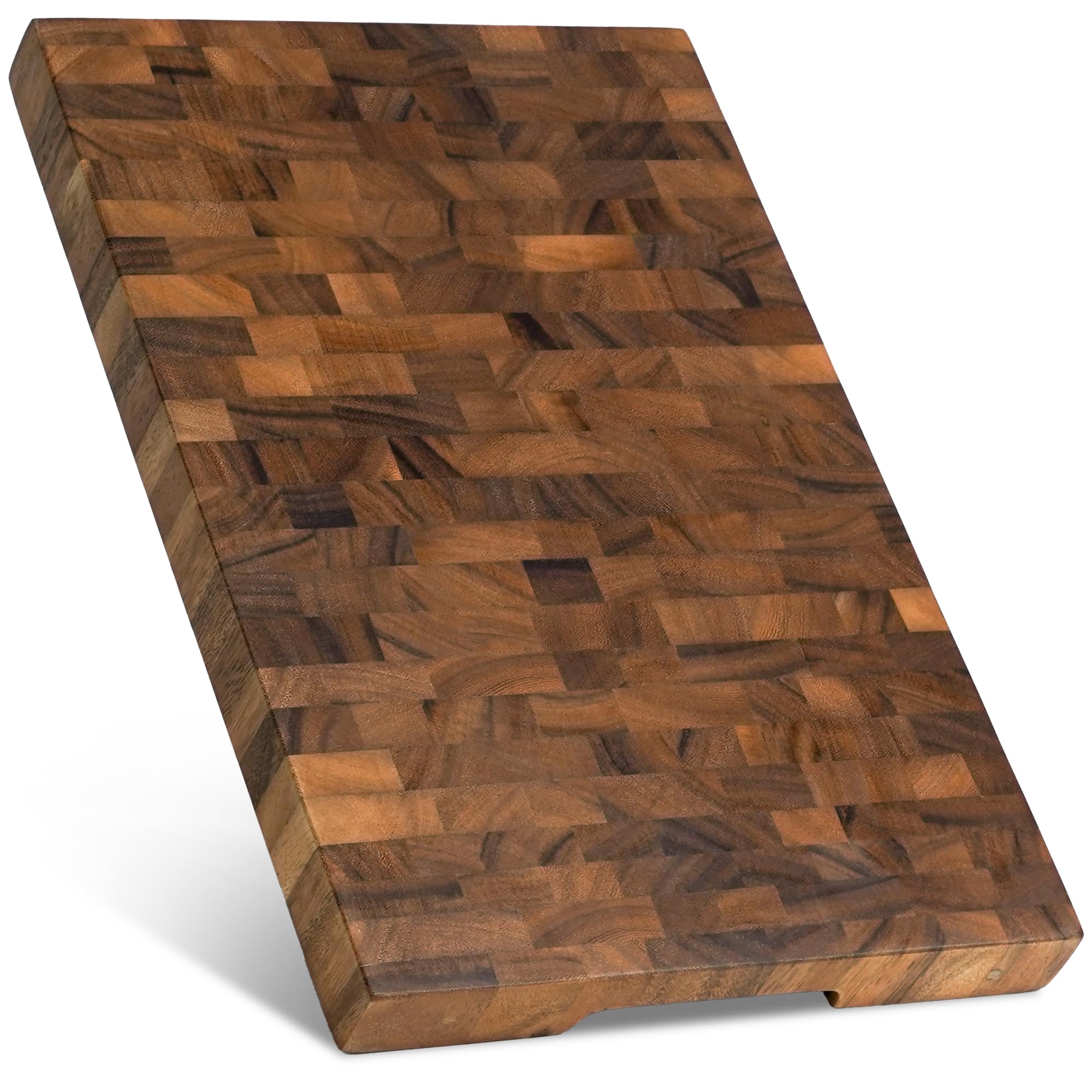
An 11-pound slab of exotic suar with no juice groove at all — the whole face is chopping room.
The number that sells this board is 260 square inches of uninterrupted prep space across a 20-inch by 13-inch face at 1.6 inches thick. There is no juice groove because the design puts every inch to work — chopping vegetables, kneading dough, rolling pastries, building pizzas. That flat, groove-free layout is a deliberate choice, and it is genuinely useful if dough and pizza are part of your cooking routine.
Eleven pounds of suar heartwood keeps the board firmly in place while you work — no flexing, no shifting. The premium end-grain construction uses self-healing wood fibers that help preserve blade sharpness and reduce visible cut marks compared to flat-grain surfaces. Suar’s naturally rich grain means no two boards look the same, and the design transitions from prep station to serving board for charcuterie or as a pizza board.
The trade-off worth naming: without a juice groove, carving a juicy roast on this board will send liquid toward the counter edge. And the recommended care is regular mineral oil every 3 to 4 weeks, so it does ask for maintenance. Some buyers report the wood buckling over time, which makes the oiling routine especially worth keeping up with. For heavy prep and dough work, the flat face is hard to argue with.
All surface, no groove: 260 square inches of flat suar end grain is room you can actually use for dough, pizza, and meal prep. Eleven pounds of mass keeps it planted while you roll and knead.
No groove, so plan around it: Carving a juicy roast here means watching for runoff. Keep the mineral oil on a 3 to 4 week schedule and the board rewards you with years of service.
Suits: Bakers and meal-preppers who want maximum flat workspace for dough, pastry, and pizza on a board that stays put.
Consider another pick if: You mostly carve juicy meats and want a groove built in to catch the runoff.
9. Bevel & Bond Maple End-Grain Cutting Board
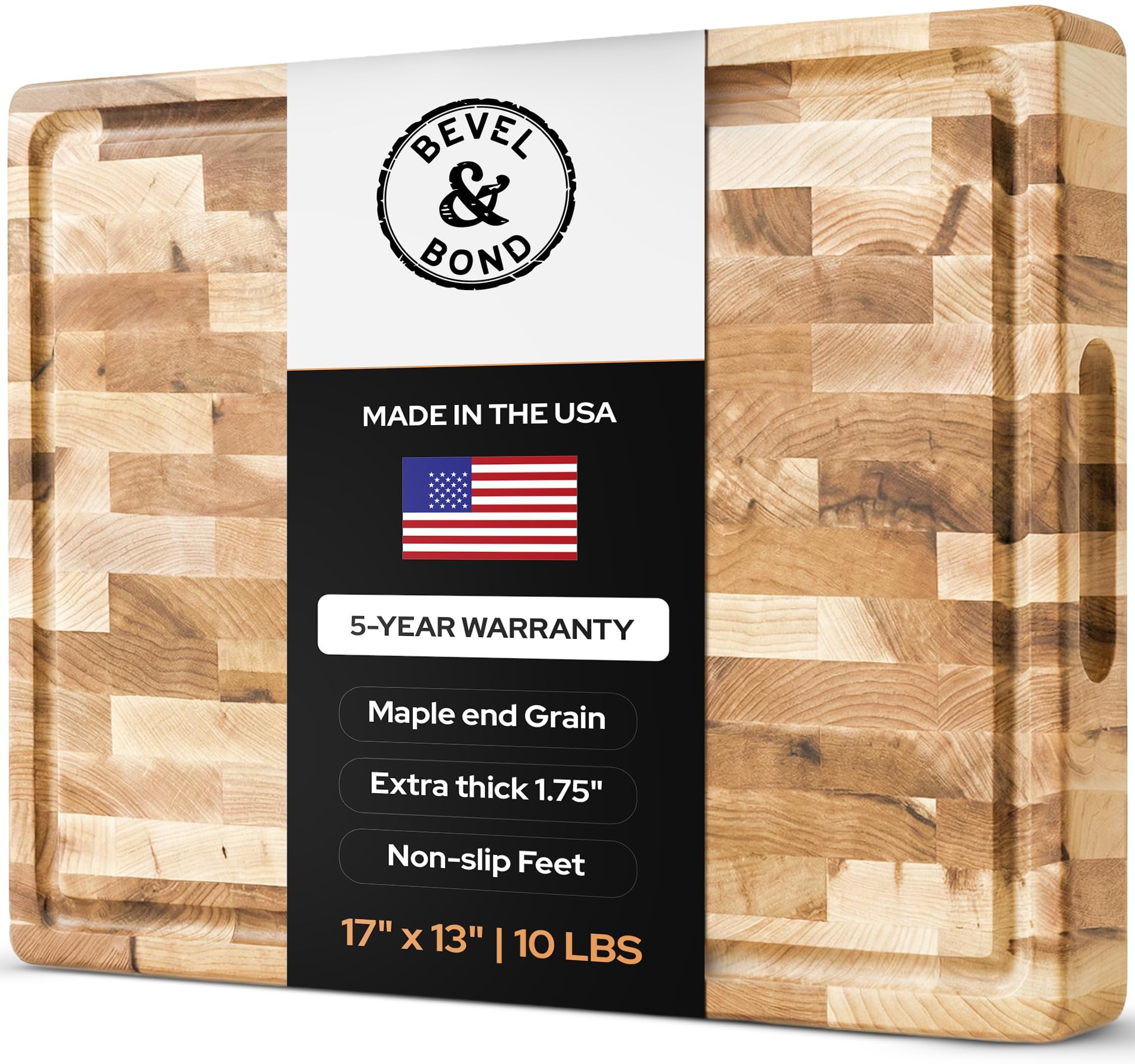
Handcrafted American maple at a full 1.75 inches, with rubber feet so it never budges.
This board comes from American woodworkers who handcraft each one, and the specs back up the craft claim: 17 inches by 13 inches at a full 1.75 inches thick. That is full butcher-block height, matched to a compact footprint. It weighs 10 pounds, which is heavy enough to stay planted under pressure but light enough to move with two hands. The 1.75-inch end-grain maple construction handles everything from fine vegetable prep to breaking down large roasts and whole chickens.
What makes it stand apart from the other thick boards here is the non-slip rubber feet. They keep the board planted on your countertop while allowing airflow underneath, so moisture does not trap beneath it. Deep finger grips on both sides let you move it from counter to table for carving, and a deep juice groove catches liquid runoff from large cuts. North American hard maple is dense enough for long-lasting durability yet gentle on your knives, and end-grain construction lets the blade edge follow the wood grain instead of cutting across it.
Bevel & Bond backs it with a 5-year warranty against manufacturing defects, and registering the board gets you a complimentary tin of Board Balm. The honest note is that no wood board is immune to trouble — some owners mention splitting, so keeping up with the monthly conditioning the maker recommends is worth taking seriously. Hand wash only, never soak, and dry it upright. If you want the full 1.75-inch thickness, made-in-USA craft, and a warranty, this board delivers all three.
Craft you can see: Handcrafted American hard maple at a full 1.75 inches thick, with rubber non-slip feet that keep it planted, a deep juice groove, and deep finger grips on both sides.
Conditioning is not optional: Some boards split, which makes the monthly Board Balm routine the most important habit you can build. Register your board and the maker sends a complimentary tin.
Choose it when: You value American craftsmanship, want the full 1.75-inch thickness, and will commit to monthly conditioning.
Pass on it if: You want a set-and-forget board that needs no oiling — this one asks for routine care to earn its 5-year warranty.
Know the Specs
Thickness and weight
Thickness is measured in inches, and anything 1 inch or more counts as a thick board. A board at 1.25 inches is a solid everyday prep surface. A board at 1.5 to 1.75 inches gives you more mass, which keeps it from sliding while you chop and gives you more material to sand back if scratches build up. Weight follows thickness and wood density. A 5.4-pound board is easy to lift; a 17.8-pound board stays planted but takes both hands to move. Match weight to how much lifting you want to do.
Grain direction
End grain means the wood fibers run vertically, like a bundle of straws facing up. Your knife edge slips between the fibers rather than slicing across them, which keeps blades sharper and shows fewer permanent marks. Edge grain runs the fibers lengthwise and looks denser on the surface; it often costs less and still delivers long life. End-grain boards are softer on knives and tend to self-heal over time with oiling. Edge-grain boards are more affordable and easier to clean the surface of. Both are legitimate choices depending on your budget and how hard you work the board.
Wood species and care
Walnut is dense, dark, and resists deep knife marks. Teak resists moisture naturally thanks to a tight grain. Maple is the traditional butcher-block wood, dense but gentle on blades. Suar is a dense exotic hardwood with bold grain. Every wood board needs the same care: hand wash with mild soap and warm water, never dishwasher, and never soak. Dry it upright so both faces breathe, and oil regularly — some boards ask for it monthly, others every few weeks.
Juice grooves and handles
A juice groove is a channel cut around the edge of the board that catches liquid from carving meat or slicing juicy fruit so it does not run onto your counter. If you carve roasts or whole birds regularly, a groove is worth having. Recessed or built-in handles make a heavy board manageable. Some boards have a flat, groove-free face on both sides for maximum chopping room — those suit dough work and vegetable prep better than carving. Think about which tasks you do more often before you pick.
Common Questions
How thick should a good wooden cutting board be?
Is end grain better than edge grain for a cutting board?
Can I put a thick wooden cutting board in the dishwasher?
How often should I oil a wooden cutting board?
Will a thick wooden cutting board dull my knives?
Is a 20-inch cutting board too big for a normal kitchen?
Can I use a heavy wooden cutting board for raw meat and vegetables?
How do I stop a lightweight wooden board from sliding?
How long does a thick wooden cutting board last?
Should I pick a wooden board with a juice groove or a flat one?
The Bottom Line
The thick wooden cutting boards winner for most kitchens is the Babilonia Large Walnut End Grain board because its 1.4-inch end-grain walnut construction protects your knives, stays planted under heavy chopping, and arrives pre-oiled with the organic oil included. If your cooking revolves around big holiday cuts, grab the Winco WCB-1824 with its 1.75-inch thickness and 17.8 pounds of hardwood stability. And for bakers who want maximum flat workspace for dough and pizza, the Shumaru XL End Grain board gives you a groove-free surface that puts every inch to work.
How we choose
We do not accept paid placement. Every pick is matched to a real buyer and a real use-case; we do not hands-on test units.
Sources
Specifications: manufacturer listings and product documentation. Review insights: verified customer reviews, as of November 2026. Pricing: not shown on this page (it changes often); check the current price via the retailer link.
As an Amazon Associate, Tactical Gear Guy earns from qualifying purchases. This does not affect which products we feature.