Specs are compiled from manufacturer listings and verified buyer reviews and can change over time — please confirm the key details on the product page before buying.
If a dropped pipe or a rolling drum can reach your instep, a plain steel-toe boot leaves that whole top-of-foot zone exposed. The boots below all carry a real metatarsal guard — either a rigid plate over the instep or a soft insert built into the tongue area — so the bone above your toes is covered too. More armor usually means more weight and a slower break-in, so the picks here are ranked by how well they balance the two.
This guide is built by comparing the manufacturers’ published specifications and the patterns across verified customer reviews, so you get each pick’s real strengths and trade-offs instead of marketing spin.
Each boot here is checked for its guard type, whether the toe cap is steel or composite, and how much waterproofing you actually get. Each pair earns its place for a different kind of job, so picking among the best work boots with metatarsal guard depends on your hazard, not the marketing.
Top Picks


How To Choose The Best Work Boots with Metatarsal Guard
The guard is the reason you are here, but it is rarely the part that decides whether you keep wearing the boot. Fit, break-in, and how the guard sits against your instep do that. A few checks up front will save you a return.
Internal vs external met guards
An internal guard sits under the upper, often as a flexible insert in the tongue or over the instep. It flexes as you walk, which makes it the friendlier choice if you are on your feet crouching, squatting, or kneeling all day. An external guard is a hinged plate bolted over the top of the boot. It puts a hard shield between your foot and anything dropping on it, and the design still covers the instep when you squat. Match the guard to your hazard and to how much flex your day demands.
Toe cap: steel or composite
Both materials pass the impact test. Steel is heavier but thinner-walled, so it often leaves more interior room. Composite is lighter and does not get as cold to the touch in winter, which is why a lot of the lighter picks here use carbon-fiber or composite toes. If the boot is already armored over the instep, a composite toe can keep the overall weight more livable.
Waterproofing and how it fails
A boot can be waterproof at the membrane and still soak your socks if the leather upper cracks or the outsole separates. Check the membrane name and the outsole material, then think about the surface you work on. Rubber overlays and full-grain leathers handle wet, muddy conditions better than breathable mesh, but mesh dries faster and runs cooler.
Side-by-Side Comparison
| Model | Best For | Met Guard Type | Toe Cap | Waterproof | Amazon |
|---|---|---|---|---|---|
| Ariat Workhog Wide Square Toe Metguard★ Best Overall | All-day comfort on the jobsite | Met guard (internal) | Composite | Waterproof | Amazon |
| Muck Chore Met GuardBest for Wet Sites | Wet, muddy outdoor work | Flexible met guard | Steel | Waterproof | Amazon |
| KEEN Utility Vista Energy MidFeatherweight Option | Light-duty warehouse and assembly | Internal met guard | Carbon-fiber | Water-resistant | Amazon |
| Carolina Foreman 6″ Met Guard | Heavy jobs on a budget | External met guard | Steel | — | Amazon |
| Timberland PRO External Met Guard 6″ | Impact hazard with squatting | External hinged met guard | Steel | — | Amazon |
| Timberland PRO Rigmaster 8″ WP Met | Oil and gas, ladder work | Internal met guard | Alloy safety toe | Waterproof | Amazon |
| KEEN Utility Louisville 6″ Int Met | Arch and ankle support | Internal met guard | Steel | Waterproof | Amazon |
| Michelin 8″ Sledge Metatarsal | Standing and ladder climbing | External ANSI/ASTM Class 75 met guard | Steel | — | Amazon |
| Carhartt Rugged Flex Met Guard 8″ | Flexible all-day protection | Poron XRD soft internal met guard | Composite | Waterproof | Amazon |
| Wolverine Warrior 8″ | Heat and oil exposure | Internal met guard | Composite | Waterproof | Amazon |
| Ariat Catalyst VX Work 8″ | Premium comfort and waterproofing | Met guard (internal) | Steel | Waterproof | Amazon |
Detailed Reviews
1. Ariat Workhog Work Boot
Our pick — 4.5+★ from 250+ verified ratings; the strongest balance of quality and price.
The instep-protected pull-on that wins on comfort before the guard ever gets tested.
If your job hands you a boot allowance but your feet do the protesting, start here. The Workhog pairs a waterproof build with a wide square toe and a composite toe cap, so you get the met guard protection without the heft of a steel cap on top of it. Ariat’s 4LR cushioning and its Shock Shield midsole are built to absorb the bounce of a long shift, which is why owners tend to describe these as a boot they forget about by lunchtime.
What everyone keeps coming back to is comfort — it dwarfs every other thing people write about. The wide square toe gives your toes room to splay, and the pull-on shaft means no laces to fiddle with when you are punching in. Durability shows up second, and the longest-lived accounts top out at around two years before a replacement. For a waterproof leather work boot with a guard, that is a respectable arc.
The honest catch is that a wide square toe runs generous. If you have a narrow foot, size down or expect a boot that swims a little. The waterproof build also runs warm in summer heat, so this is happier on a fall and winter site than a steamy shop floor. Then again, you are buying armor — a little heat is part of the deal.
What earns it the top spot
- Waterproof leather upper and composite toe in a pull-on build — no laces to break in
- 4LR and Shock Shield cushioning aimed at full-shift foot fatigue
- Wide square toe gives toes room to move without pinching the guard
Where it asks for a trade
- Wide square toe fit runs generous; narrow feet should size down
- Waterproofing and leather upper hold heat on a hot site
- Durability tops out around two years on the longest accounts
Buy this if: you want met guard protection you can wear all day without a lace-up break-in.
Look elsewhere if: you have a narrow foot or work in really hot conditions all summer.
2. MUCK Men’s Chore Met Guard Work Boots
The rubber-boot answer for anyone working knee-deep in mud with a guard over the instep.
Landscapers and concrete crews work in the kind of muck that eats leather, and this is the boot that shrugs at it. The upper is 5 mm neoprene — a rubbery, shock-absorbing material that also traps warmth — wrapped in waterproof rubber overlays and an easy-to-clean outsole. The flexible met guard in front of the steel toe stays soft as you walk and stiffens on impact. That means you get armor over the instep without a rigid plate digging into your foot every step.
Fit and warmth are where these boots earn their reputation. The toe box runs roomy, and the waterproof build keeps feet dry and warm through a cold, wet day. The interior wicking pulls sweat away so you are not sitting in a puddle by afternoon. The one thing to watch is durability — some pairs last around two years, while others come apart at the sole inside three months. Treat these as a wet-conditions boot, not a general wear-everywhere boot, and they hold up.
Because they are rubber and neoprene, they are not going to breathe like leather. In summer heat that turns into a sauna, so plan for it. And while the steel toe and steel shank add structure, they also add weight — you will feel the difference against a fabric work sneaker. For a hose-down-and-go boot, though, the trade is fair.
The pick for slop: the flexible guard is the standout, staying soft underfoot and hardening only when struck.
But be honest about lifespan: sole separation shows up on some pairs early, so reserve these for muddy, wet work rather than daily dry-site wear.
Right for: wet, mud-heavy landscaping and construction where leather boots give up.
Wrong for: dry, hot sites where breathability and long sole life matter more than waterproofing.
3. KEEN Utility Vista Energy Mid Work Boots
A 534-gram work sneaker with a hidden met guard, built for the shop floor rather than the steel yard.
At 18.8 oz (534 g) per boot, it is one of the lightest met guard boots here. That is genuinely light for anything carrying an internal met guard, and it is why this boot makes sense for assembly line, warehouse, and light maintenance work rather than heavy construction. The KEEN.ReGEN midsole returns 50% of energy per step, so your legs get some push-back over a long shift. The carbon-fiber toe cap keeps the front end light too.
Comfort is the thing people rave about most here, and it is earned through a few connected details. The mesh upper breathes, the lining wicks moisture, and the wider KEEN form suits a broad foot. The KonnectFit heel capture locks your heel down so your foot does not slide forward into the guard on a downhill walk. Break-in is measured in days rather than weeks. Durability is the honest weak spot — these are built for light-duty, not for a surface that eats leather.
The removable insole is a small win if you run your own inserts. The catch is that all that mesh means water resistance rather than waterproofing — these shed a splash, not a shift in standing water. If your site runs wet, look at the rubber and leather picks instead.
The light-duty case
- 18.8 oz / 534 g per boot with an internal met guard
- 50% energy return from the KEEN.ReGEN midsole
- Removable insoles and a roomy toe box for a wide foot
The fine print
- Water-resistant rather than waterproof mesh upper
- Durability trails heavier leather boots on rough sites
- Built for light-duty, not heavy construction
Choose these when: your day is concrete floors and light duty, and a heavy boot is the enemy.
Pass when: your site is wet or your work is heavy enough to chew through a mesh upper.
4. Carolina Men’s Foreman 6″ Met Guard Steel Toe Work Boot
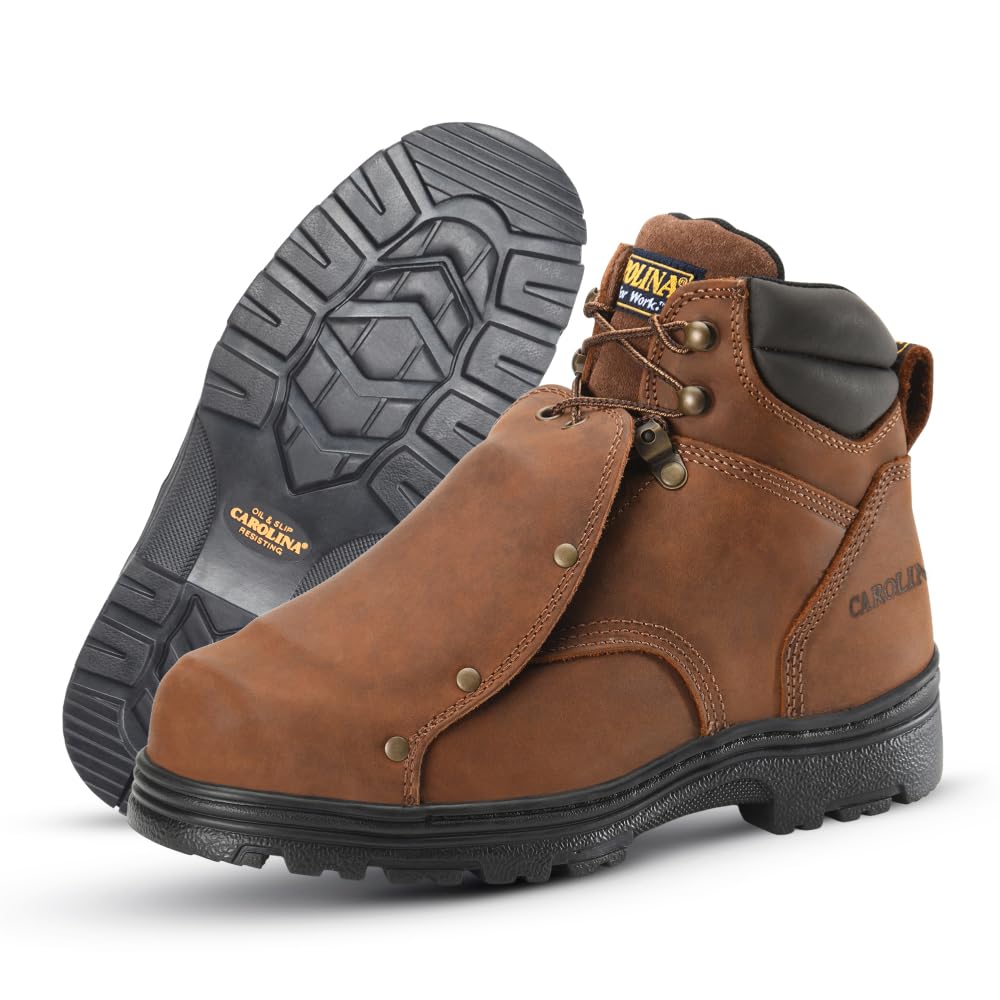
The cheapest route to a bolted-on external met plate and a steel toe.
An external met guard is a hinged plate over the instep, and it is the most literal kind of protection you can buy. The Foreman puts one over a steel safety toe and pairs the whole thing with an oil- and slip-resisting rubber outsole, so you get the classic heavy-job setup without paying premium money. At 3 lb per boot, it is a substantial piece of equipment on your foot.
Fit is the consistent bright spot — the boot runs true and suits a range of working feet. The concern is durability. Some buyers report the boots coming apart sooner than expected, which is the kind of complaint that shows up on a value boot where the leather and sole are built to a price. That does not make these bad for a short-term or seasonal job, but it does mean you should treat them as a wear item rather than a decade-long pair.
Run these if you need external protection on tight money and you are not expecting them to outlast a full apprenticeship. If you want the same guard type but a more proven track record, spend up to the Timberland PRO external guard on this list.
Entry ticket to external armor: the bolted instep plate and steel toe give serious impact protection for the leanest money here.
The realistic caveat: durability is the recurring gripe, so plan for replacement sooner than you might with a premium pair.
Reach for this if: you need external met protection on a tight budget for a short-term or seasonal role.
Move up if: you want the same guard style to survive more than one season of heavy use.
5. Timberland PRO External Met Guard Work Boot

An external hinged plate that keeps covering your instep even when you drop into a squat.
Most external guards create their own problem: squat or kneel and the rigid plate digs into your foot. Timberland PRO solves it with a hinged design, so the shield folds with your ankle instead of fighting it. Under that sits a steel safety toe and an electrical-hazard-rated build, so you are covered from toe cap to instep. The Ever-Guard leather upper is highly abrasion-resistant, and the heat-resistant thread holds up where a cheap boot’s stitching would fry.
Comfort does not get sacrificed for the armor. The 24/7 Comfort System supports the arch and cushions each step, and the moisture-wicking ReBOTL lining pulls sweat away all day. Fit is what converts most buyers, and comfort follows close behind. Protection is the third leg — people come for the guard and stay for everything else.
Two honest trade-offs. Weight divides opinion: some find it fine, others note it is heavier than a normal boot, which is expected given the plate. Durability also splits — some pairs last almost three years, others break quickly. For a boot this armored, treat the lifespan question as a fit of your job to the boot and buy from a seller with a solid return path.
Why the hinge matters
- External hinged met guard protects the instep even in a squat
- Abrasion-resistant Ever-Guard leather with heat-resistant threading
- Steel safety toe plus electrical hazard protection
Where the weight bites
- Heavier than a standard boot thanks to the metal plate
- Durability verdicts vary from almost three years to early failures
The fit for: trades where heavy objects drop and you spend the day squatting and rising.
Think twice if: you are on ladders all day and every ounce on your foot counts.
6. Timberland PRO Men’s Rigmaster 8 Inch WP Met Work Boot
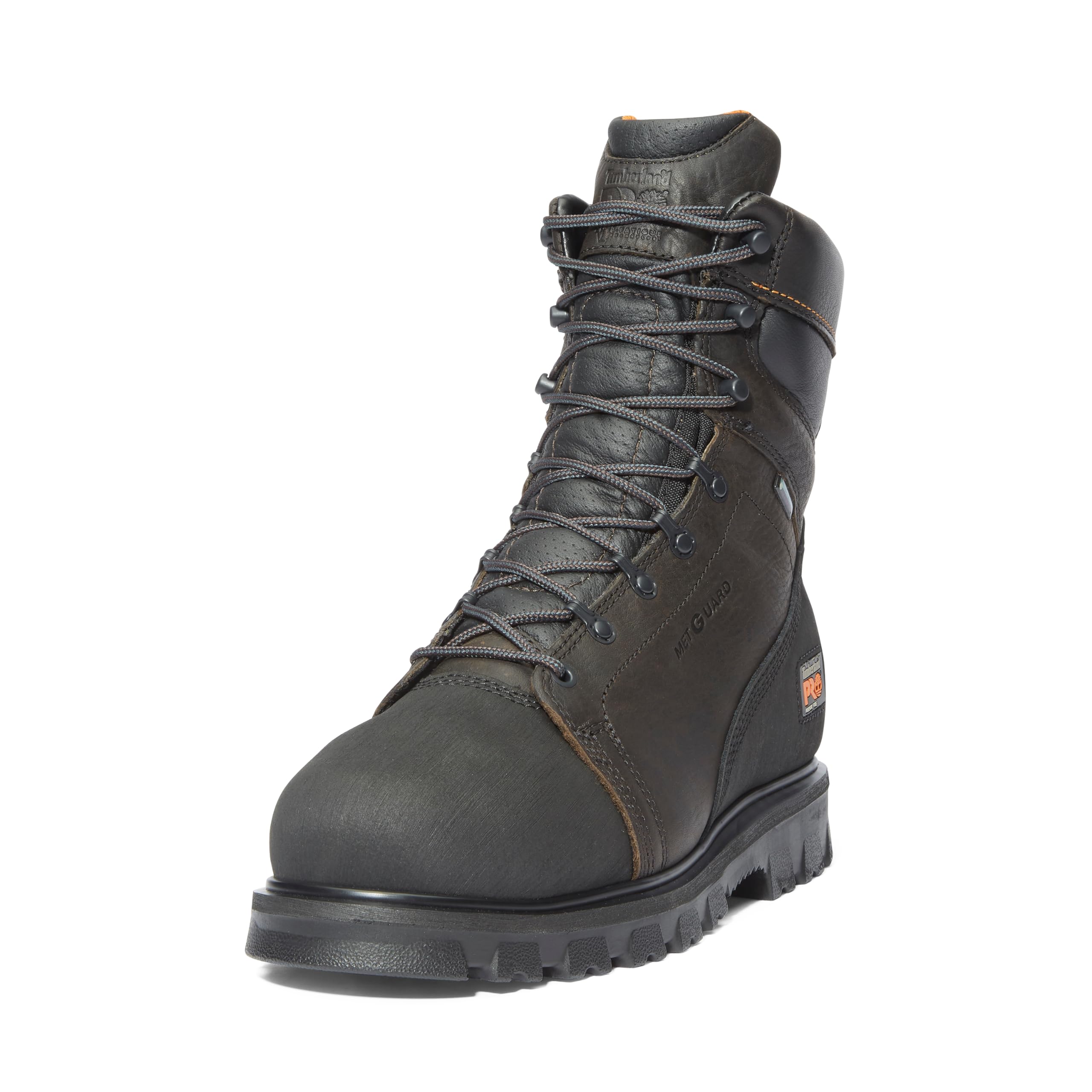
Built for oil and gas crews — a waterproof eight-inch shaft and a heel that grabs ladder rungs.
Ladder work is its own hazard, and the Rigmaster is tuned for it. The polyurethane outsole has Ladder Lock heels that grip the rung so your foot does not slip off mid-climb. An internal met guard absorbs and redirects force from falling objects, and an alloy safety toe covers the front. The eight-inch shaft gives ankle coverage that a six-inch boot cannot, and the waterproof leather with an internal membrane keeps you dry in the rain and spray of a rig site.
Fit is the strongest signal, with value close behind. The Anti-Fatigue footbed and steel shank support the arch on long shifts, and the ReBOTL lining — made with at least 50% recycled plastic — wicks moisture away. The honest caveat is break-in. These boots take a very long time to soften, and a stretch of that period involves heel discomfort and toe rubbing for some owners. Plan to wear them in gradually before a critical shift.
At 2.69 lb they are no featherweight, but the shaft height and armor explain why. If you climb ladders and work wet, the trade of a slow break-in for a locked-in heel is worth it.
The ladder advantage: Ladder Lock heels and a waterproof eight-inch shaft make this the pick for climbers in wet weather.
The patience tax: expect a long break-in with some early heel and toe rubbing before they mold to you.
Suits: rig, oil, and gas workers who spend hours on ladders in wet conditions.
Not for: anyone who needs a boot comfortable from the start on day one.
7. KEEN Utility Louisville 6″ Work Boots
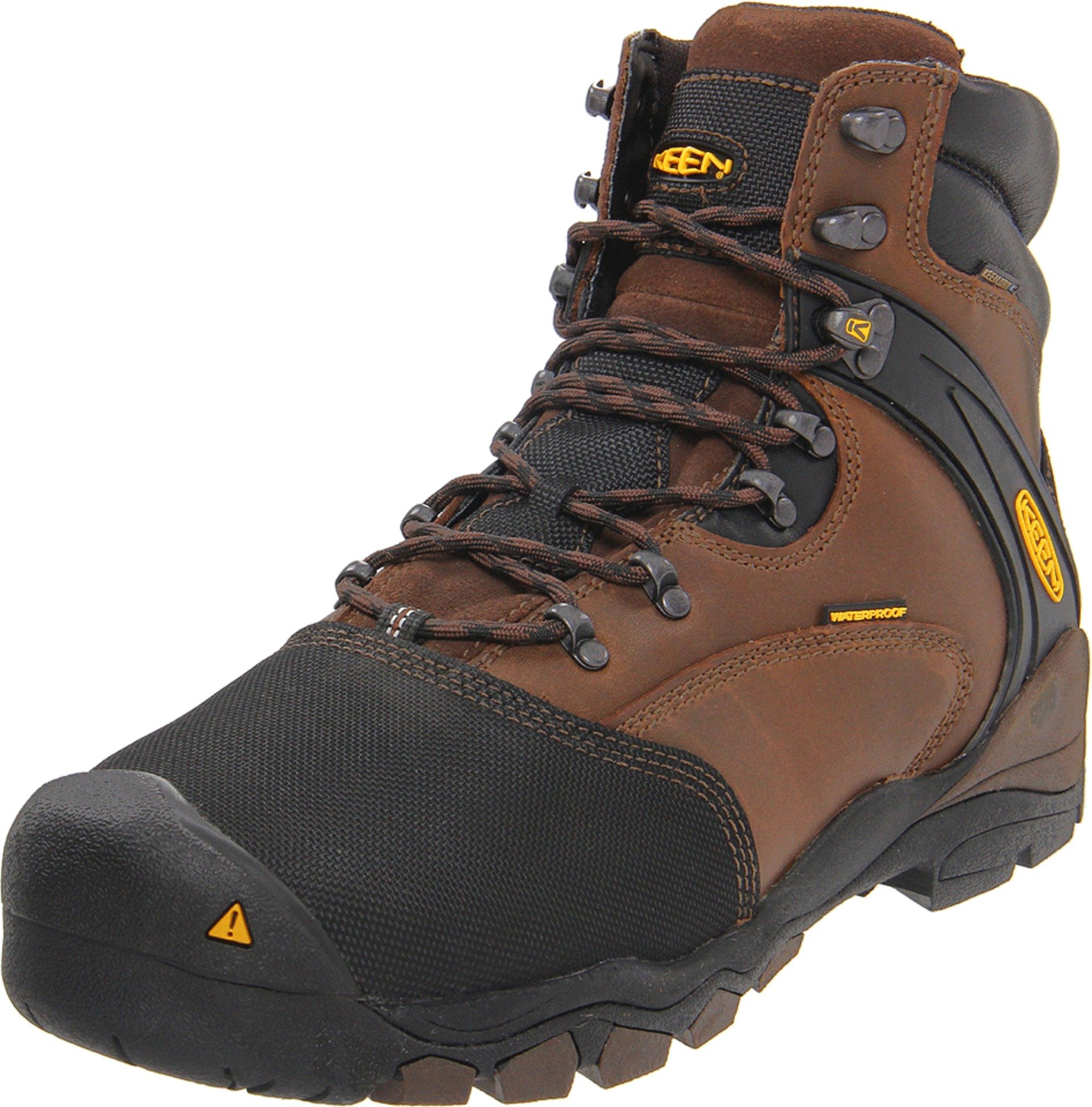
The met-guard boot that hands you real arch support and a certified slip-resistant sole.
Boots that pass the ASTM F2413 MT standard carry a tested metatarsal guard, and this one checks that box alongside I/75 C/75 EH — impact, compression, and electrical hazard ratings. The KEEN.DRY membrane breathes while keeping water out, and the combination nubuck and Tough-Tec leather upper resists abrasion where a boot scuffs most. The non-marking rubber outsole passes ASTM slip tests for wet steel and oily concrete.
Comfort leads the feedback, with construction and lightweight feel right behind. The metatomical EVA footbed supports the arch, and the dual-density midsole cushions without going mushy. The plush collar adds comfort around the ankle you will notice at hour ten. Weight is light for the armor, which is a pleasant surprise on a steel-toe boot.
Now the caution. Fit is mixed — some find it great, others say the toe runs a little tight, and the break-in takes quite a while. Durability also gets split verdicts, with sole separation appearing on a share of pairs. Size up if you are between sizes, and inspect the sole seam in the first month.
Where it shines
- Owners rate it the comfort leader in its class, citing arch and ankle support
- ASTM F2413 MT plus I/75 C/75 EH ratings
- KEEN.DRY waterproof-breathable membrane and slip-tested outsole
Where it can pinch
- Toe can run tight and break-in takes a while
- Sole separation shows up on some pairs
Your match if: you need arch support and a slip-tested sole on a waterproof met-guard boot.
Skip if: you have wide toes and want a roomier fit from the start.
8. Michelin 8″ Sledge Work Boot
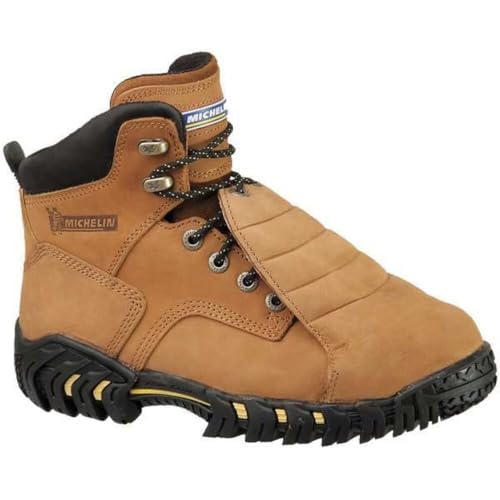
Holds up on long ladder days and hands you a full-grain leather shell with an external plate.
The Sledge takes the external route: a full-grain leather upper with an external ANSI/ASTM Class 75 metatarsal guard bolted over the instep. Full-grain leather is the densest cut of hide, so it resists scuffs and takes a beating from jobsite debris. The shock-absorbent Phylon midsole and TPU insole cushion each step for the kind of day where you are standing, walking, and climbing ladders from start to finish.
Traction and arch support round out the picture. The outsole grips, the arch support keeps the foot from rolling in, and the fit runs with enough room for a thicker work sock. Some pairs need a break-in period before they settle, which is normal for a full-leather boot. On durability, opinion splits — some pairs hold up well, others give sooner. Keep the leather conditioned and the seams checked.
The caveat is weight. At 5 lb, this is a heavy boot, and you will feel the difference on a ladder against a lighter composite boot like the KEEN Vista Energy. The protection and leather quality are the reward for that heft.
Why crews keep buying it: full-grain leather under an external Class 75 guard gives a shell that survives rough site surfaces.
The weight and lifespan tax: five pounds is real on a ladder, and durability verdicts split, so condition the leather and check the seams.
Best for: ladder-heavy general construction where leather toughness outranks saving ounces.
Consider a lighter pick: if your feet protest under a full five pounds all day.
9. Carhartt Rugged Flex 8″ Work Boot

A soft Poron XRD internal guard that moves with your foot instead of sitting rigidly over it.
Not every met guard needs to be a metal plate. This Carhartt boot uses a Poron XRD soft internal met guard — a cushioning insert that stays flexible as you walk while still taking an impact over the instep. The composite toe meets ASTM 2413-24 EH, so you are electrically hazard rated without the weight of steel. The Storm Defender membrane keeps water out while letting your foot breathe, and the Rugged Flex outsole is built to move with the boot.
The upper is brown oil-tanned leather, and reflective high-visibility piping earns its keep on a dim site. Quality is the strongest signal from owners, and the fit runs standard, so you can order your usual size with confidence. Water resistance and ankle support both draw praise for a waterproof work boot. The oil-tanned leather will develop character as it wears, which is a benefit for some and a cosmetic annoyance for others.
Durability is the one split — some call it built like a tank, others report it falling apart within a month. Buy from a seller with a solid return window and inspect the seams in the first weeks.
Why the soft guard works
- Poron XRD soft internal met guard flexes as you walk
- Storm Defender waterproof-breathable membrane with oil-tanned leather
- Composite toe with ASTM 2413-24 EH electrical hazard rating
What to watch
- Durability verdicts range from tank-like to failing within a month
- Oil-tanned leather changes appearance quickly with wear
Reach for this if: you want met protection that bends with your foot rather than a rigid plate.
Look elsewhere if: you need a proven long-term durability record before committing.
10. Wolverine Warrior, Men’s, Comp Toe, EH, Mt, WP, 8 Inch Boot
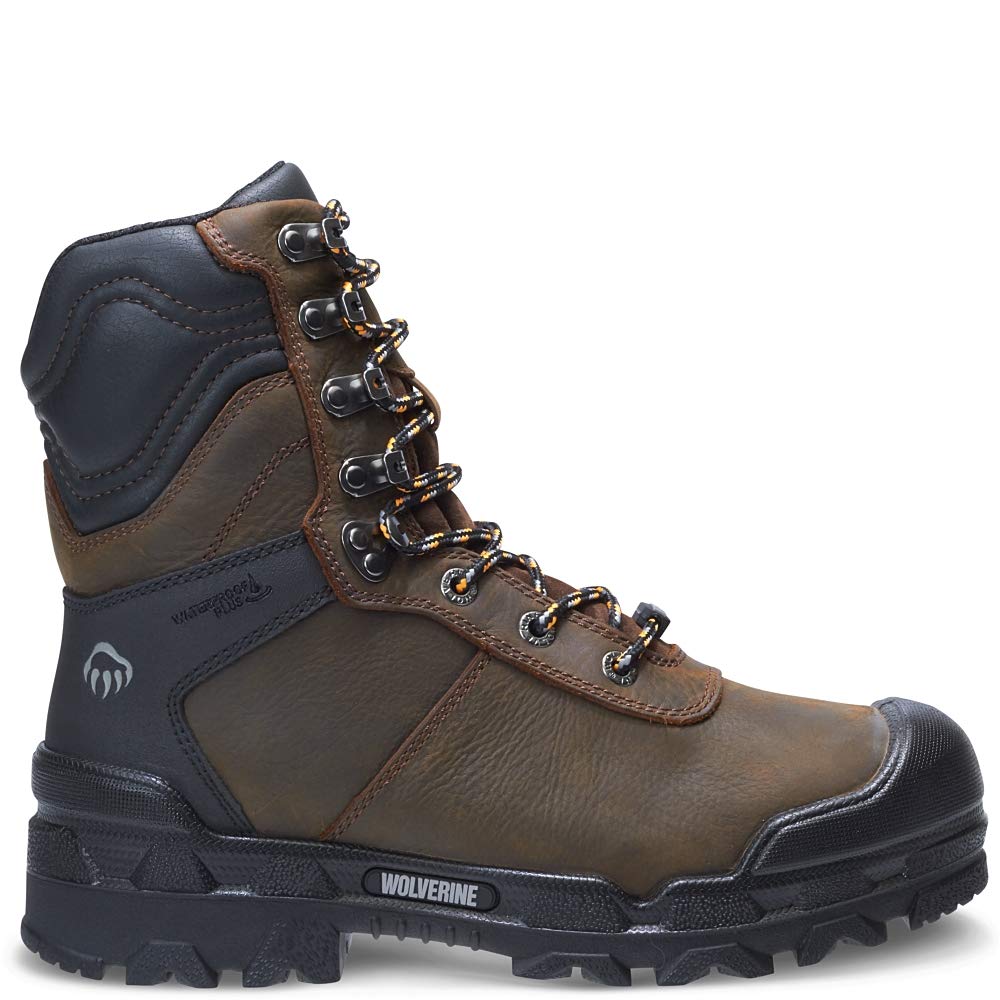
The oil- and slip-resistant rubber outsole is rated heat resistant to 932 degrees F for foundry and asphalt work.
Heat is a hazard most work boots ignore, and the Warrior handles it with an oil- and slip-resistant rubber outsole rated heat resistant up to 932 degrees F. If you work around hot asphalt, foundry spatter, or welding, that matters more than any marketing label. The build layers in waterproof full-grain leather, a moisture-wicking mesh lining, and an EPX cushion footbed under a PU midsole. Direct-attached construction makes the sole-to-upper bond a strong one.
On the safety side, this boot carries comp toe, electrical hazard, and an internal met guard, all compliant to ASTM F2413-18 M/I/C EH Mt. That is one of the fullest safety stacks on this list, and it does not ask you to pay a premium for it. Quality and comfort are the things buyers call out most, and the fit lands true.
The caveat is lifespan. Some pairs hold up extremely well, but one account describes the inside back of the boot wearing away toward the heel in about five to six months. That is not universal, but it is worth checking your heel slide and wearing proper socks to reduce friction.
The heat edge: an outsole rated to 932 degrees F separates this from every leather-and-rubber boot here.
The wear point: the lining at the back of the heel can wear through on some pairs in a matter of months.
Buy if: you work around heat, oil, or hot surfaces and need the full ASTM safety stack.
Pass if: your work is cold and dry and you want the longest possible heel-lining life.
11. ARIAT Catalyst VX Work 8″ Met Guard H2O Steel Toe

The premium end of the list, with an H2O waterproof build and a steel toe under the guard.
If you are spending top money on a work boot, you are paying for comfort and a waterproof build that lasts. The Catalyst VX brings an H2O waterproof construction and a steel safety toe under an eight-inch shaft, at 2.8 lb per boot. Quality is the thing buyers praise most, and comfort sits close behind — the two signals that tell you the premium buys real feel, not just a name.
The catch is a few fit quirks. The fit runs about a quarter size small for some feet, so consider going up. The H2O build is waterproof in rain, but a few report water resistance falling short over time, and some find these hard to break in. The Velcro closure has durability complaints that show up as a recurring gripe, so take care opening and closing it rather than yanking it.
For a boot with a met guard and waterproofing, this is the top of this list on price and on comfort ambitions. Sized right and looked after, it earns the spend.
The premium argument: H2O waterproofing and steel-toe protection in a boot people call comfortable from the start.
The honest caution: fit runs about a quarter size small, and the Velcro closure needs gentle handling.
For: buyers who want the best comfort and waterproofing and will size up a quarter to get the fit.
Hold off if: you need a wide fit from the start or find Velcro closures a chore.
Know the Specs
Metatarsal Guard Ratings
A boot marked ASTM F2413 MT has passed a test where a weight is dropped on the instep area to confirm the guard spreads the load. An external guard is a hinged plate you can see; an internal guard is a soft or semi-rigid insert hidden inside the tongue and over the instep. Neither is automatically safer — an external plate is more visible and more rigid, while an internal guard is easier to wear through a full shift. Match the guard type to the hazard and to how much flex your job needs.
Toe Cap and Weight
Steel, alloy, carbon-fiber, and composite toes all pass the same impact test, so the real difference is feel. Steel and alloy are dense and add weight; composite and carbon-fiber cut grams but can need a thicker shell that reduces interior room. A boot already armored over the instep (the top of your foot) gets heavy fast, so a light boot like the 534-gram Vista Energy is easier to wear on concrete, while a heavier leather boot suits rough terrain.
Common Questions
What does a metatarsal guard actually protect?
Is an internal or external met guard better for construction work?
Do these boots run true to size or should I size up?
How long should a met guard boot with waterproofing last?
Can a met guard boot break in without hurting?
Do I need electrical hazard protection?
Will a metguard boot fit with a wide foot?
Can I replace the insoles in a met guard boot?
Are rubber met guard boots better than leather for wet work?
How do I keep a waterproof met guard boot from leaking?
Is a composite toe better than steel for cold weather work?
The Bottom Line
The work boots with metatarsal guard pick that balances armor and all-day comfort best is the Ariat Workhog, because its waterproof composite build lets you pull it on and go without a lace-up break-in. If your work is wet and muddy, the Muck Chore is the boot that shrugs at slop. And for the heaviest impact with a lot of squatting, the hinged plate on the Timberland PRO External Met Guard is the one to reach for.
One last nudge if you are still deciding: the Workhog carries 4.5+ stars from 200+ owners, which is the strongest crowd signal on this list for a boot that also leads on comfort. Pick the guard type that matches your hazard, size up if the note tells you to, and give any leather boot a proper break-in before you judge it.
How we choose
We do not accept paid placement. Every pick is matched to a real buyer and a real use-case; we do not hands-on test units.
Sources
Specifications: manufacturer listings and product documentation. Review insights: verified customer reviews, as of November 2026. Pricing: not shown on this page (it changes often); check the current price via the retailer link.
As an Amazon Associate, Tactical Gear Guy earns from qualifying purchases. This does not affect which products we feature.