Specs are compiled from manufacturer listings and verified buyer reviews and can change over time — please confirm the key details on the product page before buying.
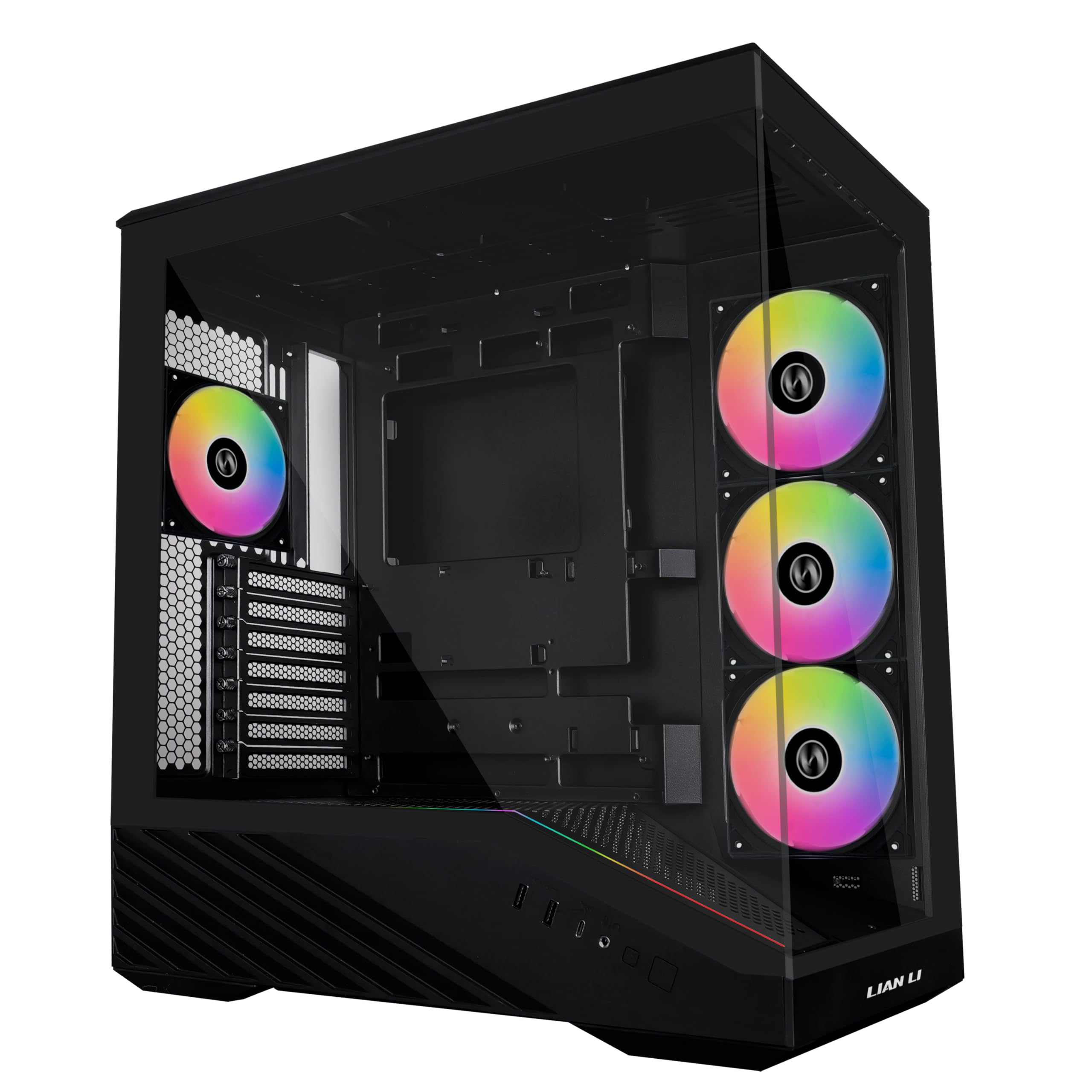
Your graphics card is the most expensive part in your PC, so it needs a case that lets it breathe. You want real GPU clearance, airflow that keeps a long gaming session from turning into a heat soak, and a build that does not fight you every time you open a side panel. The Lian Li V100 gives you the most complete package for a World of Warcraft rig. It ships with four 120mm ARGB fans (addressable RGB lights you can control), fits a 420mm card, and leaves room for a 178mm CPU cooler.
This guide is built by comparing the manufacturers’ published specifications and the patterns across verified customer reviews, so you get each pick’s real strengths and trade-offs instead of marketing spin.
Raid night does not care about your lighting, but it does care whether your GPU throttles after four hours of load. Below you will find nine chassis ranked by what they do best, with the exact GPU, cooler, and radiator numbers spelled out. Here is the honest shortlist for a proper wow computer case.
Top Picks
How To Choose The Best WoW Computer Case
World of Warcraft is not the heaviest game on the planet, but an all-night raid does load your GPU and CPU for hours on end. That makes GPU clearance and mesh intake the two specs that decide whether your build stays cool and quiet.
Start With GPU Clearance, Not Case Size
Clearance is the straight-line distance from the rear expansion slots to whatever sits in front of your card. A long triple-fan GPU can rub against a front-mounted radiator or a drive cage if you get this wrong. The cases below range from 355mm up to 420mm of GPU room, so measure your card first and then pick.
Airflow Versus Panoramic Glass
Mesh-front cases pull cool air straight across your components, while panoramic glass cases wrap the hardware in tempered glass for display. Glass looks better with ARGB lighting, but it depends on side and bottom fans for intake rather than a front mesh wall. Decide which matters more before you shop: mesh intake for cooling, or glass panels for the display.
Pre-Installed Fans Save You Money
Most of these chassis include three or four fans from the start, which cuts the cost of a build. Watch whether those fans are PWM, meaning the speed is controlled by the motherboard, and whether they carry ARGB lighting. A case that ships with four fans is a very different value than one that ships bare.
Cooler Height And Radiator Room
If you run a big tower air cooler, check the maximum CPU cooler height — the tallest here is 178mm and the shortest is 160mm. If you plan an all-in-one liquid cooler, check for 360mm radiator support at the top or front. Measure your cooler’s height and radiator size against those limits before you buy the cooler, not after.
Side-by-Side Comparison
| Model | Best For | Max GPU Length | Max CPU Cooler Height | Included Fans | Amazon |
|---|---|---|---|---|---|
| Lian Li V100★ Best Overall | Most complete package | 420mm | 178mm | 4x 120mm ARGB PWM | Amazon |
| FOIFKIN F300Best Value | Panoramic glass on a budget | 400mm | 170mm | 4x 120mm non-LED | Amazon |
| MUSETEX Y6Best Panoramic View | Dual-chamber glass display | 410mm | 160mm | 4x 120mm non-LED | Amazon |
| Thermaltake View 270 Plus | E-ATX glass tower | 420mm | — | 3x 120mm ARGB | Amazon |
| MONTECH XR Panoramic | Showcase with wood detail | 420mm | 175mm | 3x 120mm ARGB PWM | Amazon |
| MONTECH AIR 903 MAX | High-airflow mesh build | 400mm | 180mm | 4x 140mm | Amazon |
| FOIFKIN F600 | Fan count and light show | 400mm | — | 7x 120mm ARGB PWM | Amazon |
| CORSAIR 4000D RS Frame | Modular, upgradable frame | — | — | 3x RS PWM | Amazon |
| Fractal Design North | Walnut-front centerpiece | 355mm | — | 2x 140mm PWM | Amazon |
Detailed Reviews
1. Lian Li V100-ATX Mid-Tower PC Case-Black-V100RX
Our pick — 4.5+★ from 650+ verified ratings; the strongest balance of quality and price.
Four ARGB fans, a 420mm GPU bay, and a 178mm cooler ceiling — all from the box.
If you want one box that solves the whole build, this is it. The V100 arrives with four 120mm PWM-controlled ARGB fans (the speed is handled by your motherboard, and the lighting is addressable) already wired up on a daisy chain. That means you skip the separate fan purchase and the cable tangle that comes with it. It is also the highest-scoring case of the group at 4.5+ stars across 690+ ratings.
Clearance is where this thing quietly wins. You get 420mm for a graphics card and 178mm for a CPU cooler, which is more headroom than the MUSETEX Y6 offers at 160mm and more cooler room than the FOIFKIN F300 at 170mm. A top radiator up to 360mm rounds out the cooling options. For a rig that has to survive a six-hour raid, that 420mm GPU bay and 178mm cooler ceiling are the difference between fans humming along and fans screaming.
The look is the other half of the pitch. A 26-LED ARGB strip runs along the chassis and syncs with your motherboard software, so your lighting and your card lighting move as one. Both side panels pop off without tools, which makes a mid-season part swap a five-minute job instead of a screwdriver hunt. The 1800 RPM fan ceiling delivers 61.47-60.4 CFM of airflow at 26.5-30.8 dBA, so it moves real air while staying in the “barely audible” range.
What earns it the top spot
- Four PWM ARGB fans included — no extra fan budget needed
- 420mm GPU and 178mm cooler clearance handle high-end hardware
- Tool-less side panels make upgrades quick
- 26-LED ARGB strip syncs with motherboard software
Where it asks a little patience
- Mid-tower footprint still needs a measured GPU check before ordering
- Glass panels reward careful handling
Go with this if: you want the fewest extra purchases and the widest hardware headroom in one chassis.
Check first: your card’s exact length against that 420mm figure if you run an unusually deep radiator stack.
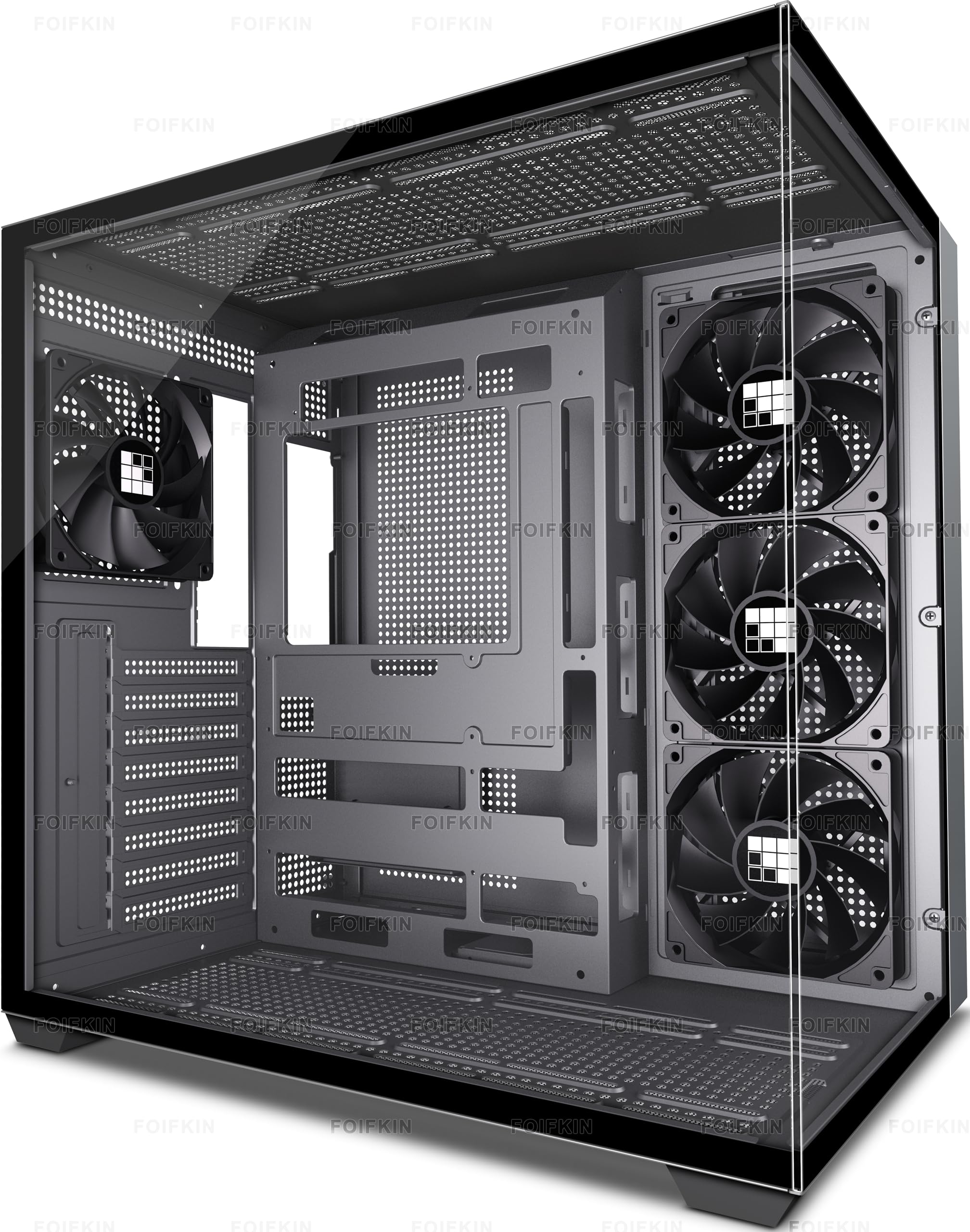
2. FOIFKIN F300 PC Case
The panoramic glass case that makes your GPU the centerpiece without wrecking your budget.
Here is the trade-off you have to understand with a panoramic design: the 270° tempered glass wraps the front and side, so you lose the front mesh wall that a traditional airflow case uses. FOIFKIN solves it with four pre-installed non-LED fans and room for up to ten 120mm fans in total. It also accepts three 360mm liquid coolers if you want to go the AIO route. Build quality is clearly the star here — that is the single thing reviewers rave about most, and it shows in the tool-free glass panels that pop off for access.
Size is generous in every direction. The case fits a GPU up to 400mm and an ATX power supply up to 220mm, with a CPU cooler ceiling of 170mm. The listed dimensions are 16.9″D x 8.38″W x 19.2″H. Compare that footprint to the Thermaltake View 270 Plus at 8.1″D x 22″W x 18″H and the FOIFKIN is a narrower, taller box. The front panel gives you one Type-C 3.0 port, one USB 3.0, one USB 2.0, plus mic and audio jacks.
The fan quality is the one aspect reviewers split on — some find the stock fans fine for cooling a mid-range build while others want stronger static pressure. Budget accordingly if you plan to run a hot card. Everything else lines up, and the fit is solid enough for an ATX board, a large PSU, and a long card at once.
Where it shines: the 270° glass gives you a showpiece look for a mid-tier build, and the tool-free panels make cable work painless. Extra-large capacity means a full ATX build with a 360mm AIO fits without gymnastics.
What to plan for: the included fans are non-LED and draw mixed opinions on strength, so a set of aftermarket fans is a smart add-on for a gaming card.
Reach for this if: the look of glass on two sides matters to you and your build stays in the mid-range power bracket.
Look elsewhere if: you need maximum airflow from the start rather than a display-first design.
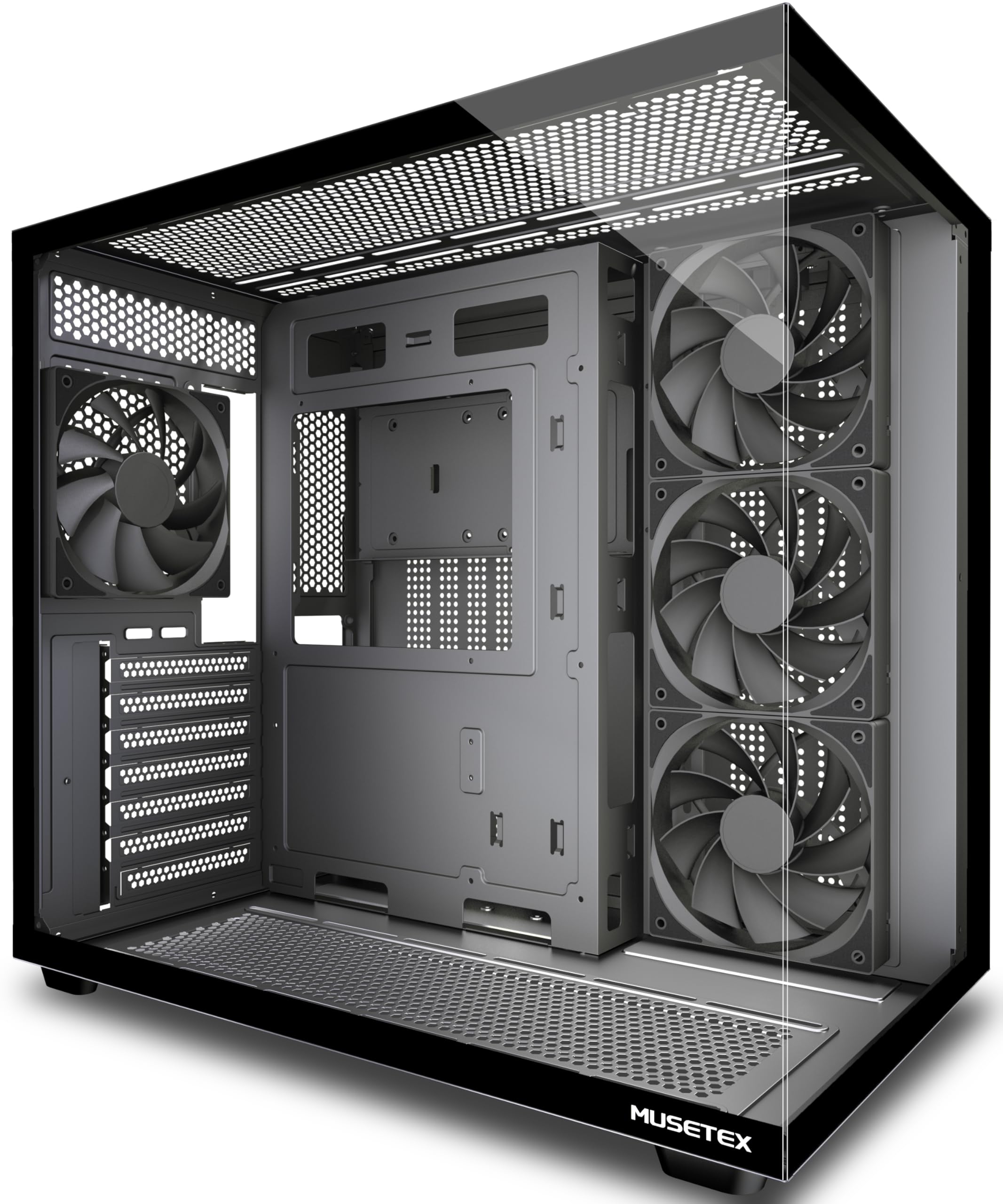
3. MUSETEX Y6 PC Case
A dual-chamber glass case that hides the power supply and shows off everything else.
The dual-chamber design is the smartest thing the Y6 does. It separates your hardware from the power supply and the cable nest behind it, which cleans up the view through the 270° glass and gives the power supply its own ventilation channel. The result is a case that looks tidy through the glass even when your cable routing is average. It also lands at 4.5+ stars, so the execution holds up.
Room is plentiful for a mid-tower. You get 410mm for a GPU, 360mm for a top-mounted liquid cooler, and up to 230mm for the power supply. The CPU cooler ceiling is the tight spot at 160mm — the lowest here, and 18mm short of the Lian Li V100’s 178mm. If you run a tall tower air cooler, measure it carefully or plan an AIO instead. The 3.5-inch drive bay holds three devices, more internal mounting than the FOIFKIN F300’s two.
Magnetic dust filters on the top and bottom do the maintenance work, and the four included non-LED fans (three reverse-blade on the side, one on the back) push air through the chamber. The case weighs 15.7 pounds, which is heavier than the 14-pound Thermaltake View 270 Plus — the glass is doing that, and it is worth knowing if you move your rig around.
The design story: the dual-chamber split keeps the power supply and cables out of the display zone, and the 270° glass panel turns your hardware into the focal point of the room.
One number to double-check: the 160mm CPU cooler limit rules out the tallest air coolers on the market, so an AIO or a shorter tower is the safer pick.
Made for: builders who want a clean, cable-hidden showcase and plan to use liquid cooling.
Only if you have room: check the 160mm cooler clearance before committing to a big air tower.
4. Thermaltake View 270 Plus TG ARGB Black Mid Tower E-ATX Case
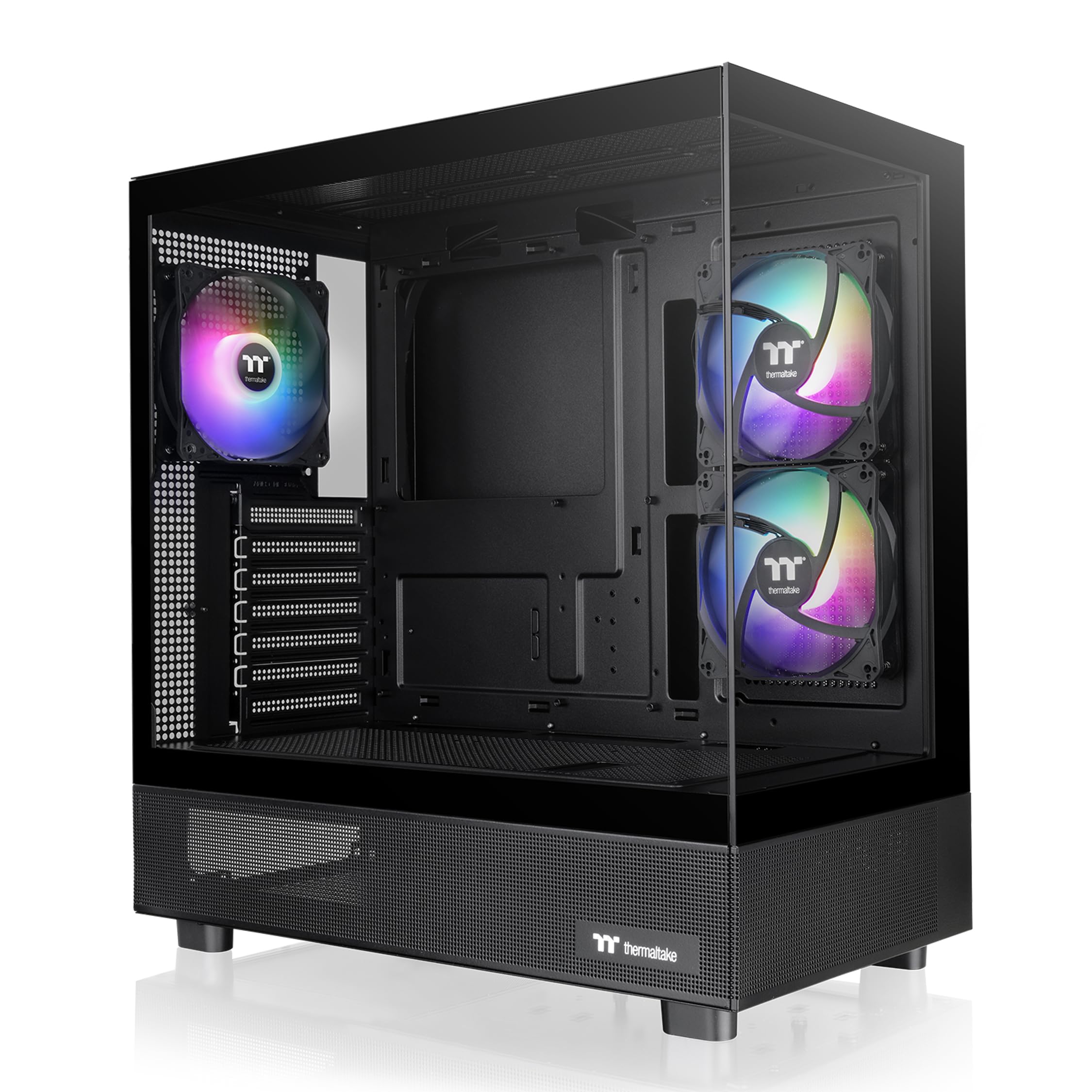
E-ATX support and a 420mm GPU bay in a pillarless glass frame.
This is the case for a build that outgrew a normal mid-tower. It accepts E-ATX motherboards alongside ATX, so a big board with extra slots is no problem. It also takes a GPU up to 420mm, matching the Lian Li V100 and edging past the FOIFKIN F300’s 400mm. The pillarless front and side glass means no vertical bar between panels, which keeps the full view uninterrupted.
Cooling support is broad: up to nine fans or a 360mm radiator at the top, with three 120mm ARGB fans included. The I/O panel gives you one USB 3.2 Gen 2 Type-C port, two USB 3.0 ports, and an HD audio jack. The removable glass panels make assembly straightforward, and the build quality is the aspect that draws the most praise — the frame feels solid when you lift it.
One honest note: some owners disagree on whether the case fits their particular needs. That usually depends on how much space the front glass configuration leaves for their airflow strategy. At 14 pounds, it is fairly light for an E-ATX box (a larger motherboard size), so it moves easily if you rearrange your desk.
Wins you over with
- E-ATX board support in an accessible mid-tower format
- 420mm GPU clearance for the longest cards
- Pillarless glass keeps the view clean
- Three ARGB fans plus 360mm radiator room up top
Worth knowing before you buy
- Full glass front favors looks over maximum intake on its own
- Big-board buyers should confirm their board’s exact E-ATX size
Suits: an E-ATX build with a long flagship card and a plan for ARGB.
Skip for: a compact desk where the extra width is dead weight.
5. MONTECH XR Panoramic PC Case

The showcase case that puts its fan faces forward and adds a touch of wood.
Two of the three included fans are reverse-blade ARGB PWM units, which means their illuminated faces point into the case instead of showing you the support frame. It is a small detail that makes a panoramic build look finished rather than assembled. The wood-grain I/O accent on the black chassis gives it a warmer, furniture-friendly look than the all-black crowd. That design is what wins people over most, with the appearance running a close second.
Clearance is strong: 420mm for a GPU, 175mm for a CPU cooler, and 230mm for the power supply. That puts it ahead of the MUSETEX Y6 on cooler height (175mm versus 160mm) and level with the Thermaltake View 270 Plus on GPU room at 420mm. It takes up to nine fans or a top 360mm radiator, so you can start with the three included and scale up for a hot card.
Cable routing has clearly been thought through, since that is the third thing reviewers call out — power cables, front-panel connectors, and GPU cables all have a path that does not require force. Removable magnetic filters at the top, side, and bottom keep the cleaning routine short. You get USB-C plus two USB 3.0 ports on the front.
Why owners like it: the reverse-blade fans turn the glass side into a proper display piece, and the routing channels make a tidy build achievable without a fight.
The catch is airflow: the panoramic front and side panels favor aesthetics, so plan to use the full nine-fan capacity if you run a power-hungry card.
Right choice when: you want a showcase build with a bit of warmth and a rigid metal frame.
Not the pick if: you prefer a pure mesh front for straightforward intake.
6. MONTECH AIR 903 MAX PC Case

A mesh-front chassis built to move air, with four big 140mm fans already fitted.
Heat is the enemy on a long gaming session, and this case attacks it with a ventilated mesh front panel. The ventilated mesh front panel lets the system pull in the air it needs, and the 478 x 230 x 493 mm chassis leaves room for demanding parts. Three 140mm HP140 ARGB PWM fans sit at the front with one 140mm PWM fan at the back, and the front lighting and fan speed are both adjustable. That is a serious fan package before you add anything.
Unlike the glass-forward cases, this one is unapologetically about cooling. Radiators up to 360mm mount at the front and on top, so you can plan a real liquid or air build without the chassis dictating the layout. The board support covers E-ATX, ATX, Micro-ATX, and Mini-ITX, and cards go up to 400mm.
Two numbers worth comparing: the 400mm GPU limit is 5mm shorter than the FOIFKIN F300’s 400mm? No — both sit at 400mm, so a card that fits one fits the other. The cooler ceiling is 180mm, though, which is the tallest of the group and clears the Lian Li V100’s 178mm. It also weighs 9.14 kg, so this is a substantial box that will not slide around on a hard floor.
The cooling argument
- Mesh front panel feeds air directly to components
- Four 140mm fans included — three ARGB at the front, one at the rear
- 180mm CPU cooler ceiling is the tallest here
- Front and top 360mm radiator support
What you give up
- Mesh trade: less of a full-glass showcase than the panoramic cases
- 9.14 kg frame is heavy to reposition
Choose this if: you run a hot card, a big air cooler, and want cooling to come first.
Give it a pass if: your build is meant to sit on display behind two panes of glass.
7. FOIFKIN F600 PC Case
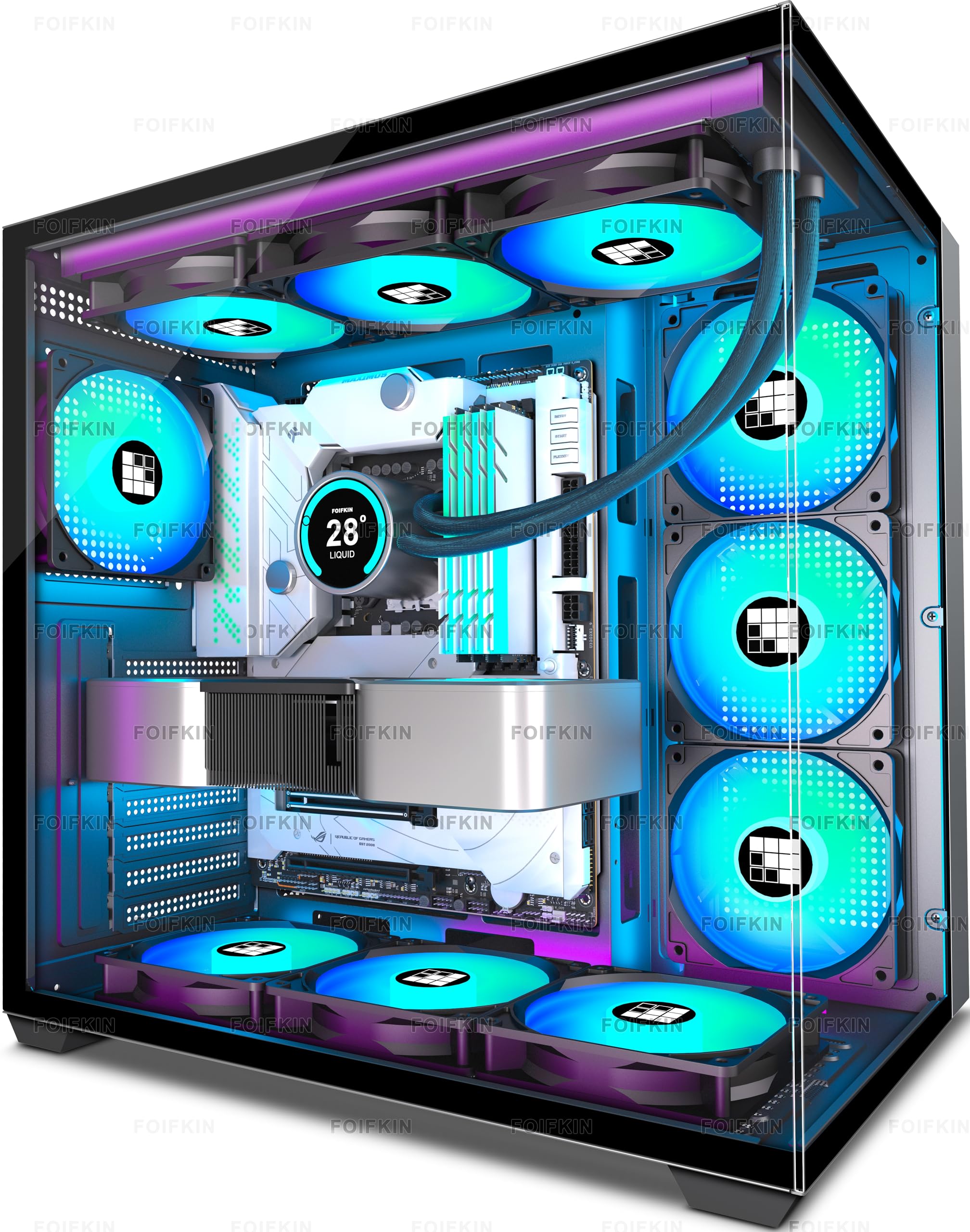
Seven ARGB PWM fans come pre-fitted in this dual-chamber glass showcase.
No other case on this list ships with this much fan hardware. FOIFKIN pre-installs seven 120mm ARGB PWM fans — six reverse-blade and one forward — so the lighting and airflow are largely handled before you open the box. The dual-chamber layout also separates the hardware from the power supply, which improves the thermal picture and helps with cable organization. Design is the aspect that draws the most praise overall, with appearance close behind.
The 270° high-hardness tempered glass showcase every detail, and the hardware support covers ATX, M-ATX, and ITX boards. You get 400mm for a GPU and a power supply up to 200mm, with support for one HDD and two SSDs. Radiator options span 360/280/240/120mm. The listed dimensions are 16.5″D x 11.2″W x 17.3″H.
Here is the honest split: cable management is divisive. Some builds route cleanly while others find it a genuine headache, and the fit feedback is similarly mixed. A little planning and some zip ties go a long way in the dual-chamber layout. If you want the maximum light show with the minimum fan shopping, this is the one.
Standout spec: seven pre-installed ARGB PWM fans is the largest fan package here, and the 270° glass turns all seven into the display.
What to budget time for: cable management splits opinion — set aside an evening for routing in the dual-chamber layout and it will look the way the glass deserves.
Buy this if: you want a lit-up glass tower and refuse to buy fans separately.
Consider a different pick if: you hate cable work and want the simplest possible routing.
8. CORSAIR 4000D RS PC Case

A modular chassis you can actually change — swap the I/O, slide the fan rails, add a side fan.
Most cases are sealed boxes. This one is built to change. The FRAME modular system lets you swap the motherboard tray for billet aluminum or the front I/O panel for more USB ports, so the case can grow with your build over several upgrades. That modularity is unusual at this size and is the whole reason it earns a slot. Build quality and a spacious interior back it up, with lots of room for fans and expansion.
Airflow gets a deliberate design here. The 3D Y-pattern airflow panel is a steel front panel perforated in three dimensions, which gives cool air a low-obstruction path. Three CORSAIR RS PWM fans come pre-installed at the front with daisy-chainable 4-pin connections and Zero RPM mode for near-silent running at low load. The InfiniRail system lets you slide fans up to 200mm (140mm in the roof) wherever you want them, so airflow goes where you point it.
The side panel near the motherboard tray doubles as a cable cover for a clean look, or you remove it and mount fans there for extra cooling. It also supports reverse-connector motherboards, so a build with hidden connectors works here. Weighing 8.2 kg, it is light enough to lift for desk cleaning.
The upgrade path
- FRAME system lets you swap the tray and I/O later
- InfiniRail slides fans up to 200mm wherever you need airflow
- Reverse-connector motherboard compatible
- Three PWM fans with Zero RPM mode
Keep in mind
- The cable-cover panel becomes a fan mount only if you remove it — one or the other
- More open frame than a sealed sound-dampened box
An easy pick for: tinkerers who plan to change parts for years and want a case that keeps up.
Less ideal for: a build-and-forget setup where modularity never gets used.
9. Fractal Design North Charcoal Black

A walnut-and-glass case that looks like furniture and cools like a proper airflow tower.
If your gaming station lives in a shared room, this walnut-and-glass case blends in instead of glowing. Front panel bars are cut from genuine walnut wood, set into a charcoal black frame with a clear tempered glass side panel. It reads as a design piece rather than a glowing box, and that appearance is what draws the loudest praise — it is the single most-praised quality here, with build quality a very close second. Two 140mm Aspect PWM fans come included to get the build started, and there is an open front with integrated mesh for natural ventilation.
It is not all looks, though. The case supports ATX, mATX, and ITX boards, seven bridgeless expansion slots, and two included 3.5″/2.5″ drive mounts plus two dedicated 2.5″ mounts. The tempered glass side panel resists scratches and keeps the view clear. Removing panels is easy — pop the side panels, unclip the front, and lift the top with an integrated tab.
The one number to respect is GPU length: up to 355mm here, or 300mm if you mount a 360mm front radiator. That is shorter than the 420mm cases elsewhere on this list, so a very long flagship card may not fit. Measure first, then commit.
The design draw: genuine walnut bars and a clear glass panel make this the most furniture-like case here, and the mesh-backed front keeps airflow real.
The clearance reality: 355mm for a GPU (300mm with a front 360mm radiator) means the longest aftermarket cards need a measurement first.
For you if: looks and a calm, room-friendly aesthetic matter as much as cooling.
Think twice if: you run an extra-long flagship GPU that needs more than 355mm of room.
Know the Specs
Max GPU Length
This is the longest graphics card the case can hold, measured from the rear bracket to whatever sits in front of it. A long card that hits a front radiator or drive cage will not seat properly, so check the card’s exact length against this figure first. The range here runs from 355mm up to 420mm.
Max CPU Cooler Height
This caps how tall a tower air cooler can be. Pick a cooler taller than the limit and the side panel will not close. Values here run from 160mm to 180mm, so a big air cooler needs a case with room to match.
Radiator Support
An all-in-one liquid cooler mounts as a radiator, so check whether the case accepts a 360mm unit at the top or front. Cases with more radiator room let you choose between air and liquid without changing the chassis.
CFM and dBA
CFM (cubic feet per minute) is how much air a fan moves, and dBA is how loud it is on the decibel scale. Higher CFM moves more air; lower dBA is quieter. The Lian Li V100’s included fans move 61.47-60.4 CFM at 26.5-30.8 dBA, a balance of airflow and noise.
Common Questions
Will a 420mm graphics card fit in these cases?
Is a mesh front better than tempered glass for cooling?
What is a dual-chamber case and why does it matter?
Do I need to buy extra fans if the case comes with some?
What does PWM mean on a case fan?
Can these cases hold a 360mm liquid cooler?
How tall a CPU air cooler will these cases take?
What is E-ATX support and do I need it?
Does the front USB-C port matter for a gaming build?
The Bottom Line
For most World of Warcraft builds, the Lian Li V100 is the one to get. It has four PWM ARGB fans (speed-controlled fans with addressable RGB lights), 420mm of GPU room, and 178mm of cooler clearance. It also has the highest score of the group at 4.5+ stars across 690+ ratings. If you want a mesh-front cooling machine instead, the MONTECH AIR 903 MAX with its four 140mm fans and 180mm cooler ceiling is the airflow answer. And if your rig lives in a shared room, the Fractal Design North’s genuine walnut front is the case that looks like it belongs there.
How we choose
We do not accept paid placement. Every pick is matched to a real buyer and a real use-case; we do not hands-on test units.
Sources
Specifications: manufacturer listings and product documentation. Review insights: verified customer reviews, as of November 2026. Pricing: not shown on this page (it changes often); check the current price via the retailer link.
As an Amazon Associate, Tactical Gear Guy earns from qualifying purchases. This does not affect which products we feature.