Specs are compiled from manufacturer listings and verified buyer reviews and can change over time — please confirm the key details on the product page before buying.
You want joints that close tight, sit square, and stay put years later — and the tool that gets you there is not the same for a biscuit slot as it is for a decorative mitered box. Some buyers want a cordless biscuit joiner that cuts slots on site. Others want a self-centering dowel jig that drills matching holes in two boards at once. A few want a pocket-hole rig that turns a scrap pile into a cabinet frame. The nine picks below cover all three joint styles, and each one is the strongest option in its lane.
This guide is built by comparing the manufacturers’ published specifications and the patterns across verified customer reviews, so you get each pick’s real strengths and trade-offs instead of marketing spin.
Doweling jigs, biscuit joiners and pocket-hole rigs solve three different problems, and picking the wrong one wastes both your lumber and your afternoon. Here is what separates a biscuit joiner, a doweling jig and a pocket-hole rig on the bench.
Top Picks


How To Choose The Best Wood Joint Tool
The first decision is not brand or budget — it is joint style. A biscuit joiner cuts a shallow oval slot and drops a compressed wood biscuit inside, which makes it fast for edge-glued panels and casework. A doweling jig drills round holes that take dowel pins, which gives you a stronger mechanical joint and works where a biscuit cannot reach. A pocket-hole jig drills an angled hole and pulls the pieces together with a screw, which is the quickest way to build a face frame or a shop cabinet. Pick the joint style your project needs first, then compare tools within that group.
Match the dowel size to the stock
Doweling jigs are sold around the pin diameter they accept, written in fractions of an inch — 1/4 inch, 5/16 inch and 3/8 inch being the common trio. A 1/4 inch pin suits thinner stock and smaller boxes. The 3/8 inch pin is what you reach for on a table apron or a thick rail. A jig that covers all three sizes in one body saves you buying twice, which is why the multi-bushing designs dominate this list. Check that the bushings are hardened steel rather than plain drilled aluminum — hard bushings are what keep the bit from wandering after the hundredth hole.
Clamping is the real accuracy feature
Almost every jig here claims accuracy, but what delivers it is how the tool holds the wood. Self-clamping designs grab both boards at once so the holes line up by geometry rather than by eye. Retractable edge stops let you slide the jig to the same reference face every time, which is how you repeat a hole position across a run of shelf pin holes or rail joints. If you are drilling one joint a month, a simple clamp-on body is fine. If you are drilling forty, the clamp and stop system is what keeps your joints tight.
Depth, bevel and thickness ranges
For biscuit joiners, look at two numbers: the biscuit sizes the depth knob selects, and the bevel range of the fence. A fence that swings from 0 to 90 degrees covers flat panel work, mitered frames and everything between. For pocket-hole jigs, the key figure is the material thickness range the guide block accepts, since a rig built for thin plywood will not clamp a thick rail. For doweling jigs, it is the pin diameter set and whether the body handles edge, corner and surface joints or only one of them.
Side-by-Side Comparison
| Model | Best For | Joint Type | Dowel / Bit Sizes | Weight | Amazon |
|---|---|---|---|---|---|
| DEWALT 20V MAX XR Biscuit Joiner (DCW682B)★ Best Overall | Cordless biscuit slots anywhere | Biscuit | #0, #10, #20 biscuits | 6 pounds | Amazon |
| Milescraft 1334 Joint MasterBest Value | All three dowel sizes in one body | Dowel | 1/4in, 5/16in, 3/8in | 16 ounces | Amazon |
| Rockler Corner Key Dowel JigDecorative Pick | Decorative mitered corners | Dowel (45° corner key) | 1/8”, 1/4”, 3/8” guides | 1.39 pounds | Amazon |
| Milescraft 1311 Joint Pro | Six holes per setup | Dowel | 1/4″, 5/16″, 3/8″ | — | Amazon |
| Dowl-it 1000 Self-centering Jig | Fast repeated centering | Dowel | 2″ size | 2.4 pounds | Amazon |
| GOINGMAKE Dowel Jig Kit | Full kit with bits and clamp | Dowel | 1/4, 3/8, 1/2 inch | 4.13 pounds | Amazon |
| Kreg Pocket-Hole Jig 520 | Pocket holes in plywood and 2×4 | Pocket-hole | Materials 1/2″ to 1 1/2″ | 2.72 pounds | Amazon |
| Kreg Pocket-Hole Jig 720 | Beginner-friendly pocket holes | Pocket-hole | Materials 1/2″ to 1 1/2″ | — | Amazon |
| Makita XJP03Z Plate Joiner | Cordless biscuit work with a 3-stop fence | Biscuit | #0, #10, #20 biscuits | 7.6 pounds | Amazon |
Detailed Reviews
1. DEWALT 20V MAX XR Biscuit Joiner DCW682B
Our pick — 4.5+★ from 400+ verified ratings; the strongest balance of quality and price.
The cordless biscuit joiner that cuts three slot sizes without ever hunting for an outlet.
You can carry this joiner to the driveway and cut without hunting for an outlet. A brushless motor (a motor with no carbon brushes to wear down) spins the 4-inch blade, and the unit runs on DEWALT’s 20V MAX battery platform — battery and charger sold separately, which is why the listing says “Tool Only.” The dual rack-and-pinion fence is why it tops this list: two geared racks move the fence face in parallel, so a height change stays square to the blade instead of drifting on one side. The depth knob clicks between #0, #10 and #20 biscuits without a wrench, so you switch biscuit sizes in seconds.
For a biscuit joiner, 6 pounds is genuinely portable — it is the sort of weight you can hold one-handed against a panel edge while the other hand steadies the board. The integral fence pivots from 0 to 90 degrees for miter work, and the paddle switch sits where either hand can reach it, so left-handed users are not fighting the grip. Two dust ports ship in the box: one angled, one Airlock-compatible, which lets you plumb it into a vac instead of letting the chips pile up behind the cut. Also included are a spanner wrench and a T20 Torx wrench for blade changes.
Where this joiner separates itself from the other biscuit machine here is adjustability without tools. The Makita XJP03Z gives you three fence stops at 0, 45 and 90 degrees, while this DEWALT swings the full range on a rack-and-pinion fence with a tool-free height and bevel setup. That matters when you are cutting a run of shelves at one angle and then a mitered frame before lunch. What buyers consistently praise is the build quality first — the tool’s reputation for real cutting performance from the start is the throughline in the feedback. Note the honest catch: there is no battery in the box, so budget for one if you are not already on the 20V MAX line.
What earns it first place
- Dual rack-and-pinion fence keeps both ends of the fence parallel through height changes
- Tool-free depth, height and bevel adjustment means no wrench between setups
- Fence swings 0 to 90 degrees for flat panels and mitered frames alike
- Paddle switch works for left- and right-handed users
- Two dust ports included, one of them Airlock-compatible
What to plan around
- Sold as tool only — battery and charger are not in the box
- At 6 pounds it needs support on long vertical cuts rather than freehand float
Right call if: you cut biscuit slots in more than one location and already own 20V MAX batteries.
Think twice if: you have no DEWALT battery on the shelf, because the tool-only package leaves you buying a power source separately.
2. Milescraft 1334 Joint Master Doweling Jig
Three dowel sizes, edge and corner and surface joints, and an aluminum body that will not flex under clamp pressure.
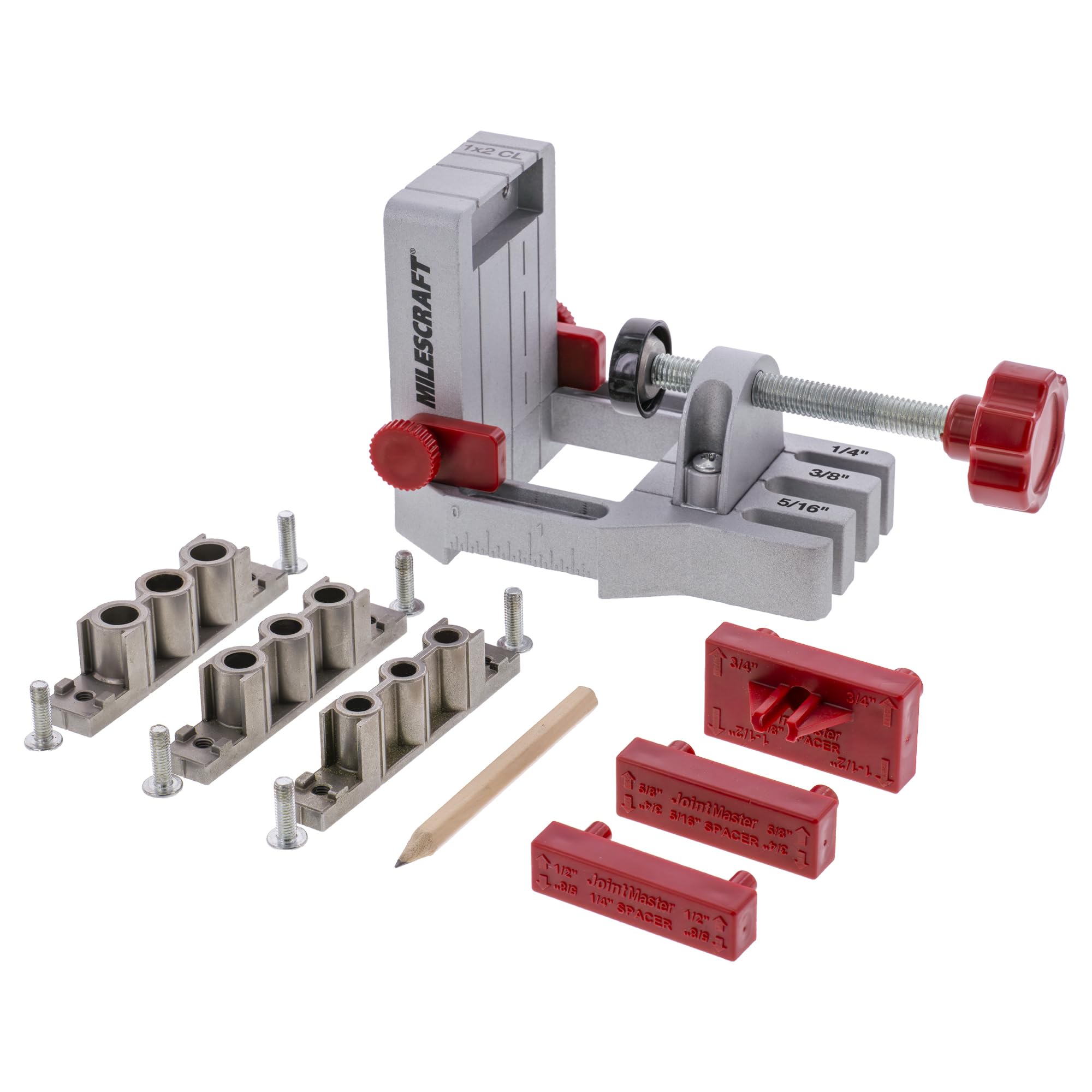
What makes this jig worth reaching for first is coverage. It takes 1/4 inch, 5/16 inch and 3/8 inch dowel pins in one body and handles edge, corner and surface joints — so a single purchase covers most of the joinery a home shop actually builds. The all-aluminum construction is the reason it holds that accuracy: a body that will not flex or bend under clamping load keeps the bushing block square to the face. Hardened steel bushings do the long-term work, holding the bit steady hole after hole instead of letting it wallow out.
Setup is where the design pays you back. The retractable edge stops automatically align the boards so the dowel pins land in the same location on both pieces — you set the reference face once and stop measuring. That is the difference between drilling a joint and drilling a joint that closes flush. At 16 ounces it is light enough to hold against a vertical panel with one hand while you swing the other board into place.
Be straight about one thing: buyers report split feedback on adjustability. Plenty find the precision setup straightforward, and a real share find initial alignment fiddly the first time out. The stops are the whole point: once your reference face is dialed, the repeatability is what you are paying for. The bigger contrast is with the 1311 Joint Pro below, which drills up to six matching holes per setup against this jig’s single-setup approach. The Joint Master wins on size flexibility; the Joint Pro wins on holes per clamp.
The case for it: one aluminum body, three dowel diameters, three joint styles, and hardened bushings that keep the bit honest over years of use.
The honest limit: the first setup asks for patience while you learn where the edge stops want the boards to sit.
Reach for this if: you want one doweling jig that covers thin stock through thick rails without buying a second body.
Look elsewhere if: you would rather clamp once and drill a whole row of holes in a single pass.
3. Rockler Corner Key Dowel Jig for Decorative Mitered Joints
The jig that runs a dowel straight through a miter at 45 degrees and leaves the oval end showing on purpose.
This jig does a job nothing else on the list does: it makes the fastener part of the look. Instead of hiding the dowel, it drills through a mitered corner at 45 degrees, so the dowel end shows as an oval on the outside face — a decorative detail that also strengthens the joint the way a spline would. Use a contrasting wood species and the pin becomes a design feature rather than a repair. That is a narrow mission, so know it before you buy: this is the jig for boxes, drawers and picture frames where the corner is meant to be seen. If your joints stay hidden, spend your money elsewhere.
Holding this jig against a small box is easy because it weighs just 1.39 pounds. The weight gap against the DEWALT is real — the biscuit joiner weighs 6 pounds, this jig weighs 1.39, a spread of more than four times. Molded reference lines and a clear alignment window do the setup work, and the guides ship for 1/8 inch, 1/4 inch and 3/8 inch dowels, so three common dowel sizes are covered from the start. You can also double-drill for multi-layered cores, or lace the joint with leather instead of a dowel if you want a different look entirely.
Two things to plan for. The jig needs to be re-clamped for each hole since clamps are sold separately and there is no built-in clamp in the body — that is a slower rhythm than the self-clamping jigs above. And extended-length bits are required to reach through the joint, which is an extra purchase if your bit drawer is standard-length only. Durability feedback runs mixed, so treat it as a precision instrument rather than a shop-floor bruiser. The performance itself is the part that holds up, and the jig does exactly what the design promises on that score.
Where it shines: exposed 45-degree dowels that turn a mitered corner into a visible detail, with molded reference lines taking the guesswork out of the angle.
What it asks of you: separate clamps and extended-length bits, plus a re-clamp for every hole.
Pick this one for: decorative boxes, drawer fronts and frames where the corner dowel is part of the look.
Pass on it for: production runs of hidden joints — the single-hole clamp cycle is too slow for that work.
4. Milescraft 1311 Joint Pro Doweling Jig
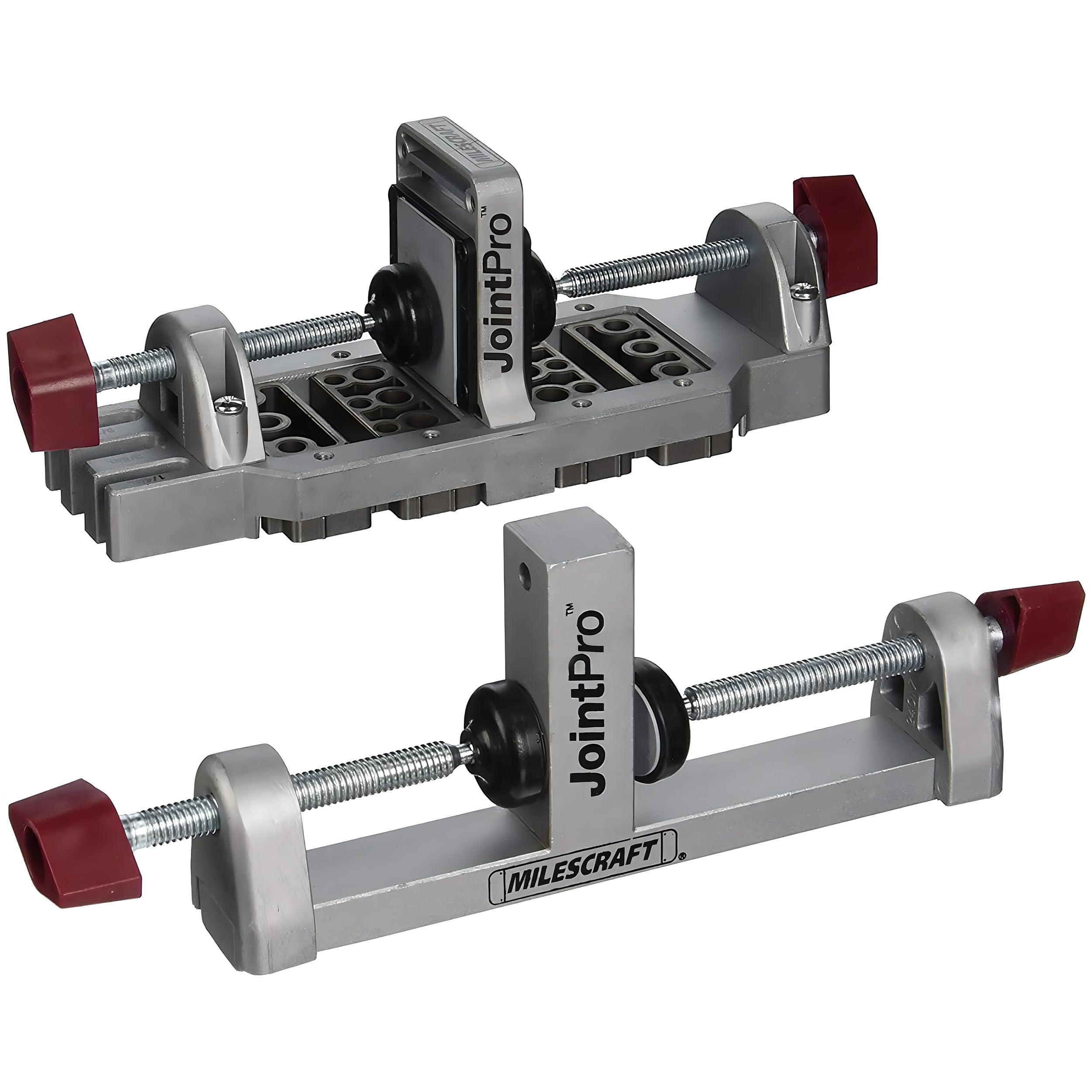
Clamp both boards once and drill up to six matching holes before you move anything.
Six holes per setup is the number that decides this pick. The steel body clamps both boards at the same time so the bores line up by mechanical position rather than by your eye, and once it is locked you drill up to six matching holes without re-clamping. On a table apron or a cabinet face frame, that is the difference between a joint you trust and a joint you hope holds. Three hardened steel bushing blocks take 1/4 inch, 5/16 inch or 3/8 inch dowels, and the body handles corner, edge and surface joints.
The all-steel build is why it tolerates a shop floor. Where the aluminum Joint Master is the lighter, more flexible body, this one is the heavier-duty version — steel does not deflect under clamp pressure, and the hardened bushing blocks resist egging out over repeated use. Detailed instructions walk you through the corner, edge and surface setups, which is useful because the two-piece main body and sub-body take a first-timer a few minutes to understand.
One thing to check before you commit: the specs run in imperial units, and Milescraft explicitly asks you to confirm the jig meets your project’s dimensional requirements. If you work in metric on a regular basis, measure your stock and your planned pin spacing against the listed dims first. The jig does what a steel self-clamping body should do; the imperial spec sheet is the only thing to verify.
The decision-maker: six matching holes per clamp cycle is the highest count in this group, and on a long run of rails it saves real time.
Measure before ordering: the imperial-unit spec sheet needs a check against your own project dimensions.
Best matched to: the woodworker building frames and aprons who wants a steel body and a full row of holes per clamp.
Not the one for: anyone working mostly in metric who has not confirmed the dimensions against their stock.
5. Dowl-it 1000 Self-centering Doweling Jig

A solid steel center block that finds the middle of the board for you and never loses a part.
Simplicity is the entire pitch here, and it lands. The solid steel center block is precision hardened, and because it self-centers, you clamp the jig on the board and the reference is already found — no measuring from an edge, no second mark to misread. There are no loose parts to lose, which sounds like a small thing until you have chased a bushing across a shop floor. The clamping system is the part that quietly wins people over: it holds firm and does not bind or stick when you release it, so the rhythm of clamp-drill-release stays smooth across a whole run.
At 2.4 pounds this jig sits in the middle of the group’s weight range — heavier than the 1.39-pound Rockler corner jig, lighter than the 4.13-pound GOINGMAKE kit. That mass comes from the steel block, which is exactly where you want it for stability. The listed size is 2 inches. It handles the doweling jobs a home shop runs most: edge joints, corner joints and shelf work. The centering action does the layout for you, so you can keep your attention on the drill.
The place this tool draws mixed feedback is hole alignment. That is worth naming honestly: the jig centers accurately, but the bushing-to-bushing path rewards a steady drill hand, so a wandering bit still shows in the finished joint. Learn the drill angle and it is a fast tool; rush it and the joint tells on you. For a jig built around repeatable centering in a small shop, that is a fair trade.
What wins people over: the self-centering steel block does the layout for you, and the clamp releases clean without sticking.
The trade-off: hole alignment rewards a controlled drill hand, so the finish depends partly on your technique.
Made for: the home shop that wants centering handled automatically and no small parts to keep track of.
Choose a different jig if: you want a fixed multi-bushing body that locks the bit path more tightly.
6. GOINGMAKE Dowel Jig Kit with Quick Positive Stop and Clamp
Bushings, bits, clamp and stop system in one box — nothing else to buy before your first joint.
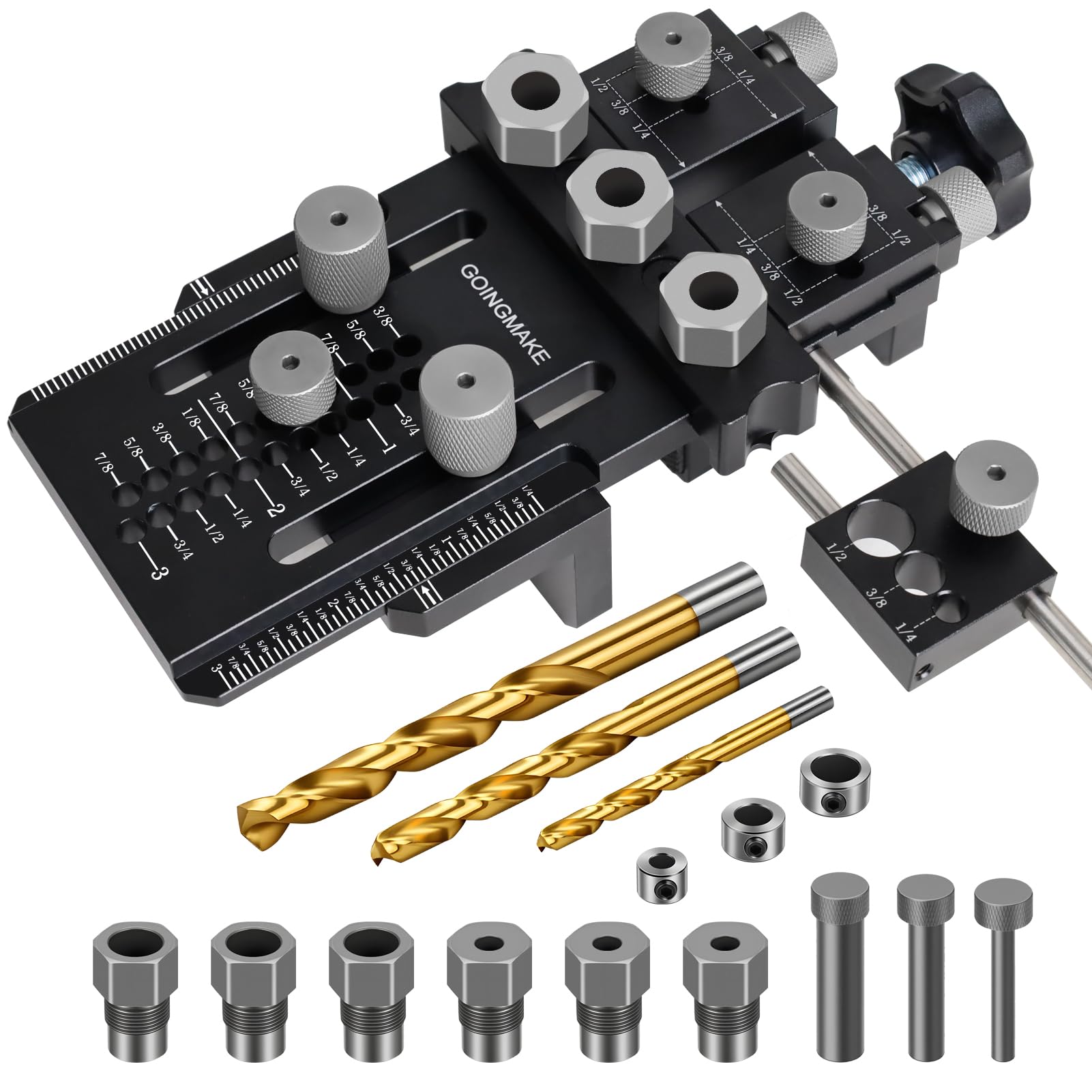
Most jigs on this list get you started and then send you shopping. This kit does not. Nine replacement hardened steel bushings cover 1/4 inch, 3/8 inch and 1/2 inch dowels at three bushings each, and three drill bits ship alongside them — 1/4 inch, 3/8 inch and 1/2 inch. At 4.13 pounds it is the heaviest of the doweling jigs here, and that mass comes from the complete package rather than dead weight. A center line pointer aligns the marks on the workpiece, and the guide drills three accurate straight holes per setup.
The stop system is where the engineering lives. Positive edge stops index in 1/8 inch increments for locating the jig on the board, and clear laser scales let you set spacing in 1/16 inch increments — so a repeated dowel position is a setting you dial in once and then repeat by eye. An extension rod and position pins let you put dowel spacing wherever the joint needs it, rather than only where the fixed bushings happen to sit. The built-in quick clamp grabs the workpiece, and you can pull it off and use your own clamps instead if you prefer.
The honest catch is the first hour. Ease of use draws split feedback — plenty of users describe it as very easy, and a real share find it a bit complicated when they first open the box. Given the number of moving settings, that is the expected price of the completeness. Get past the learning pass and it handles butt joints, miter joints, edge joints, T joints, multi-row joints and center joints. If you want the do-everything kit rather than the simplest tool, this is the one — and it is why the 1311’s simpler setup still appeals to some buyers.
Kit completeness
- Nine bushings and three drill bits included — 1/4 inch, 3/8 inch and 1/2 inch
- Positive edge stops index in 1/8 inch steps; laser scales read to 1/16 inch
- Extension rod and position pins put dowel spacing where you choose
- Quick clamp built in, and removable if you prefer your own
- Seven joint styles covered including T joints and multi-row joints
Setup reality
- The number of settings makes the first session slower while you learn it
- At 4.13 pounds it is the heaviest doweling jig on this list
Buy it for: the do-everything doweling setup with bushings, bits and clamp all in one purchase.
Skip it for: a five-minute first joint — the setup has more dials than a single-purpose jig.
7. Kreg Pocket-Hole Jig 520 KPHJ520PRO2

Drill, drive, done — the pocket-hole rig for plywood and 2×4 stock with sixty screws in the box.
Different tool, different job. A pocket-hole jig drills an angled hole and pulls the two pieces together with a screw, which is how a shop cabinet or a face frame goes together in an afternoon. This one handles material from 1/2 inch to 1 1/2 inches thick, so it covers thin plywood right up through a 2×4. The GripMaxx surface is an anti-slip clamping face that holds the workpiece in place while you drill — a small feature that saves a lot of scrap when the bit bites. The frame is impact-resistant polymer with a steel backbone, which is the right combination for a jig that gets knocked around on a bench.
Sixty screws come in the box, which means you can run a project start to finish without a second order. The VersaGrip rotating handle turns a full 360 degrees, so you can set the grip where it suits the angle you are working at instead of working around a fixed handle. Two and three-quarter pounds is light enough to move between boards without thinking about it.
The one thing to square with yourself before buying is scope. This is a pocket-hole tool, so it makes pocket-hole joints — not doweled joints, not biscuit slots. If your project is a frame, a cabinet box or a shop fixture, that is exactly what you want. If you are gluing up a tabletop and hiding the joinery, you want a biscuit joiner or a doweling jig instead. For pocket-hole work in plywood and 2×4 stock, this is the cleanest place to start.
Value read: a steel-framed body, an anti-slip clamp face, a rotating handle and sixty screws at the entry end of the pocket-hole range.
Know before you buy: it is a pocket-hole jig only, so hidden joinery on a tabletop still needs a different tool.
Matches up with: builders making shop cabinets, face frames and quick assemblies from plywood and 2×4 stock.
Does not suit: furniture work where the fastener must disappear inside the joint.
8. Kreg Pocket-Hole Jig 720, Woodworking Jig, KPHJ720

The pocket-hole jig built around an automatic toggle clamp so the wood sets itself.
The 720 solves the beginner problem: holding the board and the jig and the drill all at once. Its Automaxx automatic toggle clamp adjusts to the workpiece and locks it down, so you clamp and drill rather than wrestle. The drill guide carries an anti-slip surface, which keeps the guide from creeping on the board while the bit is turning. Like the 520, it covers plywood from 1/2 inch to 1 1/2 inch thick, so the same stock range applies — the difference is how the work gets held.
Where the two Kregs split is approachability versus configuration. The 520 ships with sixty screws and a rotating handle; this 720 leans on the automatic clamp and a polymer body, which is why it is the one most often called out as suited to beginners. The joint itself is the same pocket-screw joint either way — drill, drive, done.
The honest limit is range, and it is shared with the 520. Both are built for 1/2 inch to 1 1/2 inch material, so a thicker rail needs a different setup and a thin panel needs care. Both are built for 1/2 inch to 1 1/2 inch material, so a thicker rail needs a different setup. For DIY projects in furniture-grade plywood, the clamp makes this the friendlier of the two.
Why beginners take to it
- Automaxx automatic toggle clamp adjusts to the board and holds it
- Anti-slip drill guide surface resists creeping during the bore
- Handles plywood from 1/2 inch to 1 1/2 inch thick
- Polymer body at 2.72 pounds is easy to move board to board
Where it stops
- Material thicker than 1 1/2 inches falls outside its range
- No screw pack in the box like the 520 carries
First-timer pick: the automatic clamp means you spend your attention on the drill, not on holding three things still.
Look to the 520 instead if: you want screws in the box and a rotating handle for awkward angles.
9. Makita XJP03Z 18V LXT Lithium-Ion Cordless Plate Joiner

Three cast-in fence stops at 0, 45 and 90 degrees, plus a rack-and-pinion fence that stays put once set.
Repeatable angles are the whole point of this joiner. The cast aluminum pivot fence carries three positive stops — at 0 degrees, 45 degrees and 90 degrees — so once you are set on a mitered frame, you can return to flat panel work and back without re-checking the angle by eye. The rack-and-pinion vertical fence (a geared fence that moves both ends together) keeps the fence face parallel through every height change. Six depth settings with one-touch stops cover #0, #10 and #20 biscuits and most common sizes. The fence centers on 3/4 inch material, and large cam locks hold the adjustments where you set them.
Field work loses the cord thanks to the 18V LXT battery platform. At 7.6 pounds this is the heaviest tool on the list — the weight of a full-size joiner with a battery aboard — so it wants the workpiece secured rather than floating. The 3-amp draw is listed among the specs. Where it edges the DEWALT is the positive-stop fence: three fixed angles give a hard reference you cannot drift off, versus a full-swing fence that asks you to trust the adjuster. Where the DEWALT edges it is weight and tool-free setup — 6 pounds against 7.6, with no wrench needed on the DEWALT’s depth and bevel.
As with the DEWALT, confirm what is in the box before you order: the listing carries the unit and an instruction guide, and the battery platform is separate. The precision and adjustability are the two things that stand out in how owners describe it, and a Star Energy 5.0 series battery is noted to run it. The 3-year limited warranty covers the tool itself.
Precision angle work: three cast positive stops at 0, 45 and 90 degrees plus a rack-and-pinion fence make repeat miter setups a hard reference rather than an eyeball call.
Weight and power note: 7.6 pounds is a two-hand tool, and the 18V battery platform is separate from the unit.
Suit it to: installers and shop woodworkers who cut biscuit slots at fixed angles over and over.
Reconsider if: you want the lightest cordless joiner — 7.6 pounds asks for a secured workpiece.
Know the Specs
Dowel diameters and why fractions matter
Doweling jigs are sold around the pin diameter they accept, and the sizes are written in fractions of an inch — 1/4, 5/16 and 3/8 are the common trio, with some kits adding 1/2 inch. The pin has to match the hole, so a jig that only takes one size limits what you can build. A 1/4 inch pin suits thinner or smaller stock; a 3/8 inch pin is what you reach for on a thicker rail. A kit like the GOINGMAKE set covers 1/4, 3/8 and 1/2 inch across nine bushings, while the Milescraft 1334 covers 1/4in, 5/16in and 3/8in in one aluminum body. Check the guide bushings are hardened steel: a plain bore will wear and the bit will start to wander.
Biscuit sizes and depth stops
Biscuit joiners are described by the biscuit numbers they accept — #0, #10 and #20 being the standards — and by whether the depth change is one-touch or needs a wrench. The DEWALT switches between #0, #10 and #20 on a depth knob; the Makita offers six depth settings with one-touch stops covering the same three sizes plus most common biscuit sizes. The other biscuit-joiner figure is the fence: how far it swings and whether the stops are positive. A fence that pivots from 0 to 90 degrees covers flat panels and mitered frames; a fence with cast positive stops at 0, 45 and 90 degrees gives you a hard reference you cannot accidentally drift off.
Common Questions
Is a biscuit joiner stronger than a doweling jig?
What dowel sizes should a wood joint tool cover?
Do biscuit joiners need a battery or a cord?
What thickness of wood will a pocket-hole jig handle?
Why do doweling jigs need hardened steel bushings?
Can I use a self-centering jig on a corner joint?
How long does it take to set up a doweling jig the first time?
Is a pocket-hole joint strong enough for a bookshelf?
What is the difference between the Kreg 520 and the Kreg 720?
Will a biscuit joiner fence handle mitered frames?
The Bottom Line
For most shops, the wood joint tool that earns the bench space is the DEWALT 20V MAX XR Biscuit Joiner. Its dual rack-and-pinion fence and tool-free depth, height and bevel setup let you move between biscuit sizes and angles without reaching for a wrench. If your work is dowels rather than biscuits, grab the Milescraft 1334 Joint Master — one aluminum body covering three dowel diameters and three joint styles is the most flexible single purchase here. And for a shop that builds frames and cabinets fast, the Kreg Pocket-Hole Jig 520 brings 60 screws and a steel-framed body to the pocket-hole job. Whichever route you take, buy for the joint you actually cut most — that one decision narrows this whole list to two or three tools.
How we choose
We do not accept paid placement. Every pick is matched to a real buyer and a real use-case; we do not hands-on test units.
Sources
Specifications: manufacturer listings and product documentation. Review insights: verified customer reviews, as of November 2026. Pricing: not shown on this page (it changes often); check the current price via the retailer link.
As an Amazon Associate, Tactical Gear Guy earns from qualifying purchases. This does not affect which products we feature.