Specs are compiled from manufacturer listings and verified buyer reviews and can change over time — please confirm the key details on the product page before buying.
Most firewood frustration isn’t about strength — it’s about an axe that buries itself in the round and refuses to let go. A good splitting axe should send the log apart on the first swing and come free without a wrestling match. This guide covers the nine wood cutting axes worth your money, sorted by handle length, head weight, and who each one actually fits.
This guide is built by comparing the manufacturers’ published specifications and the patterns across verified customer reviews, so you get each pick’s real strengths and trade-offs instead of marketing spin.
Handle length matters more than most buyers expect: a longer axe builds swing speed and saves your back, but it only pays off if the handle sits right against your height. Below you’ll find every pick broken down by head weight, blade geometry, and the logs it handles best, so you can choose a wood cutting axe that splits clean instead of sticking.
Top Picks

How To Choose The Best Wood Cutting Axe
Three things decide whether an axe works for you: how long the handle is against your own height, how heavy the head is against your swing, and how the blade is shaped where it meets the wood. Get those right and the axe does the work. Get them wrong and you’ll be prying a stuck blade out of every round.
Match handle length to your body, not to the biggest number
A 36-inch handle builds serious swing speed, which is why it’s the standard for tall users working through large rounds on the ground. A 28-inch chopping axe sits lower and feels quicker in tight spots like campsite prep or brush clearing. If you’re shorter, a long handle forces you to swing around your body instead of through it. The length has to reach your natural arc, not just look impressive in the listing.
Understand what head weight actually buys you
A heavy head drives deep into dense grain, but it also costs you swings per session. A 2.8-pound head on a long handle is a speed-first setup. A 6.3-pound maul-style head is a force-first setup for knotty rounds that laugh at lighter axes. Most firewood work lands in the middle, which is why the 4.3-pound splitting head on a 36-inch handle is such a common pairing.
Look at the blade edge, not just the blade
A convex bevel — a blade that bulges outward toward the edge rather than tapering in a flat wedge — pushes wood apart and then releases. That geometry, paired with a low-friction coating, is the difference between a blade that pops free and one you have to hammer back out. Flat-ground edges cut cleanly but grab harder in wet, stringy wood.
Wood handle or composite
Hickory handles feel alive in the hand and soak up shock naturally, and you can re-haft them (fit a new handle) if they ever fail. Fiberglass and FiberComp handles are molded to the head, shrug off overstrikes (misses that hit the handle), and don’t swell or dry out with the seasons. Neither is wrong — it depends on if you want traditional feel or a handle you never have to think about.
Side-by-Side Comparison
| Model | Best For | Handle Length | Head Weight | Total Weight | Amazon |
|---|---|---|---|---|---|
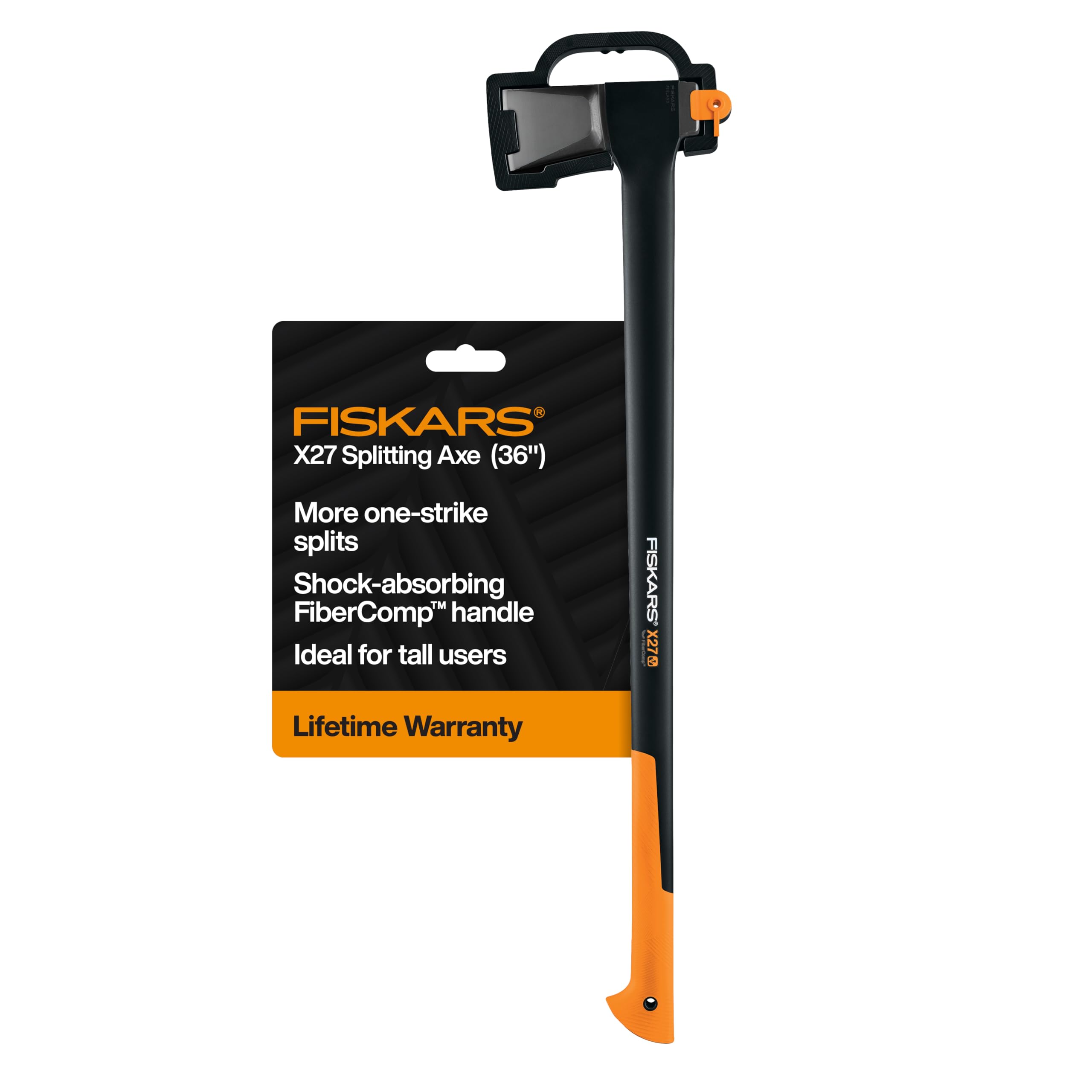
| Fiskars X27 Super Splitting Axe 36″★ Best Overall | Tall users on medium-to-large logs | 36 in | 4.3 lb | 6.3 lb | Amazon |
| 15.7″ Camping Hatchet (DWFKHT)Trail Companion | Pack-and-go kindling and carving | 15.7 in | — | 2.5 lb | Amazon |
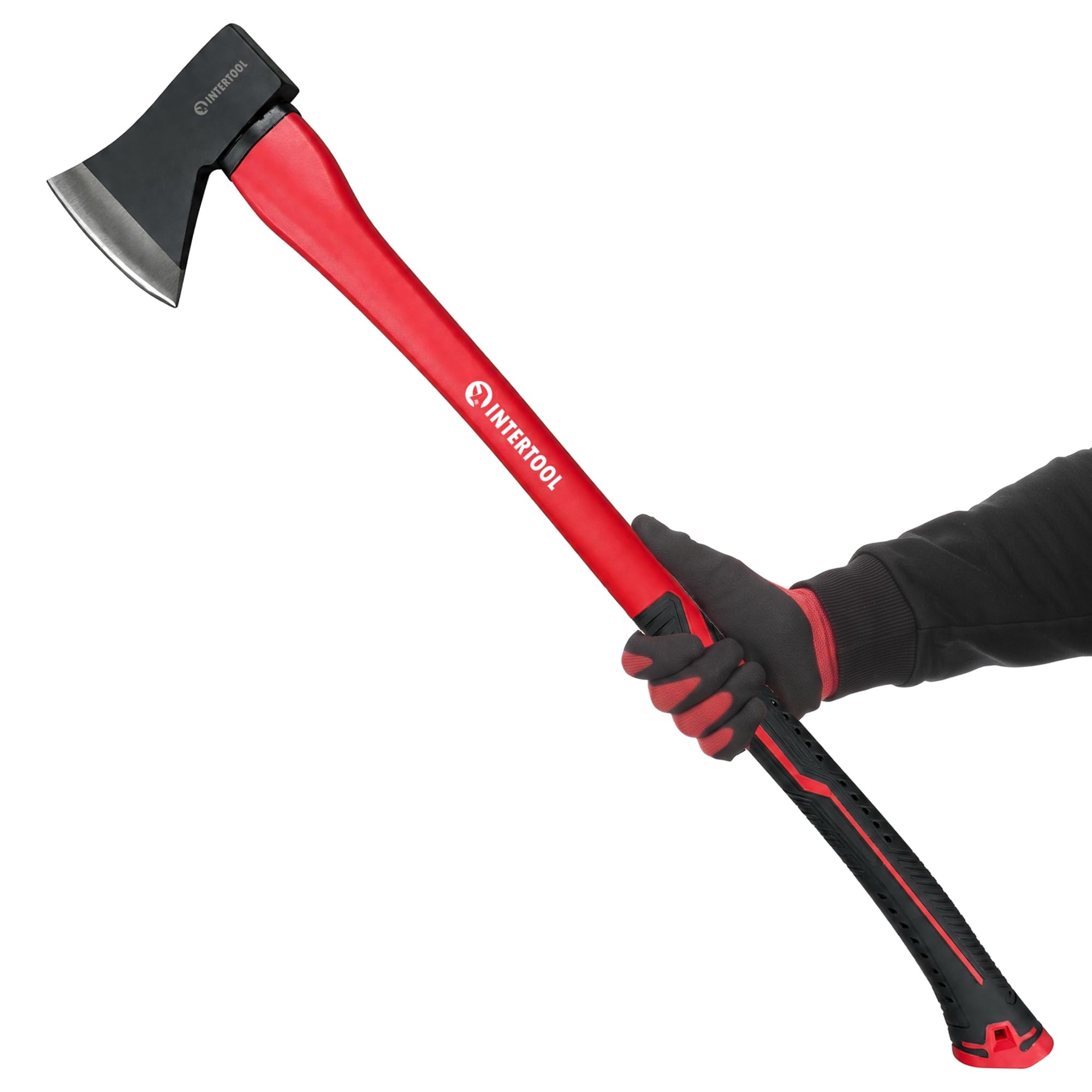
| INTERTOOL 36″ Chopping Axe HT-0264Budget Champion | Felling small trees and firewood on a budget | 36 in | 2.8 lb | 4.8 lb | Amazon |
| Fiskars A-Series Chopping Axe 28″ | Campsite and backyard all-rounder | 28 in | — | 3.5 lb | Amazon |
| Fiskars A-Series Super Splitting Axe 36″ | Medium-to-large log splitting | 36 in | — | 6 lb | Amazon |
| Helko Werk Bavarian Woodworker | Serious felling and heirloom ownership | 31 in | 3.5 lb | 5.5 lb | Amazon |
| Helko Werk Saxon Splitter | Large rounds and difficult, knotty logs | 31 in | 6.3 lb | 8.5 lb | Amazon |
| Gränsfors Bruks Small Forest Axe | Limbing and packable trail work | 19 in | — | 2.2 lb | Amazon |
Detailed Reviews
1. Fiskars X27 Super Splitting Axe 36″
Our pick — 4.5+★ from 9,000+ verified ratings; the strongest balance of quality and price.
The long-handled splitter that finally makes big rounds behave.
If you’re tall and you split firewood on a chopping block, the 36-inch handle is the reason this one leads the list. A long handle lets you swing in a full arc instead of folding your body around the strike, and that arc is where splitting force comes from. The head weighs 4.3 pounds, which is heavy enough to drive into dense grain but not so heavy that your shoulders quit before the woodpile does.
Weight was the number that surprised me here. The whole axe comes in at 6.3 pounds, which is heavier in the hand than a small hatchet but light enough to keep swinging. What wins people over is how rarely it sticks: the bevel-convex edge widens as it travels through the round, and the textured non-slip grip stops your hand sliding up the handle on a hard strike. Owners describe rounds that come apart on a single blow, and the forged steel blade holds its edge across a long season.
The catch is fit, not build. A 36-inch handle wants a taller user with room to swing, and on a short frame it turns into a clumsy chop-down motion. This axe is also built for splitting rounds, not for felling standing timber. Think of this as your firewood workhorse rather than a do-everything woodland tool.
Where it earns its place at the top
- 36-inch handle converts your swing into real speed, so medium and large logs split on the first strike more often
- 4.3-pound head is the balance point between deep bite and a swing you can repeat
- Bevel-convex blade widens through the wood, so the head releases instead of wedging
- Textured non-slip grip and shock-absorbing handle cut hand strain and guard the shaft against overstrike damage
- Lifetime warranty and a protective sheath in the box
Two things to know before you buy
- At 6.3 pounds total it wants a taller user — on a shorter frame the length works against you
- It’s a splitter, not a feller; don’t expect it to replace a proper felling axe
The verdict: The most complete splitting axe here for anyone splitting rounds at waist height, backed by 4.5+ stars across 9,000+ ratings.
Know going in: If you’re on the shorter side or splitting on the ground rather than a block, the 36-inch swing arc will feel like extra length rather than extra power.
2. 15.7″ Camping Hatchet
A hand-forged hatchet that drops into a pack without dragging you down.
At 2.5 pounds against the Fiskars X27’s 6.3 pounds, and at 15.7 inches of handle against the X27’s 36 inches, it’s a completely different animal. You carry this one to the campsite, not to the woodpile. The 15.7-inch length is short enough to swing one-handed in tight brush and long enough to get two hands on when you’re splitting kindling. A 3.7-inch blade with a hand-forged 1065 high carbon steel head does the cutting, and the beech wood handle keeps the whole thing feeling like a tool rather than a gadget.
Quality is what carries this hatchet — it’s the thing people keep coming back to, and the hand-forged look and slim head design draw a steady stream of compliments. It also arrives with a leather sheath and a sharpening stone, so you can stash it and touch up the edge on the trail. Durability is more of a split verdict: some owners have used theirs hard without trouble, while others have had the head come loose or the edge feel duller than expected from the start.
That mixed sharpness and head-to-handle durability isn’t unusual on a forged hatchet at this price — you’re buying a tool you’ll inspect and maintain, not a sealed appliance. The practical move: check the head seating before your first swing and keep the edge honed. It’s a bushcraft and carving axe first and a firewood splitter second.
Small, sharp, and packable: The 2.5-pound total and 15.7-inch length make this the easiest axe here to carry, and the hand-forged head, beech handle, and included leather sheath form a tidy trail kit.
The honest trade-off: Its edge and head seating are the two things to check on delivery, and it’s a kindling and carving tool rather than a log splitter.
Reach for this if: You want a proper forged hatchet for campfires, carving, and small wooden projects that rides in a backpack.
Look elsewhere if: You’re splitting rounds bigger than a forearm — that job belongs to one of the 36-inch splitters.
3. 36 Inch Chopping Axe HT-0264
Thirty-six inches of leverage with a 2.8-pound head against the Fiskars flagship’s 4.3 pounds.
The INTERTOOL splits the difference between a felling axe and a splitter. Its head weighs 2.8 pounds against the Fiskars X27’s 4.3 pounds, but the fiberglass handle runs the full 36 inches — so you get the long-handle leverage without the heavy head. That lighter head swings faster and tires you out slower, which makes it a sensible choice for felling smaller trees, clearing brush, and cutting firewood into burnable lengths. A 5.1-inch blade also gives you more cutting surface per stroke than the hatchet above.
What people rate highest is the build quality, closely followed by how sharp it arrives — it’s pre-sharpened from the start and the heat-treated carbon steel head carries a protective rust-resistant coating. The textured rubber grip locks your hands down, and the fiberglass shaft soaks up the shock that would otherwise travel into your wrists and elbows. It also comes with a blade cover, so you can carry it to the truck without improvising.
Durability is the honest question mark. Some owners put theirs through seasons of firewood duty; a handful report the handle failing early on. Treat the fiberglass shaft as the part to watch, keep your strikes on the log rather than the block, and the axe holds up fine. Given the quality buyers report at this price, it’s an easy one to recommend for a first firewood axe.
The trade that makes it work: Long 36-inch handle, lighter 2.8-pound head. You give up some striking mass and get a faster swing, a longer edge at 5.1 inches, and a fiberglass shaft that dampens vibration.
Worth knowing: The handle is the component most likely to give trouble, so keep overstrikes minimal.
Best for: Anyone building a first firewood setup who wants long-handle leverage and a pre-sharpened edge without going deep.
Less ideal if: You’re regularly splitting dense, knotty rounds — that calls for the heavier 6.3-pound head further down the list.
4. Fiskars A-Series Chopping Axe 28″
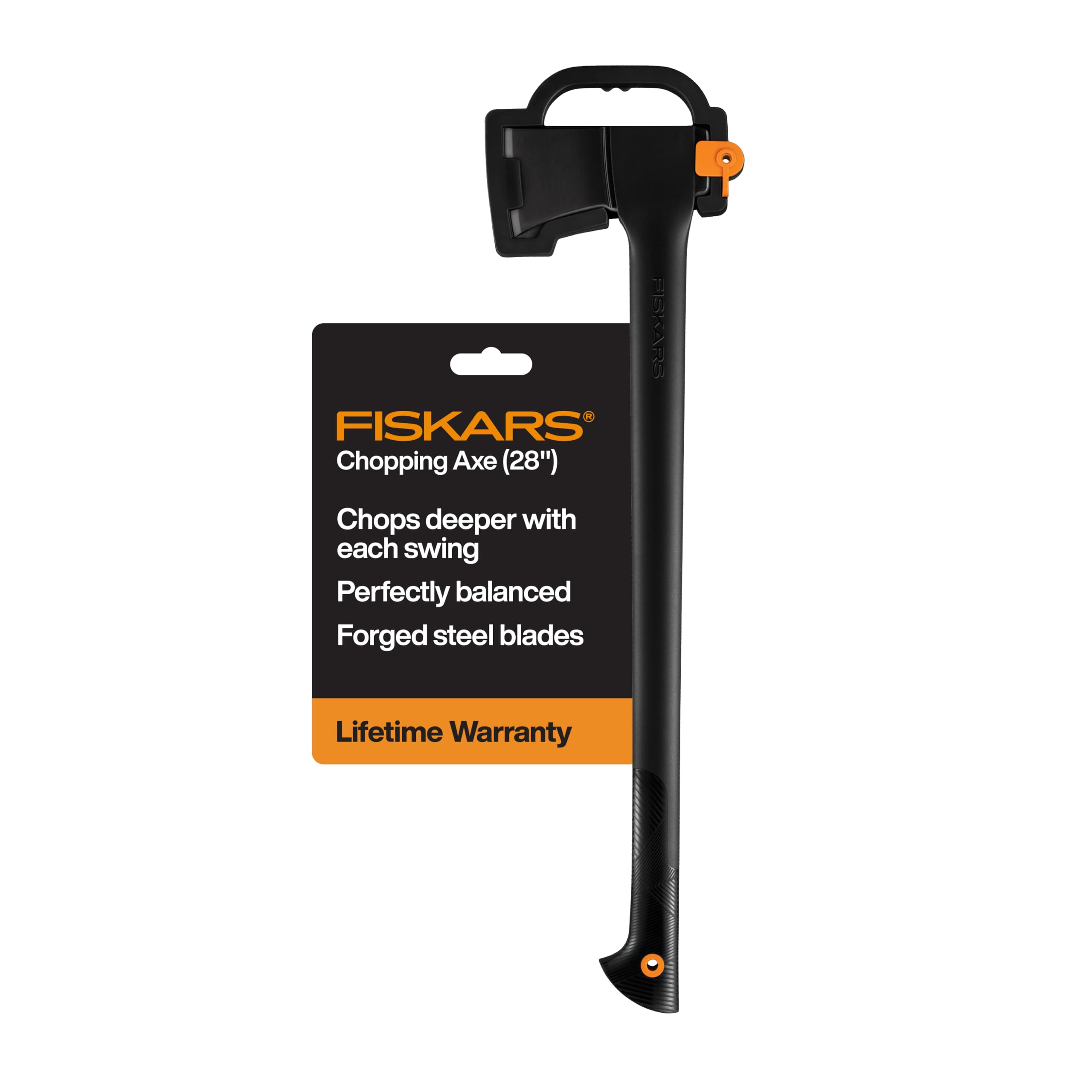
The mid-length swing that handles limbs, logs, and campsite chores without the full 36-inch reach.
Twenty-eight inches is the sweet length if you’re working in a backyard, at a campsite, or out of the back of a vehicle. It’s short enough to swing in a tight space and long enough to get real leverage on a limb. The whole tool weighs 3.5 pounds, which puts it well under the 36-inch splitters here and makes it pleasant to carry on a hike or toss in a truck bed. The forged steel head carries a hardened, non-stick edge with a low-friction coating — that slick surface stops the head from wedging and makes the blade easier to pull back out of the cut.
The A-Series handle is a FiberComp shaft, meaning a molded composite that absorbs shock and refuses to swell or dry out. What people notice most is the edge holding its bite through a full day of work rather than dulling by mid-afternoon. Owners stretch this axe across a surprising range — camping, off-road vehicle kits, and general recovery work — which says a lot about how flexible the 28-inch format is.
The only real limitation is size. It’ll fell small trees and split modest logs, but the big rounds and dense hardwoods want the 36-inch handles. So this is the one to grab when the job is mixed and you want a single axe to do most of it.
Why it’s the easy grab: 28 inches and 3.5 pounds is the middle ground — enough leverage for limbs and camp wood, light enough to carry on foot, and the low-friction coating keeps it from sticking.
One thing to accept: It’s a versatile mid-length axe, not a dedicated log splitter, so the biggest rounds are out of its range.
Pick it for: Mixed outdoor duties where one axe has to do camp wood, garden limbs, and vehicle kit duty.
Not the tool for: A woodpile of large, dense rounds you plan to split every autumn.
5. Fiskars A-Series Super Splitting Axe 36″
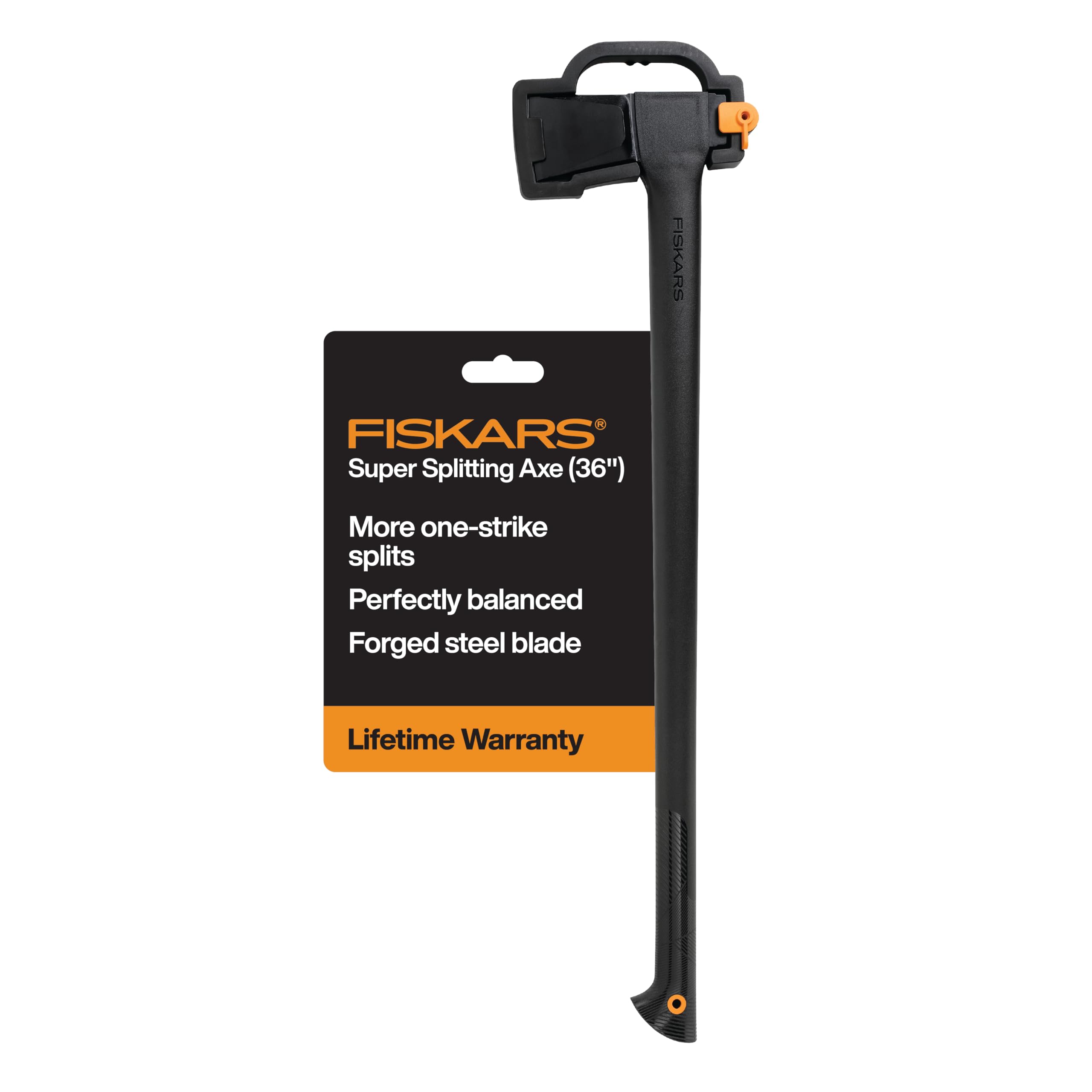
Built to send medium and large rounds apart and then let you pull the blade free.
The specs tell you exactly what you’re getting. The handle is a 36-inch FiberComp shaft — a molded composite that’s lighter than steel and absorbs shock — and the whole axe weighs 6 pounds. That’s slightly lighter than the X27’s 6.3 pounds at the same handle length. What matters is where that weight sits, not the total: a long handle with a wedge-shaped head concentrates force at the tip of the swing, so logs split with less effort. Owners describe medium and large rounds coming apart on the first strike.
The edge geometry does a lot of the work. It’s a convex bevel with a low-friction coating, which means the blade widens smoothly as it enters the round and slides back out instead of trapping itself. The insert-molded head reduces the chance of loosening over time, and the handle is built to resist the overstrike damage that kills weaker shafts. The A-Series also brings a lifetime warranty, which matters on a tool you’re going to thump into hardwood for years.
The one adjustment: this is a splitter, pure and simple. It’s designed for medium to large logs, and it wants a chopping block and a full swing. If your rounds are modest or you work on the ground, the 28-inch A-Series above is more forgiving. But if you’re processing a real woodpile, this is the shape of tool that makes the job quick.
What makes it a real splitter
- 36-inch FiberComp handle builds swing speed for one-strike splits on medium and large rounds
- Convex bevel with low-friction coating means the blade separates the wood and releases cleanly instead of sticking
- Insert-molded head resists loosening, so the head stays tight season after season
- Shock-absorbing handle and lifetime warranty back a tool built to last
The honest limits
- It’s a dedicated splitter — felling and limbing are not its job
- A 36-inch length and full swing needs room; cramped spaces make it awkward
Choose it when: Your autumn ritual is a pile of medium-to-large rounds and a chopping block, and you want each one to split on the first hit.
Pass if: You need one axe for felling, limbing, and splitting — this is the split step only.
6. Helko Werk Bavarian Woodworker Felling Axe

A hand-forged German felling axe with a slim, wide-bit head that bites deep.
This is the axe for the buyer who wants a tool with a story. The 3.5-pound Rheinland-pattern head is a full-size German cutting axe — sharp, slim, and wide at the bit, a shape named for the heavily forested Rhein River Valley where axes like this have been used for centuries. The blade runs 5.5 inches, and the whole axe comes in at 5.5 pounds on a 31-inch handle. It’s built for felling work, and the narrow bit cuts rather than crushes.
Every head is open-face drop forged by hand from German C50 high carbon steel at 53-56 HRC — that’s a hardness rating, and it means the edge resists rolling in seasoned hardwood. The handle is grade A American hickory, hand-selected for grain and density, sanded to 150 grit, and finished with boiled linseed oil. You also get a full-grain vegetable-tanned leather sheath and a 1 oz bottle of Axe Guard oil to keep the head from rusting. What people praise most is the craftsmanship — the hand-forged head and hickory handle.
But a hand-forged wood-handled axe is a tool you look after. The durability picture is split: some owners treat theirs as a lifetime tool, others have had a handle break. The wood needs oiling, the edge needs honing, and the handle needs a dry place to live. If you want something you maintain and hand down, this is exactly that. If you want an axe that needs nothing from you, look at one of the composite-handled picks.
The argument for going traditional
- Hand-forged C50 carbon steel head at 53-56 HRC holds a sharp, slim cutting edge
- Wide-bit Rheinland pattern fells and cuts with serious heft on a 5.5-pound tool
- Grade A American hickory handle, hand-finished and linseed oiled
- Full-grain leather sheath and Axe Guard oil included
What you’re signing up for
- Wood handles need oiling, dry storage, and occasional care
- Durability experience is mixed — handle failures happen
For the tool-keeper: Buyers who want a hand-forged German felling axe they’ll oil, sharpen, and hold onto for decades.
Not for the low-maintenance: If you won’t baby a hickory handle, a composite shaft is the smarter path.
7. Helko Werk Saxon Heavy Log Splitting Axe

Maul-level splitting force in an axe you can still aim.
The Saxon is the heaviest head in this lineup at 6.3 pounds, mounted on a 31-inch handle for a total weight of 8.5 pounds. That’s the axe to reach for when the rounds are big and knotty and every lighter tool here just bounces off. Helko built the head so it strikes hard without getting pinched up in the wood, and the balance means you’re swinging a tool with control rather than a sledge with an edge. There’s even a small turnaround hook on the heel of the blade for rolling logs into position.
The steel is the same German C50 carbon at 53-56 HRC used across the Helko line, hand drop forged and paired with a grade A American hickory handle finished in linseed oil. Attention to detail shows in the fit and finish — the kind of axe that looks as good on the rack as it works on the block. Owners describe it splitting large-diameter, knotty rounds in a few chops.
The trade is obvious the moment you lift it. At 8.5 pounds total it’s a session tool, not a whole-afternoon tool — your back and shoulders will tell you when it’s time to stop. And like the Bavarian above, it’s a hickory-handled axe that wants oil and dry storage. If you’re splitting big wood a few rounds at a time, that trade is worth it.
The heavy hitter: 6.3 pounds of head on a 31-inch hickory handle delivers maul-grade force with axe-grade control for difficult, large rounds.
The cost of that force: 8.5 pounds total tires you faster, and the hickory handle needs the same oiling and storage care as any wood shaft.
Reach for this if: You’ve been beaten by a round that lighter axes can’t crack and you want one tool that ends the argument.
Skip if: You split for hours at a stretch or want a light carry — the weight is the whole point and the whole problem.
8. Gransfors Bruks Small Forest Axe 19 Inch, 420

A 19-inch Swedish-made classic for limbing, kindling, and moving fast through the trees.
Nineteen inches and 2.2 pounds is about as packable as a real axe gets while still doing real work. The Small Forest Axe is built for splitting small sticks, cutting limbwood, and felling the occasional small tree — the tasks where you need an edge on a light shaft, not a splitting maul. The convex edge comes razor-sharp, and the hickory handle is paired with a vegetable-tanned leather sheath and the original Gransfors axe book.
Sharpness and cutting performance are what people talk about most — an edge that takes down a sapling in a couple of strokes. The balanced weight is the other thing you keep hearing: 2.2 pounds with the weight spread where it belongs means you can carry it all day and swing it accurately. Craftsmanship is the third leg of the reputation — these are handmade tools and they look it.
The limit is honest and built in: 19 inches is not a splitting axe. Big rounds will laugh at it, and you should not expect it to do the job of a 36-inch splitter. You’re paying for the craft and the carry-ability, not for brute force. For gear-focused trail users, that’s a fair trade; for firewood processing, it isn’t.
Carry it, don’t replace the splitter with it: A 19-inch hickory handle and 2.2-pound total make this the most packable real axe here, with a convex edge that arrives razor-sharp and a vegetable-tanned sheath on the side.
Where it ends: Splitting big rounds is out of scope, and you’re paying a premium for the handcraft and portability.
The right buyer: Pack-and-trail users who want a light, precisely made axe for limbing, kindling, and small felling work.
The wrong job: Processing a woodpile of large rounds — this axe is a scalpel, not a wedge.
Know the Specs
Handle Length
Length is the spec that decides how much speed you can build before the head lands. A 36-inch handle gives you a longer arc and more swing speed, which is why it’s standard on splitting axes for medium and large logs. A 28-inch handle sits between a hatchet and a full splitter and works in tighter spaces. Shorter than that — 19 inches and down — and you’re in packable territory where control and portability matter more than raw force. Match the length to your height and your workspace before anything else.
Head Weight and Total Weight
The head weight is the mass that does the splitting, and the total weight is what your shoulders carry. A 2.8-pound head on a long handle swings fast; a 6.3-pound head on a 31-inch handle drives deep but tires you in minutes. The Fiskars X27 pairs a 4.3-pound head with a 6.3-pound total, a common balance for everyday firewood. Look at both numbers together, because a light head on a long shaft and a heavy head on a short shaft behave nothing alike.
Blade Geometry and Coating
A convex bevel is a blade that curves outward toward the edge instead of tapering in a flat line. That curve pushes wood apart progressively and then releases, which is why splitters use it. A low-friction or non-stick coating adds a slick layer so the head slides back out instead of binding. Together they’re the difference between a clean split and a wrestling match. Cutting axes for felling tend to use a thinner, sharper profile instead.
Handle Material
Composite handles — FiberComp, fiberglass, molded synthetics — are attached to the head at the factory, absorb impact shock, and don’t swell or dry out with the seasons, which suits year-round firewood work. Wood handles, especially hickory, feel livelier in the hand, can be re-hafted (given a new handle) if needed, and reward a little oiling and dry storage. Neither is better; the choice depends on if you want zero maintenance or a tool you care for.
Common Questions
What handle length should a taller person use for splitting firewood?
Will a splitting axe stick in wet or green wood?
Is a heavier head always better for splitting logs?
Do I need a wood handle or a fiberglass one?
How sharp do these axes arrive from the start?
Can a small hatchet replace a full splitting axe?
What does the HRC rating on a Helko Werk axe head mean?
Is a chopping axe the same as a felling axe?
How do I keep the handle and head from loosening over time?
What kind of sheath comes with each axe?
The Bottom Line
For most people splitting firewood on a block, the wood cutting axe to buy is the Fiskars X27 Super Splitting Axe 36″. It pairs a 4.3-pound head with a 36-inch handle at 6.3 pounds total, and the bevel-convex edge with its textured non-slip grip is built to split medium and large rounds without burying itself in the wood. It also carries the strongest owner record of anything here at 4.5+ stars across 9,000+ ratings.
If your work is mixed — camp wood, garden limbs, and the odd small tree — the 28-inch Fiskars A-Series Chopping Axe at 3.5 pounds is the one to reach for instead. And for a pile of dense, knotty rounds that shrug off lighter heads, the Helko Werk Saxon Splitter brings a 6.3-pound head to the job. Still deciding? Start with the X27 — the edge geometry, the length, and the owner track record make it the safest single choice in this group.
How we choose
We do not accept paid placement. Every pick is matched to a real buyer and a real use-case; we do not hands-on test units.
Sources
Specifications: manufacturer listings and product documentation. Review insights: verified customer reviews, as of November 2026. Pricing: not shown on this page (it changes often); check the current price via the retailer link.
As an Amazon Associate, Tactical Gear Guy earns from qualifying purchases. This does not affect which products we feature.