Specs are compiled from manufacturer listings and verified buyer reviews and can change over time — please confirm the key details on the product page before buying.
You want a watch that looks like it flew a bomber mission, not one that looks like a fashion brand watched a documentary once. A genuine flieger dial (the big-numbered pilot face designed for quick reads in a cockpit) gets you the period look, while a generic “aviation-style” case gets you nothing but a logo. Every pick below is a real World War 2 aviator watch design or an honest period reproduction, sorted by what actually holds up on your arm.
This guide is built by comparing the manufacturers’ published specifications and the patterns across verified customer reviews, so you get each pick’s real strengths and trade-offs instead of marketing spin.
Top Picks


How To Choose The Best World War 2 Aviator Watch
A period aviator watch has to do three jobs at once. It should look like it came out of a 1940s cockpit, it should keep time without fuss, and it should feel right on your wrist all day. Most buyers get burned on the third one, because a flieger case (the wide, flat pilot housing) can look small in photos and huge on a 6.5-inch wrist.
Movement First, Because It Sets The Whole Character
A quartz movement runs on a battery and ticks once per second. An automatic movement winds itself from the motion of your arm and has no battery at all. A hand-wound mechanical movement needs you to turn the crown each day. None is “better” in the abstract — but if you want the watch to feel like a genuine piece of 1940s kit, the mechanical options carry the character. The Seagull ST1901 chronograph movement inside two of the picks here is a hand-wound column-wheel design, which is the same family of engineering used in far pricier chronographs.
Case Diameter: The Number That Decides Comfort
Pilot watches historically ran large so a pilot could read them at a glance. Modern reproductions land between 40mm and 43.5mm in diameter. A 40mm case on a leather strap sits neatly on most wrists; a 43.5mm case with a thick bezel starts to dominate. Check the case length too, not just the width — a long lug-to-lug measurement makes a watch overhang the edge of your wrist.
Dial Type And Lume: How It Reads At Night
A Type A dial uses simple 1-through-12 hour numerals. A Type B dial swaps that for an inner 12-hour ring and an outer ring marked in five-minute increments, which is what many Luftwaffe-issued pilot watches used. Both work; Type B just reads busier and more period-correct. Lume is the glow-in-the-dark paint on the hands and markers. Mineral crystal (a hardened glass) resists scratches reasonably but picks up hairline marks; sapphire crystal is harder and stays clearer longer.
Water Resistance: Read The Number Honestly
Pilot watches were never dive watches. A 30-meter rating covers handwashing and rain, not swimming. A 50-meter rating gives you a bit more margin for splashes. If you plan to swim in it, look elsewhere — none of these are built for that, and pretending otherwise is how you flood a movement.
Side-by-Side Comparison
| Model | Best For | Movement | Case Diameter | Water Resistance | Amazon |
|---|---|---|---|---|---|
| AVI-8 Hawker Hurricane Classic Chronograph★ Best Overall | Everyday pilot look | Japanese quartz chronograph | — | — | Amazon |
| Mil-Tec Vintage Aviator WatchBest Period Replica | Budget period replica | Japanese Miyota quartz | 43mm | 3 ATM (30m) | Amazon |
| Boyarca Pilot Watch AutomaticMost Compact Mechanical | Compact mechanical wear | Japan Miyota 8215 automatic | 40mm | 50m | Amazon |
| AVI-8 Hawker Hurricane Dual Time | Readable dual-time travel | Japanese meca-quartz | 43.5mm | — | Amazon |
| TOPHILL 1963 Chronograph | Full lume dial | Seagull ST1901 hand-wound | 40mm | 50m | Amazon |
| SEA-GULL 1963 International Edition | Aviation chronograph value | Seagull ST1901 hand-wound | — | 30m | Amazon |
| Laco Type B Dial Miyota Automatic | Authentic flieger pedigree | Miyota automatic | 42mm | 50m | Amazon |
Detailed Reviews
1. AVI-8 Hawker Hurricane AV-4011
Our pick — 4.5+★ from 500+ verified ratings; the strongest balance of quality and price.
The vintage chronograph dial that turns a plain wrist into a cockpit instrument panel.
This is the pick that earns its position on sheer consistency. The Hawker Hurricane chronograph blends simple hour indexing with bold hands and detailed vintage sub-dials, so the face reads instantly without a compass ring or slide rule cluttering it. A genuine leather strap lets it move from a flight jacket to a dress shirt without swapping anything. And at 2.65 ounces it stays light enough that you forget it is there by mid-morning.
Build quality is what wins people over — a solid stainless case with an accurate Japanese quartz movement inside. Quartz here means a battery, not your wrist, and that is a real plus for a watch you wear in rotation: set it, rack it, and it still tells the right time weeks later. The leather strap carries the dressy-yet-casual balance the brand bills it for, which is exactly why it works as a daily rather than a display piece.
The honest catch is wrist size. The case is built generously, and while most wearers find it right, a slimmer wrist can feel it swim. The other thing to know: AVI-8’s own product copy is candid that sub-dial function can be finicky on some units, so check the chrono pushers reset cleanly on arrival while the return window is open. If it fits, this is the watch you reach for first every morning. It is the highest-rated pick in this lineup at 4.5+ stars from 500+ owners.
What earns it the top spot
- Vintage chronograph sub-dials with bold hands and simple hour indexing for an instant read
- Genuine leather strap that shifts from casual to dress without a swap
- Lighter than many pilot chronographs at 2.65 ounces on the wrist
- Japanese quartz accuracy — a battery keeps time between wears
What to size-check first
- The case runs generous; slim wrists should confirm fit before committing
- Quartz means no period-correct winding ritual, if that is what you came for
- Verify the chronograph pushers reset properly from the start
The right call for: first-time pilot-watch buyers who want the vintage chronograph look with set-and-forget timekeeping.
Worth a second thought: if your wrist is on the slim side, the generous case is the one thing to check.
2. Mil-Tec Vintage Aviator Watch
A stone-washed stainless case that looks dug out of a 1940s footlocker, without the collector-price tag.
If the goal is the period silhouette on an entry-level budget, the Mil-Tec delivers it. Inside is a Miyota Japanese quartz movement — reliable, cheap to service, and free of winding chores. The case gets a stone-wash finish that gives it that worn-in mil-spec look from the first day, and the simple three-hander dial (just hour, minute, and second hands, no chrono clutter) keeps the face clean. The calfskin band is 20mm wide and fits wrists up to 8.8 inches in circumference, so bigger wrists are covered.
The stone-washed case and clean three-hander dial carry the period look. Housed in a 43mm stainless case at 14mm tall and only 80 grams, it sits flatter than its width suggests. Water resistance is rated to 3 ATM (30 meters, or 99 feet) — fine for rain and handwashing, not for a pool. A 2-year warranty rounds out the package.
Here is the plain truth on durability. This is a budget replica, and the crown is the weak point on the occasional unit — a handful of buyers report it letting go quickly. Treat the crown gently when you set the time and you sidestep most of that. The other real quirk: the second hand is black on a black dial, so tracking it in dim light is a strain. For a period-correct look at an entry-level tier, those are fair trades.
The replica appeal: stone-washed 43mm stainless case, Miyota quartz, and a clean three-hander dial give you the flieger look with zero winding fuss.
Handle with care: the crown is the weak spot on the odd unit, and the black second hand disappears against the black dial — set the time gently and read it in daylight.
Buy it when: you want the WW2 replica look on a tight budget and don’t mind a little crown care.
Pass on it when: easy low-light reading is a priority — the black-on-black second hand fights you.
3. Boyarca Pilot Watch
A 40mm mechanical flieger you can actually forget you’re wearing.
You get a genuine mechanical watch that skips the battery entirely. The Boyarca runs the Japan Miyota 8215 automatic movement (a self-winding engine that powers itself from the motion of your arm); it stores 40 hours of energy when you take it off, so it keeps running through a weekend on the nightstand. The frequency is 21600 beats per hour (3Hz) — a smoother sweep than a quartz tick. And it is the smallest case here at 40mm, versus the 43.5mm AVI-8 dual time, on a lightweight 70 grams including the strap.
Materials punch above the price feel. The case and screw-down back are 316L stainless steel (a corrosion-resistant surgical-grade alloy), and the crystal is flat sapphire — the harder glass that resists scuffs far better than mineral. The dial carries Super luminous powder on both hands and markers, glowing green after light charging. Water resistance is rated to 50 meters, which handles splashes with more margin than a 30-meter rating would.
Two things to weigh. First, the 40mm case is deliberately compact next to a true flieger, and a few wearers find it small for the style — the trade-off for comfort and a cleaner fit under a cuff. Second, a small-sample automatic will gain or lose a few seconds a day, so expect to reset it every so often. The fit is where it shines: the 20mm lug width makes strap swaps easy.
Materials at a glance: 316L stainless steel, a flat sapphire crystal, green Super luminous hands and markers, and genuine leather on a 40mm case — solid parts for an entry-level mechanical.
What to plan around: it is genuinely small next to a 43mm-plus flieger, and any automatic drifts a few seconds per day. If you want wrist presence, size up; if you want a comfortable daily, this is it.
Reach for this if: you want an authentic automatic pilot watch that disappears under a dress cuff and stays comfortable through a workday.
Look elsewhere if: you are chasing the oversized flieger silhouette — 40mm will feel modest.
4. AVI-8 Hawker Hurricane AV-4088

The dual-time flieger with raised numerals that read from across a room.
Two things set the Dual Time apart. The first is legibility: the case carries raised numbers inside it, so the hour markers catch light and shadow instead of flattening into the dial — exactly what you want on a pilot watch. The second is the movement. This is a meca-quartz, a Japanese hybrid engine that pairs quartz accuracy with the sweep-hand motion of a mechanical. So you get quartz timekeeping without the dead quartz tick.
This is the heavyweight twin of the standard Hawker Hurricane. At 3.53 ounces, it runs 2.65 ounces versus its own chronograph sibling — noticeably meatier on the wrist, so plan for that. The quartz core means the lumed hands and indices glow after some light charging, and the dual-time function covers a second time zone. Strap options run leather or stainless steel, so you can dress it up or down without buying another watch.
What is left to know: at 43.5mm in diameter it takes up real estate, and the added weight compared to the Classic Chronograph is not imaginary. Big wrists get the most out of it. If you want a lighter, more understated Hawker Hurricane, the chrono is the more discreet twin.
Why it reads so well
- Raised numerals inside the case catch light for a fast, clear read
- Meca-quartz blends quartz accuracy with a smooth sweep hand
- Dual-time function gives you a second time zone
- Leather or stainless steel strap options shift it from casual to dress
Where it gives up ground
- Noticeably heftier than the Classic Chronograph at 3.53 ounces
- 43.5mm case wants a fuller wrist to look right
- No mechanical winding character — it is a hybrid, not a pure automatic
Made for: the buyer who puts legibility first and likes a substantial watch on the wrist.
Second-guess it if: a light, understated watch is your preference — this one has presence.
5. AVI-8 Spitfire Lock Chronograph AV-4089
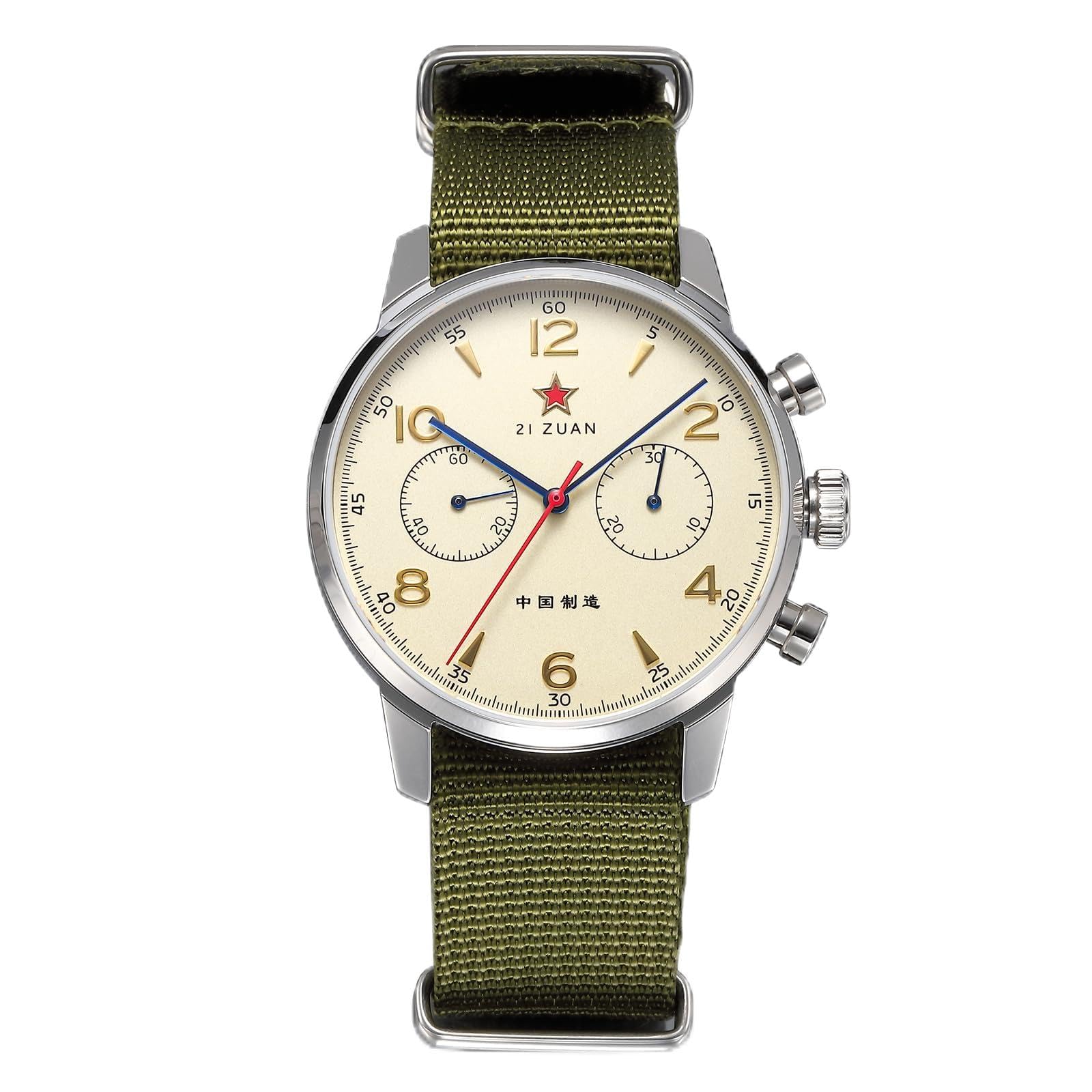
The dial becomes the nightlight — a full-lume face on a hand-wound aviation chronograph.
The 1963 traces its heritage to China’s first air force military mechanical chronograph, and the TOPHILL version packages it in a 40mm stainless case. The headline is the full lume dial: instead of just glowing hands and markers, the whole face is treated, so it lights up across its surface in the dark. Under that sits the Seagull ST1901 hand-wound movement — a column-wheel chronograph engine you wind yourself, the watchmaking equivalent of a manual transmission. It is 50m water resistant, good for daily wear like handwashing and rain, not for swimming.
Sapphire crystal keeps the glass clear and resistant to scuffs. The 316L stainless case gets polished sides for a smooth, light-catching finish. What owners keep coming back to is the look — a genuinely striking relic of a design. It keeps time well and the chronograph functions as it should according to most accounts.
The real cost of admission is winding. As a hand-wound watch it does not self-charge, so it wants attention — plan to wind it regularly, up to a couple of times a day in daily rotation to keep it running. That is the nature of a manual movement, not a fault. Buy it for the ritual and the full-lume dial; avoid it if automatic convenience is a must.
Why pilots would want it
- Full lume dial lights the whole face in the dark, not just the hands
- Seagull ST1901 hand-wound column-wheel chronograph movement
- Sapphire crystal and a 316L stainless case with polished sides
- 40mm case that suits most wrists without bulk
Round-the-clock caveats
- Hand-wound movement needs regular winding to keep running
- 50m resistance covers splashes, not swimming
- The winding routine is a genuine daily chore for some owners
Go for it if: you want a heritage chronograph with a full-lume dial and don’t mind winding the crown.
Not your watch if: you expect to put it on and forget it — manual winding is not optional here.
6. SEA-GULL 1963 Aviation Chronograph ST1901

The 1963 International Edition — same movement, transparent back, trimmed price.
Sea-Gull has been producing watches since 1955, and the 1963 is its aviation legacy piece. This International Edition keeps the ST1901 movement and core specs from the original while upgrading the case back to a transparent design — so you can actually watch the column-wheel chronograph do its work through the glass. You wind it manually via the crown, then pull position 1 to set the time. Press P1 to start the chronograph, P1 again to stop and read elapsed time, P2 to reset.
Water resistance is 30m — everyday wear and splashes, not swimming. Seagull has built watches since 1955 and was exporting Chinese watch brands internationally as far back as 1973. You are buying into that lineage. What keeps this pick in high regard is the way it presents itself against far more expensive chronographs, and it is particularly striking for a mechanical chronograph at its tier.
Two honest notes. As a manual-wind chronograph it needs winding — no automatic convenience. And the size runs on the smaller side; most wearers find it right, but if you like a large-diameter flieger, this is more restrained. For a genuine ST1901 chronograph with an exhibition back, it is hard to argue with the package.
The heritage value: a Seagull ST1901 hand-wound chronograph with a transparent case back showing the movement, backed by a maker with a decades-long history.
The fine print: it is small-dialed next to big fliegers, and manual winding is part of ownership — not a flaw, but a habit.
Well matched to: enthusiasts who want a storied mechanical aviation chronograph with a view of the movement.
Question it if: a large, oversized pilot case is what you pictured — this runs small.
7. Laco Type B Dial Miyota Automatic Pilot Watch 861690

The Type B flieger from a genuine pilot-watch name, in a 42mm automatic case.
Laco is one of the few names that were actually making pilot watches for the period, so the Type B dial here carries real flieger DNA. The layout uses an inner 12-hour ring with outer five-minute markings — the readability scheme that period navigators relied on. Under the silver stainless case and brown leather strap sits a Miyota automatic movement, so it winds from your wrist and needs no battery. The 42mm case and 50-meter water resistance make it a daily wearer, not a shelf queen.
Construction and finish are the recurring praise — the detailing holds up to close inspection, and the brown leather strap is part of the appeal. This is the premium end of the list, and that buy-in gets you the Laco name and the authentic Type B heritage. Against the entry-level replicas, the pedigree is the whole point.
A couple of things to know. An automatic movement drifts a little and is not deadly accurate; some owners also find it runs noisy, which is normal for certain Miyota automatic calibers. Neither is a defect — just character you are buying into. If you want the most authentic flieger on this list, this is it.
The pedigree angle: a genuine Laco Type B flieger dial — the inner 12-hour ring and outer five-minute scale — on a 42mm stainless automatic with a Miyota heart.
What to expect from a Miyota: it is not lab-accurate and can run audibly; the charm is in the heritage, not Swiss-quartz silence.
The pick for purists: anyone who wants authentic flieger heritage and the Laco name on the dial.
Consider the cost: it sits at the top of this list, and a Miyota automatic trades silence for character.
Know the Specs
Quartz vs Automatic vs Hand-Wound
A quartz movement runs on a battery and ticks once per second — set it and it keeps time between wears. An automatic winds itself from the motion of your arm and stores energy (the Miyota 8215 stores 40 hours; the Laco runs on a Miyota automatic too). A hand-wound movement needs the crown turned by hand, which is what the Seagull ST1901 in the 1963 models requires. Quartz is the fuss-free choice; mechanical is the character choice.
Type A vs Type B Dials
A Type A dial uses simple 1-through-12 numerals. A Type B dial splits the face into an inner 12-hour ring and an outer five-minute track — the layout the Laco uses. Type B reads busier and more period-authentic; Type A reads simpler. Neither is faster to read for a casual wearer, so pick by the look you want on your wrist.
Lume And Crystal
Lume is the glow paint on hands and markers — most picks here glow after light charging, and the TOPHILL goes further with a full lume dial that treats the whole face. Crystal is the protective glass: mineral is the softer hardened glass, sapphire is harder and resists scuffs longer — the Boyarca and TOPHILL both use sapphire.
Water Resistance Ratings
30m (3 ATM) covers splashes, handwashing, and rain. 50m gives a little more margin. None of these watches are meant for swimming or diving — a pilot watch is not a dive watch, and taking it in the pool is how you get water inside the movement. Read the number as a splash rating, not a swim rating.
Common Questions
What is a flieger watch and is it the same as a WW2 aviator watch?
Should I choose an automatic or a hand-wound movement for a pilot watch?
What case diameter is right for a flieger watch?
Is 30m water resistance enough for a pilot watch?
How long does an automatic watch run after I take it off?
Do these aviator watches work for a big wrist?
What is the difference between Type A and Type B dials?
Can I change the strap on these pilot watches?
What is a meca-quartz movement and does it feel like a mechanical?
Does a hand-wound chronograph need winding every day?
The Bottom Line
For most people, the world war 2 aviator watch winner is the AVI-8 Hawker Hurricane Classic Chronograph — a vintage chronograph dial, a genuine leather strap, and quartz accuracy that keeps time between wears, all at the top of the lineup by owner rating. If you want an authentic automatic pilot watch on a slim wrist, the Boyarca brings a Miyota 8215 and sapphire crystal in a compact 40mm case. And if genuine flieger pedigree is the whole point, the Laco Type B is the one with real period DNA. Choose by what you will actually wear daily.
How we choose
We do not accept paid placement. Every pick is matched to a real buyer and a real use-case; we do not hands-on test units.
Sources
Specifications: manufacturer listings and product documentation. Review insights: verified customer reviews, as of November 2026. Pricing: not shown on this page (it changes often); check the current price via the retailer link.
As an Amazon Associate, Tactical Gear Guy earns from qualifying purchases. This does not affect which products we feature.